We have heard it all before: “I am getting tired of the rat race. I think I'll cut back and look into a cushy teaching position at one of the podiatry schools.” “They get the summers off, don't they? Besides, my patients say I would make a good teacher.” “I'm not making it in private practice—I think I will see if any of the schools are hiring.” “You know what they say, ‘Those who can't do, teach.' They would be lucky to get a guy like me who can both do and teach.” Some who tire of the challenges of private practice look for greener pastures in academic medicine, especially as they near retirement. At the colleges of podiatric medicine we field many inquiries from private practitioners interested in easing into retirement by spending a few years sharing their experience with eager young students. However, the reality of podiatric medical education today is very different than many suppose.
Many podiatric physicians today view podiatric medical education through the same lenses they had as students. The more experienced podiatric physicians among us remember what it was like: a note-taking service where someone transcribed every word of a lecture; the smell of formaldehyde that clung to your clothes all day; the dusty stacks of the library; waiting for office hours to get a few minutes with the professor; and the lack of sleep coupled with pots of coffee.
Well, in the hallowed halls of podiatric medical education today there is still the lack of sleep and endless cups of coffee, but it is not your father's podiatry school anymore. Much has changed about how a podiatric medical degree is acquired. So much goes on behind the scenes about which the nonacademician is typically unaware. Faculty members are required to complete many assignments outside of the classroom or laboratory interaction with students. For example, all faculty members must serve on programmatic, college-level, or university-level committees such as those dealing with curriculum planning, admissions decisions, student discipline, and self-study for accreditation purposes. They are asked to interview prospective students, mentor existing students, and advise student clubs. In any given week a faculty member may be asked to meet with potential preceptors at a local hospital on Monday, attend journal club with residents on Wednesday, and supervise students at a health fair on Saturday. Average salaries of podiatric medical school faculty are significantly below the earning potential of practicing podiatrists, but benefits are generally robust.
There has been tremendous change in the past two to three decades in the approach to podiatric medical education such that the faculty member of today must adapt his or her view of the endeavor and adjust to the impactful changes. This paper reviews the areas of most significant change in podiatric medical education to expand understanding of the current innovative approaches to curriculum planning and course delivery found in the podiatric medical schools today.
For many decades, medical education followed the traditional patterns of education: exposure to enormous volumes of information, lecture as the primary tool for transmitting information, and a “passive” student role of merely listening and then rereading the notes from that day's lecture. It can be said that most medical school teaching has run contrary to the best practices of educational theory.
In medical education of the past there was plenty of attention given to what was said, but little consideration was given to how it was said. And even less attention was given to the role of the adult learner in the medical school classroom. But that pattern has begun to be replaced with a clearer understanding of the facilitative role of the instructor, what the adult learner brings to the classroom, and the adoption of technological advances that facilitate interactive learning. This changing approach to doctoral education and training has certainly been evident in the colleges of podiatric medicine in recent years. The discussion herein will help to elucidate the contemporary approach to podiatric medical education.
Resources and Technology
Gone are the days of slide projectors and chalkboards. If you were to tour a campus of one of the colleges of podiatric medicine today you would come away with several impressions. The first impression might be of the ubiquity of technology all over campus. You would find that many campuses are nearly paperless—no printed handouts or transcriptions of course lectures. Rather, there is on-demand access to at least the PowerPoint (Microsoft Corp, Redmond, Washington) presentations if not the actual audiovisual recording of every lecture offered to the class. In many schools students are given a digital tablet or a similar device for reviewing presentations and for note-taking. It is now possible to capture all lectures and place them on a server for review by students at any time from the local coffee shop or any place that has access to the Internet. You would see large computer-based testing centers, numerous computer laboratories, state-of-the-art computers connected to the Internet at each podium in every lecture hall, smart boards (large digital screens on which the instructor can move the images around or write on the screen itself) to facilitate small-group instruction, and WiFi campuswide. Some podiatric medical students are even engaged in distance learning courses while on rotation.
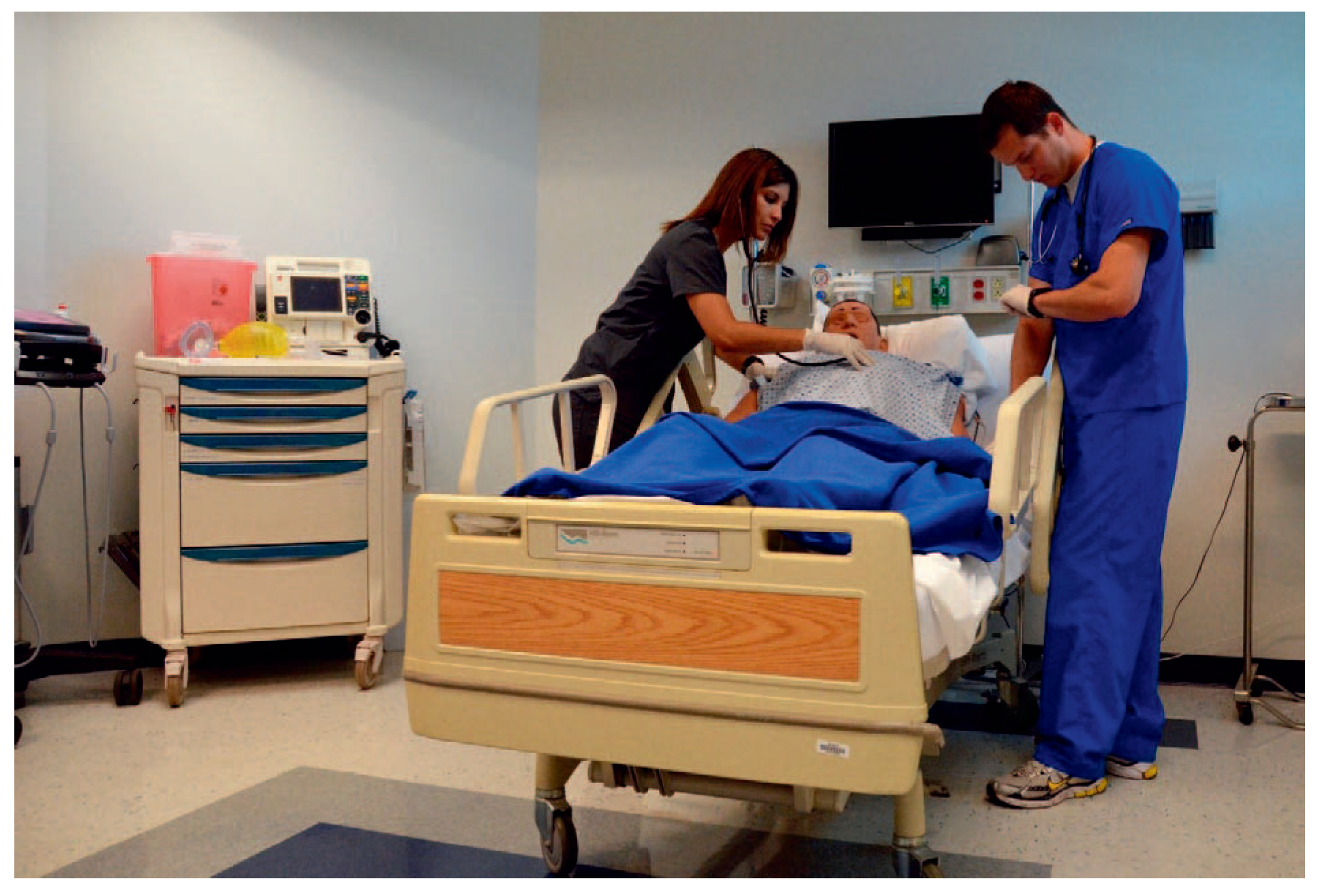
Learning management software such as Blackboard (Blackboard Inc, Washington, DC) allows professors to instantly communicate with students; deliver, receive, and grade assignments; give online quizzes; and post lectures online before delivering them. State-of-the-art simulation centers allow for high-fidelity skills laboratories (
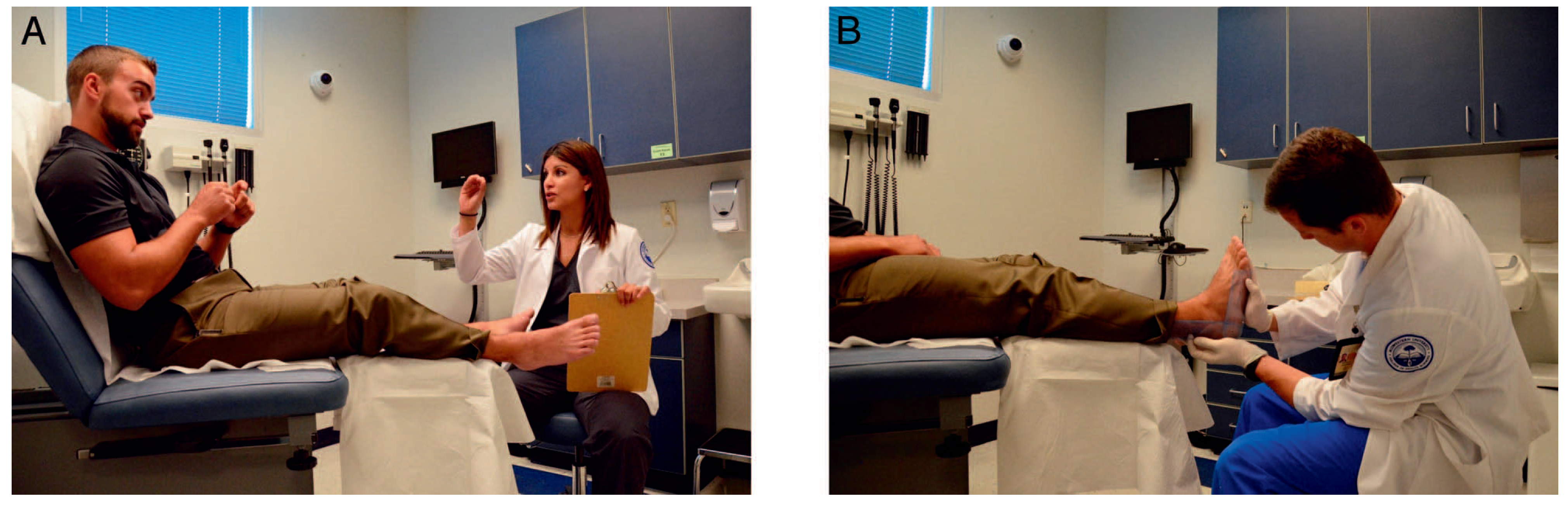
Figure 1) and audio video capture of student performance during objective structured clinical examinations or competency-based examinations (
Figure 2). In addition to training with a team of standardized patients, today's student must learn to efficiently use electronic medical records.
Figure 1.
Podiatric medical students assess a “patient” in the simulation laboratory during a practice exercise. Operated by a computer operator in an adjacent room, the manikin can speak, respond to questions, and react to the administration of medications through intravenous access. Heart and lung sounds, pulse rate, and echocardiographic readings can all be changed in response to treatment.
Figure 1.
Podiatric medical students assess a “patient” in the simulation laboratory during a practice exercise. Operated by a computer operator in an adjacent room, the manikin can speak, respond to questions, and react to the administration of medications through intravenous access. Heart and lung sounds, pulse rate, and echocardiographic readings can all be changed in response to treatment.
Figure 2.
A, A podiatric medical student takes a history from a standardized patient in the simulation laboratory during a competency-based examination. B, A podiatric medical student is required to demonstrate the skills of physical examination on a standardized patient in the simulation laboratory during a competency-based examination.
Figure 2.
A, A podiatric medical student takes a history from a standardized patient in the simulation laboratory during a competency-based examination. B, A podiatric medical student is required to demonstrate the skills of physical examination on a standardized patient in the simulation laboratory during a competency-based examination.
All of the colleges of podiatric medicine find themselves in modern new facilities with vastly different resources than those available even a decade ago. Most of the podiatric medical colleges are a formal part of larger universities where other degree-granting programs in the health professions are found. One of the colleges is not a part of a university but has academic affiliations with larger teaching institutions. Academic affiliations within a university and with other colleges and universities have opened the door to tremendous collaboration with the faculty of the other programs to enhance the depth and breadth of instruction in the basic sciences and in many of the clinical sciences. At the Arizona School of Podiatric Medicine at Midwestern University in Glendale (AZPod), the podiatric medical students share all of the basic science courses and some clinical courses with osteopathic medical students. They take the same tests and are held to the same standards. In addition, working in a higher education environment within larger colleges and universities provides ample opportunity for interprofessional collaboration in course development, faculty development of teaching skills, and cross-disciplinary instruction. For example, at AZPod, nonpodiatric instructors working with podiatric medical students include those from physical therapy, nurse anesthesia, physician assisting, pharmacy, and osteopathic medicine programs. Podiatric faculty members teach students in six other disciplines. Close affiliation with other health-care educational programs also expands the opportunity for collaborative research and makes equipment and personnel more accessible. As an example, establishment of the Innovations in Healthcare Institute at AZPod has led to the development of several “One Health” initiatives involving research on the interaction of man, animals, and their environment.
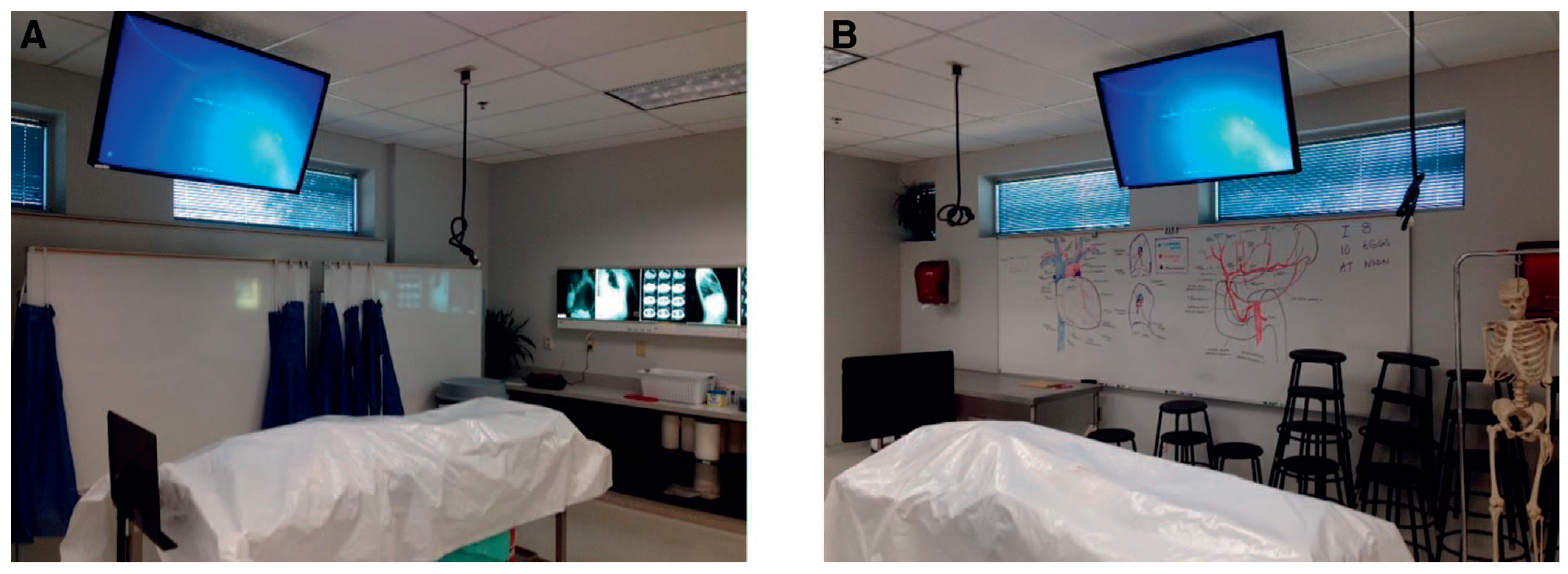
Visits to the gross anatomy laboratory no longer leave you smelling like formaldehyde for days because lighting and ventilation are much improved. At some of the podiatric medical colleges, laboratories are now equipped with several flat screen televisions mounted high on the walls (
Figure 3). Depictions of the steps of dissection are, thereby, easily displayed and can be set to loop or repeat at desired intervals. In addition, closed-circuit video cameras allow particularly excellent specimens to be displayed throughout the laboratory for easy viewing by all students. And with the use of virtual anatomical specimens and virtual microscopes, students can study histology on their laptops rather than carrying around slide boxes.
Figure 3.
Flat screen televisions plus closed-circuit video cameras in the gross anatomy laboratory facilitate case correlations, dissection, and viewing of exemplary specimens.
Figure 3.
Flat screen televisions plus closed-circuit video cameras in the gross anatomy laboratory facilitate case correlations, dissection, and viewing of exemplary specimens.
It is no longer necessary to manually search through the bound journals in the library to pull and copy an interesting article. Although most of the medical school libraries still contain textbooks and salient journals, a wide array of search engines now make it possible for faculty and students to access literally thousands of online texts and journals from home or office. Huge databases are digitally searchable, making possible not only much more rapid searches but also much more complete searches. With the use of smart phones and tablets, clinical decisions can be informed by available evidence in just minutes. Podiatric medical students of today are instructed in evidence-based practice and are taught how to use valuable search engines such as UpToDate.com (UpToDate, Alphen aan den Rijn, The Netherlands) and emedicine.com (Medscape LLC, New York, New York) from their electronic devices. Students can use their cell phones to quickly look up a vast amount of information on drugs through the Epocrates phone application (Epocrates, Watertown, Massachusetts).
Podiatric medical schools can now stay in contact with students on rotation through distance learning technology and routinely use online instruction to the advantage of the student. Asynchronous learning is facilitated through open source resources available on the Internet, including detailed case presentations, video clips, and podcasts that can be viewed on a student's cell phone at any hour of the day or night. Webinars and teleconferences are regularly used to instruct and to stay in contact with students whether on campus or off.
Curriculum
In the past, the podiatric medical school curriculum prepared students for practice. Today, graduates are prepared for 3 years or more of residency. Significantly, the curriculum has now moved to an entirely competency-based curriculum. A competency-based instructional model starts with a focus on patient care and determines which outcomes doctors need to have. It should focus on the end product or goal stated in the instruction.[
1] In 2005, all of the podiatric medical colleges adopted common overarching domains and competencies. In the past year, the Council of Faculties of the American Association of Colleges of Podiatric Medicine has revised these domains and principal competencies to better align them with allopathic and osteopathic medicine. These proposed changes have been approved by all of the colleges.
After 3 years of prodigious effort by the Council of Faculties, a very detailed Curriculum Guide was published in 2014. The 361-page dynamic document is updated annually. The guide contains all of the learning objectives expected from every podiatric medicine graduate. Each objective is ranked for its clinical relevance to a graduating student entering residency. Since its inception, the guide has added new objectives to address the changing needs of the profession. The newest domains added to the basic science section are embryology, genetics, and composite histology, and the newest domains added to the clinical sciences section include geriatrics and, perhaps more importantly, professionalism and cultural competency. While stopping short of telling colleges how to provide instruction, this watershed document helps to ensure that all of the colleges are teaching to the same objectives and expectations. The Council of Faculties Curriculum Guide is available for review at the Association's Web site (http:/www.aacpm.org).
Over the years there has been a shift toward greater emphasis on producing podiatric physicians. There has been a shift in didactic instruction to incorporate more principles of general medicine and with an emphasis on general physical diagnosis. At AZPod, podiatric medical students take a course in physical diagnosis and three courses in general medicine. In many respects, student clinical training is similar to residency rotations. For example, students can use cell phones to log learning experiences, complete postrotation examinations, and complete rotation evaluations.
Delivery Methods
One of the most significant changes in podiatric medical education in recent years has been away from teacher-centered instruction to student-centered instruction. Teachers must function more as facilitators who can not only stimulate an excitement and eagerness to learn but also help students understand how to continue to learn after they have left the classroom. They do this by implementing a variety of instructional techniques and strategies designed to engage the student in active learning. Faculty members use a variety of types of media and technology, such as HTML case-based instruction. Problem-based learning, although labor intensive, still plays a major role at many of the schools. Instructors work with students in small-group discussions, eschewing the lecture hall, to help them interact with the material, to direct their learning, and to help them identify patterns, organize material, and make connections. Students benefit from this time-tested approach to learning by becoming advanced problem solvers. The key objective of this strategy is to create independent thinkers.[
2]
Audience response systems allow the instructor to monitor the understanding of students on a given concept during an instructional session. Students respond to a multiple-choice question posed on a PowerPoint slide by using a “clicker,” and their collective responses are immediately displayed on the screen in the lecture hall. Instructors can, thereby, see what percentage of students chose each of the alternative answers and expand on or review the concept if necessary.
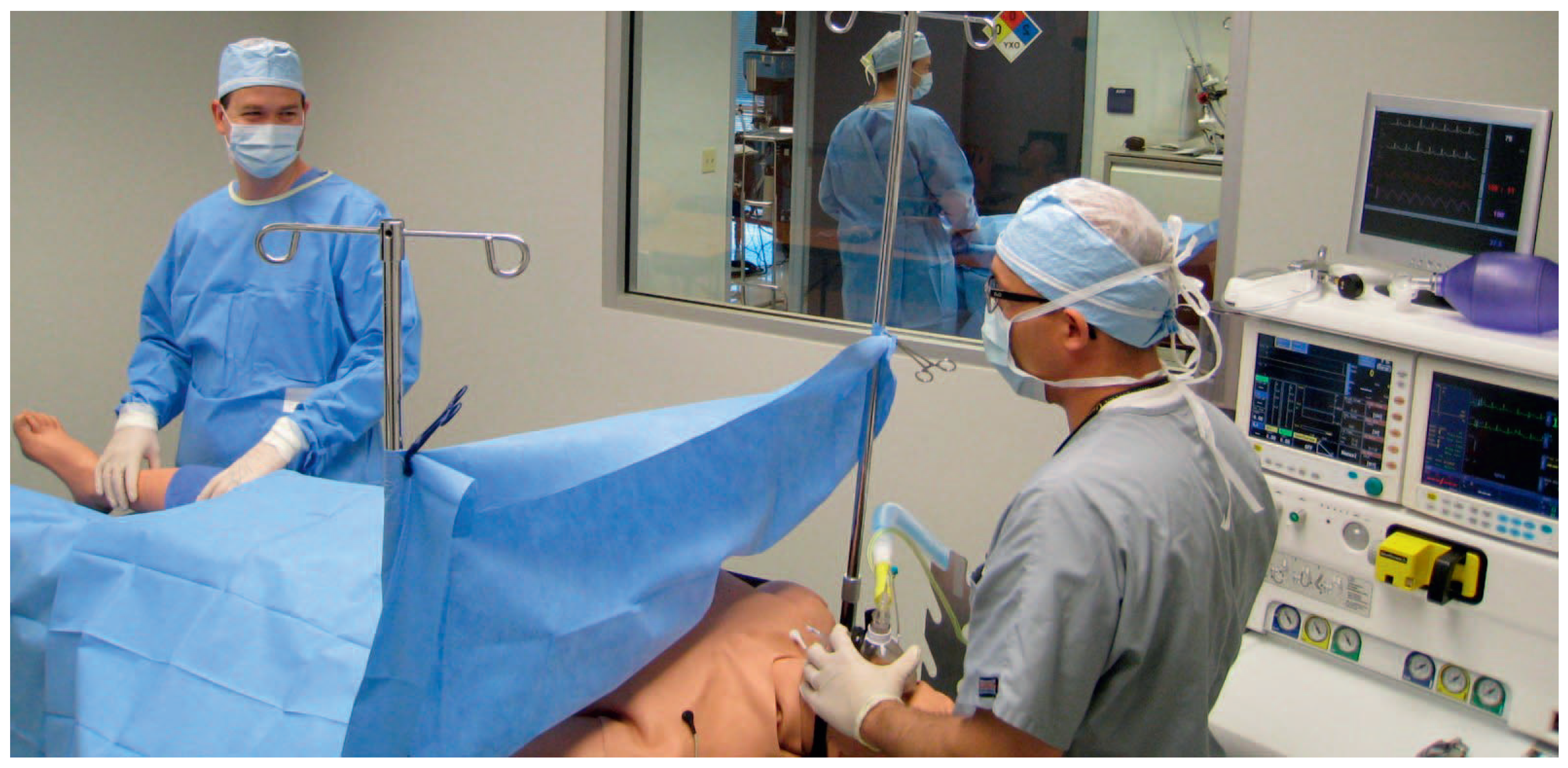
Students now use simulators and models for practicing all manner of skills, such as performing injections, starting intravenous lines, removing toenails, excising masses, practicing arthroscopy, managing airways, making osteotomies, and installing internal fixation. Students have models on which to practice checking for a dislocated hip in an infant or casting for clubfoot. Several podiatric medical schools now use high-tech simulation in laboratories constructed expressly to facilitate such simulation (
Figure 4).[
3] Simulation laboratories allow both formative and summative assessment of student acquisition of knowledge, skills, and attitudes. At laboratories such as the Clinical Skills Simulation Center at Midwestern University, with its large number of treatment rooms equipped with audiovisual monitoring and recording and with mock operating rooms and intensive care units equipped with lifelike manikins costing upward of
$250,000, such state-of-the art facilities can closely mimic reality. In addition to nine infant and adult manikins, Midwestern University employs more than 100 standardized patients who are trained to portray patients during a history and physical examination to depict realistic patient interactions and presentations of disease. The standardized patients are trained not only to portray certain maladiesbut, more importantly, also to evaluate students in the critical areas of professionalism and attitude. Through working with standardized patients, students learn how to better communicate with patients. Each of the podiatric medical colleges uses simulation in differing ways. At AZPod, in addition to simulation exercises conducted in selected courses, four detailed competency-based examinations are conducted during the third year. Passage is required to graduate.
Figure 4.
Interdisciplinary simulation using manikins for a combined training exercise for podiatric medical students and nurse anesthesia students.
Figure 4.
Interdisciplinary simulation using manikins for a combined training exercise for podiatric medical students and nurse anesthesia students.
Podiatric Physician as Educator
“The ability to teach and the ability to impart are wholly different talents.”[
4]
The role of the podiatric medical professor has changed significantly in recent years. No longer is it sufficient for the instructor to function as the all-knowing “sage on the stage” who communicates in a unidirectional manner to fill the empty skulls of his or her eager students. Although it is still important to prepare engaging PowerPoint presentations, podiatric faculty members of today must be true educators. That implies mastery of the ability to facilitate learning now and in the future.
To advance in faculty rank or attain tenure, today's podiatric medical educator must demonstrate proficiency in four major areas: scholarly activity, teaching, service, and professionalism. Formalized, detailed performance evaluation tools are used to annually assess performance in each of these areas. Many faculty members log as many continuing education hours in learning how to become better teachers as they do to maintain their skills as clinicians. All are expected to participate in faculty development training sessions offered both inside and outside of their institutions. A growing number have obtained advanced degrees in education as well. Senior faculty members are expected to mentor junior faculty. Podiatric faculty members must, indeed, “publish or perish.” They are evaluated annually in part on scholarly productivity. Students use computer-based tools to evaluate courses and critique faculty instruction. Feedback from students contributes to continual improvement in instructional technique and methods.
Students at today's colleges of podiatric medicine have unprecedented access to their instructors. Gone is the time when a student must wait for office hours. There is no longer a need for overhead public address systems. Students now reach out to faculty via email, text messaging, and social media; through Blackboard; and by using Web sites established to facilitate such communication.
Successful medical schools will harness natural curiosity. It is simply impossible to teach each student everything they could possibly need to know to practice safely and achieve the best outcomes. Students must be taught how to access needed information in a timely manner so that clinical decision making is based on the best available evidence. They must be challenged to take responsibility for their own learning.
Importantly, many of the colleges of podiatric medicine have concentrated on creating an environment that “nourishes” the student, allowing them to blossom into the best students they are capable of becoming. At AZPod there are no posted office hours. Rather, an open door policy prevails throughout the campus. Faculty mentors are assigned to each student. Big brothers and big sisters are also assigned to guide new students. Tutoring and counseling are all free to the students. Even fitness facilities and exercise classes are available to help students maintain life balance.
Assessment
Multiple-choice examinations are still the reliable workhorse for assessment of knowledge of podiatric medical students. However, many more methods are used today to help the schools gauge the preparedness of students to move on to the next level of instruction. Examples include competency-based examinations and objective structured clinical examinations, as described previously herein. They also include oral examinations, observational checklists, case-based presentations of subject matter (including the basic sciences), and a dramatic expansion of skills laboratories early in the curriculum.
Some faculty have made the bold move away from the traditional forms of assessment and are using more creative forms of assessment, one of those being portfolio assessment. A portfolio contains a purposefully selected subset of student work. Portfolios typically are created for one of the following three purposes: to show growth, to showcase current abilities, or to evaluate cumulative achievement. One of the most significant benefits of the portfolio process is asking students to reflect on the quality and growth of their work. As Paulson et al[
5] stated, “The portfolio is something that is done by the student, not to the student.” Most importantly, it is something done for the student. The student needs to be directly involved in each phase of the portfolio development to learn the most from it, and the reflection phase holds the most promise for promoting student growth.
Students are no longer permitted to take Part II of the national board examination (American Podiatric Medical Licensing Examination [APMLE] II) until they have successfully passed the Part I examination. At most schools of podiatric medicine, students are now dismissed after the third failure of any part of the national board examination. Students may not begin clinical rotations until they have succeeded on APMLE I. And students are not eligible for residency placement until they have succeeded on parts I and II of the APMLE. In addition, a Clinical Skills Physical Examination has been added as a requirement of the Part II examination so students must now successfully pass the written and clinical skills examinations to pass the Part II examination and be eligible for handoff to a residency program.
Students
Although there are always exceptions to any sweeping generalization, students of the millenial generation currently attending colleges of podiatric medicine display some distinctly different preferences as they approach their education and practice. Problem solving is a vital skill for podiatric physicians; however, today's students are not comfortable with the process. Millenial students would prefer a “cookbook” approach in which expectations are laid out clearly. They plan to work shorter hours than their forebears. They value time with friends and family. The extraordinary cost of medical education today (the average podiatric medical student debt at graduation exceeds $200,000) has given some students a sense of entitlement. Because they see themselves as being in control of the educational process, they have high expectations of instructors. They have no hesitation to say what they think about the quality of instruction, the applicability of test questions, or their workload. They challenge the relevance of selected courses and subject matter.
There is, however, a growing appreciation of the role of the adult learner in podiatric medical colleges. Research on learners has shown that adults learn differently than younger students. Adults have special needs, and those needs have to be addressed when developing educational experiences for the adult learner. Adults want to know why they need to learn something.[
6] They have a need to be seen and treated as capable and self-directed. Adults come into an educational environment with different experiences than do children or youth.[
6,
7] The richest resource for learning resides in adults themselves; therefore, tapping into their experiences through experiential techniques (discussions, simulations, problem-solving activities, or case methods) is beneficial.[
6,
8-
10] Adults want to learn what will help them perform tasks or deal with problems they confront in everyday situations.[
6,
7] This makes instruction that is focused on the future, or instruction that does not relate to their current situations, less effective. Adult learners are life-centered (task-centered, problem-centered) in their orientation to learning.[
6] They are responsive to some external motivators (eg, better job, higher salaries), but the most potent motivators are internal (eg, desire for increased job satisfaction, self-esteem). Their motivation can be reduced by training and education that ignores adult learning principles.[
6] Therefore, considerable effort is expended in today's podiatric medical schools to incorporate active learning strategies rather than rely primarily on lecture because the former results in better learning and retention.
The Future
The future of podiatric medical education is likely to bring additional significant changes. Many of these changes will derive from technology. The widespread use of podcasts, webinars, smart phones, and iPads will replace attendance in the classroom. Virtual laboratories may replace cadaver laboratories. Sophisticated simulators will allow for expanded surgical skill development before students touch real patients. Surgeries will be practiced through a virtual process before ever putting a scalpel to skin, similar to pilots learning to fly.
Today's students prefer more flexibility, which has led to greater use of asynchronous learning. In the future, students will access learning material as desired and move forward at their own rate in self-paced modules. Podiatric medical education will include just-in-time access to learning materials at any time of the day or night. There will be far fewer lectures and much more interactive engagement through simulated and authentic real-world learning exercises. The classroom of the future may become a completely virtual classroom where students and instructors interact through avatars. And in the future, professors may engage with students primarily digitally in real time. Surgical courses of the future may include laboratories on robotic surgery.
The future college of podiatric medicine may function through a blending of undergraduate and graduate studies similar to many countries around the world to eliminate waste and to streamline the development of more health-care providers.
Conclusions
A great many changes to podiatric medical education in recent years have ensured equivalency to allopathic and osteopathic education while at the same time maintaining the necessarily unique aspects of podiatric medical education and training. The explosive expansion of the use of technology allows the students to approach the material in a manner that more closely matches their own learning style.
Albert Einstein once said, “It is nothing short of a miracle that modern methods of instruction have not yet entirely strangled the holy curiosity of inquiry.”[
11] But in today's colleges of podiatric medicine, much is being done to make the learning process less a trial of drudgery to be endured and more a process of learning how to learn. As exciting as the recent changes to podiatric medical education have been, the future promises even more dramatic modifications of the learning process with the target of enhanced preparedness for future podiatric physicians.
Acknowledgments: Tanya Thoms, DPM, for assistance with photography.
Financial Disclosure: None reported.
Conflict of Interest: None reported.