There are several various accessory ossicles and sesamoid bones that can be seen throughout the foot and ankle, with reported incidences of 21.2% and 9.6%, respectively. [
1,
2,
3] These differ from one another, as accessory ossicles develop from the secondary ossification center of a bone, whereas sesamoid bones develop from their own ossification center. [
1] Often, these can be misdiagnosed by the care provider as fractures. [
4,
5]
One example of these anatomical variants is the metatarsal sesamoid bone. The hallux medial sesamoid is found to be bipartite more often than the lateral sesamoid, with a reported incidence up to 2.1% to 33.5% versus 0.4% to 2.5%, respectively, with bilateral involvement occurring in 13.5% to 90%. [
1,
3] Lesser metatarsal sesamoids are more common in the second and fifth metatarsals, with the incidences of second to fifth metatarsal sesamoids found at 0.4% to 2.8%, 0.2% to 0.5%, 0.1% to 1.0%, and 4.3% to 15%, respectively. [
3] Involvement of the medial side is more common than the lateral side. [
3]
Accessory ossicles and sesamoid bones usually remain asymptomatic until an inciting event (eg, trauma, overuse) occurs and can then cause pain or degenerative changes. They can also be found on routine imaging. [
3] Furthermore, these anatomical variants may be misdiagnosed as pathology in the emergency setting, such as sesamoid or avulsion fractures. [
2]
Among these confusing findings are lesser metatarsal sesamoids, which are a rare occurrence. [
1,
2,
3] In this instance, we demonstrate the fifth metatarsal bipartite sesamoid. Bipartite lesser metatarsal sesamoids—more specifically, one at the fifth metatarsal—have not been specifically reported in the literature to the authors' knowledge. In this article, we present the first such case of this.
Case Report
A 31-year-old woman presented to the senior author's (J.R.M.) office for evaluation of the right foot after a motor vehicle accident 7 days previously. The patient previously was evaluated at a local emergency department and, although diagnosed with a foot fracture (the patient was unable to state what the fractured bone was), all of her pain was in the ankle. She did not complain of any forefoot pain across any of the metatarsal heads. Pain was not elicited on palpation of the fifth metatarsal head plantarly or on fifth metatarsophalangeal joint active and passive range of motion.
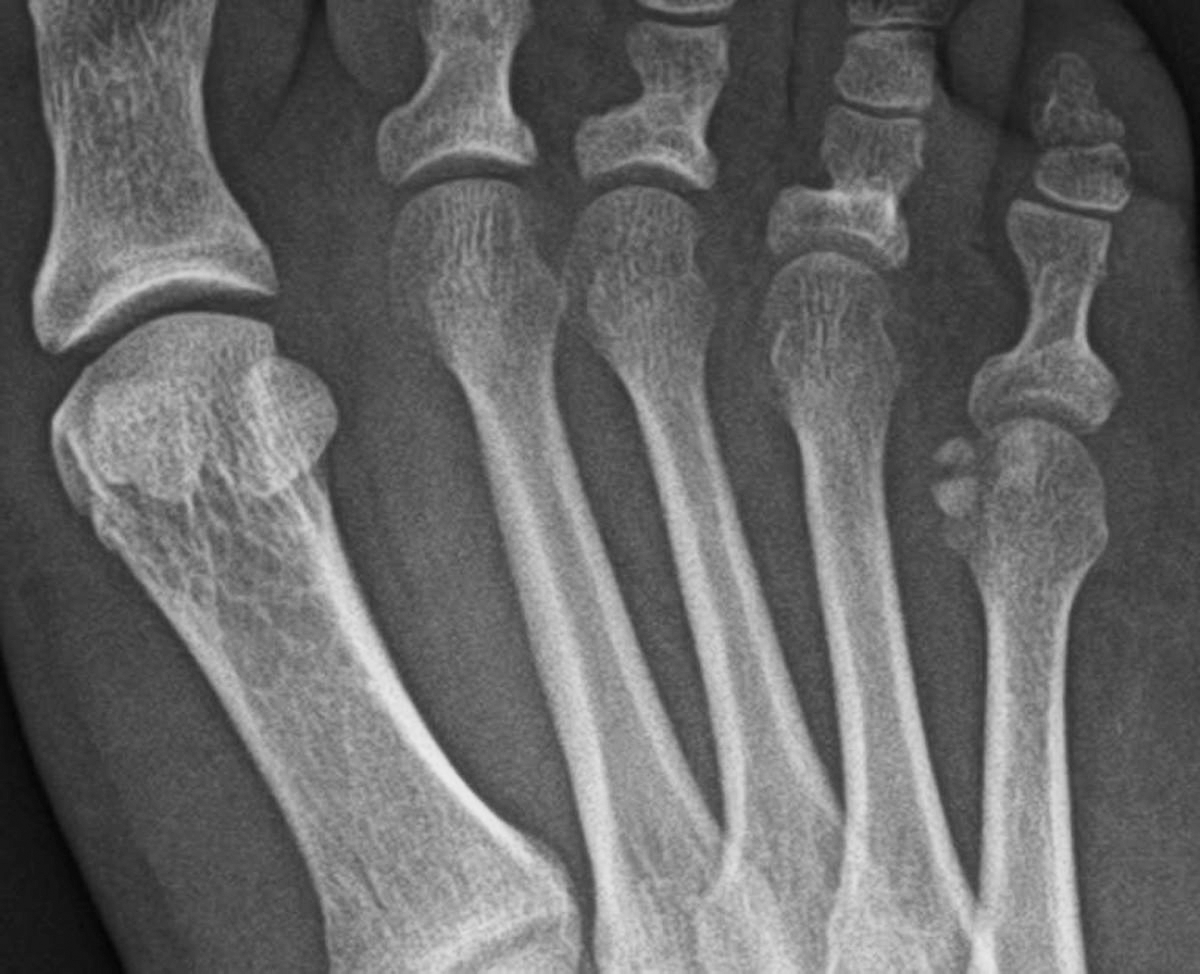
The original radiograph was reviewed (
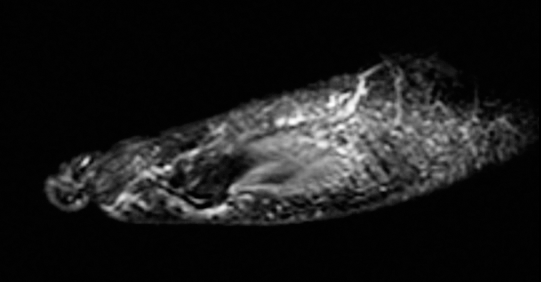
Figure 1), which revealed a bipartite sesamoid of the fifth metatarsal. Contralateral films were taken and were negative for any lesser metatarsal sesamoid. To evaluate the ankle pain after no pathology was diagnosed on radiography, magnetic resonance imaging was ordered (
Figure 2). This did not demonstrate any abnormal pathology to the forefoot after review by a postgraduate third-year resident, a postgraduate podiatric fellow, the senior author (J.R.M.), or a board-certified radiologist. There was no localized marrow edema, and the plantar plate appeared to be intact. All pathology was localized to the ankle (marrow contusion to cuboid, navicular, and talus; and partial anterior talofibular ligament and calcaneofibular ligament tearing).
Figure 1.
Demonstration of fifth metatarsal bipartite tibial sesamoid. No other accessory sesamoids are appreciated in the foot.
Figure 1.
Demonstration of fifth metatarsal bipartite tibial sesamoid. No other accessory sesamoids are appreciated in the foot.
Figure 2.
T2-weighted sagittal magnetic resonance image of the patient. There is no localized marrow edema or inflammation to the fifth metatarsal head with intact plantar plate apparatus structure.
Figure 2.
T2-weighted sagittal magnetic resonance image of the patient. There is no localized marrow edema or inflammation to the fifth metatarsal head with intact plantar plate apparatus structure.
Discussion
Missed fractures in the emergency department or urgent care happen. One study demonstrated that of 115 missed fractures (n = 3,081), the foot was the most commonly missed region (7.6% [
4]), while another study showed that combined foot and ankle fractures were the most commonly missed at 51.4% [
5] (n = 19 fractures). Observed rates of disagreement between emergency physicians and radiologists have been reported to range from 8% to 11%, leading to missed fractures being the number one emergency room error reported in malpractice claims. [
5] One study found that initial emergency room diagnosis and final foot and ankle outpatient clinic diagnosis did not match in 21.4% of patients evaluated. [
2] Anecdotally, working at a busy orthopedic practice with referral from a level II trauma center, orthopedic urgent care, local urgent care, and community hospitals, we often encounter accessory ossicles, sesamoids, pediatric apophyses, and old avulsion fragments interpreted as fresh fracture by the initial facility's physicians.
Because of the propensity of misdiagnosis, history and clinical examination are important for obtaining the correct diagnosis. In this case, these points are well demonstrated. Examination may demonstrate tenderness, edema, and erythema, and differentiation from fracture by means of radiographic evaluation may be difficult, as a bipartite sesamoid can mimic a fracture [
2,
3,
6] (
Table 1). Examination may also demonstrate none of the above findings, with radiographic evaluation revealing erroneous pathology. Our case demonstrated radiographic findings of a diagnosed fracture by the radiologist, whereas on physical examination, this region was not painful for the patient. Physical examination is one of the luxuries afforded to the clinician and not the radiologist. Because of this, it is important to give the radiologist as much information as possible to help them hone in on the correct diagnosis. Context is very important, and focus must be placed on physical examination, with imaging as a secondary tool for diagnosing and treating patients appropriately.
Table 1.
Cues for Differentiating Medial Hallux Bipartite Sesamoid versus Fracture [
1,
6].
Table 1.
Cues for Differentiating Medial Hallux Bipartite Sesamoid versus Fracture [
1,
6].
Additional studies may be of benefit in further evaluation for diagnostic accuracy, such as magnetic resonance imaging, computed tomography, or bone scan. [
1,
6] When it comes to evaluating accessory bones or sesamoids, it is recommended that bilateral radiographs be used, as the incidence of bilateral bipartite hallucal sesamoids is high. [
1,
3]
Of the articles cited, none make specific reference to bipartite lesser metatarsal sesamoids. A PubMed and Google Scholar literature search of the terms
bipartite and
fifth metatarsal produced no valid articles. Only one report noted the potential of this pathology, stating that lesser metatarsal sesamoids “appear embedded in the plantar aspect of the joint capsule and may also be multiple or multipartite,” without specific reference to figures. [
6] That being said, its diagnosis may be made using criteria similar to those used for hallucal bipartite versus fractured sesamoid (
Table 1).
Conclusions
This is the first reported instance, with radiographic evidence, in the literature of a bipartite fifth metatarsal sesamoid to the authors' knowledge. This pathology is extremely rare. It may present in conjunction with trauma and be misdiagnosed as a fracture. Advanced imaging can help differentiate between anatomical variants and true pathology. Using hallux sesamoid bipartite versus fracture cues can help in diagnosis.