Lymphangioma-like Kaposi’s sarcoma (LLKS) is a rare variant of KS that accounts for less than 5% of all KS cases [
1]. First described by Moritz Kaposi in 1872, KS is typically associated with human immunodeficiency virus (HIV) and other immunosuppressive diseases. Also, KS is associated with human herpesvirus type 8 (HHV-8) [
2,
3]. Classically, KS is found in individuals of African and Mediterranean descent without HIV. Clinically, classic KS presents with an array of cutaneous manifestations ranging in color from black-brown to dark blue–red, with a glistening appearance [
3,
4].
There are four variants associated with KS: endemic KS, classic KS, transplant-associated KS, and AIDS-associated KS. Endemic KS is often the most aggressive and is found in Africa in HIV-negative individuals. Classic KS is found in individuals of Mediterranean and Jewish descent and is often slow growing and limited to the skin. Transplant-associated KS is found in individuals receiving immunosuppressive therapy. The final variant is AIDS-associated KS, which develops in HIV-positive individuals [
2,
3].
Also, LLKS is associated with various dermatologic manifestations and is often associated with lymphedema and soft-tissue swelling, which can be attributed to misdiagnosis of the disease. Lymphangioma-like KS was first described by Ronchese and Kern in 1957, but it was not histologically described until Gange and Jones’ publication in 1979 [
5]. Lymphangioma-like KS can occur in the classic, endemic African-type, and AIDS-associated clinical subtypes of KS [
3].
To date, there have been very few published cases of LLKS. The progression of the lesions can be a slow or rapid growth depending on the involved subtype of KS. Histologic and microscopic analysis is crucial in determining the diagnosis. Several differential diagnoses of LLKS based on histologic features and patterns of vascular tumor growth have been identified. We report an unusual presentation of LLKS involving the left lower extremity.
Case Report
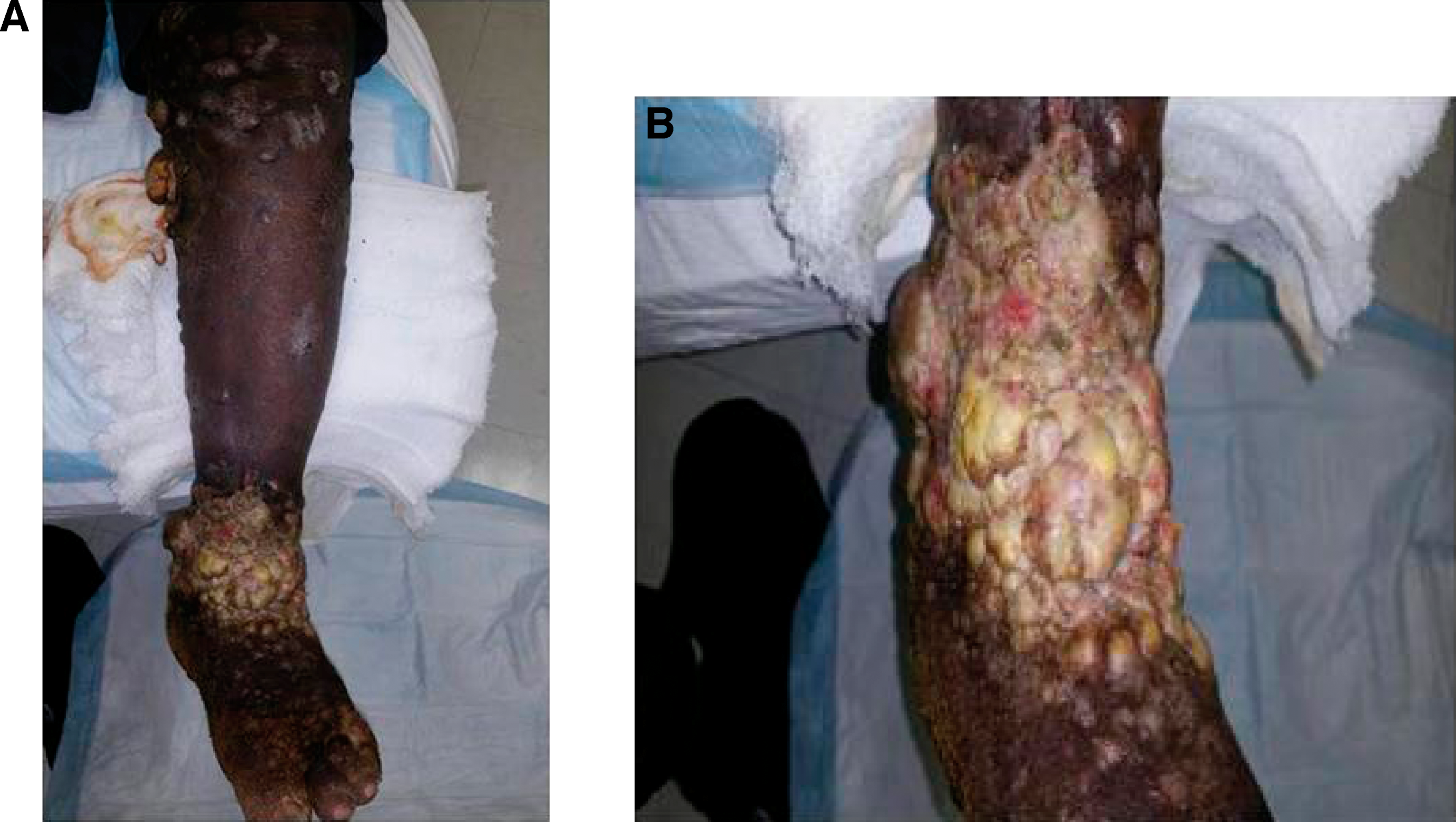
We describe a 63-year-old Haitian man who presented to the medical center in June 2009 and was admitted for cellulitis of the left foot and management of uncontrolled diabetes. The patient had multiple ulcerated, bleeding, cauliflower-like lesions with poorly defined borders on the left lower extremity (
Fig. 1). Electrocautery of the lesions was unsuccessful owing to recurrence of the lesions. The patient denied further surgical intervention and biopsy of the lesion.
Figure 1.
A, Initial presentation of the lesions on the left lower extremity. Multiple multinodular lesions extending distally from the left thigh to the left ankle and foot. B, Circumferential exophytic lesions on the left anterior ankle exhibit a fleshy-spongy appearance that is granular.
Figure 1.
A, Initial presentation of the lesions on the left lower extremity. Multiple multinodular lesions extending distally from the left thigh to the left ankle and foot. B, Circumferential exophytic lesions on the left anterior ankle exhibit a fleshy-spongy appearance that is granular.
Five years later, the patient was admitted to the medical center in July 2014 for cellulitis of the left leg. He was started on a broad spectrum of antibiotics, and wound cultures were performed for a suspected soft-tissue infection in the left lower extremity. During his examination, pedal pulses were nonpalpable owing to substantial nonpitting edema. The proximal wounds on the left lower extremity inferior to the knee contained multiple nonulcerated pedunculated lesions with a spongy consistency. Just distally, the skin appeared lichenified owing to excessive excoriations. The distal circumferential wounds near the ankle contained a more fleshy appearance that was completely ulcerated and friable. The wounds were actively weeping yellow drainage with a severe malodor. At the time, there was an infestation of maggots on the proximal nodules of the lower extremity that was cleansed with Dakin’s solution. Previous advanced imaging modalities, such as magnetic resonance images and radiographs, were reviewed with suspicion of neurofibromatosis, but because of the unilateral nature of the lesions, the diagnosis of neurofibromatosis was deemed atypical.
The patient’s medical history was significant for diabetes, coronary artery disease, cerebrovascular accident, hypertension, gangrene, peripheral vascular disease, and hyperlipidemia. The patient denied any history of alcohol or drug abuse. A loop curette full-thickness biopsy specimen was taken from a deroofed lesion on the anterior left ankle that yielded only granulating tissue with infiltrates.
Proteus mirabilis was the isolated organism noted from the wound culture. The fungal culture, acid-fast bacilli, viral isolation, and filariasis antibody were all negative. An independent laboratory reported a preliminary diagnosis of elephantiasis nostra verrucosa from the biopsy specimen and clinical presentation. After receiving pathologic reports from various laboratories without a definitive diagnosis, an additional curette biopsy specimen measuring 0.6 × 0.4 × 0.3 cm was collected in an attempt to obtain more detailed information about the origin of the nodules. Before the biopsy, we irrigated all crust and slough to avoid artifacts and secondary lesions such as excoriations or secondary infection sites. The optimal biopsy sites were newly erupted small lesions that contained epidermis and granulation tissue. Using a loop curette biopsy, we were sure to capture all layers of the lesion.
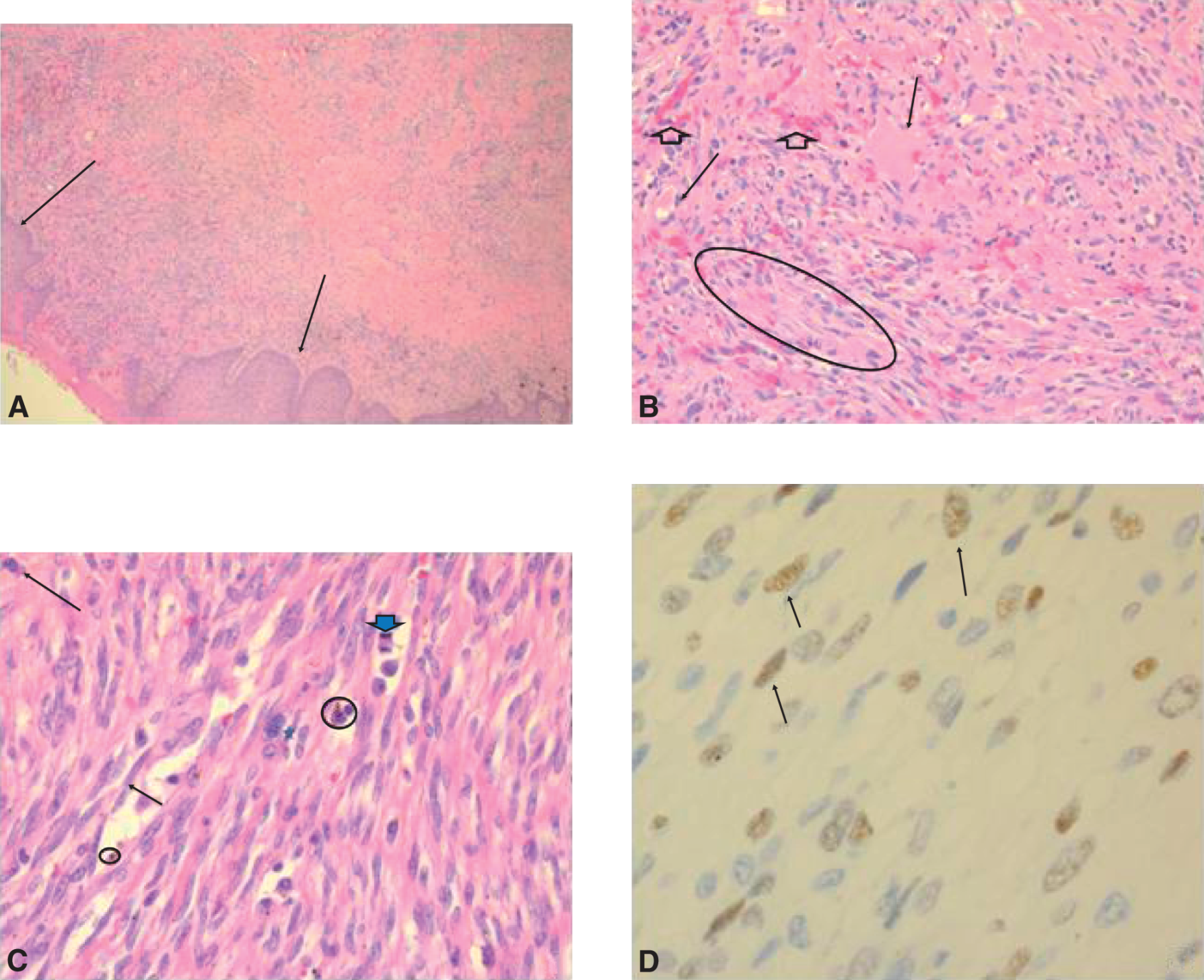
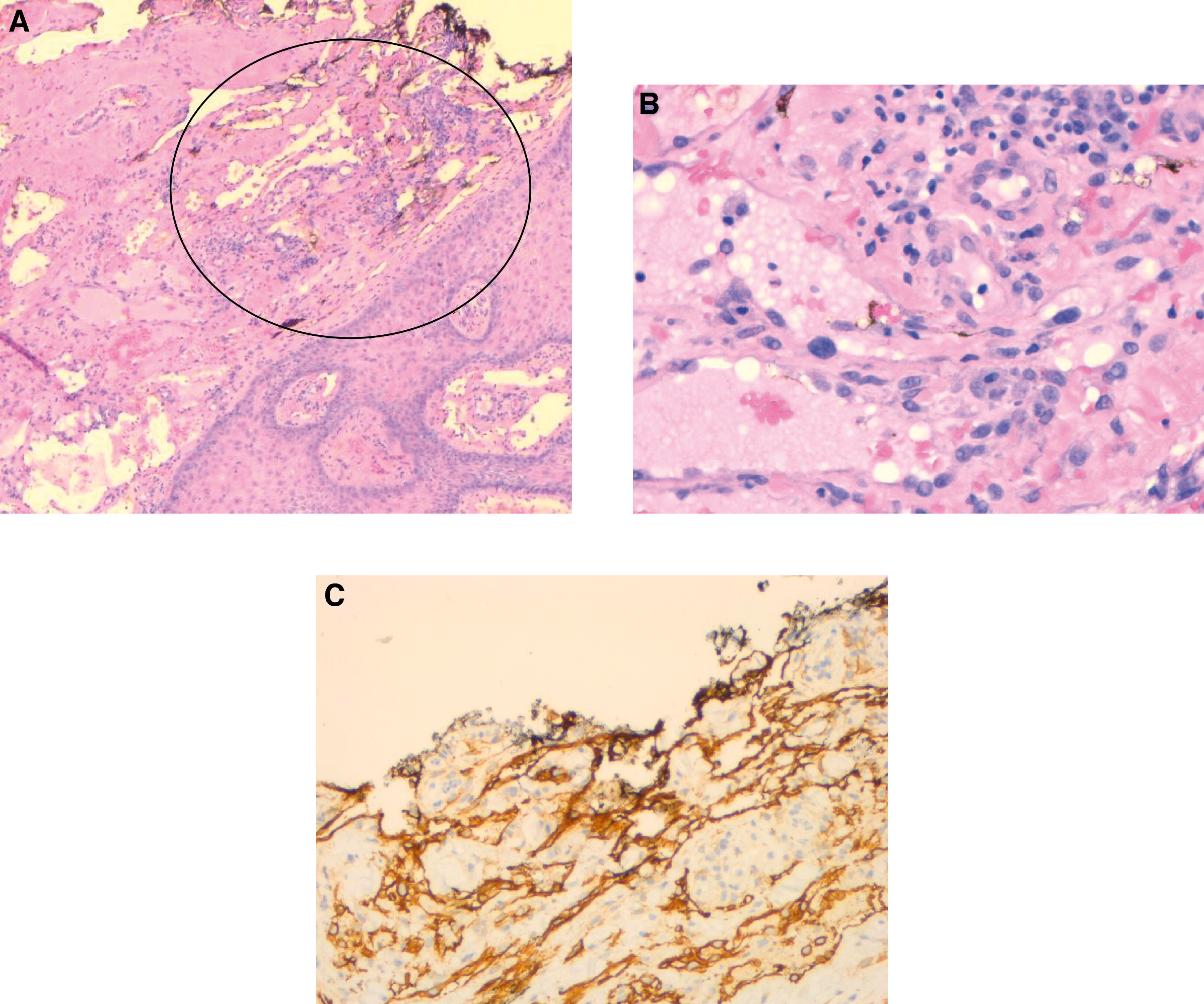
The pathology report from Weill Cornell Medical Center (New York, New York) revealed a final diagnosis of LLKS. Atypical vasoformative lesions appeared to be of lymphatic derivation. The D240 preparation was for the endothelial lining staining that revealed pseudoepithelialization of irregular lymphatic channels. These dilated lymphatic channels had sinusoidal-like communicating channels (
Fig. 2 A-C). Along these channels, collagen bundles and scattered plasma cells and lymphocytes can be identified. The presence of HHV-8 is certain due to a positive immunohistochemical stain for HHV-8 that can be noted in the nuclei of several pleomorphic cells (
Fig. 2D).
Figure 2.
A, Low-power view of this vascular tumor with appreciation of pseudoepitheliomatous hyperplasia (arrows) and proliferation of atypical spindle cells in the dermis. (H&E, x40). B, In the high-power view of this vascular lesion we can begin to appreciate the pseudovascular channels (arrows) that appear to be dilated. A fascicle plane (circle) can be seen with a better appreciation of proliferation of atypical spindle cells that form slitlike spaces. Numerous extravasated erythrocytes in the interstitial tissue that can form small cavernous hemangiomas are seen, which is a key characteristic of Kaposi’s sarcoma. (H&E, x100). C, Very-high-power view of pseudovascular channels of lymphangiomatous gapping (double arrow) and better appreciation of the fascicle plane of atypical spindle cells with splitlike spaces that appear to be dilated with channeling. An inflammatory mixture of mast cells (star), plasma cells (arrow), hemosiderin deposits (circles), and irregular mitosis of cells (block arrow). (H&E, x400) D, Very-high-power view with a positive immunohistochemical stain for human herpesvirus type 8 that can be noted in the nuclei of several pleomorphic cells. (H&E x400).
Figure 2.
A, Low-power view of this vascular tumor with appreciation of pseudoepitheliomatous hyperplasia (arrows) and proliferation of atypical spindle cells in the dermis. (H&E, x40). B, In the high-power view of this vascular lesion we can begin to appreciate the pseudovascular channels (arrows) that appear to be dilated. A fascicle plane (circle) can be seen with a better appreciation of proliferation of atypical spindle cells that form slitlike spaces. Numerous extravasated erythrocytes in the interstitial tissue that can form small cavernous hemangiomas are seen, which is a key characteristic of Kaposi’s sarcoma. (H&E, x100). C, Very-high-power view of pseudovascular channels of lymphangiomatous gapping (double arrow) and better appreciation of the fascicle plane of atypical spindle cells with splitlike spaces that appear to be dilated with channeling. An inflammatory mixture of mast cells (star), plasma cells (arrow), hemosiderin deposits (circles), and irregular mitosis of cells (block arrow). (H&E, x400) D, Very-high-power view with a positive immunohistochemical stain for human herpesvirus type 8 that can be noted in the nuclei of several pleomorphic cells. (H&E x400).

These histopathologic findings are consistent with a diagnosis of LLKS. Immediately on the diagnosis of LLKS, an enzyme immunoassay for HIV 1/2 was performed, and the results were negative. The decision was made to refer the patient to a cancer center on acquiring the new diagnosis. Unfortunately, the patient experienced another cerebrovascular accident before his initial visit to the cancer center and subsequently agreed to a left above-the-knee amputation owing to the rapid gangrenous changes in the left leg (
Fig. 1). On further investigation, it was found that the lesions had metastasized to the patient’s left scrotum. Chemotherapy and radiation treatments were deferred due to the medical condition of the patient.
Discussion
At the time of diagnosis, this 63-year-old male native of Haiti was HIV negative. Kaposi’s sarcoma is also known as HHV-8 and is a multicentric vascular neoplasm. Lymphangioma-like KS is known to be associated with different subtypes of KS, including classic KS, endemic African KS, and AIDS-related KS [
6]. If an individual is neither HIV negative nor of Mediterranean descent, care should be taken not to immediately rule out KS until a biopsy is performed. In recent literature, most KS is seen in patients with HIV.
Diagnosis of LLKS requires a histopathologic evaluation using a well-placed biopsy. There are several methods for obtaining a sample, such as shave, punch, curette, incisional, and excisional biopsy. A wound biopsy should be full thickness and near the border to capture all layers of the wound [
6]. Choosing a biopsy site for the present patient was difficult owing to the size and variation of the lesions. Acute lesions have more diagnostic features compared with chronic lesions. Chronic lesions tend to lose their characteristic features that may yield only granulation tissue with infiltrates [
7]. Incorporating normal skin can assist the pathologist in distinguishing abnormal histologic changes as well as pseudoepitheliomatous changes. Also, lesions overlying bony prominences should be avoided because they may yield nonspecific lymphocytic infiltrates and epidermal hyperplasia [
8].
Lymphangioma-like KS has characteristic histopathologic features that can preclude the diagnosis before immunohistochemical staining of HHV-8. Kaposi’s sarcoma is a vascular tumor that is composed of mesenchymal cells and will demonstrate blood vessel proliferation near the epidermis. This manifestation is driven by large amounts of cytokine and growth factors. There are several chemotactic factors that are necessary for angiogenesis. Viral interleukin-6, which closely resembles human interleukin-6, binds to interleukin-8. This process is mitogenic for endothelial cells for angiogenesis. Other cytokines include IL-1, TNF?, MIP1?, GM-CSF, cyclin D, and BCL 1-2 [
9,
10]. Granulocyte-macrophage colony-stimulating factor is responsible for spindle cell growth in an autocrine/paracrine appearance in KS.
Characteristic to LLKS, spindle cells will proliferate to form numerous pseudovascular channels or slitlike spaces with communicating channels. These slitlike spaces may form thin honeycomb patterns with blood-filled spaces [
11]. Spindle cell formations can typically preclude the diagnosis [
4]. Other important histologic characteristics are numerous mast cells and pooling of extravasated erythrocytes, which are diagnostic clues for classic KS (
Fig. 2 A-C).
Finally, immunohistochemical staining for HHV-8 can definitely rule in KS (
Fig. 2D). The immunohistochemical stains usually identify the virus to be located in the lymphatic endothelium or pseudovascular channels. The endothelial cell is the most widely accepted host of the virus [
4,
9]. Histologic differential diagnosis includes spindle cell hemangioma, lymphangioendothelioma, hobnail hemangioma, low-grade angiosarcoma, neurofibroma, fibrous histiocytoma, leiomyoma, and inflammatory pseudotumor.
With additional stain and preparation, the lymphangiomatous pattern can be identified to assist in the diagnosis of this rare form of KS. Dilated lymphatics can be easily identified with D240 preparation. Easy visualization of these communicating sinusoidal tracts of lymphatic channels can be seen (
Fig. 3).
Figure 3.
A, Low-power view with visualization of dilated communicating neolymphatic channels with no well-defined spaces and poorly designed. B, High-power view of dilated irregular lymph vessels filled with lymph fluid and the presence of irregular spindle cells. Some extravasation of red blood cells and hemosiderin deposits can be seen. C, High-power view with D240 staining of the endothelial lining of lymphatic channels clearly demonstrating the poor structures and anastomosis of the channels.
Figure 3.
A, Low-power view with visualization of dilated communicating neolymphatic channels with no well-defined spaces and poorly designed. B, High-power view of dilated irregular lymph vessels filled with lymph fluid and the presence of irregular spindle cells. Some extravasation of red blood cells and hemosiderin deposits can be seen. C, High-power view with D240 staining of the endothelial lining of lymphatic channels clearly demonstrating the poor structures and anastomosis of the channels.
Treatment of small LLKS lesions involves wide excisional debridement of the lesion in conjunction with radiotherapy and chemotherapy. Common drugs of choice are taxol and doxorubicin. Both KS and LLKS can become widespread beyond the edges and may affect internal organs. Management with combined chemotherapy, radiotherapy, and surgery may have some therapeutic effects over the years.