Despite a good understanding of risk factors for lower-extremity ulceration and major limb amputation[
1-
6] and the development of multidisciplinary diabetic foot amputation prevention teams,[
7-
10] literally hundreds of major limb amputations are performed daily worldwide.[
11] One relatively universal functional goal after major limb amputation is for the patient to walk in a prosthetic device.[
12-
16] In fact, however, there is relatively little published evidence on how many patients actually walk after major limb amputation and, specifically, what factors are associated with successful ambulation.[
17-
27]
In a series of 553 patients, Taylor et al[
17] identified a 55% functional ambulation rate 12 months after major amputation and found older age, history of bilateral amputation, and the presence of end-stage renal disease (ESRD) to be associated with failure of ambulation. Suckow et al[
18] found 1-year independent or assisted ambulation rates of 65.1% for below-the-knee amputations (BKAs) and 41.3% for above-the-knee amputations (AKAs) in patients with peripheral arterial disease also undergoing lower-extremity bypass. Evans et al[
19] reported a 2-year rate of ambulation in a prosthesis of 64% for patients at the Georgetown University Hospital Center for Wound Healing undergoing BKA. Nehler et al[
20] found at least some ambulation in 49% of BKAs and 54% of AKAs in a series from a university hospital and a Veterans Affairs hospital. And Cruz et al[
21] described a 23% ambulation rate in patients at a Veterans Affairs hospital undergoing BKA or AKA.
The objectives of this retrospective, observational investigation were to 1) determine what percentage of patients successfully walked in a prosthesis within 1 year after major limb amputation and 2) assess which patient factors might be associated with ambulation in a prosthetic device within 1 year after BKA and AKA at an urban US tertiary-care health system with a multidisciplinary limb salvage team.
Methods
After receiving approval from the Temple University institutional review board, a retrospective medical record review was performed over a 2-year data collection period, allowing for at least 12 months of postoperative follow-up. Initially, a Current Procedural Terminology code search identified consecutive patients undergoing major lower-limb amputation in a single health-care system between January 1, 2012, and December 31, 2014, with follow-up extending to December 31, 2015. Specific codes used in this search were 27590 (amputation, thigh), 27592 (Guillotine thigh amputation), 27596 (reamputation, thigh), 27598 (disarticulation at knee), 27880 (amputation, leg), 27882 (Guillotine leg amputation), 27886 (reamputation, leg), 27888 (amputation, ankle), and 27889 (disarticulation at ankle). Patients were then grouped into their definitive level of amputation by the end of the data collection period: 1) unilateral BKA, 2) unilateral AKA, 3) other level of unilateral major lower-limb amputation, or 4) bilateral major lower-limb amputation.
The primary outcome measure was considered documented ambulation in a prosthesis within 12 postoperative months. Other extracted information from the medical record included the age at time of amputation, sex, race (American Indian/Alaskan Native, black/African American, white, Native Hawaiian/Pacific Islander, Asian, or other), ethnicity (Hispanic/Latino or non-Hispanic/Latino), laterality, insurance coverage (Medicaid, Medicare, or private insurance), presence of 6-month outpatient follow-up with the vascular surgery or rehabilitation service, any preamputation history of outpatient evaluation by a podiatric physician, any preamputation or postamputation history of outpatient evaluation by a podiatric physician, 1-year mortality, documented preamputation ambulation, preamputation living situation (home or facility/other/unknown), postoperative living situation at last follow-up (home or facility/other/unknown), presence of diabetes mellitus, nearest periamputation hemoglobin A1c level, body mass index, presence of ESRD, presence of chronic obstructive pulmonary disease, history of tobacco use, presence of dementia, presence of coronary artery disease, presence of peripheral arterial disease, history of preamputation ipsilateral limb revascularization (endovascular or open bypass), and healing of major lower-limb amputation (amputation healed primarily or required a secondary procedure for infection or dehiscence). The presence of diabetes mellitus, ESRD, chronic obstructive pulmonary disease, dementia, coronary artery disease, and peripheral arterial disease was defined by International Classification of Diseases, Ninth Revision code at discharge.
Data were stored in a password-protected and encrypted personal computer for subsequent statistical analysis. All of the statistical analyses were performed using SAS software, version 9.2 (SAS Institute Inc, Cary, North Carolina). Categorical variables are described in terms of a frequency count (percentage) and were analyzed with the χ2 test and odds ratio (95% confidence interval), with statistical significance set at P < .05. Continuous variables are described in terms of the mean ± SD and range and were analyzed with the independent t test.
Results
The Current Procedural Terminology search yielded 305 surgical procedures performed on 167 patients. Seventy-four patients (44.31%) had a final result of unilateral BKA, with a 50.0% documented return to ambulation. Fifty-five patients (32.93%) had a final result of unilateral AKA, with a 20.0% documented return to ambulation. Three patients (1.80%) had a final result of another level of unilateral major amputation, with a 33.33% documented return to ambulation. And 35 patients (20.96%) had a final result of bilateral major lower-limb amputation, with a 2.86% documented return to ambulation. The overall number of patients who returned to ambulation after any type of major lower-limb amputation at our facility during this period was 50 of 167 (29.94%). Of the 129 patients with a final result of unilateral BKA or AKA, 32 (24.81%) required a secondary surgical procedure due to wound-healing complications.
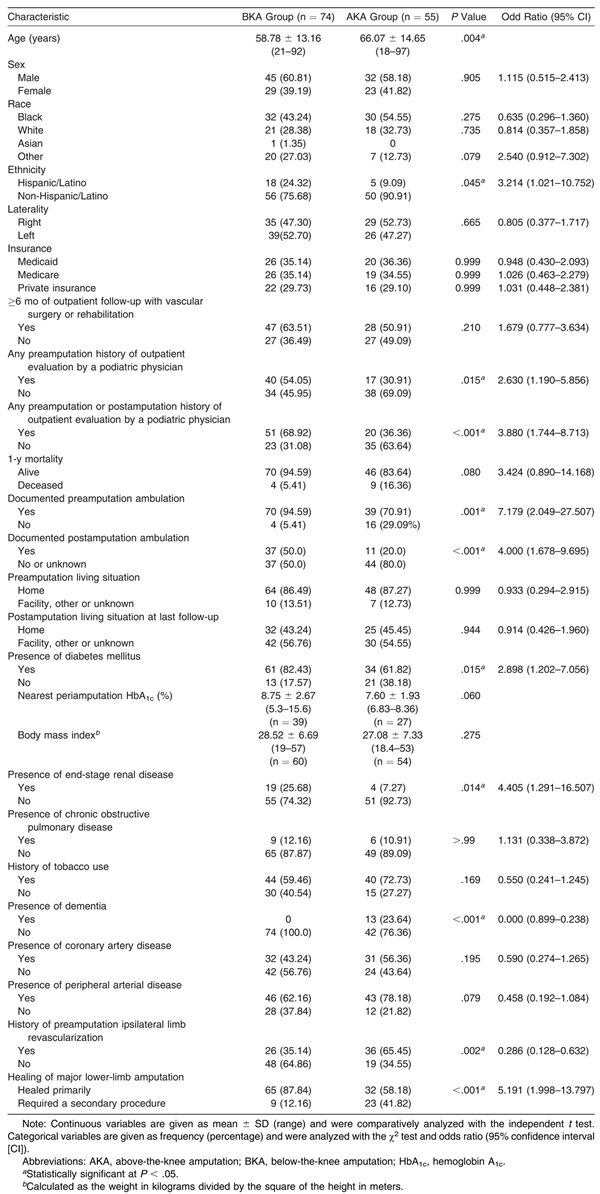
We first compared extracted information from patients undergoing BKA with that from patients undergoing AKA (
Table 1). Patients undergoing BKA were relatively younger (58.78 versus 66.07 years;
P = .004) and were more likely to be Hispanic/Latino (24.32% versus 9.09%;
P = .045), have a preamputation history of outpatient evaluation by a podiatric physician (54.05% versus 30.91%;
P = .015), have any preamputation or postamputation history of outpatient evaluation by a podiatric physician (68.92% versus 36.36%;
P < .001), be ambulatory before amputation (94.59% versus 70.91%;
P < .001), walk after amputation (50.0% versus 20.0%;
P < .001), have diabetes mellitus (82.4% versus 61.82%;
P = .015), have ESRD (25.68% versus 7.27%;
P = .014), and have an amputation that healed primarily without requiring a secondary procedure (87.84% versus 58.18%;
P < .001). Patients undergoing BKA were less likely to have dementia (0% versus 23.64%;
P < .001) and to have a history of preamputation ipsilateral limb revascularization (35.14% versus 65.45%;
P = .002).
Table 1.
Comparison of Patients Undergoing BKA versus AKA.
Table 1.
Comparison of Patients Undergoing BKA versus AKA.
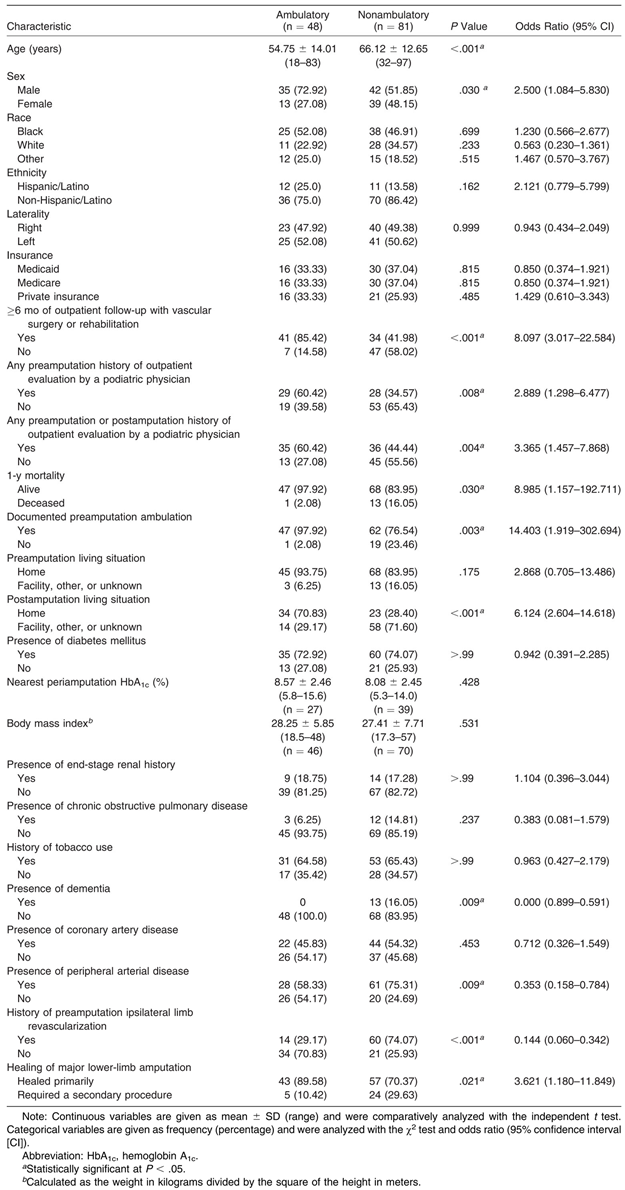
We then compared extracted information for patients with documented ambulation in a prosthesis within 1 year after BKA or AKA with that for patients who did not walk in a prosthesis within 1 year after BKA or AKA (
Table 2). Patients who walked were relatively younger (54.75 versus 66.12 years;
P < .001) and were more likely to be male (72.92% versus 51.85%;
P = .030), have at least 6 months of outpatient follow-up with either the vascular surgery or rehabilitation service (85.42% versus 41.98%;
P < .001), have a preamputation history of outpatient evaluation by a podiatric physician (60.42% versus 34.57%;
P = .008), have any preamputation or postamputation history of outpatient evaluation by a podiatric physician (60.42% versus 44.44%;
P = .004), be ambulatory preamputation (97.92% versus 76.54%;
P = .003), return home after the amputation (70.83% versus 28.40%;
P < .001), and have an amputation that healed primarily without requiring a secondary procedure (89.58% versus 70.37%;
P = .021). Patients who walked were less likely to be deceased within 1 postoperative year (2.08% versus 16.05%;
P = .030), have dementia (0% versus 16.05%;
P = .009), have peripheral arterial disease (58.33% versus 75.31%;
P = .009), and have a history of preamputation ipsilateral limb revascularization (29.17% versus 74.07%;
P < .001).
Table 2.
Comparison of Patients Undergoing Either Below-the-Knee or Above-the-Knee Amputation Regarding Postamputation Ambulation.
Table 2.
Comparison of Patients Undergoing Either Below-the-Knee or Above-the-Knee Amputation Regarding Postamputation Ambulation.
Finally, we compared extracted information for patients with documented ambulation in a prosthetic device within 1 year after BKA with that for patients who did not walk in a prosthesis within 1 year after BKA (
Table 3). Patients who walked were more likely to have at least 6 months of outpatient follow-up with either the vascular surgery or rehabilitation service (86.49% versus 40.54%;
P < .001), have any preamputation or postamputation history of outpatient evaluation by a podiatric physician (81.08% versus 56.76%;
P = .044), and return home after their amputation (62.16% versus 24.32%;
P = .003).
Table 3.
Comparison of Patients Undergoing BKA Regarding Postamputation Ambulation.
Table 3.
Comparison of Patients Undergoing BKA Regarding Postamputation Ambulation.
Discussion
The first objective of this study was to determine the percentage of patients who walked in a prosthesis within 1 year after major lower-limb amputation at an urban US tertiary-care hospital with a multidisciplinary limb salvage team, and we observed what we consider to be a low rate of confirmed ambulation. The overall rate was approximately 30% during this 2-year period, with the highest individual rate (occurring in patients undergoing unilateral BKA) not exceeding 50%. This is in line with the previously published literature reporting a range from 23.0% to 65.1%.[
17-
21] Although we agree that many patients may function well with a prosthesis after major lower-limb amputation,[
12-
16] we found that this did not occur in most of the investigational cohort. We conclude that this finding may speak to the importance of limb salvage techniques and should play a role in the education and consent of patients facing major amputation. The procedure may not be as definitive and function-returning as is sometimes thought, particularly given that we observed that approximately 25% of patients undergoing BKA or AKA required a secondary surgical procedure on the site.
We also observed a relatively poor outpatient follow-up rate for patients undergoing major amputation at Temple University Hospital. At this facility, the vascular surgeon performing the amputation will refer the patient to the rehabilitation service for prosthesis fitting and gait training. However, we observed that 41.86% of patients undergoing BKA or AKA had no outpatient follow-up with either service 6 months after amputation. First, we conclude that this low follow-up rate should be considered a limitation of this study and has the potential to deflate the observed ambulation rates. As a consequence of practicing in an urban metropolis, patients have multiple competing health-care centers in relatively close proximity. It is possible that some of these patients had the amputation performed at our facility but were followed up with rehabilitation at another facility and were, therefore, not found in the electronic medical record. Even given this potential, however, we conclude that the role of a multidisciplinary limb salvage team in the care of patients should not end with a major amputation. Although amputation is often viewed as a treatment “failure” by these types of teams, we believe that the care of the patient should extend until maximal functional results have been achieved.[
28-
32] Speaking plainly, these results have changed our care of postamputation patients to emphasize longer and more functionally definitive follow-up.
The second objective of this investigation was to identify patient factors that might be associated with ambulation after major amputation. We observed statistically significant differences indicating that younger patients, male patients, and patients who walked before their amputation, returned home after their amputation, and healed their amputation primarily without requiring a secondary procedure were more likely to walk postamputation than their counterparts. This is also in line with other published data on factors associated with postamputation ambulation rates.[
17] We conclude that this adds to the body of knowledge with respect to outcomes after major amputation and could be useful not only in medical decision making but also in the education and consent of patients faced with major amputation.
Interestingly, we also observed an apparent positive association of evaluation by podiatric physicians with postamputation ambulation. Patients with a history of outpatient evaluation by a podiatric physician before a major amputation were 2.63 times as likely to undergo BKA as opposed to AKA and were 2.90 times as likely to walk after these amputations. Specific to those undergoing BKA, patients with a history of outpatient evaluation by a podiatric physician before or after their amputation were 3.27 times as likely to walk. To our knowledge, this is the first study to investigate or report such results. Although we do not conclude that there is a causative effect of podiatric medical evaluation on major amputation outcome, it is at least an interesting finding that could be worthy of future investigation. We hypothesize that it is probably more likely that patients who see podiatric physicians are more likely to follow up with other medical services and recommendations, but this was not specifically studied in this investigation.
As with any scientific investigation, critical readers are encouraged to review and assess the study design and specific results to reach their own independent conclusions; the present study represents our conclusions based on the data. We also embrace the fact that all investigations have limitations, and this one had several to consider. First, data were collected from a limited number of patients in a single health-care center, and, therefore, these results might not be representative of a broader population sampling. Particularly considering the follow-up rate, it would be interesting to attempt to study all amputations occurring in multiple health-care facilities of an urban environment instead of in just a single center. Second, all retrospective studies have inherent limitations. We were dependent on procedural billing codes for identification of the cohort, as well as physician documentation and diagnosis coding during data collection. Any inaccuracies in these data would result in inaccuracies in data analysis and interpretation. Third, we included all amputations occurring during the data collection period, not just those performed as a result of diabetic foot disease. One might hypothesize that amputations occurring in younger patients as a result of acute trauma might have higher rates of ambulation compared with older patients with diabetes mellitus, peripheral arterial disease, and other comorbidities, for example. Fourth, when examining differences between groups with respect to demographic factors, we could have chosen to perform a multivariate comparative model as opposed to using the χ2 test and odds ratio analyses. We also focused the comparative analyses on the unilateral BKA and AKA groups, as opposed to the bilateral amputation and other level of amputation groups. We felt as though this provided the most clinically relevant information for readers given the sample sizes and observed ambulation rates. Finally, as previously discussed, the relatively short-term observed follow-up should be considered a limitation.
Conclusions
The results of this investigation provide physicians working on a multidisciplinary limb salvage team with evidence regarding the rate of and factors associated with ambulation after major lower-limb amputation. We hope that these data are used in the development of future investigations, improving the outcomes of patients faced with major amputation.
Financial Disclosure: None reported.
Conflict of Interest: None reported.