Case Report
We present a partial first ray of the left foot with anatomical connections coming from an Egyptian mummy. The specimen was recovered by one of us (A.I.) during the fifth archaeological season of the Spanish/German mission of the Museu Egipci de Barcelona/Eberhard Karls Universitat Tübingen at the bottom of a shaft dated to the end of the Old Kingdom period in the Necropolis of Sharuna, Middle Egypt. This huge necropolis covers from the beginnings of Dynasty VI of the Old Kingdom (circa 2325 BC) to the beginnings of the Coptic period (fourth–ninth centuries AD), and 438 individuals have been identified and their pathologies studied. [
6]
The partially mummified and hard piece belongs to an adult male dismembered by plunderers in search of jewelry. The individual was exhumed in the 4013B site and has been dated to the end of the sixth dynasty (2355 to 2195 BC) by the location place, the typology of the individual mummification, and the archaeological pieces found in the context.
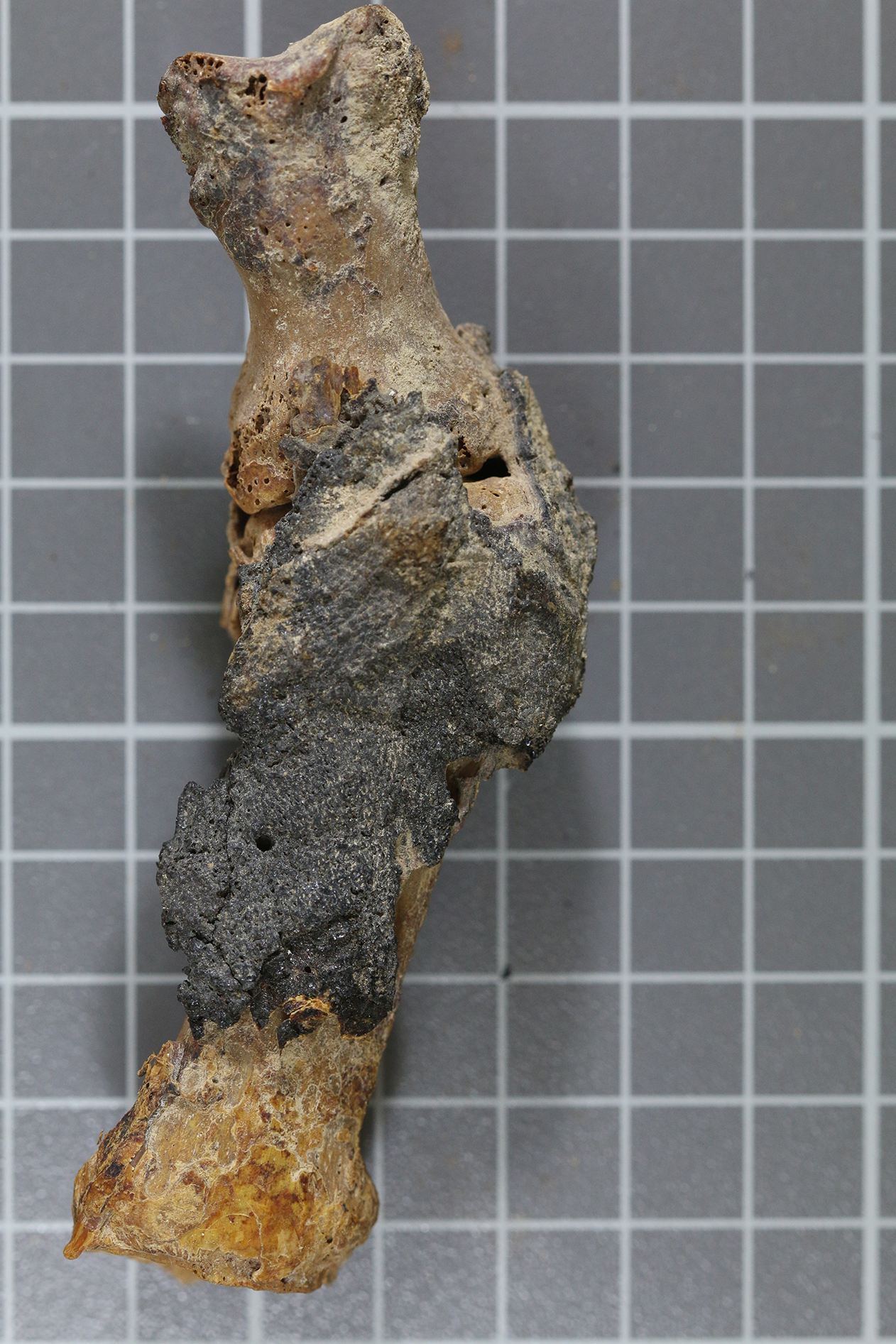
The specimen consists of a partial left foot that conserves the first ray in anatomical connection between the first metatarsal bone and the first phalange of the great toe. The mummification process has preserved the periarticular components (
Fig. 1): the joint capsule, dorsal skin, intrinsic ligaments (collateral and sesamoids), part of the extensor hallucis tendon, both sesamoid bones, part of the flexor hallucis brevis, and the attachment of the abductor and adductor hallucis muscle.
Figure 1.
Hallux valgus of the individual from the 4013B site of the Sharuna necropolis (end of the Old Kingdom period).
Figure 1.
Hallux valgus of the individual from the 4013B site of the Sharuna necropolis (end of the Old Kingdom period).
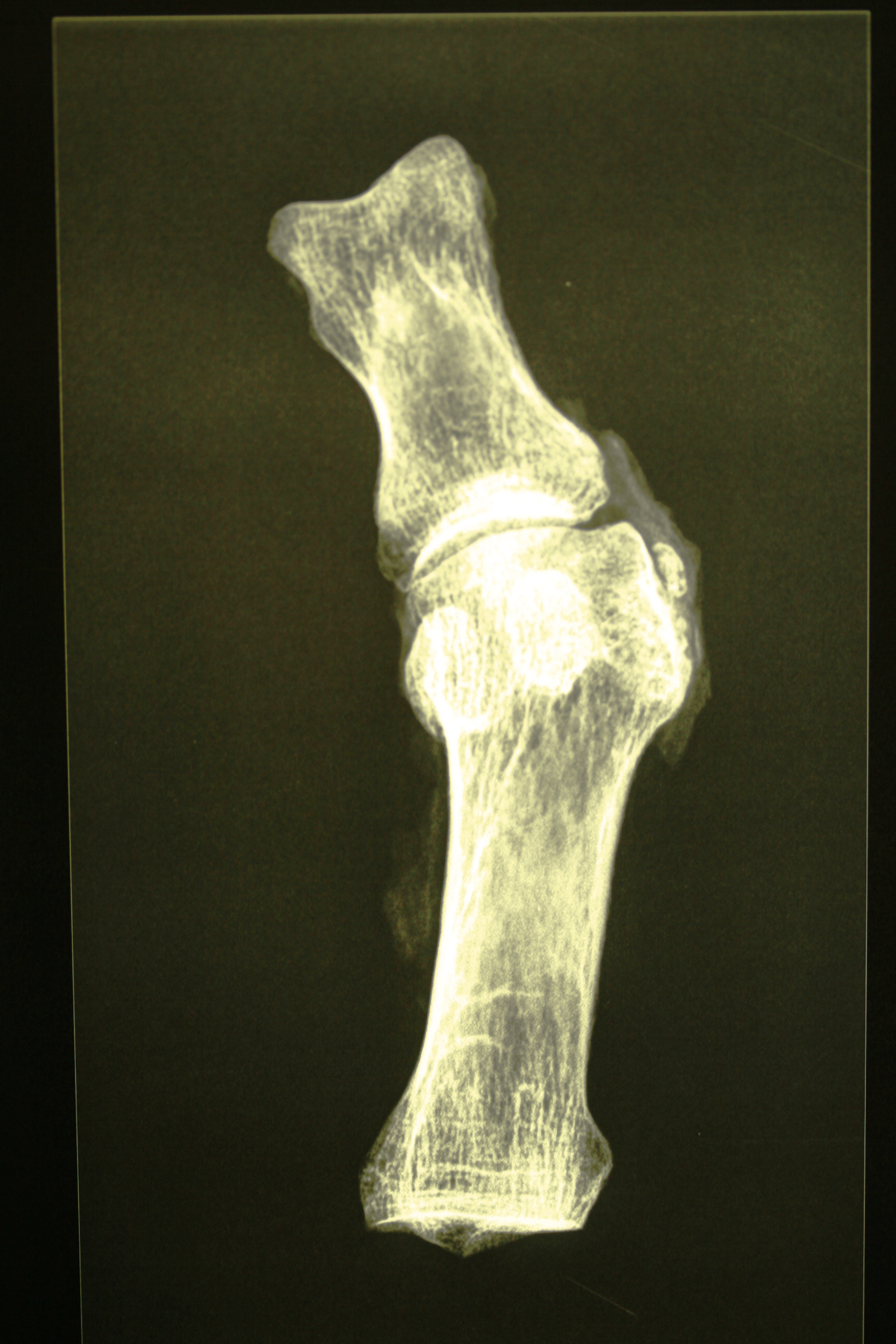
The piece shows a lateral deviation compatible with HV. A field radiographic study demonstrated a metatarsophalangeal angle of 28° (reference range, 8°–10°) (
Fig. 2), a lateral subluxation of the sesamoid bones, and an irregularity on the medial side of the first metatarsal head with the presence of joint calcifications.
Figure 2.
Field radiograph of the hallux valgus.
Figure 2.
Field radiograph of the hallux valgus.
Discussion
The condition of HV in archeological remains used to be demonstrated in dry bone by rearticulating the joint surface of the first metatarsal head with the distal joint surface of the first phalangeal bone of the great toe. In some cases, complementary studies, such as radiography and quantitative metatarsophalangeal angles, have been applied.
There are few examples of HV in prehistoric times. The cases published to date are the Chancelade Man, discovered in 1888 in the Grotte de Raymonden, Chancelade, Dordogne (France), dated to the Magdalenian period (16,000 to 10,000 BP) [
7]; the two cases found in the necropolis of Afalou-Bou-Rhummel (Algeria) dated to the Epipaleolithic period (10,000 to 9000 BC) [
8]; and the individual H9 from the end of the Mousterian period in the necropolis of Qafzeh (Israel) dated to 35,000 BP. [
9]
The diagnosis of these prehistoric cases has always been performed on dry bone by mounting the hypothetical axis of the first ray and taking into account the congruence of the deviation of the joint surfaces and the position of the sesamoid groove; by this method, the individual H9 from Qafzeh shows a metatarsophalangeal angle of 17°. The only exception to this method of diagnosis is the individual 28 from Afalou-bou-Rhummel that was found in connection due to a hard gangue.
It is difficult to elucidate the etiology of these prehistoric findings owing to the paucity of cases and the impossibility of knowing whether they walked barefoot, which points us toward an idiosyncratic abnormality.
Aside from the previously mentioned cases, there are no other cases found, and the lack of examples in Ancient Egypt, where the great toe had artistic relevance, is significant. The HV is not described in the paleopathologic bibliography, although diseases of the great toe would not be uncommon. The presence of exo-prostheses in the hallux of two mummies is noteworthy: the first case is a female individual from the XXI dynasty that shows a two-component hallux prosthesis in the right foot [
10]; the second case is a superbly well-crafted wooden prosthesis after hallux amputation in an individual from the early Third Intermediate Period (XXI to XXII dynasty). [
11]
In historical times, there are described some cases of HV: the individual E-49 from Ercolano (Italy) from the Roman period (first century AD), in which a radiographic analysis was performed, [
12] or the individual 44 from the Merovingian cemetery of Montataire (Oise, France) dated to the sixth and seventh centuries. [
13]
The regular use of footwear in ancient times might be the cause of the increase in HV cases, and thus, in the Middle Ages, the incidence of HV increased exponentially. The two most important descriptions of this period are the study of the Ipswich Blackfriars site (Suffolk, England) from the 13th to 16th centuries, with 14 HV deformities from 239 individuals, [
14] and the analysis of 605 first metatarsal bones from the Notre-Dame-du-Bourg cathedral (Alpes-de-Haute-Provence, France) dated between the 11th and 17th centuries, with 21.8% HV (132 individuals). [
15] It is remarkable that examples of HV are common in the artworks of this period. Great masters of painting, such as Rubens, Van Dyck, Giambattista Tiepolo, Botticelli, Rembrandt, Pietro della Francesca, and Velazquez, among others, have shown in their paintings images of this alteration.
In nearly all of the previously mentioned cases, the diagnosis was obtained through indirect factors, such as the presence of exostosis or irregularity on the medial side of the first metatarsal head, lateral angulations of the joint surface, fibular subluxation of sesamoid grooves, and, finally, shifting of the components of the joint.
The mummification process could lead to different deviations of the foot. The most common are plantarflexion mimicking a clubfoot, [
16] extreme plantarflexion of the finger, and, in the reverse condition, extreme dorsiflexion; in those cases, feet are wrapped, and precisely because of the wrapping mechanism, fingers can show some lateral deviation. In the present case, the mummification was incomplete and partially natural, including the feet.
In conclusion, the individual found in the 4013B shaft, who lived more than 4,000 years ago in the last years of the Old Kingdom, shows a mummified left HV that we consider to be mild to moderate.