Knife injuries pose a severe risk at both the soft-tissue and vascular levels. Penetrating injuries can present as severe trauma or subtle wounds, many times associated with confounding factors such as intractable pain, secondary injury, and patient instability. In the setting of an otherwise stable patient, sufficient evaluation must be undertaken to avoid overlooking subtle soft-tissue or vascular complications. [
1] It is not uncommon for patients with a documented retained knife injury to present in stable condition. In one study, 91% of patients presenting to the emergency department (ED) with various retained knife injuries were deemed to be hemodynamically stable on initial examination. [
2] There are three important signs to observe in these patients. Vital signs, although imperative, can be initially deceiving in pediatric patients compared with adults. In fact, these patients can maintain normal blood pressure even in settings of acute blood loss at 25% to 30% volume. [
3] Only minor elevations in heart rate or decreases in extremity perfusion can signal impending cardiovascular collapse. [
4] Therefore, prompt intravenous access and close monitoring are necessary in this population. The next important consideration in these patients is to rule out the “hard signs” of vascular injury: expanding hematoma, hemorrhage, absent pulses, or palpable bruit. Such patients warrant immediate surgical exploration. Patients without hard signs should then be assessed for hematomas, history of arterial bleeding, location of wound entry as it relates to nearby arteries, and any neurologic deficits, known as the “soft signs” of vascular injury. [
1,
5] Risk of arterial injury in patients with soft sign injuries varied in one study from 3% to 25%. [
5]
Despite minimal blood loss, the clinician should maintain a high degree of suspicion for potential arterial involvement. As reported in the literature, there are rare instances when stable patients experience sudden hemodynamic collapse after removal. Reportedly it was due to a tamponade effect created by the lodging of the knife in a nearby artery. [
6] Multiple sources indicate the importance of leaving retained objects in place during the initial assessment. [
2] Note that protocols for imaging in these patients are still controversial. Spiral computed tomography or computed tomography angiography can also be used in lieu of arteriography for faster detection of arterial involvement. [
5,
7,
8]
Eidelman et al [
7] cite delayed changes on conventional radiographs of up to 14 days after the initial incident. They point toward bone scans in cases of suspected osteomyelitis. [
7] Anteroposterior and lateral radiographs seem most useful as a fast and cost-efficient mechanism for characterizing the depth of the injury and bone or joint involvement in patients who are less suspicious for infection. [
8]
Decisions on extraction require individualized considerations. In patients with retained objects in obvious need of removal, emphasis should be placed on simplicity of removal. The clinician should take into account the proximity to joints, tendons, vessels, or nerves, as well as the potential for patient discomfort. Newton and Love [
1] reported that 58% of stable patients taken to the operating room were successfully treated with simple extraction of the knife and no further surgical exploration. The risk of postextraction bleeding in those patients was 5%, a remarkably low number in an otherwise traumatic injury. [
1] The American College of Emergency Physicians seems to be more proactive with object removal, suggesting that many objects can be removed in the ED. [
8] The American College of Emergency Physicians does recommend consultation for deep wounds of the hands or feet, citing increased complexity in these cases. [
8]
Patients with penetrating wounds should always be screened for tetanus prophylaxis. Guidelines state that patients older than 7 years with clean wounds be treated with tetanus-diphtheria prophylaxis only if the tetanus vaccination history is unknown or the patient has had fewer than three previous doses of tetanus toxoid. Patients with clean wounds should never receive tetanus immune globulin. Patients older than 7 years with significantly contaminated wounds should be given tetanus-diphtheria and tetanus immune globulin if there is an unknown vaccination history or if there have been fewer than three documented tetanus toxoid doses. Serology is unreliable for inclusion or exclusion in most cases, as
Clostridium tetani is discovered in only 30% of wounds and can also be found in patients who are considered “protected” with an antitoxin of greater than 0.1 IU. There are also cases of reported false positives, making serologic results even less decisive. [
9]
Infection risk in these patients is less well-known due to outdated studies, showing ranges from 0.6% to 14.8%. Osteomyelits, a rare complication of infection, is seen in only 0.5% of these patients. [
7] Prophylactic antibiotic drug use in patients with a retained injury has been a controversial topic in penetrating wounds because not all cases of antibiotic drug administration lead to lower infection rates. [
8] What is certain is that all penetrating wounds will become contaminated. In one study, open puncture wounds were cultured at the time of wounding and were found to be predominantly colonized with coagulase-negative staphylococcus and streptococcus. Within 5 days, almost 50% of wounds were composed of acinetobacter,
Escherichia Coli, or
Pseudomonas aeruginosa; only 3% of reported wounds were still infected with staphylococcus. A current literature review encourages prophylactic use of penicillin, 2 to 4 μm every 4 hours, or cefazolin, 1 g intravenously every 8 hours, for 1 to 5 days in otherwise stable patients. [
7,
10] On removal of the retained part, surgical debridement with high-pressure saline is considered standard protocol when treating retained wounds. A literature review cites the benefits of initially using saline-soaked mesh gauze with follow-up in 3 to 4 days to repeat cleansing before definitive closure with sutures. [
8] This approach allows for proper assessment of the wound over time and ensures more proactive surveillance for complications.
Case Report
We report the case of a 13-year-old white girl who presented to the ED by ambulance from home after an incidental penetrating injury to her right foot with a knife. The patient explained that she was chasing salamanders in her backyard with her friends when she felt a transient “prick” in her foot. She continued the chase until she captured the salamander. Her friends noted that she had a knife stuck in the bottom of her foot, and her stepfather was informed. He used a sports sock as a tourniquet on the leg and called the paramedics. The paramedics' request that the patient release the salamander were met with loud protests against freeing her hard-caught friend. She declined analgesics from the paramedics, noting a pain level of 4 on a scale from 1 to 10. Intravenous line access was obtained in the ED, and the patient was started on 1 L of intravenous normal saline and was placed on oxygen per nasal cannula.
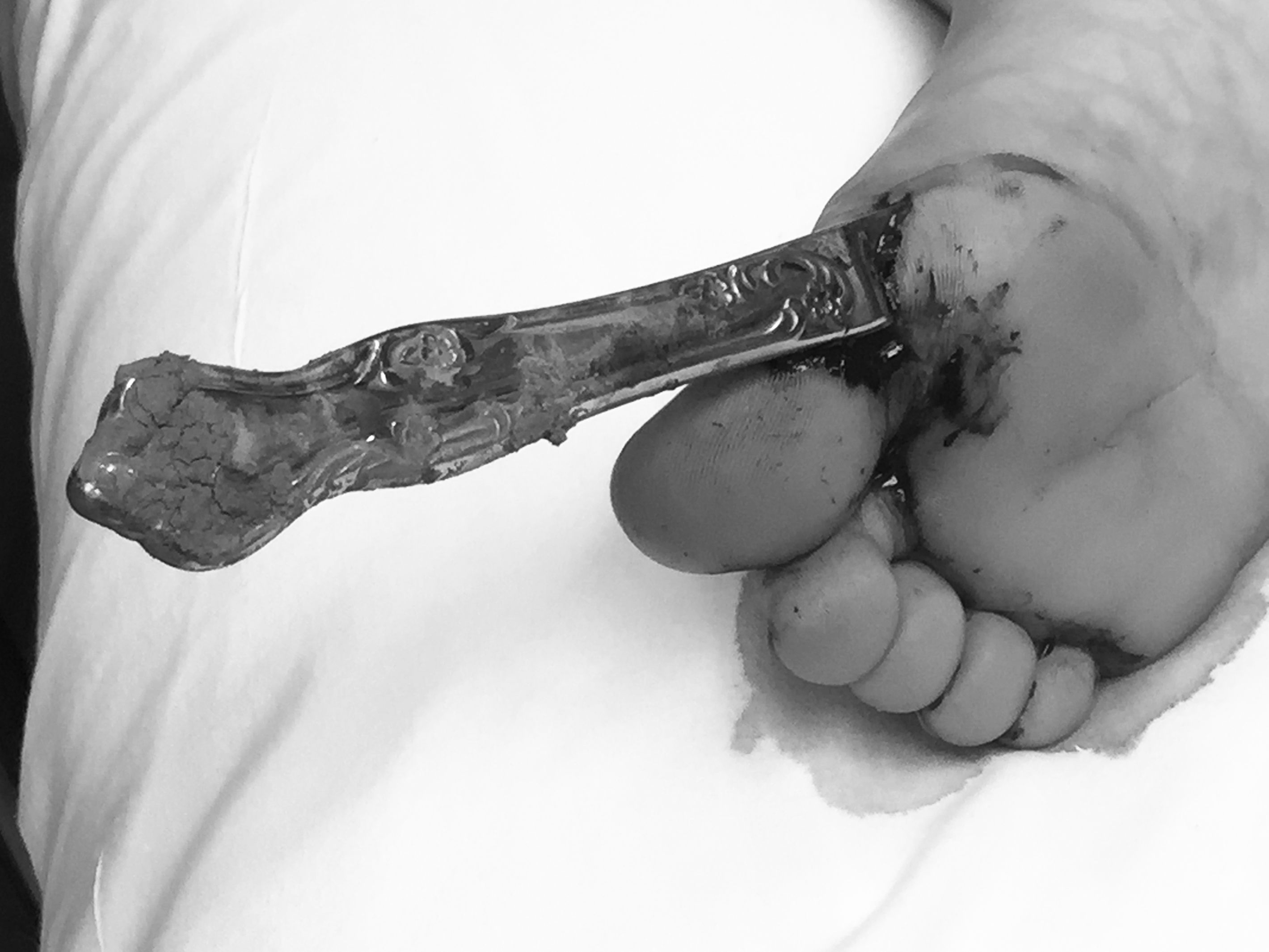
The patient denied any current medical issues, surgical history, allergies, or current medication use. On initial examination we noted a young lady with stable vital signs in no apparent distress other than her vocal frustration about having to let go of the salamander. A tourniquet around the distal leg was noted and removed before examination. Strength and sensation were intact throughout her lower extremities and feet. The skin was warm to the touch, with appropriate capillary refill, dorsal pedis pulses, and posterior tibial pulses. A knife could be seen protruding from her right foot with surrounding entry wound marks and minimal blood loss (
Fig. 1). Her parents reported that she had received all of her childhood vaccinations but were uncertain about her tetanus vaccination status.
Figure 1.
Clinical presentation to the emergency department of a retained knife blade in the right foot.
Figure 1.
Clinical presentation to the emergency department of a retained knife blade in the right foot.
Her initial complete blood cell count and basic metabolic panel were significant only for a white blood cell count of 13.1×10
9/L and an absolute neutrophil count of 9.6×10
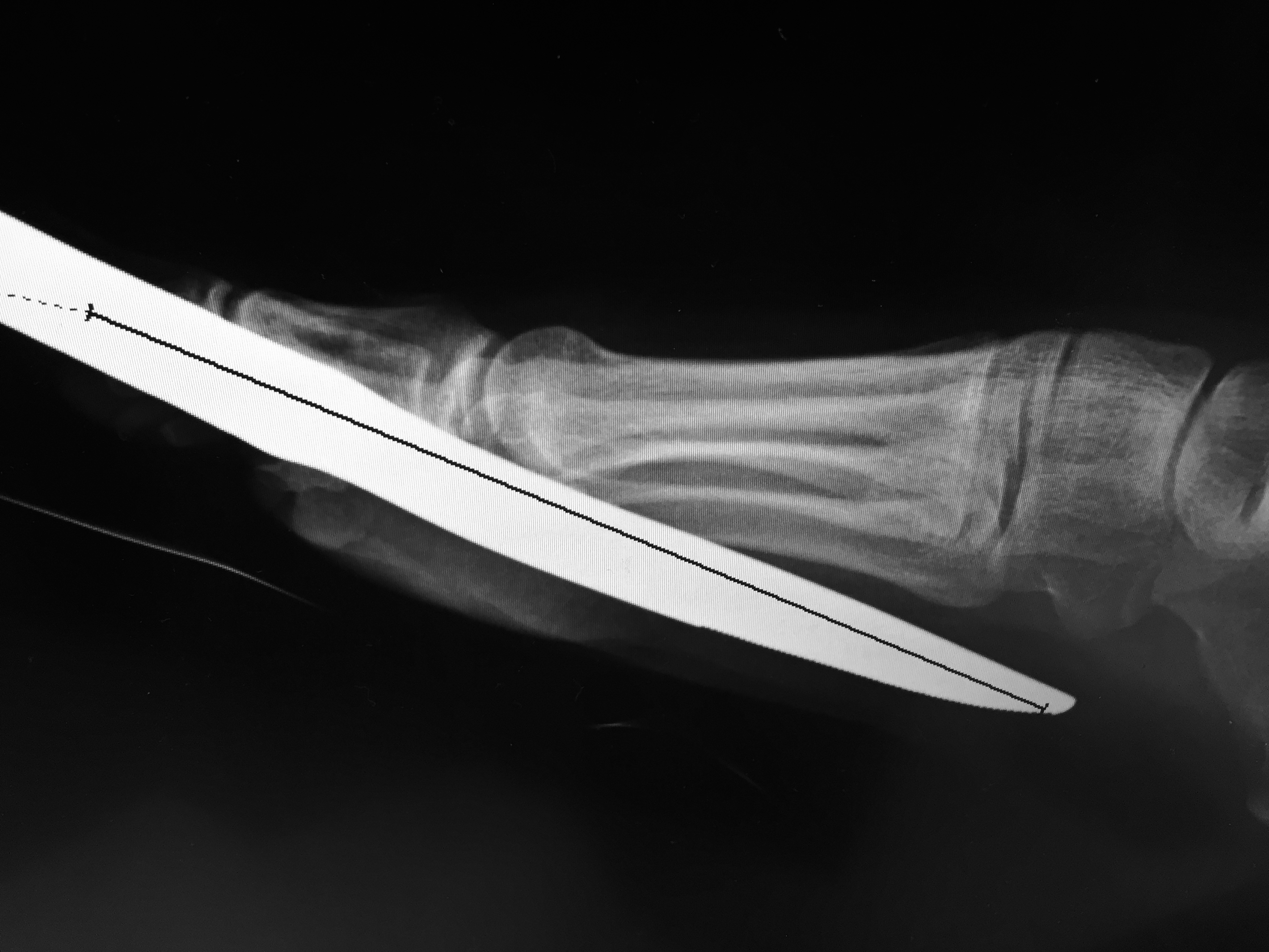
9/L. Her erythrocyte sedimentation rate was 6 mm/h. The patient was given 1 g of cefazolin (Ancef; GlaxoSmithKline, Research Triangle Park, North Carolina) intravenously. Anteroposterior and lateral (
Fig. 2) radiographs were obtained showing a knife lodged in the patient's right foot approximately 14 cm deep, medial to lateral from the first toe to the level of the navicular bone without any fractures or bony abnormalities. Throughout the work-up, the patient experienced growing anxiety about her injury and expressed mildly increased pain. She also began to develop tachycardia but continued to decline analgesia. Consultation was obtained with the orthopedic surgery and podiatric medicine departments, and, ultimately, it was decided to take the patient to the operating room for extraction of the knife by the podiatric physician in the setting of increasing pain, anxiety, and tachycardia. A second dose of cefazolin was given, and the patient was transferred to the operating room.
Figure 2.
Lateral radiograph of a retained knife blade in the right foot.
Figure 2.
Lateral radiograph of a retained knife blade in the right foot.
While in the operating room, the patient was placed under general anesthesia. The podiatric physician was able to remove the knife by simple extraction without further intervention. One small incision was made proximally near the tip of the knife. Six liters of saline were used to irrigate the wound from the proximal incision to the distal laceration site to remove any other foreign material from the wound. The laceration site and incision site were loosely closed with 2-0 nylon sutures, and the site was wrapped with dry, sterile dressing. The patient tolerated the procedure well and was admitted to a general medicine floor under the care of the podiatric physician.
The patient was started on intravenous azithromycin (Zithromax; Pfizer Inc, New York, New York), 500 mg/d. Postoperative radiographs revealed only a small amount of air at the laceration site and surrounding edema in the plantar soft tissue with no bony abnormalities.
Follow-up laboratory tests revealed a continued white blood cell count of 13.5×10⁹/L, with an absolute neutrophil count of 10×109/L. Routine and anaerobic wound cultures were obtained from the site, revealing no bacterial growth. The patient finished a second dose of azithromycin and was discharged from the hospital on postoperative day 1 with trimethoprim/sulfamethoxazole (Bactrim DS; AR Scientific, Philadelphia, Pennsylvania), amoxicillin/clavulanate (Augmentin; GlaxoSmithKline, Research Triangle Park, North Carolina), and acetaminophen/codeine (Tylenol 3; Janssen Inc, Markham, Ontario, Canada). The patient was discharged in good condition with minimal pain. A second irrigation and debridement was performed during a follow-up outpatient podiatric medical visit 3 days later. New cultures were ordered, with no subsequent growth. The site was noted to be clean, and final closure of the site was performed. Furthermore, during the visit the patient expressed that she had no concerns or complications, with improved use of the foot and decreased pain.
Discussion
This case is being conveyed to highlight a paucity of reported cases involving retained knife injuries and to further evaluate decision making involving a retained injury in an otherwise stable pediatric patient. It is evident from a literature review that definitive management guidelines for these patients are conflicting. Many sources stressed medical decision making on a case-by-case basis, specifically when it comes to extraction of a knife. It must be noted that appropriate consultation and timeline of extraction were highly debated during the duration of this patient's stay in the ED. As noted previously herein, both the orthopedic surgery and podiatric medicine departments were asked to view the case before a decision was made by the podiatric physician to remove the knife under anesthesia. There are certainly many sources that would suggest removing the knife in the ED under local anesthesia. Yet, an important ideal to take from this clinical scenario as mentioned previously herein is that these patients can rapidly destabilize with few clinical clues. For this reason, we maintained a high suspicion of a hidden bleed.
Another point of contention came with management of the wound after extraction and debridement. In the present patient, sutures were applied to the site in a loose manner to maintain the integrity of the lesion. This conflicts with the current literature that suggests the use of saline-soaked mesh gauze without definitive closure for ease of accessibility to the wound until outpatient follow-up. However, the decision to use sutures was ultimately guided by concern for the integrity of a site under increased mechanical stress in the plantar region. Regarding antibiotic drug coverage, the use of cefazolin preoperatively did coincide with proposed guidelines of penetrating wounds. However, there seem to be no definitive guidelines for postoperative outpatient coverage of retained wounds. As noted herein, microbial isolates range from simple staphylococcus and streptococcus bacteria to organisms such as P aeruginosa. The concern for a potential pseudomonas infection ultimately guided our use of azithromycin in this patient during the inpatient postoperative period, which is not explicitly supported by the literature review. The choice of outpatient antibiotic agents for this patient did correlate more with guidelines suggesting the use of antimicrobial agents that cover predominantly staphylococcus or streptococcus bacteria. Overall, no clinical complications were noted postoperatively or during follow-up under our care.