Sesamoids of the foot and ankle develop from their own ossification centers. [
1] They are round or oval shaped. The medial sesamoid of the hallux is larger than its lateral counterpart. Yoshioka et al [
2] found that in a healthy foot, the mean length of medial and lateral sesamoids is 10.6 and 10.1 mm, respectively.
The function of the sesamoids is to reduce friction between the tendon and other rigid structures, producing a more efficient gliding mechanism between adjacent tissues. They are partially or completely embedded in the corresponding tendon. In the hallux, medial and lateral sesamoids are embedded in the substance of the medial and lateral slips of the flexor hallucis brevis tendons. [
1,
3,
4]
The presence of hallucal sesamoids is an anticipated finding, and only their absence merits attention, whereas sesamoid bones of the lesser metatarsals are seen rarely and are accepted as accessory bones. Accessory sesamoids are usually asymptomatic and are incidentally seen on plain radiographs.
Accessory ossicles and sesamoids can be found in the foot and ankle together with other variations, such as bipartition and coalition. The reported prevalence of accessory ossicles and sesamoids in the foot and ankle ranges from 18% to 36.6% in the general population. [
4,
5]
Regarding studies investigating the prevalence of accessory lesser metatarsal sesamoids, it is interesting that two of these reports were from the Turkish population. [
1,
5] Kiter et al [
5] reported the distribution of metatarsophalangeal joint sesamoid bones in 602 feet of 371 Turkish individuals. Second, third, fourth, and fifth metatarsophalangeal joint sesamoids were present in 2.8%, 0.5%, 1.0%, and 15.1% of the radiographs, respectively. They also reported that the presence of accessory sesamoids in the fifth metatarsophalangeal joint is 2.7 times higher in males than in females. [
5]
The other study of Turkish individuals was reported by Coşkun et al. [
1] After investigation of foot radiographs from 984 patients, the prevalence of sesamiod bones in the second, third, fourth, and fifth metatarsophalangeal joints was reported to be 0.4%, 0.2%, 0.1%, and 4.3%, respectively. [
1] Contrary to the previous study, [
5] no significant difference in prevalence was found between male and female patients.
Longo et al [
6] investigated the prevalence of accessory ossicles and sesamoids in 505 Italian women with hallux valgus deformity. They reported second, third, and fourth metatarsophalangeal joint sesamoid bones in 15, six, and nine patients, respectively. They did not find any significant difference in the prevalence of accessory ossicles and sesamoid bones according to side.
Herein, we present a case of a 68-year-old woman with accessory sesamoid bones in all of the metatarsophalangeal joints with mild metatarsalgia symptoms.
Case Report
A 68-year-old woman was referred to the orthopedic clinic with right foot pain. Physical examination revealed mild metatarsalgia without any callosities on the plantar aspect of the foot. Other than mild hallux valgus deformity, there were no lesser toe deformities. On standing, the patient had no clinical appearance of pes planus or pes cavus deformity.
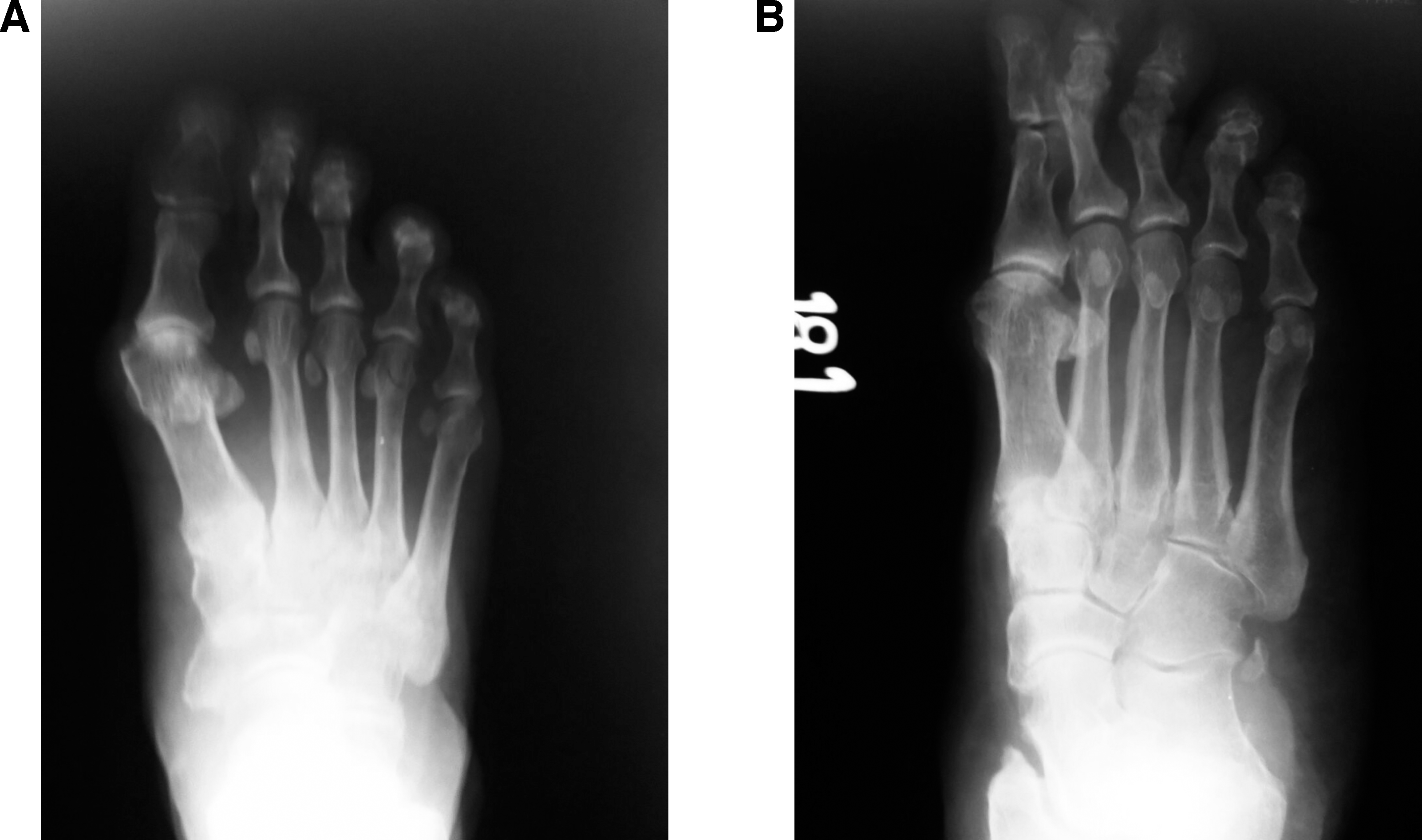
Weightbearing dorsoplantar and nonweightbearing oblique radiographs of the right foot revealed the presence of plantarly located sesamoid bones in all of the lesser metatarsophalangeal joints (
Fig. 1). Two ossicles were present under the fourth and fifth metatarsal heads, and a single ossicle was located under the second and third metatarsal heads. The lengths of the sesamoids were as follows: medial hallux sesamoid, 10.1 mm; lateral hallux sesamoid, 9.0 mm; second metatarsal sesamoid, 6.7 mm; third metatarsal sesamoid, 6.5 mm; medial fourth sesamoid, 6.1 mm; lateral fourth sesamoid, 4.3 mm; lateral fourth sesamoid, 3.9 mm; medial fifth sesamoid, 4.5 mm; and lateral fifth sesamoid, 3.2 mm.
Figure 1.
Dorsoplantar (A) and oblique (B) radiographs of the patient.
Figure 1.
Dorsoplantar (A) and oblique (B) radiographs of the patient.
Conservative treatment of the patient included metatarsal padding and footwear modification. After 3 months of follow-up, her metatarsalgia was found to be reduced.
Discussion
Sesamoid bones of the first metatarsophalangeal joint are considered to be a normal part of the skeleton; however, sesamoid bones at the lesser metatarsals and the hallux interphalangeal joint are rarely seen and are accepted as accessory bones.
Herein, we reported the case of a 68-year-old woman with accessory lesser metatarsal sesamoids in all of the metatarsophalangeal joints, and, to our knowledge, this is the only case reported in literature. All of the accessory bones were able to be diagnosed by standard radiographs. Conservative treatment modalities were successful and reduced the patient's symptoms.
Lesser metatarsal sesamoids are much more common on the medial side than on the lateral side, and they are always more predominant in the second and fifth metatarsals than in other lesser metatarsals. [
1,
5] According to the study by Coşkun et al, [
1] possible reasons for these differences in frequency are the asymmetry of the metatarsal head at the plantar surface of the foot and the transverse plantar arch, both of which lead to unequal stress on the metatarsal heads.
Aper et al [
7,
8] showed that selective sesamoid resections (medial, lateral, or both sesamoidectomy) caused significant decreases in the effective tendon moment arm of the flexor hallucis longus and brevis tendons in two different cadaver studies. Lesser toe sesamoids might have similar beneficial effects on tendon moment arms of lesser toe flexors.
In the literature, there are studies showing the frequencies of accessory lesser metatarsal sesamoid bones for each metatarsophalangeal joint. However, this is the first case reporting a patient with lesser metatarsal sesamoids in all of the metatarsophalangeal joints.