Charcot's neuroarthropathy (CN) is a limb-threatening complication of peripheral neuropathy that can result in significant deformity and instability as the disease progresses from the acute to the chronic phase [
1]. In 1966, Eichenholtz [
2] described a classification system based on radiographic findings that separates the process into 3 distinct stages. Shibata et al [
3] later added a stage 0 that describes an early stage of the disease process clinically recognized as an edematous lower extremity with increased local warmth but without radiographic fragmentation. More recently, CN has been separated into 2 main phases: active (acute) and nonactive (chronic) based on whether the involved limb is inflamed or stable, respectively [
4].
The pathogenesis of the CN disease process is poorly understood. Jeffcoate [
5] described a cycle of uncontrolled inflammation due to activation of the receptor activator of nuclear factor kappa-B ligand (RANKL)/osteoprotegerin system dictating the transition from nonactive to active Charcot's. RANKL belongs to the tumor necrosis factor superfamily and stimulates the expression of nuclear transcription factor NFκB, which, in turn, induces the maturation of precursor cells into mature osteoclasts. NFκB simultaneously causes increased expression of the glycoprotein osteoprotegerin, which acts as a decoy receptor for RANKL and has a protective effect on bone. This system of bone turnover is accelerated in patients with CN due to neuropathy and the inability to perceive pain, resulting in further trauma and the inability to stabilize structural damage [
5]. Several studies have shown using bone markers that there is a marked increase in osteoclast activity to osteoblast activity in acute CN, resulting in significant local osteopenia [
6,
7]. Once the foot or ankle collapses, the bone quality is too weak to support internal fixation.
Up to this point, the gold standard in treatment for active CN has been total-contact casting to off-load the foot and ankle in hopes of preventing deformity progression and instability [
8]. However, in some cases, early in the disease process may be the best time to surgically intervene, before architectural collapse and consolidation in a malaligned position. Eichenholtz [
2] himself believed that the optimal timing for surgical management is either early in stage 1 or late in stage 3, after which the healing process may “grind to a halt,” resulting in nonunion. We present a case report of a patient with diabetes mellitus and CN of the subtalar joint treated during the active stage of disease with staged reconstruction.
Case Report
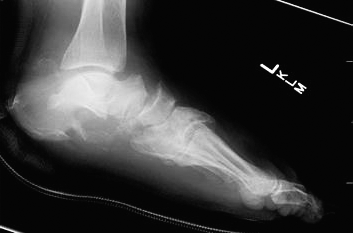
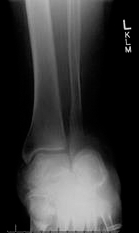
A 54-year-old man presented with unilateral left lower-extremity swelling of 5 weeks' duration. He had a history of lupus antibody hypercoagulable state, lower-extremity deep venous thrombosis, and insulin-controlled diabetes mellitus for 7 years. He reported pain in the affected limb at a level of 2 on a scale from 0 to 10 in the setting of profound peripheral neuropathy, and he denied any preceding trauma. Before presentation, he was diagnosed as having lower-extremity cellulitis and was treated for 2 days with intravenous vancomycin and piperacillin/tazobactam without symptom improvement. Further work-up included radiographs, revealing a complete lateral dislocation of the subtalar joint and subluxation of the talonavicular joint (
Figs. 1 and
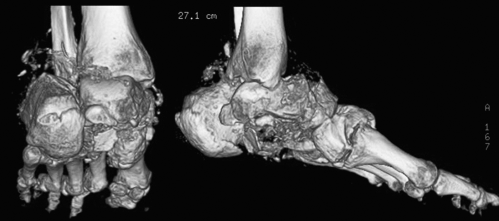
2). Magnetic resonance imaging and computed tomography with three-dimensional reconstruction were performed before referral (
Fig. 3). The patient was diagnosed as having fracture-dislocation and was sent for treatment. On examination, his pulses were palpable, and there were no open wounds. His Semmes-Weinstein monofilament sensation, Achilles deep tendon reflexes, and vibratory sensation were absent. There was decreased ankle and subtalar joint range of motion and gross deformity to the rearfoot, with apparent increased width. The left foot was notably warmer to the touch than the right foot, with significant edema to the level of the tibial tuberosity. From the initial evaluation he was diagnosed with active CN involving the subtalar joint, with dislocation.
Figure 1.
Lateral view of the left foot showing complete dislocation of the subtalar joint in an acute Charcot event.
Figure 1.
Lateral view of the left foot showing complete dislocation of the subtalar joint in an acute Charcot event.
Figure 2.
Mortise view of the left ankle showing complete lateral dislocation of the subtalar joint in an acute Charcot event.
Figure 2.
Mortise view of the left ankle showing complete lateral dislocation of the subtalar joint in an acute Charcot event.
Figure 3.
Three-dimensional computed tomographic reconstruction of an acute Charcot foot with dislocation of the subtalar joint.
Figure 3.
Three-dimensional computed tomographic reconstruction of an acute Charcot foot with dislocation of the subtalar joint.
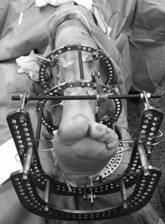
A staged reconstruction was planned. The first goal was to reduce the deformity and then hold the correction with a multiplane circular ring external fixator. Once the CN moved to the nonactive state, a more formal and permanent arthrodesis would be performed.
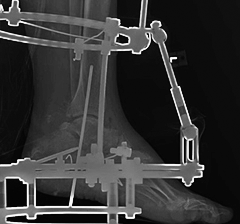
The index procedure consisted of reducing the dislocation using a 1-cm incision over the sinus tarsi. This allowed access to the subtalar joint to aid in reduction. A universal femoral distractor (Synthes Inc, West Chester, Pennsylvania) allowed distraction and initial stability of the reduced deformity. The femoral distractor was fixated with two Shanz pins, one in the medial tibia and the other in the posterior calcaneal tuberosity. After the temporary reduction was made more substantial (
Fig. 4) with a transarticular pin through the heel, across the subtalar and ankle joints, these Shanz pins were later attached to the external fixator to augment overall stability.
Figure 4.
Lateral view of the left ankle showing external fixation with temporary transarticular pin fixation.
Figure 4.
Lateral view of the left ankle showing external fixation with temporary transarticular pin fixation.
The external fixator was maintained for 2 months to allow for the disease process to become inactive and soft-tissue edema to resolve. This also allowed the soft-tissue envelope to be optimized for definitive internal fixation (
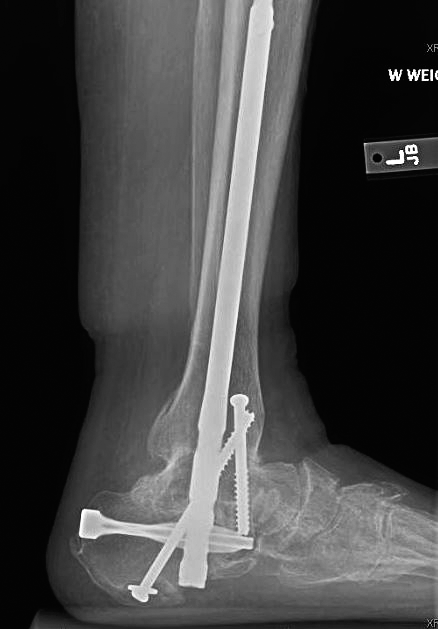
Fig. 5). After removal of the external fixator, the patient was placed in a short-leg cast for an additional 2 weeks to maintain stability and reduction and allow the pin sites to heal. The definitive procedure was scheduled as a tibiotalocalcaneal arthrodesis with retrograde intramedullary nail fixation (
Fig. 6). This procedure was performed through a lateral approach with a fibular takedown osteotomy.
Figure 5.
External fixation applied with visualization of the soft-tissue envelope.
Figure 5.
External fixation applied with visualization of the soft-tissue envelope.
Figure 6.
Lateral view of the left ankle showing a tibiotalocalcaneal arthrodesis with intramedullary fixation.
Figure 6.
Lateral view of the left ankle showing a tibiotalocalcaneal arthrodesis with intramedullary fixation.
The patient was kept nonweightbearing for 12 weeks and transitioned to a Charcot restrained orthotic walker. At 3 months he showed clinical and radiographic signs of arthrodesis. He was transitioned into a double upright brace, and at 1-year follow-up he remained ulcer free with a plantigrade foot with occasional wear of diabetic shoes.
Discussion
There is a paucity of research available that describes early operative correction for active CN with a staged protocol. Simon et al [
9] first described early surgical management for acute CN. Fourteen patients with Eichenholtz stage 1 at the level of the tarsometatarsal joints underwent extensive debridement and open reduction and internal fixation with autologous bone graft. The reported results were considered successful, with no immediate or long-term complications. Mean follow-up was 41 months (range, 25.3–77.3 months) [
9].
Mittlmeier et al [
10] retrospectively reviewed 22 patients with midfoot (n = 9) or hindfoot (n = 17) CN who underwent primary surgical reconstruction and reorientation arthrodesis owing to instability, nonplantigrade foot position, and deformity with ulceration or impending ulceration. Eight of the 22 patients had preoperative ulceration, and all healed at final follow-up. Minimum follow-up was 6 months. Nine patients developed complications leading to additional surgery. American Orthopaedic Foot and Ankle Society scores rose from a preoperative mean of 39 to 70 postoperatively. Of the 22 patients studied, only four were assigned active CN based on the Eichenholtz classification. Owing to the heterogeneity of this patient cohort, it was impossible to identify whether the patients with active CN did well in this study [
10].
Although the mainstay of treatment for early CN is off-loading, we believe that this case illustrates that aggressive early surgical correction for selected patients can be warranted and favorable. Addressing the deformity before consolidation allows for ease of reduction intraoperatively. It is the opinion of the authors that early intervention also avoids the RANKL-driven local osteopenia that results from the Charcot foot syndrome itself but also the disuse osteopenia seen over long periods of nonweightbearing. Finally, early intervention in selected patients with external fixation allows for soft-tissue inspection to monitor active inflammation and the transition to a nonactive phase while maintaining an intact soft-tissue envelope free of ulceration.
The primary goals of early external fixation are to maintain reduction, prevent structural collapse, aid in soft-tissue management, and provide a more rigid form of skeletal stabilization. Once it is achieved, a definitive procedure can be performed to internally fixate weakened or disrupted anatomy. At this interval, surgical techniques such as super constructs and beaming can be used [
11].
Conclusions
As CN is further studied and better understood, research addressing early surgical intervention in the active stage is paramount. Determining whether there is a critical window of opportunity before increased osteoclast activity in the acute stage and what anatomical locations warrant this approach are key questions moving forward.