Pregnant women often experience lower-extremity pain and back pain. The incidence of this type of pain in pregnancy is at least 50%.[
1] This is not surprising considering that during the gestation period, women's bodies undergo many changes as the fetus develops and the body prepares for delivery. Some of these changes include weight gain,[
2,
3] alterations in spinal alignment,[
4] decreased abdominal muscle strength,[
5] and increased joint laxity.[
2,
6]
Increased joint laxity is of particular concern because it may lead to increased foot arch flexibility, resulting in lower-extremity alignment changes and pain.[
7] Women who experience greater increases in mobility in the peripheral joints during pregnancy demonstrate a greater incidence of back pain during pregnancy.[
6] Thus, women who are predisposed to increased laxity of connective tissue may be more susceptible to joint malalignment and pain. Extreme foot arch characteristics, such as pes planus and excessive hindfoot eversion, may predispose people to lower-extremity overuse injuries, as seen in military recruits.[
8]
One method of assessing the medial longitudinal arch of the foot is with the Arch Height Index Measurement System. This method uses specialized sliding calipers to measure the foot length (FL), truncated foot length (TFL; from the back of the heel to the head of the first metatarsal), and dorsal height at half foot length (DH). These measures are taken in both the seated and standing positions. The standing arch height index (AHI) is calculated as standing DH/standing TFL. Similarly, seated AHI = seated DH/seated TFL. Changes in these measures have been reported after pregnancy compared with measurements from the first trimester, including decreased AHI.[
7]
Given these changes, the Arch Height Index Measurement System may be an appropriate tool for use in clinical practice to assess the musculoskeletal health of pregnant women. However, the calipers can be costly and are not widely available. A more convenient method may be one using digital photogrammetry to assess these same measures.[
9] The photogrammetry method has been shown to have equivalent intrarater reliability and to be highly correlated to the caliper method in men and nonpregnant women.[
10] Furthermore, measurements obtained through digital photography are highly correlated with measures obtained by radiography.[
9]
However, swelling of the foot may affect the photographic measurements required for AHI assessment by making the foot appear longer and higher, regardless of actual structural changes in the arch. Eighty-seven percent of pregnant women report swelling of the lower extremity.[
11] These reports are supported by Alvarez et al,[
12] who found a significant increase in foot volume from the 13th to the 39th weeks of pregnancy. However, it is reasonable to hypothesize that the caliper method, using metal rods lightly pressed against the skin, is not affected by swelling. The goal of this study was to compare the values obtained by the caliper and photogrammetry methods in pregnant women to determine whether the photogrammetry method is a concurrently valid method for assessing arches in a pregnant population. The ratio given by DH/TFL, assessed using calipers, has been previously established as the most valid measure compared with radiographic assessment, which is the gold standard for arch assessment.[
13] We hypothesize that the caliper and photogrammetry methods are highly correlated in the second trimester but differ by the third trimester because swelling is most prevalent in late pregnancy.[
14]
Methods
Participants
Ten primigravid women in their second trimester were recruited to participate, along with a control group of 10 nulliparous women (
Table 1). Each control subject was matched to a pregnant participant based on the self-reported prepregnancy weight of the pregnant woman. Pregnant women made three study visits: once during each of the second trimester (mean ± SD: 25.25 ± 1.75 weeks), third trimester (mean ± SD: 36.38 ± 0.74 weeks), and postpartum (≥4 weeks after birth). Women in the control group made one visit.
Table 1.
Demographic Characteristics of the Study Participants.
Table 1.
Demographic Characteristics of the Study Participants.
Procedures
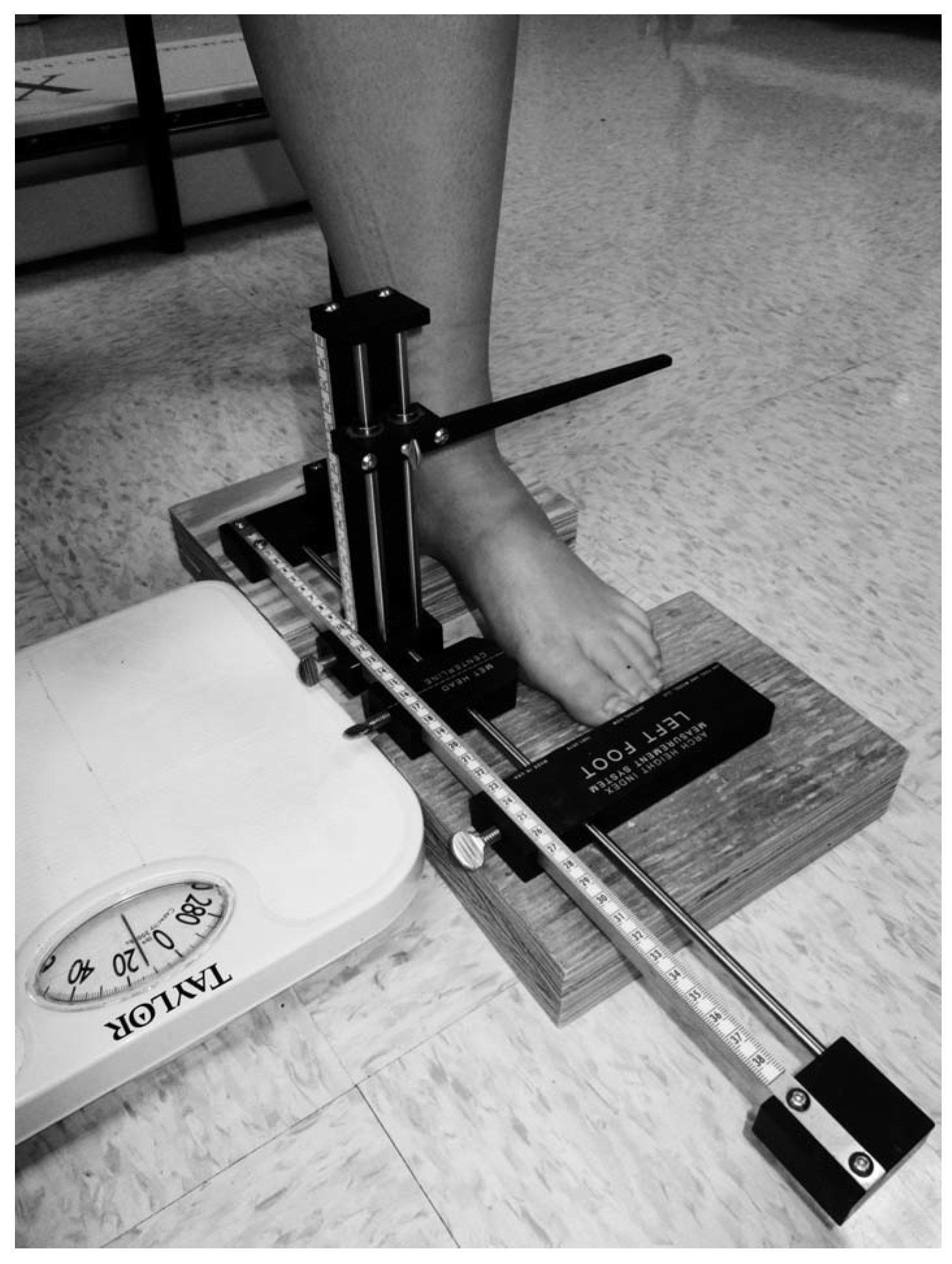
At the first visit, West Virginia University institutional review board–approved written informed consent was obtained from each participant. Participants wore their own tight-fitting clothing and were barefoot. Weight was assessed using an analogue bathroom scale (2020W mechanical rotating dial scale; Taylor Precision Products, Oak Brook, Illinois). The AHI was assessed using calipers (JAK Tool and Model LLC, Matawan, New Jersey) following the protocol of Butler et al[
15] (
Fig. 1). First, with the participant seated, the left foot was placed across two wooden blocks, both 4.5 cm tall, so that the medial longitudinal arch was left unsupported. A goniometer (Lafayette Instruments Co Inc; Lafayette, Indiana) was used to set the ankle at such an angle that there was 120° between the line from the head of the first metatarsal to the medial malleolus and the line from the medial malleolus to the head of the fibula. The right foot was placed on the scale, with a distance of 15 cm between the feet. The calipers were then placed such that the heel cup was against the posterior of the foot, and FL, TFL, and DH were recorded. Then, the individual was asked to stand, and the scale was checked to ensure that the subject was standing with half her body weight on each foot. Again, FL, TFL, and DH were recorded. The AHI measurement using calipers has been found to have an intrarater reliability of 0.87 to 0.92.[
10,
13]
Figure 1.
Caliper method of arch height index assessment.
Figure 1.
Caliper method of arch height index assessment.
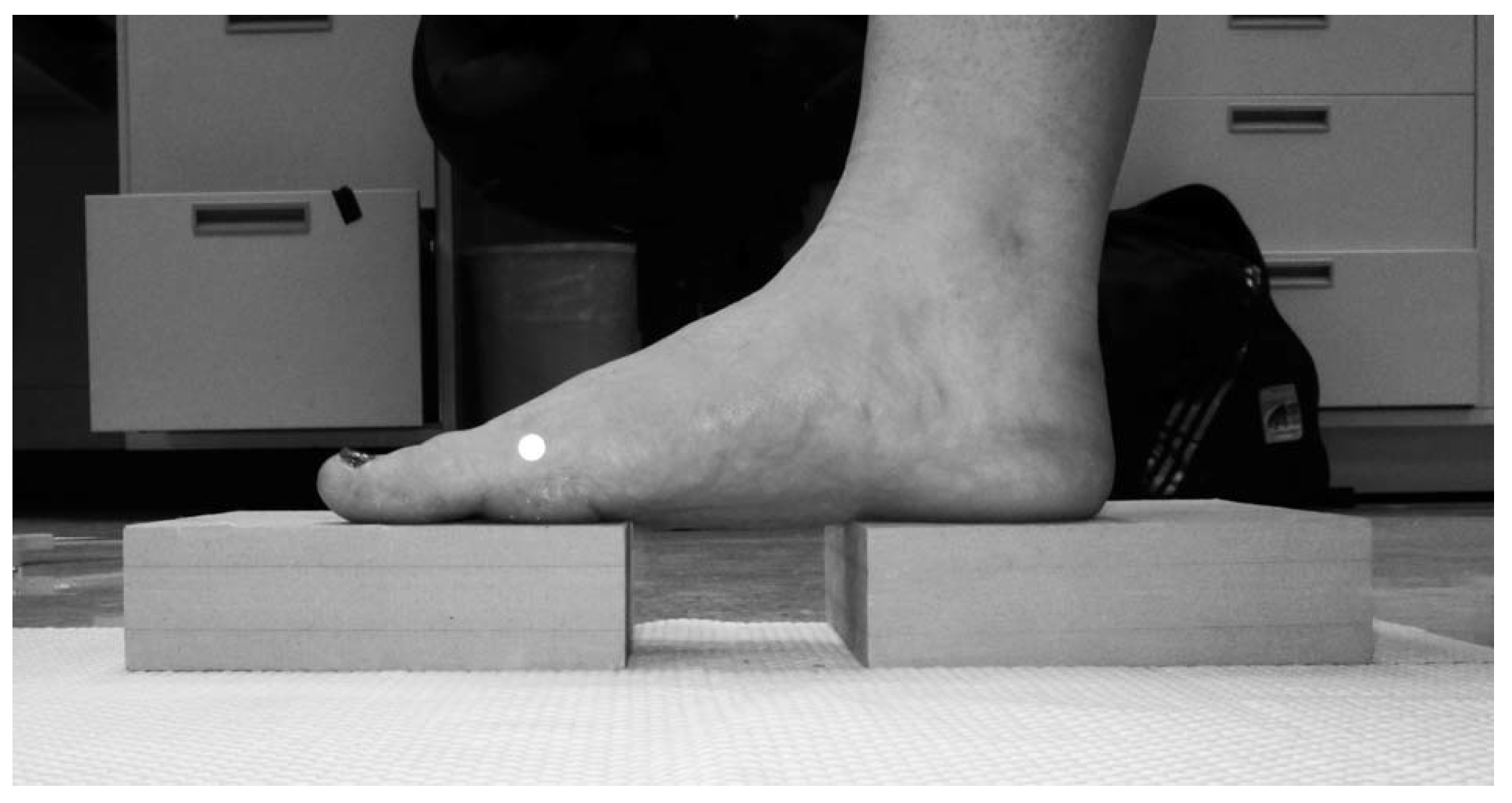
Next, photographs were taken according to the methods of Pohl and Farr (
Fig. 2).[
10] The left foot remained on the wooden blocks, with the medial border of the foot aligned with the edge of the block. The right foot rested on the scale slightly behind the left foot so as not to obstruct the photograph. A digital camera (PowerShot A2300; Canon, Tokyo, Japan) was placed on a block 4 cm high, 55 cm from the medial border of the foot and 10 cm anterior to the rear of the foot. A reflective marker was placed over the head of the first metatarsal of the left foot, and a photograph was taken of the foot. The images were uploaded onto a personal computer and were processed using ImageJ software (National Institutes of Health, Bethesda, Maryland). The TFL and FH were recorded in units of pixels. The photogrammetry method of AHI calculation has been found to have an intrarater reliability of 0.88 to 0.94.[
10] The setup was then reversed to take measurements of the right foot. This gave a total of 20 pregnant feet and 20 control feet. All of the measurements for this study were made by the same tester (K.H.).
Figure 2.
Digital photogrammetry method of arch height index assessment.
Figure 2.
Digital photogrammetry method of arch height index assessment.
Statistics
Statistical analysis was performed for all groups using a statistical software program (IBM SPSS Statistics for Windows; IBM Corp, Armonk, New York). Mixed model absolute agreement type intraclass correlation coefficient (ICC) was used to determine correlation between the two methods for sitting and standing AHI.[
16] The ICC values were classified based on value ranges from Portney and Watkins,[
16] where 0.75 or less is poor-to-moderate reliability, greater than 0.75 is good reliablity, and greater than 0.90 is reasonable reliablity for clinical measures.
Results
The AHI values for all of the groups and time points are listed in
Table 2. Absolute ICCs between the photogrammetry and caliper methods across all of the participants, including controls and pregnant women at all of the time points, were reasonable for sitting AHI (0.908) and moderate for standing AHI (0.708). For the control group only, ICCs were reasonable for sitting AHI (0.819) and moderate for standing AHI (0.674). Likewise, for the pregnant group across all of the time points, ICCs were reasonable for sitting AHI (0.929) and moderate for standing AHI (0.647). The ICC measures for sitting AHI remained in the reasonable range at each time point of measurements in the pregnant group, including second trimester (0.927), third trimester (0.968), and postpartum (0.955). The ICCs were moderate for standing AHI in the second trimester (0.759), third trimester (0.694), and postpartum (0.789).
Table 2.
Arch Height Index (AHI) Values Obtained by the Caliper and Photogrammetry Methods.
Table 2.
Arch Height Index (AHI) Values Obtained by the Caliper and Photogrammetry Methods.
Discussion
This study examined the relationship between AHI measurements obtained during pregnancy via the caliper method and the photogrammetry method. It was hypothesized that results from the caliper and photogrammetry methods of AHI assessment were highly correlated in control, second trimester, and postpartum participants, but that in third trimester participants correlation is weaker due to swelling skewing the results. This hypothesis was not supported because the strength of the correlation was similar across all groups, including third trimester participants. However, in all of the groups, the absolute correlation between methods for standing AHI (0.674–0.789) did not reach the level considered reasonable for clinical use (0.90), as defined by Portney and Watkins.[
16] This is likely due to the fact that although measures from the two methods followed similar patterns, the photogrammetry method produced greater values, especially in the standing posture (
Table 2). The standard error of the photogrammetry method relative to the caliper method was 1.1% for sitting versus 5.7% for standing AHI. It is possible that standing values show a greater difference because standing for the photogrammetry method requires a different stance, with the foot not being measured positioned behind the foot being measured, so as not to obstruct the view of the camera. When correlations were assessed using a consistency correlation[
17] across all of the participants, the relationship was stronger (0.883) and very near the value considered clinically acceptable.
These results are supported by those of Pohl and Farr,[
10] who concluded that in a nonpregnant population, the photogrammetry method was reliable compared with the caliper method. This study also found that results were not directly comparable because values from the photogrammetry method were generally higher than those assessed via calipers (mean ± SD: 0.384 ± 0.023 versus 0.375 ± 0.020 for sitting AHI and 0.361 ± 0.025 versus 0.345 ± 0.025 for standing AHI). Therefore, although the photogrammetry method is concurrently valid with the caliper method for sitting AHI only, the photogrammetry method shows high correlation using a consistency model. This means that although the two methods do not produce the same values, they do rank individuals in the same order.[
17] Thus, the photogrammetry method may still be an effective tool, but clinicians cannot directly compare measures between methods.
In a pregnant population, an association between changes in foot shape and structure and lower-extremity and foot pain has not yet been investigated. However, runners with stage I posterior-tibial tendon dysfunction exhibit lower seated AHI than controls.[
18] This difference is of interest when considering whether changes in AHI during pregnancy might influence musculoskeletal pain and injury. In that case, the photogrammetry method of AHI assessment may be an appopriate and readily available tool for investigation into the relationship between changes in foot structure and musculoskeletal pain during pregnancy.
There are a few limitations to the present study. First, we were unable to determine actual arch height. This would require an imaging technique, such as radiography or ultrasound. However, the ratio of DH to TFL has been found to be valid compared with arch height measured by radiography (ICC 10% weightbearing = 0.844, ICC 90% weightbearing = 0.851).[
13] Second, although the photogrammetry method requires equipment that is less expensive and more widely available, it requires more time to process results, and this trade-off should be considered in determining the most appropriate tool in each setting. Finally, we made the assumption that the caliper method is unaffected by swelling and, therefore, is an appropriate standard by which to compare the photogrammetry method. However, it is possible that the caliper method is also affected by swelling.
Conclusions
The photogrammetry method of AHI assessment is concurrently valid with the caliper method only when measuring sitting AHI in pregnant women. It may still be an effective tool for standing AHI assessment in pregnant women because it has higher consistency correlation with the caliper method. However, clinicians should not directly compare values obtained by the photogrammetry and caliper methods. Future research should determine the relationship between AHI and the musculoskeletal health of pregnant women, who are prone to alterations in AHI.