Next Article in Journal
What is the Standard of Treatment for Plantar Psoriasis?
Previous Article in Journal
The Effect of Variable Lower Extremity Immobilization Devices on Emergency Brake Response Driving Outcomes
 
 
Journal of the American Podiatric Medical Association is published by MDPI from Volume 116 Issue 1 (2026). Previous articles were published by another publisher in Open Access under a CC-BY (or CC-BY-NC-ND) licence, and they are hosted by MDPI on mdpi.com as a courtesy and upon agreement with American Podiatric Medical Association.
Article

Impact of Arch Height Flexibility on Dynamic Plantar Pressure in Healthy Young Subjects with Planus Feet

by
Jinsup Song
1,
Kersti Choe
1,
Michael Neary
2,
Rebecca A. Zifchock
2,
Kenneth Cameron
2,
Michael Trepal
3,
Marian Hannon
4 and
Howard J. Hilstrom
5
1
Temple University School of Podiatric Medicine, Philadelphia, Pennsylvania, USA
2
United States Military Academy (USMA), West Point, New York, NY, USA
3
New York College of Podiatric Medicine, 53 E 124th St., New York, NY 10035, USA
4
Institute for Aging Research, Hebrew SeniorLife, 1200 Center St., Boston, MA 02131, USA
5
Hospital for Special Surgery, New York, New York, USA
J. Am. Podiatr. Med. Assoc. 2016, 106(sp1), 7; https://doi.org/10.7547/8750-7315-2016.1.song

Published: 1 January 2016

INTRODUCTION

Healthy feet are important for health and well-being. Previous studies of 2,994 subjects (65.5 y) showed that those with pes planus had an increased odds of having foot deformities, hyperpronation in gait, and lower outcomes.[1]
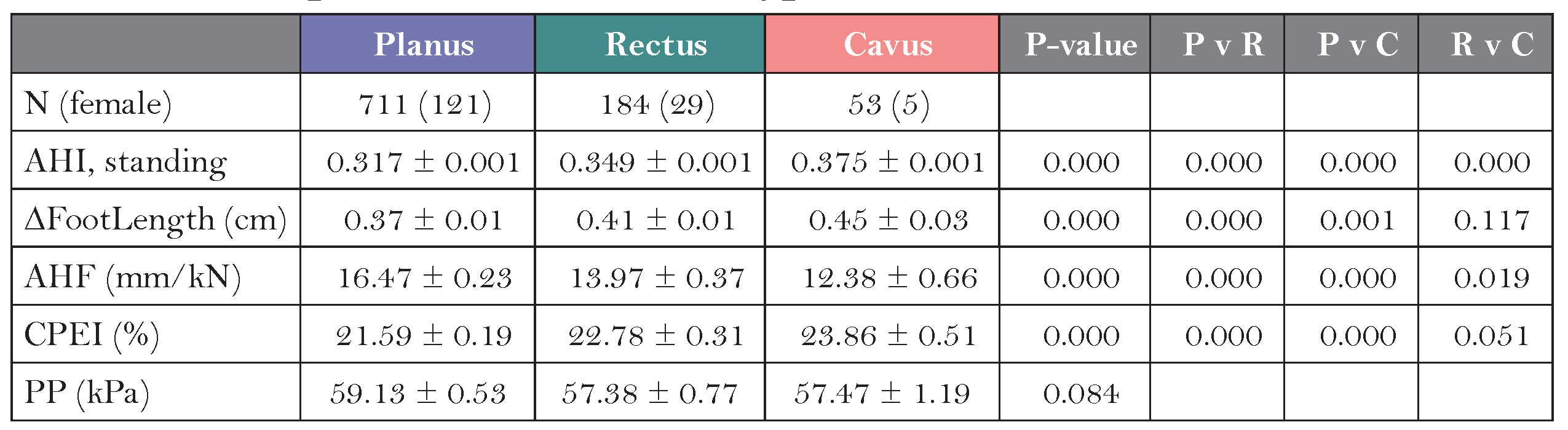
The investigators assessed foot structure, function, and arch height flexibility (AHF) in 1, 090 cadets of the USMA who volunteered for the study at the beginning of basic training. Prevalence of pes planus, based on standing arch height index (AHI), was 73.4% overall [2]. Planus feet demonstrated greater AHF, hyper-pronation (reduced center of pressure excursion index, CPEI), and smaller foot elongation compared to rectus and cavus foot types, see Table 1. Flexible feet displayed a significantly greater pronatory foot posture (lower AHI), greater flexibility (larger foot elongation), and greater amount of pronation in gait (lower CPEI) than those feet with referent and stiff arches.
The purpose of this study was to elucidate the complex relationship between foot function and flexibility while controlling for foot structure.
Table 1. Comparsion across 3 foot types.
Japma 106 00007 i001
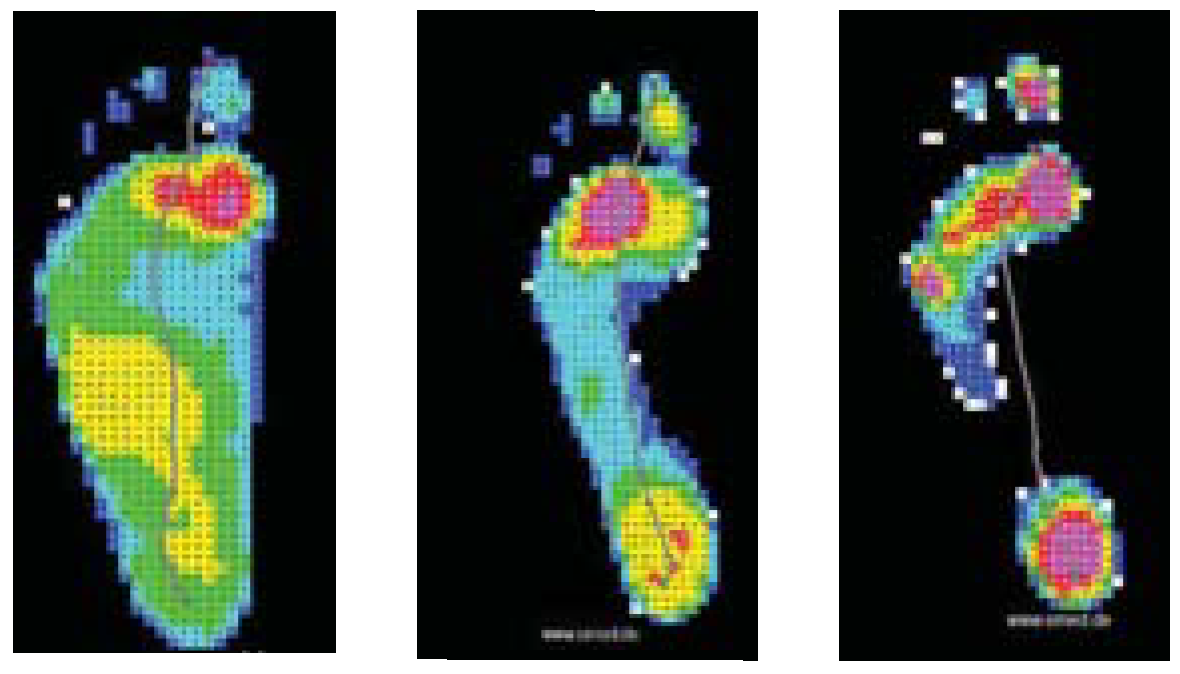
Figure 1. A sample dynamic plantar pressure for the planus, rectus, and cavus foot types are shown from left to right.
Japma 106 00007 g001

METHODS

Of the 1,090 USMA cadets (172 female, 18.5 ± 1.1 years, 24.5 ± 3.0 kg/m2 ), 1,414 planus feet were included in the analysis.
AHI (arch height at half the foot length / truncated foot length) and AHF (arch drop from sitting to standing in mm/40% of body weight in kN) were measured using arch height index measurement system (AHIMS, JAK Tool, Cranbury Township). AHF is stratified into 3 categories: largest quintile as flexible, middle 3 quintiles as referent, and smallest quintile as stiff. Gross foot structure was categorized into one of three foot types (planus, rectus, and cavus), based on the standing arch height index (AHI)[2].
Japma 106 00007 i002
Dynamic foot function was assessed using emed-X (novel GmbH, Munich) with 4 sensors/cm2 at 100 Hz, utilizing the two-step method during comfortablepace walking. Five trials of barefoot dynamic plantar pressure were obtained for each foot The Center of Pressure Excursion Index (CPEI, %) and Peak Pressure (PP, kPA) were calculated for each trial.
Generalized Linear Model with an identify link function was used to examine the effects of AHF category while accounting for potential dependence in bilateral data. The Wald Chi-square was calculated for each dependent variable with significance set at p < 0.05. Post hoc pairwise comparisons for all pairs were performed using the Generalized Chi Square test at P < 0.05.
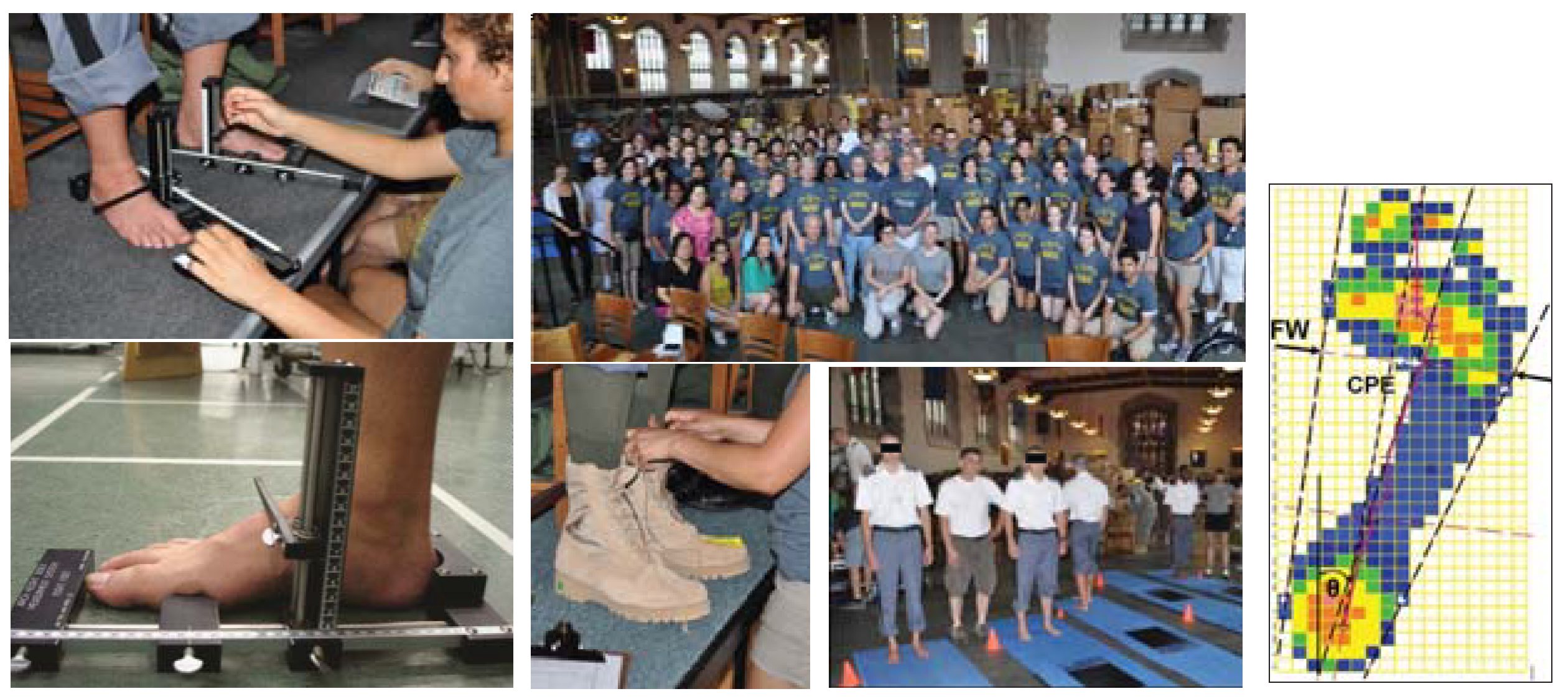
Figure 1. Arch height index (AHI) and arch height flexibility (AHF) were measured using the AHIMS (left). Dynamic plantar pressure was measured using novel emed-X system while subjects walked at self-selected comfortable speed (right). CPEI was used to quantify the plantar loading profile of each footprint; reduced CPEI is associated with hyper-pronation.
Japma 106 00007 g002

RESULTS

Those subjects with planus foot type with increased arch flexibility showed greater hyperpronation (reduced CPEI) while those planus feet with increased stiffness showed increased peak pressure in gait.
Table 2. Comparsion across 3 AHF categories in subjects with pes.
Japma 106 00007 i003

DISCUSSION

A significant difference (P<0.05) was shown in CPEI and PP. Results suggest that, in addition to foot structure (AHI), the arch flexibility may affect dynamic foot function.
This study includes a comprehensive measure of foot structure, function, and flexibility in a large sample of healthy active young subjects.
Lower extremity overuse injuries are common and costly problem. About a third of all (55.6% of female) USMA cadets experienced a lower extremity musculoskeletal injury by the end of their first year of training.
Identifying potentially modifiable risk factors for subsequent lower extremity injury incidence, based on a set of comprehensive measures of foot as well injury history, is expected to assist in the development of effective injury preventive measures.

Acknowledgments

Volunteers from the New York College of Podiatric Medicine, Temple University School of Podiatric Medicine, Hospital for Special Surgery, and novel GmbH were instrumental in the data collection. We also appreciate the study particpants and support of the United States Military Academy.

References

  1. Hagedorn, T.J.; Dufour, A.B.; Golightly, Y.M.; Riskowski, J.L.; Hillstrom, H.J.; Casey, V.A.; et al. Factors affecting center of pressure in older adults: the Framingham Foot Study. Journal of foot and ankle research 2013, 6, 18. [Google Scholar] [CrossRef]
  2. Hillstrom, H.J.; Song, J.; Kraszewski, A.P.; Hafer, J.F.; Moontanah, R.; Dufour, A.B.; Chow, B.S.; Deland, J.T. Foot type biomechanics part 1: structure and function of the asymptomatic foot. Gait Posture 2013, 37, 445–51. [Google Scholar] [CrossRef] [PubMed]
  3. Song, J.; Choe, K.; Neary, M.; Zifchock, R.; Cameron, K.; Trepal, M.; Hannon, M.; Hillstrom, H. Differences in foot structure, function, and flexibility in USMA cadets across race and gender, Gait and Posture, in review.