Rapidly changing patient demographic characteristics in the United States is an issue demanding more and more attention. Although the overall population of the United States continues to grow, there has been an extraordinary population increase in ethnic minorities in recent years. Asian, Hispanic, and African American populations have had the most significant increase. From 2000 to 2010, the Asian population grew by 43.3%, the Hispanic population by 43.0% , and the African American population by 12.3%.[
1,
2] During the same time, the white population grew only 5.7%.[
1,
2] The US Census Bureau predicts that by 2050, the Hispanic and Asian populations will double and the African American population will increase by another 35%.[
3] The US Department of Commerce estimates that ethnic minorities will account for 90% of the total population growth by the year 2050.[
4]
It is clear that the US population is becoming more diverse, and as the ethnic background of the US population becomes more diverse, so do the cultures that make up the population. The expansion of cultural diversity introduces many challenges into today's society, especially for those less proficient in English and whose religions and customs represent unfamiliar beliefs.[
5] These challenges are present in every aspect of our society, including health care. Cultural differences have created barriers between patients and their medical providers and have led to health-care disparities.[
5] The recent changes in demographic characteristics have increased awareness of the health disparities in minority populations in the medical world. With census projections suggesting greater changes in the future, health-care providers must make improvements in minority patient care to better serve the needs of the changing population.[
5]
Overwhelming research results show how rampant health disparities are in the United States. Health disparity, as defined by the US Department of Health and Human Services (DHHS), is a difference in health in persons who have experienced obstacles in getting appropriate health-care based on their racial or ethnic group, religion, socioeconomic status, sex, age, or other characteristics historically linked to discrimination or exclusion.[
6] In 2002, the Institute of Medicine (IOM) extensively reviewed the literature examining health disparities. The IOM report suggests that racial and ethnic minorities have an increased risk of disease and have decreased access to quality health care.[
7] The report documents staggering differences in treatments and outcomes across many chronic disease categories, including heart disease, stroke, cancer, human immunodeficiency virus/acquired immunodeficiency syndrome, respiratory illness, diabetes, and more.
There have been many suggestions as to why these disparities exist. Minority populations face a higher rate of poverty and are less likely to be insured.[
8,
9] Some authors attribute lower-quality health care in minority populations to their lower socioeconomic status.[
7-
9] Low-income families often visit public clinics, which, with the rising cost of health care, are quickly becoming overwhelmed.[
10] Busier clinics have less time for patient-doctor interaction, rushed visits, and, ultimately, a lower quality of care.[
8,
10] Furthermore, when socioeconomic status is adjusted for, minority patients still report lower-quality care and a higher amount of mistrust in their doctor. Race and ethnicity, along with socioeconomic status, are still key reasons for lower-quality health care in minority groups. Communication barriers also create problems in health care.[
7,
9] Communication barriers include not only language differences but inherent misconceptions about unfamiliar cultures. These barriers lead to time constraints, misunderstandings, and misdiagnoses.[
7,
9,
11,
12] Problems have also been linked to medical research because many clinical trials have included predominantly white paticipants.[
9] The subsequent procedures are then used throughout all racial and ethnic groups.[
9] This leads to complications because not all racial and ethnic groups respond to treatments in the same way, whether the response is biological or social.[
9] Poor patient outcomes are further aggravated because unsatisfied patients are less likely to be compliant and are more likely to delay medical treatment.[
10] Improving the quality of minority patient visits and experiences will enhance health-care outcomes in these patients and help reduce minority patient health disparities.[
13]
In November 2000, in an attempt to improve health care in the United States, Healthy People 2010 was published by the DHHS. Healthy People 2010 was a nationwide health promotion program with two specific goals: to increase the quality and years of healthy life and to eliminate health disparities.[
14] After completion and evaluation of the initiative, the DHHS recently published Healthy People 2020 with expanded goals. Not only are they striving to increase the quality of life and eliminate health disparities, but their goals are to achieve health equity and improve the general health of all groups.[
15] To eliminate health disparities, it is critical to understand how patients' ethnicities guide patient visits and, ultimately, patient outcomes.[
7,
16] To achieve this understanding, health-care professionals need to become more culturally competent.[
7,
13]
In 1989, Cross et al[
17] defined cultural competency as a set of congruent behaviors, attitudes, and policies that come together to enable a system, agency, or set of professionals to work effectively in cross-cultural situations. To better understand cultural competence, they provided a continuum that defined six stages of cultural competency.[
17] The Cross model describes cultural competence with reference to a system or agency, but it can be adapted to better describe cultural competence at an individual level.
Table 1 provides the modified continuum of the Cross model. Cultural competence is not only having an understanding of other cultures but also being aware of how one's own beliefs and assumptions may interfere with the relationships people have. It emphasizes three critical elements in their model of cultural competence: 1) attitudinal self-awareness, 2) culture-specific knowledge, and 3) skills that promote effective sociocultural interactions by an individual. This model has been widely cited and used as the conceptual framework for cultural competence. Cultural competence is a developmental process that can be accomplished only over time.[
17] It also stated that there is always room for growth and further development in cultural competency, and individuals should strive to progress through the stages of cultural competence, with “cultural proficiency” being their ultimate goal.[
17] Failure of health-care professionals to possess cultural competency is a key reason for health-care disparities.[
7] Many health-care professionals are recognizing this and are making cultural competency a goal in their practices.
Table 1.
Cross Continuum of Cultural Competency.
Table 1.
Cross Continuum of Cultural Competency.
Medical education lacks adequate training on the subject of cultural competency.[
18,
19] Medical schools in the United States, Canada, and the United Kingdom require cultural competency to be addressed; however, the schools are allowed to determine their own methods and format for diversity education.[
18] Medical education governing bodies need to clearly state their expectations on medical schools' understanding of cultural competency.[
18] There needs to be guidelines for implementing and delivering cultural competency courses to create consistency throughout the medical field.[
18,
19]
Leaders in podiatric medicine are now calling for changes in podiatric medical education. The Council on Podiatric Medical Education (CPME) encourages the incorporation of cultural competency subject matter into the curriculum at the colleges of podiatric medicine.[
20] The CPME also states that colleges must use the eight core components of podiatric medicine competence in curriculum planning that were developed by the Council of Deans of the American Association of Colleges of Podiatric Medicine.[
20] One of the core components includes practicing with professionalism, compassion, and concern and in an ethical manner regardless of the patient's social class, sex, or racial/ethnic background.[
20] Recognizing the need for diversity education, Des Moines University College of Podiatric Medicine and Surgery (CPMS) decided to integrate cultural competency into its educational curriculum.
Looking at the previous CPMS curriculum, cultural competency had been touched on only in the first 2 years. Physical Diagnosis, Introduction to Podiatry, Geriatrics, and Behavioral Medicine courses each have a lecture discussing the topic for a total of 4 hours of cultural competency education in the curriculum. Students also had opportunities to attend guest speaker presentations, but student attendance was not required. Considering the limited amount of subject volume that the students were exposed to during their first 2 years and recent CPME suggestions, it was decided to design and implement a course dedicated entirely to cultural competency for third-year CPMS students.
Many studies were reviewed to determine the most effective way to implement the cultural competency course. We could not find any literature relating cultural competency to podiatric medical education. Examination of studies related to cultural competency in the medical, dental, and nursing literature proved to be beneficial. It would have been a challenge to create and administer a lecture-style course in an already tight curriculum, so the course was delivered online. A study by Pilcher et al[
21] suggested that video training along with group discussion and self-reflection were effective in producing changes in students' awareness about cultural competency. Its goal was to improve the quality of cultural competency education in podiatric medicine by introducing a cultural competency course design for podiatric medical education.
The objectives of this report were to describe the process and materials used to develop a cultural competency course for podiatric medical education, assess the effectiveness of the new educational program, and make recommendations for improvement. We used two outcome measures to assess the effectiveness of the program: knowledge acquisition and attitudinal change, each measured according to a survey developed by Pilcher et al.[
21] We expect that taking the course will have a positive effect on students' knowledge acquisition and attitudinal change related to cultural competency.
Methods
The CPMS's cultural competency course is a 10-week online course consisting of a variety of activities, including four videos from the Worlds Apart series, online group discussions, and a self-reflective essay. Students have 1 week to view each short video in case study format[
22] and post responses to three questions related to that video on the school Web site discussion board under their assigned group. Students then have 1 week to discuss their group's posts for that video. This process continues until all four videos have been viewed and discussed. Students then have 1 week to review the Worlds Apart Facilitators Guide and post a self-reflective essay discussing how their views of cultural competency have changed since going through the online program.[
22] Students then have 1 week to discuss the essays of group members. The course schedule is listed in
Table 2.
Table 2.
Cultural Competency Course Schedule.
Table 2.
Cultural Competency Course Schedule.
Before administering the course, a formal evaluation was developed to assess the course's effectiveness. Pilcher et al[
21] adapted a survey created by Management Sciences for Health (Medford, Massachusetts) to be administered to students before and after the course. The pretest and posttest surveys were identical to allow for score comparison. The survey consisted of 25 questions. It was designed to evaluate two of the three critical elements that Cross et al[
17] emphasized in their article: attitudinal self-awareness and culture-specific knowledge. According to Pilcher et al,[
21] the first 21 questions tested knowledge acquisition of various cultural elements. These questions were multiple choice or true/false and were scored 4 points for a correct answer and 0 points for an incorrect answer, for a total of 84 points. The last four questions measured attitudinal self-report of cultural awareness. These four questions were scored on 4-point scales. The two cultural knowledge questions used a 4-point scale of “not knowledgeable” to “very knowledgeable,” and the cultural awareness questions used a 4-point scale ranging from “not aware” to “very aware.” This technique was used following the results of Pilcher et al's study, which suggested that the course produced changes in students' knowledge levels regarding cultural competency.[
21,
24]
The CPMS administered the 10-week course to the students in the graduating class of 2013. The class of 2014 did not take the course. With permission from Pilcher et al, their cultural competency assessment survey was administered to the students of the 2013 and 2014 DPM classes. The 2013 students completed the pretest before the 10-week course and the posttest after completing the course. The 2014 students completed the same pretest, did not take the course, and then were given the same posttest 10 weeks later. The survey questions were categorized to assess either knowledge acquisition or attitudinal change. The results from 42 students in the 2013 class and 37 students in the 2014 class were collected and organized into a Microsoft Excel worksheet (Microsoft Corp, Redmond, Washington). The results were analyzed using a statistical software package (IBM SPSS Statistics for Windows, version 19.0; IBM Corp, Armonk, New York). A repeated-measures analysis of variance was used to evaluate changes in the data because this allowed comparison of two sample groups over time. The analysis compared the knowledge acquisition scores, attitudinal change scores, and overall scores of the two classes. These results were analyzed to examine changes in students' levels of cultural competency.
This study was approved by the Des Moines University institutional review board. All of the course data were deidentified by the course instructor before analysis. Survey data were anonymous.
Results
The scores on the first 21 pretest and posttest questions were averaged to create a composite index for knowledge acquisition. The scores on the last four pretest and posttest questions were averaged to create a composite index of attitudinal change. The mean scores are given in
Table 3.
Table 3.
Pretest and Posttest Scores.
Table 3.
Pretest and Posttest Scores.
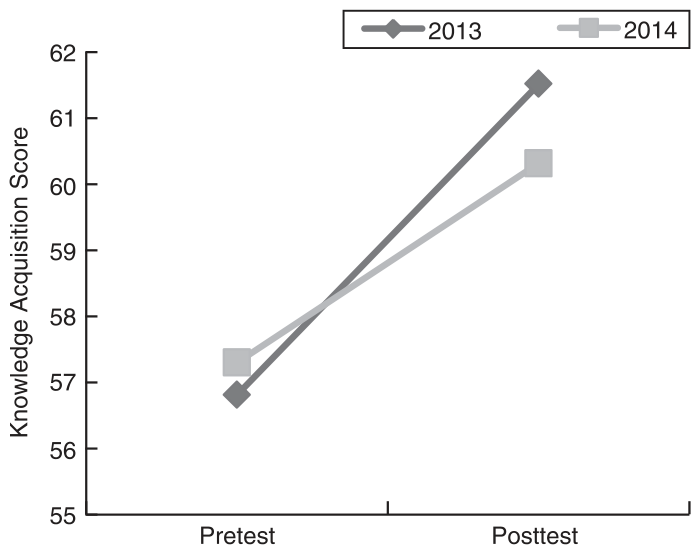
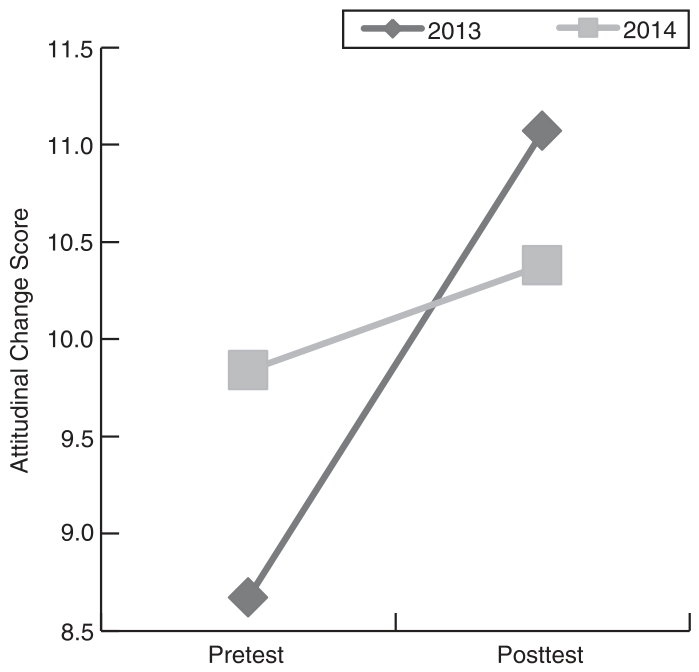
Mean scores increased in both study groups. The class that took the cultural competency course (2013) had an increase in mean knowledge acquisition scores of 4.71 points and an increase in mean attitudinal change scores of 2.4 points. The class that did not take the cultural competency course (2014) had an increase in mean knowledge acquisition scores of 3.02 points and an increase in mean attitudinal change scores of 0.54 points. The scores were evaluated for statistical significance to determine whether the change in scores could be attributed to taking the cultural competency course.
The statistical significance of the changes (differences) between the pretest and posttest scores were evaluated using a within-subjects analysis of variance. To perform this evaluation, the general linear model approach was used in which the pretest and posttest scores represented the within-subjects factor and the class year or cohort represented the between-subjects factor.
Table 4 examines the effect of the cultural competency training experience on knowledge acquisition as a dependent variable. Students in both groups experienced a significant improvement from pretest to posttest scores (F(1,77) = 15.1;
P < .001). However, there was no significant difference in the magnitude of change in the scores of the two groups, as represented by the first-order interaction between knowledge acquisition and class year/cohort (F(1,77) = 0.72;
P > .05). Thus, we conclude that taking the 10-week cultural competency course did not make a significance difference in terms of improvement in knowledge acquisition scores.
Table 4.
Knowledge Acquisition Analysis of Variance.
Table 4.
Knowledge Acquisition Analysis of Variance.
Table 5 examines the effect of the cultural competency training experience on attitudinal change as a dependent variable. This analysis also showed that both student groups experienced a significant improvement from pretest to posttest scores (F(1,77) = 38.1;
P < .001). In addition, it showed a significant difference in change of scores relating to taking the 10-week cultural competency course (F(1,77) = 15.2;
P < .001). Hence, in this case, we conclude that although both student groups showed improved attitudinal change scores, students who took the 10-week cultural competency course had a statistically significant improvement in their test scores compared with the group that did not take the course. The profile plot line graphs of scores and the patterns of the detected changes are depicted in
Figs. 1 and
2.
Table 5.
Attitudinal Change Analysis of Variance.
Table 5.
Attitudinal Change Analysis of Variance.
Figure 1.
Knowledge profile plot line graph showing estimated marginal mean scores.
Figure 1.
Knowledge profile plot line graph showing estimated marginal mean scores.
Figure 2.
Attitudinal profile plot line graph showing estimated marginal mean scores.
Figure 2.
Attitudinal profile plot line graph showing estimated marginal mean scores.
Discussion
The present study provides evidence that administering cultural competency training as a stand-alone didactic course in podiatric medical education has academic value. Similar to the study by Pilcher et al,[
21] the present findings suggest that taking a course in cultural competency produces changes in students' attitudinal self-awareness relating to cultural competence.[
21]
The skills learned in a course such as this can help promote cooperation and communication, improve clinical diagnosis and management, avoid cultural blindness and unnecessary medical testing, and lead to a deeper understanding between patient and physician.[
23] Along with completing the pretests and posttests, each student was asked to complete a self-reflection essay and a postcourse evaluation after finishing the course. Self-reflection, along with encouraging critical thinking and enhancing student learning, is an effective way to assess a course from a student's perspective.[
21,
24,
25] Self-reflection papers and postcourse evaluations can be analyzed to explore trends in student responses and reveal strengths and weaknesses in a course.[
24] Further analysis needs to be performed to determine the trends of the students' self-reflective essays and course evaluations for the presented course.
The research presented raises the opportunity for improvements in the cultural competency course provided to third-year podiatric medical students at CPMS. Looking back at the three critical elements of the cultural competence model of Cross et al,[
17] cultural competency training should be aimed at improving attitudinal self-awareness, culture-specific knowledge, and skills that promote effective sociocultural interactions by an individual. The course design presented herein attempts to address the first two of these three elements. This study shows that the course was a positive experience for the students, but weaknesses were uncovered. It is clear that the course needs to be more effective at delivering information aimed at knowledge acquisition. There are many studies comparing the effectiveness of online education versus traditional classroom education. Yang et al[
26] showed that student effort expenditure and engagement was greater in a traditional face-to-face course. They also highlighted the fact that students show more effort and engagement when the course material is perceived to be more valuable to the student.[
26] Based on this study and others, it is concluded that to improve knowledge acquisition scores, the course should be offered in a traditional classroom setting, or at least a combination of an online and traditional classroom setting. Further studies can assess the efficacy of the changes to the course.