Isolated subtalar arthrodesis is regarded as effective treatment for subtalar joint problems, including osteoarthritis caused by fractures of the calcaneus or talus, isolated subtalar joint instability, talocalcaneal coalition, deformities of the hindfoot, calcaneal facture, and primary or secondary osteoarthritis [
1-
5]. Traditionally, triple arthrodesis has been considered to be favorable for talocalcaneal problems. However, isolated subtalar arthrodesis possesses the advantages of preserved hindfoot motion and limited tarsometatarsal joint stress [
6,
7].
Degeneration has been reported to occur in the ankle and transverse tarsal joints after subtalar arthrodesis [
3]. In the study by Glanzmann and Sanhueza-Hernandez [
8], there was no evidence of degeneration. It is still under debate whether degeneration occurs after subtalar arthrodesis. In addition, the relation between hindfoot height (HH)/talar inclination and ankle motion is still pending [
9,
10]. In this retrospective study, 37 patients with subtalar arthrodesis were followed up. We evaluated clinical outcomes, degenerative joint changes, and ankle and hindfoot function after subtalar arthrodesis.
Materials and Methods
Patients
Between January 1, 1996, and August 31, 2011, 50 patients (33 men and 17 women; mean age, 42.6 years; age range, 13–74 years) underwent isolated subtalar arthrodesis. The pathologic findings leading to subtalar arthrodesis included fracture of the calcaneus (42 patients), talocalcaneal coalition (two patients), calcaneal osteoarthritis (one patient), tarsal sinus syndrome (three patients), and flatfoot (two patients). Patients who simultaneously underwent another arthrodesis or had deformity after surgery were excluded.
Operative Technique
The procedures were carried out with the patients supine, with a thigh tourniquet in place. A horizontal skin incision was centered over the lateral aspect of the hindfoot. The residual cartilages on the surfaces of the subtalar joint were removed with a power saw to create two flat surfaces. Screws were placed through the tuberosity of the calcaneus to the talar body. When necessary, a bone graft was performed. The cast was removed after 4 to 6 weeks, and radiographs were taken.
Method
All of the patients provided written informed consent. The Medical Outcomes Study 36-item Short Form Health Survey and the American Orthopaedic Foot and Ankle Society rating system were used for preoperative and postoperative evaluations [
11]. The 6 points for subtalar motion were not assigned; therefore, a postoperative score of 94 of 100 was regarded as the maximum possible score. The physical examination focused on pain at the ankle and hindfoot.
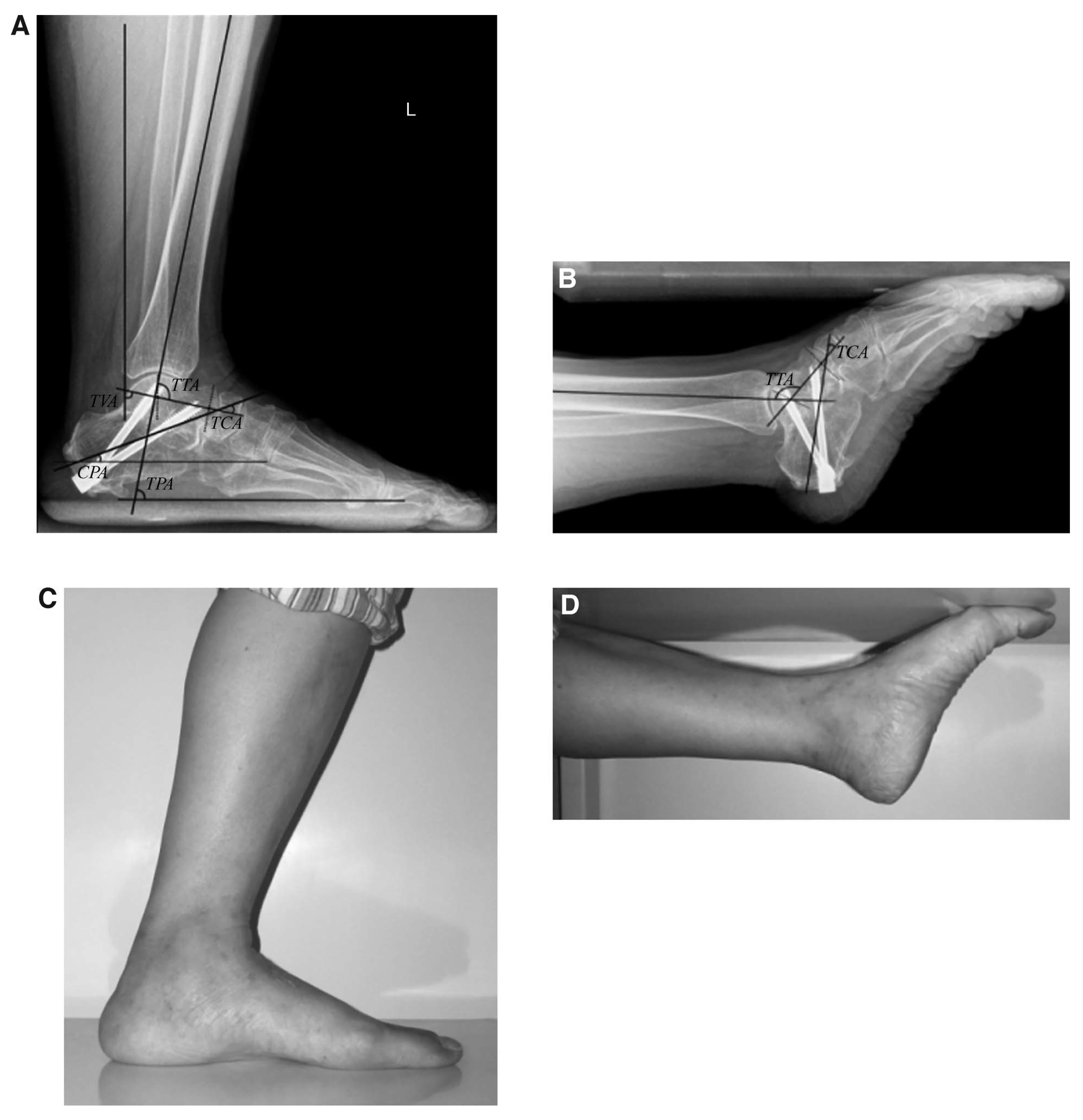
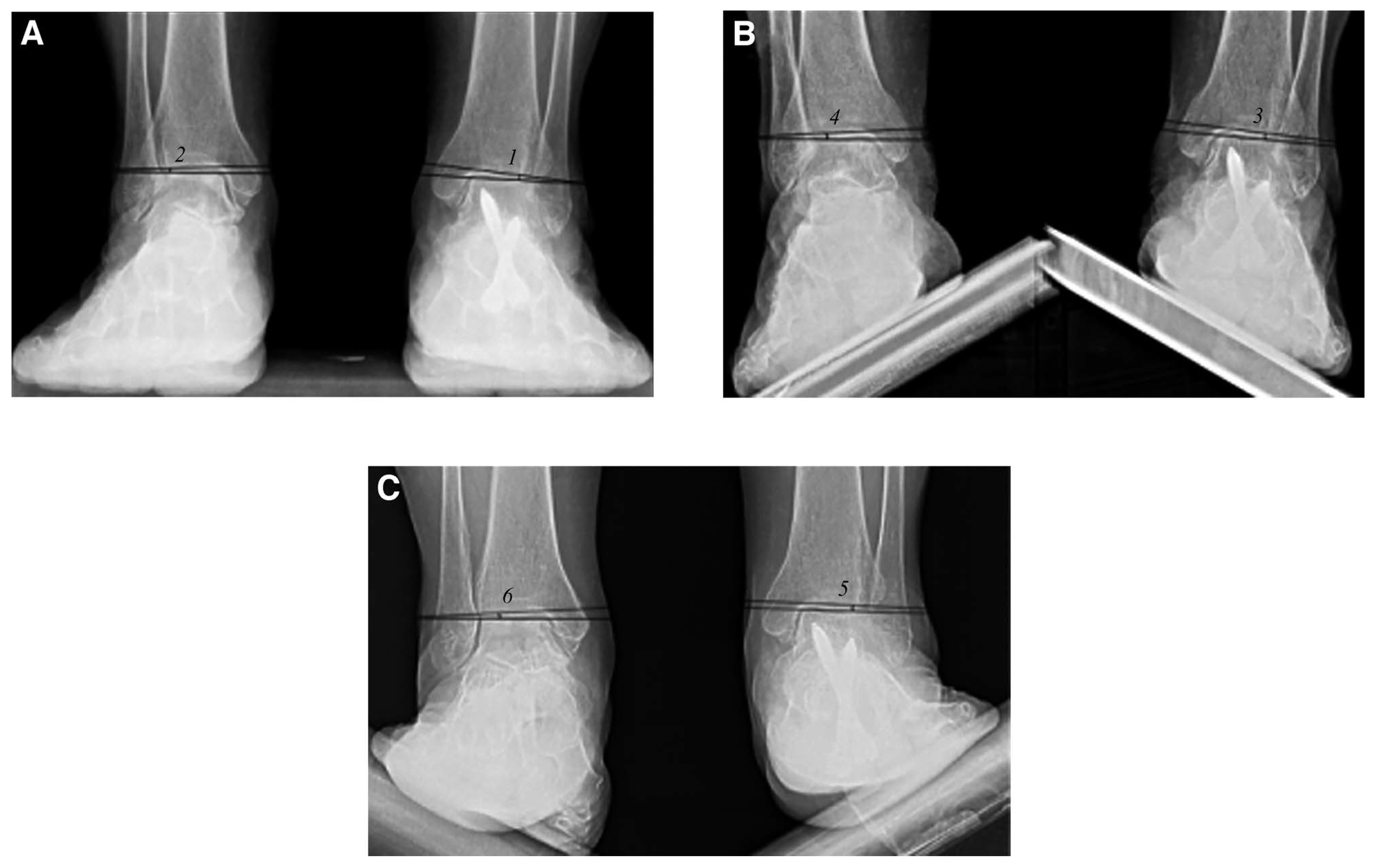
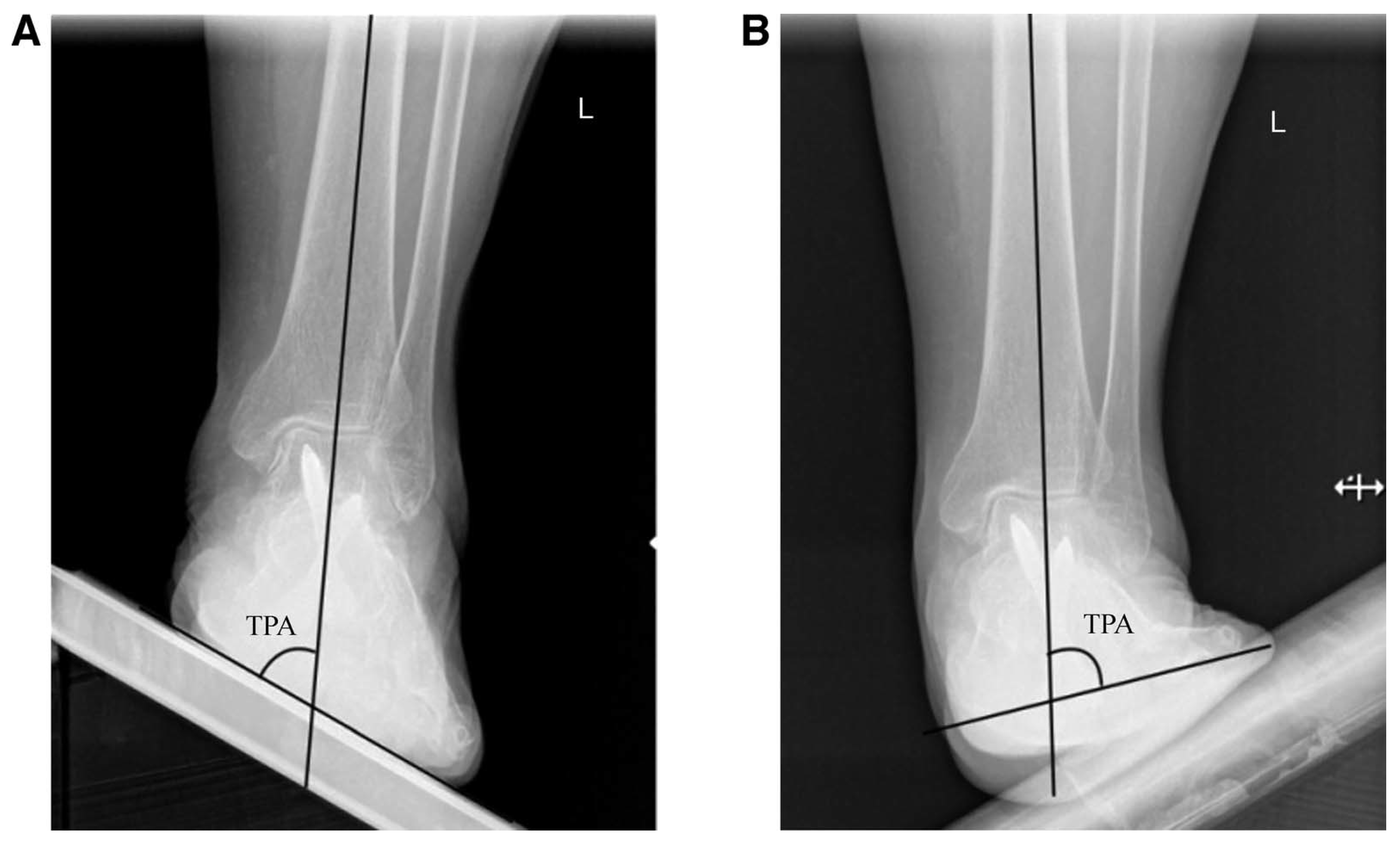
Radiographs taken at the final follow-up visit included anteroposterior radiographs of the foot and ankle, Mortise's ankle radiographs, inversion and eversion radiographs, and dorsoplantar radiographs of the foot. The following parameters were assessed: tibiotalar angle, talar-vertical angle (TVA), talocalcaneal angle, tibial-plantar minimal angle (TPA), calcaneoplantar angle (CPA), HH, and tibiotalar tilt angle (TTTA) (
Figure 1,
Figure 2 and
Figure 3). The position of the plantar surface was revealed by the ligature between the first and fifth metatarsal heads. All of the angles were measured by PACS (Picture Archiving and Communication Systems) system UniWeb Viewer 6.1 software (EBM Technologies, Honolulu, Hawaii).
Figure 1.
Lateral radiographs of the ankle joint of a patient with subtalar arthrodesis in maximum dorsiflexion (A) and maximum plantarflexion (B). A patient with the ankle joint in maximum dorsiflexion (C) and maximum plantarflexion (D). CPA, calcaneoplantar angle; TCA, talocalcaneal angle; TPA, tibial-plantar minimal angle; TTA, tibiotalar angle; TVA, talar-vertical angle.
Figure 1.
Lateral radiographs of the ankle joint of a patient with subtalar arthrodesis in maximum dorsiflexion (A) and maximum plantarflexion (B). A patient with the ankle joint in maximum dorsiflexion (C) and maximum plantarflexion (D). CPA, calcaneoplantar angle; TCA, talocalcaneal angle; TPA, tibial-plantar minimal angle; TTA, tibiotalar angle; TVA, talar-vertical angle.
Figure 2.
Anteroposterior radiographs of the ankle joint in the neutral position (A), 30° of inversion (B), and 30° of eversion (C). Angles 1, 3, and 5 represent the tibiotalar tilt angles (TTTAs) of the affected side in the neutral position, 30° of inversion, and 30° of eversion, respectively. Angles 2, 4, and 6 represent the TTTAs of the healthy sides in the neutral position, 30° of inversion and 30° of eversion.
Figure 2.
Anteroposterior radiographs of the ankle joint in the neutral position (A), 30° of inversion (B), and 30° of eversion (C). Angles 1, 3, and 5 represent the tibiotalar tilt angles (TTTAs) of the affected side in the neutral position, 30° of inversion, and 30° of eversion, respectively. Angles 2, 4, and 6 represent the TTTAs of the healthy sides in the neutral position, 30° of inversion and 30° of eversion.
Figure 3.
Radiographs of the tibial-plantar minimal angle (TPA) of the affected and healthy sides in 30° of inversion (A) and 30° of eversion (B) in the frontal plane.
Figure 3.
Radiographs of the tibial-plantar minimal angle (TPA) of the affected and healthy sides in 30° of inversion (A) and 30° of eversion (B) in the frontal plane.
Statistical Analysis
Data are presented as mean ± SD. We used statistical software (IBM SPSS Statistics for Windows, Version 19.0; IBM Corp, Armonk, New York) for data analysis by the t test, analysis of variance, and Pearson correlation analysis. Statistical significance was set at P < .05.
Discussion
Isolated subtalar arthrodesis was commonly used for the treatment of subtalar problems. In this study, 36-item Short Form Health Survey and American Orthopaedic Foot and Ankle Society scores were significantly increased postoperatively. There was evidence of degeneration in the joints, but these changes were not symptomatic. The angle range of motion was correlated with the talar inclination and HH.
Russotti et al. [
12] demonstrated that no degenerative changes were observed in 41 patients with fusion of the talocalcaneal joint. Easley et al. [
3]. reported that there was evidence of degenerative changes in the transverse tarsal joints (15 feet) and ankle (five feet) after isolated subtalar arthrodesis. In the study by Glanzmann and Sanhueza-Hernandez [
8], degeneration in the adjacent joints was observed in only three of 41 patients with arthroscopic subtalar arthrodesis. In this study, there was evidence of degeneration in the talonavicular, calcaneocuboid, metatarsocuboid, and ankle joints after subtalar arthrodesis. However, these changes were observed on radiographs but were not symptomatic.
The subtalar joint allows inversion or eversion of the foot for adaptation in the uneven slope [
13]. The stability of the ankle can be judged by the TTTA in inversion and eversion [
14-
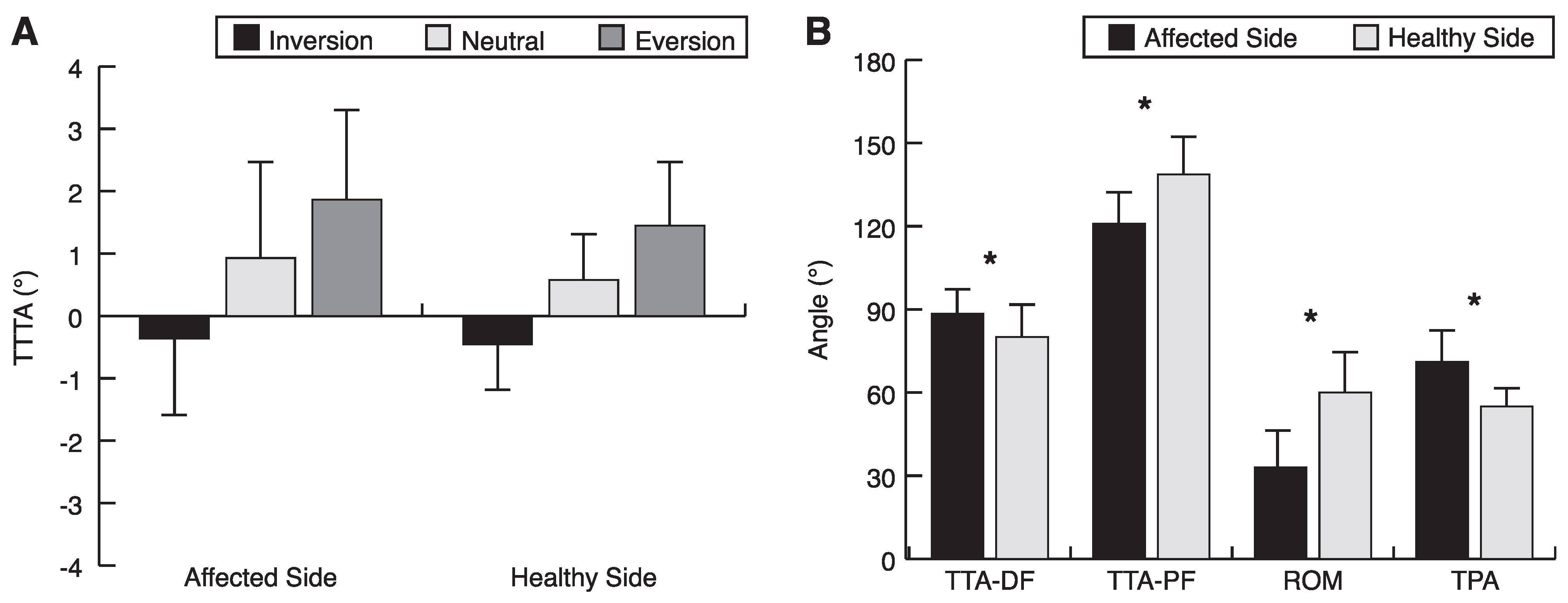
16]. In this study, TTTA changes were less than 3° from 30° of inversion to the neutral position then to 30° eversion, which can be considered good mechanical stability of the ankle. In this study, the TPA of the affected sides was larger than that of the healthy side in inversion and eversion. The results revealed that the inversion and eversion abilities of the ankle were, indeed, reduced but could be compensated for with inversion and eversion of the midfoot. Because of the increased compensatory activity of the midtarsal joints on uneven slope, the range of motion of the talonavicular, calcaneocuboid, and lateral tarsometatarsal joints was increased, thereby promoting the prevalence of degeneration.
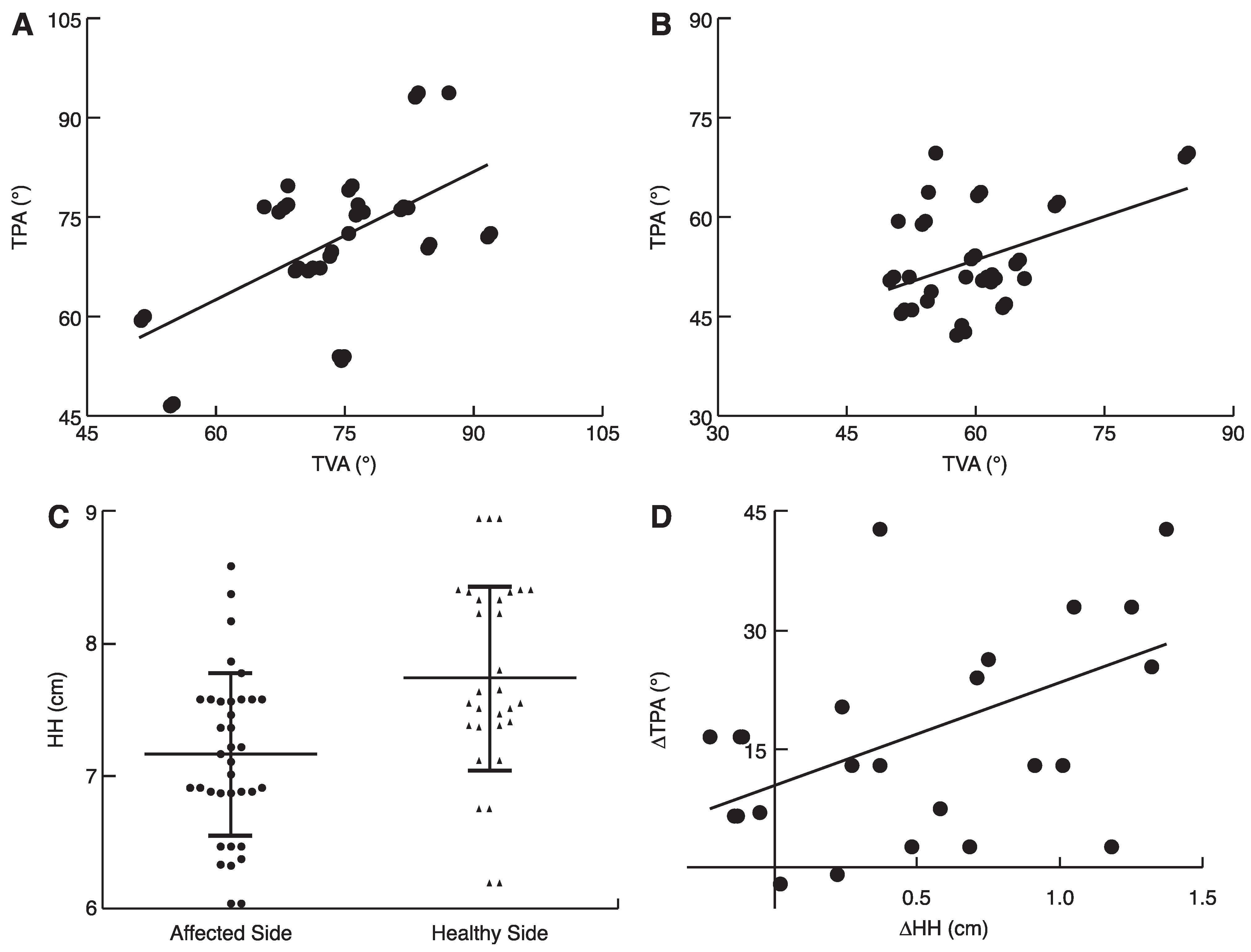
The range of motion of the ankle joint of the affected side in the sagittal plane is significantly reduced compared with that of the healthy side, indicating that plantarflexion and dorsiflexion activities of the ankle were reduced by subtalar arthrodesis. In this study, the TVA of the affected side was lower than that of the healthy side in 32 patients, and 29 patients had reduced HH. There was a positive correlation between HH/talar inclination and range of motion of the ankle joint. In this study, although most patients received a bone graft, it is difficult to determine the proper talar tilt angle for the different lesions and types of surgery. For patients with calcaneal compression fractures, cartilage in the articular surface of the posterior subtalar was mainly removed, but little cartilage in the anterior and median articular surfaces was removed, which led to the increase in the TVA. These results suggest that bone grafting is required when HH is decreased and talar inclination is smaller. In addition, calcaneofibular impingement will easily happen with the reduction of HH, which contributes to the residual pain in the lateral wall. Carr et al. [
9] demonstrated that loss of ankle function was observed in patients with a dorsiflexed talus and shortening of the hindfoot after subtalar distraction arthrodesis and believed that ankle impingement and pain were due to decreased talar declination. Thus, the motion limitation of the ankle joint may be due to the change in talar declination and HH after surgery.
In addition, there is no significant difference between the affected side and the healthy side in terms of the CPA. Also, the bilateral CPA is not significantly related to the TPA. All of the results indicate that subtalar arthrodesis has no significant effect on the degree of calcaneal inclination, and motion limitation of the ankle is not related to calcaneal inclination.
In conclusion, subtalar arthrodesis is an effective treatment for subtalar joint lesions, which could induce joint degeneration. The motion of the ankle joint was limited, which was related to talar declination and HH. These results provide references for further subtalar joint lesion therapy by subtalar arthrodesis.