In the developed world, the increased focus on a healthy lifestyle has helped turn the population into more active members, which has had very positive physical and mental effects. [
1,
2,
3,
4] This is why the past quarter century has seen a significant increase in running volume. It is estimated that 30 to 34 million people in the United States practice some form of running. These figures have increased by 10.3% [
2,
5,
6] in the past 2 years.
The rise in the practice of physical activity also has certain negative sides to it, such as a higher risk of sports injuries. The most severe running injuries include sunstroke, dehydration, hypothermia, frostbite, fatigue, blisters, subungual hematomas, cramps, and joint stiffness. [
7,
8] Approximately 50% of sports injuries are caused by overuse and overload, as well as repeated microtrauma. The musculoskeletal system is, thus, exposed to many forces focused on the knee and lower, causing local tissue damage. The most common of these injuries are Achilles tendinosis and pain in the distal tibial segment, mainly in runners and track-and-field athletes, with an emphasis on jumping sports. [
1,
5]
It is estimated that 27% to 70% of runners presently have some kind of injury and that 63% have at some point in their lives had an injury in the lower limb, with 23% experiencing symptoms for more than 6 months in the form of localized pain or some alteration that required them to change or even lessen their training, to seek medical attention, or to take drugs. [
5,
9] The incidence of running injuries varies from 37% to 56%, depending on how the incidence is measured; if it is measured according to running time, 2.5 to 12.1 injuries occur for every 1000 hours of running, with the knee joint being the most vulnerable to injury. In terms of severity, 30% to 70% of all injuries needed a reduction in training, and more than 79% of them required medical attention. Little running experience (<3 years) and excessive running distance (>32 km/wk) have been identified as risk factors. [
10]
Running injuries are, by nature, complex and multifactorial. They have extrinsic and intrinsic causes, the former being distance, ground stiffness, footwear, flexibility, time, intensity, and training frequency and the latter being the alignment of the foot, muscle weakness, previous injuries, biomechanical abnormalities, sex, and body mass index. [
5,
9,
11] Therefore, running injuries are not the result of one isolated variable but the consequence of a structural and functional combination of different factors. Despite this fact, being a recreational runner seems to be a recurring risk factor present in stress fractures and several other lower-limb overuse injuries. [
5]
In studies of running, most of the focus has traditionally been on the knee and the hip as the anatomical locations in which most injuries tend to occur. Having said that, recent studies have also begun to describe and analyze the foot and ankle biomechanics, understanding their importance in this sport as the interface between the body and the ground. It is, therefore, vital to know how to interpret and control their movements and to make them work in perfect harmony. It must be taken into consideration that during the gait pattern the impact slightly diminishes, shifting from a distal to a proximal joint state. That is why altered foot alignment or malfunction can alter the gait pattern and, in doing so, affect the whole lower limb. [
12]
Regarding responsible extrinsic factors, traction between the shoe and the foot surface is one of the major factors affecting lower-extremity injuries because the ankle joint peak loading in the transverse plane increased by approximately 12% in the high-traction shoe. [
13] Other factors commonly associated with long-term foot overload and pain are footwear adjustment and the movement of the foot itself on dorsal and plantar surfaces. [
14] Moreover, some researchers have established that during running, the structure of the footwear must adapt to the runner to benefit his or her sport performance and for muscular optimization. [
12]
Sport footwear has been designed to increase performance in all sports, aiding in the movement and interaction dynamics between gait and footwear. The characteristics of the footwear, such as traction, stability, flexibility, and weight, may be modified to achieve a specific goal. A great deal of attention is also given to the understanding of the shoe as protection for the foot because it helps prevent acute injuries and chronic diseases during exercise.
The aims of this article were to analyze the scientific literature published in the past 20 years on the most common running injuries and to identify risk factors and potential protective factors (mainly those related to footwear).
Methods
The bibliographic search began with the collection of papers from the MEDLINE/PubMed, ENFISPO, Cochrane Library, and Cumulative Index to Nursing and Allied Health Literature electronic databases related to the fields of health and biomechanics. The key words footwear, running, running injuries, overuse injuries, and injuries prevention and the combination of all of them were used in the search; we did not use Medical Subject Heading terms because they did not increase the results. Further articles were obtained through cross-references derived from the initial search.
The search was limited to English and Spanish articles whose topic of study was related to the objectives of this review and that were not more than 20 years old. The search was conducted between February 1 and November 30, 2013.
After critical reading and assessment of the articles performed by two external editors, assessment of the methodological quality was completed. For this purpose, the Critical Appraisal Skills Programme Spanish tool was used. This resource helped control the risk of bias in each study and to mark their general evidence. In the end, 25 articles were selected, all of them written in English, and they were then accepted by the corresponding ethical committee according to the Helsinki Declaration on Human Rights.
The study inclusion criteria were as follows: selected participants through sports events or clubs, recreational runners (>10 miles per week or >5 miles per training or race) or elite runners (>20 miles per week), healthy individuals with 1 year or more without a lower-extremity injury, and injured individuals with injuries diagnosed by a medical professional (physician, physical therapist, or athletic trainer) for physical injuries or symptoms.
Results

In total, 276 articles were identified by electronic search, and 25 of these met the inclusion criteria and were deemed suitable for review (
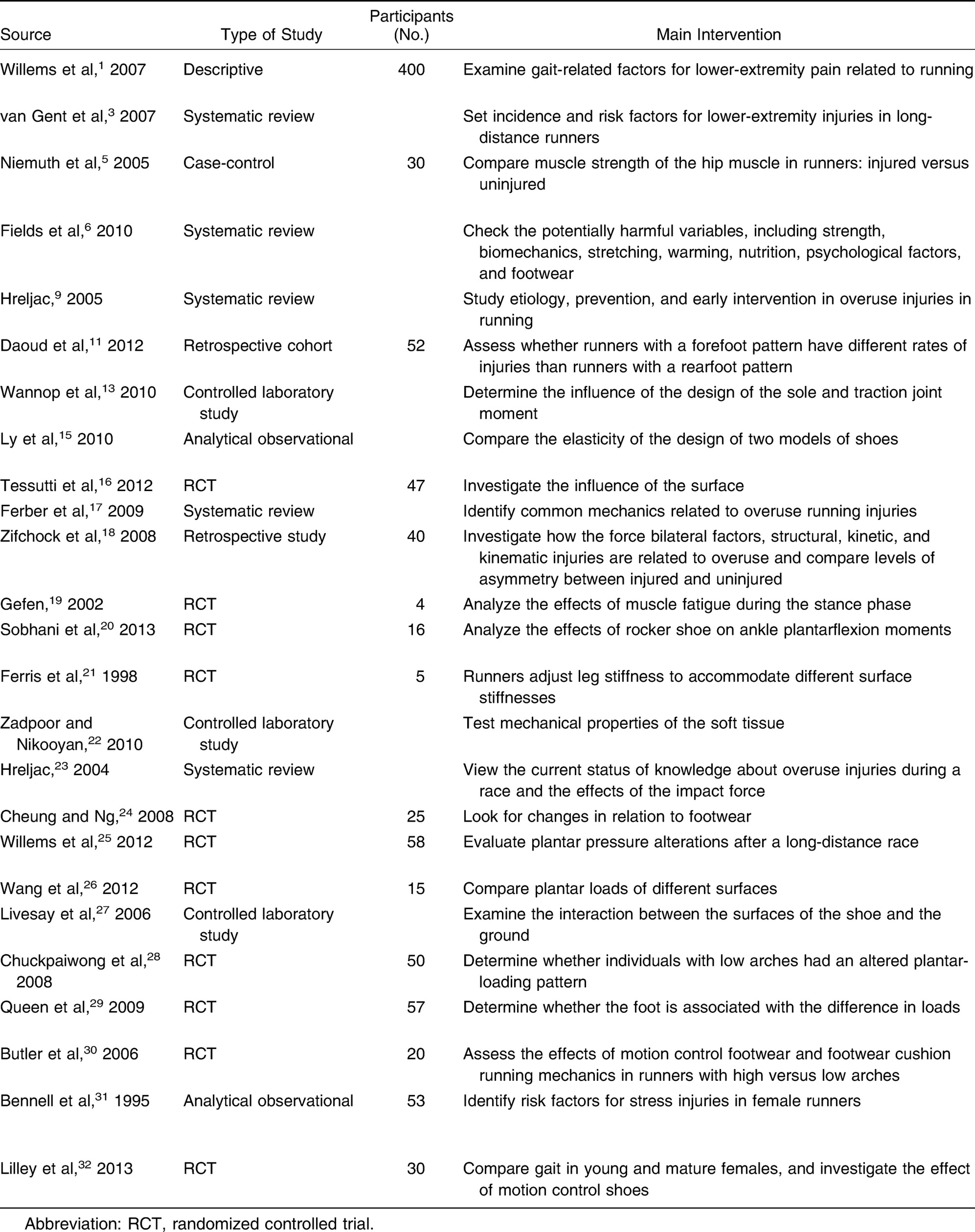
Fig. 1). There were 11 randomized controlled trials, five systematic reviews, three controlled laboratory studies, two analytical observational trials, two retrospective studies, one case-control study, and one descriptive study (
Table 1).
Figure 1.
Literature review search strategy.
Figure 1.
Literature review search strategy.
Table 1.
Summary of the 25 Studies Included in the Systematic Review
Table 1.
Summary of the 25 Studies Included in the Systematic Review
Injuries seem to be due to inadequate interaction between the runner (his or her biomechanics) and external factors (ground stiffness, footwear, and training). [
15,
16] Once the causes that could determine the risk of injury had been reviewed, van Gent et al [
3] concluded that the most important risk factors were advanced age (not taking into account the risk threshold), difference in length between the lower limbs, genu varum or bow-leggedness, the height of male athletes (>1.70 m), the intake of alcohol, previous injuries, and weekly training distance. [
3]
It is estimated that approximately 50% of running injuries are due to overuse. Of those, two-thirds occur in the knee or below the knee. These injuries are the result of repeated microtrauma, which eventually produces local tissue damage. The most common injuries caused by overuse include Achilles tendinosis, [
1] patellofemoral pain syndrome, medial tibial stress syndrome, shin splints, stress fractures, [
9] periostitis, and compartment syndrome. [
1] The causes are not easy to determine, although they are usually paired with repetitive stress; increased training volume, strength, or distance; or altered biomechanics. [
1] Runners with severe overpronation have greater torsional strengths that result in associated instability and lead to injuries. [
17]
During the stance phase, the muscles contract and generate the swing, helping maintain stability and protect the skeleton from external forces. Inadequate muscle stabilization, together with pronation, is the leading factor in causing overuse injuries. [
6] As for the lower-extremity kinetic chain, injury prevention derives from the hip control of the distal segments. [
5] Strengthening of the gluteus maximus and medius stabilizes the pelvis and regulates the adduction moment and internal rotation of the hip as well as knee abduction and pronation. [
18] Internal rotation range of motion and peak tibial acceleration are commonly associated with an increased risk of injury, specifically, patellofemoral pain syndrome, iliotibial band syndrome, and tibial stress fracture. [
5,
17,
18]
According to a recent survey, the foot is left in a vulnerable position during muscle fatigue, making it likely for two types of injury to occur. The first type is an acute injury caused by joint collapse due to an impaired ability to resist dynamically the inversion/eversion tendency of the foot (peroneal muscle weakness). This leads to ankle sprain and excessive strain injuries. The second type of injury may result from deterioration of the muscular ability to reduce the level of impact loads and the intensity of bone strains during the stance phase. Contraction of the pretibial and gastrocnemius and soleus muscle groups during heel strike helps protect the bone from tensile stresses. Were physical stress limits to be exceeded, local microfailures at the cortical surface of the bone would appear, building up on top of one another and producing stress fractures. [
19]
Bearing in mind that the structures of the musculoskeletal system adapt themselves to the level of repeated stress, injuries could be avoided by minimizing stress, as the stress-frequency relation is a dynamic one. When the levels of stress are either reduced or removed, tissue reabsorption occurs. This weakens the structure, favoring the injury. On the contrary, when the levels of stress are maintained or increased, positive tissue remodeling occurs. This leads to strengthening of the structure. During running, ground reaction forces are the only external factor responsible for overuse injuries. Running styles produce characteristic curves on impact that vary depending on the intensity and direction of the active forces. They also contribute to varus and valgus moments. [
9]
According to Daoud et al, [
11] because the running gait pattern (rearfoot, forefoot, or midfoot) influences the kinematic dissipation, it is also related to the appearance of injuries. Ground reaction forces vary because of the strike pattern. In runners who usually rearfoot strike, these forces are greater. Stress fractures; plantar fasciitis; low-back, hip, and knee pain; medial tibial stress syndrome; and patellofemoral pain syndrome are all connected to it. A proper strike pattern contributes to limiting the advance of overuse tendinopathies. A slight modification to the sole of the shoe can help improve the ankle internal plantarflexion moment, thus reducing painful symptoms. A rearfoot strike increases the rate and magnitude of the joint movements, which, in turn, implies increased hip external rotation, knee internal rotation, and foot adductor rotation, putting the structures under greater tensions. Evidence suggests that a runner with a rearfoot strike has approximately twice the rate of minor (2.6) and moderate (2.4) injuries as individuals with other strike patterns. [
11,
20]
The leg muscles adapt themselves to the surface, influencing kinematic variables such as stride frequency and ground contact time. [
21] Studies suggest that muscle tuning enables ground reaction forces to dispel, contributing to the specific cost of running and helping us understand the behavior of the load during running. [
22] The impact force peak during running varies in magnitude from 1.5 to 5 body weights and can last 10 to 30 msec and, according to Hereljac, [
23] is connected to the display of overuse running injuries.
As running progresses, muscle fatigue starts to develop, affecting the strike pattern. [
24] Muscle fatigue increases the load on the rearfoot, heightening the pressure peak and the impulse. This leads to more overuse running injuries. A research study by Willems et al [
25] intended to assess the effects of fatigue on plantar pressure distribution. The obtained data determined the maximal peak force under the first and second metatarsal heads after 30 minutes of running. The risk of stress fractures of the metatarsal heads and of patellofemoral pain syndrome may also be increased. A hypothesis suggests that the evertor muscles are weaker than the invertor muscles. Muscle fatigue lengthens the stance phase, increasing the risk of ankle sprains. [
25]
According to Hreljac, [
9] the two main training variables most often identified as risk factors for running injuries are running distance and intensity. Running a greater distance increases the number of repetitions. Increased intensity causes greater ground reaction forces. It is, therefore, concluded that runners should not increase their weekly mileage by more than 10%. Cumulative training errors account for as much as 60% of running injuries, and half of those come as a result of excessive mileage. Fields et al [
6] stated that eccentric training included in an integrated training session can be regarded as a main factor of improvement of Achilles tendinosis, patellofemoral pain syndrome, and hamstring strain. [
6,
9]
Alterations in the surface characteristics can affect the movement pattern and can be a disruptive factor for the technical performance of the runner. [
16] The surface dictates the load mechanics and its absorption. [
26] A research study by Tessutti et al [
16] assessed the characteristics of different surfaces, observing a difference between peak pressures of 16%. They concluded that grass attenuates pressure better than any other running surface. However, its nonuniformity requires higher energy expenditure by the runner, increasing contact time. Rubber, on the other hand, behaves like a rigid surface, with a shorter contact time. The most rigid surfaces, such as asphalt and concrete, presented greater pressure values. [
16] Wang et al [
26] add that runners are known to adapt their lower extremities to the surface to keep the ground reaction forces constant. This can be interpreted as a shock-absorbing capability during heel strike and its adaptation to the hardest ground surfaces. Running on elastic surfaces increases leg muscle stiffness, and running on harder surfaces diminishes it, influencing the tendon and ligament lever arm. [
26]
Footwear traction is one of the leading causes of noncontact lower-extremity injuries. Rotational traction happens when the footwear comes in contact with the surface. As footwear traction increases, there is a steady increase in joint and muscle forces. [
13,
25]
Recent studies by Livesay et al [
27] have proved that the shoe-surface interaction depends on the physical distribution of the materials of the shoe sole, mainly in the heel and toes; on the surface contact time; and on the weight and gait pattern of the runner. [
27] Wannop et al [
13] stated that traction is influenced by the surface of the shoe sole. The high-traction shoe increases loading in the ankle (transverse plane) by 12%. It has been shown that 90% of injuries to the ligament are caused by rotational traction. Concerning the shoe, greater traction leads to a greater incidence of injury because the loads are also greater. [
13] Further research has illustrated that the shock absorption properties of running shoes do not play a significant role on soft surfaces because the intrinsic gain is less than 2%, whereas on harder surfaces the gain is 10%. [
27]
It has been shown that low- and high-arched individuals are more prone to experience injuries than runners with normal feet. Proper footwear is, therefore, suggested to modify the biomechanical changes of running, reducing the risk of injuries by 50%. A research paper published by Chuckpaiwong et al [
28] reveals that ground reaction forces and impact peaks behave differently depending on the foot. [
28] As stated in a study on the morphologic features of the foot by Queen et al, [
29] runners with flat feet demonstrated an increase in contact area and loading in the medial midfoot area. This implies that tendon and ligament overload, in doing so, modifies healthy joint mechanics. [
29] Thus, runners with flat feet are more likely to sustain soft-tissue injuries, such as posterior tibial tendinitis, ankle strains, knee injuries, and overuse injuries, such as patellofemoral pain syndrome and metatarsal stress fracture, most commonly in the second and third metatarsals. High-arched individuals present higher loading rates, suggesting a greater risk of stress fracture to the femur, tibia, and fifth metatarsal. [
29,
30]
According to Bennell et al, [
31] the incidence of stress fractures varies when observed in men and women, being more likely in the latter because women may experience menstrual disturbances. The lack of estrogen contributes to reduced bone density. This, together with the running stress, increases the number of stress fractures in female athletes. [
31] Lilley et al [
32] showed via a comparative study the connection between the prevention of injuries and female footwear. They concluded that having motion control running shoes can directly impact the alignment of the extremity, thus affecting the lever arm. However, its influence on prevention of injuries has not been proved. [
32]
Discussion
The purpose of this article was to identify risk factors for running injuries with the intent to recognize the etiologies that produce them and to be able to guide the runner in prevention. The lesion production mechanism is complex and varied; therefore, it is difficult to precisely identify factors favoring injury. We found that the analyzed articles describe a variety of protective factors and risk factors, but not exactly in an independent way, but classified as a summation of intrinsic and extrinsic factors that jointly predispose the runner to injury.
In addition, we identified how each type of runner, according to morphologic features and practicing running style, presents a different risk. The type of lesion produced is also associated with these parameters being important to define further the association between certain risk factors and the injuries they predispose to.
The lesion production mechanism in running makes specific and effective prevention difficult because there are many causes that are interrelated. Considering the characteristics identified in this review, and its specific association with a type of injury, we can direct toward prevention, which may reduce the risk of occurrence, although it is difficult to directly associate prevention and injury; thus, although we can optimize the run and reduce injuries, it is very difficult to avoid injuries completely.
Study Limitations
Because running is a very popular sport nowadays, lots of studies have been conducted recently. Because running is an individual and no-rules sports, there are many different ways of practicing it, so it is difficult to find, train in, and practice common patterns. All of the studies tried to associate injuries with risk factors, but we consider it necessary to focus on each kind of injury and to describe its biomechanics, its production mechanism, and the best way to avoid it instead of recognizing risk factors without associating them directly.
It will be fundamental to isolate direct causes and effective prevention mechanisms in order to reduce the rate of injury and healing time.
Implications
The implications of the key points of this systematic review merit special consideration. The evidence suggests that extrinsic variables (ie, training hours, alcohol intake, and type of training) and intrinsic variables (ie, increased age, lower limb biomechanics, and lower limb length difference) should be checked before the start of training (
Table 2).
Table 2.
Elements of Protective Factors and Risk Factors in the Runner
Table 2.
Elements of Protective Factors and Risk Factors in the Runner
We suggest carrying out new research with this criterion in order to determine the implication of variables in a quantitative way, which could contribute to the development of a more accurate way to train runners.