Forefoot disorders, namely, hallux abducto valgus and hallux rigidus, are routinely diagnosed in a foot and ankle practice. Radiographs have traditionally aided in assessment, surgical planning, and postoperative evaluation of these foot deformities.[
1] Metatarsal protrusion distance (MPD), or relative first metatarsal length, is one such radiographic measurement.[
2] Measuring the MPD involves taking the bisection of the first two metatarsals, placing a compass at the bisection and drawing arcs to the distal aspect of each metatarsal, and measuring the distance.[
3] Essentially, it compares the distance between the first and second metatarsals.
Although the MPD is considered to be a reliable measurement in predicting hallux abducto valgus,[
4] the validity of analyzing three-dimensional objects on a two-dimensional image is called into question. Radiographs distort images and have been found to overestimate absolute metatarsal length by 15%.[
2] Zgonis et al[
5] found no difference in MPD between a control group and a group of patients with hallux rigidus. Furthermore, they found that those with hallux rigidus demonstrated a significantly shorter (absolute length) first metatarsal than the control group. These authors make mention of similar findings reported by Coughlin and Shurnas[
6] that hallux rigidus is not associated with a long first metatarsal, among other findings. In addition, many have found that foot position alters radiographic analysis. Perry et al[
7] found that manipulation of the tarsometatarsal angle caused the length of the first metatarsal to measure shorter on an anteroposterior radiograph than its absolute length. They further claimed that the standing lateral view is more accurate than the standing anteroposterior view for measuring the length of the first metatarsal.[
7] Other researchers have found that the planus or cavus foot types can distort radiographic lengths, stating that the length of the metatarsals can be altered due to plantar or dorsal deviation.[
8]
Moreover, some surgical procedures involve intentional plantarflexion of the metatarsal, and how this affects the radiographic MPD has yet to be established. The purpose of this study was to first compare the lengths of the first and second metatarsals measured by two standard radiographic views in asymptomatic feet. The second objective was to compare the measured lengths of the first and second metatarsals found on anteroposterior radiographs with actual lengths found using diagnostic ultrasound. The final objective was to investigate relative length (MPD) between the first and second metatarsals on lateral and anteroposterior views.
Methods
This is a case series performed between June 29, 2012, and February 6, 2013. Ethics approval was obtained from and all research was performed at the Foot and Ankle Institute for Research in Oak Lawn, Illinois. Participants included 27 volunteers (54 feet) with asymptomatic feet. The inclusion criteria included healthy adults aged 20 to 50 years without foot pain, trauma, or surgery to the lower extremity, free of any neurologic or systemic disease, and without gait abnormalities. Informed consent was obtained before volunteer participation. We obtained standard anteroposterior and lateral digital radiographs of the left and right feet. Actual (absolute) first and second metatarsal lengths were measured using a diagnostic 8-MHz ultrasound unit on the left and right feet of each volunteer. The foot was placed flat on the ground as the patient sat in an upright position on a chair. The measurement was taken with the probe placed on the longitudinal axis on the dorsum of the foot over the first metatarsal. A straight metal paperclip placed perpendicular to the probe was used to identify the metatarsophalangeal joint and the proximal first metatarsal cuneiform joint. Markings were then made on the dorsum of the foot at the distal and most proximal extent of the metatarsal just medial to the extensor hallucis longus. The distance between these markings was obtained using a 6-inch digital caliper (Neiko Tools USA, China).
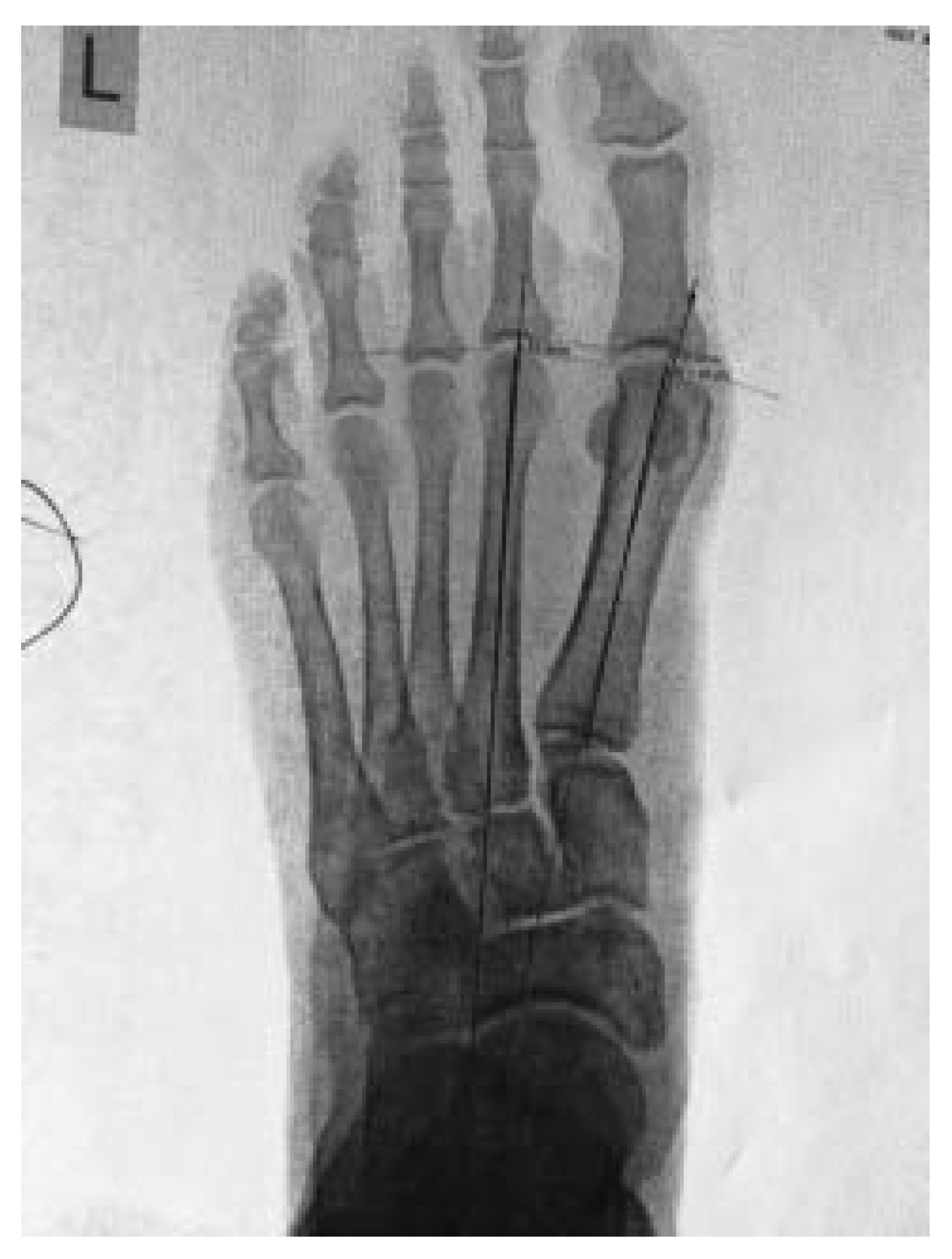
Two podiatric medical residents (K.T. and S.M.) and one podiatric medical student (J.R.) performed blinded radiographic measurements using digital measuring tools of the absolute first and second metatarsal lengths on each of the three views. The anteroposterior measurements from radiographs were then compared with the first and second metatarsal lengths found on ultrasound. The relative distances, or MPDs, between the first and second metatarsals were obtained by one resident using Duke’s method on the anteroposterior radiographic views (
Fig. 1).[
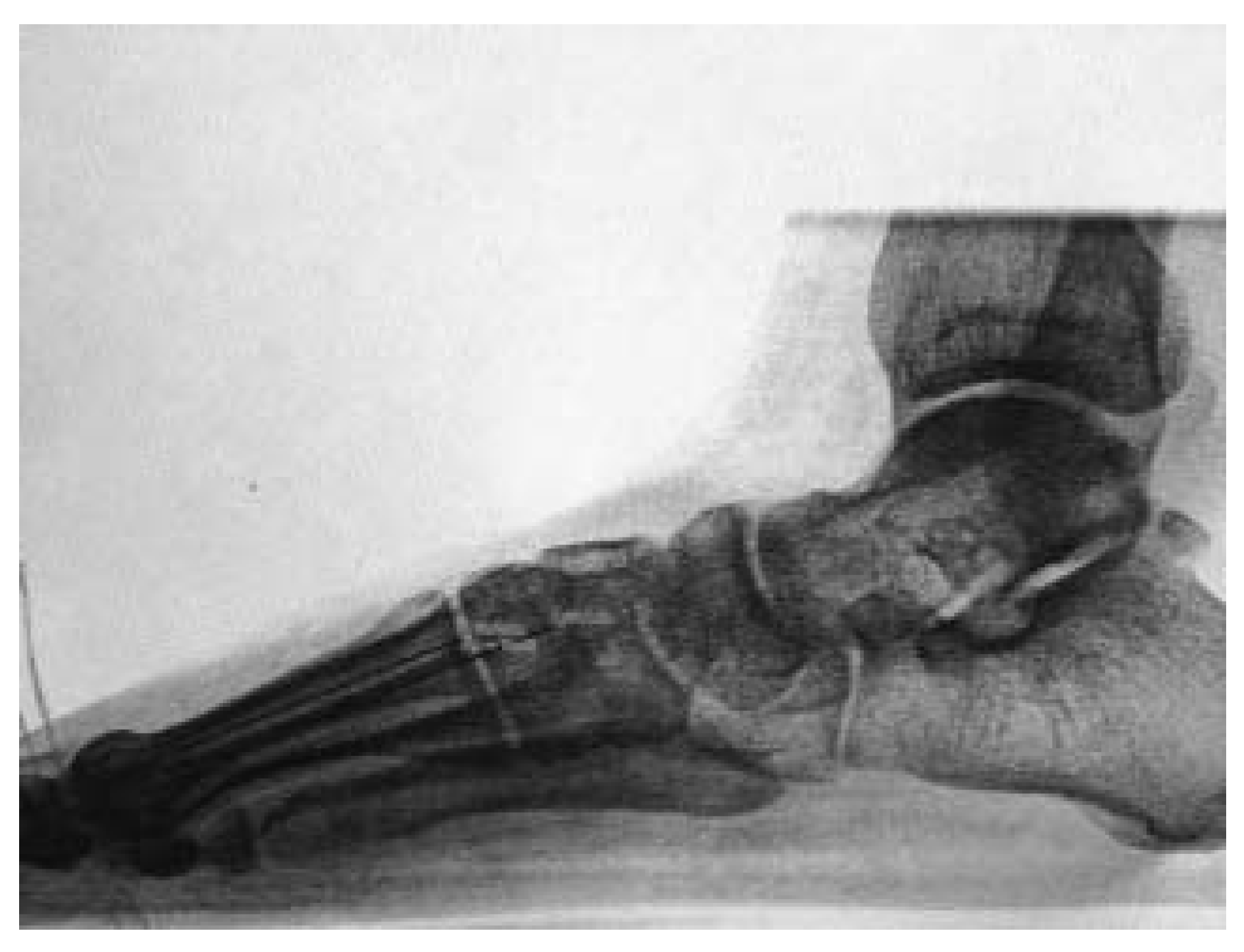
9] Duke’s method was obtained by taking the difference between two arcs drawn using the intersection of the longitudinal axis of the first and second metatarsals as an axis point for anteroposterior measurements. For the lateral MPD, a new method was applied using the distalmost aspect of the metatarsal head, the bisection of each metatarsal, and a common axis point of the intersection of the longitudinal axis of the talus at the talonavicular joint (
Fig. 2). The relative distances found on the anteroposterior and lateral views were compared. Statistical analysis consisted of a two-way repeated-measures analysis of variance (with independent variables including rater and radiographic view) and
t tests performed at the Center for Lower Extremity Ambulatory Research at Rosalind Franklin University of Medicine and Science, Chicago, Illinois.
Figure 1.
Relative first to second metatarsal length. The difference is measured between two arcs drawn using the intersection of the bisection of the first and second metatarsals as an axis point.
Figure 1.
Relative first to second metatarsal length. The difference is measured between two arcs drawn using the intersection of the bisection of the first and second metatarsals as an axis point.
Figure 2.
Relative length of the first metatarsal compared with the second metatarsal (metatarsal protrusion distance). For the lateral view, a new method was applied using the distalmost aspect of the metatarsal head, the bisection of each metatarsal, and a common axis point of the bisection of the longitudinal axis of the talus at the talonavicular joint.
Figure 2.
Relative length of the first metatarsal compared with the second metatarsal (metatarsal protrusion distance). For the lateral view, a new method was applied using the distalmost aspect of the metatarsal head, the bisection of each metatarsal, and a common axis point of the bisection of the longitudinal axis of the talus at the talonavicular joint.
Results
First Metatarsal Absolute Length on Radiographs
First metatarsal length measurements were significantly affected by view (mean difference, 5.3 mm; 95% confidence interval [CI], 4.88–5.78 mm;
P < .001), with no significant difference between raters (
P = .039). Measurements were longest on anteroposterior (mean, 71.4 mm) versus lateral (mean, 66.1 mm) radiographs (
Table 1).
Table 1.
First Metatarsal Absolute Length Measurements.
Table 1.
First Metatarsal Absolute Length Measurements.
Second Metatarsal Absolute Length on Radiographs
Absolute second metatarsal length measurements were significantly affected by view (mean difference, 2.84 mm; 95% CI, 2.8–3.6 mm) and by rater (
P = .024). Two of the raters differed from each other (mean difference, 0.707;
P = .024), and the intraclass correlation coefficient between these same raters was 0.891. The measurements taken by the principal investigator did not differ significantly between these two raters. Measurements were longest on anteroposterior (mean, 86.3 mm) versus lateral (mean, 83.4 mm) radiographs (
Table 2).
Table 2.
Second Metatarsal Absolute Length Measurements.
Table 2.
Second Metatarsal Absolute Length Measurements.
Radiographic Absolute versus Ultrasound-Guided Length
First metatarsal anteroposterior values were 13.9% longer than ultrasound measurements. The mean length was 71.60 mm on the anteroposterior view versus 62.84 mm on ultrasound (mean ± SD difference, 8.76 ± 3.04 mm; t = 21.1; P < .001). Second metatarsal anteroposterior values were 15.3% longer than ultrasound measurements. The mean length was 86.40 mm on the anteroposterior view versus 74.97 mm on ultrasound (mean ± SD difference, 11.43 ± 3.20 mm; t = 24.2; P <.001).
Relative MPD Between Two Radiographic Views
The relative MPD revealed the first metatarsal to be significantly shorter on lateral views than on anteroposterior views (mean difference, 3.85 mm; 95% CI, 2.7–5 mm; t = 6.694; P < .001). The mean MPD on anteroposterior views was −0.76 mm and on lateral views was −4.61 mm. A negative value indicates a shorter first metatarsal compared with the second metatarsal.
Of the 54 feet, 49 displayed shorter first metatarsals on the lateral compared with the anteroposterior view, one had no difference between the lateral and anteroposterior views, and four had longer first metatarsals on the lateral than the anteroposterior view. Sixteen feet had longer first metatarsals on anteroposterior views, which measured shorter on lateral views. Thirty-three feet measured longer or equal to the second metatarsal and subsequently shorter on the lateral view.
Discussion
In evaluating adults with asymptomatic normal feet, where, theoretically, various foot morphologies and excess subtalar joint motion are minimized, this study confirms that different radiographic views alter the absolute and relative length measurements of the first and second metatarsals.
For the first metatarsal, a mean difference of 5.3 mm was found among all of the views, with the anteroposterior measurement being the longest. No difference was found between raters. The second metatarsal was also found to be longest on the anteroposterior view, with a mean difference of 2.84 mm between views. There was a significant difference between two of the raters. However, the mean difference between these raters was small at 0.7 mm, and the intraclass correlation coefficient was high at 0.89 for these raters. In addition, neither of these raters’ measurements differed significantly from those of the third rater. Therefore, the anteroposterior measurements from the third rater were used to compare against actual metatarsal lengths found on ultrasound.
In comparing radiographic measurements with ultrasound-guided actual first and second metatarsal length measurements, the first metatarsal was found to be 13.9% longer on radiographs. The second metatarsal was found to be 15.3% longer. Therefore, these findings corroborate a previous assertion that one should expect approximately 15% magnification in absolute length when evaluating metatarsals on the anteroposterior radiograph. In analyzing the first metatarsal length alone, the mean length across all raters on the lateral view (66.1 mm) matches much more closely with the mean length found on ultrasound (62.84 mm). This compares with the mean first metatarsal length on the anteroposterior view of 71.4 mm. Although the actual length measured via ultrasound was not taken in the same projection as the lateral view, this does suggest that perhaps the more accurate test to measure the first metatarsal length is the lateral projection of the foot and ankle. Perry et al[
7] similarly claimed that the standing lateral view is more accurate than the standing anteroposterior view for measuring the length of the first metatarsal.
Just as absolute lengths differ, so do relative lengths as measured by MPD on the anteroposterior and lateral views. The first metatarsal was significantly shorter on lateral views compared with anteroposterior views, with a mean difference of 3.85 mm. Only four feet displayed a longer first metatarsal on the lateral versus the anteroposterior radiograph. Interestingly, 33 of 54 feet had a first metatarsal that was equal in length or longer than the second metatarsal measured on the anteroposterior view, which then measured shorter on the lateral view. Sixteen of these 33 feet had a longer first metatarsal on the anteroposterior view, which then measured shorter on the lateral view. Although a new technique for measuring the difference between the first and second metatarsals was used for the lateral view, the technique was similar to Duke’s method in that a reproducible axis point and bisection of the first and second rays were used. Although this technique is not validated, there is no true consensus on the most accurate measurement for MPD. Hardy and Clapham’s method is recommended by the American Orthopaedic Foot and Ankle Society and is used by several researchers.[
10] However, even researchers who cite using Hardy and Clapham’s method actually describe using the technique of Duke et al.[
4]
The primary objective of our study was simply to state that radiographs are inaccurate in assessing metatarsal length measurements, both absolute and relative to each other, in various views of the foot. This is clearly seen because length measurements varied considerably between views, and this was consistently found by three raters. The second objective was to compare radiographic measurements with actual measurements of metatarsals. A limitation of this aspect of the study is that measurement tools differed and that measurements taken using digital tools may be more accurate and precise than those found by using the digital caliper and ultrasound to find actual length measurements. As we could not physically visualize and measure the metatarsal of each person, this was the best compromise to determine actual metatarsal length. Again, this was a secondary objective to verify the magnification and inaccuracies that have been described previously when interpreting radiographs.
Physicians are called on to evaluate the first ray using the anteroposterior view, which highlights transverse plane motion. Anatomy of the foot reveals triplane motion of the first ray. According to Valmassey,[
11] the first-ray joint axis is oriented 45° from the sagittal and frontal planes, causing dorsiflexion and plantarflexion along with inversion and eversion to occur equally and simultaneously. This axis deviates 9° from the transverse plane. Although a helpful guide, measurements obtained from the transverse plane, or the anteroposterior view, do not fully represent the three-dimensional anatomy and motion of the foot and first ray.
Conclusions
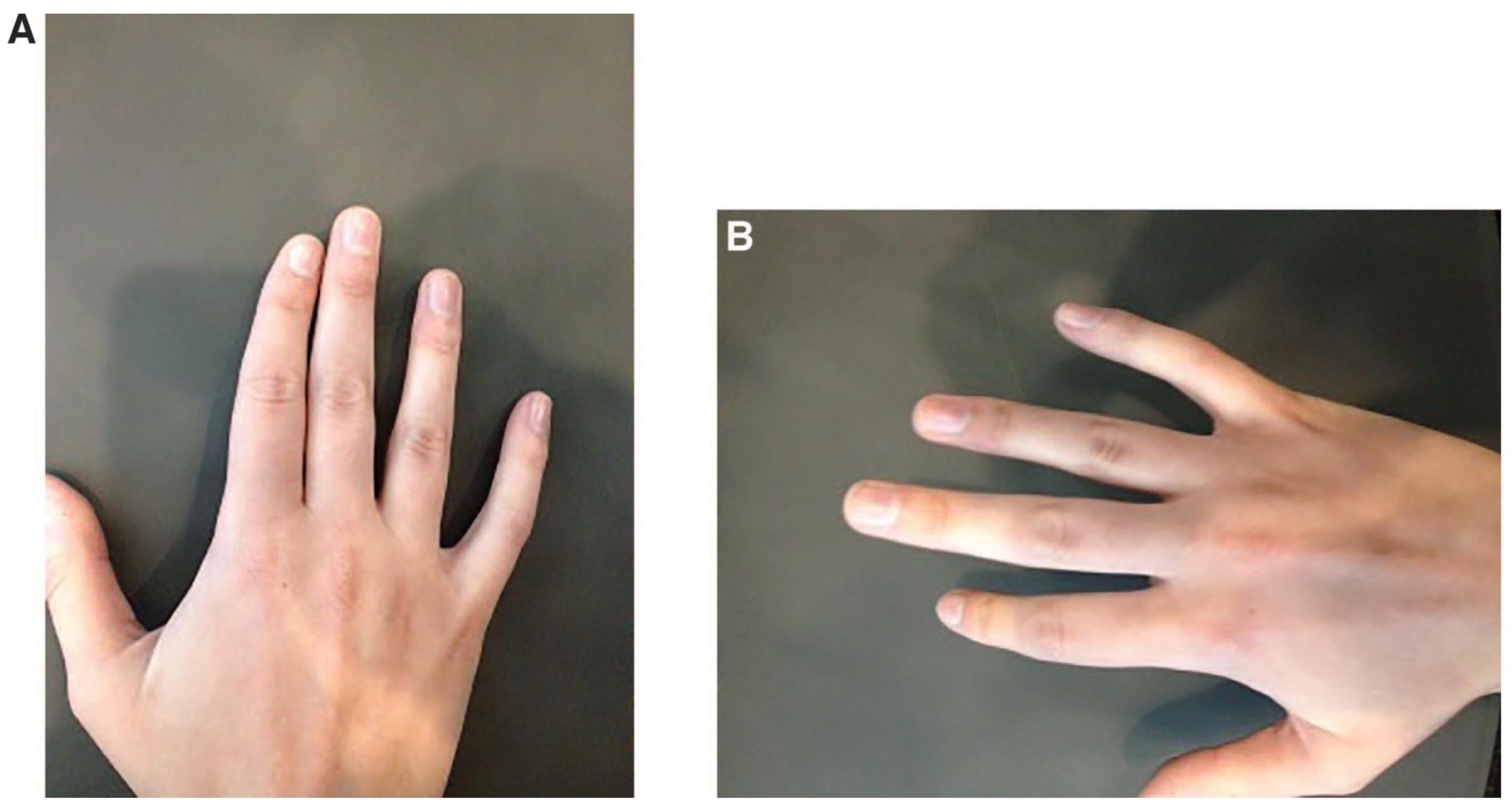
In conclusion, one must use caution in using the anteroposterior radiograph to plan to “shorten” or “lengthen” a metatarsal surgically. Similarly, one should use caution in analyzing surgical outcomes based solely on the anteroposterior radiograph. This simple study demonstrates that the absolute and relative lengths are significantly altered between radiographic views and, therefore, are invalid. It is also hypothesized that with plantarflexion of the hallux, one may expect to observe concurrent shortening of the first metatarsal relative to the second metatarsal on an anteroposterior radiograph. Similarly, with dorsiflexion of the hallux, one may see concurrent lengthening of the first metatarsal relative to the second metatarsal on anteroposterior radiographs (
Fig. 3). Subsequent studies may investigate the effect of surgical manipulation of the metatarsal and the effect that this has on different radiographic views.
Figure 3.
Simulated anteroposterior view. The pointer finger is plantarflexed in part B.
Figure 3.
Simulated anteroposterior view. The pointer finger is plantarflexed in part B.