Traumatic injuries to the hindfoot, including intra-articular calcaneal fractures (HFXs) and Achilles tendon ruptures (ATRs), can lead to a highly variable course of recovery and result in considerable loss of function. Thus, an understanding of the variations in the level of function and characteristics of how the foot is loaded early in the recovery process can be invaluable for planning an effective rehabilitation program.
Intra-articular fractures to the calcaneus are usually the result of falls from a height or motor vehicle trauma and often lead to long-term decreases in functional abilities compared with preinjury levels. [
1,
2,
3] After operative repair, these fractures can result in difficulty returning to previous work-related activities and additional costly operative procedures. [
1,
3,
4] Individuals who sustain HFXs must often deal with long-term range-of-motion limitations and post-traumatic osteoarthritis that can eventually lead to fusions of the subtalar joint. [
1,
4,
5] Previous studies assessing plantar pressure patterns and temporal characteristics during walking in individuals with HFXs have reported that contact time is reduced on the involved side compared with the uninvolved side and that, in most cases, plantar pressures are significantly increased in the lateral forefoot. Rosenbaum et al [
6] studied 14 patients, two-thirds of whom were managed surgically, using a pressure sensor platform to assess dynamic plantar pressures. They reported not only that forces were reduced on the injured foot versus the noninjured foot but also that peak plantar pressures were significantly decreased in the medial forefoot and significantly increased in the lateral forefoot. The patients in that study were all assessed 4 years after surgery. Schepers et al [
7] also used a pressure platform to assess 21 individuals with unilateral HFXs 1.5 years after operative repair. Similar to the results of the study by Rosenbaum et al, [
6] they reported that forces were reduced on the injured foot compared with the noninjured foot. In contrast to the study by Rosenbaum et al, however, Schepers et al found that maximum plantar pressures were increased under the medial forefoot region of the involved extremity. In a more recent study, Hirschmuller et al [
8] assessed plantar pressures and several gait parameters in 60 individuals 1 year after surgery to repair a unilateral HFX. Using a pressure sensor platform for data collection, they reported a shorter contact period during walking on the injured side, with increased peak plantar pressures in the midfoot and lateral forefoot regions.
Although the Achilles tendon is the strongest and thickest tendon in the human body, it is the most commonly ruptured tendon, and the incidence is increasing. [
9] Achilles tendon repairs account for 40% of all operative tendon repairs. [
9] Although the incidence of ATRs ranges from 11.3 to 37.7 per 100,000, [
10,
11] few studies have assessed plantar pressure or temporal characteristics of walking after operative repair of an ATR. Chan et al [
12] assessed 19 individuals who had undergone an operative repair of the Achilles tendon 6 to 62 months after injury and reported that step length and stance phase duration were similar between the injured and noninjured extremities. In a more recent study, Mezzarobba et al [
13] reported no differences between extremities in step length, step duration, or gait speed in 21 individuals with an ATR 2 years after surgery. They also reported that the ATR repair group exhibited a reduction in force during the propulsion phase of walking and a decrease in forefoot plantar pressures measured using a specially designed baropodometric platform.
Operative repair of HFXs and ATRs in most cases involves a period of nonweightbearing. After the period of nonweightbearing, both groups of patients are often immobilized in a walking boot for 10 to 12 weeks. After Achilles tendon repair, patients are often initially placed in a walking boot with the foot plantarflexed to avoid tendon elongation, which would result in functional deficit. [
11,
14] This period of immobilization for both groups often leads to joint stiffness, difficulties with gait, and a decreased level of function once the patient is allowed to begin walking without the walking boot.
Although the assessment of plantar pressures and various temporal characteristics of walking can provide valuable information on the loading patterns and weight acceptance on the injured and noninjured feet, patient self-reported outcome instruments also play an important role in determining the patient's functional status. The Lower Extremity Functional Scale (LEFS) consists of 20 items (each with a maximum score of 4) and has been shown to be a reliable and valid measure of documenting lower-extremity function. [
15] Binkley et al [
15] administered the LEFS to 107 patients with lower-extremity musculoskeletal dysfunction and reported that the sensitivity to change of the LEFS was superior to that of the SF-36 and that the minimal clinically important difference was 9 scale points. In a more recent study, Yeung et al [
16] used the LEFS to assess functional performance in 142 inpatients in an orthopedic rehabilitation ward. They also concluded that the LEFS was a reliable and valid tool to assess group and individual changes in function with high levels of responsiveness.
In previous studies focused on assessing plantar pressure and temporal characteristics in individuals who have had either an HFX or an ATR, the length of time between the operative repair and the assessment has ranged from 1 to 5 years. Although waiting to assess the effectiveness of surgery and rehabilitation after this length of time can provide important information regarding long-term outcomes, assessing various parameters after this length of time does not permit the modification of rehabilitation programs or the implementation of early orthotic device/footwear interventions that could improve those long-term outcomes. In addition, previous studies assessing plantar pressure patterns have used platform systems to collect data. Whereas platform systems offer the advantage of having higher resolution due to a greater number of sensors, a major disadvantage is that pressure data can be collected only from a single foot contact, which requires multiple walking trials. In addition, another factor that can affect pressure data collection using a platform system is termed
targeting. Targeting refers to patients altering their walking pattern so that they can ensure that their foot makes contact with the platform. [
17] The use of a pressure sensor insole placed inside the patient's shoe eliminates the problem of targeting. In addition, in-shoe pressure data collection provides the clinician with information about the pressures occurring in the shoe at the shoe-foot interface.
To our knowledge, no studies have compared the differences in temporal characteristics of walking or plantar pressure patterns in individuals who have had operative fixation of an HFX compared with individuals with an operatively repaired ATR at the end of 12 weeks of immobilization in a walking boot. The purpose of this study was to determine whether differences exist in functional levels, temporal characteristics, and plantar pressure patterns during walking in individuals who have had surgical fixation of an HFX compared with those who have undergone surgical repair of an ATR. We developed three hypotheses for this study. First, we hypothesized that patients undergoing HFX surgical fixation are more likely to report lower LEFS scores and have a less pronated foot posture on the involved side compared with those who have undergone an ATR repair. Second, we hypothesized that individuals who have undergone operative fixation after HFX demonstrate slower gait velocity and shorter stance phase duration on the involved side compared with those who have undergone an ATR. Finally, we hypothesized that mean maximum pressures after HFX are decreased in the medial and lateral forefoot regions compared with the ATR group and that medial and lateral forefoot pressures are lower in the involved extremity than in the uninvolved extremity for both groups.
Results
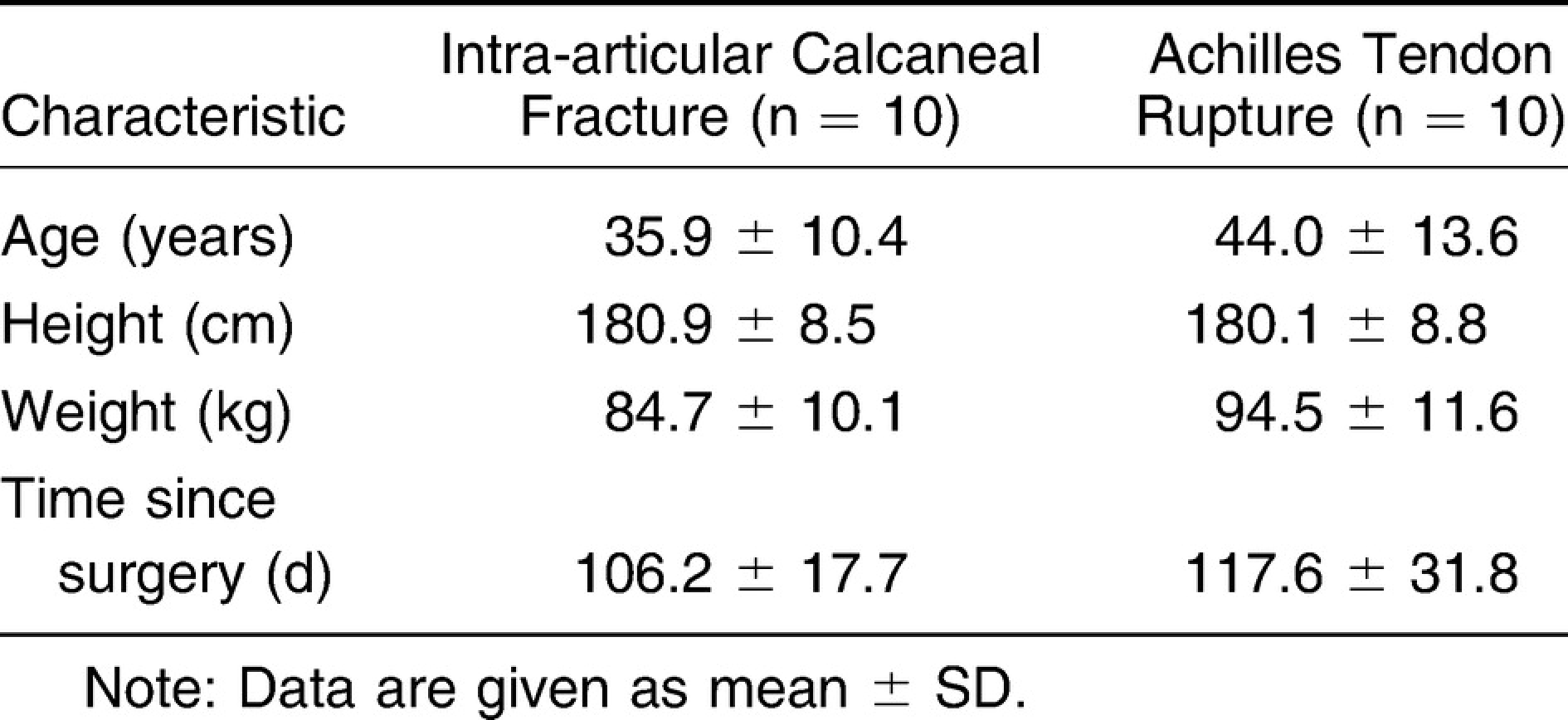
The mean age, height, and weight of the study groups are given in
Table 1. No significant differences (
P > .05) were observed between the two groups regarding age (
P = .151), height (
P = .842), weight (
P = .058), or days since surgery (
P = .364). The mean ± SD LEFS score for the HFX group (41.2 ± 13.5) was significantly (
P = .007) less than that for the ATR group (56.9 ± 0.4).
Table 1.
Demographic Characteristics of the 20 Study Participants by Group
Table 1.
Demographic Characteristics of the 20 Study Participants by Group
The result of the two-way ANOVA test for the transformed FPI scores showed that the main effect of groups was not significant (
P = .852), but the main effect for extremity indicated that regardless of group membership, the involved extremity was significantly (
P = .050) less pronated than the uninvolved extremity. No significant (
P = .635) interaction was found between the two groups and the two extremities (
Table 2).
Table 2.
Stance Duration and Foot Posture Index Values by Group and Extremity
Table 2.
Stance Duration and Foot Posture Index Values by Group and Extremity
The HFX group was found to have significantly (
P = .009) slower gait velocity compared with the ATR group. The mean ± SD gait velocity for the HFX group was 0.70 ± 0.23 m/s and for the ATR group was 1.03 ± 0.26 m/s. The mean stance durations for each group and for the involved and uninvolved extremities for the two groups are shown in
Table 2. The two-way ANOVA test on stance phase duration showed that the HFX group had significantly (
P = .034) longer stance phase durations compared with the ATR group and that significantly (
P = .001) less time was spent on the involved foot compared with the uninvolved foot regardless of the group. The two-way interaction for this analysis was found to be significant (
P = .010), indicating that the less time spent on the involved extremity compared with the uninvolved extremity was only for the HFX group and not for the ATR group (
Table 2).
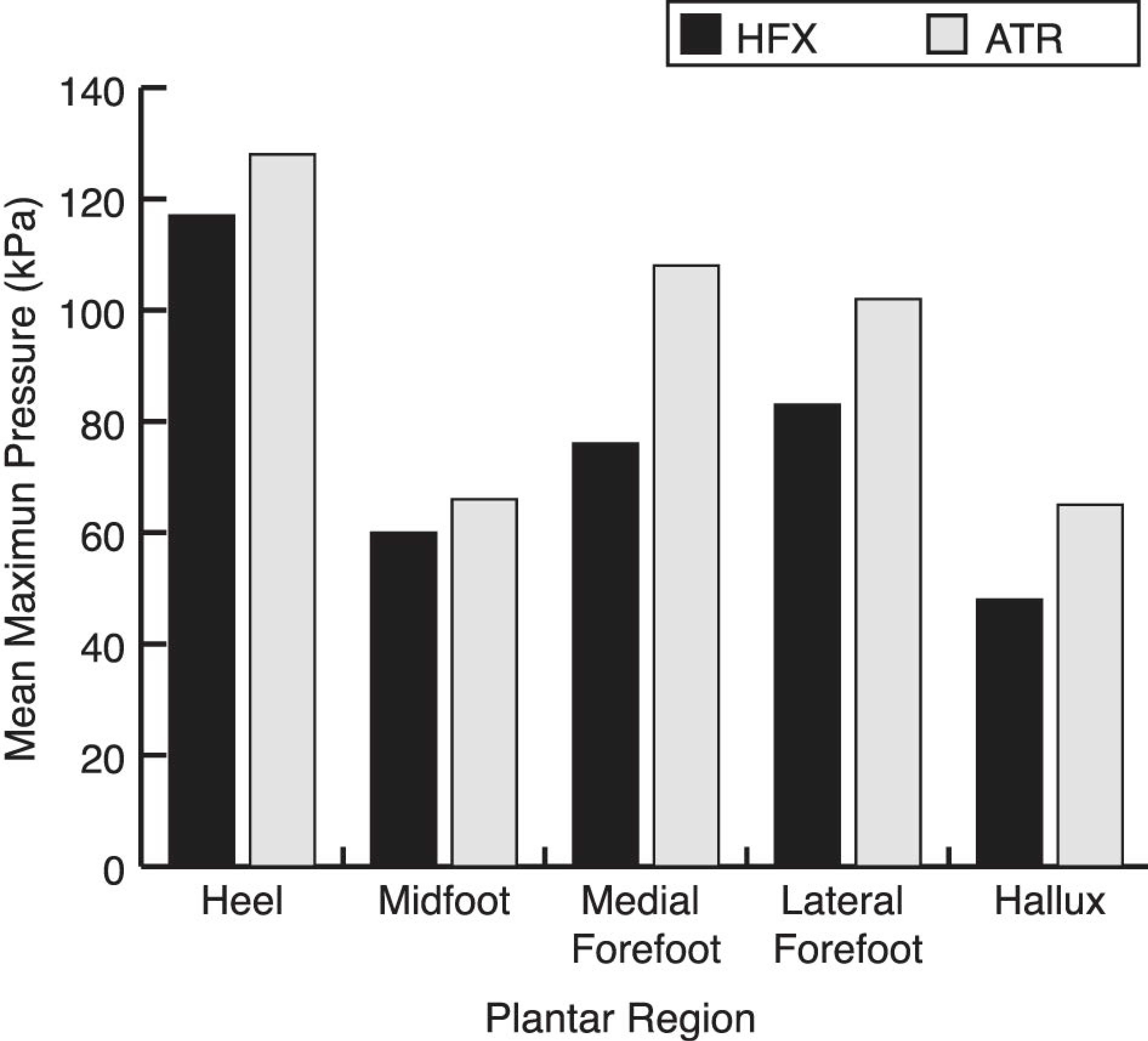
The mean maximum plantar pressure values for the two groups and each extremity in each of the plantar regions are shown in
Table 3 and
Fig. 2. The two-way ANOVA test showed that there was no significant difference between the two groups (
P = .562) or between the two extremities (
P = .180) for the heel region. In addition, there was no significant (
P = .062) interaction between the groups and the extremities for the heel region.
Table 3.
Maximum Plantar Pressures by Group and Extremity for the Five Plantar Regions Studied
Table 3.
Maximum Plantar Pressures by Group and Extremity for the Five Plantar Regions Studied
Figure 2.
Mean maximum plantar pressures in each of the five plantar regions of the foot for the intra-articular calcaneal fracture (HFX) and Achilles tendon rupture (ATR) groups.
Figure 2.
Mean maximum plantar pressures in each of the five plantar regions of the foot for the intra-articular calcaneal fracture (HFX) and Achilles tendon rupture (ATR) groups.
For the midfoot region, mean maximum plantar pressure was found to be significantly (
P = .028) lower in the HFX group compared with the ATR group, and there was no significant (
P = .068) difference between the two extremities. There was, however, a significant (
P = .004) interaction between the groups and the extremities (
Table 3 and
Fig. 2). This significant interaction indicated that there was a greater difference in mean maximum pressure of the midfoot between the involved and uninvolved extremities for the HFX group compared with the ATR group.
For the medial forefoot region, mean maximum plantar pressure was found to be significantly (
P = .031) less in the HFX group compared with the ATR group. In addition, the medial forefoot region mean maximum plantar pressure for the involved extremity was significantly (
P = .000) less than that for the uninvolved extremity, regardless of group membership. Finally, there was no significant (
P = .716) interaction between the groups and the extremities (
Table 3 and
Fig. 2).
For the lateral forefoot region, mean maximum plantar pressure was found to be significantly (
P = .027) less in the HFX group compared with the ATR group. In addition, the lateral forefoot region mean maximum plantar pressure for the involved extremity was significantly (
P = .002) less than that for the uninvolved extremity, regardless of group membership. Finally, there was no significant interaction (
P = .965) between the two groups and the two extremities (
Table 3 and
Fig. 2).
To help further understand the loading of the medial and lateral forefoot in each of the two groups, a series of correlated t tests was performed to determine whether the mean maximum pressure in the medial forefoot was different from that in the lateral forefoot. The results of those tests showed that the maximum pressure in the medial forefoot was significantly (P = .017) less than that in the lateral forefoot for the involved extremity of the HFX group but not the ATR group (P = .205). Furthermore, the maximum pressure in the medial and lateral forefoot regions was not significant for the involved (P = .911) or the uninvolved (P = .197) extremity.
For the hallux region, mean maximum plantar pressure was found to be significantly (
P = .027) less in the HFX group compared with the ATR group. In addition, the mean maximum plantar pressure for the involved extremity was significantly (
P = .018) less than that for the uninvolved extremity, regardless of group membership. Finally, there was a significant (
P = .004) interaction between groups and extremities, indicating that the difference between the involved and uninvolved extremities was greater in the HFX group compared with the ATR group (
Table 3 and
Fig. 2).
Discussion
The intent of this study was to determine the differences in functional levels, temporal characteristics, and plantar pressure patterns during walking for individuals who have had operative fixation of an HFX compared with those who have undergone an ATR repair. Based on the findings of previously published studies that had investigated either HFX or ATR, we developed three hypotheses. We hypothesized those individuals undergoing operative fixation of an HFX are more likely to report lower LEFS scores and have a less pronated foot posture on the involved side compared with those who have undergone ATR. Our rationale for this hypothesis was that individuals with an HFX would have significantly greater loss of hindfoot range of motion on the involved side compared with those with an ATR, leading to a lower level of function and a loss of foot mobility. Based on the results of this study, the mean LEFS score for the HFX group was statistically significantly lower than that for the ATR group. The transformed FPI scores were also lower for the involved side compared with the noninvolved side, irrespective of the group. Thus, while the level of function for the HFX group was lower than that for the ATR group, the involved foot for both groups was significantly less pronated than the noninvolved foot. Although we did not assess foot mobility in this study, because the FPI has previously been shown to be correlated with foot mobility, [
20] one could speculate that the amount of mobility of the involved foot for both groups was also decreased. The difference in the LEFS score between the HFX and ATR groups in the present study was 15.7 points. The minimal clinically important difference for the LEFS score is 9 points, [
15] which indicates that there was not only a statistically significant difference in function between the two groups but also a clinical difference. As a result, the hypotheses regarding the FPI and the LEFS were supported by the results of this study.
We also hypothesized that individuals who have undergone operative fixation after HFX demonstrate a slower overall walking velocity and a shorter stance phase duration on the involved side compared with those who have undergone an ATR repair. The findings of this study support both hypotheses in that the walking velocity was significantly slower for the HFX group compared with the ATR group, and the HFX group spent less time on the involved foot than on the uninvolved foot. There was no difference in the time spent on the involved versus the uninvolved foot for the ATR group. The slower gait velocity and the lack of symmetry in contact time between the involved versus uninvolved foot not only is in agreement with the previous research findings but also provides further evidence to support the reduction in the functional levels in the HFX group. [
8] The results of the present study regarding step duration and gait speed after ATR, however, are in contrast to the previous literature, indicating that there were no differences between the involved and uninvolved extremities. [
12,
13] This observed difference could be related to the fact that the present study involved patients approximately 3.5 months after surgery, whereas the other studies looked at individuals 6 or more months after surgery. As such, it is possible that walking speed and stance phase duration eventually equilibrate after rehabilitation in individuals who have ruptured the Achilles tendon.
The results of the present study show that there was no difference in the mean maximum pressure for the heel region between the involved and noninvolved feet or between the HFX and ATR groups. In the midfoot region, although there was no difference in mean maximum pressure between the involved and noninvolved feet for either the HFX or the ATR group, midfoot pressure was lower in the HFX group compared with the ATR group.
As previously discussed, two of the three previous studies that have assessed plantar pressures in individuals after operative fixation of an HFX reported decreased peak plantar pressures in the medial forefoot and increased pressures in the lateral forefoot. [
6,
8] The results of the present study support the previously published literature for the involved extremity but not the uninvolved extremity. Medial and lateral forefoot pressures for the HFX group were significantly less than those for the ATR group, with pressure values for the involved foot also significantly less than those for the noninvolved foot for both groups. Mean maximum pressures were 28% higher in the lateral forefoot compared with the medial forefoot for the HFX group.
In the only study to assess pressures in individuals with an operatively repaired ATR, Mezzarobba et al [
13] reported a decrease in forefoot pressures. The results of the present study show that medial and lateral forefoot pressures were statistically significantly higher in the AFR group compared with the HFX group. In addition, there was no difference between the medial and lateral forefoot regions, regardless of the extremity examined.
As expected, the forefoot pressures were significantly lower in the medial and lateral forefoot regions for the involved foot compared with the noninvolved foot of the ATR group. The forefoot pressures in the involved foot for the ATR group were almost identical: the medial forefoot pressure was 83.0 kPa and the lateral forefoot pressure was 84.6 kPa (
Table 3 and
Fig. 2). The findings in the hallux were similar to those in the forefoot region in that maximum plantar pressure was less in the HFX group compared with the ATR group. These findings support the third hypothesis that the HFX group has decreased pressures in the medial forefoot region and increased pressures in the lateral forefoot region, whereas the ATR group has a symmetrical pressure reduction in both forefoot regions.
The fact that lateral forefoot pressures were increased while medial forefoot and hallux pressures were decreased in the HFX group supports the previous findings of Rosenbaum et al [
6] and Hirschmuller et al [
8] that after open reduction and internal fixation for an HFX, individuals adopt a more lateral loading pattern when walking. This is further supported by the findings of Jansen et al, [
25] who showed that after HFX, individuals had lateralization of their gait line during walking. The fact that this seems to begin so early in the rehabilitation process (3.5 months after the surgical intervention) supports the need to use interventions, including manual therapy, foot orthotic devices, and footwear modifications, in an attempt to facilitate greater loading of the medial foot.
The reduction in mean maximum plantar pressures in the medial and lateral forefoot regions of the involved foot of the HFX and ATR groups also indicates that the propulsion phase is reduced in these individuals, most likely secondary to calf muscle weakness and a lack of foot mobility. These findings are in agreement with those reported by Mezzarobba et al, [
13] who assessed individuals 2 years after an ATR operative repair.
In addition to the small number of participants being a limitation of the present study, data collection occurred over a shorter period and occurred soon after the patients were allowed to begin using a walking boot. In contrast, previous studies have focused on assessing plantar pressure and temporal gait characteristics in individuals after HFX or ATR 1 to 5 years after operative intervention. Although waiting to assess the effectiveness of surgery and rehabilitation for this extended period can provide important information regarding long-term outcomes, an important goal of this study was to assess foot posture, walking speed, and plantar pressure in the early stages of the rehabilitation program. Assessment of these variables early in the rehabilitation process is critical for selecting the most effective conservative interventions, including manual therapy, foot orthoses, and footwear. Although further research is always necessary, in our opinion, the use of these conservative interventions can have a major effect on the patient's long-term outcomes.