Magnetic resonance imaging (MRI) plays a major role in diagnosing pathologic abnormalities in the foot and ankle because of its superiority over other imaging modalities in revealing normal anatomy and pathologic abnormalities in the soft tissues.
Tendons are acellular and are composed of dense collagen that is well organized. On MRI, tendons should have low, homogenous signal intensity. One of the complexities associated with MRI is the magic angle artifact (MAA).
Magic angle refers to an artifactual increase in T2 relaxation time (with a corresponding increase in signal in normal tendons), which can mimic tendinopathy/tendinosis or partial tears. The degree of MAA, also cited as the magic angle effect, depends on the orientation of the tendons relative to the main magnetic field, B
0 [
1]. The maximum influence of this phenomenon occurs when a tendon is 55° from the B
0 [
2]. The phenomenon is also increased when short TE imaging is used, as in T1- or proton density–weighted imaging [
3]. It has also been discussed that short tau inversion recovery imaging has higher sensitivity for visualizing tendon abnormalities and reducing the effects of the magic angle versus fast spin-echo imaging [
4].
Standard MRI of the foot and ankle is performed with the patient supine and with the foot at a right angle to the lower leg [
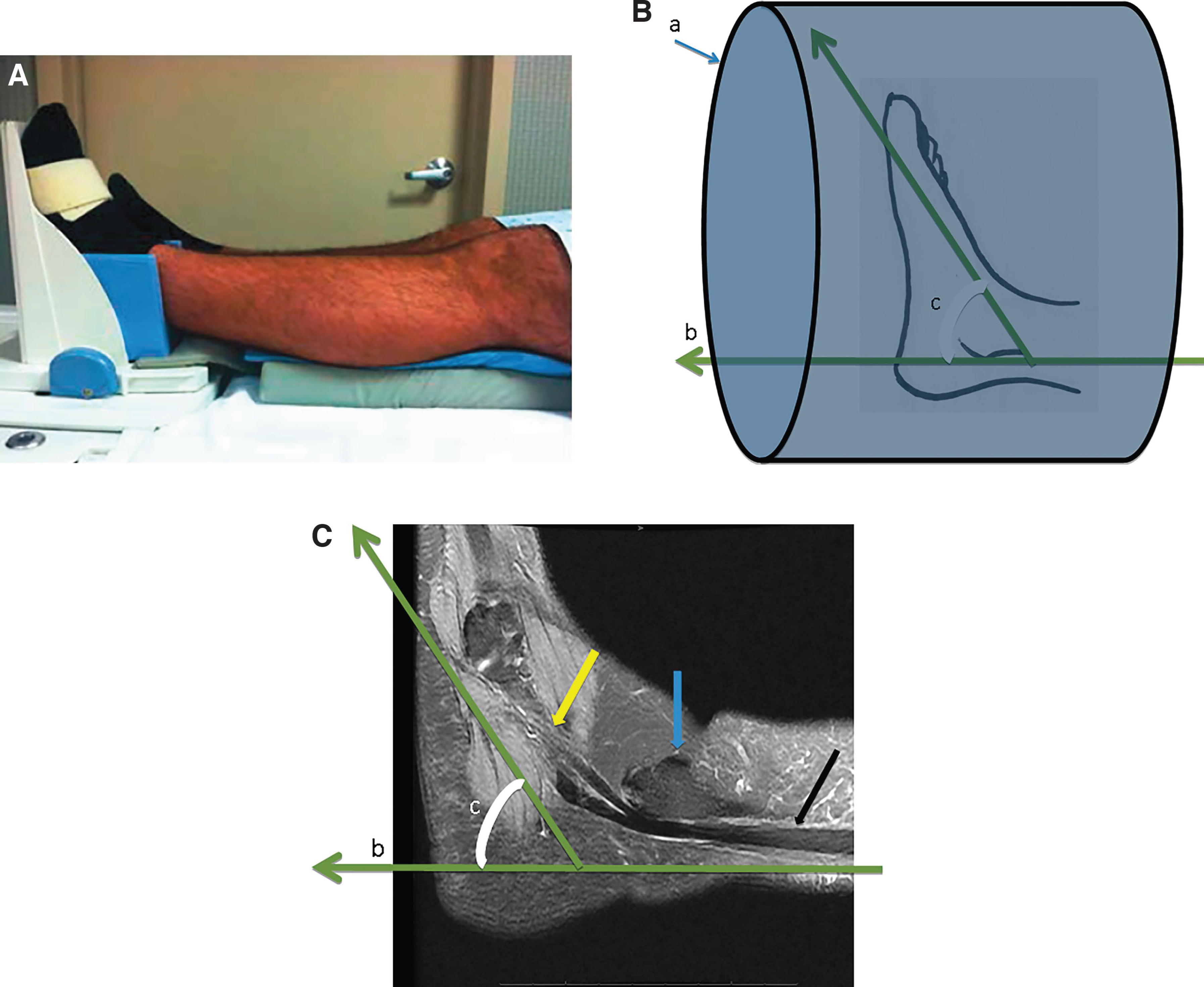
5]. When the patient is in a supine position, the peroneal tendons are configured at approximately a 90° angle as they pass posterior to the lateral malleolus (
Figure 1). There are numerous references in the literature stating that foot plantarflexion decreases the MAA in ankle tendons with 1.5-T imaging [
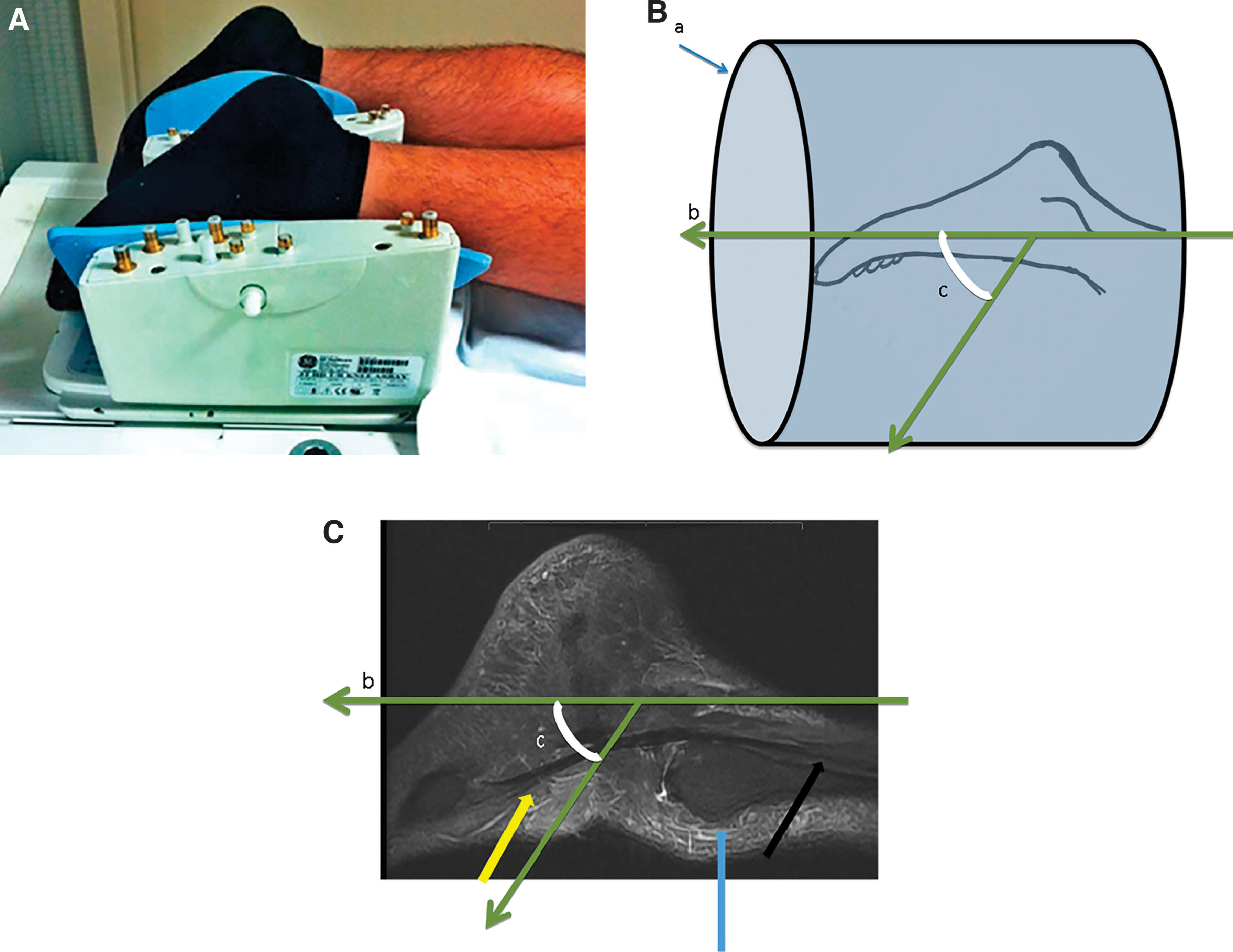
6]. Plantarflexion straightens the tendons and decreases the likelihood of magic angle influence (
Figure 2). To our knowledge, there are no reports describing the effects of plantarflexion on the magic angle in ankle tendons with 3T imaging. We present case examples in which peroneal tendon pathology was indeterminate on standard imaging and only after subsequent imaging in the prone plantarflexed position could the abnormalities be either ruled out or confirmed. In addition, we provide a case only in plantarflexion that shows how clearly pathologic abnormalities can be visualized using the prone plantarflexed position on a 3T imaging system, with surgical correlation.
Figure 1.
Standard ankle coil. A, Picture of ankle position in the standard ankle coil (coil top removed to show ankle) with the patient supine. Schematics of the ankle as it would be in the magnetic resonance imaging (MRI) bore in the standard supine right angle position (B) and the corresponding single sagittal MRI slice through the peroneal tendons (C). a indicates MRI bore; b, direction of magnetic force (B0); and c, 55° relative to B0. The lateral malleolus is indicated by a blue arrow; the proximal peroneal tendons by a black arrow, and the distal peroneal tendons by a yellow arrow. Note how the course of the distal peroneal tendons in the standard position closely approximates the 55° angle, increasing magic angle artifact.
Figure 1.
Standard ankle coil. A, Picture of ankle position in the standard ankle coil (coil top removed to show ankle) with the patient supine. Schematics of the ankle as it would be in the magnetic resonance imaging (MRI) bore in the standard supine right angle position (B) and the corresponding single sagittal MRI slice through the peroneal tendons (C). a indicates MRI bore; b, direction of magnetic force (B0); and c, 55° relative to B0. The lateral malleolus is indicated by a blue arrow; the proximal peroneal tendons by a black arrow, and the distal peroneal tendons by a yellow arrow. Note how the course of the distal peroneal tendons in the standard position closely approximates the 55° angle, increasing magic angle artifact.
Figure 2.
Prone plantarflexed coil. A, Picture of ankle in the prone plantarflexed position using a knee coil. Schematics of the ankle as it would be in the magnetic resonance imaging (MRI) bore in the prone plantarflexion position (B) and the corresponding single sagittal MRI slice through the peroneal tendons (C). a indicates MRI bore; b, direction of magnetic force (B0); and c, 55° relative to B0. The lateral malleolus is indicated by a blue arrow; the proximal peroneal tendons by a black arrow; and the distal peroneal tendons by a yellow arrow. Note how the course of the distal peroneal tendons in the prone plantarflexion position is more parallel to B0, decreasing magic angle artifact.
Figure 2.
Prone plantarflexed coil. A, Picture of ankle in the prone plantarflexed position using a knee coil. Schematics of the ankle as it would be in the magnetic resonance imaging (MRI) bore in the prone plantarflexion position (B) and the corresponding single sagittal MRI slice through the peroneal tendons (C). a indicates MRI bore; b, direction of magnetic force (B0); and c, 55° relative to B0. The lateral malleolus is indicated by a blue arrow; the proximal peroneal tendons by a black arrow; and the distal peroneal tendons by a yellow arrow. Note how the course of the distal peroneal tendons in the prone plantarflexion position is more parallel to B0, decreasing magic angle artifact.
MRI Protocol
All MRI was performed on a 3T GE system (GE Discovery 750 or GE XT Signa HDxt; GE Healthcare, Waukesha, Wisconsin). Initial imaging was performed using a standard ankle protocol, which included supine positioning and angling of the foot at approximately 90° relative to the leg (
Figure 1). A dedicated HD foot/ankle coil was used. Sequences obtained included T1 non–fat saturated in the axial plane; proton density fat saturated in the axial, coronal, and sagittal planes; and proton density non–fat saturated in the coronal and sagittal planes. Axial proton density fat-saturated sequences were analyzed for this study and had the following parameters: repetition time, approximately 3420 msec; echo time, approximately 45 msec; echo train, 7; and bandwidth, approximately 31.25 Hz. Precise values differed slightly depending on the machine and patient anatomy. Follow-up imaging was performed with the same 3T imaging systems in a prone position with the foot angled 50° to 70° plantarflexed relative to the neutral, 90° position (140°–160° angle relative to the leg). Images were acquired with an HD knee coil. Axial proton density fat-saturated sequences and axial T1 non–fat-saturated sequences were obtained with the same parameters as detailed previously herein.
Case 1
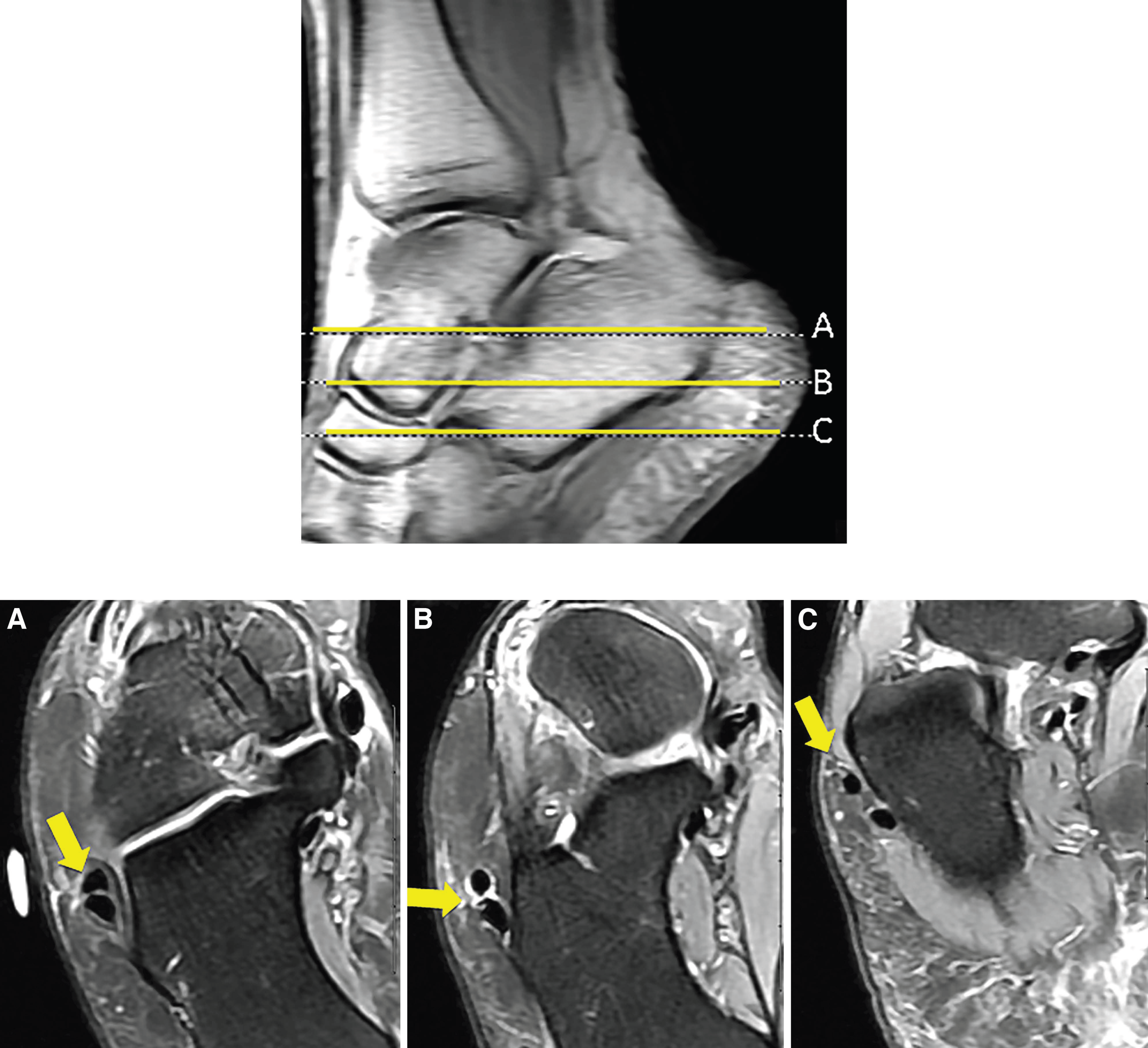
A 41-year-old woman with a medical history of gastroesophageal reflux disease, duodenal ulceration, and insomnia presented to a local foot and ankle surgeon with right ankle pain. The patient reported running approximately 3 weeks earlier, when she developed sudden pain after twisting her ankle. The patient did not respond to 1 month of conservative treatment consisting of rest, ice, elevation, and compression with an ankle brace, which she had received at the local urgent care facility. At the initial time of the injury, plain films were obtained that were negative for any fractures or dislocations. Physical examination showed crepitus with passive and active range of motion and mild pain over the lateral ankle ligaments. The patient was sent for MRI of her ankle to assess for a causative pathologic abnormality associated with lateral ankle pain and to rule out a possible osteochondral defect of the talus. Per the standard supine protocol earlier described, the patient had an MRI that showed thickening of the anterior talofibular ligament in addition to hyperintensity in the peroneal tendons (
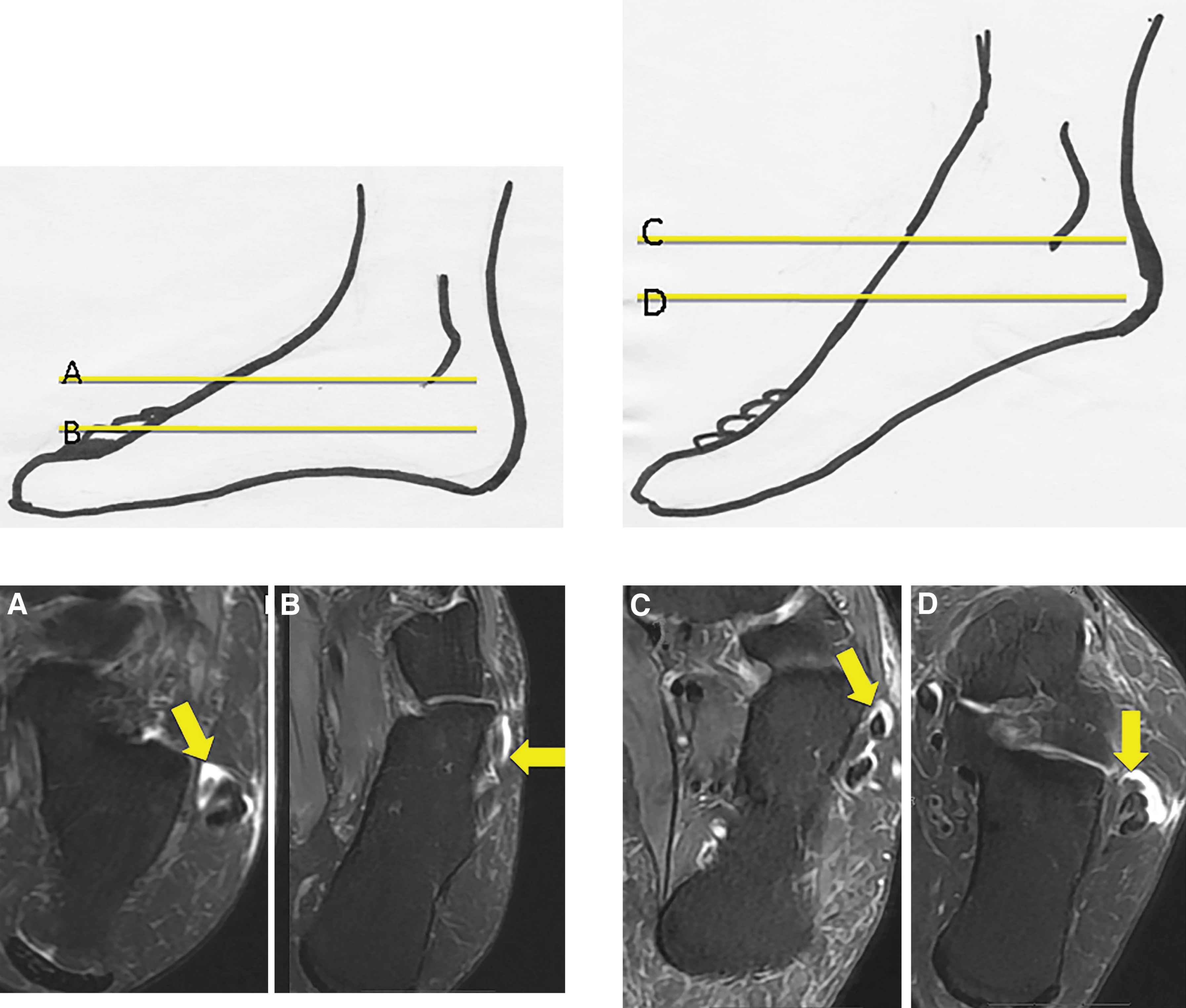
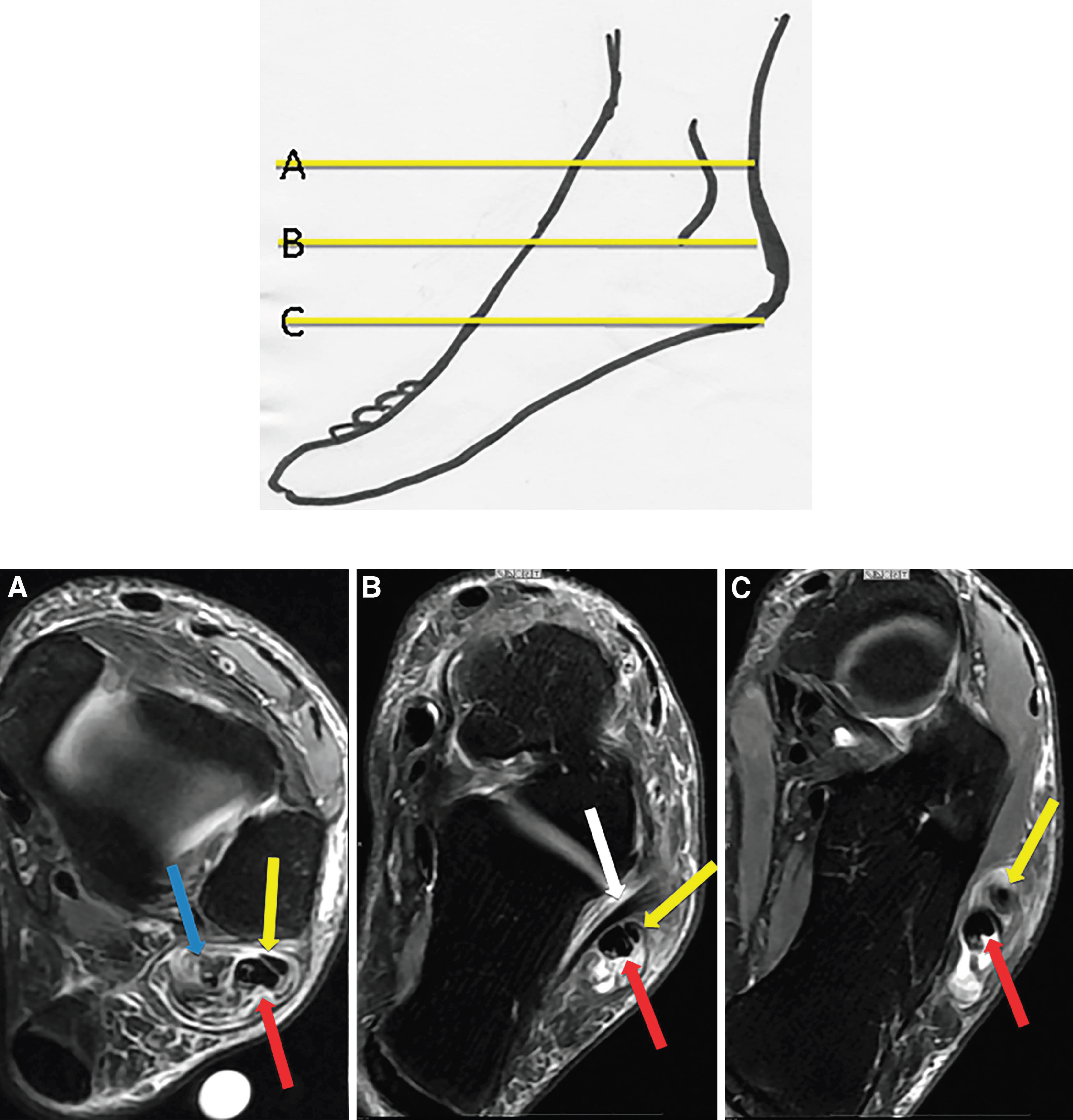
Figure 3). It could not be determined whether the peroneal tendon hyperintensity was due to tendinopathy/tendinosis or MAA. Therefore, the patient returned to the radiology center 2 days later for prone plantarflexion imaging, which showed no intratendinous pathologic abnormalities and minimal tenosynovitis surrounding the tendon (
Figure 4). The patient was instructed to avoid impact activities, and she started physical therapy. With 16 sessions of physical therapy, the patient had complete symptom resolution 8 months after the initial injury.
Figure 3.
Case 1: Sagittal imaging. Sagittal scout image in the standard supine right angle position (A) showing planes for three corresponding axial proton density fat-saturated images (B, C, and D) through the normal peroneal tendons. Note the hyperintensity in the peroneal tendons due to magic angle artifact (yellow arrows). Compare this with the low-signal appearance of the normal peroneal tendons in the prone plantarflexion images (
Figure 4).
Figure 3.
Case 1: Sagittal imaging. Sagittal scout image in the standard supine right angle position (A) showing planes for three corresponding axial proton density fat-saturated images (B, C, and D) through the normal peroneal tendons. Note the hyperintensity in the peroneal tendons due to magic angle artifact (yellow arrows). Compare this with the low-signal appearance of the normal peroneal tendons in the prone plantarflexion images (
Figure 4).
Figure 4.
Case 1: No pathology. Sagittal scout image in the prone plantarflexion position (A) showing planes for three corresponding axial proton density fat-saturated images (B, C, and D) through the normal peroneal tendons. Peroneal tendons with normal low-signal appearance (yellow arrows). Trace peroneal tenosynovitis is also noted on image C.
Figure 4.
Case 1: No pathology. Sagittal scout image in the prone plantarflexion position (A) showing planes for three corresponding axial proton density fat-saturated images (B, C, and D) through the normal peroneal tendons. Peroneal tendons with normal low-signal appearance (yellow arrows). Trace peroneal tenosynovitis is also noted on image C.
Case 2
A 53-year- old woman with a medical history of hypertension, asthma, HLD, and chronic pedal problems presented to a local foot and ankle surgeon with left ankle pain. The patient had bilateral cavovarus deformity and had undergone a calcaneal osteotomy on the right approximately 2 years earlier. She denied any acute inciting injury but reported increased lateral-sided pain. Initial imaging in the standard supine right angle position showed mild peroneal tenosynovitis and hyperintensity in the peroneus longus and brevis tendons. It could not be determined whether the hyperintensity in the peroneal tendons was due to tendinopathy/tendinosis, partial tear, or MAA. Therefore, the patient returned for prone plantarflexion imaging, which was performed later the same day. This showed a small partial tear of the peroneus brevis tendon at the level of the lateral malleolus, mild tendinosis of the peroneus longus and brevis tendons, and mild peroneal tenosynovitis (
Figure 5). The patient followed up with her physician, was instructed to be weightbearing as tolerated in a CAM walker, and was followed up in 6 weeks. Secondary to loss of insurance, the patient never received further treatment and reported substantial lateral pain 6 months later.
Figure 5.
Case 2: True pathology. A–C, Axial proton density fat-saturated images from two levels in the supine standard right angle position demonstrating indeterminate hyperintensity in the peroneal tendons. D–F, Axial proton density fat-saturated images obtained from the prone plantarflexion position in the same patient confirming the abnormal hyperintense signal in the peroneal tendons, indicating tendinopathy/tendinosis. Peroneal tenosynovitis is also noted.
Figure 5.
Case 2: True pathology. A–C, Axial proton density fat-saturated images from two levels in the supine standard right angle position demonstrating indeterminate hyperintensity in the peroneal tendons. D–F, Axial proton density fat-saturated images obtained from the prone plantarflexion position in the same patient confirming the abnormal hyperintense signal in the peroneal tendons, indicating tendinopathy/tendinosis. Peroneal tenosynovitis is also noted.
Case 3
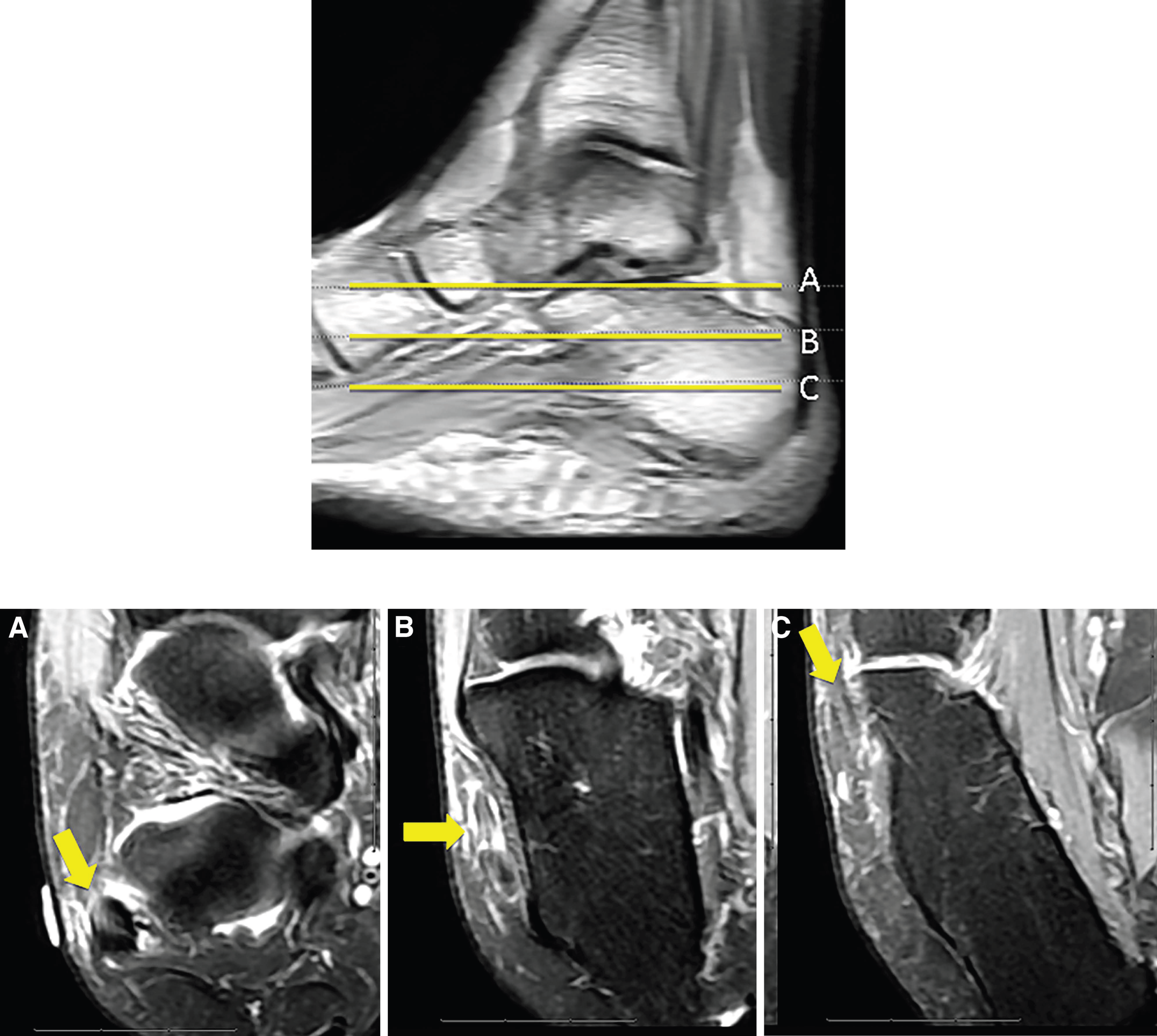
A 53-year-old man with a medical history of tendinitis of the patellar tendon and Achilles tendon presented to a foot and ankle surgeon for evaluation of left ankle pain. The patient had pain for 10 years; however, he reported increased activity and hearing a pop on a 5-mile walk 2 days before presentation. On physical examination, pes cavus deformity was noted, with pain along the peroneal tendons. The patient received an injection in the peroneal sheath and was referred to our facility for imaging of the left ankle. The MRI was performed entirely in the prone plantarflexed position and showed a split tear of the peroneus brevis tendon at the level of the distal fibula and a complete tear at the retromalleolar groove, with an exuberant tendinous scar, granulation tissue, and complex tenosynovitis (
Figure 6). Imaging also showed tendinosis and a longitudinal partial tear of the peroneus longus tendon and mild degeneration of the peroneal retinaculum. The patient was taken to the operating room approximately 2 weeks later, where a calcaneal osteotomy was performed to correct his rearfoot varus deformity along with peroneus longus tendon debridement with tubularization and left peroneus brevis tenodesis. The patient had a standard postoperative course and was placed in University of California Biomechanics Laboratory orthoses, with no peroneal pain 10 months after initial presentation.
Figure 6.
Case 3: Prone plantarflexed pathology with surgery. A, Three axial proton density fat-saturated images were obtained in the prone plantarflexion position. There is diffuse peroneal tenosynovitis. B, Just above the lateral malleolus is a longitudinal split partial tear of the peroneal brevis. The medialized tear fragment shows degeneration with extensive interstitial tearing (blue arrow). Lateralized tear fragment is shown by the yellow arrow. The peroneus longus tendon (red arrow) has mild tendinosis with interstitial partial tearing and is invaginated between the medial and lateral tear fragments of the peroneus brevis tendon. C, Just below the lateral malleolus is a complete tear of the medialized tear fragment. The lateralized tear fragment (yellow arrow) remains intact just lateral to peroneus longus tendon (red arrow). Note the intact calcaneofibular ligament (white arrow). D, Distal image showing the distal peroneus longus tendon (red arrow) and the lateralized tear fragment of the peroneus brevis tendon (yellow arrow) and marked peroneal tenosynovitis.
Figure 6.
Case 3: Prone plantarflexed pathology with surgery. A, Three axial proton density fat-saturated images were obtained in the prone plantarflexion position. There is diffuse peroneal tenosynovitis. B, Just above the lateral malleolus is a longitudinal split partial tear of the peroneal brevis. The medialized tear fragment shows degeneration with extensive interstitial tearing (blue arrow). Lateralized tear fragment is shown by the yellow arrow. The peroneus longus tendon (red arrow) has mild tendinosis with interstitial partial tearing and is invaginated between the medial and lateral tear fragments of the peroneus brevis tendon. C, Just below the lateral malleolus is a complete tear of the medialized tear fragment. The lateralized tear fragment (yellow arrow) remains intact just lateral to peroneus longus tendon (red arrow). Note the intact calcaneofibular ligament (white arrow). D, Distal image showing the distal peroneus longus tendon (red arrow) and the lateralized tear fragment of the peroneus brevis tendon (yellow arrow) and marked peroneal tenosynovitis.

Discussion
Many foot and ankle surgeons use MRI for diagnosis and surgical planning. If left unrecognized, MAA can impede the diagnostic accuracy of imaging in the ankle. Using patients as their own internal controls, we demonstrated that when the patient is prone and plantarflexed during imaging, there is less artifactual abnormal signal in the peroneal tendons, resulting in an improved ability to define pathologic abnormalities. To our knowledge, this is the only article that describes MAA effects in the ankle using 3T imaging and in a clinical practice setting.
There has been a substantial amount of literature discussing magic angle effects and the accuracy of MRI for diagnosing true peroneal tendon pathologic abnormalities. Park et al. [
7] looked at 97 patients with lateral ankle instability who underwent MRI with surgical correlation. The MRI was very accurate at measuring peroneus brevis split tears, peroneus brevis swelling, peroneus longus interstitial tears, peroneus longus swelling, fluid collection, and dislocation greater than 95%; however, normal MRI findings were only 88% accurate, with 97% sensitivity and 68% specificity [
7].
Mengiardi and Pfirrmann [
1], in 2006, looked at 30 patients and five cadavers to evaluate the effects of MAA with patients in the prone and supine positions. The authors showed that MAA occurred significantly more in the supine versus the prone position, with magic angle effect presenting in the peroneus brevis tendon of all 30 patients and in the peroneus longus tendon in 23 of 30 when the patient was supine. Magic angle effect was present in both peroneal tendons in only one patient in the prone and plantarflexed position. These results are consistent with the present findings; however, a 1.5-T system was used, and no imaging was presented of the same patient.
From the cases described herein and through further clinical experience, we now believe that the diagnostic accuracy of ankle MRI in the prone plantarflexed position is superior to that in the standard supine right angle position. We consequently changed our standard ankle MRI protocol at our facility to the prone plantarflexed position. This imaging technique can be even more advantageous with persistent pain after surgery to determine whether a new pathologic abnormality has developed. However, the standard supine right angle position is still used when either Achilles tendon or plantar fascia injury is suspected because these structures become lax in plantarflexion, which decreases diagnostic accuracy.
Conclusions
The MAA can be a substantial problem in the MRI evaluation of suspected peroneal tendon pathologic abnormality. The inability to determine pathologic versus normal anatomical findings can lead to a delayed or inaccurate diagnosis. These problems are reduced through use of the prone plantarflexed position with 3T imaging.
Financial Disclosure: None reported.
Conflict of Interest: None reported.