The relationship between hyperglycemia and adverse outcomes after surgery has been widely documented, particularly regarding infectious complications.[
1-
7] Most of these studies have focused on patients with a history of diabetes mellitus. Patients with diabetes mellitus are at a higher risk for infection compared with those without diabetes. Long-term glucose control as measured by hemoglobin A
1c (HbA
1c) level has been recognized as a major risk factor after coronary artery procedures and myocardial infarction and for a significantly higher incidence of 30-day morbidity after vascular surgery procedures.[
6-
10] Similarly, perioperative hyperglycemia, measured by finger stick and serum glucose level, has been shown to be an independent risk factor for postoperative complications.[
1,
2,
5,
11] Moitra and colleagues[
12] documented the relationship between HbA
1c level and perioperative glucose control in noncardiac surgery patients. They found that long-term glycemic control affected perioperative glucose control and that patients with poor preoperative glycemic control (HbA
1c level ≥7% [≥53 mmol/mol]) had higher perioperative glucose levels compared with patients with HbA
1c levels less than 7% (<53 mmol/mol). They concluded that although perioperative glucose level was a stronger predictor of postoperative control, diabetic patients can be more easily screened with HbA
1c level well in advance of surgery.
In reviewing the foot and ankle literature in particular, there are few studies evaluating long-term glycemic control as a potential perioperative risk. Poorly controlled and complicated diabetes has been shown to be a significant risk factor for infection after foot and ankle surgery.[
13-
15] Myers and colleagues,[
13] in their comparison of ankle and hindfoot fusions in patients with and without diabetes, found that patients with diabetes and an HbA
1c level greater than or equal to 7% (≥53 mmol/mol) had a statistically significantly higher postoperative infection rate. The other studies considered cases involving treatment for diabetic foot infections. Younger et al[
15] determined that HbA
1c level was an important determinant of the healing rate after a transmetatarsal amputation. They determined that an HbA
1c level of 10% (86 mmol/mol) was a threshold above which healing was poor. They emphasized the necessity of obtaining HbA
1c levels on initial consultation, and they recommended delaying surgery until daily glycemic control was acceptable. Lepore et al[
16] found that patients who underwent amputation for diabetic foot ulcerations had a significantly higher HbA
1c level than those without amputation. Conversely, Aragon-Sanchez and Lazaro-Martinez[
17] determined in their study of surgical treatment of osteomyelitis in diabetic feet that perioperative glycemic control was a predictive factor for amputation, whereas long-term glycemic control was not.
Patients with diabetes mellitus, especially when the disease is poorly controlled, may have associated comorbid conditions that place them at higher risk for postoperative complications. Postoperative complications lead to higher health-care costs and poorer overall outcomes. To our knowledge, no previous multivariate analysis based on HbA1c levels of surgical outcomes of diabetic patients after a wide array of foot and ankle surgical procedures has been performed. Understanding the association between HbA1c and postoperative complications may help guide surgical decision making.
Research Design and Methods
The study was approved by the institutional review board of Scott and White Healthcare (Temple, Texas). A query of electronic medical records was performed to identify all of the diabetic patients who had undergone foot or ankle surgery between January 1, 2007, and December 31, 2011, at four Scott and White Healthcare facilities (Temple, Waco, Round Rock, and Bryan/College Station, Texas). We used
Current Procedural Terminology (
CPT 2008; American Medical Association, Chicago, Illinois) codes 27600 to 28899 and
International Classification of Diseases, Ninth Revision (World Health Organization, Geneva, Switzerland) codes 250.0 to 250.9 to extract the data from electronic medical records. Patient medical records were reviewed for inclusion and exclusion criteria (
Table 1). Multiple variables were then collected as noted in
Tables 2 and
3. Body mass index (BMI) (the weight in kilograms divided by the square of the height in meters) was calculated from the preoperative height and weight measurements recorded by an anesthesiologist.
Table 1.
Inclusion and Exclusion Criteria
Table 1.
Inclusion and Exclusion Criteria
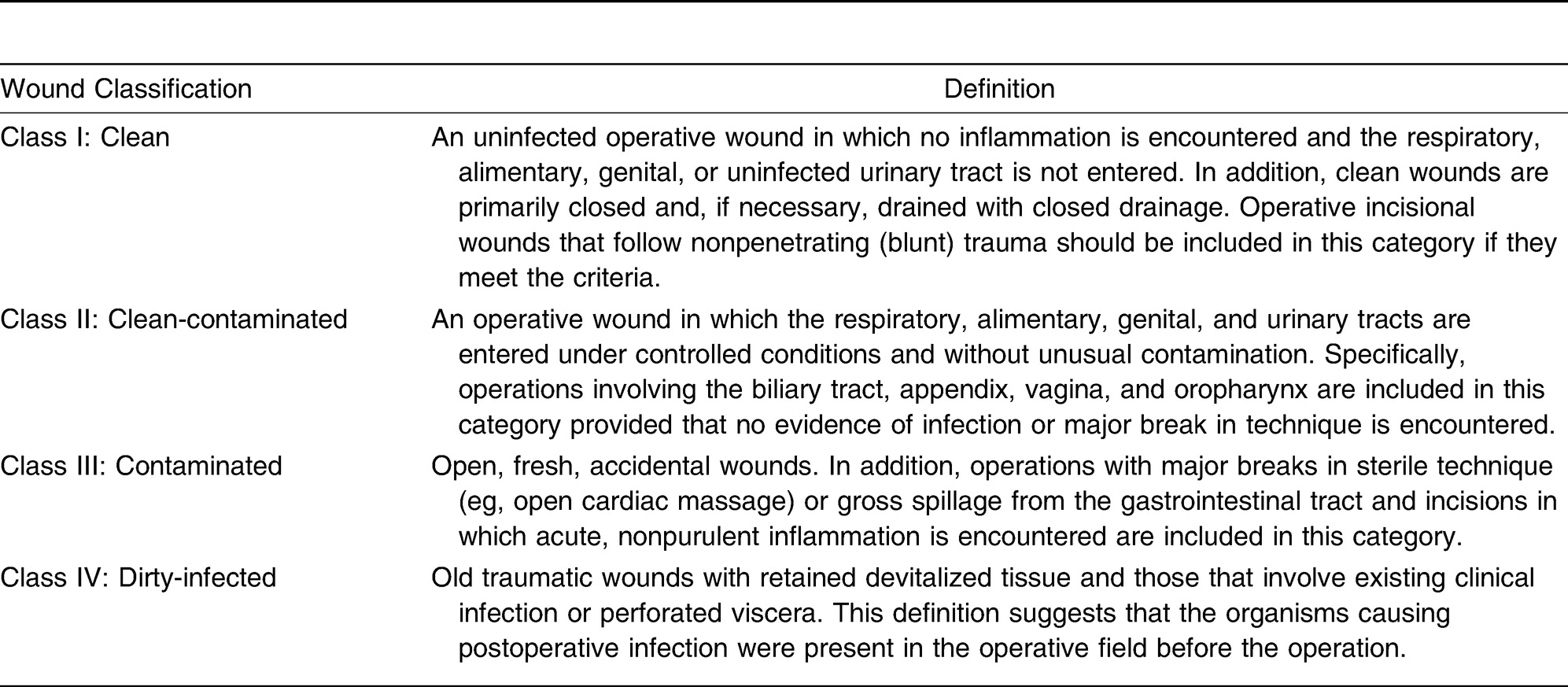
Table 2.
Surgical Wound Classification of Garner[
18] and Simmons[
19]
Table 2.
Surgical Wound Classification of Garner[
18] and Simmons[
19]
Table 3.
Perioperative, Intraoperative, and Postoperative Variables Collected
Table 3.
Perioperative, Intraoperative, and Postoperative Variables Collected
The diagnosis of diabetes mellitus was made during the preoperative evaluation on the basis of the history. All of the patients had to be receiving pharmacological therapy for diabetes to be included in the study. Medical records were used to determine the presence of the following comorbid conditions: peripheral neuropathy, previous foot ulceration, peripheral vascular disease, and smoking history. Patients were diagnosed as having peripheral sensory neuropathy if they had any sensory deficit noted, regardless of degree or the test used to diagnose neuropathy. Peripheral vascular disease was based on diagnosis or nonpalpable pulses. Patients were considered to have a positive tobacco history if they were currently smoking at their preoperative history and physical examination documented in the medical record. A postoperative infection was defined as an infection that occurred within 30 days after surgery. The severity of the surgical site infection was defined as superficial incisional and deep incisional as defined by the Centers for Disease Control and Prevention.[
20] Wound complications included wound dehiscence, hematoma/seroma, bulla formation, and persistent wound drainage more than 3 weeks after surgery.
Elective and emergency surgeries were included. Forefoot procedures included procedures for hallux valgus, hallux limitus, hammertoe correction, open reduction and internal fixation, metatarsal fractures (including Lisfranc fracture), lesser metatarsal osteotomies (metadductus correction, Weil osteotomies, Tailor bunionectomy, etc), neurectomies, soft-tissue mass excision (ganglion cyst, fibroma, etc), and tarsometatarsal joint arthrodesis. Rearfoot procedures included, but were not limited to, fracture repair (ankle, calcaneal, cuboid, etc), hindfoot arthrodesis (tibiotalocalcaneal, ankle, pantalar, triple, subtalar, pseudotriple, etc), Achilles tendon debridement/repair, tarsal tunnel release, ankle arthroplasty, plantar fascial release, and osteotomies (flatfoot or cavus foot reconstruction).
For patients who had a postoperative infection, a return to the operating room for subsequent surgical intervention was not included in the data analysis.
Results
A total of 3,795 patients were identified after an initial search of electronic medical records. After screening for the inclusion and exclusion criteria, we identified 322 patients with a diagnosis of diabetes mellitus who had undergone foot and ankle surgery. Most of the patients were excluded owing to lack of laboratory values, insufficient follow-up, having an infection or undergoing antibiotic drug therapy at the time of operation, or a combination of one or more of these factors. The age of the patients ranged from 29 to 80 years (mean ± SD, 60.2 ± 10.39 years). Of the patients, 225 were men (69.9%) and 97 were women (30.1%). There were 222 (68.9%), 57 (17.7%), 38 (11.8%), 2 (0.6%), 2 (0.6%), 1 (0.3%), and 0 white, other, African American, Hispanic, unknown, Asian, and American Indian patients, respectively. Two patients were missing BMI, and for the remainder, the mean ± SD BMI was 33.8 ± 7.56 (range, 19.2–59.6). Twenty-four (7.5%), 126 (39.1%), 49 (15.2%), 72 (22.4%), and 163 (50.6%) patients had peripheral vascular disease, peripheral neuropathy, a smoking history, a history of ulcer, or at least one of the previous comorbidities, respectively.
Surgery time was missing for 29 patients, and for the remainder the mean ± SD time was 75.1 ± 49.96 min (range, 3–327 min). The mean ± SD HbA1c value was 7.5% ± 1.65% (range, 4.8%–15.9%), or 58 mmol/mol. Glucose level was missing for 27 patients, and for the remainder the mean ± SD level was 160.6 ± 64.24 mg/dL (range, 41–572 mg/dL).
Of the procedures, 7 (2.2%), 186 (57.8%), and 129 (40.1%) were both forefoot and rearfoot/ankle, forefoot only, and rearfoot/ankle only, respectively. Sixty-three (19.6%), 199 (61.8%), and 60 (18.6%) of the procedures were both osseous and soft tissue, osseous only, and soft tissue only, respectively. According to the surgical wound classification in
Table 2, 287 (89.1%), 34 (10.6%), and 1 (0.3%) were clean, clean-contaminated, or other, respectively. There were 3 deep venous thrombosis/pulmonary emboli (0.9%).
There were 74 superficial (23.0%) and 19 deep (5.9%) postoperative infections and 229 procedures (71.1%) with no infection. This is a total of 93 infections (28.9%). There were 116 other wound complications (36.0%). Five patients (1.6%) developed Charcot arthropathy. There were 11 ipsilateral amputations (3.4%).
Bivariate Analyses
Infection
Of the 159 patients with no comorbidity, 34 (21.4%) had an infection, and among the 163 patients with at least one comorbidity, 59 (36.2%) had a complication. This was χ[
2] test significant (
P = .003). The mean ± SD HbA
1c level in patients with infection was 8.3% ± 1.89%, or 67 mmol/mol, and in those without complication, it was 7.2% ± 1.44%, or 55 mmol/mol. This was
t test significant (
P < .001). The remaining variables were not statistically significant (
Table 4).
Table 4.
Bivariate Analysis of Infection Complication
Table 4.
Bivariate Analysis of Infection Complication
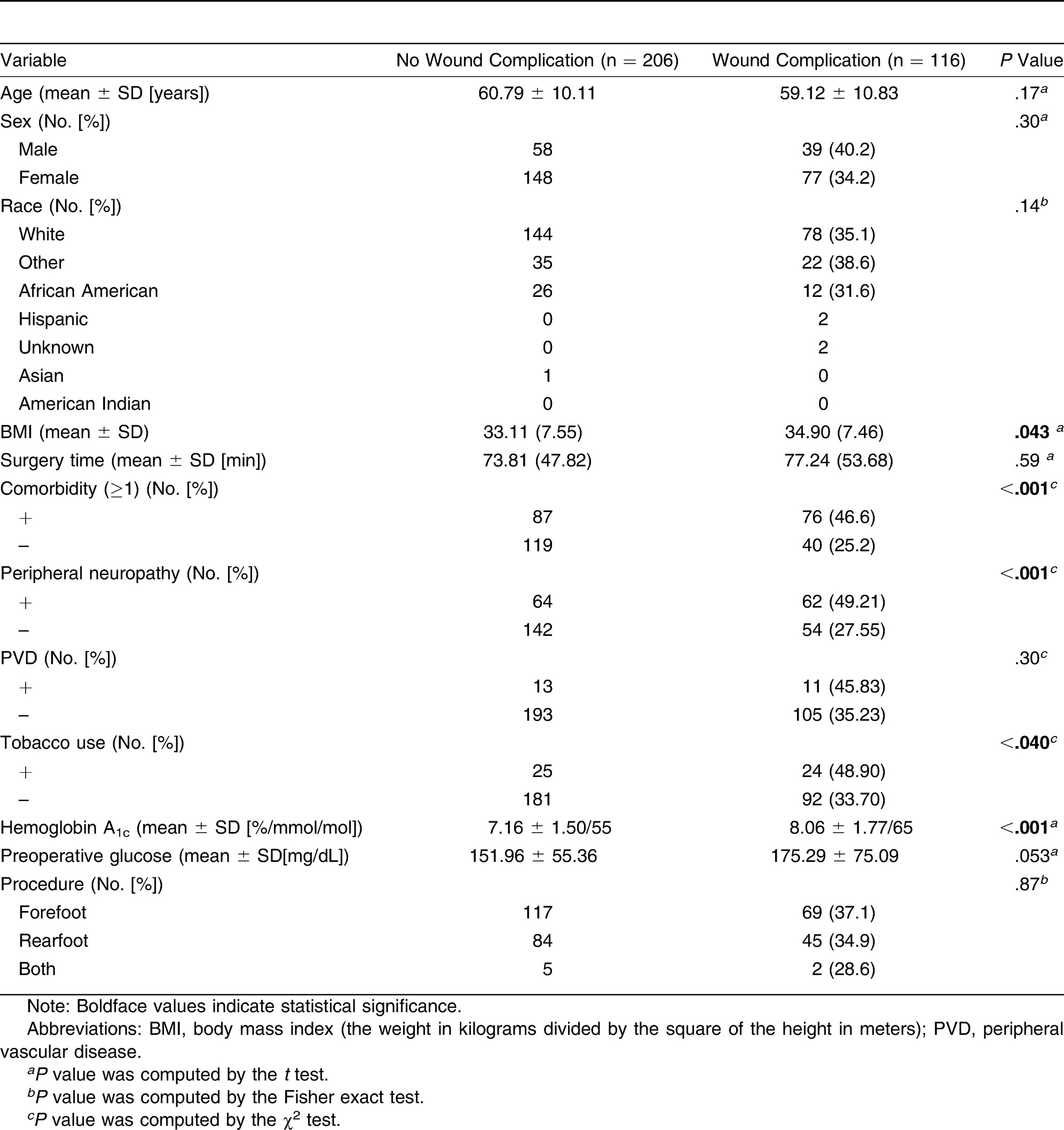
Wound Complications
Patients with complications had a mean ± SD BMI of 34.9 ± 7.46; in those without complications, mean ± SD BMI was 33.1 ± 7.55. This was
t test significant (
P = .043). Of the 159 patients with no comorbidity, 40 (25.2%) had a complication, and of the 163 patients with at least one comorbidity, 76 (46.6%) had a complication. This was χ[
2] test significant (
P < .001). The mean ± SD HbA
1c level in those with complications was 8.1% ± 1.77%, or 65 mmol/mol, and in those without complications it was 7.2% ± 1.50%, or 55 mmol/mol. This was
t test significant
(P < .001). The remaining variables were not significant (
Table 5).
Table 5.
Bivariate Analysis of Wound Complications
Table 5.
Bivariate Analysis of Wound Complications
Logistic Regression Analyses
Infection
Using a logistic regression model for infection with the covariates age, sex, race, BMI, presence of any comorbidity, HbA1c level, serum glucose level, and type of procedure (osseous/soft tissue), the only significant factor was HbA1c level. Each 1% increase in HbA1c increased the odds of infection by a factor of 1.59 (95% confidence interval [CI], 1.28–1.99).
Wound Complications
In a logistic regression model for wound complications with the covariates age, sex, race, BMI, presence of any comorbidity, HbA1c level, and serum glucose level, the only significant factors were HbA1c level, with each 1% increase in HbA1c increasing the odds of wound-healing complication by a factor of 1.25 (95% CI, 1.02–1.53), and presence of any comorbidity (odds ratio, 2.03; 95% CI, 1.22–3.37).
Discussion
This retrospective study showed that a higher HbA
1c level was associated with an increased risk of infection and wound-healing complications after foot and ankle surgery. The mean HbA
1c levels for those with and without a postoperative infection were 7.2% (55 mmol/mol) and 8.3% (67 mmol/mol), respectively. For those with and without postoperative wound complications, these levels were 7.2% (55 mmol/mol) and 8.1% (65 mmol/mol), respectively. In the literature, the relationship between HbA
1c levels and surgical infections is not consistent. No significant relationship was demonstrated after total joint arthroplasty,[
21] penile prosthesis,[
22] and other major surgical procedures,[
4,
23] whereas other studies have shown a relationship with postoperative complications.[
6-
10,
13,
15,
16,
24,
25]
Perioperative serum glucose measurement has been advocated to be a stronger predictor of postoperative complication in several studies.[
1,
2,
7,
13,
17,
23,
25-
28] However, in the present study, perioperative glucose measurement did not have any statistically significant association with postoperative infection (174 mg/dL with and 155 mg/dL without) or wound-healing complication (175 mg/dL with and 152 mg/dL without). One explanation for this contradiction is that most of the previously cited studies involved high-risk surgical procedures, whereas the present data included all aspects of foot and ankle procedures, including elective procedures. As well, in many cases, there were potentially multiple perioperative glucose laboratory values. It was up to the reviewer to determine which value to extract. If the perioperative glucose value was the immediate preoperative or fasting glucose level, this may not have been an adequate representation of daily glucose levels. In addition, if immediate postoperative values were obtained, this may have been misleading because perioperative glucose levels can be inflated secondary to surgical stress. Although some literature supports tight perioperative glycemic control,[
29,
30] it remains a controversial topic because a randomized controlled trial assessing intraoperative glucose control did not demonstrate added benefit for tight management.[
31]
Having at least one comorbidity was also significantly associated with developing a postoperative infection in the present study. In this cohort, 63.4% (59 of 93) of those with postoperative infection had one or more comorbidities. Specifically, after post hoc exploration of the data, having neuropathy was significantly associated with developing postoperative infection (χ
2 P < .001). Fifty-six percent (52 of 93) of those with postoperative infection had neuropathy. This is in agreement with other authors, who show that peripheral neuropathy is a risk factor for postoperative infection.[
13,
32-
35]
In analyzing postoperative wound complications, BMI, one or more comorbidities, and HbA
1c level were found to be significant risk factors in bivariate analysis. When comorbidities were broken down, BMI (
P < .043), peripheral neuropathy (
P < .001), and tobacco use (
P < .040) were significantly associated with wound complications in the bivariate analysis. However, after adjusting for other covariates, only HbA
1c level and one or more comorbidities were significant risk factors. Several authors have demonstrated that obesity has a deleterious effect after orthopedic trauma.[
36-
41] Karuncher et al[
36] and Porter et al[
39] showed that obese patients were at increased risk for the development of a wound complication after surgery. Graves et al[
41] found in their study that obesity had a trend toward association with wound-healing complications. Increased tension on the fascial edges at the time of closure, with associated increased tissue pressure, which, in turn, reduces microperfusion and oxygen, has been suggested to cause surgical dehiscence in obese patients.[
42,
43] Hematoma and seroma formation are additional risks for obese patients. Armstrong[
44] found that obese patients were more prone to hematoma formation, with delayed healing and decreased tissue oxygenation. Although these studies were not specifically on patients with diabetes, one could presume that this holds true in diabetic patients. In the present study, BMI was not significantly associated with postoperative complications. This may be due to the obese cohort (mean BMI = 33.2) with a small low BMI population.
After post hoc exploration of the data, we discovered an association between smoking and postoperative wound complications (24 of 49 [49.0%]). The impact of smoking on wound-healing complications has been well studied. Sorensen,[
45] in a systematic review, discussed three harmful mechanisms of smoking on wound healing: 1) a temporary reduction in tissue perfusion and oxygenation, 2) impairment of inflammatory cell functions and oxidative bactericidal mechanisms, and 3) attenuation of reparative cell functions, including synthesis and deposition of collagen. It was concluded that this attenuation of inflammation and proliferation was responsible for the higher incidence of wound-healing complications. Increased awareness, early recognition, and treatment of wound complications in the postoperative period is warranted because smoking can only further increase the risk of complication.
We recognize several shortcomings in this study. First, the retrospective nature of this study limits the accuracy of the data collected from the medical records. A drawback to the definitions of peripheral neuropathy, peripheral vascular disease, and smoking history are that these are vague and depend on physician preference in history and physical examinations. We recognize the shortcoming of measuring preoperative glucose levels within 30 days of surgery, as this is a broad time frame. Although most of these measurements were taken the day of surgery, this could not be guaranteed for all of the patients because there is no standard time frame before surgery within which they must have had a glucose read. We felt that complications reported in the medical records were more reliable than effectiveness or success measured subjectively by each surgeon. Although it is still possible that complications can be underreported, they would not be overdocumented. Those with less than 3 months of follow-up, who were not included in the study, might also have had undocumented complications occurring after the last visit. Therefore, the true rate of complication might have been higher than what we reported. Second, we did not determine whether insulin-dependent diabetic patients had worse postoperative wound complications than those controlled with diet or oral hypoglycemic medications. Only patients with a history of pharmacologically controlled diabetes reported preoperatively were included in the study. This may be important because these medications have metabolic effects outside of just reducing serum glucose levels. Third, surgeons were not blinded to patients' diabetes state before the operation. Surgeons select patients and change the surgical plan according to patients' medical history. For example, one may minimize soft-tissue dissection in exchange for anatomical reduction in a trauma case if one knows that the patient's diabetes is not well controlled. As well, the reviewers were not blinded regarding other variables, and bias stemming from knowing other results may have affected the final result.
In addition, many diabetic patients, owing to lack of HbA1c measurements, were excluded from this study. This may disproportionally exclude noncompliant, high-risk patients because they are less likely to keep appointments and undergo laboratory tests. This may have resulted in undersampling of noncompliant, high-risk patients in elective cases because surgeons would be less likely to operate on those patients. On the other hand, healthy, well-controlled diabetic patients may not have HbA1c levels evaluated regularly; therefore, many of them may have been excluded in this study. Whereas undersampling of healthy patients may have caused underestimation, oversampling of high-risk, noncompliant patients in emergency (higher-risk) cases may have overestimated the effect of HbA1c level on postoperative complications. This is a limitation to the study, but we are trying to identify risk factors as opposed to determine the incidence of postoperative complications.
Note that this study included emergency cases. Stress-induced hyperglycemia after musculoskeletal injuries is not a new concept. Stress-induced hyperglycemia refers to an elevation of blood glucose levels during times of illness.[
46,
47] In a small series of patients without a history of diabetes, Funsten[
48] noted an immediate increase in blood glucose levels after injury. Richards et al[
28] found that hyperglycemia was an independent risk factor for surgical site infection in orthopedic trauma patients without a history of diabetes. Therefore, the mean perioperative serum glucose level may have been artificially elevated in the emergency cases. Assuming that the emergency cases have more postoperative complications, the effect of serum glucose level could have been inflated in this cohort. Nonetheless, we did not detect association between perioperative serum glucose level and postoperative complications in this study.
The strengths of this study are that 1) all of the study sites had nearly identical strict perioperative protocols; as a result, patients received uniform infection precautions, antibiotic prophylaxis, and thrombophylaxis and 2) we were able to adjust for other variables that may have confounded the effect of HbA1c level, providing a clearer view of the impact of HbA1c level on postoperative complications in patients with diabetes.