In the past 50 years, the education, training, and scope of practice of practitioners who receive the degree of doctor of podiatric medicine (DPM) have experienced exponential growth. This has resulted in a health professional licensed to engage in independent practice and to provide preventive, diagnostic, and virtually unrestricted medical and surgical care of diseases and disorders affecting the foot and ankle. These responsibilities have led to major changes in the podiatric medical curriculum, including the creation of mandatory graduate medical education. Entrance into the profession now includes a 4-year postbaccalaureate program followed by 3 years of hospital-based residency training. The current undergraduate podiatric medical curriculum virtually mirrors the content in biochemistry, physiology, microbiology and immunology, pharmacology, and pathology required of MD and DO students. This part of the curriculum may be organized in the traditional manner in which basic sciences are provided by discipline or by integrating the basic sciences and clinical sciences into courses in each of the body systems. Similarly, the preclinical curriculum prepares DPM students to perform a complete history and physical examination. Gaps that may not be filled in the undergraduate curriculum are covered in the first year of residency, which is similar to what used to be the traditional MD/DO internship but with the addition of clinical rotations in podiatric medicine and surgery. Before the end of the second year of podiatric medical school, students are required to satisfactorily complete Part I of the National Board of Podiatric Medical Examiners to assess basic science knowledge and concepts. Part II is completed before and as a prerequisite for graduation. This is an examination in the clinical aspects of podiatric medicine and surgery as well as medicine and surgery. Before the end of the first year of graduate medical education, Part III, an assessment of clinical knowledge and concepts, must also be completed. All states require satisfactory completion of all three parts of the National Board of Podiatric Medical Examiners as part of eligibility for podiatric medical licensure.
With few exceptions, clinical rotations for podiatric medical students take place in hospitals and other clinical facilities where training typically is also being provided for residents in MD and DO residency programs. In 2000, the Joint Commission permitted DPMs to perform physical examinations on patients they admitted. [
1] Admitting privileges, including the right to perform podiatric surgical procedures, is typically granted to DPMs who have become board certified through a process quite similar to what MDs and DOs must complete. This includes completion of residency training and satisfactory completion of demanding written and oral examinations as well as documentation of a required distribution and number of podiatric surgical procedures. In the 1960s, there were very few podiatric surgical residencies, ranging in duration from 6 months to a year, and in 1971, 30 one-year programs. [
2] In the 1970s, a few 2-year programs evolved, and in the past two decades the standard duration for residency training programs in podiatric surgery became 3 years, becoming a requirement in July 2011. Similar to the requirements for an unrestricted license to practice medicine, almost all states mandate at least 1 year of graduate medical education to acquire a license, but, as with MDs and DOs, the ability to practice without board certification or eligibility is almost impossible, as is acquisition of hospital privileges. Prerequisites for board certification include completing approved Council on Podiatric Medical Education residency training.
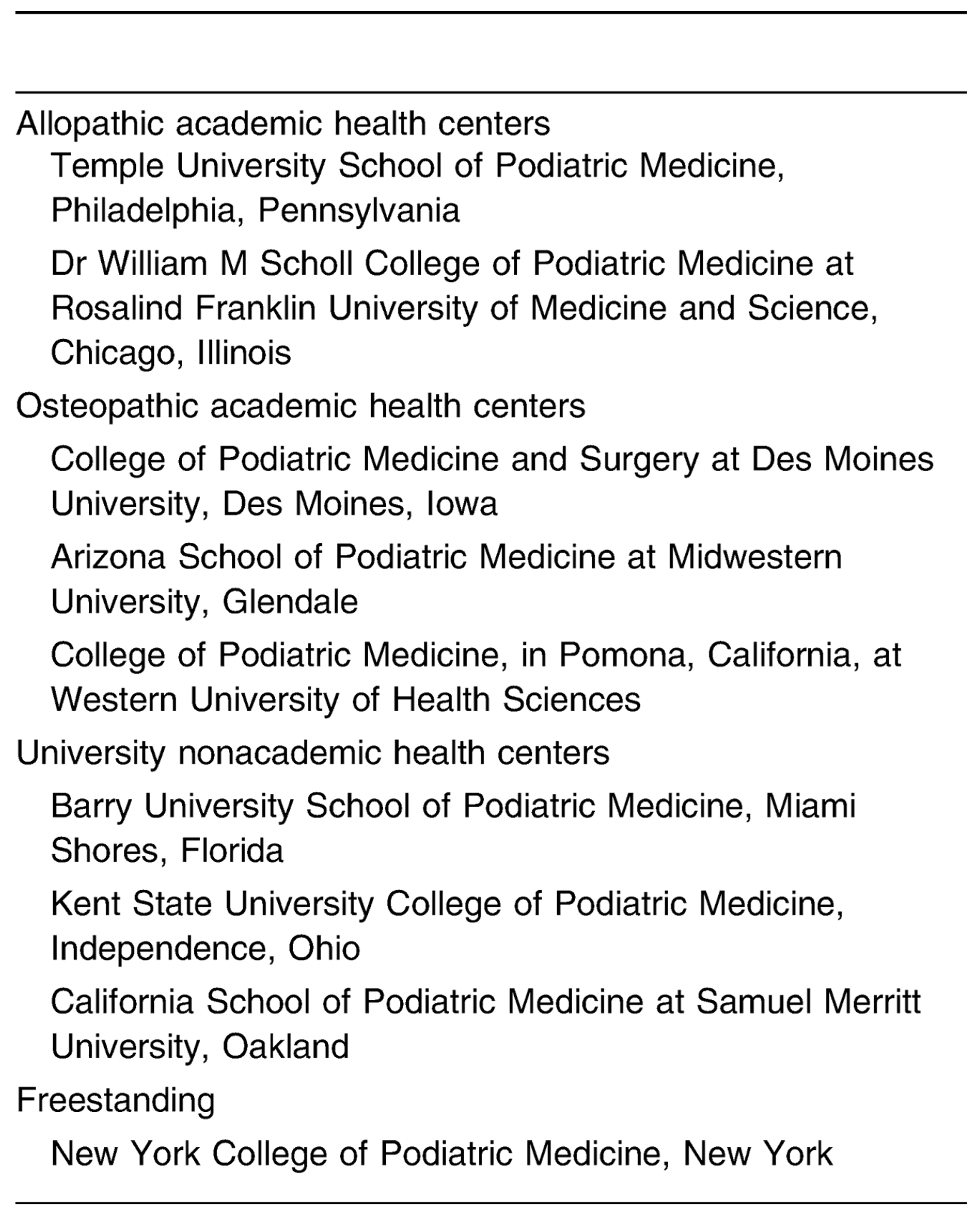
Currently, there are nine podiatric medical schools in the nation, all nonprofit and accredited by the Council on Podiatric Medical Education. Two of the schools are part of an allopathic academic health center, three are part of an osteopathic medical academic health center, two are part of a university without an academic health center, and one is freestanding (
Table 1).
Table 1.
Podiatric Medical Schools by Academic Environment
Table 1.
Podiatric Medical Schools by Academic Environment
Entrance Requirements for Podiatric Medical School
Prerequisites for entrance into all of the podiatric medical schools mimic those required by US colleges granting the MD and DO. The requirements set forth by the Council on Podiatric Medical Education require all applicants to have completed a minimum of 90 credit hours, although more than 97% hold a bachelor's degree on admission. Prerequisite courses minimally include biology, chemistry, organic chemistry, physics, and English. Similar to US-accredited medical and osteopathic medical schools, many applicants also have completed graduate degrees. Since 1978, podiatric medical school applicants have had to satisfactorily complete the Medical College Admissions Test as a prerequisite for entrance. Applicants being considered for admission attend a personal interview to help assess their interpersonal skills and clarify their motivation for a career in podiatric medicine. Letters of reference are required, and virtually all applicants provide letters from their undergraduate school health professions advisory committee.
Faculty
Each podiatric medical school has a full-time faculty, who hold part-time appointments, and clinical faculty located at affiliated hospitals and other clinical sites. All faculty providing education and training in podiatric medicine and surgery are board certified and licensed in the state in which they practice. Education and training in other fields of medicine in podiatric medical schools are provided by faculty who are board certified or eligible in their specialties. Those from schools located in academic health centers also hold academic appointments in the school of medicine or osteopathic medicine. Faculty from schools that are not part of an academic health center providing education and training in fields of medicine other than podiatric medicine frequently also hold faculty appointments at medical schools in the area. Podiatric medical schools also have a core of full-time basic science faculty who hold doctoral degrees in the discipline in which they provide instruction.
Predoctoral Education
On examination of schools that grant the MD or DO degree accredited by the Liaison Commission on Medical Education (LCME) or the Commission for Osteopathic College Accreditation, basic medical science requirements equate with those completed by podiatric medical students. Indeed, in the first 2 years of existence of one currently accredited osteopathic medical school, the curriculum, faculty, and facilities of one of the accredited colleges of podiatric medicine was employed. Podiatric medical students in academic health centers typically share the same basic science curriculum as their DO/MD counterparts. However, because DPM students already have selected their specialty, they also complete additional instruction in lower-extremity anatomy. Traditional core clinical rotations for MD and DO students include medicine, surgery, pediatrics, obstetrics and gynecology, and psychiatry. These rotations typically range from 4 to 8 weeks. Although podiatric medical students generally do not complete core clinical rotations in pediatrics, obstetrics and gynecology, or psychiatry, they typically complete clinical clerkships in medicine, emergency medicine, orthopedic surgery, general surgery, and, often, dermatology. Note that as the podiatric medical curriculum is now designed, only a half year or less of additional time would be necessary to meet the requirements for the MD or DO degree and the requirements for the DPM. This does not include additional time for osteopathic principles and practice that must be completed in osteopathic medical schools.
The education and training that the DPM receives includes 4 years of undergraduate podiatric medical education, 3 years of graduate medical education, and the virtual requirement to acquire board certification. When one observes DPMs providing clinical care, they function in a manner analogous to physicians with MD or DO degrees in their respective specialties.
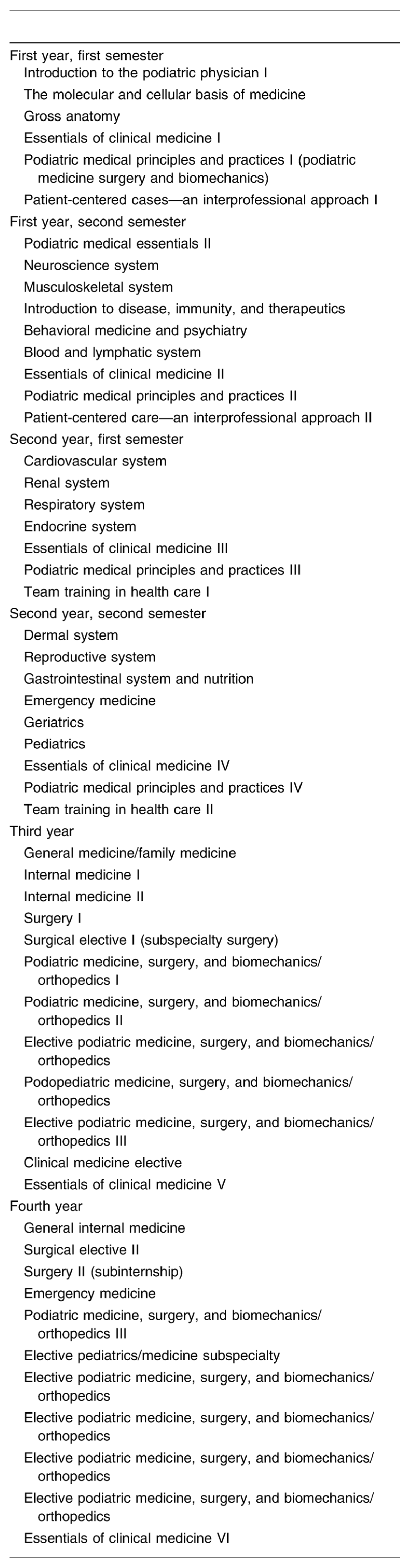
An example is provided of the clinical curriculum for students at Western University of the Health Sciences College of Podiatric Medicine, Pomona, California, which is part of an osteopathic academic health center (
Table 2). Podiatric medical students gain experience in a broad range of clinical practice. In the second year, they receive clinical experience with patient simulations and standardized patients, entering clinical clerkships in years 3 and 4.
Table 2.
Outline of a Clinical Curriculum at an Accredited Podiatric Medical School by Semester
Table 2.
Outline of a Clinical Curriculum at an Accredited Podiatric Medical School by Semester
The Podiatric Medical Patient Examination
The initial DPM visit for a new patient begins with acquisition of the patient's chief concern and a medical history comparable with that of other medical specialists. Frequently, radiographs or other imaging studies are ordered. Similarly, skin and other soft-tissue lesions may be biopsied, and bone may be removed, all of which are sent for examination by a pathologist. Podiatric medical practitioners recognize that the pedal extremity is frequently a mirror of systemic disease. Especially at the initial visit, and frequently at all visits, patients who visit the DPM will have, in addition to a comprehensive examination of pedal extremity, blood pressure determined and, when indicated, a blood sample collected. An example of the typical components of the podiatric examination includes a comprehensive lower-extremity assessment of the vascular, integumentary, neurologic, and musculoskeletal systems. Frequently, findings are identified that ultimately lead to a high index of suspicion for conditions such as diabetes (or the onset of some of its complications), cardiovascular disorders, upper or lower motor neuron disease, gout, and soft-tissue or bony neoplasms, both malignant and nonmalignant. In this process, it is essential for the DPM to function interprofessionally and be an integral part of medical and surgical specialist teams.
The Podiatric Medical Patient
Although patients seen by podiatric medical practitioners may range from children to very elderly individuals, the older adult is an extremely common visitor. This cohort of society frequently has several coexisting chronic diseases, many of which having manifestations in the foot and ankle. Many such conditions may severely limit the ability to walk. Not only does that adversely affect the quality of life, it may result in a reluctance to engage in this most common physical activity. The current epidemic of diabetes also has resulted in a major increase in the number of patients seen in podiatric medical practices. Ideally, such care is preventive, but too often it is for the treatment of limb-threatening complications of the disease, including neuropathy, ischemia, ulcers, and gangrene. It is anticipated that such serious problems will begin to become more common even in younger people owing to the growing diabetes epidemic in children, who may have their disease for many years before reaching age 30 years. [
3]
Integrating Podiatric Medicine into Mainstream Health Care
For decades, the venue for most podiatric medical care was independent community practice. In the early 1960s, there was a wave of hospital-based podiatric medical care as surgical care became more common. This exposed the podiatric medical practitioner to the MD and DO as well. It became one of the early seeds of interprofessional collaboration and was a way to familiarize other providers with the potential role of the DPM in health care as well as providing an orientation about their education and training. Those few DPMs who did perform surgery in the then Joint Commission on the Accreditation of Hospitals (JCAH) facilities did so only if there was oversight by a board-certified MD surgeon. But Bulletin 44 from the JCAH in April 1967 lifted that supervisory requirement. Podiatric medicine appeared for the first time in the JCAH standards in 1970. In 1977, the American College of Surgeons recognized DPMs as practitioners permitted to perform hospital surgery, and in the same year, the American Medical Association recognized the right of “qualified members of the profession to have practice privileges in hospitals based on their education, training, and experience.” However, the admitting physical examination had to be performed by an MD or DO. This too has changed, and today the DPM with hospital privileges may perform his or her own admitting physical examination. In 1976, the then Joint Commission on the Accreditation of Health Care Organizations recognized podiatric medical residents, resulting in them being trained not only by DPMs but also by MDs and DOs, allowing clinical rotations to take place on medical and surgical services. [
4-
9]
The collective impact of all of these changes led to the demise of the very few existing podiatric medical hospitals, which typically were small institutions that admitted patients only for foot surgery. In fact, until these changes occurred, it was extremely difficult for DPMs to acquire hospital surgical privileges. As a result, the few podiatric medical hospitals were almost always filled. However, not too long after the actions of the JCAH, virtually every podiatric medical practitioner was able to acquire hospital privileges, even if they were not residency trained, which was typically the case. As would be expected, the podiatric medical hospitals no longer could survive because DPMs could obtain surgical privileges much nearer to their community practices. This was a convenience for patients and their families and for the podiatric surgeon. For example, in the San Francisco Bay Area, DPMs frequently traveled 30 miles to the California Podiatry Hospital, a facility that had obtained JCAH accreditation and ultimately was forced to close because other hospitals closer to the podiatric surgeon became readily available all over the Bay Area.
Another phenomenon that supported the evolution of podiatric medicine was the acquisition of faculty appointments of DPMs to MD and DO medical schools. A few of these schools are Harvard, Stanford, George Washington University, Baylor, Case Western Reserve, Georgetown, Thomas Jefferson, Mount Sinai, University of Texas, University of Minnesota, University of Pittsburgh, and University of Arizona. [
10] Osteopathic medical schools also have similarly appointed DPMs to their faculty. Appointments range from instructor to full professor. Departments granting such appointments are surgery, orthopedics, plastic surgery, physical medicine, public health, family medicine, and dermatology.
The Uniformed Services has indicated that a DPM may be privileged as any other member of the medical staff in the surgical service. The national standard for DPMs with the appropriate postgraduate education is the management of all disorders of the anatomical region of the foot and ankle and related structures affecting the foot and ankle. Podiatrists for whom residency training included medical history taking and physical examination could be privileged to perform the complete history and physical examinations in the inpatient and outpatient settings. The DPM performs and records the history and physical examinations on the appropriate medical form(s) and could be privileged to admit patients if educationally prepared to perform the history and physical examinations. Podiatrists are licensed independent practitioners and have no requirement for physician supervision. [
11]
One of the most significant steps toward DPMs becoming licensed as physicians and surgeons was instituted in 2009 in California. The California Podiatric Medical Association, California Medical Association, and California Orthopedic Association formed a task force to review the curricula of the two California podiatric medical schools and identify any deficiencies compared with LCME-accredited medical schools.
The plan is to have the podiatric medical schools meet accreditation standards set by the LCME, the same standards that medical schools must meet, said California Orthopedic Association Executive Director Diane Przepiorski. If the effort is successful, the schools would be LCME accredited, and one day California podiatric physicians could be licensed as physicians and surgeons. [
12]
Conclusions
The importance of podiatric medical care has been very much underestimated by the public and even by members of the medical community. Too frequently, examination of the foot and ankle is cursory or does not occur at all during routine physical examinations unless patients note pain or some other perceived abnormality. Even without the presence of pain, examining the pedal extremity can reveal early signs of a local or systemic disease that, if recognized, can be treated, interrupting or decelerating its natural history (eg, early identification of pre-ulcerative lesions or neuropathic changes in people with diabetes). Also, painful feet often discourage people from walking, engaging in other weightbearing exercise that may maintain or improve their cardiovascular health, and maintaining their independence. Often unappreciated is the cost-effectiveness of podiatric medical care, with its emphasis on prevention, especially in the growing number of people at risk. Another extremely important aspect of such care is the early identification of pedal problems that, if treated early, may prevent devastating and even limb-threatening complications. To prevent or comprehensively treat problems affecting the pedal extremity, podiatric medical education has gone through a major evolution, training qualified practitioners to accept expanded patient care responsibilities. For years there has been an unfilled gap in the comprehensive approach to conditions affecting the foot and ankle. This requires not only knowledge and skills that focus on one component of the foot and ankle but also an appreciation of the interrelationship of all of the structures that are required to maintain its very complex function. As a result, during the past five decades the responsibilities of the DPM and the curriculum required to practice the specialty have logarithmically expanded. Finally, many problems affecting the foot are manifestations of systemic disease, and the curriculum of podiatric medical schools and residency training programs makes these practitioners qualified to identify or have a high index of suspicion for such diseases and disorders. This evolution has resulted in podiatric medical practitioners with education and training that has led them toward becoming fully licensed physicians and surgeons.