Several authors have suggested that before assessing standing foot posture, the patient should be placed in a standing position that replicates the individual's angle of gait and base of support during walking. The angle of gait is defined as the deviation of the sagittal plane of the foot to the line of progression, and it is often referred to as the amount of toe-out or toe-in.[
1] The base of support or base of gait is defined as the distance between the feet that occurs at the midstance phase during walking.[
1] Root et al[
2] stated that before measuring what they termed the “resting and neutral calcaneal stance position,” individuals should be placed in their normal angle and base of gait. They indicated that this position was required to ensure that the examiner was observing the individual's feet in the usual midstance attitude.[
2] Hlavac[
3] also stated that placement of the individual in his or her angle and base of gait must be considered when measurements of osseous relationships in the foot are obtained from radiographs.
Several studies have reported that using a standardized foot position when performing foot posture measurements is important to improve measurement reliability.[
4,
5] McPoil et al[
6] reported higher levels of reliability for the measurement of tibial varum when participants were placed in their angle and base of gait while walking. A more recent study reported that foot posture measurements were significantly different when assessed in three different placements of the feet in standing.[
7] The three foot placements assessed in that study included a standardized placement, an individual-determined placement after marching in place, and a rater-determined foot placement based on observation of the participant's angle of gait and base of support while walking. Based on the results of these studies, it seems that a standardized placement of the feet, whether individual determined or rater determined, is necessary when obtaining measurements of foot posture to ensure consistency.
The Foot Posture Index (FPI) is an observational scoring system consisting of six criteria used to quantify standing foot posture that was introduced in 2006.[
8] Previous research has demonstrated that the FPI not only has high levels of reliability[
9‐
11] but also can be used to discriminate variations in foot posture between controls and individuals with knee osteoarthritis,[
12] medial tibial stress syndrome,[
13] and plantar fasciitis.[
14] Before the clinician performs the FPI, the FPI protocol requires that the individual march in place for several steps, stop, and then stand in a relaxed position. Because a variation in foot placement could potentially affect foot posture and the FPI score, a key question is whether the individual-determined placement of the feet after marching in place can be reproduced if a follow-up assessment of the FPI is required in a future clinic visit.
Although an extensive review of the literature was performed, we could not find any previous research that has assessed the between-session consistency of individual-selected versus rater-determined foot placement. Thus, the purpose of this study was to determine whether individuals can reliably place their feet in the same standing position after marching in place or whether the standing position must be determined by the clinician or rater observing the angle and base of gait while an individual walks to ensure the consistency of the placement of the feet between sessions. We hypothesized that the standing foot placement determined by the clinician or rater observing the angle and base of gait during walking would be more consistent than the angle and base foot placement obtained by having the individual march in place.
Methods
Participants
Twenty individuals (12 women and 8 men) volunteered to participate in the study. Participants were recruited from the Regis University (Denver, Colorado) community and met the following inclusion criteria: 1) no history of congenital deformity in the lower extremity or foot, 2) no history of lower-extremity or foot fractures, 3) no systemic diseases that could affect lower-extremity or foot posture, and 4) no history of trauma or pain to either foot, lower extremity, or lumbosacral region at least 12 months before the start of the investigation. The mean age of the 20 participants was 24.8 years (range, 22–31 years). The Regis University institutional review board approved the protocol for data collection, and all of the participants provided written informed consent before participation.
Procedures
Data collection consisted of two sessions, 1 week apart, for the participant-determined marching in place (MinPA&B) and the rater-determined (RATERA&B) angle and base of gait. Two raters (O.T. and H.K.) assessed the 20 participants for the RATERA&B condition. The raters were two physical therapy graduate students who had successfully completed a one-semester course on gait analysis and had attended a 1-hour training session to receive verbal instructions and to practice the observation techniques required for angle and base of gait determination.
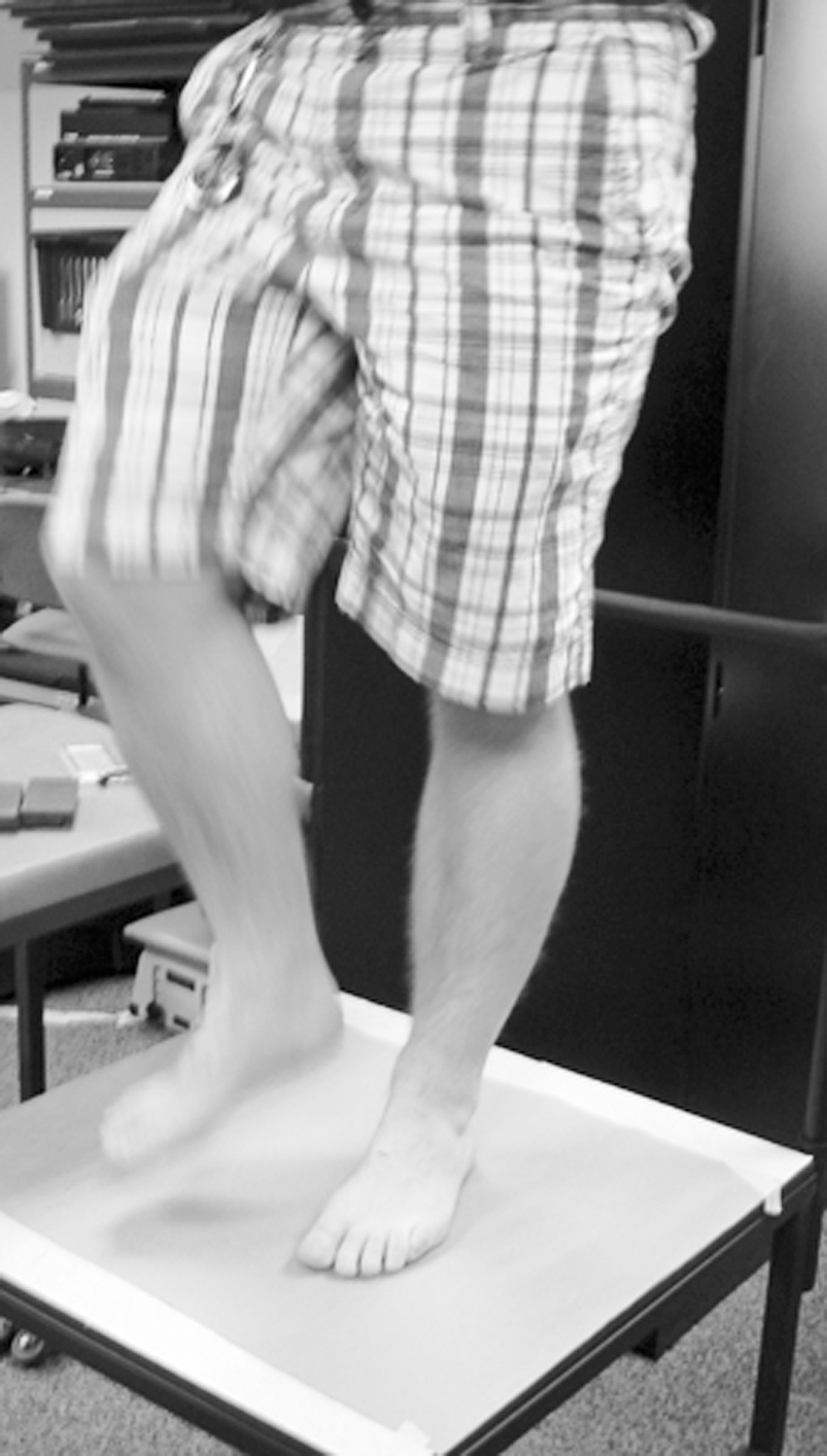
For the MinPA&B foot placement, each participant was first asked to stand on a piece of butcher paper that was taped to an elevated table. The participant was then instructed to march in place for 10 sec, stop, and then place his or her feet in a comfortable standing position. The position of the participant's feet was then traced on the piece of butcher paper (
Fig. 1). The second rater repeated the same procedure for the MinPA&B foot placement, including making a second foot position template. Each participant returned 1 week later, and the entire procedure was repeated for the MinPA&B.
Figure 1.
Participant marching in place on butcher paper.
Figure 1.
Participant marching in place on butcher paper.
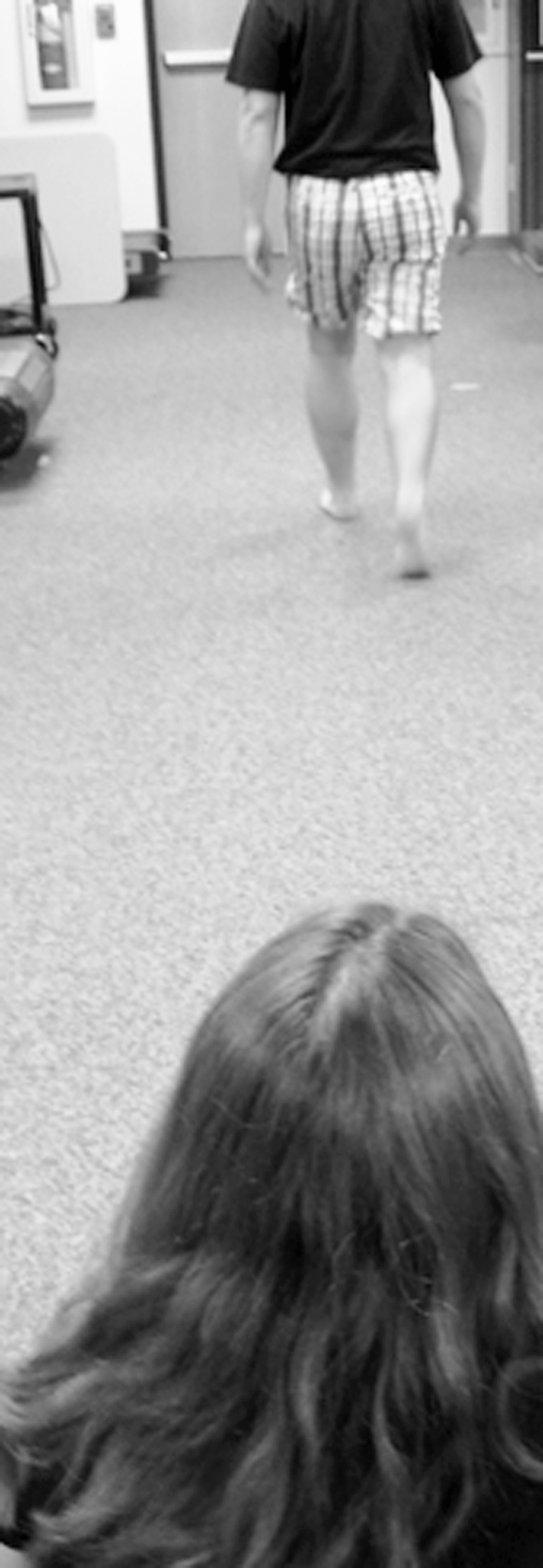
For the RATERA&B foot placement, each participant was asked to walk at a comfortable, self-selected pace across an 8-m walkway while the first rater observed the participant's base and angle of gait while walking (
Fig. 2). The angle of gait was defined as the number of toes observed with respect to the lateral aspect of the lower leg, and the base of support was defined as the distance observed between the heels while walking. After walking over the walkway twice, the participant was asked to stand on a piece of butcher paper that was taped on an elevated table. The first rater then placed the participant's feet in the respective angle and base position they had observed while the participant was walking. The position of the participant's feet was then traced on the piece of butcher paper. The second rater repeated the same procedure for the RATERA&B foot placement, including making a second foot position template. Each participant returned 1 week later, and the entire procedure was repeated for the RATERA&B. To prevent any possible rater or participant bias, a third investigator (J.M.) with the same level of experience as the first two raters performed all of the foot tracings, and the order of testing was randomized.
Figure 2.
Rater observing a participant's angle of gait and base of support while walking.
Figure 2.
Rater observing a participant's angle of gait and base of support while walking.
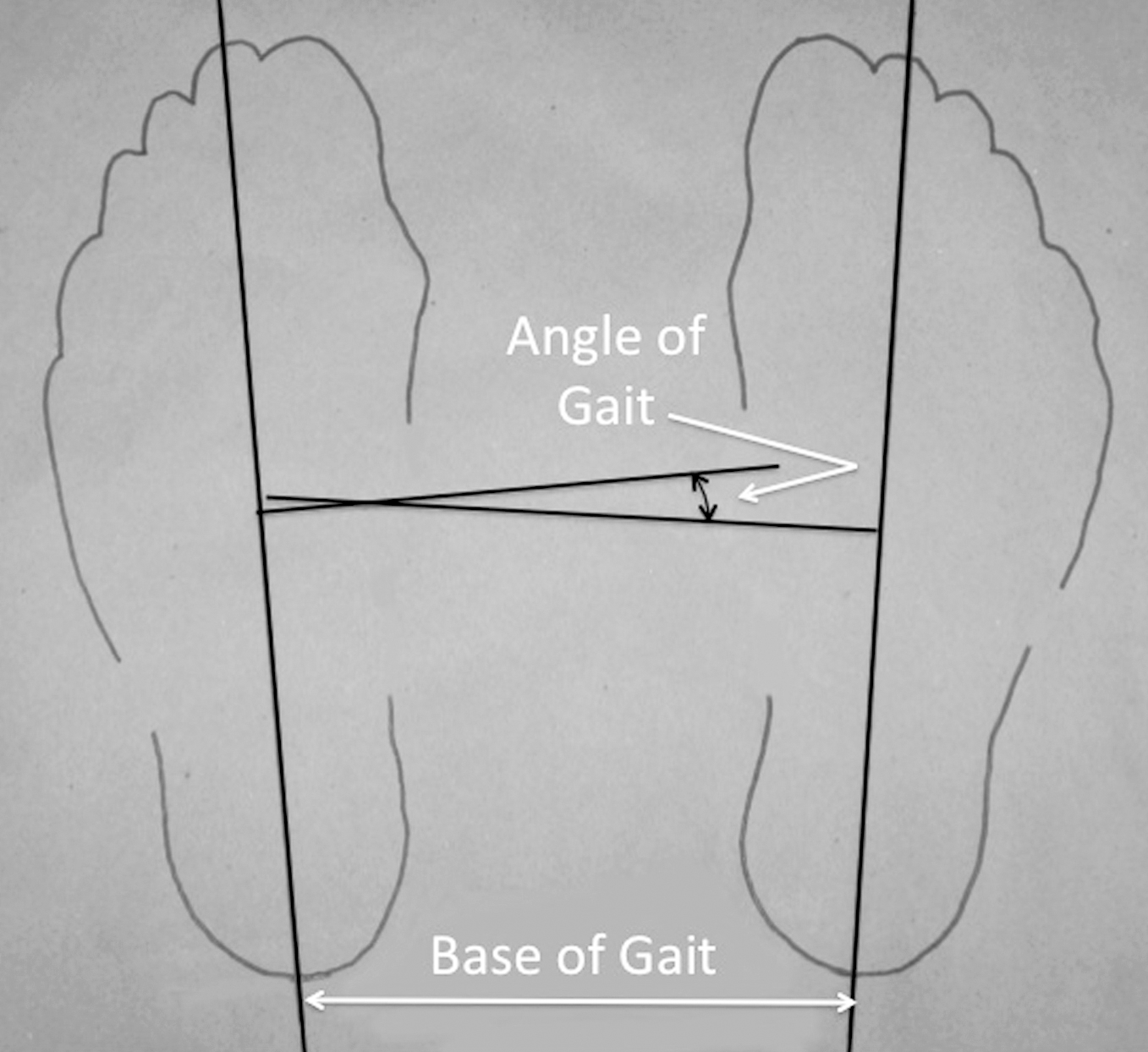
The two foot placement tracings for each session of MinPA&B and RATERA&B were analyzed by a fourth rater (D.E.) to determine the base and angle foot placement from each tracing. The fourth rater also had the same level of experience as the first two raters. On each of the four foot placement tracings, the heel was bisected and the midpoint of the second toe was marked on each foot. A long-axis foot line was then drawn by connecting the heel bisection point to the midpoint of the second toe. To determine the base of support, the distance between the left and right long-axis foot lines was measured at the most posterior aspect of the heel tracing. To determine the angle of the foot, a perpendicular line was drawn medially across both feet from the midpoint of the left and right long-axis foot lines (
Fig. 3). The angle formed by the left and right perpendicular lines was used to represent the angle of the foot for the left and right feet (
Fig. 3). The two measures obtained for the angle and base foot placement for MinPA&B and RATERA&B were used for further statistical analysis.
Figure 3.
Determination of the angle of the feet and base of support from a template.
Figure 3.
Determination of the angle of the feet and base of support from a template.
Data Analysis
For the variable RATERA&B, the consistency of each rater to place each participant in their angle and base of gait was assessed using intraclass correlation coefficients (ICCs) to determine between-session (ICC
3,2) and between-rater (ICC
2,2) reliability.[
15] For the between-rater reliability assessment, each rater's measurements for the two sessions were averaged. The level of reliability for the ICC was classified using the characterizations reported by Landis and Koch[
16]: slight indicates that the correlation ranged from 0.00 to 0.20; fair, 0.21 to 0.40; moderate, 0.41 to 0.60; substantial, 0.61 to 0.80; and almost perfect, 0.81 to 1.00. In addition to ICC values, the SEM was also calculated as another index of rater reliability. The SEM is in the same units as the original measurement and represents how the angle and base of gait measurements would vary if measured more than once by each rater.[
17] A
t test was performed to determine whether statistical differences existed between the two raters for the angle and base mean values obtained in RATERA&B. For the MinPA&B variable, the consistency of each participant to place his or her feet in the same angle and base foot placement between sessions 1 and 2 was assessed using a paired
t test.
In addition to descriptive statistics, Pearson product moment correlation coefficients were also performed to assess the relationship of the angle and base measurements obtained in MinPA&B and RATERA&B between sessions 1 and 2. Because of the number of t tests performed, an alpha level of .01 was used for all tests of statistical significance, thus reducing the probability of a type I error. StatView, version 5.0.1 (SAS Institute, Inc, Cary, North Carolina), was used for all of the statistical analyses.
Results
The mean ± SD angle and base of foot placement values for MinPA&B and RATERA&B by session are listed in
Table 1. The between-session and between-rater ICC and SEM values for RATERA&B for both raters were all greater than 0.93 and are listed in
Table 2. On the basis of the classification scheme proposed by Landis and Koch,[
16] all of the ICC values obtained would be classified as almost perfect. The between-session and between-rater SEM values for both raters were all less than 6% of the mean values of the angle and base of gait measurements. The results of the
t tests were not significant between the two raters for either base or angle of gait mean values obtained in RATERA&B. The mean values for the angle and base foot placement obtained in MinPA&B were also not significantly different between sessions 1 and 2, indicating that the participants were consistent in their foot placement between sessions.
Table 1.
Angle and Base Feet Placement Values
Table 1.
Angle and Base Feet Placement Values
Table 2.
Between-Session and Between-Rater Reliability Intraclass Correlation Coefficients (ICCs) and SEMs
Table 2.
Between-Session and Between-Rater Reliability Intraclass Correlation Coefficients (ICCs) and SEMs
Because the raters and the participants were consistent with the angle and base foot placement in either MinPA&B or RATERA&B, the angle and base data for sessions 1 and 2 were combined and averaged to assess for group differences. For base of support, the mean ± SD values for MinPA&B were 17.66 ± 2.74 cm and for RATERA&B were 18.55 ± 3.25 cm. The t test evaluating the base of support for MinPA&B compared with RATERA&B was not significant (P < .031). For the angle of the feet, the mean ± SD values for MinPA&B were 15.80° ± 6.28° and for RATERA&B were 11.50° ± 4.99°. The t test evaluating the angle of the feet for MinPA&B compared with RATERA&B was significant (P < .0006).
The Pearson correlation coefficients for base of support between sessions 1 and 2 were 0.78 (r2 = 0.61) for MinPA&B and 0.63 (r2 = 0.40) for RATERA&B. The Pearson correlation coefficients for the angle of the feet between sessions 1 and 2 were 0.74 (r2 = 0.55) for MinPA&B and 0.59 (r2 = 0.35) for RATERA&B.
Discussion
The purpose of this study was to determine whether individuals could reliably place their feet in the same standing position after marching in place or whether foot placement in standing must be determined by a rater observing the angle and base of gait while walking. The first step in the analysis of the data was to determine the consistency of 1) each rater's ability to place each participant in his or her angle and base of gait between sessions 1 and 2 (RATERA&B) and 2) each participant's ability to place his or her feet in the same angle and base foot placement after marching in place between sessions 1 and 2 (MinPA&B). The results indicate almost perfect levels of between-session and between-rater reliability for both raters for RATERA&B. Although there are no standardized methods for assessing SEM levels, all SEM values for RATERA&B were less than 6% of the mean values for base and angle of gait. There were also no significant differences between the base or angle foot placement values for MinPA&B, indicating that each participant was consistent in foot placement after marching in place between sessions 1 and 2. Based on these results, we concluded that the consistency of the raters (RATERA&B) and participants (MinPA&B) in reproducing foot placement between sessions 1 and 2 was at a high enough level to warrant further analyses of the data.
We hypothesized that the standing foot placement determined by the clinician observing the angle and base of gait during walking would be more consistent than the foot placement obtained by having the individual march in place. The results of the Pearson correlation coefficients indicate that the raters or the participants could not replicate the same base or angle foot placement between two sessions 1 week apart. Thus, we rejected the hypothesis. The correlations do suggest that the participant marching in place could reproduce his or her angle and base foot placement between sessions at a more consistent level than the raters observing the participant when walking. For base of support, the Pearson correlation coefficient between sessions 1 and 2 was 0.78 for MinPA&B (participant determined) versus 0.63 for RATERA&B (rater determined). For the angle of the feet, the Pearson correlation coefficient between sessions 1 and 2 was 0.74 for MinPA&B (participant determined) and 0.59 for RATERA&B (rater determined). The difference in the mean values for the base of support recorded for MinPA&B and RATERA&B was only 0.89 cm, which was not significant. There was, however, a significant difference in the mean values between MinPA&B and RATERA&B, with the angle of the feet for MinPA&B being 4.31° greater than that for RATERA&B. Thus, the primary difference between the two methods for determining the angle and base foot placement was that the participant placed his or her feet in a greater degree of toeing-out after marching in place compared with the angle of gait observed by the raters. Based on these results, it seems that asking the participant to march in place provides a more consistent base and angle foot placement compared with having a clinician or rater observe an individual while walking. These findings are clinically relevant because asking the patient to march in place is more time efficient and does not require an extended space for the patient to walk in the clinic compared with the clinician observing the patient walking.
Although asking the patient to march in place has a greater degree of consistency in the angle and base of gait foot placement, note that the Pearson correlation coefficient between sessions 1 and 2 for marching in place was not a perfect correlation. With a perfect correlation, r = 1.0. Using the protocol in this study of having the participant march in place for 10 sec, the correlation between sessions 1 and 2 was 0.78 for base of support and 0.74 for angle of the feet. Based on these results, the clinician could not depend on the patient to assume the same angle and base foot placement between sessions after marching in place. If the clinician uses marching in place to position the patient in his or her base of support and angle of the feet, the position of the initial foot placement in the first session would have to be documented to ensure the same foot placement in future sessions or visits. After having the patient march in place in the first session or visit, we recommend that the clinician measure and record the distance between the most prominent protuberance of the medial malleoli to document the base of support. To document the angle of the feet, we recommend recording the number of toes that are visually observed bilaterally with respect to the lateral aspect of the leg (ie, two toes on the left and three toes on the right). With these data, if foot posture measurements or the FPI were reassessed in a follow-up session or clinic visit, the clinician would simply ask the patient to stand and position the feet the same distance apart (based on the medial malleolar distance measurement) and with the same number of toes showing bilaterally to replicate the original angle and base foot placement.
Possible limitations to this study include the fact that only inexperienced raters were used for observation of the angle and base of gait foot placement. Note that although the raters in this study did not have extensive clinical experience, visual observation of the angle and base of gait was not significantly different between the two raters, and only the angle of the feet that was self-selected by the participant after marching in place was significantly different. The fact that the participant chose to stand in a greater degree of toe-out could be attributed to personal preference and not related to his or her actual angle of gait when walking. Although this factor could affect the generalizability (external validity) of the results, because the findings for MinPA&B and RATERA&B are similar, the clinician can be confident using the more time-efficient method of marching in place when it is necessary to position a patient in his or her angle and base foot placement.
Conclusions
Based on the findings of this study, we recommend asking the patient to march in place when it is necessary to position a patient in his or her angle and base foot placement for more than one clinical visit. Although marching in place provides the clinician with a more consistent base and angle foot placement compared with having a clinician observe an individual while walking, the results of this study also indicate that the patient will not likely assume the same angle and base foot placement between sessions after marching in place. Thus, it is critical that the clinician document the patient's foot placement in the first session to ensure the same foot placement in future sessions or clinic visits.