Prevention of foot ulceration is crucial if reductions in amputation rates among individuals with diabetes are to be established.[
1] The causal pathway of ulceration is complex, but strong associations have been identified among diabetic peripheral neuropathy, repetitive mechanical tissue stress, and ulceration. Eighty-two percent of diabetic patients presenting with foot ulcerations also have the clinical signs and symptoms of diabetic neuropathy.[
1,
2,
3,
4,
5,
6] The combination of sensation loss and increased plantar pressure predisposes the neuropathic foot to plantar diabetic foot ulceration.[
3,
6,
7,
8,
9,
10] Therefore, attention to reducing plantar pressure is considered a crucial part of optimizing healing potential and preventing tissue breakdown in neuropathic diabetic feet.[
7,
11,
12,
13] Insole therapy is an effective method of reducing plantar pressure and is used extensively as part of the ulcer prevention strategy.
Clinical trials supporting insole provision for neuropathic foot ulcer prevention have focused primarily on the short-term capacity of the device to reduce plantar pressures, with little thought given to the longer-term effect of wear and tear on insole longevity or to implications for practice. With few clinical trials extending beyond 6 months, there is a need for a study with a longer follow-up to investigate the functional durability of insoles used to reduce plantar pressures in the diabetic neuropathic foot.
Most investigations into the physical durability of insoles have been restricted to the laboratory setting. Past studies have attempted to experimentally replicate the repetitive loading of the gait cycle to examine the effect of wear on material effectiveness.[
14,
15,
16] However, this simulated approach does not fully replicate in-shoe conditions, and, thus, generalization of findings to clinical practice is not advised. For example, laboratory testing protocols have used only vertically directed, highly cyclic forces to fatigue the test material, disregarding the effect of the potentially destructive horizontal shear forces generated in the shoe and variations in load rate, frequency, and duration, which are more reflective of an individual’s daily activity. Moreover, the tests have been conducted under laboratory conditions that are unrepresentative of the hot and humid environment found in the shoe. A further limitation common to most laboratory studies is the nature of the test material. The test sample selected is generally an example of a material used to fabricate insoles, tested independently in raw sheet form. Rarely examined is the glued laminate of several materials, heat molded to a profile of the foot and milled into the finished product for clinical use. Therefore, laboratory-based findings cannot predict clinical performance; thus, a clinical trial is needed to investigate the insole’s response to prolonged everyday wear in the shoe under conditions of increased heat and humidity.
Several laboratory studies have investigated the compression set of an insole material as a measure of durability. This parameter has been calculated as the difference in thickness of the test material before and after the application of a predetermined repetitive compression load over a given period.[
14,
15,
16] Accepted as a useful measure of a material’s physical response to load, this simple measure has yet to be adapted for use in clinical practice to provide useful information relating to insole durability.
Insoles require frequent review and replacement to remain useful. Current replacement depends on resource availability, professional judgment of the physical appearance of the device, and the return of foot lesions or ulceration, potentially putting this high-risk patient group at additional ulceration risk. Although a few trials have investigated the functional ability of insoles to reduce peak pressure, only one[
17] extended data collection beyond 6 months, and none incorporated quantitative measures of physical insole wear or related study findings to device durability. Therefore, the purpose of this study was to investigate the functional and physical durability of insoles used for ulcer prevention in neuropathic diabetic feet over 12 months in terms of peak pressure reduction and compression set.
Methods
Between March 1, 2006, and October 31, 2007, and as part of a larger randomized controlled trial, 60 consecutive patients fulfilling the enrollment criteria and undergoing foot assessment were recruited at two centers in southwest England. Written consent was obtained from the participants after explanation of the study. Ethical approval was granted by the Cornwall and Plymouth Research Ethics Committee.
Patients were eligible if they were diagnosed as having type 1 or 2 diabetes mellitus, were diagnosed as having diabetic peripheral neuropathy, had palpable or biphasic pulses, were free of lowerlimb vascular or neuropathic ulceration (for a minimum of 6 months), scored grade 0 on the Wagner classification for foot ulcer, were able to walk a minimum of 10 m unaided, and were willing to comply with the requirements of the study. Peripheral neuropathy was tested clinically using a C0128 tuning fork and a 10-g Semmes-Weinstein monofilament and following a method previously described.[
18,
19] Patients were excluded if they presented with severe fixed midfoot or rearfoot deformity, had a history of major bone or joint surgery of the lower limb, or were unable to comprehend simple instructions and comply with the study protocol.
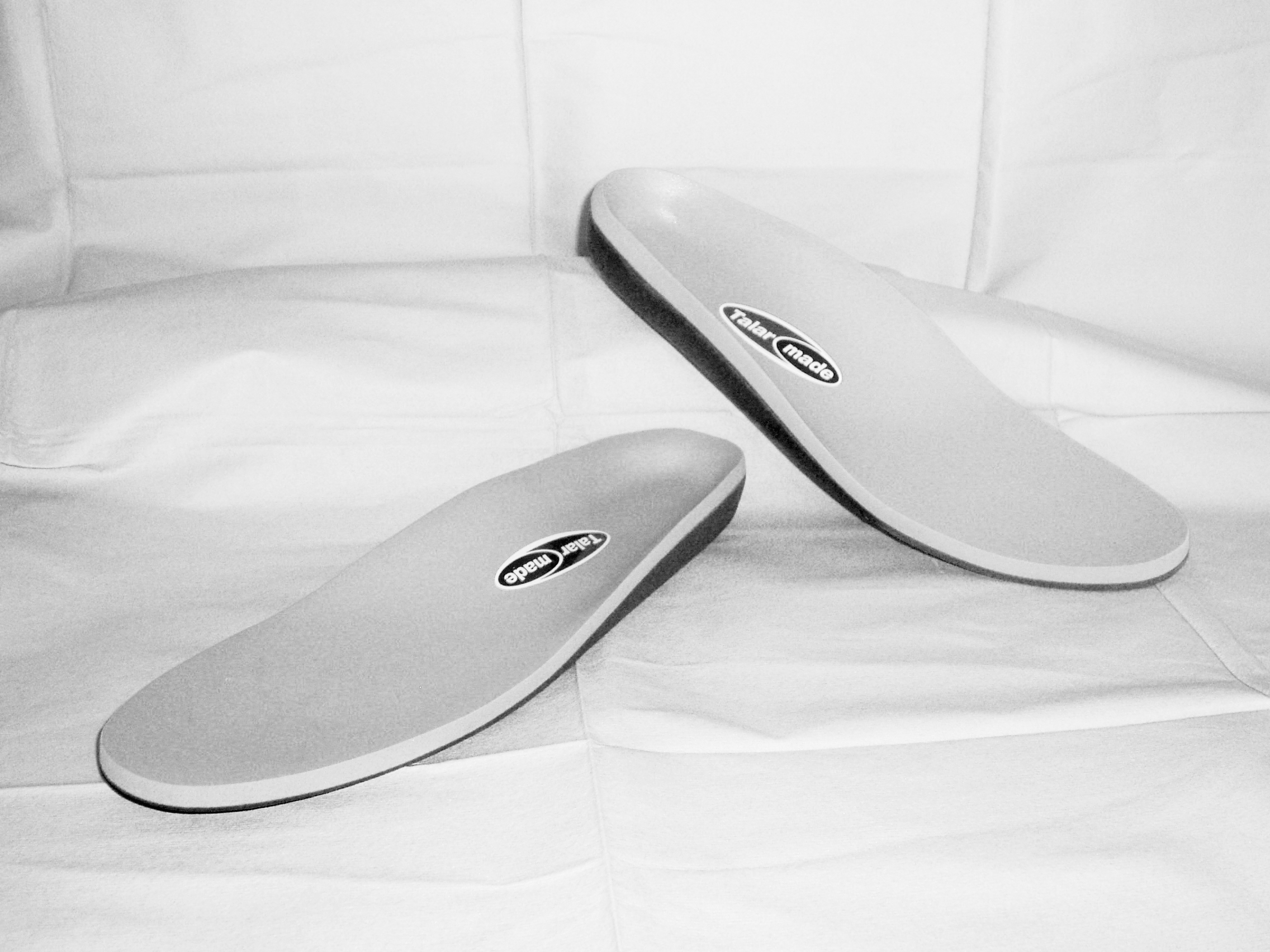
On entry into the trial, participants were assessed and fitted with one pair of blue, medium-density, 3-mm, full-length, molded ethylene vinyl acetate insoles covered with 6-mm full-length gray Poron (Rogers Corp, Rogers, Connecticut) (Fig. 1); each participant had an equal chance of receiving either a custom-made or a prefabricated version of the insole. In addition, participants were supplied with two pairs of modular nonbespoke therapeutic footwear (County Orthopaedic Footwear Ltd, Kettering, England).
Data were collected at three stages: insole issue, 6 months, and 12 months. The functional durability (the ability of the insole to maintain a reduction in mean peak pressure over time) of the insole over a 12-month period was investigated. Reductions in peak pressure data were captured using an in-shoe pressure analysis system (F-Scan; Tekscan, Boston, Massachusetts). Before calibration, each sensor underwent equilibration and was trimmed and fitted into each shoe at the foot-insole interface. After calibration, if sensor saturation pressure exceeded 2,000 kPa, the sensor was discarded. Calibration was checked for within and between foot repeatability; excessive variation prompted sensor recalibration. Participants underwent debridement of existing calluses before the collection of pressure data and wore 20 denier stockings during pressure data collection.
Figure 1.
Example of the insoles used in the clinical trial.
Figure 1.
Example of the insoles used in the clinical trial.
Data were collected immediately after sensor calibration, recording two test conditions: with insoles and without insoles. Each test condition consisted of three participant runs, first a learning run and then two recorded runs. Ten movies were saved per participant during each session. Movies assessing calibration quality were not required for the analysis. The remaining eight movies consisted of two with insole trials and two without insole trials, and each trial contained data from left and right feet.
All eight movie files for a single participant were opened and set to show ‘‘peak averaging’’ of multiple steps or frames. Presented as a single image, peak averaging is created by averaging a group of ‘‘peak’’ frames. Each peak frame represented the peak reached by an individual sensel over a single step. The first and last step of each trial was excluded to allow for gait acceleration and deceleration. A minimum of three peak frames (steps) were incorporated into each peak-averaging image. The ‘‘show panes’’ function was selected, defaulting to peak contact pressure depicted by a black square covering an area of four sensels in the peak-averaging image. This black square identified the maximum peak pressure experienced by an area of four sensels (approximately 1 cm2) in the peakaveraging image. This option shows the highest pressure experienced by any part of the foot during the multiple steps recorded. For each test condition, the peak pressure was calculated using the mean of the maximum peak pressure from the two trials.
Further evaluation of insole durability over a 12-month period was undertaken through the repeated measurement of material depth across the three periods at two sites of interest. The two reference points corresponding to the center of the heel and the first metatarsophalangeal joint were identified with permanent ink, and the insole depth at each point of interest was measured using an outside caliper and a rule. The points of interest were selected as potential areas of high wear and tear. The heel was chosen because it represented the site of initial impact for most feet corresponding to the first vertical ground reaction force peak on the force-time curve, the point at which insoles are repeatedly subjected to the high-loading response force peak generated by body weight and vertical acceleration. The first metatarsal head was selected as an identifiable site in the insole underlying the area most at risk for ulceration in the diabetic foot.[
20]
During pilot work, a single clinician trialed three repeated measures of material thickness using the same outside caliper and rule on 30 occasions across 1 week. We found that in 96% of cases, the first value recorded was within 0.17 mm of the average. Based on this information, a single measure of material thickness was recorded at each data collection session. Details regarding footwear and insole compliance were monitored using a brief self-reporting questionnaire completed at 1, 6, and 12 months.
Left and right feet were analyzed independently at baseline and follow-up. The foot and corresponding anatomical plantar site demonstrating the highest peak pressure without the insole at baseline was selected to be taken forward for analysis. Initial analysis of data found no difference in durability between insole conditions. Therefore, appropriate for the investigation of insole durability, repeatedmeasures analysis of variance was conducted on merged data to assess the impact of time on peak pressure reduction and insole compression across the three periods (issue of intervention, 6-month follow-up, and 12-month follow-up). Data analysis was undertaken using two strategies: available data (n = 43), including all participants completing the trial, and compliant data (n = 18), using a subgroup of participants reporting full compliance (equivalent to wearing the insoles and footwear for a minimum of 7 hours per day, 7 days a week for the study duration).
Results
Sixty participants (79% male; mean age, 69 years) with a mean duration of diabetes of 10 years were included in the trial. On trial entry, two participants reported a history of foot ulceration, and 22 presented with forefoot callus and toe deformity. Seventeen participants (28%) were lost to follow-up during the 12-month period: 4 (7%) experienced illness or long-term hospitalization, 3 (5%) died, 7 (12%) withdrew or did not attend follow-up, 1 (2%) was excluded because of corrupt data, and 2 (3%) developed foot ulceration at the hallux.
Reduction in Peak Pressure Over Time as a Measure of Insole Durability
The functional durability of the insole over a 12-month period was evaluated in terms of the ability of each insole to maintain a reduction in mean peak pressure over time. Analysis was conducted using two strategies: all available data (n = 43) and compliant data (n = 18). No significant differences in the reduction of mean peak pressure were found when the same participants were tested across three periods (issue of intervention, 6-month followup, and 12-month follow-up) (
Table 1). Thus, time from issue had no predictable effect on the magnitude of mean peak pressure reduction achieved by the insole when applied to the neuropathic diabetic foot.
Compression Set as a Measure of Insole Durability
The physical durability of the insole over a 12-month period was evaluated in terms of mean insole compression over time. A significant difference was observed in insole thickness measured on three separate occasions (issue of intervention, 6 months, and 12 months) at both sites of interest (sub–first metatarsal head: all available data [n = 43]—F = 16.2, P < .001, g2 = 0.448; compliant data [n = 18]—F = 4.78, P < .001, g2 = 0.424; central heel seat: all available data [n = 43]—F = 29.8, P < .001, g2 = 0.599; compliant data [n = 18]—F = 12.3, P < .001, g2 = 0.658). The materials selected for insole fabrication compressed over the 12-month period after issue.
Further pairwise comparisons were undertaken to establish the periods between which significant differences had taken place. For both sites (sub–first metatarsal head and central heel seat), significant differences in insole depth were observed between issue and 6 months and between issue and 12 months for all of the comparisons tested (
P < .05) (
Table 2); however, there were no differences between 6- and 12-month comparisons (
P < .05). Most insole compression occurred during the initial 6 months after issue; the mean compression set recorded for this period was 0.69 and 0.53 mm at the central heel seat and 0.33 and 0.32 mm at the first metatarsal head for participants completing the trial and the subgroup reporting full compliance, respectively. During the final 6 months of the trial, no further significant change in insole compression was found.
Table 1.
Outcomes Across Time for Absolute and Percentage Reduction in Peak Pressure Using Two Data Analysis Strategies: Intention-to-Treat and As-Treated.
Table 1.
Outcomes Across Time for Absolute and Percentage Reduction in Peak Pressure Using Two Data Analysis Strategies: Intention-to-Treat and As-Treated.
Discussion
Physical signs of wear were observed over a 12-month follow-up period; insole compression was recorded predominantly during the first 6 months but not during the final 6 months. Although it was shown that the condition of the insole deteriorated particularly during the first 6 months after issue, this deterioration did not seem to detrimentally affect insole function. The magnitude of reduction in peak pressure maintained by the insoles continued for the full 12-month study duration.
Insoles are effective in reducing mean peak pressure when used in the neuropathic diabetic foot. Time from issue does not seem to influence the ability of the insole to reduce peak pressure over a 12-month period, even for individuals reporting the greatest wear times. Reductions in peak pressure observed at insole issue in this study of 37% and 39% are marginally better than the initial reductions in peak pressure demonstrated by other studies testing insoles for people with diabetic neuropathy. Mohamed and colleagues[
21] compared custom Plastazote orthoses with custom AliPlast (JMS Plastics Supply Inc, New Jersey)/Plastazote (Zotefoams plc, Croydon, England) orthoses in two groups of eight people with diabetic neuropathy, and Lobmann and colleagues[
17] compared 18 high-risk neuropathic individuals provided with custom-made ethylene vinyl acetate insoles in therapeutic shoes with 63 controls wearing neutral polyvinylchloride shoes. Both studies reported a mean initial reduction in peak pressure of 32%.
Likewise, at 6 and 12 months of follow-up, the reductions in peak pressure observed with the addition of insoles in the present trial (33% and 35%) are better than findings presented elsewhere. Over a shorter test period (3 months), one study[
21] reported a mean reduction in peak pressure of 26%, whereas a second study[
17] found a reduction of 28% after 6 months, falling to 13% at 12 months. Two possible explanations are offered for the apparent enhanced performance across time of the insoles evaluated in the present trial.
Table 2.
Significant Pairwise Comparisons Across Time for the Compression Set at the First Metatarsal Head and Central Heel Seat Using Two Data Analysis Strategies: Intention-to-Treat and As-Treated.
Table 2.
Significant Pairwise Comparisons Across Time for the Compression Set at the First Metatarsal Head and Central Heel Seat Using Two Data Analysis Strategies: Intention-to-Treat and As-Treated.
Differences in the methods used to calculate mean peak pressure between studies make meaningful comparison of results difficult. Reduction in peak pressure was calculated in this trial as the difference in mean peak pressure measured with and without insoles at each data collection point (issue, 6 months, and 12 months). Lobmann and colleagues[
17] defined reduction in mean peak pressure as the difference between that measured without insoles at baseline and that recorded when wearing insoles at each data point (issue, 6 months, and 12 months). This alternative technique does not account for the plantar pressure increase associated with disease progression over time, resulting in a comparative underestimate of insole effect.
We believe that the present clinical trial is the first to quantitatively investigate the physical durability of insoles used to reduce plantar loads under diabetic neuropathic feet. Lobmann and colleagues[
17] theorized that in their trial the reduced insole effectiveness over time might be a consequence of material compression, although this was not measured and no visual change in insole condition was observed. Furthermore, Mohamed and colleagues[
21] describe making modifications to Plastazote insoles after only 1 month of use to compensate for the effects of material compression. Although detail regarding the extent of material compression was not reported, the clinical need for modification suggests that insole compression is extensive and general across the trial population. Previously published laboratory studies investigating the physical characteristics of orthotic materials used in the manufacture of orthoses for patients with diabetes found Plastazote to have a higher compression set than the other test materials, indicating that material compression might readily occur under load in the shoe.[
22]
The compression set in this study was measured from two standardized locations on the insoles. This method of measurement was devised as a simple, consistent, and clinically repeatable estimate of insole wear and seems sensitive enough to measure change in insole compression over time. These findings suggest that most insole compression occurred during the first 6 months after issue irrespective of compliance. Furthermore, although statistically significant, the amount of compression was not sufficient to affect insole performance measured in terms of plantar pressure reduction. Materials selected for insole manufacture in this study were chosen for their semicompliant properties and cushioning effect; it is plausible that the compression set recorded early in the trial may be representative of the material’s standard acceptable operational response to load. The compression set threshold above which insole performance becomes compromised is undetermined. The follow-up period of 12 months does not seem sufficient to generate enough compression set to adversely affect insole function.
Although shoe wear time may not be associated with material fatigue, Chantelau and Haage[
23] reported that neuropathic patients with diabetes and a history of foot ulceration wearing protective shoes for more than 60% of the daytime reduced their ulcer relapse rate by 50%. Therefore, for the purposes of analysis, participants reporting more than 60% daytime wear of insoles and footwear for the duration of the 12-month study were considered compliant, having accumulated sufficient wear time to achieve therapeutic effect. Although proved to be an important and useful consideration for insole clinical efficacy, compliance may not truly represent activity levels while wearing insoles and footwear. Moreover, the accuracy of the self-reported record of compliance is limited by and dependent on the recall and honesty of the participants. However, it seems likely that participants wearing the insoles for the longest time would also record the longest wear times and weightbear in them the most.
Of the 43 participants completing the study 18 (42%) reported full compliance equivalent to wearing the insoles and shoes for a minimum of 7 hours a day 7 days per day for 12 months. Footwear compliance, although low, seems favorable compared with compliance rates reviewed elsewhere.[
23,
24] Only one other study achieved compliance levels as high as 42%; this study surveyed 161 patients 5 months after receiving diabetic footwear. Of the 31% of patients who responded, 42% reported using the footwear for more than 60% of the day.[
2]
The most common reason given by participants for not wearing the insoles and shoes more frequently was removal while indoors despite footwear education recommending indoor insole and footwear use. Improving insole and footwear compliance in patients with diabetic neuropathy is crucial to the success of diabetic foot health maintenance. Insole compliance may be improved if patients were provided with both indoor and outdoor footwear to accommodate insoles.[
2,
24] The possible implications of participant compliance on insole durability have not been fully considered in the design or analysis of other trials investigating insole performance. Only one other trial[
17] provided an indication of compliance; descriptive data were presented recording an average self-reported insole wear time of just 4 hours per day.
There were no differences in insole compression or peak pressure reduction over the 12-month trial between patients who were wearing their insoles 7 hours a day, 7 days a week and those who were not. This may have been because patients categorized as noncompliant for the purposes of this trial still used their insoles and footwear enough to cause compression or, conversely, because insole durability exceeded the study follow-up period.
This study has some equipment and method limitations. First, it is impossible to differentiate between the natural variations in pressure parameters occurring during gait and variability in the FScan equipment from changes in loading patterns secondary to the intervention. However, the F-Scan data collection protocol optimized equipment reliability and repeatability, and in the context of this study it is reasonable to assume that any small variation other than that associated with the insole type would be constant throughout the study; therefore, although the pressure-related data may not be entirely valid, any differences recorded between test conditions remain applicable. Second, in-shoe pressure measurement systems are capable of measuring vertical force only; therefore, although we recorded the effectiveness of the insole in reducing vertical peak pressure, we were unable to measure horizontal shear.
Conclusions
Although several small trials have investigated the functional ability of insoles to reduce peak pressure, only one extended the observation beyond 6 months, and none have quantitatively measured physical insole wear. The present results suggest that physical changes in insole condition occurring through normal use may not signify a need for insole replacement. Therefore, in-shoe pressure measurement evaluation seems to be the most accurate method for determining loss of function and frequency of insole replacement in the neuropathic diabetic foot. Moreover, there is a need for longer-term studies (extending beyond 12 months) to map the functional deterioration of insoles in the diabetic neuropathic foot and provide practitioners without access to pressure measurement systems with information regarding frequency of insole replacement. Although an absolute recommendation cannot be made at this time regarding frequency of insole replacement for the diabetic neuropathic foot, these results indicate that some insoles are effective at maintaining a reduction in peak pressure for 12 months regardless of wear frequency.