Next Article in Journal
Happy New Year!
Previous Article in Journal
Recognizing the Prevalence of Changing Adult Foot Size. An Opportunity to Prevent Diabetic Foot Ulcers?
 
 
Journal of the American Podiatric Medical Association is published by MDPI from Volume 116 Issue 1 (2026). Previous articles were published by another publisher in Open Access under a CC-BY (or CC-BY-NC-ND) licence, and they are hosted by MDPI on mdpi.com as a courtesy and upon agreement with American Podiatric Medical Association.
Article

When a Heel Won’t Heal. An Important Differential to Consider

by
Catriona I. Wootton
* and
Sheelagh M. Littlewood
Department of Dermatology, Queens Medical Centre, Derby Rd, Nottingham, NG7 2UH, United Kingdom
*
Author to whom correspondence should be addressed.
J. Am. Podiatr. Med. Assoc. 2014, 104(1), 123; https://doi.org/10.7547/0003-0538-104.1.123

Published: 1 January 2014

To The Editor:
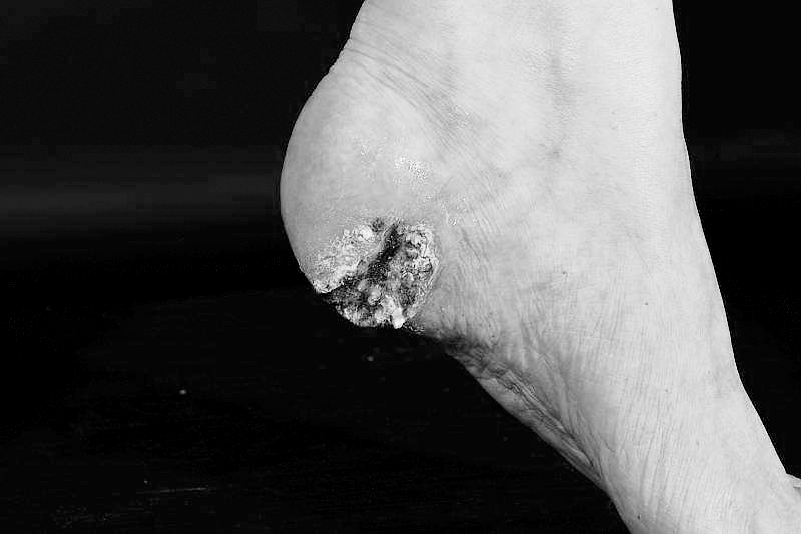
A 43-year-old woman recently presented to our dermatology department with a warty lesion on the medial aspect of her left heel (Fig. 1). The lesion, which was assumed to be a viral wart, had been present for 11 years and had proven refractory to all treatment attempts. She had visited several different clinicians with this lesion including her general practitioner and podiatrist, and multiple treatment modalities had been tried.
Figure 1. Warty lesion on medial left heel.
Japma 104 00123 g001
The lesion was very hyperkeratotic with a filiform architecture and was causing significant pain and limiting mobility. She was otherwise well with no comorbidities.
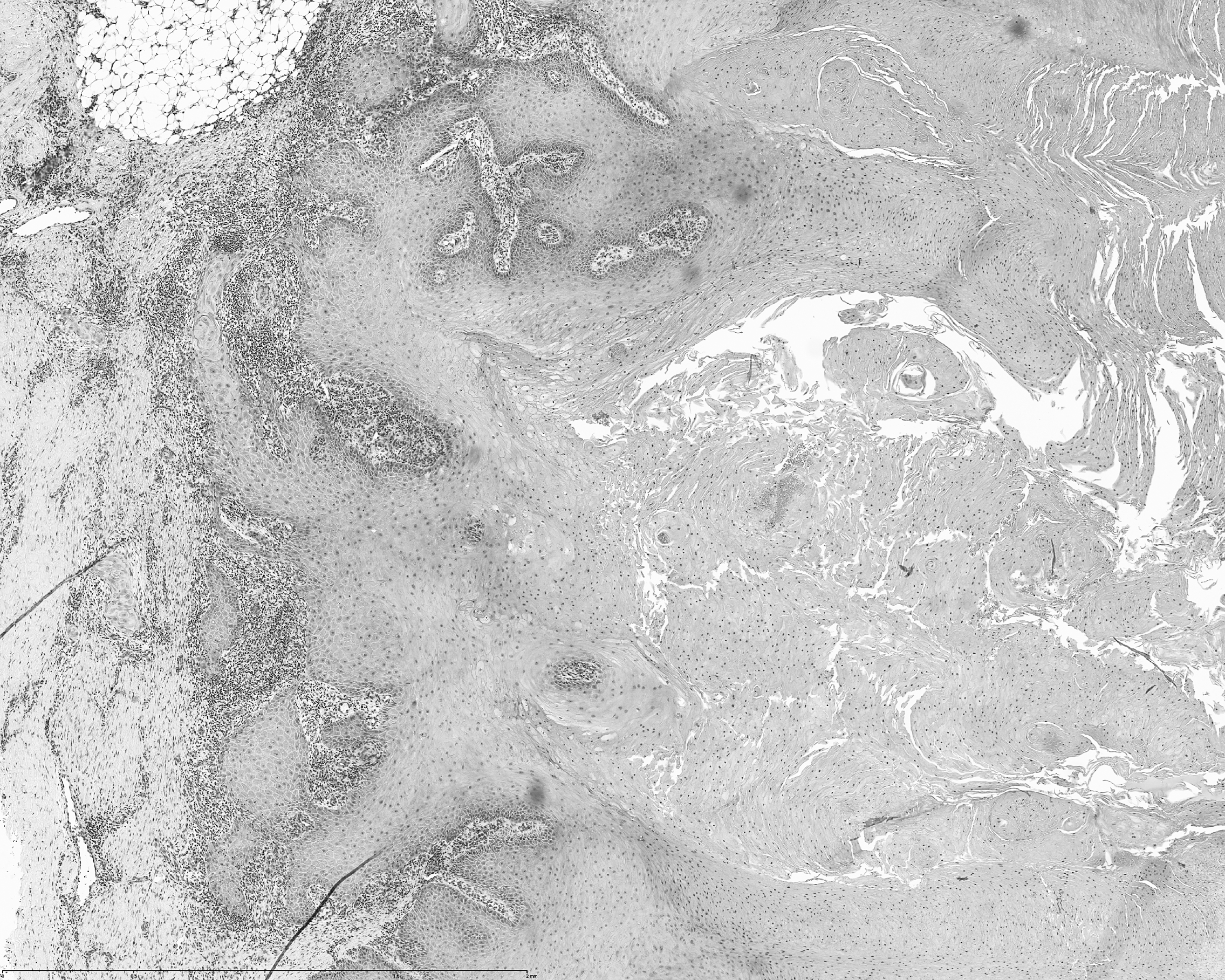
A curettage biopsy was arranged but was unfortunately too shallow to provide adequate information so a further incisional biopsy was performed (Fig. 2). This revealed a well-differentiated invasive squamous cell carcinoma at the base of the lesion, in keeping with carcinoma cuniculatum.
Figure 2. Histology image from incisional biopsy.
Japma 104 00123 g002
Carcinoma cuniculatum, so named because of its resemblance to a rabbit warren in terms of morphology, is a rare variant of squamous cell carcinoma. Although these tumors rarely metastasize, they can be locally invasive. Excision is the treatment of choice, and the size and depth of the excision depends on the extent of the tumor, which is usually confirmed on magnetic resonance imaging (MRI). [1]
Our patient's MRI revealed only soft-tissue involvement and surgical excision was arranged.
Although a rare condition, clinical suspicion is vital for the identification of this tumor as diagnosis relies on biopsy from the base of the lesion. It is an important diagnosis to consider in any recalcitrant warts.

Financial Disclosures

None reported.

Conflict of Interest

None reported.

Reference

  1. QuinnAG, PerkinsW:“Non-Melanoma Skin Cancer and Other Epithelial Skin Tumours” inRook's Textbook of Dermatology,Vol 3,edited byTBurns, SBreathnach, NCox, et al, p 52.26, Wiley-Blackwell, UK, 2010.