Tight fitting shoes are considered one of the leading causes of diabetes-related foot ulcers [
1‐
5] and may account for half of all diabetes-related amputations. [
1,
3] Analyses of five articles attributing pedal tissue injury to shoe wear demonstrated a weighted average of 29% causality (
Table 1). [
1‐
5] Nixon et al [
6] found that among 440 veterans measured, those with diabetic foot ulcers (DFU) were 5.1 times more likely to be wearing ill-fitting shoes than those without ulcers, and only 20% of diabetic patients had properly sized shoes for length and width. Burns et al [
7] studied 65 elderly patients on a rehabilitation ward and reported a 10-fold increase of ulceration or pain from incorrect shoe length. This is additionally important because it indicates that incorrect shoe length may be a better predictor than width of ulcer risk or pain due to shoe wear. So why are ill-fitting shoes so prevalent?
Table 1.
Analysis of Diabetic Foot Ulcer or Amputation Events Attributed to Shoe Wear
Table 1.
Analysis of Diabetic Foot Ulcer or Amputation Events Attributed to Shoe Wear
We believe one major reason is unrecognized changes in the size and shape of the adult foot over time. Harrison et al [
8] reported that 33% of diabetic patients presented with shoes that did not match their self-reported shoe size. This affects patients who self-select their shoe wear in particular, as evidenced by the 3-fold reulceration rate among patients who self-selected their shoes over a 3-year period. [
1] Even among those patients using therapeutic shoe wear, however, two structured literature reviews present conflicting evidence regarding their benefit. [
9,
10] Even the control groups referenced in those reviews demonstrated a 7-fold variation in measured outcomes. This highlights the multifactorial nature of the problem indicating that no one solution will remedy the issue of pedal injury attributable to shoe wear. While recognizing the implicit complexity of the problem, the current study—the
Veterans Shoe Size Survey—was undertaken specifically to evaluate the prevalence and extent of change in foot length over time in a male veteran population and examine various possible causes for these changes.
Research Design and Methods
This cohort study was conducted in the podiatry clinic at the Veterans Affairs (VA) Regional Medical Center, White River Junction, VT, and was approved by the local institutional review board. A convenience sample of 200 eligible Veterans presenting to the VA podiatry clinic were recruited and consecutively enrolled if they were able to “clearly recall their weight and shoe size upon induction into military service” and agreed to participate.
Inclusion criteria included male veterans who were able to confidently self-report weight and shoe size upon entry into military service. Exclusion criteria included significant prior foot surgery affecting shoe size or trauma affecting the ligamentous or musculotendinous support structures of the foot, uncertainty about weight or shoe size on induction into military service, marked edema (defined as edema requiring compression or leading to medical issues), neuromuscular disease or cognitive disorders that would affect reliability of recall.
Following enrollment, a survey was completed to document self-reported shoe size and weight upon entering military service, maximum lifetime weight, and occupational activity scale. The clinical exam included current weight without shoes and current shoe size with socks on as measured with a Brannock device (Liverpool, NY). Intra-examiner reliability for the Brannock device has been described as good with an intra-class correlation coefficient of 0.88 and all clinical assessments were performed by a single examiner (J.E.C.). [
11] In patients with diabetes, protective sensation was also determined using established methods. [
12] Poorly fit shoes were defined as those marked as ± 1 full size different than their clinical foot measurement with shoe size determined to the nearest half size.
Statistical analyses were performed using STATA 10.1 (Statacorp, College Station, TX). Dichotomous variables were analyzed using a Fisher's Exact Test and continuous data were analyzed using linear regression. Significance was predefined as P < 0.05.
Results
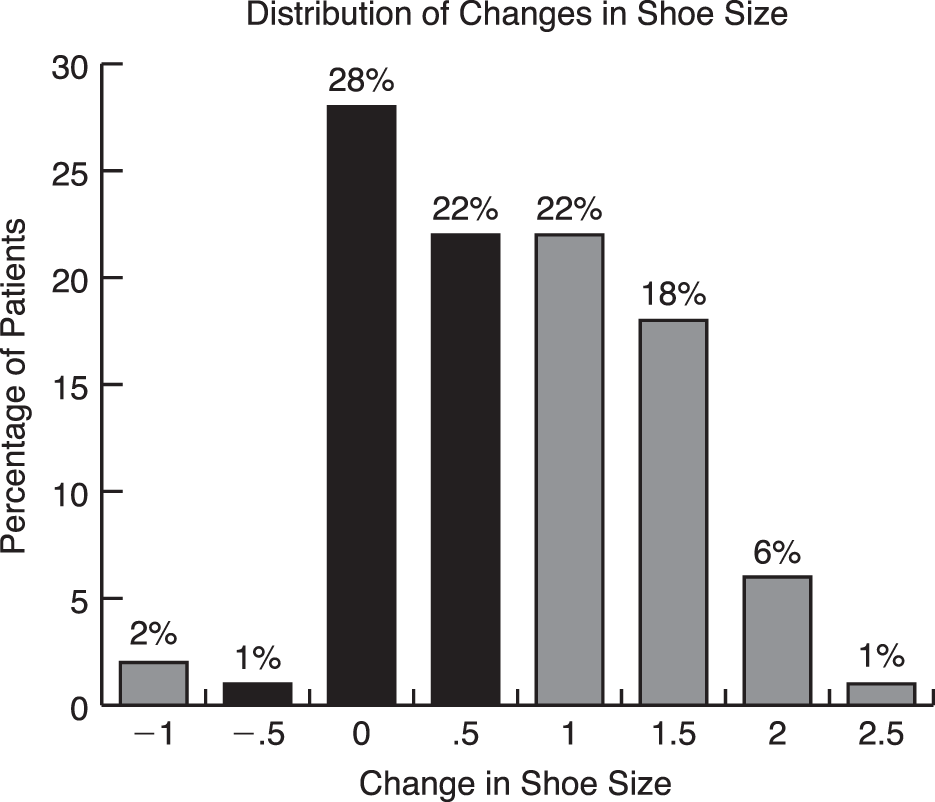
Forty-eight percent of study participants had a ≥1 shoe size change in foot length since skeletal maturity, with 61% of the 60- to 64-year-old age group reporting such changes. There was an average increase of 0.75 (range: −1 to 2.5) (
Fig. 1). The average age was 65.3 years (SD = 11.4). Overall the average adult weight gain was 48 lbs (SD = 38). Fifty-one percent of patients had diabetes; 21% had sensory neuropathy; and 7% had a previous foot ulcer. The most active period of change occurred between the ages of 50 and 64 years (
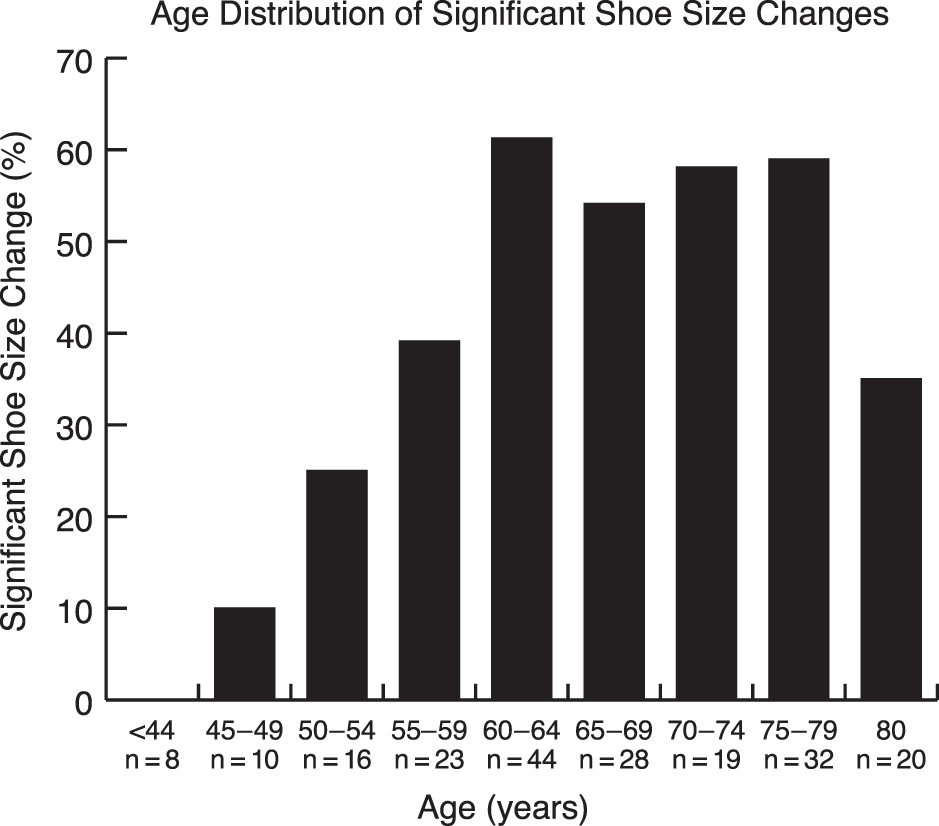
Fig. 2). Up to age 49, only 1 of 18 participants had a significant change in shoe size. From age 50 to 64 years, the rate steadily increases until reaching a plateau at 65 years of age. In the univariate analysis, age and weight change were associated with significant changes in shoe size (
P = 0.04 and
P = 0.001 respectively). After controlling for change in weight, the association with age remained. We were equally interested in the absence of any significant association with changing foot length and diabetes, neuropathy, baseline adult weight, and occupational activity. Prior work has, however, shown neuropathy to be independently associated with higher reulceration rates, thus making this subgroup of patients of particular concern in focusing our prevention efforts. [
3]
Figure 1.
Bar chart depicting the number of study participants per .5 shoe size increment of change during adulthood. Grey bars indicate pre-defined clinically significant change (± 1).
Figure 1.
Bar chart depicting the number of study participants per .5 shoe size increment of change during adulthood. Grey bars indicate pre-defined clinically significant change (± 1).
Figure 2.
Bar chart depicting the number of study participants per age group who experienced significant changes in shoe size (as defined in
Figure 1). n = number of study participants.
Figure 2.
Bar chart depicting the number of study participants per age group who experienced significant changes in shoe size (as defined in
Figure 1). n = number of study participants.
Discussion
In our study population of 200 male veterans, we found that 48% of the participants showed a significant change in shoe size (≥1 full size in length following skeletal maturity). Ninety-eight percent of those individuals experienced this change as an increase in shoe size, which calls into question the assertion that neuropathic patients select smaller shoes to increase sensation. Those most affected by increasing foot length were a) individuals between the ages of 50 and 64, and b) those who experienced the greatest weight gain in adulthood. There was no clear association with changing foot length and measured study variables, meaning the underlying cause is likely one or more excluded variables. We believe ligamentous laxity (foot splay) is the most likely candidate given the association with weight change and age, along with the preponderance of increasing, versus decreasing, foot length found in our analysis. Finally, we believe that the substantial percentile drop in the number of people with significant shoe size change in the group of participants who were 80 years old and older may represent increased mortality associated with the aforementioned weight gain.
As far as we are aware, our study is the first to describe foot size changes, within individuals, following skeletal maturity, and so the information presented is both novel and relevant. We were also unable to identify any ongoing cohort studies or international surveillance efforts able to definitively address foot size changes over time. [
13] Although several authors have previously described issues regarding improper shoe fit, [
6‐
8,
14] the only other research we identified looking at foot size changes over time was a cross-sectional, cross-generational study from Japan that reported negligible changes in foot length. [
13] However, this population- based study did not make comparisons within individuals. Other studies have looked at changes in foot size within individuals, specifically following exercise, [
15] and during pregnancy. [
16‐
18] Of the pregnancy studies, one study demonstrated an increase in foot length [
18] and another increased volume. [
16] We feel that this may be significant in that systemic ligamentous laxity and weight gain are associated with pregnancy, making it an interesting proxy for the conditions we feel precipitate changes in adult foot size.
We also feel that there are significant clinical implications for defining an estimated prevalence and time period for changing adult foot size, also known as the “age of splay”. For example, this information may help raise awareness of the process and its relationship to the inexplicable prevalence of shoe injury in at-risk populations. In turn, recommended screening practices to mitigate the impact of this problem, such as screening for shoe fit, can be more broadly promoted. We feel that this is important as we know these changes are largely unrecognized, as Rosario and Calsolari [
19] demonstrated. In an effort to improve the sensitivity of acromegaly screening, they surveyed 17,000 patients from general practice clinics and found only 0.5% of study participants an increase in foot size over the past 5 years, which is inconsistent with our study findings. Reddy and Child [
20] specifically stated that prevention of diabetic foot problems will require more attention to correct shoe size though devices for clinical identification may not be readily accessible or be an efficient use of a physician's clinic time. We feel that there is a clear role for professional organizations in narrowing the gap between knowledge and action via improved education and more specific practice guidelines for the screening and fitting of therapeutic shoes. One example of a clinically accessible shoe size screening tool for the at-risk patient population involves removing the patient's shoe liners, which in most cases will have made a dynamic impression of the foot over time. To determine proper fit, the provider should be able to lay a pencil widthwise between the distal most impression of the longest digit and the end of the liner, otherwise known as the “pencil test.” Alternatively, the width of the examiner's fifth finger can be used instead of a pencil. If this gap is not observed, or if the lateral digit impression is completely off the insole, then a more formal measurement should be performed in the office or on referral to a qualified pedorthotist or shoe fitter. Given the ease and accessibility of this screening technique we would recommend including the pencil test as part of the at-risk patient's annual foot exam with interval formal measurements between the ages of 50 and 80.
Despite the potential significance of these findings there are several limitations to our study. First, recall bias could be present regarding recall of shoe size at skeletal maturity. Yet there are studies suggesting acceptable reliability of long-term recall, especially associated with a major life event such as induction into military service. [
21,
22] There is also the possibility that industry standards for shoe construction have changed over time, although the Brannock foot measuring device has remained unchanged over the decades covered in our investigation. This study also involved only male veterans surveyed at a single clinic location, which limits the generalizability of the findings. The reason for this was to minimize confounding factors such as prior births, skewed weight reports among females, and hormonal variables. The scope of this work is also limited and fails to consider other factors such as variable compliance, sometimes based on subjective “perceived value” of shoes, and absent standards of sizing among manufacturers. These should also be addressed as part of a comprehensive effort to decrease pedal injuries related to shoe wear.