Adult osteonecrosis of the tarsal navicular, otherwise known as Mueller-Weiss syndrome, is an extremely rare condition of which there is limited literature. The etiology of this condition is unknown; however, many deem that Mueller-Weiss syndrome is a spontaneous disease, given its bilateral distribution in reported cases. [
1-
4] Unlike that of Köhler's disease, which is caused by osteochondrosis of the navicular bone in the pediatric population, this condition is often symptomatic and debilitating. [
5-
11]
Schmidt [
12] was the first to document an abnormality of the adult tarsal navicular in 1925 when he wrote a case report on a 20-year-old male with pluriglandular insufficiency syndrome. Müller, [
13] a German orthopedic surgeon who was the chief of surgery in Heidelburg, further described this abnormality as a dorsomedial midfoot protrusion of the navicular bone with a characteristic comma-shaped configuration pointing laterally. He theorized that the characteristic comma shape was secondary to collapse due to compressive forces from the midtarsal bones. Müller subsequently wrote in another study in 1928 that this condition was congenital. This hypothesis was based on histological findings of the navicular bone, which did not demonstrate secondary findings of prior injury. [
14]
In 1929, Weiss, a radiologist from Vienna, proposed that the deformity described by Müller was due to osteonecrosis based on radiologic findings of joint space narrowing and increased bone sclerosis, which he attributed as similar to Kienböck disease or osteonecrosis of the lunate. [
15] In 1939, Brailsford wrote that compression and “listhesis” or subluxation of the talo-navicular-cuneiform articulations along with midtarsal osteoarthritis were characteristic signs for what he called “osteochondritis” of the navicular bone. [
4] In 1987, Haller [
2] wrote that radiographic signs for what is now called Mueller-Weiss syndrome included fragmentation of the navicular bone with volume loss in the lateral aspect causing a comma-shaped deformity. [
16] More recently, Catonne, [
1] in 2004, performed a study on 25 patients and found that flattening and “expulsion” of the navicular bone is a common finding in Mueller-Weiss syndrome.
The goal of this case report is to enable both foot and ankle specialists and radiologists to better understand the diagnostic imaging findings for this rare entity.
Case 1
A 58-year-old female presented with progressive right midfoot pain for 1 year. She described the pain as dull, persistent, and localized in the dorsomedial aspect of the midfoot. Her pain was exacerbated with weightbearing, and she related no history of trauma. Her medical history included HIV and hypertension. Her medications included methadone for pain.
Physical exam revealed a dorsal bony prominence at the talonavicular joint. Pain was elicited with range of motion and palpation, especially at the dorsomedial aspect of the midfoot. Her neurovascular status was intact. There was no right foot edema or other major findings.
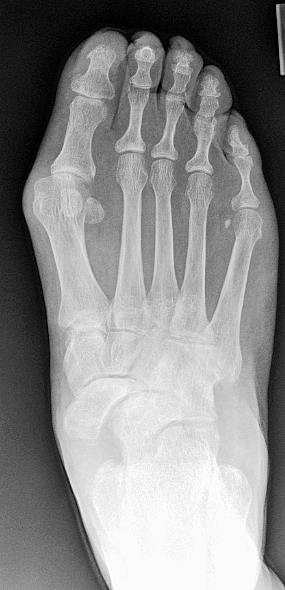
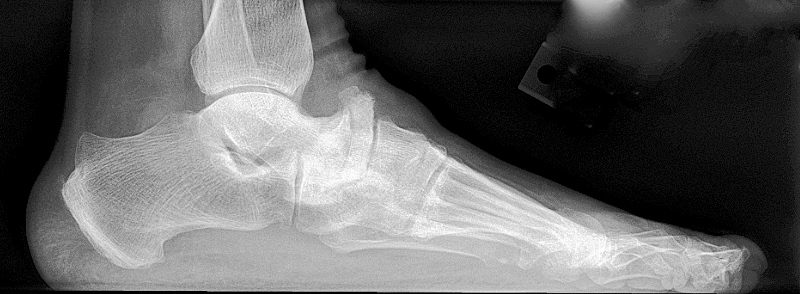
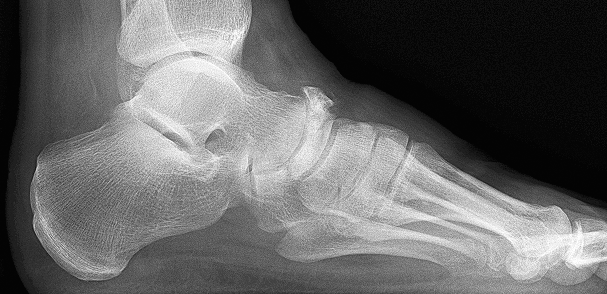
The radiographs demonstrated dorsomedial subluxation of the navicular bone with proximal migration of the lateral cuneiform, resulting in contact of the talus and lateral cuneiform. Articulations of the navicular bone with the medial and middle cuneiform remained; however, these articulations were narrowed. In the lateral aspect of the navicular bone, there was increased sclerosis and collapse, which led to a comma-shaped configuration when seen on a posteroanterior view (
Fig. 1). Dorsal osteophytic formation and narrowing at the talonavicular joint were also noted. In addition, the remainder of the Chopart joint revealed narrowed joint spaces with associated subchondral sclerosis indicative of degenerative arthritis (
Fig. 2).
Figure 1.
Posteroanterior weightbearing radiograph demonstrating a comma-shaped configuration of the navicular bone (Case 1).
Figure 1.
Posteroanterior weightbearing radiograph demonstrating a comma-shaped configuration of the navicular bone (Case 1).
Figure 2.
Lateral weightbearing radiograph view shows sclerosis and dorsal subluxation of the navicular bone with respect to both the talus and cuneiforms (Case 1).
Figure 2.
Lateral weightbearing radiograph view shows sclerosis and dorsal subluxation of the navicular bone with respect to both the talus and cuneiforms (Case 1).
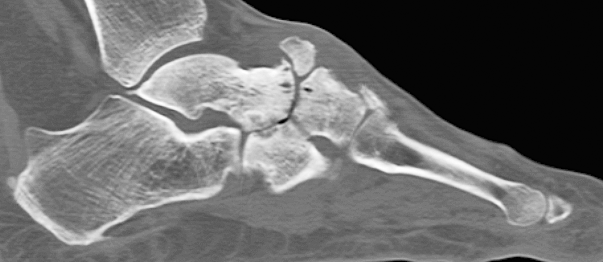
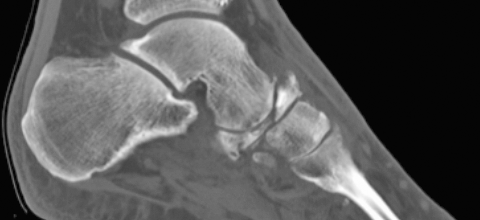
A computed tomography (CT) scan of the right foot was subsequently obtained, which further revealed abnormal articulation of the talus with the lateral cuneiform and cuboid. In addition, there were numerous associated subchondral cysts affecting the navicular, talus, third cuneiform and cuboid (
Fig. 3).
Figure 3.
Sagittal computed tomography reformation shows dorsal subluxation of the navicular bone. Note the numerous subchondral cysts and abnormal articulation of the talus with the lateral cuneiform and cuboid (Case 1).
Figure 3.
Sagittal computed tomography reformation shows dorsal subluxation of the navicular bone. Note the numerous subchondral cysts and abnormal articulation of the talus with the lateral cuneiform and cuboid (Case 1).
Case 2
A 48-year-old male presented with worsening pain in the left foot secondary to an inversion injury, which occurred 3 months prior. He described his pain as an intermittent ache. His medical history was significant for type 1 diabetes and hypertension.
Physical exam showed concentric edema to the midtarsus along with a palpable dorsal bony prominence. He had pain upon palpation and range of motion localized in the medial aspect of the midtarsal joint. His neurovascular status was intact.
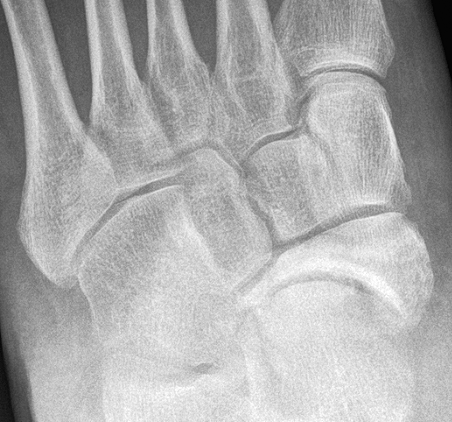
The radiographs revealed sclerosis of the navicular with patchy areas of radiolucency along with collapse of the lateral aspect of the bone, giving a comma-shaped configuration in the shallow oblique view (
Fig. 4). The talonavicular joint was narrowed, and the navicular bone subluxed dorsomedially (
Fig. 5).
Figure 4.
Shallow oblique radiograph view demonstrating a medially subluxed comma-shaped navicular bone (Case 2).
Figure 4.
Shallow oblique radiograph view demonstrating a medially subluxed comma-shaped navicular bone (Case 2).
Figure 5.
Lateral weightbearing radiograph view revealing a collapsed and sclerotic navicular bone (Case 2).
Figure 5.
Lateral weightbearing radiograph view revealing a collapsed and sclerotic navicular bone (Case 2).
A CT scan further demonstrated a distracted, comminuted fracture at the lateral navicular bone. The fracture margins were smooth and demonstrated increased attenuation indicative of nonacute deformity. The CT scan also showed an effusion surrounding the midtarsal joints (
Fig. 6).
Figure 6.
Sagittal computed tomography reformation shows a comminuted fracture of the navicular bone (Case 2).
Figure 6.
Sagittal computed tomography reformation shows a comminuted fracture of the navicular bone (Case 2).
Case 3
A 31-year-old male presented with intermittent left midfoot pain for 2-year's duration. However, during the past 6 months, he had experienced severe pain that was exacerbated with gait. His medical and operative histories were significant for obesity and a gastric bypass.
Upon physical exam, he had pain and swelling to the midfoot, primarily at the medial aspect of the tarsal-navicular and navicular-medial cuneiform joints. There was pain with range of motion, especially during gait. His neurovascular status was intact.
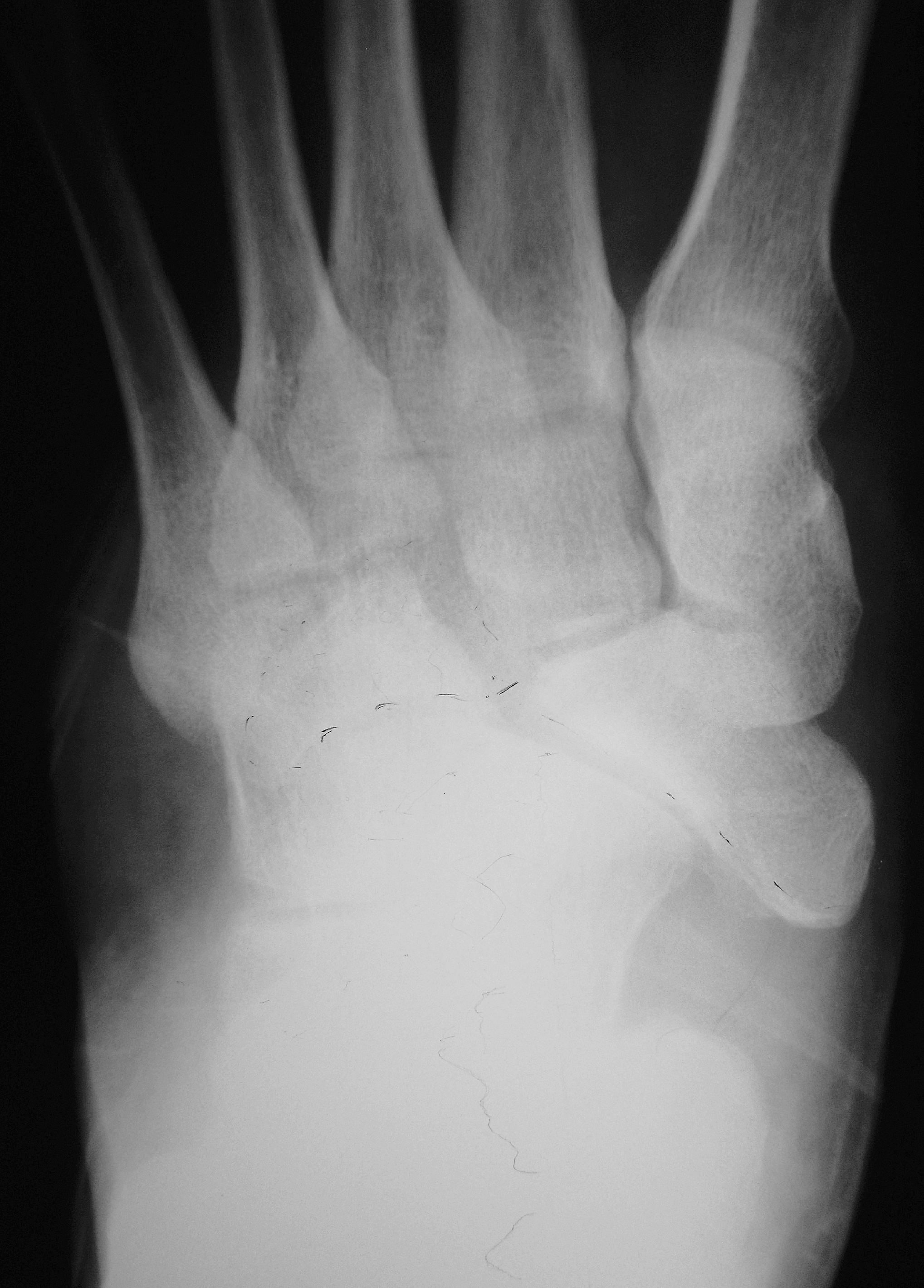
Radiographs demonstrated medial subluxation of the navicular bone with complete disarticulation with the lateral cuneiform, which migrated proximally to articulate with the talus. There was mild thinning of the lateral navicular bone (
Fig. 7). The comma-shaped configuration of the tarsal navicular was also noted.
Figure 7.
Posteroanterior weightbearing radiograph view reveals a medially subluxed navicular bone with proximal migration of the lateral cuneiform (Case 3).
Figure 7.
Posteroanterior weightbearing radiograph view reveals a medially subluxed navicular bone with proximal migration of the lateral cuneiform (Case 3).
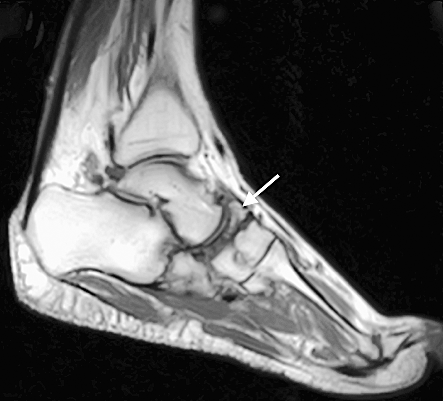
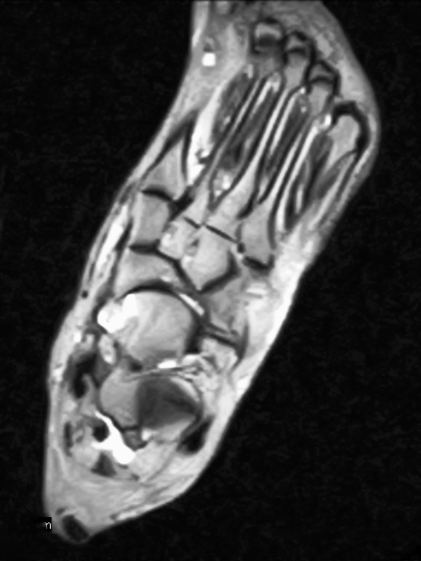
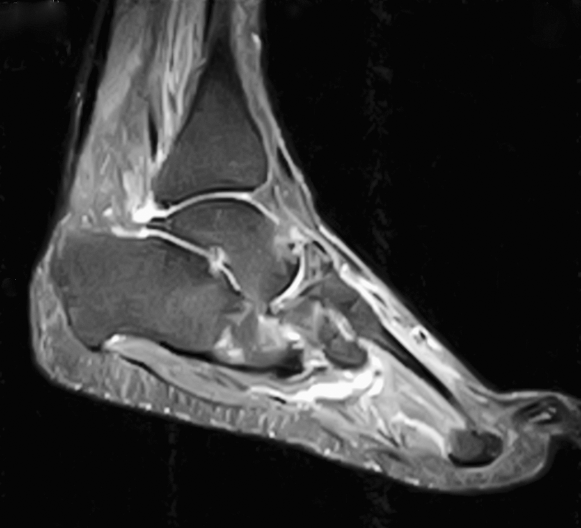
Magnetic resonance imaging (MRI) was then obtained, which further revealed collapse of the plantar and lateral aspect of the navicular bone seen as a triangular shape on the sagittal image (
Fig. 8) and comma shape on the coronal image (
Fig. 9). Additionally, increased signal intensity in the short T1 inversion recovery sequence represented associated bone edema (
Fig. 10).
Figure 8.
Sagittal T1-weighted image of the foot shows collapse of the plantar aspect of the navicular bone, giving it a triangular configuration shown by the arrow (Case 3).
Figure 8.
Sagittal T1-weighted image of the foot shows collapse of the plantar aspect of the navicular bone, giving it a triangular configuration shown by the arrow (Case 3).
Figure 9.
Coronal T2-weighted image of the midfoot demonstrates a medially subluxed navicular bone with a comma configuration (Case 3).
Figure 9.
Coronal T2-weighted image of the midfoot demonstrates a medially subluxed navicular bone with a comma configuration (Case 3).
Figure 10.
Sagittal short T1 inversion recovery image demonstrates high-signal intensity in the navicular bone indicating bone edema (Case 3).
Figure 10.
Sagittal short T1 inversion recovery image demonstrates high-signal intensity in the navicular bone indicating bone edema (Case 3).
Discussion
The radiographic findings for Mueller-Weiss syndrome are distinct on the basis of our case series, along with those of the authors discussed earlier. All cases included dorsomedial subluxation of the navicular bone. These findings are congruent with that of Müller's study. [
13] Collapse and tapering of the lateral navicular were also observed in these cases, which result in the shape of a comma consistent with that of Brailford's study. [
17] In addition, increased sclerosis in the lateral margin of the navicular bone was seen as previously described by Haller. [
2] Subchondral cyst formation and narrowed midfoot joint spaces were seen, indicating degenerative arthritis in the midtarsus of all of our patients. Also noted in all three cases presented was the narrowing of the body of the navicular from superior to inferior. Although this finding can be appreciated on plain film analysis, it was best visualized through the use of CT and magnetic resonance imaging. We believe that the observed secondary degenerative osteoarthritis was a result of abnormal biomechanics owing to the medially subluxed navicular bone as was described by Viladot et al. [
16]
Conclusions
Although Mueller-Weiss syndrome is a rare condition, it should be included in the differential diagnosis, especially when the clinical picture is not congruent with the more common etiologies of midtarsal pain. This condition, if left untreated, causes progressive, irreversible, structural damage to the midtarsus. By recognizing the diagnostic imaging findings for Mueller-Weiss syndrome—sclerosis, dorsomedial subluxation, and comma-shaped configuration of the navicular bone—both the foot and ankle specialists and radiologists can more accurately diagnose this condition.