Recent natural disasters, threatened influenza pandemics, and the ongoing potential use of weapons of mass destruction by terrorist groups have prompted a focus on strengthening the disaster response system, including the need for surge manpower utilization and strategic planning for use of that additional manpower. That is, the medical and public health infrastructure may require supplementation of personnel due to an overwhelming number of victims or potential victims.
Reports have shown that critical barriers to emergency preparedness include the lack of trained individuals in the medical and public health workforce and their inability or unwillingness to respond to emergency situations.[
1,
2] Furthermore, it is recognized that disaster response may be compromised by a shortage of responders due to health-care worker casualties, fear, or a greater-than-expected manpower requirement.[
1–
3] Hence, there is need for a large pool of available responders.
In the event of a catastrophe, preplanned assignments performed by mobilized personnel with relevant training should decrease morbidity and mortality in the affected population. It has been suggested that these personnel could be augmented with nontraditional first responder professions,[
3,
4] and because podiatric physicians receive training in medicine and surgery, it has been proposed that they may represent a competent body of adjunct health-care workers with the ability to assist during disasters. There is, however, an expressed need to determine and outline the role of podiatric physicians in such disasters and to identify additional disaster-associated training that will be needed.[
5]
In 1998, the podiatric medicine profession officially recognized that it has a role in public health and that the profession should take steps to ensure that podiatric medicine becomes an integral part of the health-care system and a contributor to community health through public health and policy activities.[
6] Hence, podiatric medicine has the professional mission and podiatric physicians have the skills to contribute to disaster response.
The purpose of this study was to ascertain the opinions of professional and academic leaders in the podiatric medicine profession regarding the potential skills, ethical responsibilities, appropriate roles and tasks, and preferred sources of education and training of podiatric medicine professionals as surge responders to catastrophic events.
Methods
Study Overview
This cross-sectional study used a survey instrument previously designed and applied to ascertain the opinions of academic and organizational leadership from various health-care disciplines on the topic of participation in catastrophic event response by their profession.[
3,
7] The survey was conducted between February and May 2007. An anonymous, self-administered, structured questionnaire was mailed to the deans of eight podiatric medical schools and to the state society presidents from each state in the United States and Puerto Rico. These academic and professional leaders were asked to complete the questionnaire and return it by mail. Additional follow-up mailings were sent monthly during the 2 months after the initial mailing.
Descriptive tabulation of data was conducted, and response differences between the deans and the society presidents were tested by the Fisher exact test. The study was approved by the New York University School of Medicine institutional review board.
Sample
Potential participants were identified through searches conducted via the Internet to identify podiatric medicine leadership, including all podiatric medical school academic deans and state society presidents. Contact information ascertained from the Internet was entered into the study database.
Study Questionnaire
Catastrophe response content experts at the New York University College of Dentistry had previously prepared the study questionnaire, and the survey instrument had been administered to dental academic and professional leadership.[
3,
7] The questionnaire has a generic design meant for use with most health-care professional disciplines (
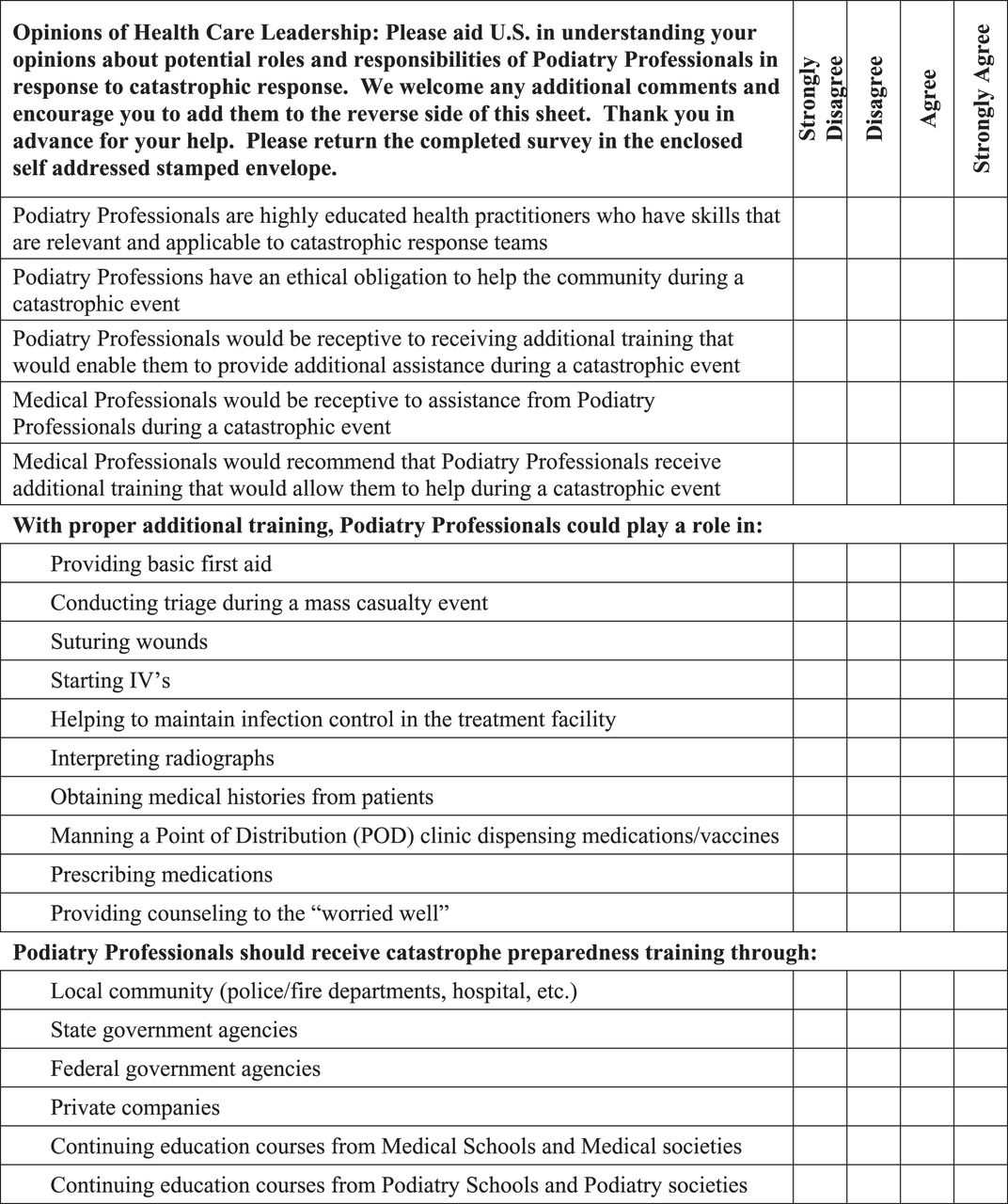
Fig. 1). The questionnaire has three topical sections, and each of these themes was itemized into discrete questions with a Likert scale for responses: strongly disagree, disagree, agree, or strongly agree.
The three topical survey sections were skills and ethical responsibilities to respond to catastrophic events (5 questions), appropriate roles and tasks during catastrophic events (10 questions), and preferred sources of education and training for catastrophic preparedness (6 questions).
Figure 1.
Survey instrument for assessing the opinions of presidents of state podiatric medical societies and deans of podiatric medical schools about podiatric physicians’ potential roles and responsibilities in response to a catastrophic event.
Figure 1.
Survey instrument for assessing the opinions of presidents of state podiatric medical societies and deans of podiatric medical schools about podiatric physicians’ potential roles and responsibilities in response to a catastrophic event.
Study Data Collection Operations
A study questionnaire, cover letter, and stamped, addressed return envelope were mailed to each of the identified study deans and society presidents. The cover letter explained the purpose of the survey and invited participants to complete and return the questionnaires. After 1 month, an identical questionnaire was mailed to all of the participants, accompanied by a reminder letter requesting completion of the survey. The letter stated that persons who had already completed the survey should ignore the second questionnaire. A third and final mailing was then conducted the following month.
Data Management and Analysis
All of the data returned within the allotted time were double entered into an Excel spreadsheet (Microsoft Corp, Redmond, Washington) and checked for data entry errors. A statistical software package (IBM SPSS, version 14; IBM, Armonk, New York) was used to conduct descriptive data analyses, and the Fisher exact test was used to compare the scores of the podiatric medical school deans with those of the state podiatric medical society presidents.
Results
All eight of the podiatric medical school deans and 27 of the 51 state podiatric medical society presidents (53%) returned their questionnaires within the allotted period.
Table 1 presents the responses of podiatric medicine leadership to statements regarding skills and ethical responsibilities of podiatrists in responding to catastrophic events. Both groups of podiatric medicine leaders agreed or strongly agreed with statements that podiatric physicians have skills applicable to catastrophe response, are ethically obligated to help the community during a catastrophe, and would be receptive to receiving additional training to develop skills for catastrophic event management. Thirty-three of the 35 leaders (94%) reported that they believed that medical professionals would be receptive to the assistance of podiatric physicians. Nearly 86% of the leaders (30 of 35) felt that medical professionals would recommend that podiatric physicians receive additional training before assisting in response to a catastrophe; the proportions of those strongly disagreeing (n = 0), disagreeing (n = 5), agreeing (n = 13) and strongly agreeing (n = 9) with the statement among the state society presidents was variable and statistically significantly differed from the eight agree responses of the deans (
P = .05), although
P = .315 when the responses were aggregated as any agreement versus any disagreement.
Table 1.
Responses of Podiatric Medicine Leadership to Statements Regarding Skills and Ethical Responsibilities of Podiatric Physicians in Responding to Catastrophic Events.
Table 1.
Responses of Podiatric Medicine Leadership to Statements Regarding Skills and Ethical Responsibilities of Podiatric Physicians in Responding to Catastrophic Events.
Table 2 presents findings for the two leadership groups regarding statements related to tasks that podiatric physicians, after receiving additional training, could perform in a disaster. There were no statistically significant differences between the leadership groups. Deans and society presidents agreed with statements that podiatrists could provide basic first aid and suturing of wounds, assist with maintaining infection control, and obtain medical histories. With one exception, all of the society presidents and deans agreed that with additional training, podiatric physicians could play a role in conducting triage during mass casualty events, starting intravenous lines, interpreting radiographs, managing a point of distribution, prescribing medications, and providing counseling to the worried well.
Table 2.
The Role That Podiatric Medicine Professionals Could Play in Response to Catastrophic Events After Receiving Further Training.
Table 2.
The Role That Podiatric Medicine Professionals Could Play in Response to Catastrophic Events After Receiving Further Training.
Table 3 presents leader opinions on sources that could provide catastrophe preparedness training to podiatric medicine professionals. Approximately 85% of the respondents felt that local and state departments/agencies and medical and podiatric medical schools could provide appropriate training. A lower percentage of respondents (76%) felt that the federal government was a good source for training. Notably, only 59% of the leaders felt that private companies were a good option, with 73% (19 of 26) of the society presidents agreeing that such companies were a good source compared with only 12% (1 of 8) of the deans (
P = .002). Two society presidents strongly disagreed that private companies would be appropriate for the training, the only training source with that level of a negative response.
Table 3.
Local, Governmental, Private, and Other Organizations That Could Be Tapped to Provide Catastrophe Preparedness Training to Podiatric Medicine Professionals.
Table 3.
Local, Governmental, Private, and Other Organizations That Could Be Tapped to Provide Catastrophe Preparedness Training to Podiatric Medicine Professionals.
Discussion
In August 2004, a meeting of experts in the fields of bioethics, emergency medicine, emergency management, health administration, health law and policy, and public health was convened by the Agency for Healthcare Research and Quality and the US Department of Health and Human Services Office of the Assistant Secretary for Public Health Emergency Preparedness. The purpose of the meeting was to examine how current standards of care might need to be altered in response to a mass casualty event to minimize morbidity and mortality.[
8] The panel emphasized that for health-care systems and providers to respond effectively to a mass casualty event, a variety of important legal, policy, and ethical issues related to altered standards of care must be addressed.
Several initiatives regarding scope-of-practice and standards-of-care issues have been made. Public Law 109–417, the Pandemic and All-Hazards Preparedness Act, was passed in December 2006. The law encourages states to implement mechanisms to waive licensing requirements applicable to health-care professionals wishing to provide emergency medical services during a declared disaster. Important elements proposed for such temporary licensing changes include freedom from liability, except gross negligence or willful misconduct, and waiver of relevant licensure requirements for out-of-state practitioners to practice in the affected state. Furthermore, the law contains a provision that authorities can directly assign these professionals to specific duties, such as the performance of vaccinations or physical examinations.[
9] Colorado and Illinois provide two examples of state activities addressing the Pandemic and All-Hazards Preparedness Act. Colorado has made preparedness plans that include enhancing surge capacity to respond to such events. This was accomplished by preparing, in advance, legal drafts of possible Executive Orders for the governor to create a legal framework for the response.[
8] In Illinois, Public Act 94-0733 gives power to the Illinois Department of Public Health and the Illinois Emergency Management Agency to suspend requirements for licensure and modify scope-of-practice provisions for state-licensed practitioners during a declared disaster.[
10] These ongoing activities to ensure a legal framework for nontraditional disaster responders to practice outside their defined scope of practice remove a primary barrier for professionals, such as podiatric physicians, to be incorporated into a surge response capacity.
In a 2006
Journal of the American Podiatric Medical Association letter entitled “Natural and Man-made Disasters: Where Is Podiatric Medicine?” Dr. Leonard Levy presented a challenge to the podiatric medicine profession’s members and leadership.[
5] Although there is little doubt that many individual podiatric physicians are involved in community disaster response initiatives, there are no published reports regarding organized efforts to establish a role or mechanisms of participation by the profession. With the limitation that 47% of society presidents did not respond, the survey reported on herein supports the statement that the podiatric medicine professional leadership believes that there is a basis for podiatric physicians, and in fact an ethical obligation, to participate in catastrophe response. Furthermore, there is broad consensus that podiatric physicians have the education and skills that can be enhanced with additional training and that many podiatrists will be receptive to assisting in disaster responses. To be effective, rather than a hindrance, personnel with catastrophe response training need to be part of the official response agencies’ plans across the spectrum of disaster activities, ie, prevention, response, mitigation, and recovery. At a minimum, podiatric physicians should be educated to have personal, family, and office disaster plans that are responsive to this spectrum of disaster activities.
Given the need for a surge response that in some situations will demand a large pool of responders, the podiatric medicine profession is well-placed to participate on a more than individual volunteer level. The positive responses of the academic and organizational leadership to questions regarding podiatric physicians and catastrophic event response give support to the recommendation that the profession consider what, and how, disaster training can be included in academic competencies at the podiatric medical school level and in continuing education.[
11–
13] In addition, disseminating information regarding disaster response agencies and organizations in which podiatrists can participate, such as the Medical Reserve Corps,[
14,
15] should be welcomed by the podiatric medical association membership. In fact, an important aspect of the profession’s activities should be to ensure that trained and educated podiatric physicians are coordinated with and integrated into the response agencies and their plans. With these objectives accomplished, podiatric medicine has a role in strengthening the nation’s catastrophic event surge response.