The teaching and assessment of professionalism have become central areas of research and practice in medicine and in allopathic and osteopathic medical education generally, both at the undergraduate and graduate levels [
1]. In contrast, discussion of professionalism as it relates to podiatric medical education is nearly nonexistent in the literature, despite its inclusion as one of eight core components of podiatric medical competence that have been approved by the Council on Podiatric Medical Education [
2], the accrediting body for podiatric medicine. Specifically, among the standards and requirements for accrediting colleges of podiatric medicine is the expectation that students will ‘‘practice with professionalism, compassion, and concern and in an ethical fashion regardless of the patient’s social class, gender, racial, or ethnic background [
3].’’
(p56)Included among the standards and requirements for podiatric medical residency programs is the expectation that residents will ‘‘practice with professionalism, compassion, and concern in a legal, ethical, and moral fashion [
4].’’
(p24) In demonstrating this competency, residents are expected to, among other things, ‘‘demonstrate professional humanistic qualities [
4].’’
(p24) A literature search linking professionalism and podiatric medicine reveals only two citations, the first dating back to 1955 [
5] and the second to 2004, when Diaz and Stamp [
6] presented three general case-based illustrations of challenges to professionalism considered relevant to podiatric medicine. The first article focused on chiropody, a precursor to podiatric medicine, and the second article defined ‘‘medical professionalism’’ as ‘‘the set of attitudes, values, and conduct exhibited by medical providers [
6].’’
(p206) The illustrations provided in that article were general examples that could have been applied to a range of professions, and resources relative to professionalism and ethics were only briefly discussed.
There is a compelling need to begin to study the teaching and assessment of professionalism in podiatric medical education given that it is a core competence for podiatric medical practice and there is a dearth of literature about its development and assessment.
Purpose of the Study
The purpose of this study was to elicit at a single institution podiatric medical students’ perceptions of professionalism-related issues in the clinical setting, ie, critical incidents illustrating lapses in professionalism, and to conduct a qualitative analysis of these critical incidents to identify recurrent themes.
Definitions of Professionalism
The focus on professionalism and professional behavior in medical students and residents has increased significantly in recent decades [
1], and various researchers [
7,
8,
9,
10,
11] have formulated a wide range of definitions associated with professionalism. Swick [
7] defines professionalism as a set of behaviors in which physicians demonstrate subordination of their own interests to the interests of others; adherence to high ethical and moral standards; responsiveness to societal needs, with behaviors reflecting a social contract with the communities they serve; core humanistic values, including honesty and integrity, caring and compassion, altruism and empathy, respect for others, trustworthiness; accountability for themselves and for their colleagues; a continuing commitment to excellence; a commitment to scholarship and to advancing their field; dealing effectively with high levels of complexity and uncertainty; and reflection on their actions and decisions.
Hatem [
8] comments that professionalism has been defined as ‘‘the extended set of responsibilities that include the respectful, sensitive focus on individual patient needs that transcends the physician’s self-interest, the understanding and use of the cultural dimension in clinical care, the support of colleagues, and the sustained commitment to the broader, societal goals of medicine as a profession.’’
(p709)Cohen [
9] defines professionalism ‘‘as the means by which individual doctors fulfill the medical profession’s contract with society,’’
(p608) and also views it as a way of behaving, compared with humanism, which he perceives as a way of being [
10]. Arnold and Stern [
11] acknowledge that a multitude of definitions are associated with the concept of professionalism and address the critical link between defining and assessing professionalism. According to these definitions, ‘‘Professionalism is demonstrated through a foundation of clinical competence, communication skills, and ethical and legal understanding, upon which is built the aspiration to and wise application of the principles of professionalism: excellence, humanism, accountability, and altruism [
11].’’
(p19)Several researchers [
12,
13,
14] apply a sociologic interpretation to professionalism and believe that the list of behaviors and characteristics commonly used in defining the term is insufficient. Other researchers [
15,
16,
17] argue that the current focus on professionalism is overly simplistic and advocate for consideration of other variables when discussing professionalism, including sociologic, political, and economic variables. Hafferty and colleagues [
15,
16] advocate for a ‘‘complexity science’’ view of professionalism and believe that multiple and interactive factors influence medical professionalism. Hafferty and Castellani [
16] argue that the conceptualization of professionalism, at the individual and organizational levels, existed in Abraham Flexner’s approach to medical reform, which he articulated in
Bulletin No. 4, commonly referred to as the ‘‘Flexner Report [
18].’’ According to Hafferty and Castellani, Flexner viewed professionalism ‘‘as a dynamic and fundamentally social process [
16].’’
(p289) Finally, the importance of the social nature of professionalism should not be overlooked, and many researchers identify professionalism as a social contract [
7,
9,
10,
13,
16,
19,
20,
21,
22,
23,
24,
25,
26].
Principles and Elements of Professionalism
The focus on professionalism in recent decades continues to grow and intensify, especially since it is recognized that unprofessional behavior in medical school may be linked to disciplinary problems in residency and practice [
27]. In the early 1980s, the American Board of Internal Medicine [
28] identified four major principles associated with humanistic behavior, including principles related to compassion, integrity, respect, and moral behavior, and inspired significant changes in medical education through an increased focus on the importance of behavior in medicine [
1]. Borne of American Board of Internal Medicine’s initial efforts to change medical education was the mid-1990s Project Professionalism, which yielded a list of the elements of professionalism, including altruism, accountability, excellence, duty, honor and integrity, and respect for others [
29].
In 2002, a cooperative effort sponsored by the American Board of Internal Medicine Foundation, the American College of Physicians Foundation, and the European Federation of Internal Medicine resulted in development of the Physician Charter [
10,
30,
31]. The Charter identified 10 responsibilities or commitments every physician is expected to fulfill, along with three fundamental principles. The principles address the primacy of patient welfare, patient autonomy, and social justice, and the commitments focus on professional competence, honesty with patients, patient confidentiality, maintaining appropriate relationships with patients, improving quality of care, improving access to care, just distribution of finite resources, scientific knowledge, maintaining trust by managing conflicts of interest, and professional responsibilities [
30].
Associated with the increasing focus on the importance of professionalism in medical education, in 1999, the Accreditation Council for Graduate Medical Education [
32] mandated professionalism as one of six general competencies for instruction and assessment of residents. In addition, the Liaison Committee on Medical Education [
33], the national accrediting body in the United States and Canada for medical education programs leading to the MD degree, includes in its current accreditation standards the expectation that every program ‘‘will define the professional attributes it wishes its medical students to develop in the context of the program’s mission and the community in which it operates... . As part of their formal training, medical students should learn the importance of demonstrating the attributes of a professional and understand the balance of privileges and obligations that the public and the profession expect of a physician [
34].’’
(p21)The American Podiatric Medical Association, the national organization representing most practicing podiatric physicians, maintains a Code of Ethics [
35] that all members are obligated to follow. The Preamble to the Code of Ethics states, ‘‘All podiatrists have the responsibility of aspiring to the highest standards of conduct and ethical behavior... [
35] .’’
(p2) The Code [
35] establishes values and principles expected of podiatric physicians and includes professionalism among them. In discussing professionalism, the Code states, ‘‘The podiatrist should, at all times, act in a professional manner before patients, colleagues, and the general public. This conduct should extend not just to the podiatrist’s professional life but should encompass his/her public and private lives as well [
35].’’
(p5) Conceptual Framework
Various conceptual frameworks exist related to professionalism [
16,
36]. Ginsburg et al [
36] focus on professional behaviors, which are argued to be highly context dependent, and propose a new conceptual framework for the evaluation of professional behaviors that requires consideration of behaviors in terms of context, conflict, and the resolution process.
Alternatively, Hafferty and Castellani advocate for an approach that conceptualizes professionalism ‘‘as a complex system divided into three separate albeit interconnected levels of analysis [
16].’’
(p294) The micro level focuses on the individual and his or her work, the meso level focuses on professionalism in terms of relationships and social interactions, and the macro level focuses on professionalism as a social movement [
16]. Essentially, this model presents professionalism as a complex system with differing levels that are highly interdependent and influenced by various forces. The interaction between and among differing levels is constant, and all of the levels combine to create an overall system of professionalism. The conceptual framework offered by Hafferty and Castellani
16 will be used to guide this qualitative analysis of students’ perceptions of professionalism-related issues in the clinical setting.
Design and Methods
Podiatric medical students were asked about critical incidents related to professionalism encountered in the clinical environment. As part of their educational experience, students participate in discussions regarding various ethical issues and dilemmas and complete workshops that reinforce for students in their clinical years that professional behavior should guide their professional lives.
As part of their clinical experiences, students rotate through a variety of facilities offering the full range of podiatric medicine and surgical services. Supervision by an attending physician is provided for all clinical experiences, but students are also provided the opportunity to independently interact with patients, staff, and their peers frequently during a clinic session. For example, a student may interview a patient, obtain a medical history, and perform a focused examination of the lower extremity without the immediate presence of an attending. The student presents his or her findings to the attending, who will then accompany the student into the treatment room to meet with the patient. Therefore, students may witness, hear about, or personally commit lapses in professional behavior at various points during a clinical experience.
Data Collection Method: Survey
A variety of methods, such as surveys and individual or group interviews, could have been used to collect the data, and this study used a written survey designed to capture student reports of critical incidents demonstrating lapses in professionalism. The written survey was chosen to ensure the confidentiality of student responses and to encourage participation by as many students as possible. In contrast, the use of focus groups or interviews could have raised concerns regarding confidentiality and could have limited participation since students’ schedules vary significantly.
The use of critical incidents in examining students’ experiences with medical professionalism has been reported [
37,
38,
39,
40,
41,
42,
43,
44,
45]. Branch [
38] recommends their use ‘‘as an especially effective means to address learners’ most deeply held values and attitudes in the context of their professional experiences.’’
(p1063) The approach used by Branch [
38] included the identification of a critical incident involving the survey respondent. Other methods for capturing meaningful student experiences have also been reported, including reflective writing [
46,
47], narrative inquiry [
48,
49,
50,
51], guided reflection [
8], and focus group sessions [
52].
Portions of the study were designed on the basis of work performed by Ginsburg et al [
52], which examined professional lapses reported by senior medical students at three universities. That study relied on focus group sessions rather than on written reports of incidents and captured specific instances of lapses in professional behavior that the students had witnessed, had knowledge of, or identified in themselves [
52]. Transcriptions of the sessions were then analyzed for instances of professionalism dilemmas. In comparison, this study used a written survey but still sought to collect specific reports of actual instances involving professional lapses that students had witnessed, heard about, or been personally involved in, followed by analysis of those instances. In essence, the questions and parameters associated with the work of Ginsburg et al [
52] were selected for this study.
This study used a written electronic survey to capture the data so that all of the students had the opportunity to participate and freely express their ideas without influence from a facilitator or peers. Certain aspects of Ginsburg’s approach to data analysis were applied. Specifically, the inclusion and exclusion criteria used by Ginsburg et al [
52], which required that the description was of a specific event rather than a generalization and of an actual occurrence rather than a hypothetical one, were applied. These criteria were used to establish consistent and limited parameters for student responses that then generated actual examples of lapses in professionalism. This study intended to capture real incidents, not predicted or imagined ones, so applying the inclusion and exclusion criteria suggested by Ginsburg et al [
52] was beneficial.
Coding Structure
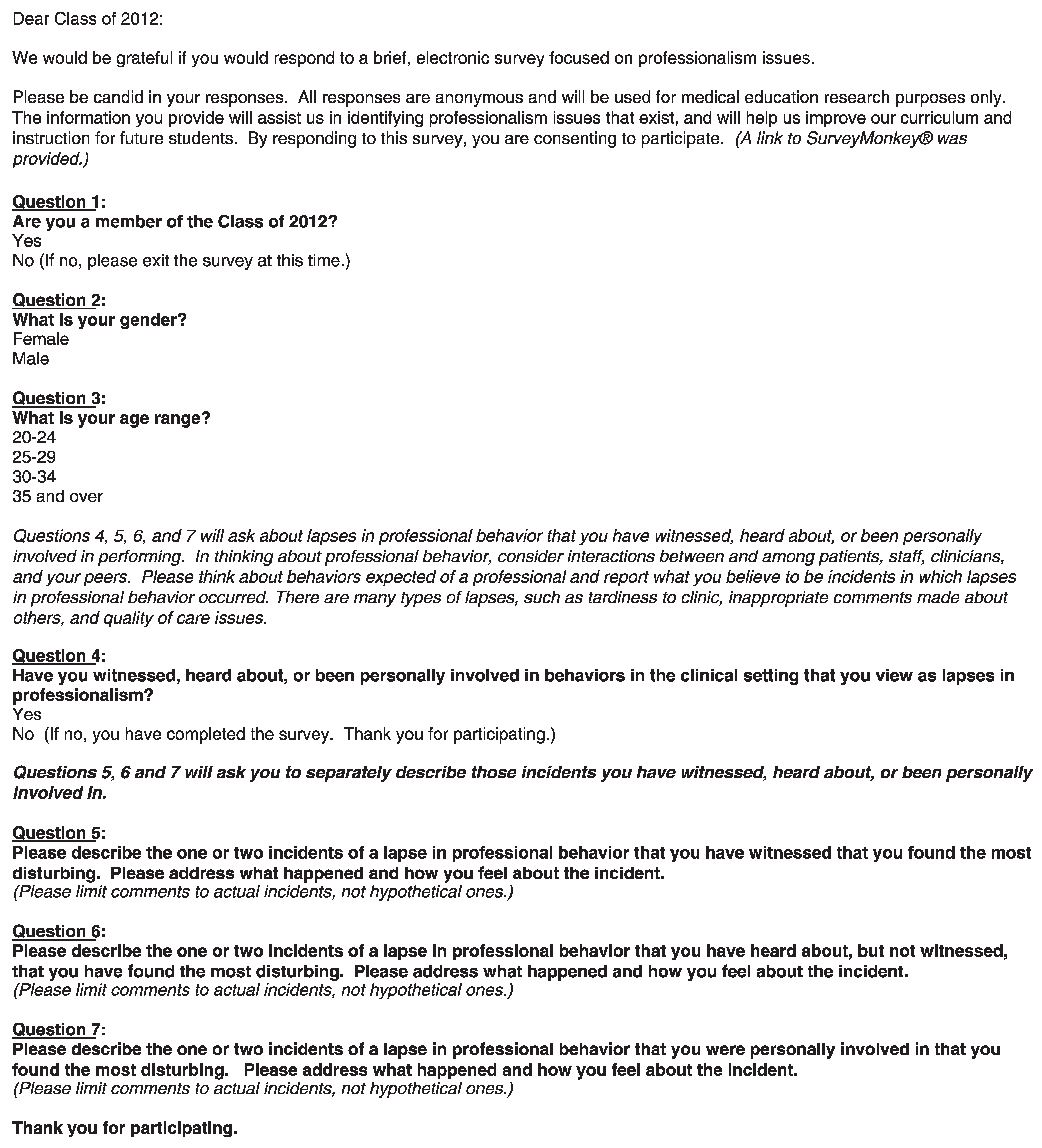
We used a coding structure that delineated the critical incidents according to whether the student witnessed the professional lapse, had knowledge of it but did not witness it, or identified it in themselves. The structure provided a useful categorization of incidents as an initial starting point in the analysis phase. In addition, it was anticipated that using a limited and specific structure could aid students in recalling and reporting various incidents. Students were asked to provide critical incidents illustrating lapses in professionalism so that recurrent themes in these incidents could be identified. The students were asked to describe the incident(s) in detail and to address the feelings they experienced that were associated with the incident.
Institutional review board approval from the Rosalind Franklin University of Medicine and Science and the University of Illinois at Chicago was obtained before initiating the study. A single survey (
Fig. 1) was made available to all members of the class of 2012, which included 88 students. The survey was administered by a staff member with no influence over a student’s academic progress or status. Students were given a 2-week window for completing the survey. The initial request to complete the survey was made by e-mail, the standard method used by the Dr. William M. Scholl College of Podiatric Medicine for communicating with students. Three follow-up requests to encourage survey completion were sent during the open survey period. The results were then reviewed by the staff member, and all personally identifiable information was redacted before the primary investigator received the deidentified data.
Analysis of Data
Thematic content analysis with constant comparative analysis was used to analyze the data. Corbin and Strauss [
53] describe useful methods for the collection, analysis, and interpretation of data so that theories can be developed. Two coders read the results independently and identified major categories and concepts. The coders then discussed their initial results and agreed on six core themes. Each coder independently reviewed each response according to the agreed-on broad categories. The coders then met to compare results, and only minor discrepancies were found and resolved. Refinement of the core themes occurred, and subthemes were identified where appropriate.
Results
Sixty-six students (75%) in the class responded and agreed to participate in the survey. Sixty-two students reported their sex, with 27% (n1/4 17) identifying themselves as female and 73% (n1/4 45) as male. The predominant age group of those responding was 25 to 29 years, with 69% (n1/4 43) identifying themselves in that range. Sixty-three students responded to the question asking whether they had witnessed, heard about, or been personally involved in behaviors in the clinical setting that they viewed as lapses in professionalism. Forty-two students (67% of those responding to the question) answered yes, whereas 33% (n1/4 21) responded no. Twenty-seven students, or 64% of those who reported viewing lapses in professionalism, responded in each of the three categories requested: behaviors witnessed, behaviors heard about, and behaviors personally involved in.
The amount of detail provided in each category varied, with the greatest number of descriptive responses formulated relative to witnessed events. Of the 27 recorded responses, 25 provided detailed information and 2 responders left a blank line, which was recorded as responding to the question without providing any details versus not answering the question, which was done by 59% of those responding to the survey (n1/4 39). For the question requesting information about events students had heard about, of the 27 responses received, six provided no meaningful information and two focused instead on offering general feedback regarding the request to complete the survey without providing any actual examples of lapses in professional behavior.
The question asking students to discuss lapses that they were personally involved in yielded the least amount of data. Of the 27 responders, 15 provided either no meaningful information and did not respond to the question, indicated that the question was not applicable, or stated that they were unable to recall any incidents.
Six predominant themes were identified regarding behaviors demonstrating professional lapses, and these themes and subthemes appear in
Table 1. Multiple distinct comments were frequently embedded in a single response, and many comments could be coded in more than one category, resulting in a total of 86 coded responses spanning all six categories. The predominant themes, along with their percentage of coded responses, include attending physician treatment of students (38%), treatment of patients (26%), student behavior (24%), issues related to remediation policies and procedures (5%), issues related to billing and coding (5%), and relationships between student and staff, referring specifically to medical assistants in the clinical setting (2%).
Attending Treatment of Students. Students focused extensively on their interactions with attendings, and the greatest number of comments, 33 (38%), were coded in this category. Students provided rich accounts of experiences involving attendings and often expressed dissatisfaction with the treatment they received from certain attendings. In general, the feelings regarding negative interactions were intensified when the behavior occurred in the presence of peers or patients. Eight responders expressed concerns when they observed or experienced negative behavior from an attending in the presence of their peers.
The link between attendings’ treatment of students and the treatment of patients was particularly strong, with 14 responses being coded in both categories. In addition, students demonstrated heightened sensitivity when they perceived the behavior of an attending as negatively interfering with their personal interactions with patients. Seven of the responses referred to interactions occurring in the presence of patients and peers.
Treatment of Patients. Twenty-six percent of comments (n1/4 22) were coded in this category. Students discussed various incidents involving the treatment of patients and focused on the critical link between the behavior of an attending toward a student and the possible impact of that behavior on a patient’s perceptions of that student. Several students explained how a patient’s confidence in their ability to provide care could be negatively influenced by interactions with an attending. In fact, students were most concerned about the treatment they received from attendings when patients were involved, and the importance of the patient’s opinion to students was obvious.
Finally, cultural issues in relation to the treatment of patients were identified by two responders. The students recognized that challenges may arise when treating patients of a different culture, particularly when potential barriers were not effectively acknowledged and addressed.
Student Behavior. Comments regarding the behavior of students appeared frequently, with 21 responses coded in this category. A primary subtheme in this category was student attendance, with 19 of the responses focused on attendance- related issues. The responses included reports of students arriving late to a clinical experience, calling in sick, or limiting patient interactions. Only two comments identified behaviors unrelated to attendance, and only one of them revealed a professional lapse that potentially affected patient care.
Few reports involving a student’s personal involvement in professional lapses were identified, and only one student remotely addressed a possible lapse that he or she personally committed. The report of that lapse was subtle, with no details revealed other than the student stating, ‘‘I have certainly made comments to colleagues and/or patients that may be seen as unprofessional by others.’’
Issues Related to Remediation Policies and Procedures. Four responses focused on the impact of the Dr. William M. Scholl College of Podiatric Medicine remediation policies and procedures and associated certain student behaviors with academic failure. In each of the responses, students perceived a connection between what they considered to be inappropriate or irresponsible behaviors with poor academic performance.
Issues Related to Billing and Coding. Several responses (n1/4 4) focused on billing and coding issues, and students offered strong opinions on situations involving billing and coding.
Student and Medical Staff Relationships. Issues regarding student and medical staff relation- ships were reported infrequently, with only two responses. Both responses centered on relationships that students perceived as being too friendly for the clinical environment.
Discussion
To our knowledge, this study is unique in addressing podiatric medical students’ perceptions of professional lapses and allows for an initial exploration into the thoughts and opinions of this subset of students. The study confirms that podiatric medical students have experienced several types of professional lapses in behavior. In addition, they possess the ability to not only identify those lapses but to also differentiate between acceptable and unacceptable behaviors.
Several researchers [
54,
55] have reported studies eliciting reports of critical incidents related to professionalism in medicine and have developed and reported various classification schemes. Jha et al
54 identified thematic areas including compliance to values, patient access, the doctor-patient relationship, and personal awareness and motivation. Hicks et al [
55] focused on ethical dilemmas experienced by students and identified conflicts associated with medical education and patient care, responsibilities exceeding the student’s capabilities, and episodes of care perceived to be substandard.
In a systematic review, Wilkinson et al [
56] focused on linking assessment tools to definable elements of professionalism to identify gaps between recognized components of professionalism and tools to assess them. As part of their study, records of incidents of unprofessionalism were examined and were analyzed relative to major themes and subthemes. In general, the results indicated that critical incident reports can be used to assess many aspects of professionalism, including adherence to ethical principles, effective interactions with patients and their family and friends and with other members of health-care teams, reliability, and continuous improvement of self. Many of the themes identified by this study are consistent with those found in the other studies. Multiple incidents involving professional lapses that students have heard about, witnessed, or committed were reported and available for analysis and classification.
Power Differentials
Power differentials between students and attendings exist, and those present challenges for students. Students frequently expressed frustration with the behaviors of certain attendings yet did not suggest or address methods for dealing with those frustrations. In fact, none of the responses indicated that any of the students who responded had ever attempted to directly confront or eliminate the behaviors they found offensive. Instead, it became apparent that students struggled with a sense of powerlessness or helplessness in situations involving their superiors and often tolerated certain behaviors. If this study had also focused on asking the students to suggest possible solutions to the situations encountered, the results could have been different. Rather than tolerating unacceptable behaviors, students may have suggested the possibility of addressing the behaviors by openly reporting the offenders.
Institutional Influence
Do institutional factors exist that discourage or prevent students from reporting lapses in professionalism, or is it possible that students presume that attendings are already aware of their colleagues’ improper behavior and are complicit in allowing it to continue? Although none of the responders specifically alluded to a culture of silence among any of their attendings or in facilities pertaining to professional lapses, it would be only speculation to suggest that students have either perceived or experienced such a culture. Is it possible that since students frequently model what they observe and experience, they may choose to adopt the same culture when perceiving a culture of silence? Exploration into the peer relationships among attendings and their effect on students’ perceptions of professionalism could be an area for future research.
Attendings’ Perspectives
The inappropriate behaviors of attendings toward students described through this anonymous reporting mechanism certainly present challenges. It is apparent that further exploration into the behavior of the attendings toward students in the clinical environment is needed. However, although we have no intention of excusing or dismissing any of the reports of seemingly inappropriate behaviors or comments of attendings reported by students, a cautionary approach in addressing the reported behaviors is warranted. The perspectives of the attendings are lacking in this study, and it is unknown what, if any, student actions or inactions might have occurred that could have influenced the responses of their attendings.
Attendings are expected to assist and support students in developing into professionals who possess all of the knowledge, skills, and attitudes necessary to provide quality health care to the public. If a student’s performance in the clinical environment does not meet reasonable expectations, or potentially threatens the health and safety of the patient, one might expect an attending’s response to be necessarily stern. There is a clear dilemma in this study in that some of the reports received may describe an attending’s reaction to a student’s inappropriate behavior, but the student’s role in generating a particular response from an attending is unknown, overlooked, or ignored. Therefore, in analyzing the results, it should be recognized that the perspective of the attending is not represented.
In addition, podiatric medical students have high levels of stress due to the rigors of the academic and clinical program, and a student’s ability to anonymously report what they perceive to be abuses or lapses in the behavior of their attendings may actually serve as a type of release for some who choose to freely provide descriptive and potentially inflammatory reports. It is a limitation of this study that a mechanism to verify the accuracy of the reports provided, or the extent of the reporters’ objectivity, did not exist. Still, the details provided in many of the reports suggest opportunities for development efforts aimed at attendings.
Interactions with Patients and Peers
The emphasis placed by students on their interactions with patients and peers should not be overlooked. It seems that students care deeply about how they are perceived by their colleagues and especially by their patients. Students also recognize how patients may be influenced by the treating podiatric physician and often commented on the negative effects of reprimands occurring in the presence of patients. Students do not want their relationship with the patient to be compromised, and they recognize and value their interactions with patients. Students are also keen observers of their attendings’ interactions with patients and demonstrated the ability to identify and condemn behaviors that are inappropriate or unacceptable, and that potentially violate the boundaries of professionalism.
Few reports were submitted that focused on attendings’ treatment of students occurring outside of the presence of a patient or peer. It could demonstrate that students truly value the opinions of patients to a greater degree than previously realized or that students may be more tolerant of attendings’ behavior that does not directly involve patients or peers. It also seems that the impact of negative treatment of students by attendings is simply compounded when patients or peers are involved. One wonders whether the behavior of attendings toward students when others are not present substantially differs or simply affects the student(s) in different ways. Another possibility is that student interactions with attendings occurring outside of the presence of a patient or peer are simply infrequent, which would naturally limit the number of incidents available to report.
Personal Lapses
The fact that students were able to focus on the professional lapses they witnessed or heard about, yet demonstrated little ability to report on lapses they personally committed or were involved in, raises questions. Have students developed the proper knowledge, skills, and attitudes necessary to fully reflect on their own behavior and are they able to recognize and address their own personal lapses? Or, is there a reluctance or unwillingness among students to report their own lapses? It is also conceivable that students are simply so affected by the lapses of others that the focus of their reporting centered on the behaviors of others rather than on their own behavior. A final possibility is that students are not engaged in behaviors that would be considered professional lapses.
Interconnected Levels of Analysis
Returning to Hafferty and Castellani’s [
16]
‘‘interconnected levels of analysis’’ that represent one approach for conceptualizing professionalism, two of the three levels are readily identifiable in the results of this study, and the third level is suggested in a more subtle manner. The micro level, which focuses on the individual and his or her work, was evident in the many comments from students offering descriptive accounts of what occurred to them, often while rendering patient care. One student even explicitly stated, ‘‘All of the above mentioned are incidences that occurred to me.’’ Many other students similarly offered details about how situations affected them personally. The meso level, which focuses on professionalism in terms of relationships and social interactions, was also evident, particularly in the reports focused on the opinions and perceptions of patients and peers who were involved in incidents involving the negative behaviors of attendings.
A blending of the micro and meso levels frequently occurred, with many students focusing on how the decisions and actions of others influenced their own interactions and relationships with colleagues, attendings, and patients. The heavy emphasis on students’ relationships with patients and peers, as previously discussed, is an example of the micro and meso levels interconnecting.
The third and final interconnected level, the macro level, which focuses on professionalism as a social movement, was suggested to a limited extent in the brief comments associated with billing and coding issues. The responders suggested how billing and coding decisions may impact the entire profession. This perspective is refreshing in that it demonstrates awareness by students of the impact of behaviors on more than just oneself. It also creates opportunities to begin to consider the role and responsibility of organized podiatric medicine in professionalism-related issues. Finally, the comments regarding remediation policies and procedures could be associated with the macro level, especially since policy decisions occur at high levels when considered from the students’ perspective.
Implications of the Study
Certainly, these initial results regarding students’ perceptions of professionalism-related lapses in the clinical environment are promising, especially since they provide evidence that podiatric medical students possess the ability not only to identify behaviors that are inappropriate or unprofessional but also to reject or condemn those behaviors as well.
In general, the insights into student thinking provided by this study are interesting because they seem to reveal that students possess an understanding of professionalism. Students also seemed to demonstrate levels of maturity that reflect well on them as future practicing professionals. Among the Dr. William M. Scholl College of Podiatric Medicine’s goals is to develop responsible, capable, and compassionate professionals, and those attributes were identifiable in many of the responses received. Students also frequently expressed a keen awareness of acceptable behaviors and were readily capable of discerning among various behaviors regarding their acceptability. The fact that many of the responders were vocal and forthright in rejecting inappropriate behaviors reflects well on them in general.
The fact that students do not automatically report professional lapses yet can identify them when they occur is encouraging. The fact that many of the responders vocalized rejection of unprofessional behaviors reassures us that efforts designed to enhance students’ understanding of what it means to be a professional could be having a positive impact.
Limitations
This initial study of podiatric medical students’ identification of professionalism lapses in the clinical setting provided valuable insights into students’ perceptions of professionalism. However, limitations exist, including a small sample size. This study served as an initial data collection effort, and no previous studies have been performed at this institution for comparative purposes. In addition, opportunities for triangulation, which allows the data collected to be compared with data obtained from other sources, were not identified. The process for data collection and analysis could certainly be enriched by introducing either focus group sessions or one-on-one interviews with selected students in the future. Other research opportunities exist related to this topic, and the collection of additional data via replication of the study would be beneficial.
Conclusions
This study serves as an initial needs assessment for a select class of podiatric medical students and provides results that will be useful for developing professionalism-related instructional activities that could benefit students and attendings. There exists a need for the deliberate planning of instructional methods that will aid in expanding students’ understanding of professionalism. Opportunities to consider and discuss professionalism-related issues through curricular changes should be explored. In addition, a discussion of the behaviors identified in this study would also likely be beneficial. Providing those who interact with students more instruction and guidance regarding their roles as mentors seems to be important as well. Finally, establishing formal mechanisms or systems for reporting professionalism-related violations would be beneficial to students, and creating an ongoing assessment process relative to professionalism would be useful.
An important first step in the process of planning curricular changes was the identification of students’ perceptions of professionalism-related issues. Without question, the study reinforced the importance of extending educational efforts on professionalism beyond what currently exists.
The research related to professionalism among podiatric medical students is limited, and this study serves as an initial exploration of professionalism related issues in podiatric medicine. Many future research opportunities exist, including an examination of professionalism-related issues experienced in various other settings. As a result of this study, it has become apparent that there is an immediate and critical need to develop appropriate instructional and assessment activities related to professionalism that support podiatric medical students’ ongoing journeys to become practicing professionals.
Financial Disclosure
None reported.