Adequate ankle dorsiflexion range of motion is necessary for normal performance of several functional activities, such as walking, running, and stair negotiation. A limitation of ankle dorsiflexion has been implicated as a risk factor in several lower-extremity disorders, such as plantar fasciitis, ankle sprain, and patellofemoral pain syndrome [
1,
2,
3,
4,
5]. Dorsiflexion range of motion has also been associated with self-reported functional ability after an ankle fracture [
6,
7].
Some inconsistencies exist, however, regarding the importance of ankle dorsiflexion in several conditions. For example, whereas several studies [
4,
5,
8] associated ankle dorsiflexion limitation with patellofemoral pain syndrome and patellar tendinopathy, a recent investigation did not detect any difference in ankle dorsiflexion between patients with patellofemoral pain syndrome and controls. In addition, whereas two studies [
3,
10] prospectively associated a limitation of ankle dorsiflexion with an increased risk of sustaining an ankle sprain, another study [
11] found no difference in dorsiflexion range of motion between athletes who sustained an ankle sprain and those who did not.
One possible explanation for the inconsistencies mentioned previously herein is the various measuring techniques that have been used to assess ankle dorsiflexion range of motion. In some studies [
1,
2,
4,
11], dorsiflexion was measured in nonweightbearing conditions, whereas other studies [
3,
5,
6,
7,
8,
9,
10] used a weightbearing measurement. Similarly, when ankle dorsiflexion has been used as an outcome measure for the effectiveness of various therapeutic interventions, it has been measured in both weightbearing and nonweightbearing conditions [
12,
13,
14,
15,
16].
Nonweightbearing measuring techniques typically attempt to prevent motion of the subtalar joint and, thus, better isolate the motion available at the talocrural joint [
1,
2,
4]. Although nonweightbearing measurements have demonstrated adequate intrarater reliability, the interrater reliability has typically ranged from poor to moderate [
17,
18,
19,
20].
Weightbearing measurements have several advantages over nonweightbearing measurements. First, they are relatively easy to perform. Second, they potentially apply a greater moment of force to the ankle via the patient’s own body weight, thus stressing the joint through its full excursion. Third, they are performed in a more functional position, and finally, they seem to possess greater interrater reliability [
21,
22,
23]. There are, however, some disadvantages to weightbearing measurements. They cannot be taken on individuals with a restricted weight- bearing status (after trauma/surgery), and, perhaps more importantly, weightbearing measurements probably do not isolate motion to the talocrural joint as well as nonweightbearing measurements [
21]. Weightbearing measurements are likely to include a greater amount of subtalar motion, as well as motion of the more distal joints of the foot. The latter is supported by the greater range that has been recorded in studies using weightbearing measurements [
3,
5,
6,
7,
8,
9,
15,
21,
22,
23,
24].
The interchangeable use of weightbearing and nonweightbearing measurements throughout the literature suggests that clinicians and researchers consider the two techniques as measuring the same construct. Nevertheless, it has been a clinical impression of ours, as well as others [
25], that in some patients, bilateral dorsiflexion range of motion comparisons yield different findings under weightbearing and nonweightbearing conditions. This would imply that the two measurements assess two different constructs or, at least, different aspects of the same construct. To our knowledge, no study has compared a weightbearing and a nonweightbearing ankle dorsiflexion measurement in a single sample. A significant difference between the weightbearing and nonweightbearing measurements, or lack of a strong correlation between them, would suggest that the two measurements essentially assess two different constructs and, therefore, should not be used interchangeably. The comparison between the weightbearing and nonweightbearing measurements may also help explain some of the inconsistencies that were found in previous investigations into the role of ankle dorsiflexion in several lower-extremity disorders.
The aims of this study were 1) to compare weightbearing and nonweightbearing ankle dorsiflexion measurements and 2) to examine the correlation between the two measurements. We hypothesized that the weightbearing and nonweightbearing measurements would produce significantly different results and that the correlation between them would not reach a high level (r < 0.7).
Methods
Participants
Forty-three healthy individuals (29 women) were recruited from the campus of Ariel University Center, Ariel, Israel. The mean ± SD age, height, and body mass were 25.5 ± 4.9 years, 168.4 ± 9.6 cm, and 63.3 ± 12.2 kg, respectively. Individuals recruited for this study also participated in another investigation that assessed lower-extremity quality of movement during a step-down maneuver. Individuals were included if they were aged 18 to 65 years and were free of pain in the lower extremities or lumbar spine. Individuals were excluded from participation if they had undergone surgery in the lower extremities or lumbar spine during the 6 months preceding participation in the study or had any balance impairments secondary to a vestibular or neurologic disorder or secondary to the use of medications. Before participation, all of the participants reviewed and signed consent forms approved by the ethics committee of Ariel University Center.
Procedure
Two examiners performed data collection for this investigation. One examiner (A.R.) had 12 years of clinical experience in physical therapy management of musculoskeletal conditions. The other examiner (Z.K.) had more than 25 years of teaching and clinical experience in the field of kinesiology and neurologic rehabilitation.
Data collection took place in the gymnasium of the Department of Physical Therapy at Ariel University Center. Data were collected on each participant by the two examiners to establish the interrater reliability of the weightbearing and nonweightbearing measurements. A data collection session lasted approximately 1 hour for each participant (including data collected for both investigations). Typically, two participants were tested simultaneously during each data collection session. First, each examiner completed the measurements of one participant. Once data collection of the first participant was completed, the examiners switched and began data collection of the second participant. Although both examiners were present in the gymnasium during the data collection session, they were positioned on opposite ends of the room so that neither one had knowledge of the results of the other. All of the testing was performed on the dominant limb of each participant, defined as the limb used to kick a ball.
Measurements
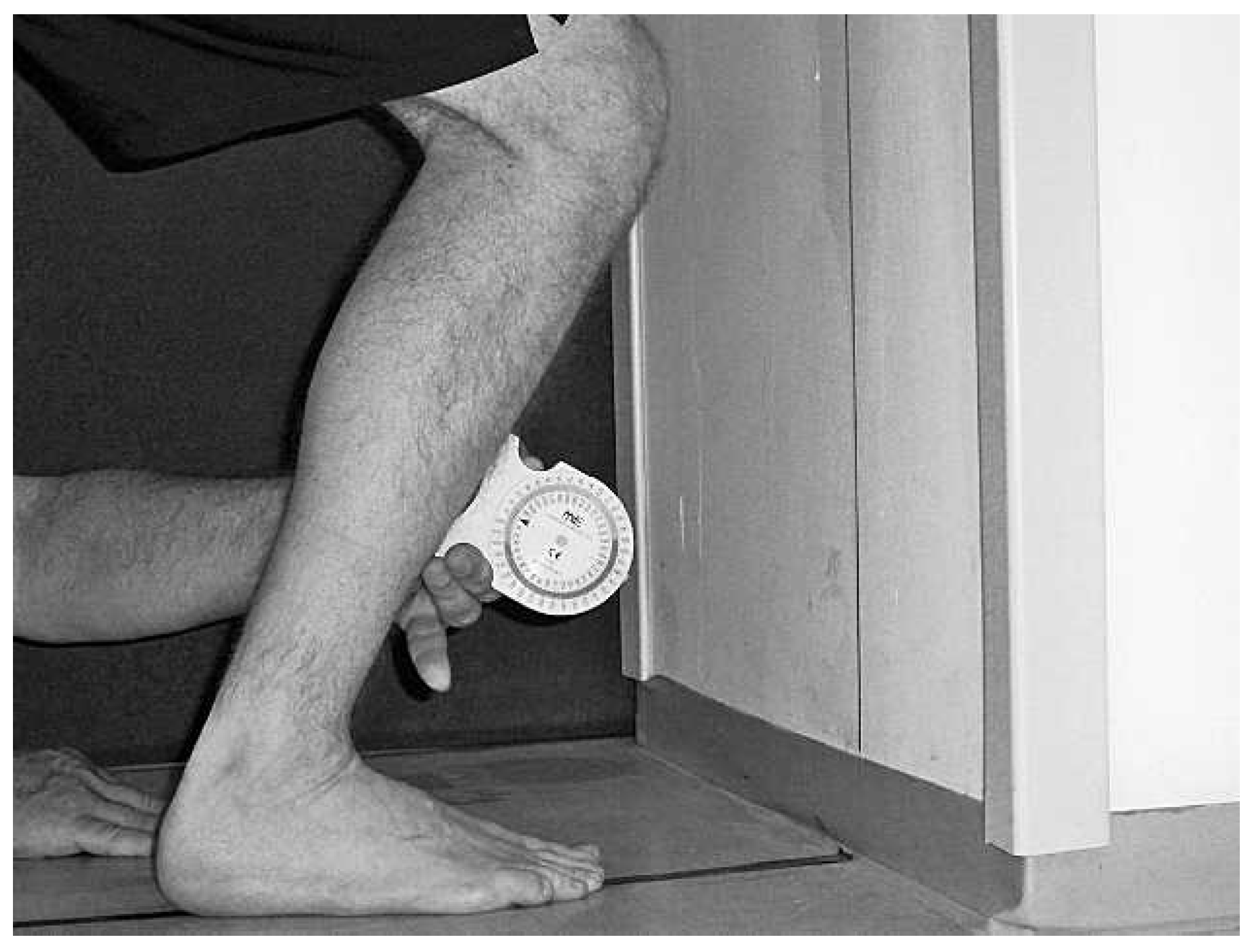
Weightbearing Ankle Dorsiflexion. Ankle dorsiflexion in weightbearing was measured with a fluid-filled inclinometer with 1° increments as described by Bennell et al [
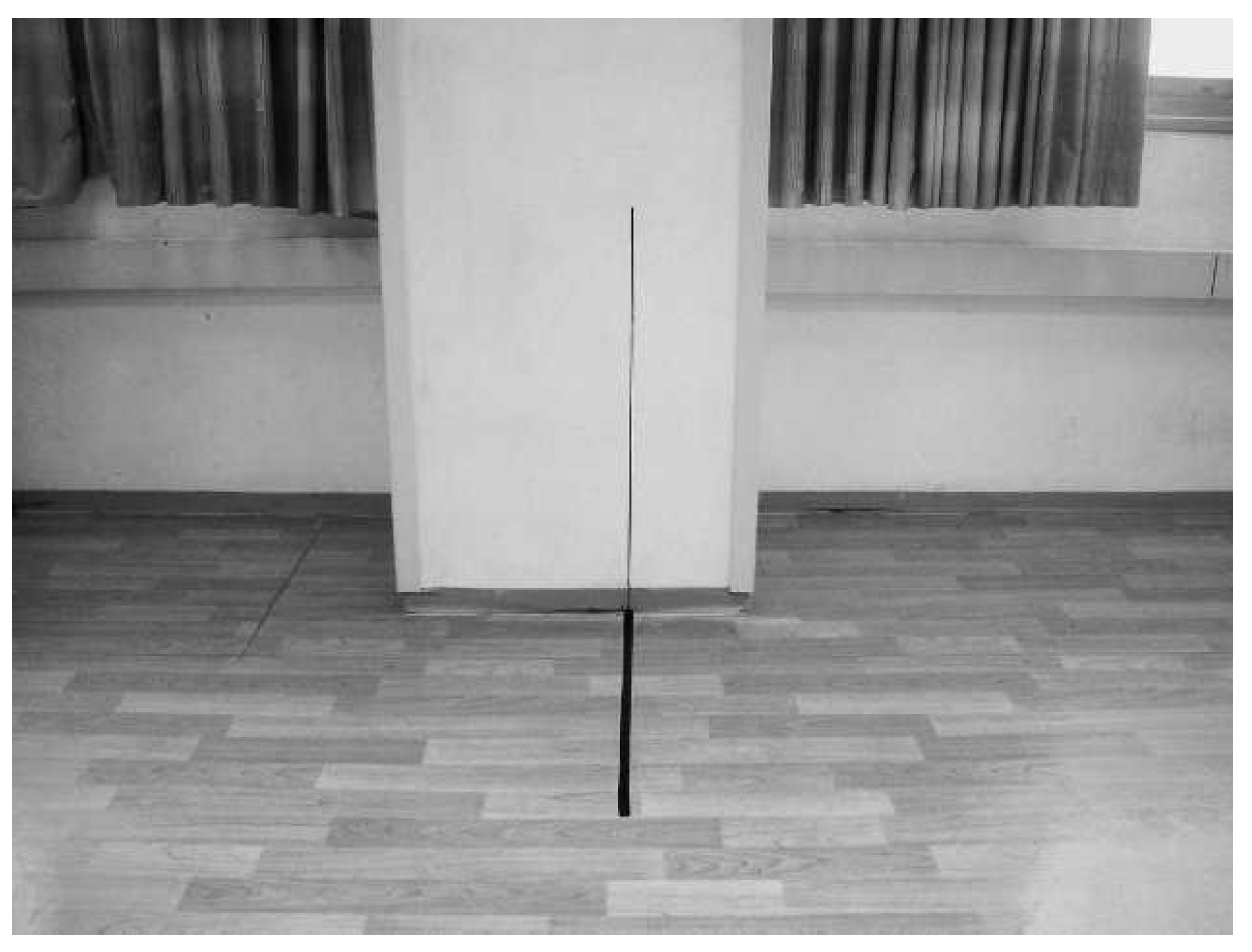
21]. A 50-cm-long line was drawn on the floor and a continuous 60-cm-long line was drawn on the wall where the test was to be performed (
Figure 1). A 1-cm-wide red sticker was placed on the anterior aspect of the tibia of each participant 15 cm distal to the tibial tuberosity. The individual placed the tested foot on the floor line so that the line bisected his or her heel and the second toe was positioned over the line. The participant was then asked to lunge forward and bring his or her kneecap as close as possible to the vertical line drawn on the wall without lifting the heel off the floor (
Figure 2). Once maximal dorsiflexion was achieved, the examiner placed the inclinometer, which was first zeroed on a fixed vertical reference, over the marked spot on the anterior tibia of the participant. The range of dorsiflexion was recorded, and the participant returned to the starting position. The procedure was repeated three times, with the average being used for data analysis.
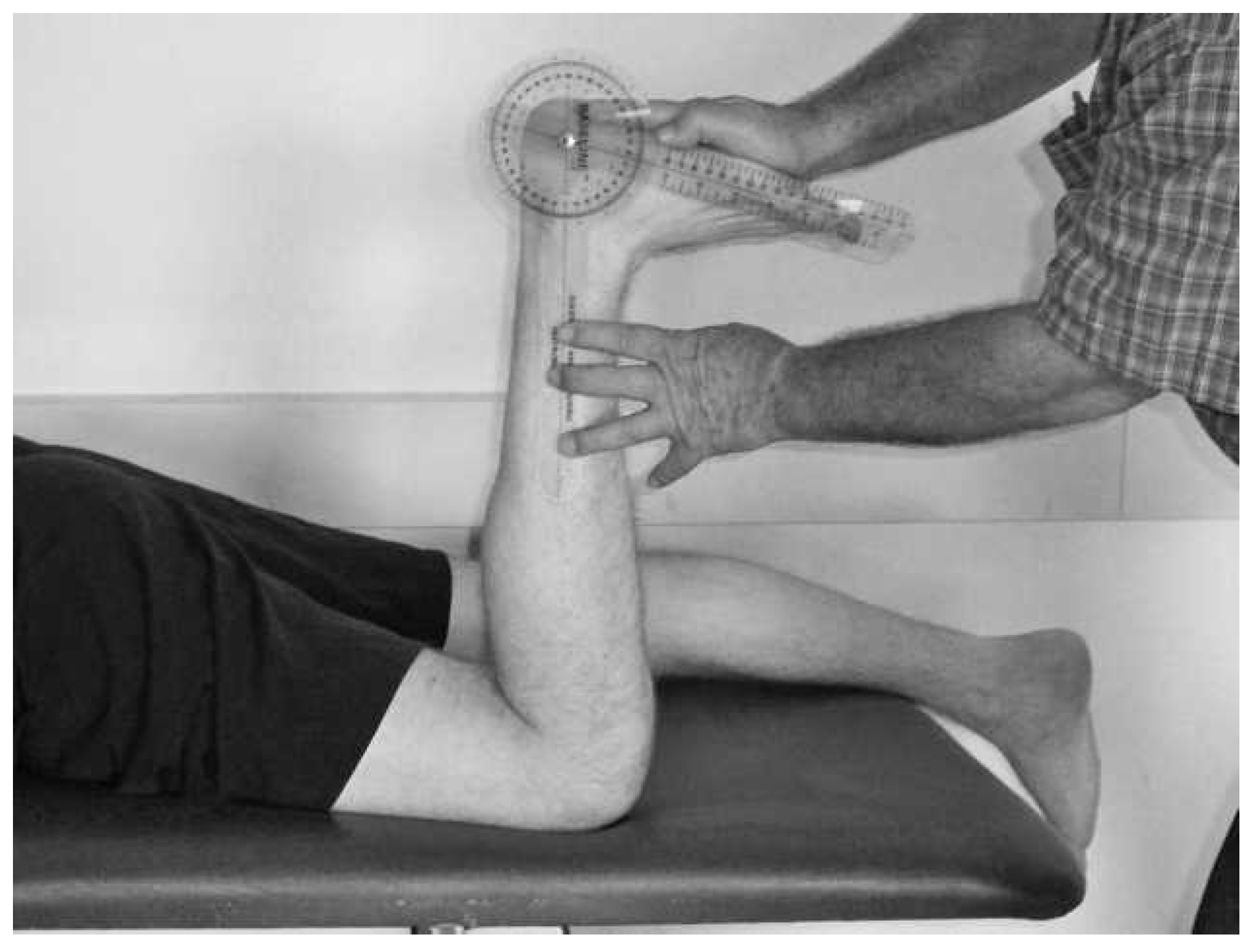
Nonweightbearing Ankle Dorsiflexion. Passive nonweightbearing ankle dorsiflexion was measured with a universal goniometer with 1° increments in a modification of the technique described by Piva et al [
4] (
Figure 3). The individual was placed in a prone position with the knee positioned at 90° of flexion. The examiner manually verified a subtalar neutral position and placed the ankle at maximal dorsiflexion. Dorsiflexion was measured as the angle between the lateral midline of the leg (a line from the head of the fibula to the tip of lateral malleolus) and the lateral border of the foot (parallel to the inferior aspect of the calcaneus). The average of three measurements was used for data analysis.
A mixed-model intraclass correlation coefficient for absolute agreement (ICC[
3,
2]) was used to estimate the interrater reliability of both range of motion measurements. An ICC greater than 0.75 represents excellent reliability; 0.4 to 0.75, fair to good reliability; and less than 0.4, poor reliability [
26]. To express the measurement error in the original units of the measurement, the SEM was calculated with the following formula: SEM = SD × √(1 − ICC). The ICC and SEM values for the weightbearing and nonweightbearing measurements are outlined in
Table 1.
Data Analysis
Data analysis was performed using a statistical software package (SPSS, version 15.0; SPSS Inc, Chicago, Illinois). Descriptive statistics (mean ± SD) for the weightbearing and nonweightbearing ankle dorsiflexion measurements by either examiner were calculated. A paired t test was used to assess the difference between the weightbearing and nonweightbearing measurements of either examiner. The Pearson product moment correlation coefficient was used to examine the correlation between the two measurements of either examiner (weightbearing versus nonweightbearing).
Results
For both examiners, mean 6 SD ankle dorsiflexion range of motion in weightbearing was more than twice that measured in nonweightbearing (examiner 1: 49.7° ± 6.4° and 24.6° ± 5.0° for the weightbearing and nonweightbearing measurements, respectively; examiner 2: 49.3° ± 5.9° and 23.2° ± 5.4° for the weightbearing and nonweightbearing measurements, respectively). These differences reached significance for both examiners (P < .0001). The weightbearing and nonweightbearing measurements correlated moderately (r = 0.6 and r = 0.64 for examiners 1 and 2, respectively; P < 0.01).
Discussion
Ankle dorsiflexion range of motion as measured in weightbearing produces significantly different results compared with the range measured in nonweightbearing. We were somewhat surprised by the magnitude of the difference between the range of motion measured under the two conditions. Ankle dorsiflexion in weightbearing averaged more than twice the range recorded in nonweightbearing. Several factors might have contributed to the difference between the weightbearing and nonweightbearing dorsiflexion values. First, the greater moment applied to the ankle during the weightbearing measurement may explain this difference. We conducted post hoc testing of seven individuals using a hand-held dynamometer and a force plate to estimate the moment applied to the ankle during the nonweightbearing and weightbearing measurements, respectively. Based on these tests, we estimate that the average moment applied to the ankle during the weightbearing measurement is three to four times the moment applied during the nonweightbearing measurement (58.9 Newton-meters [Nm] during the weightbearing measurement versus 16 Nm during the nonweightbearing measurement). Second, motion at the more distal foot joints during the weightbearing measurement may have also contributed to the greater range recorded in this condition. Except for asking the participants to aim their knees at a line drawn on the wall in front of them, we did not attempt to control the motion of the subtalar, or more distal, joints during the weightbearing measurement. Therefore, some subtalar, midtarsal, and tarsometatarsal joint motion has likely occurred under the weightbearing measurement condition. In contrast, we attempted to maintain the subtalar joint in a neutral position during the nonweightbearing measurement. In addition, we aligned the distal arm of the goniometer along the lateral aspect of the calcaneus, rather than the forefoot, in a further attempt to isolate talocrural motion during the nonweightbearing condition. We acknowledge, however, that some motion of the midtarsal and tarsometarsal joints likely occurred during the nonweightbearing measurement as well. A third possible reason for the difference between the two measurements is the measuring instrument and the slightly different reference lines used for both measurements. We used a fluid-filled inclinometer for the weightbearing measurement and a universal goniometer for the nonweightbearing measurement. The use of a fluidfilled inclinometer during the weightbearing measurement necessitated a different proximal reference line than the one used for the nonweightbearing goniometric measurement (anterior tibia for the weightbearing measurement versus the lateral midline of the leg for the nonweightbearing measurement). The more anterior reference line used for the weightbearing measurement has the potential to inflate the dorsiflexion angle recorded in this condition. Indeed, during pilot testing before data collection, in which we compared a weightbearing measurement with an inclinometer placed over the anterior tibia and a weightbearing measurement with a goniometer placed over the lateral midline of the leg, we found a 5° to 8° greater range with the inclinometer. However, because of the magnitude of this difference, we do not believe that using the same measuring instrument, or reference lines, in both measurement conditions would have changed the findings significantly. Furthermore, the choice of the measuring instrument was meant to reflect common clinical practice. Weightbearing dorsiflexion is commonly measured by the distance from the individual’s great toe to a wall or with an inclinometer placed over the anterior aspect of the tibia [
8,
9,
12,
13,
21,
23]. Nonweightbearing dorsiflexion range of motion is typically measured with a goniometer using similar reference lines to the ones we used [
2,
4,
16,
18,
19,
20]. In any event, the present method does not allow us to determine the relative contribution that the moment applied to the ankle, the motion at adjacent joints, or the measuring instrument might have had on the range of motion measured under the two conditions.
This investigation indicated only a moderate correlation between the weightbearing and non- weightbearing dorsiflexion measurements (r = 0.6–0.64). Furthermore, a correlation coefficient is an acceptable measure only of the association between the ranks of two sets of scores. A correlation coefficient does not allow prediction of the magnitude of one set of scores by the other. A correlation of 0.6 to 0.64 means that only 36% to 40% of the variance of the weightbearing measurement can be explained or predicted by the nonweightbearing measurement, and vice versa. Much of the variance in each measurement is, therefore, explained by other factors.
The moderate correlation between ankle dorsiflexion in weightbearing and nonweightbearing suggests that the two measurements do not assess the exact same phenomenon. This finding implies that the measurements should not be used interchangeably as measures of ankle dorsiflexion range of motion. The greater ease of performance and the better interrater reliability are two factors favoring use of the weightbearing measurement. However, the current literature does not suggest a definitive advantage to either measuring technique. For example, when investigating its relation to the risk of an ankle sprain, dorsiflexion was associated with an increased risk when it was measured under weightbearing conditions [
3,
10] but not under nonweightbearing conditions [
11]. Conversely, when investigating its relation to patellofemoral pain syndrome, dorsiflexion was associated with an increased risk when measured under nonweightbearing conditions [
4] but not under weightbearing conditions [
9]. When investigating its relation to functional ability after an ankle fracture, a positive correlation was found when dorsiflexion was measured in weightbearing conditions [
6,
7]. However, we are unaware of a comparable study that used a nonweightbearing measurement. Given these findings, we suggest that the choice of the measuring technique reflect the purpose of the measurement. If the association between ankle dorsiflexion and functional activities, such as squatting, jump landing, or stair climbing, is of interest, we suggest that the weightbearing measurement be used. This measurement more accurately replicates the position of the ankle during these activities. The nonweightbearing measurement may not stress the ankle to its full excursion and, therefore, may not be sensitive enough under these circumstances. If, however, the association between ankle dorsiflexion and nonweightbearing activities is of interest, or if weightbearing is contraindicated, the nonweightbearing measurement should be used. Another possible indication for using a nonweightbearing measurement is when dorsiflexion range of motion is used as an outcome measure for the effectiveness of an intervention. Johanson et al [
15] used both a weightbearing and a nonweightbearing measurement to assess the effectiveness of a 3-week gastrocnemius stretching program. Although significant postintervention gains were found under both measuring conditions, the effect size measured with the nonweightbearing measurement was 2.0 versus only 0.6 with the weightbearing measurement [
15]. This finding is in agreement with the moderate correlation between the weightbearing and the nonweightbearing measurement in the present study. Finally, given the inconsistencies in the findings of previous studies, it would also seem prudent to use both measuring techniques to avoid false-negative findings.
A useful future direction of study would be to assess the sensitivity to change of either measurement (weightbearing and nonweightbearing) in response to several therapeutic interventions with established clinical efficacy. This would help clinicians and researchers in choosing the measurement that would be more likely to reflect the effects of such interventions.
Conclusions
Weightbearing and nonweightbearing measurements of ankle dorsiflexion produce significantly different results. Although a significant correlation does exist between the two measurements, either one explains only 36% to 40% of the variance of the other. Therefore, the two measurements possibly measure two different constructs and may produce different findings when used as independent variables or as outcome measures. The preferred measuring technique should be determined by the specific purpose of the investigator/clinician. Given the findings of this investigation and of previous studies, it would also seem prudent to include both measurements whenever possible in order to avoid false-negative findings.