Fast and effective, lidocaine is the local anesthetic most often used before outpatient procedures. [
1] During the infiltration of lidocaine, however, patients frequently experience a burning or stinging sensation. [
1,
2] This perceived pain and anxiety has been extensively studied in hopes of finding methods or techniques to reduce the discomfort and make the administration of lidocaine more tolerable to the patient. Previous research [
3–
5] has linked the pain of lidocaine administration to the acidic nature of the solution, which is necessary to preserve and extend the shelf life of the bottled preparations. Buffering the solution with sodium bicarbonate before injection has been shown in several studies [
3,
6,
7] to reduce the sensation of pain. Buffered lidocaine solutions, however, can lose their potency within hours; thus, many practitioners forgo this practice, finding it inconvenient, difficult to mix, and expensive.
One of us (S.L.B.) noted that injecting a bacteriostatic saline solution into the anesthesia site immediately preceding lidocaine infiltration seemed to reduce the burning sensation. Although the mechanism of the anesthetic effect of the bacteriostatic saline solution containing 0.9% benzyl alcohol (BAS) is unclear, it is thought that the benzyl alcohol is responsible. [
8–
11] Earlier studies [
8–
11] have suggested that the inclusion of benzyl alcohol in the saline solution was necessary to obtain pain reduction.
The goal of this study was to test whether lidocaine’s sting can be reduced when preceded by a BAS injection. We report the results of a double-blind, randomized study of 45 adult volunteers in which we rated the pain of lidocaine infiltration after BAS administration compared with the pain without a preceding BAS injection. Local infiltration of BAS before the lidocaine injection, although it requires two separate injections, seems to offer a practical pain-reducing method for practitioners.
Materials and Methods
Participants
Approval for this study was given by the institutional review board of Midwestern University. Participants were unpaid volunteers from the Midwestern University student body and faculty and friends of Midwestern University students. After being fully informed about the design, risks, and potential hazards, 45 adult volunteers gave their consent to participate in the study. All of the participants were asked about their history of neurologic and traumatic foot abnormalities; none of the participants indicated a positive history, and, therefore, no one was rejected. Because the data were collected immediately after the injections, no participant data were lost in this study. Each participant was given instructions on how to reach us if they experienced any long-term effects from the injections. As far as we know, more than 1 year after the study, there were no adverse outcomes from this investigation.
This study was performed on 3 separate days during September and October 2007. The participants included 23 women and 22 men. The average participant age was 33.6 years (age range, 22–69 years). Average height and weight were self-reported to be 170.2 cm (67 inches) and 75.75 kg (167 pounds), respectively.
Basic Protocol
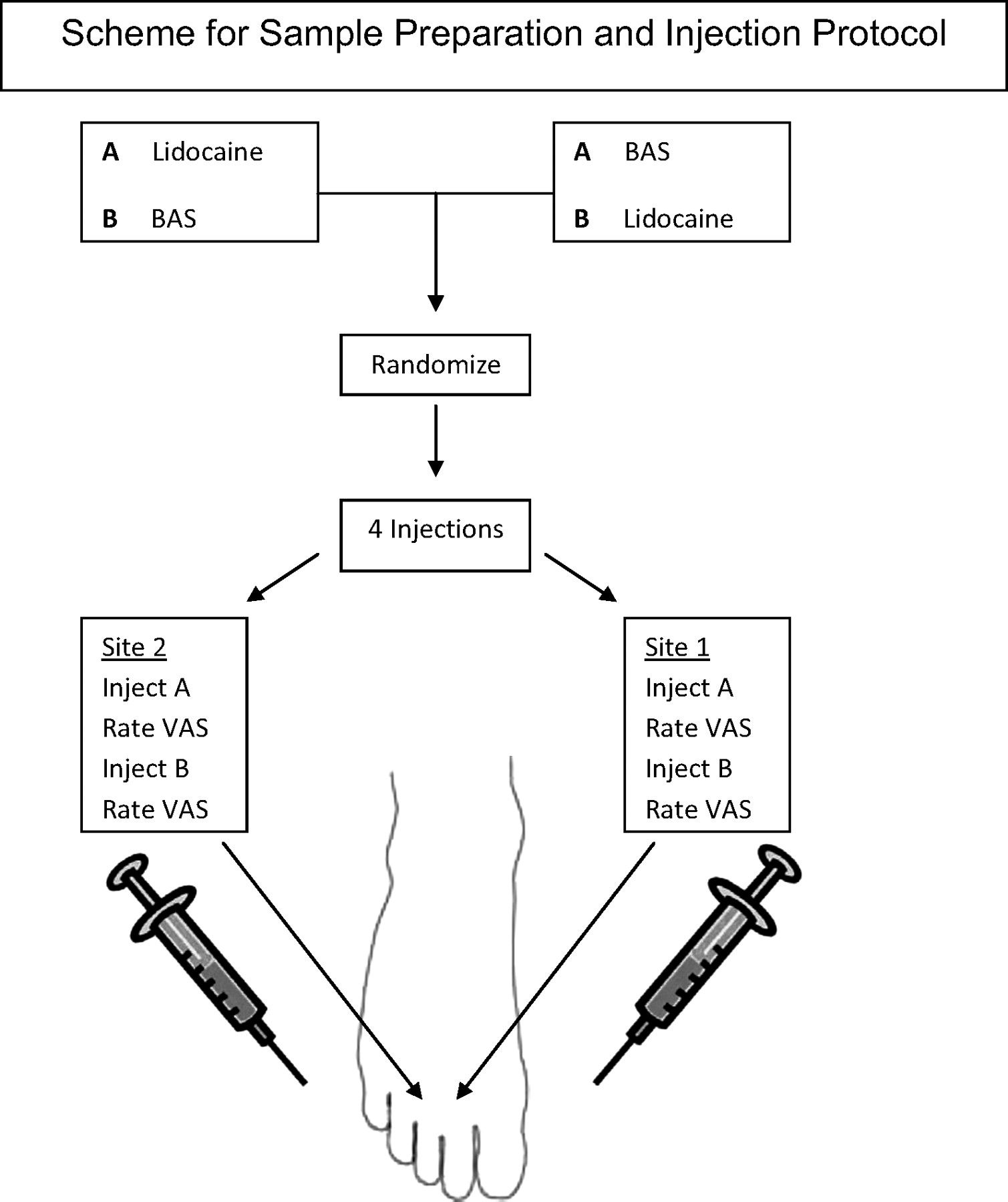
An outline of the study design is shown in
Figure 1. Each participant received four injections at two sites on the same foot. At one site, there was a control set of injections: lidocaine injection followed immediately by BAS injection. At another site there was the test set of injections: BAS injection followed by lidocaine injection. The injection order of the control set before or after the test set of injections was randomized and hidden from the participant and from the podiatric physician injecting the samples. The participant was asked to rate the pain felt on injection by marking on a visual analog scale.
This protocol needed to distinguish the sensation of lidocaine alone from the sensation of lidocaine preceded by BAS infiltration. However, we could not blind an experiment in which the control set has one injection, lidocaine, and the test set has two injections, BAS followed by lidocaine. The solution to this problem was to include a BAS injection after the lidocaine injection, used for the control. This way, we created two separate injection sets that could be randomized and conformed to the informed consent, which indicated that the injections would contain either lidocaine or BAS.
Figure 1.
Sample preparation, randomization, and injection protocol. BAS indicates bacteriostatic saline solution containing 0.9% benzyl alcohol; and VAS, visual analog scale.
Figure 1.
Sample preparation, randomization, and injection protocol. BAS indicates bacteriostatic saline solution containing 0.9% benzyl alcohol; and VAS, visual analog scale.
Sample Preparation
For each participant, four syringes were prepared as two sets of two 5-mL syringes. Each set was packaged in a plastic bag and contained a syringe with 1.5 mL of BAS and a syringe with 1.5 mL of 1% lidocaine without epinephrine. The solutions were drawn straight from the bottles using a sterile drawing technique and with no dilution. The syringes were given color-coded labels and identification codes: the colored label was for set identification (yellow or orange) and the code was for sample identification. By design, one colored set had the lidocaine-filled syringe labeled as Azzx## and the BAS-filled syringe labeled as Bzzy##. The other colored set had the BAS-filled syringe labeled as Azzy## and the lidocaine-filled syringe labeled as Bzzx##, where z was the participant identification number, x was 1–5 for lidocaine, y was 6–0 for BAS, and ## were random digits. A and B were randomly established for each color set by coin flip. If heads, lidocaine was A for yellow, B for orange; if tails, lidocaine was A for orange, B for yellow. Because the syringe labeled A was always injected first, it was guaranteed that lidocaine would be injected first in one set and second in the other set. While the patient was being seated, the two bags were shuffled, mixed, and set out for the injecting physician so that it could not be determined which was injected first, lidocaine or BAS. The code was revealed only at the writing of this article. The number of individuals who received lidocaine injections first of the four injections was 22 and BAS first of the four injections was 23.
Clinical Procedure
Participants received a total of four injections in two sets on the dorsum of one foot. Injection sites were separated by approximately 5 cm on similarly innervated and sensitive areas of the dorsum of the foot as determined by the injecting podiatric physician. It was completely random whether the set with lidocaine as the leading injection or the set with BAS as the leading injection was selected. Lidocaine was injected first in one site, followed by BAS, and BAS was injected first in the other site, followed by lidocaine. For consistency, the medial site was always injected first. After every injection, participants were asked to rate the pain of the infiltration on a 100-mm visual analog scale.
One investigator (J.M.) filled the syringes, randomized the set injection order, and labeled the syringes. All of the injections were performed by the same podiatric physician (S.L.B). To best isolate the pain of the actual infiltration while minimizing the general pain of injection, we used 30-gauge needles, a cold spray of ethyl chloride for 3 sec (immediately preceding punctures), and a slow injection technique (>45 sec per injection). [
7,
12] The participant was shielded from the injecting physician with a curtain and was instructed to be silent and to give no indications of pain level. Blinding was not removed until data collection was complete. All four injections were made one after another, with no delays in between. The right foot was used in all but one case.
Visual Analog Pain Scale
The method for assessing pain was based on a visual analog pain scale. The visual analog scale is well established in the literature as a reliable measure of pain as long as values are compared for the same individual. [
13–
16] Therefore, we based the main findings of this study on relative differences in the visual analog scale scores. Each participant was handed a sheet with four scales labeled with the codes from the syringes in order of injections 1 to 4. The scales were numbered 0 to 10 with hash marks every 1 cm. The participants made a mark on a line immediately after each injection. The marks were read using a ruler to the nearest 0.1 value on the scale.
Data Analysis and Methods
Data from each injection were recorded on a visual analog pain scale and analyzed. During the injections of two participants, irregularities were noted during the clinical procedure: an injection into a nerve for participant 21 and a barb on a needle for participant 41. For participant 44, the record keeping indicated an inconsistency in the coded samples. These three data were flagged and rejected from the analysis. The analytical methods are shown in
Figure 2 according to the CONSORT (Consolidated Standards of Reporting Trials) Statement guidelines (
http://www.consort-statement.org).
Figure 2.
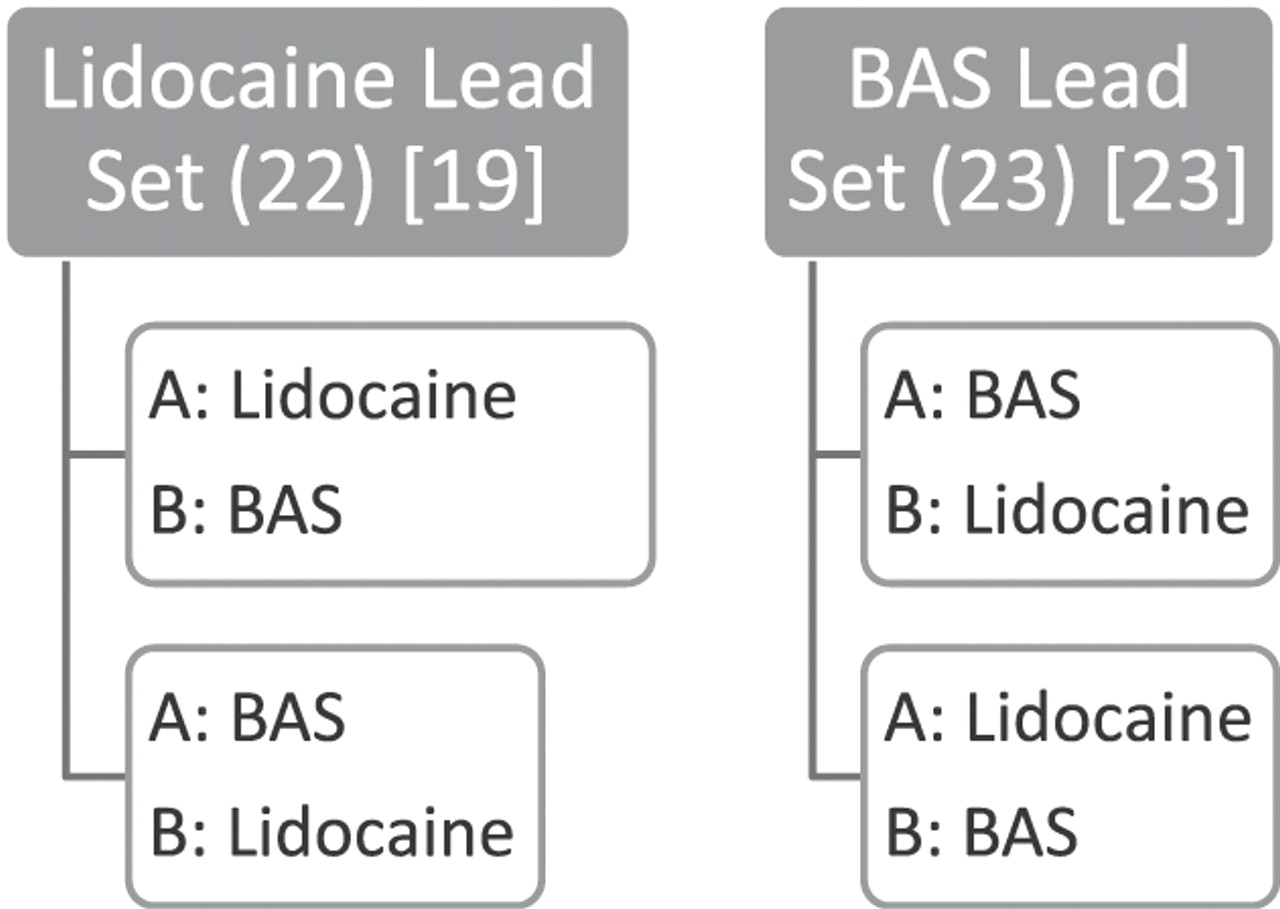
Possible orders of injections at sites 1 and 2 for each study participant. The number of study participants who received the order is shown in parentheses. The number of study participants included in the statistical analysis is shown in brackets.
Figure 2.
Possible orders of injections at sites 1 and 2 for each study participant. The number of study participants who received the order is shown in parentheses. The number of study participants included in the statistical analysis is shown in brackets.
The final group consisted of 42 individuals, of whom 19 received lidocaine as the lead injection and 23 received BAS as the lead injection. We compiled the differences between the reported pain of the lidocaine infiltrations performed first versus the lidocaine injections performed after the BAS infiltration. We assumed that lidocaine infiltration injected before BAS infiltration would approximate the experience of lidocaine injected alone. We also compiled the differences in the reported pain of BAS injection before and after lidocaine injection.
To determine the significance of the pain scores, we used the Wilcoxon signed rank test using SPSS for Windows, version 16 (SPSS Inc, Chicago, Illinois) because the data were nonparametric, being skewed toward the low end of the visual analog scale. We calculated power and effect size using G*Power version 3.0 (freeware from Universitat Dusseldorf) based on the means of the Wilcoxon signed rank test for a sample size of 42.
Results
The results are shown in
Figures 3 through
5. We note that the overall perception of pain from the injections was quite low. Thirty-six percent of all lidocaine injections and 49% of all injections were rated 0 on the visual analog pain scale (
Table 1).
Table 1 also shows that the percentage of 0 scores on the visual analog scale for lidocaine injections after preinjecting with BAS was 40%, a 36% improvement over lidocaine controls. Several participants commented that they could not feel the injection at all.
Table 1.
Percentage of VAS Pain Scores of 0 by Type of Injection
Table 1.
Percentage of VAS Pain Scores of 0 by Type of Injection
The experimental design contains an inherent asymmetry in the order of injections. Although each participant received the same set of injections, lidocaine followed by BAS or BAS followed by lidocaine, there was an arbitrary order. Each participant received either BAS, lidocaine, lidocaine, BAS or lidocaine, BAS, BAS, lidocaine.
Figure 2 shows that 19 participants received a set of injections led by lidocaine and 23 received a set of injections led by BAS.
Figure 3.
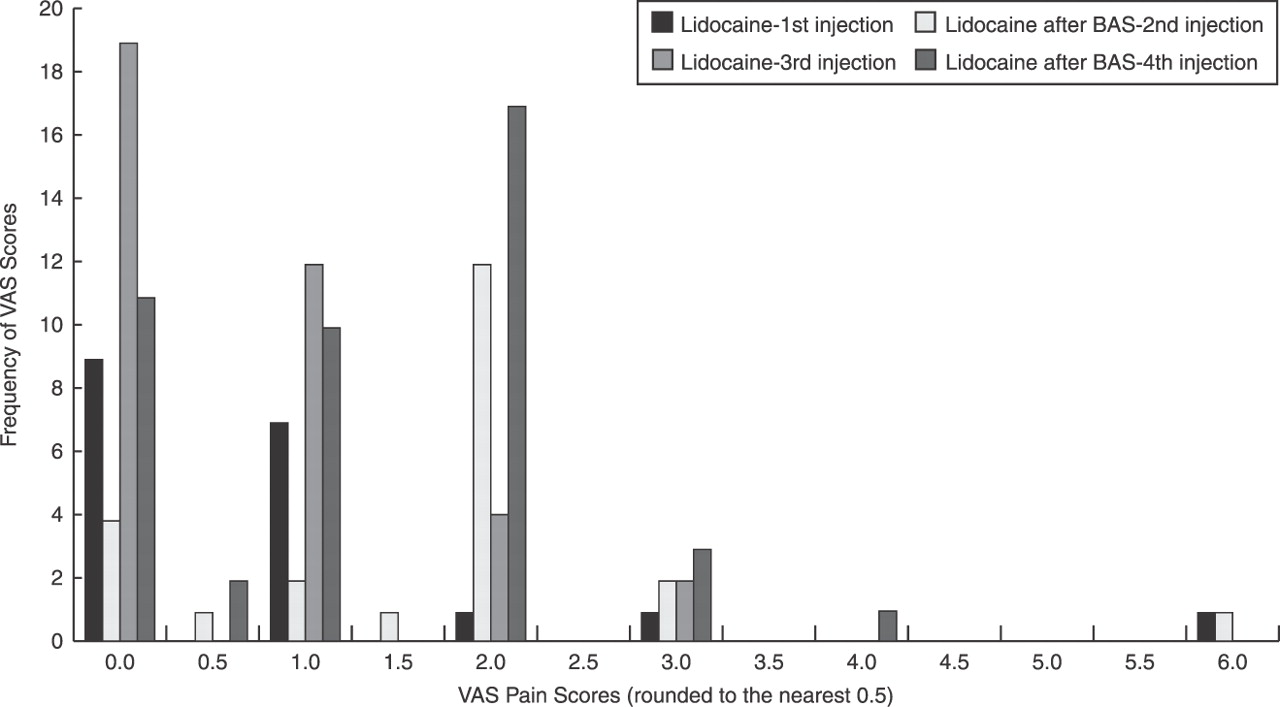
Frequency of visual analog scale (VAS) pain scores by order of injection. BAS indicates bacteriostatic saline solution containing 0.9% benzyl alcohol.
Figure 3.
Frequency of visual analog scale (VAS) pain scores by order of injection. BAS indicates bacteriostatic saline solution containing 0.9% benzyl alcohol.
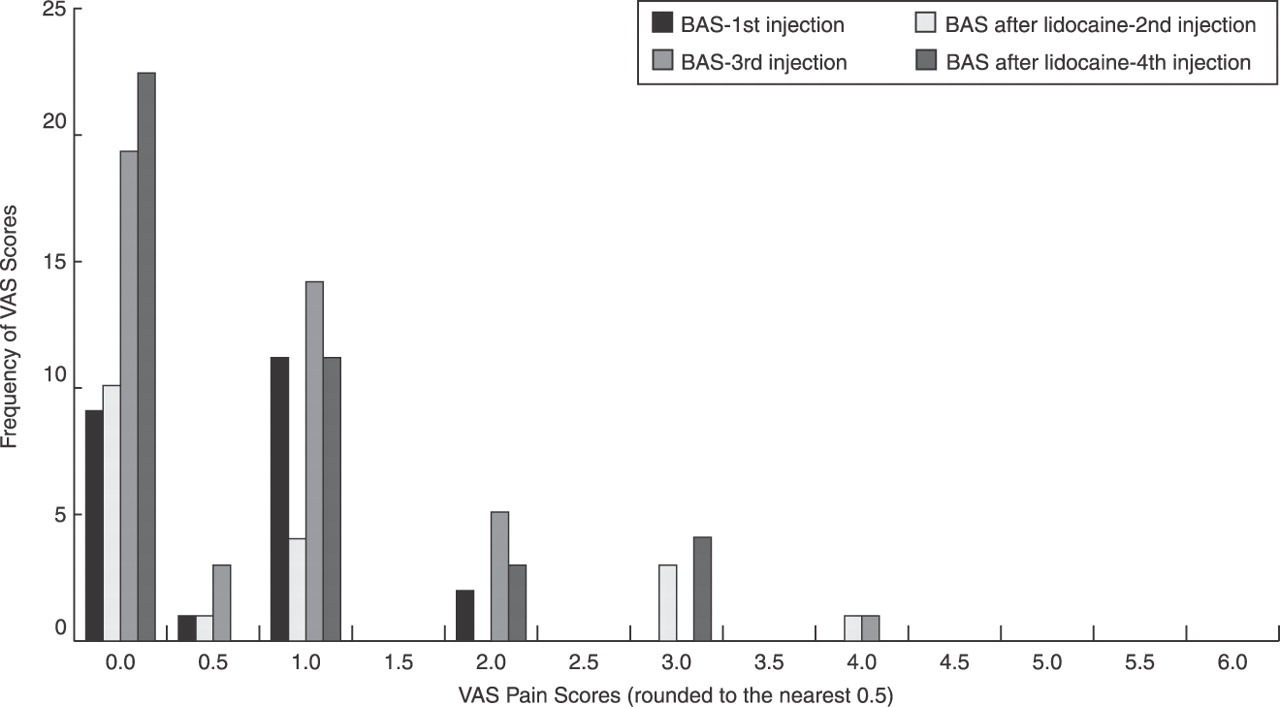
The histograms in
Figures 3 and
4 are divided in two ways. On the vertical dimension, we plot the total numbers of participants reporting a visual analog scale pain score based on whether they received the injection first of four injections or later in the sequence. On the horizontal dimension, the first bar refers to the injection of the first of a sequence into one area, eg, in
Figure 3, the left bar represents lidocaine and the right bar represents lidocaine injected after BAS into that site; in
Figure 4, the left bar represents BAS and the right bar represents BAS injected after lidocaine into that site. It is also possible to break down these data by location of injection. Because the medial space was always injected first, the data with either lidocaine or BAS injections first of four injections will always refer to the medial injection location.
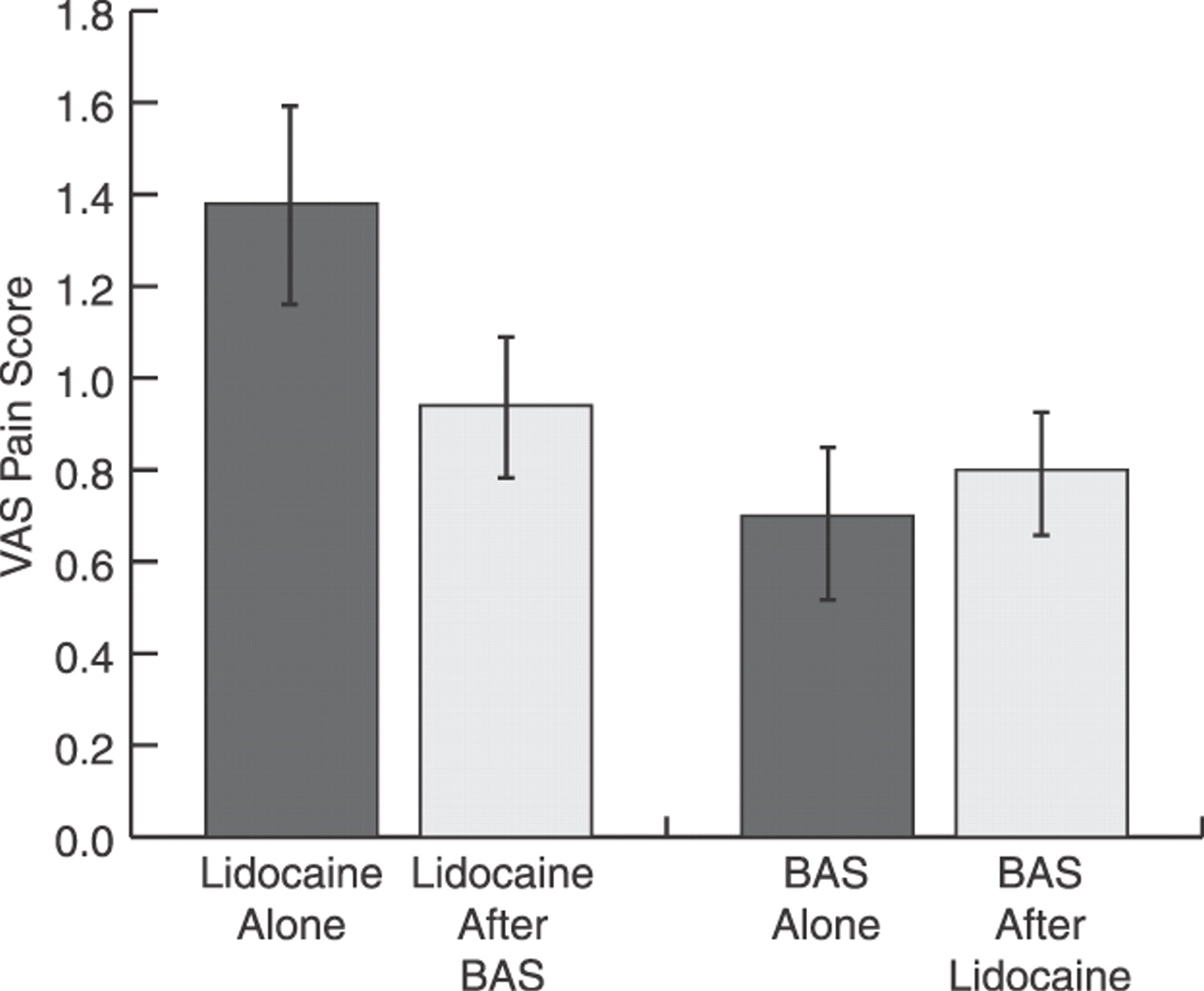
We calculated the average visual analog scale pain scores of lidocaine infiltration and BAS infiltration (
Figure 5). The average of the pain of lidocaine injection after BAS infiltration, 0.94 (95% CI, 0.79, 1.10), is reduced from the average pain of the lidocaine injection by itself, 1.38 (95% CI, 1.17, 1.60). The average visual analog scale pain score of BAS alone, 0.69 (95% CI, 0.56, 0.82), is less than that of BAS after lidocaine infiltration, 0.79 (95% CI, 0.63, 0.96).
Figure 4.
Frequency of visual analog scale (VAS) pain scores by order of injection. BAS refers to bacteriostatic saline solution containing 0.9% benzyl alcohol.
Figure 4.
Frequency of visual analog scale (VAS) pain scores by order of injection. BAS refers to bacteriostatic saline solution containing 0.9% benzyl alcohol.
Figure 5.
Average visual analog scale (VAS) pain scores of lidocaine and bacteriostatic saline solution containing 0.9% benzyl alcohol (BAS) infiltrations. Error bars represent 95% confidence intervals.
Figure 5.
Average visual analog scale (VAS) pain scores of lidocaine and bacteriostatic saline solution containing 0.9% benzyl alcohol (BAS) infiltrations. Error bars represent 95% confidence intervals.
Using the Wilcoxon signed rank test, a two-tailed P = .028 was obtained. A power analysis was performed before and after the trial. Based on the initial estimate, an effect size of 0.5 and a power of 0.9 for 95% confidence yielded a sample size of 47. We recruited 45 participants. In fact, the effect size was lower than we predicted, 0.348, which gives a post hoc power of 0.576.
The results of the visual analog scale pain scores broken down by the relative order of injection for lidocaine infiltration are summarized in
Table 2. Note that the difference in the averages indicate that there must be some effect of the order of injections. It is interesting that the
P value decreases dramatically, from .028 to .008, when the control arm value, lidocaine, is not the first of the four injections but rather the first injection is BAS, the value of which does not directly affect the outcome.
Discussion
These results show that the pain of lidocaine infiltration can be controlled and that there is a moderate but statistically significant reduction in the pain caused by lidocaine injection when preceded by an infiltration of BAS. Beyond this straightforward conclusion, there are several aspects of this study design that deserve comment.
Note that we may have detected an inverse effect of the relative pain of lidocaine and BAS infiltration. The average pain from lidocaine overall, whether it was the first injection or was injected after BAS, is 1.16, and the average pain from BAS overall, whether it was injected before or after lidocaine, is 0.74. Thus, there is a tendency to perceive lidocaine as more painful than BAS. This perception is further seen in the data from BAS injections before and after lidocaine.
Figure 5 shows that BAS injected alone is perceived as the least painful (average visual analog scale score, 0.69 [95% CI, 0.56, 0.82]) of all four types of infiltration. The fact that BAS injected after lidocaine (average visual analog scale score, 0.79 [95% CI, 0.63, 0.96]) is more painful than is BAS in general reinforces the premise that the deadening effect of lidocaine comes at an initial cost of stinging. This may be surprising given the expectation that lidocaine deadens the area to future injections. An explanation for this effect is that perhaps the BAS further diffuses the residual lidocaine deeper into new tissues, which causes a slight increase in perceived pain.
The inherent design of this study has an asymmetry that might influence interpretation of the results. Although each participant received the same four injections, 19 experienced lidocaine as the first injection and 23 experienced BAS as the first injection. If all of the participants had equal expectations of what the injections would feel like, then this order should not make a difference. However, the perception of lidocaine is not consistent between the times when lidocaine is the first of all of the injections (average visual analog scale score, 0.95) and when lidocaine is injected third of all of the injections (average visual analog scale score, 1.73). Because the key variable of the study was perception of the pain of lidocaine, we propose that there may be a distortion of the sensation of lidocaine injection when it is injected first of the four injections. If BAS is the first of all of the injections, then any distortion in perception of the “first stick” does not have a direct effect on the data. If the lidocaine injection is not the first injection experience of all four injections, then the data fit the hypothesis much better (P = .008).
This same phenomenon may have occurred in a similar study [
9] that looked at the effect of BAS on the pain of propofol infiltration. In this study, [
9] BAS was injected before propofol injection. The researchers noted that in a few cases, the participants experienced unexpectedly more pain from the BAS injection than from the propofol injection. The sensitization from expectation of the first injection may have also had an effect in that study. In a follow-up study, we plan to have a control injection to account for this first-stick effect.
Table 2.
Significance and Average VAS Pain Scores Based on Injection Order
Table 2.
Significance and Average VAS Pain Scores Based on Injection Order
There is also the possibility that the first-stick effect is correlated with the injection site. Because we always injected medially first, the first stick always went into the medial site. Because of the similar innervation of the second and third intermetatarsal areas, we doubt that there is anything physiologic to explain the observed phenomenon. Varying the first injections between sites 1 and 2 would have improved the study.
In addition, these data suggest that we encountered a “floor effect.” [
17] In an effort to perfect the “painless injection” technique by using a small-bore needle and slow injection, [
18,
19] we achieved very low scores of perceived pain of lidocaine injections. As noted in
Table 1, 36% of lidocaine and 49% of BAS infiltrations were rated 0 on the visual analog pain scale. The floor effect may contribute to an increase in type II error, which could lead to a reduction of power in the data.
One weakness of this study design is that the results are underpowered. As discussed previously herein, this arises from the fact that so few participants experienced significant pain. It is inherently difficult to compare the efficacy of pain reduction protocols if the baseline protocol does not produce a sufficient number of individuals reporting significant pain. Technically, the large percentage of patients with low (including zero) pain scores causes these data to be skewed to the left to such a degree that we are forced to use a nonparametric statistical technique, ie, the Wilcoxon signed rank test. It is generally accepted that nonparametric techniques have lower statistical power and higher type II error rates than parametric techniques. [
20]
Conclusions
The statistically significant pain reduction seen in this study supports the hypothesis that injecting BAS into the anesthesia site directly preceding lidocaine infiltration reduces pain. We note that pain perception for all of the injections was generally low, which may be due to the slow infiltration and the technique used. [
7] This study demonstrates, however, that even with good technique, pain may still be reduced further with the use of a buffering BAS before lidocaine injection.
The approach we investigated would be a beneficial addition to a physician’s toolkit because it uses ordinary accessible supplies without any complicated mixing or calculations. The simple step of injecting BAS before local lidocaine anesthesia may lower the patient’s pain without the need to buffer entire bottles of lidocaine. This effectively saves resources for the clinician by preventing the waste of unstable anesthetic while providing the most comfortable experience for the patient.