Diabetic foot, a serious complication of diabetes mellitus, has an incidence rate of 1% in northern European countries to 11% on the African continent, accounting for a high social, economic, and health-care cost. [
1] One of the most devastating complications of diabetes is limb amputation. Amputations are preceded by an ulcer [
2] in approximately 85% of cases, and diabetes is involved in 40% to 70% of nontraumatic amputations. [
3]
Diabetic foot conditions develop due to two principal causes—neuropathic and vascular—which lead to a foot lesion [
4] when they are combined with an external or internal trauma. Ulcers are mainly caused by diabetic polyneuropathy associated with the risk of a loss of protective foot sensation when traumas take place. [
4] Other neuropathy-related factors that increase the risk of foot ulcers, such as orthopedic deformities and biomechanical alterations (because motor functions are affected), have been identified. [
5]
Currently, we know that peripheral diabetic neuropathy affects the sensitive and motor functions, as well as the autonomic functions, [
6] although its implications and onset have not been defined clearly in diabetic foot syndrome. It has been ascertained that diabetes affects the biomechanics of patients’ feet in several ways. On the one hand, the nonenzymatic glycation of type I collagen [
7] is believed to cause limited joint mobility, especially in the ankle joint and the first metatarsophalangeal joint [
8–
11]; on the other hand, motor neuropathy is believed to cause deformities because the mechanical balance between the extrinsic and intrinsic musculature of the foot is altered. [
12–
14] It has been suggested that limited joint mobility associated with deformities increases plantar pressures in the diabetic foot, thus causing overloads that may lead first to plantar hyperkeratosis and, subsequently, to neuropathic ulcer. [
15,
16]
However, several articles pointing to controversies in the assumptions of the aforementioned paradigms have been published. It is believed that a neuropathic ulcer [
17] cannot be explained by plantar pressure alone and that the relationship between deformities and neuropathies does not seem to be well established either. [
12,
18] Some researchers [
12,
13] have demonstrated, with nuclear magnetic resonance studies, that the intrinsic weakening of the foot musculature, as suggested by the volume reduction of the lumbrical and interosseous muscles, was present in diabetic patients regardless of the presence of neuropathy.
There is no accurate evidence of diabetes causing limitations to the ankle joint [
19] or the first metatarsophalangeal joint [
20] because these conditions are widespread in the general population, particularly in the age groups in which type 2 diabetes mellitus manifests for the first time. [
21]
This study aims to identify the biomechanical characteristics of diabetic patients with and without neuropathy by determining the range of joint movement and by monitoring the rate and distribution of calluses and identifying any orthopedic foot deformities.
Methods
An observational comparative study was performed of 281 patients enrolled from the Diabetic Foot Unit of the Complutense University of Madrid between July 1, 2007, and September 30, 2008, and from the Manzanares Diabetic Patients Association (Ciudad Real, Spain) during visits made in July and October 2007. People volunteering from the Diabetic Patients Association were included in the study for the purpose of selecting patients outside of the clinic who normally did not visit their physician with concerns about foot abnormalities.
Patients with diabetes mellitus older than 18 years and without active ulcers were recruited. Patients who had undergone major amputation, those who had Charcot’s foot, those in wheelchairs, bedridden patients, and those who needed walking aids (eg, crutches or splints) were excluded from the study. Patients with the following vascular conditions were also excluded: ankle-brachial index less than 0.5 or transcutaneous oxygen pressure less than 30 mm Hg or the absence of both distal pulses (the posterior tibial pulse and the pedis pulse).
All of the patients underwent a neurologic examination using a 5.07 Semmes-Weinstein monofilament 10 g and a biothesiometer (both from Novalab Ibérica, Madrid). The threshold established for the Semmes-Weinstein monofilament was when the patient did not feel the filament in more than four of the ten examined points. [
22] The foot points examined were the plantar surface of the first, third, and fifth toes; the plantar aspect of the first, third, and fifth metatarsal heads; the internal and lateral plantar surfaces in the midfoot; the plantar surface of the heel; and the dorsum of the foot, between the first and second toes. Vibratory sensibility was considered to be affected if the patient did not feel the vibration of the instrument’s head when voltages greater than 25 V were applied. [
23] Biothesiometers were applied to both maleoli, the first and fifth metatarsal heads, and the bony prominence of the first interphalangeal joint in the hallux. Vibratory sensibility was considered to be affected when the patient did not feel the biothesiometer in the hallux. [
24] Patients were considered to have neuropathy when they did not perceive these two examined sensibilities [
25] (Semmes-Weinstein monofilament and biothesiometer; n = 124). The control group was comprised of patients who had normal perception of the two described tests (n = 157). Patients who had loss of sensation in only one of the neurologic states examined were excluded.
Joint mobility was measured in the ankle joint, the first metatarsophalangeal joint, the subtalar joint, the relaxed calcaneal stance position, and the neutral calcaneal stance position. [
26,
27] The ankle joint was examined with the patient supine and the ankle joint in the neutral position; a vertical line was marked on the patient’s skin from heel to midcalf, and the maximum range of talar extension in passive motion was measured in degrees with a goniometer. The reference value for the ankle joint was greater than 90° of dorsiflexion.
The passive range of movement of the first metatarsophalangeal joint was examined with the patient also in the supine position, and a horizontal line was drawn from the big toe to the heel. The maximum range of passive extension to plantarflexion was recorded. The reference value of movement in off-loading is greater than 65°. The same range was explored with the patient standing. The reference value in loading is greater than 30°.
Subtalar joint movements (inversion and eversion) were examined with the patient in the prone position, holding the calcaneus with one hand and the talar head/neck with the thumb and index finger of the other hand. Holding the talus rather than the tibia isolated the subtalar joint from ankle motion; adduction and abduction movements with the hand on the calcaneus were applied. Reference values were considered to be 20° in inversion and 10° in eversion.
Relaxed calcaneal stance position was measured by bisecting the posterior surface of the calcaneus while the patient was in a standing position. The angle that this line made with the ground was recorded with a goniometer. The reference value was 2° to 3°. Neutral calcaneal stance position was measured by placing the foot into its neutral position. The reference value was assumed to be between neutral and 3° of varus.
The following deformities were registered: hallux abducto valgus, hammer toes, claw toes, crowded toes (supraductus or infraductus), and tailor’s bunions. Hallux abducto valgus was defined as disruption of the first metatarsophalangeal joint with lateral deviation of the hallux, frequently associated with a bunion. Hammer toes were considered only when the proximal phalanx was extended. Claw toes were defined when the metatarsophalangeal joint was in dorsiflexion and the proximal and distal interphalangeal joints were in plantarflexion. Crowded toes were the deformities that associated a hyperextension of the metatarsophalangeal joint with a varus or valgus rotation, which situated the toe above (supraductus) or below (infraductus) the contralateral toe. Tailor’s bunion was considered as a prominence at the lateral aspect of the fifth metatarsal head with the fifth toe deflected to varus.
Thickened skin resulting from abnormal loading as a consequence of biomechanical alterations was defined as a callus. The locations of the calluses were defined according to the anatomical areas in which they appeared. The assessments of joint mobility and deformities were performed by the same examiner (J.L.L.), who has extensive experience in such clinical aspects.
The statistical analysis was performed with SPSS version 15.0 for Windows (SPSS Inc, Chicago, Illinois). The Student t test for independent samples was performed to compare the medium in quantitative variables. The χ2 statistical test was used to identify differences in the proportions of qualitative variables. Odds ratios and their 95% confidence intervals were determined through a univariate and multivariate logistic regression model. A significant 5% difference was assumed for a type I error (P < .05).
All of the patients agreed to participate in this study by signing an informed consent form. This study was approved by the ethics committee of Madrid’s San Carlos Clinical University Hospital on July 2, 2007.
Results
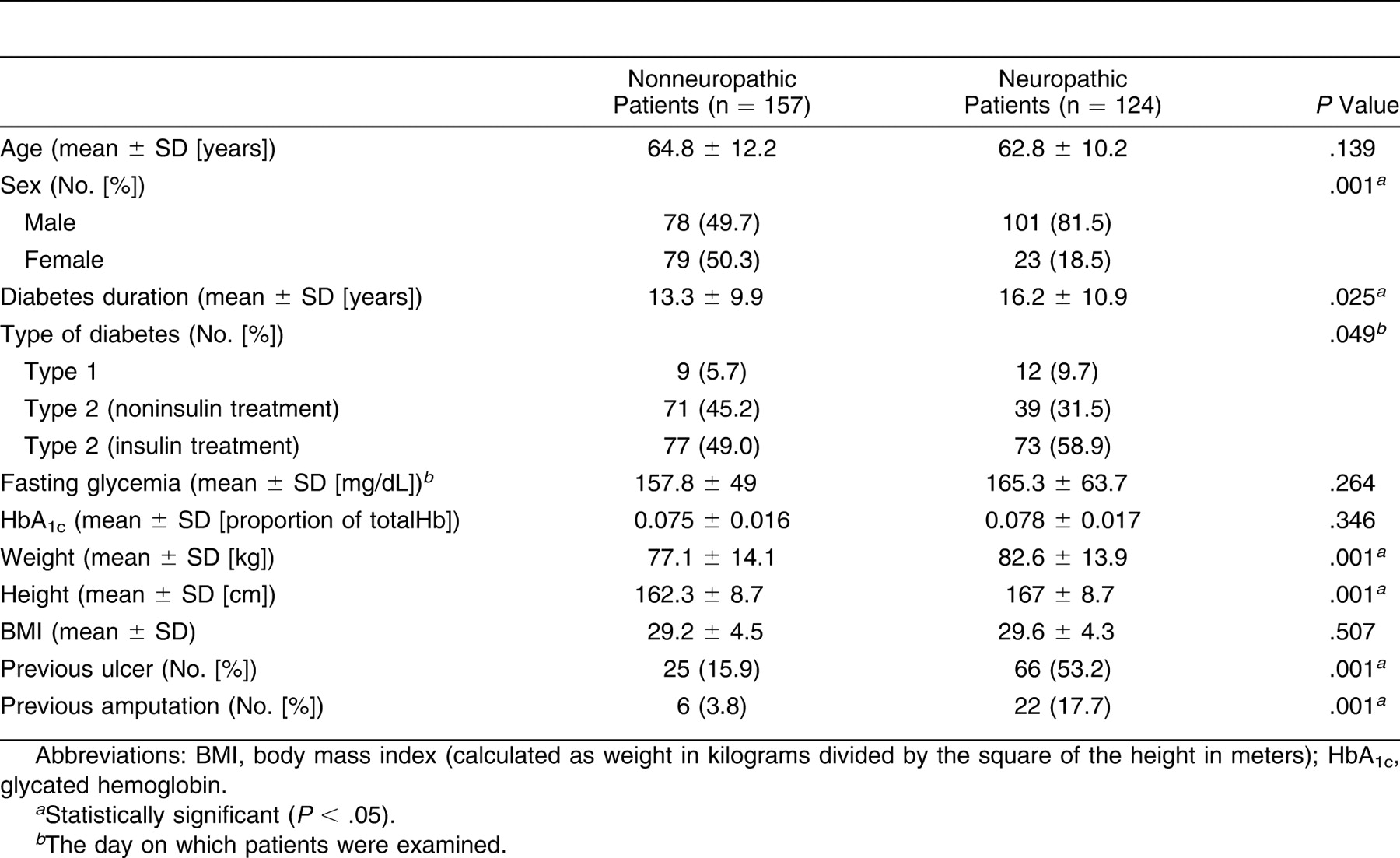
The patient characteristics are summarized in
Table 1. The results show limited joint mobility compared with the reference values [
26,
27] of most of the joints examined in both study groups. However, there was a higher level of limited joint mobility in the case of the first metatarsophalangeal joint when the patient was resting and in inversion of the subtalar joint in the neuropathic patient group (
P < .05) (
Table 2).
Hallux abducto valgus (
P = .001) and hammer toes (
P = .027) were significantly more frequent in patients without neuropathy. Claw toes were more frequently found in neuropathic patients, but the difference was not significant (
P = .06). Neuropathic patients did not show a higher rate of foot deformities compared with nonneuropathic patients for the other deformities studied (
Table 3).
Of the 281 diabetic patients, 130 of 157 without neuropathy (82.8%) and 90 of 124 with neuropathy (72.6%) had calluses. Calluses were more frequent in diabetic patients unaffected by neuropathy (
P = .039) (
Table 4). A multivariate logistic regression model was constructed using the significant variables from the univariate analysis.
Table 5 summarizes the effect of the following variables: sex, age, duration of diabetes in years, and neuropathy.
Discussion
The results of this study show that patients with diabetes mellitus experience limited joint mobility in all of the examined foot joints. However, no substantial differences were found between patients with and without neuropathy. Neuropathy was seen as a risk factor only in the range of movement of the first metatarsophalangeal joint with the patient resting (mean ± SD: 57.2° ± 19.5° versus 50.3° ± 22.5°,
P = .008). Other authors [
11,
18] have found that limitation of the first metatarsophalangeal joint was present in almost 50% of their patients. The limitation of the first metatarsophalangeal joint (when loading <30°, and 60° offloading) has been identified as a risk factor that can lead to ulcers in the medial plantar area of the hallux or in the central metatarsals as a result of a pressure transfer syndrome. However, this relationship has recently been disputed because no cross-link has been found between hallux ulcers and limited mobility in this joint. There were other patients with the same limited mobility who developed ulcers in other foot areas. [
18]
Table 1.
Descriptive Characteristics of the 281 Study Patients
Table 1.
Descriptive Characteristics of the 281 Study Patients
Table 2.
Examined Joint Mobility Ranges in Both Patient Groups
Table 2.
Examined Joint Mobility Ranges in Both Patient Groups
The values of ankle joint mobility were similar in both groups (83.0° ± 5.2° versus 82.8° ± 9.3°;
P = .826). The limited dorsal flexion of the ankle joint has been described by several authors, [
5,
9] and, subsequently, several research studies [
8,
10] have identified a tendency in patients with neuropathy to develop a functional clubfoot that would raise the pressure in the forefoot, thus increasing the risk of ulcers in this area. In the present study, neuropathy was not associated with a higher rate of limited mobility in this joint. Most of the research performed to assess limited joint mobility in the feet of patients with neuropathy is retrospective and examines the feet after they have experienced a lesion, when their joint mobility has been reduced (probably as a result of long-lasting treatments involving immobilization and off-loading of the feet while healing the ulcer, which, on average, takes 8–12 weeks in the case of neuropathic ulcers).
Table 3.
Foot Deformities in Both Patient Groups
Table 3.
Foot Deformities in Both Patient Groups
As to the presence of deformities, we observed that patients without neuropathy were more prone to foot deformities, although in some cases, eg, hallux abducto valgus and hammer toes, neuropathy was not found to be a risk factor (hallux abducto valgus: odds ratio = 0.4,
P = .001; and hammer toes: odds ratio = 0.413,
P = .027). Only patients with neuropathy seemed to be more prone to claw toes compared with those who did not have claw toes caused by neuropathy (48.4% versus 59.7%;
P = .06), although no significant statistical differences were found. Digital deformities in patients who already had diabetes before the onset of neuropathy have been described by Greenman et al, [
13] proving, through nuclear magnetic resonance studies, that the lumbrical and interosseous muscular volume of patients with diabetes mellitus decreased compared with that of healthy patients and that this alteration is more severe in patients with neuropathy. Similar research studies [
12] have demonstrated a relationship between the effect on the weakness of intrinsic musculature and diabetic foot neuropathy, but according to statistical models, this occurs in only approximately 36% of patients. As for the present research study, in the multivariate logistic regression model, the only deformity that seemed to be closely linked to diabetes was tailor’s bunion (odds ratio = 1.051,
P = .017), although it had a low value. Recently, Bus et al [
28] suggested that the role of these muscle factors in claw toe development may not be primary or as straightforward as previously believed.
Table 4.
Locations of Calluses in Neuropathic and Nonneuropathic Patients’ Feet
Table 4.
Locations of Calluses in Neuropathic and Nonneuropathic Patients’ Feet
There was a higher presence of calluses in patients without neuropathy (82.8% versus 72.6%;
P = .039), and, surprisingly, the appearance of calluses in the plantar zone of the hallux was more frequent in patients without neuropathy (25.5% versus 14.5%, odds ratio = 0.497,
P = .024). Until recently, the presence of calluses had been assumed to be more frequent in patients with neuropathy, but these findings may be due to the fact that patients with neuropathy do not feel pain and calluses are more evident; however, it does not mean that calluses are more prevalent. [
11,
16,
18]
In the multivariate logistic regression model, women had a greater risk factor in terms of experiencing calluses in the plantar area of the hallux (expB = 2.787,
P = .001), in the central metatarsal plantar area (expB = 1.909,
P = .01), and in the dorsum of the fifth toe (expB = 2.673,
P = .001). This higher tendency in females to have calluses is probably related to the use of narrow-heeled shoes rather than to diabetes. [
29]
Similar to previous studies, [
8,
9,
16,
17] we believe that limitations related to the diagnosis criteria of neuropathy in the present study can be found. We defined a “neuropathic patient” as one who does not feel the vibration higher than 25 V with the biothesiometer and does not feel the light touch with the Semmes-Weinstein monofilament. Motor and autonomic neuropathy should be addressed in future trials for a better classification of the patient and to associate each alteration with the biomechanical characteristics.
Table 5.
Summary Table of the Multivariate Logistic Regression Model Encompassing the Variables that Were Considered to Affect the Dependent Variable
Table 5.
Summary Table of the Multivariate Logistic Regression Model Encompassing the Variables that Were Considered to Affect the Dependent Variable
The differences found in the present study compared with previous studies can probably be explained by the fact that individuals who did not usually visit the podiatric physician or the general physician to treat their foot problems were enrolled in the research, the main limitation of which was the lack of healthy patients in the same age range. However, it is logical to think that the age of individuals who develop type 2 diabetes means it is difficult to find patients with healthy feet. Most of the population experiences some type of biomechanical alteration [
22] because they use the wrong shoes and because of the lack of childhood prevention plans for foot abnormalities.
The main biomechanical alterations in diabetic patients’ feet are currently considered to be attributable to the neuropathy, and deformities are, thus, classified as a further risk of this condition, and it is assumed to be one of its consequences. [
30] However, these paradigms have been described in previous studies that classified patients only according to sensory diabetic neuropathy. [
8,
9,
16,
17] In the present study, we have the same limitation because the autonomic and motor aspects of diabetic neuropathy were not measured. New prospective studies are probably necessary to address the biomechanical alterations in the diabetic population, and we would define which conditions could be considered due to the neuropathy or due to pathomechanical conditions of the foot.
We have not addressed in the present study the lifestyle of these patients, especially in relation to activity patterns. Sport practice, type of job, or sedentary lifestyle may affect limited joint mobility and other biomechanics characteristics. Furthermore, another limitation in this study is that we did not acquire a systematic foot radiograph in these patients. Bone abnormalities, joint inflammatory disease, and other causes of limitations in pedal joint range of motion could have been found.
We believe that in diabetic patients, onset of the disease does not occur with a healthy foot, or at least not in most cases, and, therefore, the diagnosis should be linked to a biomechanical foot examination to promptly identify any ulcer risk factors, such as limited joint mobility, deformities, hyperkeratosis, and areas at risk for lesions.
Broadening research studies to examine all of the mechanical alteration variables jointly and extending research to patient groups without diabetes in the same age range will allow us to improve the knowledge available on the development of foot deformities.