Next Article in Journal
Challenges of Distal Bypass Surgery in Patients with Diabetes. Patient Selection, Techniques, and Outcomes
Previous Article in Journal
Arterial Imaging in Patients with Lower-extremity Ischemia and Diabetes Mellitus
 
 
Journal of the American Podiatric Medical Association is published by MDPI from Volume 116 Issue 1 (2026). Previous articles were published by another publisher in Open Access under a CC-BY (or CC-BY-NC-ND) licence, and they are hosted by MDPI on mdpi.com as a courtesy and upon agreement with American Podiatric Medical Association.
Article

Current Assessment of Endovascular Therapy for Infrainguinal Arterial Occlusive Disease in Patients with Diabetes

by
Daniel M. Ihnat
and
Joseph L. Mills
*
Department of Vascular and Endovascular Surgery, University of Arizona Health Sciences Center, 1501 N Campbell Ave, PO Box 245072, Tucson, AZ 85724
*
Author to whom correspondence should be addressed.
J. Am. Podiatr. Med. Assoc. 2010, 100(5), 424-428; https://doi.org/10.7547/1000424
Published: 1 September 2010

Abstract

Endovascular therapy has increasingly become the initial clinical option for the treatment of lower-extremity peripheral arterial occlusive disease not only for patients with claudication but also for those with critical limb ischemia. Despite this major clinical practice paradigm shift, the outcomes of endovascular therapy for peripheral arterial disease are difficult to evaluate and compare with established surgical benchmarks because of the lack of prospective randomized trials, incomplete characterization of indications for intervention, mixing of arterial segments and extent of disease treated, the multiplicity of endovascular therapy techniques used, the exclusion of early treatment failures, crossover to open bypass during follow-up, and the frequent lack of intermediate and long-term patency and limb salvage rates in life-table format. These data limitations are especially problematic when one tries to assess the outcomes of endovascular therapy in patients with diabetes. The purpose of the present article is to succinctly review and objectively analyze available data regarding the results of endovascular therapy in patients with diabetes. (J Am Podiatr Med Assoc 100(5): 424–428, 2010)

Diabetes and cigarette smoking are the most important risk factors for peripheral arterial disease [1]. The coronary literature [2,3,4] demonstrates a significantly increased mortality rate and need for repeated interventions in patients with diabetes who undergo angioplasty compared with surgical bypass. The increased mortality and secondary intervention rates imply that patients with diabetes have higher restenosis rates after endovascular interventions. In contrast, there are no prospective randomized studies, to our knowledge, comparing infrainguinal endovascular therapy with surgical bypass in patients with diabetes. Patients with diabetes more commonly present with involvement of the deep femoral and tibial arteries than do nondiabetic patients; however, diabetic patients present with heterogeneous patterns and may have arterial occlusive disease in any vascular territory. Endovascular therapy is less effective in smaller arteries, such as tibial arteries, than in femoropopliteal arteries [5,6] regardless of the presence of diabetes.

Factors that Influence the Outcome of Endovascular Therapy

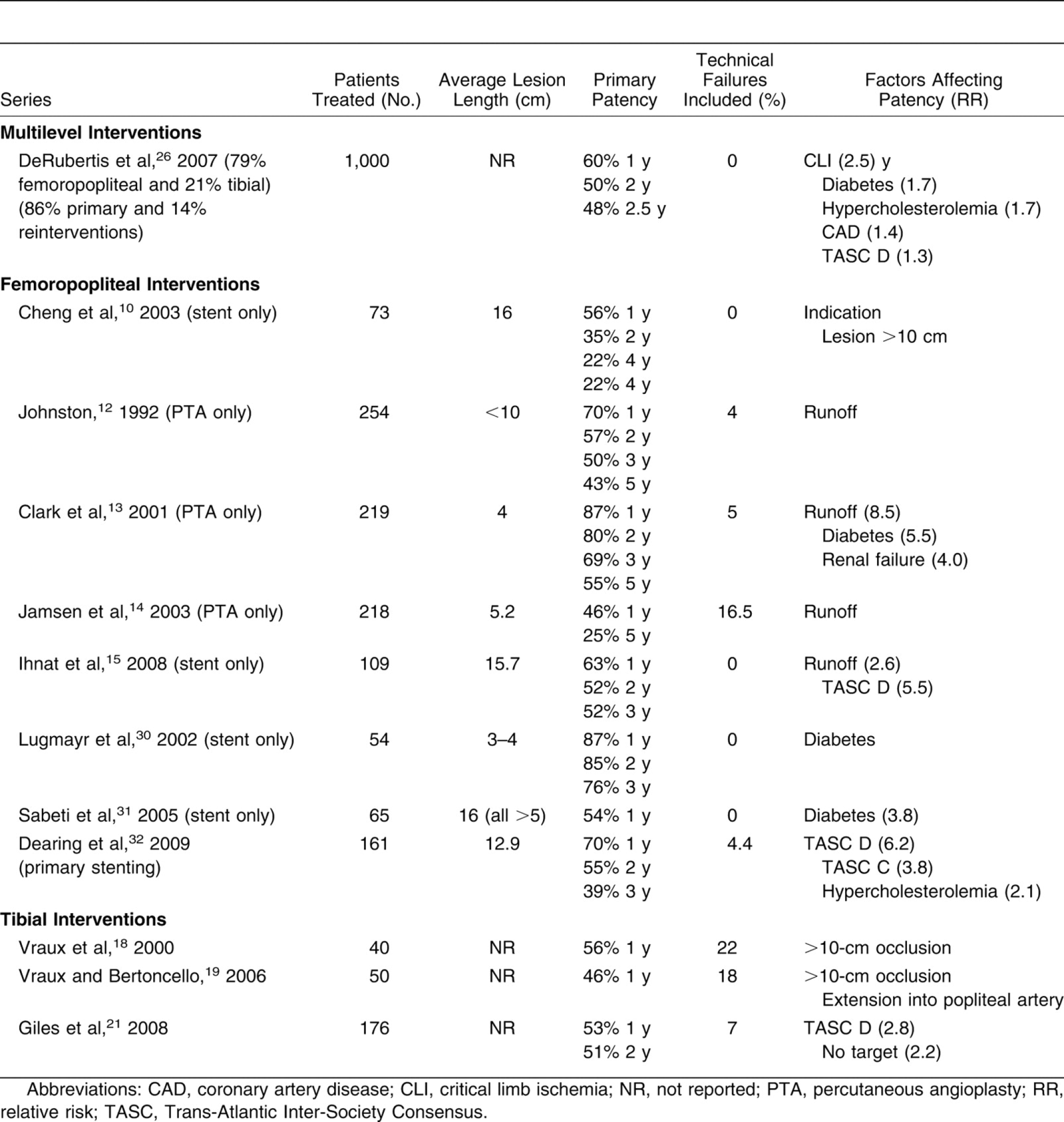
Because peripheral arterial disease has multiple risk factors and the severity of disease encompasses a vast range, large cohorts of patients with peripheral arterial disease include a myriad of presentations. This complicates the analysis of outcomes for claudication and critical limb ischemia treatment, especially in diabetic patients. Even the definition of critical limb ischemia is not optimal. Consider that in the placebo arm of the Circulase trial [7], patients with critical limb ischemia who did not undergo revascularization had a limb salvage rate of 87% at 6 months. This was similar to the amputation-free survival rates seen in the open surgery and endovascular therapy arms of the BASIL (Bypass versus Angioplasty in Severe Ischaemia of the Leg) trial [8]. The heterogeneity of the patients combined with the lack of a more specific working definition of critical limb ischemia makes defining outcomes challenging. Factors that have been shown to negatively impact endovascular therapy outcomes include the indication [9,10] for the procedure, lesion length [5], Trans-Atlantic Inter-Society Consensus classification [11], runoff score [12,13,14,15], occlusion versus stenosis [5], renal failure, [13] and excessive or heavy calcification [16,17] (Table 1). Evaluating the impact of diabetes on endovascular therapy remains difficult because patients with diabetes more commonly have multiple adverse risk factors.
Table 1. Factors Affecting Primary Patency After Endovascular Therapy: Comparative Results of Published Series.
Japma 100 00424 i001

Effect of Diabetes on Outcomes of Endovascular Therapy and Open Surgical Bypass

Technical success rates for infrainguinal endovascular interventions are worse in the tibial arteries [18,19,20,21] than in the femoropopliteal arteries [13,22]. Similarly, heavy lesion calcification portends technical failure [16,17]. Because patients with diabetes are more susceptible to developing more heavily calcified atherosclerotic arteries and tibial artery occlusive disease, it is intuitive that patients with diabetes would have lower technical success rates compared with nondiabetic patients. In a retrospective review of infrainguinal endovascular interventions primarily in the femoropopliteal segment, Lazaris et al. [23] found a decreased technical success rate in patients with diabetes versus nondiabetic patients (81% versus 93%; P = 0.05). More dramatically, they found a significantly increased rate of complications in diabetic patients (16.7% versus 3.9%; P = 0.03).
The available infrainguinal revascularization data are primarily nonrandomized and retrospective. Nonetheless, large series of infrainguinal surgical bypasses generally demonstrate no difference in the technical success or patency rates of patients with diabetes compared with nondiabetic patients [24,25]. In contrast, DeRubertis et al. [26] evaluated 1,000 consecutive percutaneous interventions in the femoropopliteal and tibial arteries and found a diminished primary patency rate in patients with diabetes (hazard ratio = 1.7). In fact, diabetes was one of the most important risk factors affecting primary patency, second only to the indication for the procedure (hazard ratio = 2.5). In a prospective nonrandomized study, Dick et al. [27] compared surgical and endovascular interventions for iliac, femoropopliteal, and tibial artery occlusive disease and found poorer sustained clinical benefit in patients with diabetes. Sustained clinical benefit was defined as improvement in Rutherford class [28], amputation-free survival, and freedom from target-extremity revascularization; however, the difference was primarily due to target-extremity revascularization. Secondary sustained clinical benefit and limb salvage were equivalent to those in nondiabetic individuals. The authors concluded that multiple revascularizations might be required in patients with diabetes to achieve similar limb salvage rates.

Endovascular Therapy for Peripheral Arterial Disease of the Femoropopliteal Arteries

These reports comprise heterogeneous groups of patients with multilevel and single-level arterial occlusive disease involving different arterial territories. However, some clinical investigators have focused on the results of endovascular therapy in a single arterial territory. In a registry of 219 limbs that underwent femoropopliteal angioplasty, Clark et al. [13] found diabetes to be significantly associated with reduced primary patency (relative risk = 5.5); this association was stronger than that for renal failure (relative risk = 4.0) but weaker than that for poor tibial runoff (relative risk = 8.5). Another retrospective study [29] compared subintimal angioplasty with placement of covered stents in long-segment superficial femoral artery occlusions and found diabetes to be strongly associated with decreased primary patency (hazard ratio = 7.2). Some investigators [30,31] evaluated patients who underwent femoropopliteal stenting and found that diabetes significantly decreased patency rates, whereas others [15,32] have not. Baril et al [33] evaluated predominantly claudicants with Trans-Atlantic Inter-Society Consensus II B and C femoropopliteal lesions and did not find an association between diabetes and restenosis. Bakken et al. [34] separately evaluated patients with claudication and critical limb ischemia who underwent endovascular therapy for superficial femoral artery occlusive disease. In the claudication group, insulin-dependent diabetic patients maintained primary patency rates similar to those of nondiabetic patients but decreased assisted patency rates and increased restenosis rates at 3 years. Conversely, in patients with critical limb ischemia, diabetes did not affect patency or restenosis rates, although it did negatively impact limb salvage rates.

Endovascular Therapy for Peripheral Arterial Disease of the Tibial Arteries

In the tibial arteries, Giles et al. [21] evaluated 176 patients, 72% of whom had diabetes and underwent infrapopliteal artery angioplasty, and found that only Trans-Atlantic Inter-Society Consensus D lesions and poor runoff predicted restenosis, reintervention, decreased patency, and reduced limb salvage rates. Sadek et al. [35] treated 89 limbs with tibial artery endovascular therapy and found improved secondary patency in patients who underwent endovascular interventions for multilevel disease compared with isolated tibial artery disease. Interestingly, the limb salvage rates were equivalent. Similarly, Gray et al. [36] reviewed their database of patients treated for tibial artery occlusive disease. They found that one-third of patients had isolated tibial artery disease; the remainder had multilevel occlusive disease. Patients with isolated tibial artery disease had worse outcomes with respect to overall survival, amputation-free survival, limb salvage, maintenance of ambulatory status, independent living, and secondary patency. Isolated tibial disease was not an independent predictor of the worse outcomes, but instead, the presence of tissue loss and end-stage renal disease correlated most strongly with poor outcomes. These authors suggested that isolated tibial artery disease is a surrogate marker for more severe tissue loss. None of these studies found an association between diabetes and reduced endovascular therapy patency rates.

Limb Salvage, Morbidity, and Mortality

The surgical bypass literature [24,37] generally suggests that limb salvage rates are not significantly worse in patients with diabetes compared with those without. Conversely, Bakken et al. [34] found decreased limb salvage rates in patients with insulin-dependent diabetes treated with endovascular therapy for femoropopliteal artery occlusive disease, despite similar patency rates. This finding remained statistically significant after patients with end-stage renal disease were excluded. Similarly, Conrad et al. [38] evaluated endovascular therapy of the femoropopliteal arteries in 110 patients with critical limb ischemia (15% with end-stage renal disease) and found that diabetes significantly increased the risk of amputation (hazard ratio = 11.5). Conversely, Dick et al. [27] found no difference in limb salvage rates in patients with diabetes and attributed their results to close surveillance and an aggressive policy of multiple secondary interventions.
Because endovascular therapy is minimally invasive, unless a major bleeding complication occurs, mortality is usually more a reflection of the patient’s underlying comorbidities rather than the stress of the procedure itself. Jamsen et al. [14] also found an increased mortality rate for patients with diabetes (odds ratio = 2.0) in 304 patients who underwent infrainguinal revascularization with an endovascular attempt–first approach; only 10.5% underwent surgical bypass. The BASIL trial [8] did not detect a significant decrease in survival rates for patients with diabetes, although less than one-third of the patients in this trial of endovascular therapy versus bypass for severe limb ischemia had diabetes. Instead, the investigators found a decrease in survival rates for patients living more than 2 years who underwent endovascular therapy first.
In summary, patients with diabetes mellitus undergoing infrainguinal endovascular therapy are a heterogeneous group, and further investigation is required to more completely understand the impact of diabetes on outcomes. Patients with diabetes undergoing endovascular therapy most likely have higher rates of technical failure and subsequent amputation. Also, diabetic patients probably have higher rates of restenosis after endovascular therapy in the femoropopliteal arteries; data are less clear for tibial endovascular therapy. The impact of diabetes on patency and restenosis rates in the femoropopliteal arteries is probably less important than are Trans-Atlantic Inter-Society Consensus classification and tibial artery runoff. Of diabetic patients with critical limb ischemia, those presenting with isolated tibial artery occlusive disease are more likely to have more advanced tissue loss, end-stage renal disease, and a worse prognosis.

Financial Disclosure

None reported.

Conflicts of Interest

None reported.

References

  1. Criqui MH: Peripheral arterial disease: epidemiological aspects. Vasc Med 2001, 6, (suppl 1). 3.
  2. Investigators BARI: Influence of diabetes on 5-year mortality and morbidity in a randomized trial comparing CABG and PTCA in patients with multivessel disease: the Bypass Angioplasty Revascularization Investigation (BARI). Circulation 1997, 96, 1761.
  3. Weintraub WS, Stein B, Kosinski A, et al: Outcome of coronary bypass surgery versus coronary angioplasty in diabetic patients with multivessel coronary artery disease. J Am Coll Cardiol 1998, 31, 10.
  4. Hoffman SN, TenBrook JA, Wolf MP, et al: A meta-analysis of randomized controlled trials comparing coronary artery bypass graft with percutaneous transluminal coronary angioplasty: one- to eight-year outcomes. J Am Coll Cardiol 2003, 41, 1293.
  5. TASC Working Group. Management of peripheral arterial disease (PAD): Trans-Atlantic Inter-Society Consensus (TASC). J Vasc Surg 2000, 31, S1.
  6. Trans-Atlantic Inter-Society Consensus for the management of PAD. J Vasc Surg 2007, 43, (suppl). S1.
  7. Brass EP, Anthony R, Dormandy J, et al: Parenteral therapy with lipo-ecraprost, a lipid-based formulation of a PGE1 analog, does not alter six-month outcomes in patients with critical leg ischemia. J Vasc Surg 2006, 43, 752.
  8. Bradbury AW, Adam DJ, Bell J, et al: The Bypass versus Angioplasty in Severe Ischaemia of the Leg (BASIL) trial: an intention-to-treat analysis of amputation-free and overall survival in patients randomized to a bypass surgery-first or a balloon angioplasty-first revascularization strategy. J Vasc Surg 2010, 51, 5S.
  9. Taylor SM, Cull DL, Kalbaugh CA, et al: Comparison of interventional outcomes according to preoperative indication: a single center analysis of 2,240 limb revascularizations. J Am Coll Surg 2009, 208, 770.
  10. Cheng SWK, Ting AWC, Ho P: Angioplasty and primary stenting of high-grade, long-segment superficial femoral artery disease: is it worthwhile? Ann Vasc Surg 2003, 17, 430.
  11. Surowiec SM, Davies MG, Eberly SW, et al: Percutaneous angioplasty and stenting of the superficial femoral artery. J Vasc Surg 2005, 41, 269.
  12. Johnston KW: Femoral and popliteal arteries: reanalysis of results of balloon angioplasty. Radiology 1992, 183, 767.
  13. Clark TWI, Groffsky JL, Soulen MC: Predictors of long-term patency after femoropopliteal angioplasty: results from the STAR Registry. J Vasc Interv Radiol 2001, 12, 923.
  14. Jamsen TS, Manninen HI, Tulla HE, et al: Infrainguinal revascularization because of claudication: total long-term outcome of endovascular and surgical treatment. J Vasc Surg 2003, 37, 808.
  15. Ihnat DM, Duong ST, Taylor ZC, et al: Contemporary outcomes after superficial femoral artery angioplasty and stenting: the influence of TASC classification and runoff score. J Vasc Surg 2008, 47, 967.
  16. Mitchell DC, Murray A, Wood RF, et al: Laser-assisted angioplasty for arterial occlusion of the lower limb: initial results and follow-up. Br J Surg 1992, 79, 81.
  17. Zeller T, Frank U, Burgelin K, et al: Initial clinical experience with percutaneous atherectomy in the infragenicular arteries. J Endovasc Ther 2003, 10, 987.
  18. Vraux H, Hammer F, Verheist R, et al: Subintimal angioplasty of tibial occlusions in the treatment of critical limb ischemia: mid-term results. Eur J Vasc Endovasc Surg 2000, 20, 441.
  19. Vraux H, Bertoncello N: Subintimal angioplasty of tibial vessel occlusions in critical limb ischemia: a good opportunity? Eur J Vasc Endovasc Surg 2006, 32, 663.
  20. Tartari S, Zattoni L, Rolma G, et al: Subintimal angioplasty of infrapopliteal artery occlusions in the treatment of critical limb ischemia: short-term results. Radiol Med 2004, 108, 265.
  21. Giles KA, Pomposelli FB, Hamdan AD, et al: Infrapopliteal angioplasty for critical limb ischemia: relation of TransAtlantic Intersociety Consensus class to outcome in 176 limbs. J Vasc Surg 2008, 48, 128.
  22. Schillinger M, Sabeti S, Loewe C, et al: Balloon angioplasty versus implantation of Nitinol stents in the superficial femoral artery. N Engl J Med 2006, 354, 1879.
  23. Lazaris AM, Tsiamis AC, Fishwick G, et al: Clinical outcome of primary infrainguinal subintimal angioplasty in diabetic patients with critical lower limb ischemia. J Endovasc Ther 2004, 11, 447.
  24. Pomposelli FB, Kansal N, Hamdan AD, et al: A decade of experience with dorsalis pedis artery bypass: analysis of outcome in more than 1000 cases. J Vasc Surg 2003, 37, 307.
  25. Conte MS, Bandyk DF, Clowes AW, et al: Results of PREVENT III: a multicenter, randomized trial of edifoligide for the prevention of vein graft failure in lower extremity bypass surgery. J Vasc Surg 2006, 43, 742.
  26. DeRubertis BG, Faries PL, McKinsey JF, et al: Shifting paradigms in the treatment of lower extremity vascular disease: a report of 1000 percutaneous interventions. Ann Surg 2007, 246, 415.
  27. Dick F, Diehm N, Galimanis A, et al: Surgical or endovascular revascularization in patients with critical limb ischemia: influence of diabetes mellitus on clinical outcome. J Vasc Surg 2007, 45, 751.
  28. Rutherford RB, Baker JD, Ernst C, et al: Recommended standards for reports dealing with lower extremity ischemia: revised version. J Vasc Surg 1997, 26, 517.
  29. Kougias P, Chen A, Cagiannos C, et al: Subintimal placement of covered stent versus subintimal balloon angioplasty in the treatment of long-segment superficial femoral artery occlusion. Am J Surg 2009, 198, 645.
  30. Lugmayr HF, Holzer H, Kastner M, et al: Treatment of complex arteriosclerotic lesions with nitinol stents in the superficial femoral and popliteal arteries: a midterm follow-up. Radiology 2002, 222, 37.
  31. Sabeti S, Mlekusch W, Amighi J, et al: Primary patency of long-segment self-expanding nitinol stents in the femoropopliteal arteries. J Endovasc Ther 2005, 12, 6.
  32. Dearing DD, Patel KR, Compoginis JM, et al: Primary stenting of the superficial femoral and popliteal artery. J Vasc Surg 2009, 50, 542.
  33. Baril DT, Marone LK, Kim J, et al: Outcomes of endovascular interventions for TASC II B and C femoropopliteal lesions. J Vasc Surg 2008, 48, 627.
  34. Bakken AM, Palchik E, Hart JP, et al: Impact of diabetes mellitus on outcomes of superficial femoral artery endoluminal interventions. J Vasc Surg 2007, 46, 946.
  35. Sadek M, Ellozy SH, Turnbull IC, et al: Improved outcomes are associated with multilevel endovascular intervention involving the tibial vessels compared with isolated tibial intervention. J Vasc Surg 2009, 49, 638.
  36. Gray BH, Grant AA, Kalbaugh CA, et al: The impact of isolated tibial disease on outcomes in the critical limb ischemic population. Ann Vasc Surg 2010, 24, 349.
  37. Schanzer A, Mega J, Meadows J, et al: Risk stratification in critical limb ischemia: derivation and validation of a model to predict amputation-free survival using multi-center surgical outcomes data. J Vasc Surg 2008, 48, 1464.
  38. Conrad MF, Cambria RP, Stone DH, et al: Intermediate results of percutaneous endovascular therapy of femoropopliteal occlusive disease: a contemporary series. J Vasc Surg 2006, 44, 762.