Lower-extremity ulceration is prevalent throughout the world and poses a major threat to limb integrity. Although trauma and cancer can result in amputations, most new amputations occur because of complications associated with diabetes mellitus; vascular surgeons and podiatrists are frequently managing these issues. Foot ulcers occur in up to 25% of patients with diabetes and precede more than eight in ten nontraumatic amputations. In 2005, approximately 1.6 million people in the United States were living with limb loss; this number is expected to more than double by 2050. Nearly half of all patients who undergo amputation will develop limb-threatening ischemia in the contralateral limb, and many will ultimately require an amputation of the opposite limb within 5 years. In 2000, the Centers for Disease Control and Prevention (CDC) estimated that 12 million Americans were diagnosed with diabetes and the estimated annual direct and indirect costs of diabetes treatment in the United States was approximately
$174 billion, with 1 in 5 diabetes dollars spent on lower-extremity care. Preventing ulcerations and/or amputations is critical from both medical and economical standpoints. [
1-
7]
The pathophysiologic mechanisms underlying diabetic foot disease are multifactorial and include neuropathy, infection, ischemia, and abnormal foot structure and biomechanics. It is, therefore, not surprising that the management of the diabetic foot is a complex clinical problem requiring an interdisciplinary approach. Although peripheral neuropathy has a central role and is present in nearly all patients with diabetic foot lesions, vascular specialists maintain a critical management role since untreated inadequate perfusion to a limb will always result in a nonhealing wound and possible amputation. Lack of arterial blood flow decreases tissue resilience, leads to rapid tissue death, and impedes wound healing. As a rule, severe lower-limb ischemia generally requires an aggressive revascularization strategy.
Podiatric physicians play key roles in the interdisciplinary approach. Successful management of foot ulcers involves recognition and correction of the underlying etiology as well as appropriate wound care and prevention of recurrence. Offloading strategies such as total contact casting and removable walkers have resulted in significant accelerations in healing times. Stresses placed upon the foot can be intrinsic or extrinsic in nature. These external forces can result from inappropriate footwear, traumatic injury, and/or foreign bodies. Tight or shallow-fitting shoes are a frequent and preventable component, which often leads to the development of neuropathic ulcerations. It has been shown that by using a variety of shoe modifications, such as extra-depth, rocker sole design, and custom molded insoles, it is possible to reduce plantar foot pressures, thereby, decreasing risk of ulceration.
Reconstructive foot surgery often becomes a conservative treatment to avoid major amputation and chronic neuropathic wounds. The endpoints for chronic diabetic foot wounds include reduction in the number of major amputations, prevention of infection, decreased probability of ulceration, maintenance of skin integrity, and improvement of function. Prophylactic foot surgery has become a viable option in preventing recurrent ulceration and reducing the risk of major amputations. Surgical biomechanics, soft-tissue reconstruction, and appropriate off-loading are all essential to creating a stable plantigrade platform from which to keep these difficult patients free of tissue breakdown and as functional as possible.
Thus an aggressive interdisciplinary approach to foot disease should provide optimal medical and surgical care and improved outcomes. The presence of multiple practitioners caring for the same patient increases the opportunity for life-long follow-up surveillance of vascular and podiatric disease. Numerous centers around the world have reported significant reductions in amputations and ulcer recurrence when limb-assessment protocols have been established and an interdisciplinary team assembled. However, the question arises as to which medical disciplines should comprise the interdisciplinary team. Many groups describe their team consisting only of a vascular surgeon and a podiatric physician; others argue that the team should be broader and include other groups such as an orthopedic surgeon, infectious disease specialist or medical microbiologist, an endocrinologist, a reconstructive surgeon, physical therapists, pedorthists, and orthotists. Obviously, no clear answer exists regarding which providers should be involved in this team approach or the extent of involvement provided by each member. It is understandable that there are many barriers to forming a team and establishing the right support structure for it to become successful. This may be partly due to the fact that various levels of team involvement are required in caring for the needs of each individual patient. Regardless, it is clear that limb preservation requires a series of steps including reestablishing adequate perfusion, serial wound debridements, appropriate wound coverage, aggressive infection management, and correction of underlying biomechanical abnormalities. At a minimum, vascular surgeons and podiatrists are essential components of the team. Optimized wound care is then critical after required medical and surgical interventions have been accomplished.
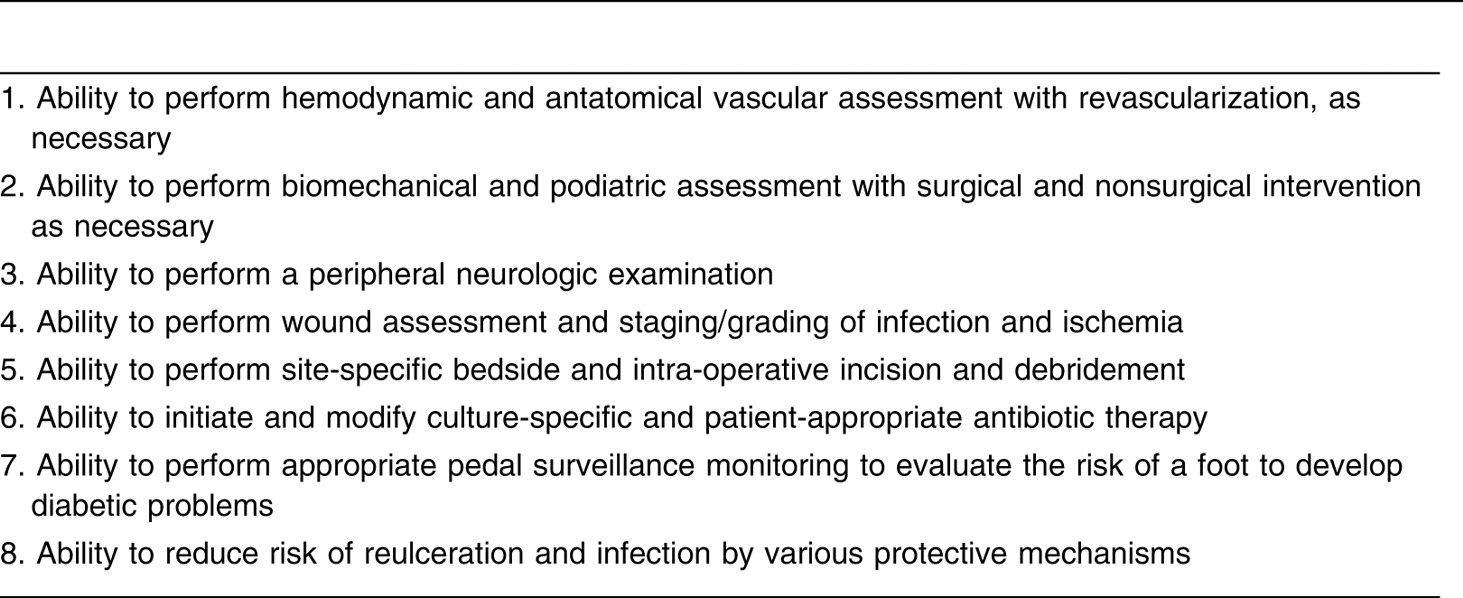
Unfortunately, not all critical components of an interdisciplinary team are available in either general hospitals or wound-care facilities. Some individual physicians and surgeons with experience and training across a broad spectrum of disciplines may appropriately treat conditions in areas that lack dedicated limb-preservation centers, but for complex cases, the preservation results will likely be inferior to the team approach. Therefore, while the constituents of teams may differ in various locales based on myriad factors, it is our contention that there are certain critical elements on a diabetic foot care “checklist” (
Table 1) that constitute an essential, professional skill set required of a diabetic-foot-care team.
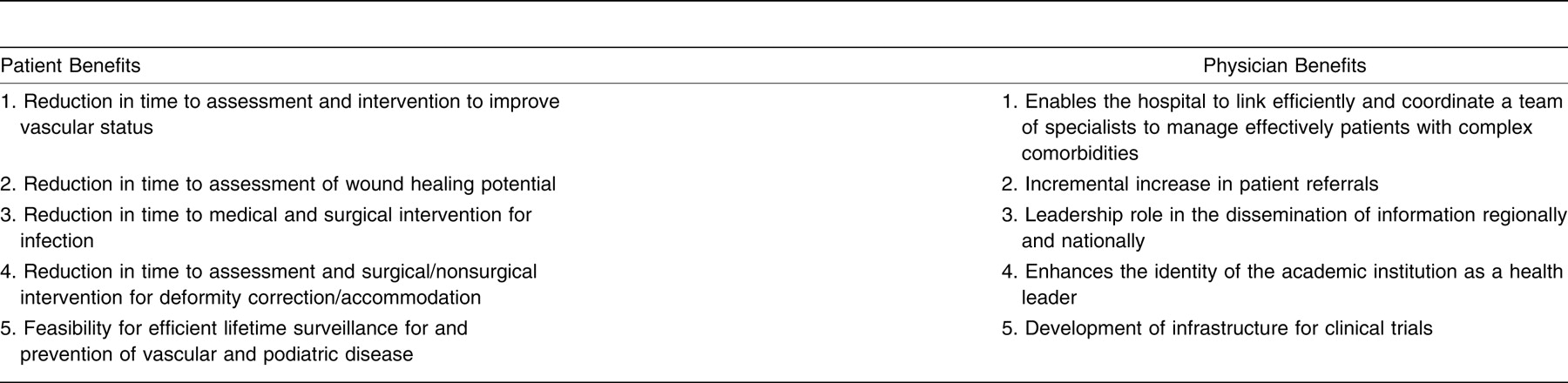
Patients are not the only beneficiaries of a collaborative approach among specialists (
Table 2). The presence of a truly interdisciplinary center enables the hospital to link efficiently and coordinate a team of specialists to effectively manage patients with complex comorbidities, in addition to their foot pathology. Patients can be assessed by a variety of specialists within a brief time period, resulting in a coordinated plan of care along established evidence-based algorithms. The initial screening determines the priority by which disciplines need to be involved in each patient’s plan of care. The establishment of this distinct, readily identified “center” results in an incremental increase in patient referrals for the participating physicians, especially from primary-care physicians and podiatric physicians in the region. The center also provides the participants with a leadership role in the dissemination of information regionally and nationally enabling the medical center to be at the forefront in the development of new information and strategies for both the prevention and treatment of limb-threatening disorders. When performed in the setting of an academic institution, this approach also allows use of the infrastructure to design and implement clinical research trials and attract industry-supported clinical trials involving algorithms for optimal management for functional foot salvage and new technology in wound healing and orthotics.
Support for educational-based programs for the region not only enhances the identity of the academic institution as a health leader but also engenders goodwill among the regional primary-care and specialty physicians. Use of innovative technology in the medical center expedites the dissemination of information and the design and implementation of clinical research programs.
In summary, the interdisciplinary team approach to diabetic foot issues is beneficial for patients and required for achieving optimal management and prevention of complications. Collectively, the interdisciplinary team should direct its efforts toward restoring and maintaining an ulcer-free lower extremity with functional limb salvage as the ultimate goal. Collaboration among specialists should be extended to creation of consensus documents and structured educational programs that emphasize the interdisciplinary care of patients with diabetes. Legislative advocacy to ensure adequate health-care resources to support these guidelines will be more effective when multiple specialty groups are heard as one voice. It is with this level of inter-professional collaboration among vascular surgeons and podiatric physicians that we can realize the goal of reducing the unnecessarily high number of diabetes-related amputations in the United States and worldwide.