Next Article in Journal
Comparative Analysis of Human Gait While Wearing Thong-Style Flip-flops versus Sneakers
Previous Article in Journal
The Impact of a Podiatric Lead Limb Preservation Team on Disease Outcomes and Risk Prediction in the Diabetic Lower Extremity. A Retrospective Cohort Study
 
 
Journal of the American Podiatric Medical Association is published by MDPI from Volume 116 Issue 1 (2026). Previous articles were published by another publisher in Open Access under a CC-BY (or CC-BY-NC-ND) licence, and they are hosted by MDPI on mdpi.com as a courtesy and upon agreement with American Podiatric Medical Association.
Article

A Proof-of-Concept Study for Measuring Gait Speed, Steadiness, and Dynamic Balance Under Various Footwear Conditions Outside of the Gait Laboratory

by
James S. Wrobel
1,2,
Sarah Edgar
2,
Dana Cozzetto
2,
James Maskill
2,
Paul Peterson
2 and
Bijan Najafi
1,2,*
1
Center for Lower Extremity Ambulatory Research (CLEAR) at the William M. Scholl College of Podiatric Medicine at Rosalind Franklin University of Medicine and Science, North Chicago, IL
2
William M. Scholl College of Podiatric Medicine at Rosalind Franklin University of Medicine and Science, 3333 Green Bay Rd, North Chicago, IL 60064
*
Author to whom correspondence should be addressed.
J. Am. Podiatr. Med. Assoc. 2010, 100(4), 242-250; https://doi.org/10.7547/1000242
Published: 1 July 2010

Abstract

Background: This pilot study examined the effect of custom and prefabricated foot orthoses on self-selected walking speed, walking speed variability, and dynamic balance in the mediolateral direction. Methods: The gait of four healthy participants was analyzed with a body-worn sensor system across a distance of at least 30 m outside of the gait laboratory. Participants walked at their habitual speed in four conditions: barefoot, regular shoes, prefabricated foot orthoses, and custom foot orthoses. Results: In the custom foot orthoses condition, gait speed was improved on average 13.5% over the barefoot condition and 9.8% over the regular shoe condition. The mediolateral range of motion of center of mass was reduced 55% and 56% compared with the shoes alone and prefabricated foot orthoses conditions, respectively. This may suggest better gait efficiency and lower energy cost with custom foot orthoses. This tendency remained after normalizing center of mass by gait speed, suggesting that irrespective of gait speed, custom foot orthoses improve center of mass motion in the mediolateral direction compared with other footwear conditions. Gait intercycle variability, measured by intercycle coefficient of variation of gait speed, was decreased on average by 25% and 19% compared with the barefoot and shoes-alone conditions, respectively. The decrease in gait unsteadiness after wearing custom foot orthoses may suggest improved proprioception from the increased contact area of custom foot orthoses versus the barefoot condition. Conclusions: These findings may open new avenues for objective assessment of the impact of prescribed footwear on dynamic balance and spatiotemporal parameters of gait and assess gait adaptation after use of custom foot orthoses.

Musculoskeletal pain is a common complaint for patients presenting to the podiatric physician’s office. Custom and prefabricated foot orthoses have been a frequently prescribed treatment modality in an attempt to ameliorate patients’ pain. Many meta-analyses [1-5] have been performed on the clinical effectiveness of custom and prefabricated foot orthoses in patients with various musculoskeletal conditions. Gait laboratory studies [6-16] have also attempted to better elucidate the cause and effect of custom and prefabricated foot orthoses on gait dynamics. Recently, it has been suggested that custom and prefabricated foot orthoses may have a role as proprioceptive stimulators or gait perturbation devices [17,18] This has lead to preliminary investigation into the role of custom and prefabricated foot orthoses in postural control and balance [19-22]
Until recently, measuring these parameters in static and dynamic conditions outside of the constraints and subsequent methodological issues of the gait laboratory has been elusive. Traditionally, gait is assessed using laboratory-based systems such as optical motion measurement systems and force platforms in a gait laboratory [23-26] Although these systems are clinically accepted as the gold standard, there have been several drawbacks. First, the number of consecutive strides that can be measured is limited. This means that intercycle variability of gait, involved in balancing the body and walking during varying circumstances, cannot be investigated using the existing systems because it requires a larger number of consecutive strides to be measured. Instrumented treadmills can address this limitation; however, uncertainty remains regarding the extent to which treadmill walking can be used to mimic overground walking [27]. In addition, the narrow path offered by the treadmill and the limited freedom for intercycle speed variability may hinder freedom in the selection of gait trajectory or speed. Therefore, it may not replicate the natural gait behavior of individuals during everyday life. Finally, recent studies revealed that individuals may modify their gait pattern when walking outside of a gait laboratory environment. For example, Najafi et al [26], by studying the gait pattern of 25 elderly participants inside and outside of a gait laboratory environment, demonstrated that elderly people walk significantly faster outside of a gait laboratory environment despite excellent test-retest reliability (intraclass correlation coefficient >0.9). This was the case for measurement inside and outside of a gait laboratory. These results may indicate that gait parameters assessed inside of a gait laboratory environment may not replicate gait outdoors, where individuals more frequently use their prescribed footwear.
Advances in the technology of body-worn sensors during the past decade have allowed investigators to use this technology for measuring various aspects of human performance, including the spatiotemporal parameters of gait [25,28-30] joint and segment angles (kinematics) [31-36] daily physical activity [37-43] and the risk [19-36] and fear [44] of falling. These studies [25,30,37,45] are based on the use of miniaturized and integrated sensors combined with lightweight, small measuring devices that can be carried without interfering with normal activity. One of the main advantages of body-worn sensors compared with laboratory-based measuring systems is that they are ambulatory and can be used in free conditions continuously for long periods [26].
The aims of the present pilot study were to measure the effect of custom and prefabricated foot orthoses on self-selected walking speed, intercycle gait speed variability, and dynamic balance measured by the range of motion of center of mass in the mediolateral direction and during each gait cycle.

Methods

Participants

The participants were four healthy podiatric medical students (2 women and 2 men) with a mean ± SD age of 25.8 ± 2.99 years (range, 23–30 years) and a mean ± SD body mass index (calculated as weight in kilograms divided by the square of the height in meters) of 23 ± 2.55 (range, 19.5–25.5). The study received ethical approval in accordance with the Rosalind Franklin University of Medicine and Science Institutional Review Board. All of the participants provided informed consent before the start of testing. Participants were excluded if they had active musculoskeletal conditions, pain, or fatigue. On average, participants were wearing custom foot orthoses for 7 weeks, and all of the participants were naïve to the prefabricated foot orthoses condition.

Shoe and Foot Orthoses Conditions

The students performed the casting on each other for the custom foot orthoses. However, in an attempt to help ensure that proper casting techniques were used, Dr. Beth Jarrett’s ten criteria for evaluating a neutral suspension cast were used. If any criterion was absent, the casting was repeated. These ten evaluation criteria included overall quality, good skin lines, cast markings present, forefoot to rearfoot relationship of the cast matches the foot, straight lateral border, fifth digit in line with the lateral column, one-third to two-thirds rule for the slope of the medial longitudinal arch, plantar bisection of the calcaneus passing through the second metatarsal, hallux parallel to the supporting surface, and appropriate thumb position in the sulcus. The same physician monitored and approved each cast that was made before any further steps were taken in constructing the custom foot orthoses. Participants received a standard prescription for custom functional foot orthoses posted with the forefoot balanced to the rearfoot deformity (neutral calcaneal stance position), with the following exceptions: 1) a valgus rearfoot (neutral calcaneal stance position) received a flat rearfoot post and 2) a rearfoot varus of greater than 6° was posted to a maximum of 6° varus. Minimum arch fill was used, with the following exceptions: in individuals who cannot dorsiflex their ankle past zero and in individuals who are obese (>30% over the ideal body weight), medium arch fill was used. All of the orthotic shells used in this study were made of 4-mm polypropylene, with three having ethylene vinyl acetate topcovers and one having a neoprene topcover. The prefabricated foot orthosis was the Dr. Scholl’s Tri-Comfort orthotic device (http://www.drscholls.com). Participants walked in habitual shoes that were judged not to have excessive wear or alignment issues.

Equipment

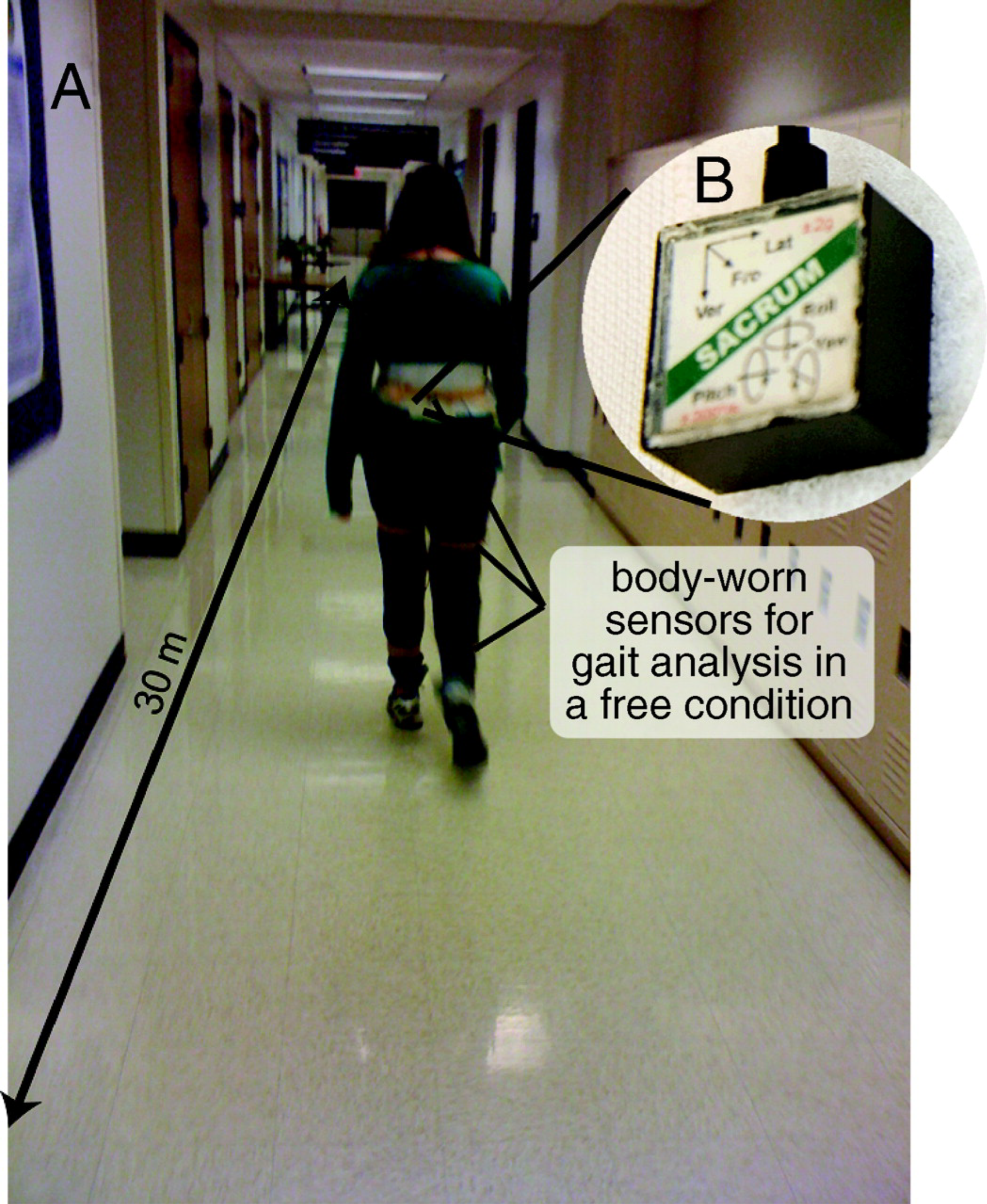
Allowing the participant to walk for extended distances outside of the laboratory provides data most similar to those seen under normal conditions. The Physilog (BioAGM, La Tour de Peilz, Switzerland) allows the participant to walk around in various conditions outside of a gait laboratory while recording data using five sensors attached to the right and left anterior shins, the right and left anterior thighs, and posteriorly to the lower back (Figure 1). Each sensor measures the angular velocity of the segment around the mediolateral axis (flexion-extension). The signals are digitized (16 bit) at a sampling rate of 200 Hz and are stored for off-line processing on a Secure Digital memory card (2 Mb). The method for calculating spatiotemporal parameters of gait has been described in detail in previous publications [28,37,46] To summarize, the gait phases are determined from the precise moments of heel strike (initial foot contact) and toe-off (terminal foot contact). These moments are extracted from gyroscopes attached to each shank through a local minimal peak detection scheme [28,37] Based on the participant’s height and using a biomechanical model, spatial parameters (ie, lower-limb stride length and stride velocity) can be estimated by integrating the angular rate of rotation of the thigh and shank [28,37] Finally, to assess center-of-mass displacement during walking (eg, mediolateral and anteroposterior rotation of center of mass per cycle), another sensor is attached to the lower back. This sensor provides range-of-motion estimates of center of mass for each cycle and, therefore, allows us to assess an individual’s postural control during gait [47].

Measurement Protocol and Walking Procedures

Participants were then tested in random order under the following conditions: barefoot, wearing habitual shoes (shoes alone), wearing habitual shoes and custom foot orthoses, and wearing habitual shoes and prefabricated foot orthoses. The tests were conducted indoors in a well-lit, level hallway with tile flooring. Participants were instructed to walk at their habitual speed down the hallway and to stop once they reached a predetermined stopping point of 30 m. Participants were then asked to turn around and return to the starting point, constituting the second trial. Participants repeated the walking trials under each of the two remaining conditions. Each condition was repeated twice, producing overall four trials per condition. The first three trials were considered warm-up trials, and only the last trial per condition was used for the final analysis. To isolate steady-state gait, the first three and last three strides were excluded before analysis. The main outcome measures were average velocity, coefficient of variation of velocity, and center-of-mass range of motion in the mediolateral direction.

Statistical Analysis

Considering the small sample size, we used the Mann-Whitney U test to compare the gait data between each footwear condition. A U value of 8 or higher was considered statistically significant. In addition, the Wilcoxon rank sum test was used to compare between footwear conditions. Because the sample size was small, we used the “exact” method instead of the “approximate” method for estimating the P value. For all tests, an α = 0.05 was considered statistically significant. Intercycle gait variability was assessed with the coefficient of variation expressed in percentage. Coefficient of variation was defined as follows: (SD)/(mean value) ×100. All of the calculations were made using Matlab (Version 7.4 [R2007a]; The MathWorks Inc, Natick, Massachusetts). In addition, age, sex, body mass index, and medical history were also assessed.

Results

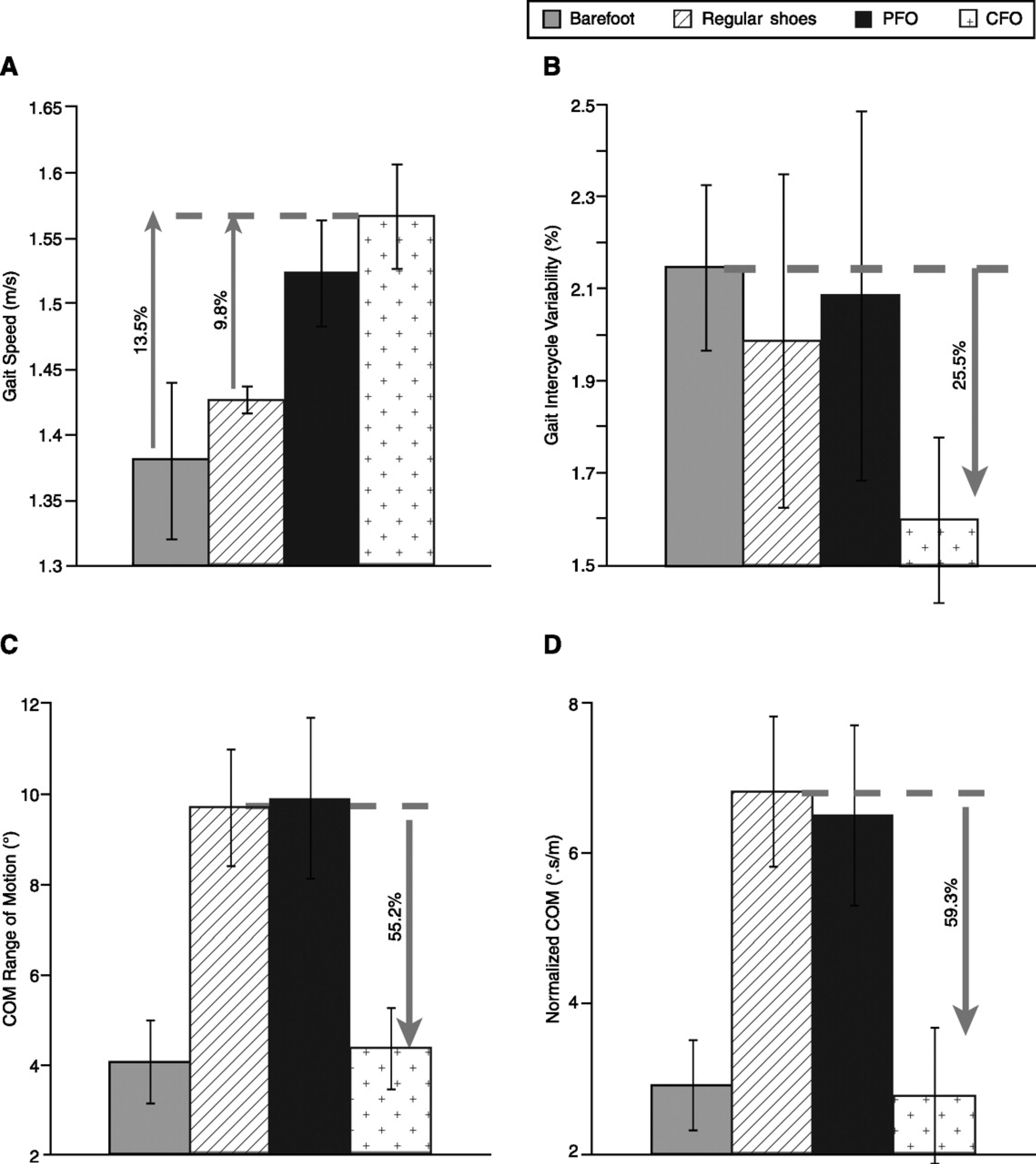
These results demonstrate gait improvement for speed and for range of motion of center of mass (Table 1). The average gait speed was increased for all of the participants with the use of custom foot orthoses compared with the barefoot (U = 16.0, P < .05), shoes alone (U = 16.0, P < .05), and prefabricated foot orthoses (U = 8.5, P = .9) conditions. By using custom foot orthoses, gait speed was increased on average by 13.5%, 9.8%, and 2.8% compared with the barefoot, shoes alone, and prefabricated foot orthoses conditions, respectively (Figure 2A). A similar tendency was observed for intercycle gait variability (gait rhythmicity). The coefficient of variation of gait speed was reduced when using custom foot orthoses by 25% (U = 15, P < .05), 19% (U = 10, P = .4), and 23% (U = 11, P = .6) compared with the barefoot, shoes alone, and prefabricated foot orthoses conditions, respectively, suggesting that gait becomes more stable (rhythmic) after using custom foot orthoses (Figure 2B). Range of motion of center of mass during gait in the mediolateral direction was reduced by 55% (U = 16, P < .05) and 56% (U = 15, P < .05) by using custom foot orthoses compared with shoes alone and prefabricated foot orthoses, respectively, suggesting that the energy cost during walking is reduced by using custom foot orthoses (Figure 2C). On the same note, center-of-mass range of motion normalized by gait velocity was reduced by 59% (U = 16, P < .05), 57% (U = 15, P < .05), and 5% (U = 9, P = .8) compared with the regular shoes, prefabricated foot orthoses, and barefoot conditions, respectively, suggesting that irrespective of gait speed, custom foot orthoses improve center of mass motion in the mediolateral direction compared with other footwear conditions (Figure 2D).

Discussion

The Impact of Custom Foot Orthoses on Gait Speed

In this pilot study of four healthy habitual custom foot orthoses users, we found an increase in self-selected walking speed of 13% compared with the barefoot condition and 10% compared with the regular shoe condition. We are not entirely surprised by the results of increased walking speed while wearing custom foot orthoses compared with shoes because softer midsoles in shoes have been implicated as dampening mechanoreceptor activity in the soles of the feet [48]. Also, contoured functional orthoses may have a better chance at stimulating more mechanoreceptor activity in the soles of the feet independent of foot type. They have been shown to increase contact area and midfoot pressure [49]. This may increase the indentation velocity to the plantar skin. Simonetti et al [50] described faster indentation velocities that activated deeper and higher-frequency tactile sensors (eg, Pacinian corpuscles), resulting in greater amplitude compound sensory action potentials. In addition, barefoot runners and walkers have been shown to decrease the vertical ground reaction force independent of speed [51,52] This decreased vertical ground reaction force in the barefoot condition in the context of the findings of Simonetti et al [50] may partially explain some of the present observations.

Impact of Custom Foot Orthoses on Gait Automaticity (Gait Steadiness)

Although not initially intuitive, the finding of decreased walking speed variability merits further discussion. Walking is a highly practiced activity, and it is often considered “automated.” [53-57] This attribute has emerged from several experiments [53,54] demonstrating that the subcortical locomotor brain regions produce an oscillatory pattern responsible for the automatic production of elaborate locomotor synergies. Automaticity and rhythmicity are also termed gait steadiness [26,58] It implies that a healthy individual is able to reproduce limb-coordinated movements from stride to stride during steady-state walking [59]. However, a higher level of cortical activity during gait would require more reliance on intact brain functioning and sensory feedback (eg, somatosensory, proprioceptive, vestibular, and visual feedback). For example, several studies [53,60] demonstrated that walking on irregular terrain may challenge somatosensory feedback. Also, adding an attention-demanding task during walking (ie, the dual-task paradigm) may demand more cortical involvement [55,56,58,61,62] Both of these conditions impact gait steadiness. Similarly, it stands to reason that any improvement in sensory feedback may improve gait rhythmicity.
Recently, it has been suggested that custom foot orthoses may have a role as proprioceptive stimulators or gait perturbation devices [17,18] Therefore, it stands to reason that gait steadiness could be improved after using custom foot orthoses. To validate this hypothesis and assess gait steadiness, we estimated intercycle gait variability. Stride-to-stride variability is a measure of the consistency of limb movements [59]. In particular, stride velocity variability is calculated from the mean and SD of stride velocity and is expressed as follows: coefficient of variation = (SD)/(mean value) ×100 [26,56] It is a measure of rhythmic gait speed. Low stride velocity variability reflects the automated rhythmic feature of gait and is a clinical index of gait steadiness [56,58,61-63] Because walking is one of the most repetitive and “hard-wired” human movements [64], the coefficient of variation is low, usually less than 3% in young healthy adults [56,63] The present results demonstrated a significance reduction of more than 19% after using custom foot orthoses compared with the other footwear conditions. This may suggest that custom foot orthoses may improve somatosensory/proprioceptive feedback during walking, which is key to regulating gait rhythmicity.
Previous authors have suggested that there may be inherent variability of gait as an adaptive mechanism in healthy individuals. Li et al [65] did not demonstrate a statistically or clinically significant correlation between stability and variability measures when they observed five participants walk on a treadmill at six different speeds. They concluded that gait intercycle variability was independent of stability (dynamic balance). However, uncertainty remains regarding the extent to which treadmill walking can be used to mimic overground walking [27]. In particular, the narrow path offered by the treadmill and the limited freedom for intercycle speed variability may hinder freedom in the selection of gait trajectory or speed. Therefore, assessing gait with a treadmill may not replicate the natural gait rhythmicity behavior of the individual during everyday life. Using overground walking in a free condition, we demonstrated that gait automaticity is improved by wearing custom foot orthoses, which may be interpreted as better sensory feedback information during the custom foot orthoses condition. Further investigation is required to validate this hypothesis during the dual-task condition (ie, walking + an attention-distractive task). Under dual-task conditions, a higher level of cortical activity during gait is required to control gait automaticity, and, hence, the contribution of sensory feedback is more crucial to maintain rhythmic stepping. In addition, although a reduction in gait variability and range of motion of center of mass was observed after using custom foot orthoses compared with regular shoes and prefabricated foot orthoses, reduction in gait variability compared with the barefoot condition did not lead to an improvement in dynamic balance. This observation is consistent with the finding by Li et al [65], in which they suggested that gait intercycle variability is independent of dynamic balance during gait. Further study is required to validate this hypothesis by comparing gait variability and dynamic balance in patients with postural instability and control participants.

Impact of Custom Foot Orthoses on Dynamic Balance Control and Energy Cost During Walking

Custom foot orthoses have also been implicated as improving postural control. A previous study [19] described improved postural control (measured by center of pressure velocity) after 6 weeks of custom foot orthoses wear in patients with a high degree of forefoot varus. Another study [22] of middle-aged women found that after 4 weeks of wearing various textured orthoses there were no changes in mediolateral or anteroposterior stability or base of support. In a study of 77 older adults by Mulford et al [20], patients randomized to the prefabricated foot orthoses group demonstrated significant improvement in Berg Balance scores immediately after wearing prefabricated foot orthoses and 6 weeks thereafter. All of these previous studies assessed postural control during static balance rather than during dynamic balance (postural control during walking). In the present study, to assess postural control during gait, we measured range of motion for center of mass during each cycle of gait. The results suggest that custom foot orthoses improve dynamic postural control during walking by reducing the center of mass range of motion in the mediolateral direction. Movement in center of mass in the mediolateral direction has been implicated as very important during step-to-step transition during double support, describing 60% to 70% of the metabolic energy expended during walking [66]. In addition, several authors [67-69] suggested that minimizing the amount that the body’s center of gravity is displaced from the line of progression is the major mechanism for reducing the muscular effort of walking and, consequently, saving energy. Therefore, reduction in range of motion of center of mass after using custom foot orthoses may suggest a reduction in the energy cost of walking, which, in turn, could reduce fatigue and back pain. However, further study is needed to experimentally validate this hypothesis.

Study Limitations

There are potential limitations to this pilot study. First, it is a small cross-sectional study of four young and healthy custom foot orthoses users. The students performed the gait laboratory testing. A larger cohort study using the dual-task method is needed to improve the statistical power and permit better elucidation of the role of custom foot orthoses in gait steadiness. Second, participants were naïve to the prefabricated foot orthoses condition, thus limiting potential comparisons with the other conditions. According to this pilot study, sample sizes of eight and 20 participants are required to observe a significant difference (power = 80%, α = 5%, paired comparison, 2-tailed) for gait speed improvement compared with the shoes alone and barefoot conditions, respectively. With the same criteria, a sample size of less than five is required to observe a significant difference in center-of-mass range of motion (or postural control during gait) due to custom foot orthoses use compared with shoes alone and prefabricated foot orthoses. In addition, it was not possible to blind the participants regarding which orthoses they were using in their shoes because they could see and feel the differences between the two.

Conclusions

We found that the use of custom foot orthoses resulted in improved walking speed, gait rhythmicity (steadiness), and dynamic balance in the mediolateral direction. These results suggest that wearing custom foot orthoses may improve somatosensory/proprioceptive feedback, which, in turn, helps the individual walk faster and with more stability while possibly expending less energy compared with wearing regular shoes and prefabricated foot orthoses.

Table 1. Comparison of Gait Speed, Range of Motion of COM in the ML Direction, and Gait Intercycle Variability in the Three Conditions.
Japma 100 00242 i001
Figure 1. The innovative Physilog device based on body-worn sensors that extract spatiotemporal parameters of gait, joint angles, and balance control in a free condition and for long periods of walking.
Japma 100 00242 g001
Figure 2. Gait comparisons among the barefoot, regular shoes alone, prefabricated foot orthoses (PFO), and custom foot orthoses (CFO) conditions for gait speed (A), intercycle coefficient of variation (gait intercycle variability) (B), range of motion of center of mass (COM) in the mediolateral direction (C), and COM range of motion normalized by gait speed (D). Error bars represent SD.
Japma 100 00242 g002

Acknowledgment

Dr. Beth Jarrett for her contributions to student oversight of orthoses casting, casting evaluation, and manufacturing.

Financial Disclosure

None reported.

Conflict of Interest

None reported.

References

  1. Brouwer RW, Jakma TS, Verhagen AP, et al: Braces and orthoses for treating osteoarthritis of the knee. Cochrane Database Syst Rev1:CD004020, 2005.
  2. Collins N, Bisset L, McPoil T, et al: Foot orthoses in lower limb overuse conditions: a systematic review and meta-analysis. Foot Ankle Int28:396, 2007.
  3. Hawke F, Burns J, Radford JA, et al: Custom-made foot orthoses for the treatment of foot pain. Cochrane Database Syst Rev3:CD006801, 2008.
  4. Lee SY, McKeon P, Hertel J: Does the use of orthoses improve self-reported pain and function measures in patients with plantar fasciitis? A meta-analysis. Phys Ther Sport10:12, 2009.
  5. Rome K, Handoll HH, Ashford R: Interventions for preventing and treating stress fractures and stress reactions of bone of the lower limbs in young adults. Cochrane Database Syst Rev2:CD000450, 2005.
  6. Arndt A, Wolf P, Liu A, et al: Intrinsic foot kinematics measured in vivo during the stance phase of slow running. J Biomech40:2672, 2007.
  7. Guldemond NA, Leffers P, Schaper NC, et al: The effects of insole configurations on forefoot plantar pressure and walking convenience in diabetic patients with neuropathic feet. Clin Biomech (Bristol, Avon)22:81, 2007.
  8. Hastings MK, Mueller MJ, Pilgram TK, et al: Effect of metatarsal pad placement on plantar pressure in people with diabetes mellitus and peripheral neuropathy. Foot Ankle Int28:84, 2007.
  9. MacLean C, Davis IM, Hamill J: Influence of a custom foot orthotic intervention on lower extremity dynamics in healthy runners. Clin Biomech21:623, 2006.
  10. Mueller MJ, Lott DJ, Hastings MK, et al: Efficacy and mechanism of orthotic devices to unload metatarsal heads in people with diabetes and a history of plantar ulcers. Phys Ther86:833, 2006.
  11. Nawoczenski DA, Cook TM, Saltzman CL: The effect of foot orthotics on three-dimensional kinematics of the leg and rearfoot during running. J Orthop Sports Phys Ther21:317, 1995.
  12. Nawoczenski DA, Ludewig PM: Electromyographic effects of foot orthotics on selected lower extremity muscles during running. Arch Phys Med Rehabil80:540, 1999.
  13. Nawoczenski DA, Ludewig PM: The effect of forefoot and arch posting orthotic designs on first metatarsophalangeal joint kinematics during gait. J Orthop Sports Phys Ther34:317, 2004.
  14. Nester C, Jones RK, Liu A, et al: Foot kinematics during walking measured using bone and surface mounted markers. J Biomech40:3412, 2007.
  15. Nester CJ, van der Linden ML, Bowker P: Effect of foot orthoses on the kinematics and kinetics of normal walking gait. Gait Posture17:180, 2003.
  16. Umberger BR, Nawoczenski DA, Baumhauer JF: Reliability and validity of first metatarsophalangeal joint orientation measured with an electromagnetic tracking device. Clin Biomech (Bristol, Avon)14:74, 1999.
  17. Nigg BM: The role of impact forces and foot pronation: a new paradigm. Clin J Sport Med11:2, 2001.
  18. Richie DH Jr: Effects of foot orthoses on patients with chronic ankle instability. JAPMA97:19, 2007.
  19. Cobb SC, Tis LL, Johnson JT: The effect of 6 weeks of custom-molded foot orthosis intervention on postural stability in participants with >or=7 degrees of forefoot varus. Clin J Sport Med16:316, 2006.
  20. Mulford D, Taggart HM, Nivens A, et al: Arch support use for improving balance and reducing pain in older adults. Appl Nurs Res21:153, 2008.
  21. Stude DE, Brink DK: Effects of nine holes of simulated golf and orthotic intervention on balance and proprioception in experienced golfers. J Manipulative Physiol Ther20:590, 1997.
  22. Wilson ML, Rome K, Hodgson D, et al: Effect of textured foot orthotics on static and dynamic postural stability in middle-aged females. Gait Posture27:36, 2008.
  23. Winter DA: Human balance and posture control during standing and walking. Gait Posture3:193, 1995.
  24. Najafi B, Miller D, Jarrett BD, et al: Does footwear type impact the number of steps required to reach gait steady state? An innovative look at the impact of foot orthoses on gait initiation. Gait Posture32:29, 2010.
  25. Aminian K, Najafi B: Capturing human motion using body-fixed sensors: outdoor measurement and clinical applications. Computer Animation Virtual Worlds15:79, 2004.
  26. Najafi B, Helbostad JL, Moe-Nilssen R, et al: Does walking strategy in older people change as a function of walking distance?. Gait Posture29:261, 2009.
  27. Dingwell JB, Cusumano JP, Cavanagh PR, et al: Local dynamic stability versus kinematic variability of continuous overground and treadmill walking. J Biomech Eng123:27, 2001.
  28. Aminian K, Najafi B, Bula C, et al: Spatio-temporal parameters of gait measured by an ambulatory system using miniature gyroscopes. J Biomech35:689, 2002.
  29. Moe-Nilssen R, Helbostad JL: Estimation of gait cycle characteristics by trunk accelerometry. J Biomech37:121, 2004.
  30. Najafi B, Helbostad JL, Moe-Nilssen R, et al: Does walking strategy in older people change as a function of walking distance?. Gait Posture29:261, 2009.
  31. Dejnabadi H, Jolles BM, Casanova E, et al: Estimation and visualization of sagittal kinematics of lower limbs orientation using body-fixed sensors. IEEE Trans Biomed Eng53:1385, 2006.
  32. Dejnabadi H, Jolles BM, Aminian K: A new approach for quantitative analysis of inter-joint coordination during gait. IEEE Trans Biomed Eng55:(pt 1):755, 2008.
  33. Dejnabadi H, Jolles BM, Aminian K: A new approach to accurate measurement of uniaxial joint angles based on a combination of accelerometers and gyroscopes. IEEE Trans Biomed Eng52:1478, 2005.
  34. Favre J, Luthi F, Jolles BM, et al: A new ambulatory system for comparative evaluation of the three-dimentional knee kinematics, applied to anterior cruciate ligament injuries. Knee Surg Sports Traumatol Arthrosoc14:592, 2006.
  35. Favre J, Jolles BM, Aissaoui R, et al: Ambulatory measurement of 3D knee joint angle. J Biomech41:1029, 2008.
  36. Favre J, Jolles BM, Siegrist O, et al: Quaternion-based fusion of gyroscopes and accelerometers to improve 3D angle measurement. Electronics Lett42:612, 2006.
  37. Najafi B: Physical Activity Monitoring and Risk of Falling Evaluation in Elderly People [PhD dissertation], Electrical Engineering Department, Ecole Polytechnique Federale de Lausanne (EPFL), Lausanne. ,2003.
  38. Salarian A, Russmann H, Vingerhoets FJ, et al: Ambulatory monitoring of physical activities in patients with Parkinson’s disease. IEEE Trans Biomed Eng54:2296, 2007.
  39. Paraschiv-Ionescu A, Buchser EE, Rutschmann B, et al: Ambulatory system for the quantitative and qualitative analysis of gait and posture in chronic pain patients treated with spinal cord stimulation. Gait Posture20:113, 2004.
  40. Paraschiv-Ionescu A, Buchser E, Rutschmann B, et al: Nonlinear analysis of human physical activity patterns in health and disease. Phys Rev E Stat Nonlin Soft Matter Phys77: (pt 1):021913, 2008.
  41. Buchser E, Paraschiv-Ionescu A, Durrer A, et al: Improved physical activity in patients treated for chronic pain by spinal cord stimulation. Neuromodulation8:40, 2005.
  42. Najafi B, Aminian K, Paraschiv-Ionescu A, et al: Ambulatory system for human motion analysis using a kinematic sensor: monitoring of daily physical activity in the elderly. IEEE Trans Biomed Eng50:711, 2003.
  43. Aminian K, De Andres E, Rezakhanlou K, et al: Motion analysis in clinical practice using ambulatory accelerometry. Model Motion Capture Tech Virtual Environ.1537:1, 1998.
  44. de Bruin ED, Najafi B, Murer K, et al: Quantification of everyday motor function in a geriatric population. J Rehabil Res Dev44:417, 2007.
  45. Zijlstra W, Aminian K: Mobility assessment in older people: new possibilities and challenges. Eur J Ageing4:3, 2007.
  46. Aminian K, Trevisan C, Najafi B, et al: Evaluation of an ambulatory system for gait analysis in hip osteoarthritis and after total hip replacement. Gait Posture20:102, 2004.
  47. Deillon V, Najafi M, Thomi C, et al: Evaluation of standing balance using a body fixed kinematic sensor: ESMAC abstracts 2004. Gait Posture20: (suppl 1):S61, 2004.
  48. Robbins S, Waked E, Allard P, et al: Foot position awareness in younger and older men: the influence of footwear sole properties. J Am Geriatr Soc45:61, 1997.
  49. Guldemond NA, Leffers P, Sanders AP, et al: Casting methods and plantar pressure: effects of custom-made foot orthoses on dynamic plantar pressure distribution. JAPMA96:9, 2006.
  50. Simonetti S, Dahl K, Krarup C: Different indentation velocities activate different populations of mechanoreceptors in humans. Muscle Nerve21:858, 1998.
  51. Divert C, Mornieux G, Baur H, et al: Mechanical comparison of barefoot and shod running. Int J Sports Med26:593, 2005.
  52. Squadrone R, Gallozzi C: Biomechanical and physiological comparison of barefoot and two shod conditions in experienced barefoot runners. J Sports Med Phys Fitness49:6, 2009.
  53. Courtemanche R, Teasdale N, Boucher P, et al: Gait problems in diabetic neuropathic patients. Arch Phys Med Rehabil77:849, 1996.
  54. Nutt JG, Marsden CD, Thompson PD: Human walking and higher-level gait disorders, particularly in the elderly. Neurology43:268, 1993.
  55. Beauchet O, Dubost V, Aminian K, et al: Dual-task-related gait changes in the elderly: does the type of cognitive task matter?. J Mot Behav37:259, 2005.
  56. Beauchet O, Kressig RW, Najafi B, et al: Age-related decline of gait control under a dual-task condition. J Am Geriatr Soc51:1187, 2003.
  57. Beauchet O, Annweiler C, Dubost V, et al: Stops walking when talking: a predictor of falls in older adults?. Eur J Neurol16:786, 2009.
  58. Maki BE: Gait changes in older adults: predictors of falls or indicators of fear. J Am Geriatr Soc45:313, 1997.
  59. Gabell A, Nayak US: The effect of age on variability in gait. J Gerontol39:662, 1984.
  60. Allet L, Armand S, de Bie RA, et al: Gait alterations of diabetic patients while walking on different surfaces. Gait Posture29:488, 2009.
  61. Hausdorff JM, Cudkowicz ME, Firtion R, et al: Gait variability and basal ganglia disorders: stride-to-stride variations of gait cycle timing in Parkinson’s disease and Huntington’s disease. Mov Disord13:428, 1998.
  62. Hausdorff JM, Forman DE, Ladin Z, et al: Increased walking variability in elderly persons with congestive heart failure. J Am Geriatr Soc4:1056, 1994.
  63. Dubost V, Kressig RW, Gonthier R, et al: Relationships between dual-task related changes in stride velocity and stride time variability in healthy older adults. Hum Mov Sci25:372, 2006.
  64. Beauchet O, Annweiler C, Lecordroch Y, et al: Walking speed-related changes in stride time variability: effects of decreased speed. J Neuroeng Rehabil6:32, 2009.
  65. Li L, Haddad JM, Hamill J: Stability and variability may respond differently to changes in walking speed. Hum Mov Sci24:257, 2005.
  66. Kuo AD: The six determinants of gait and the inverted pendulum analogy: a dynamic walking perspective. Hum Mov Sci26:617, 2007.
  67. Perry J: Gait Analysis of Normal and Pathological Function, Slack Inc, Thorofare. ,1992.
  68. Malanga G, Delisa J: “Clinical Observation,” in Gait Analysis in the Science of Rehabilitation, ed by J DeLisa, p 2, Diane Publishing, Baltimore. ,2000.
  69. Seymour R: Prosthetics and Orthotics: Lower Limb and Spinal, Lippincott Williams & Wilkins, Philadelphia. ,2002.