Article

Adoption Visibility and Equity Market Responses to Blockchain Adoption Announcements

Business School, University of Colorado Denver, Denver, CO 80204, USA
*
Author to whom correspondence should be addressed.
J. Risk Financial Manag. 2026, 19(7), 464; https://doi.org/10.3390/jrfm19070464 (registering DOI)
Submission received: 10 May 2026 / Revised: 15 June 2026 / Accepted: 23 June 2026 / Published: 26 June 2026
(This article belongs to the Special Issue Emerging Trends and Innovations in Corporate Finance and Governance)

Abstract

This paper examines stock market reactions to corporate blockchain adoption announcements and explores whether the visibility of such initiatives shapes investor response. While prior research documents strong valuation effects during early phases of technological hype, evidence from more mature stages of diffusion remains limited. Accordingly, this study provides exploratory evidence on investor behavior in a later-stage adoption context. We construct a hand-collected dataset of 51 announcements by publicly traded firms across multiple industries and employ a standard event-study methodology to estimate abnormal returns over short announcement windows, using both market-model and Fama–French factor specifications. Adoption visibility is conceptualized as a multidimensional construct capturing (i) the intensity of communication surrounding the initiative and (ii) whether the application is customer-facing or internally oriented. The results indicate that average abnormal returns around announcement dates are positive but economically modest and statistically insignificant. These findings suggest that blockchain adoption announcements no longer trigger uniform market repricing effects. Instead, investors appear to respond more selectively, potentially differentiating based on the perceived informational content and strategic relevance of the initiatives. Overall, the analysis offers exploratory evidence consistent with a shift in investor response as emerging technologies move beyond hype-driven phases toward more mature stages of diffusion. The results should be interpreted with appropriate caution and motivate further research using larger samples and complementary empirical approaches.

1. Introduction

Blockchain and cryptocurrency technologies have moved from niche experimentation toward more mainstream exploration and adoption, enabling applications such as decentralized finance, cross-border payments, tokenized assets, and smart-contract–driven markets. At the same time, these innovations create challenges for financial systems, including regulatory uncertainty, market volatility, scalability limitations, cybersecurity risks, and potential implications for monetary policy and financial stability (Weingärtner et al., 2023; Bonaparte, 2025).
As blockchain capability diffuses into enterprise settings, publicly listed firms increasingly issue announcements describing pilots, launches, partnerships, or expansions of blockchain initiatives. For investors, these announcements represent a potential information event: they may contain new signals about strategic direction, technological capability, and future cash-flow opportunities or risks. Event-study methodology is commonly used to evaluate such information events because, under semi-strong efficiency, new public information should be reflected in security prices around its release (Fama, 1970; MacKinlay, 1997; Kothari & Warner, 2007).
Yet the existing evidence on stock market reactions to corporate blockchain-related disclosures is mixed in both magnitude and persistence, suggesting that investor interpretation is conditional rather than automatic. Research examining early blockchain-related disclosure waves documents positive short-window reactions—particularly for speculative disclosures—followed by substantial reversals over subsequent weeks, consistent with overreaction under heightened attention regimes (Cheng et al., 2019). Related work similarly finds that the favorability and persistence of price responses depend on whether blockchain investments appear credible and subsequently substantiated, highlighting that investors distinguish between credible strategic commitments and more ambiguous “cheap talk” (Autore et al., 2021). In contrast, evidence from broader international samples outside peak hype windows points to much smaller average effects—on the order of a few tenths of a percent on the announcement day—alongside systematic heterogeneity by use case and implementation conditions (Klöckner et al., 2022).
This dispersion in findings implies that a central research challenge is not simply whether “blockchain adoption” creates shareholder value, but rather when and why capital markets interpret blockchain adoption announcements as value-relevant information. Two mechanisms are especially salient. First, corporate blockchain announcements may function as signals of managerial intent and organizational capability. Signaling theory predicts that market responses depend on whether investors perceive a signal as informative, costly, and credible rather than generic or opportunistic (Spence, 1973; Connelly et al., 2011; Bergh et al., 2014). Second, the impact of disclosure depends on investor information-processing constraints. Limited-attention frameworks and attention-based evidence suggest that investors do not process all public information equally; rather, announcement frequency, message salience and channel characteristics influence what is noticed, traded on, and incorporated into prices (Ramos et al., 2020; Ugras & Ritter, 2025).
Building on these mechanisms, we propose and examine the concept of adoption visibility—the degree to which a blockchain initiative is both (i) attention-activating in public communications and (ii) economically interpretable to investors. We operationalize visibility using two dimensions. The first is communication intensity, capturing the extent to which the firm’s announcement emphasizes and amplifies the blockchain initiative. Communication intensity should, in principle, increase the probability that investors notice and respond to the information, but it may also be discounted if perceived as promotional rather than informative.
The second is whether the initiative is customer-facing versus back-end. Customer-facing applications (e.g., payments, wallets, customer products) tend to be more interpretable because their potential demand and monetization channels are easier to map, whereas back-end applications (e.g., process efficiency, settlement infrastructure, compliance tooling) may have longer horizons and more opaque cash-flow implications. Prior research on market reactions to innovation and marketing actions suggests that short-horizon valuation effects tend to be stronger when the implications of an announcement are more transparent and directly interpretable by investors and customers (Chaney et al., 1991; Rubera & Kirca, 2012).
We empirically examine whether—and under what visibility conditions—corporate blockchain adoption announcements are associated with abnormal stock returns around announcement dates. Using a hand-collected dataset and a standard event-study design, we estimate abnormal returns under a market model and verify robustness with multi-factor specifications. We then test cross-sectional variation by visibility and related strategic controls (e.g., stage of adoption), evaluating whether visibility primarily operates through attention activation, interpretability, or their interaction.
The results indicate that, on average, blockchain adoption announcements are associated with small and statistically insignificant abnormal returns, suggesting that such disclosures do not systematically resolve valuation uncertainty in financial markets. However, substantial cross-sectional variation exists. In particular, announcements characterized by higher communication intensity exhibit directionally more favorable market reactions, although the evidence should be interpreted as exploratory because coefficient estimates are statistically imprecise. These findings are consistent with attention-based theories of asset pricing and with the idea that information processing constraints shape how investors incorporate complex technological disclosures into prices (Barber & Odean, 2008; Hirshleifer et al., 2009).
This study contributes to the literature on financial risk and information processing in several ways. First, it introduces adoption visibility as a multidimensional disclosure construct that integrates attention activation and economic interpretability. Unlike traditional measures of disclosure salience or media attention, which focus primarily on information prominence, adoption visibility captures both the likelihood that investors notice a disclosure and their ability to translate it into economically meaningful expectations. This distinction is particularly important for emerging technologies characterized by high complexity and uncertain commercialization pathways.
Second, it refines the interpretation of mixed prior results by shifting focus from blockchain adoption as a binary event toward adoption visibility as a boundary condition for market interpretation. The broader literature already indicates that blockchain disclosure reactions depend on speculation, credibility, and context (Liu et al., 2022; Ali et al., 2023; Antsipava et al., 2025). Our framework provides a structured way to distinguish attention activation from interpretability in the content and positioning of adoption announcements and offers a more nuanced explanation of how information about emerging technologies becomes incorporated into asset prices.
Third, it bridges disclosure and attention theory with enterprise blockchain research by introducing a construct that is measurable at the announcement level and relevant to both managers and investors (Hirshleifer & Teoh, 2003; Feuerriegel & Pröllochs, 2021).
Finally, it offers practical implications for firms’ disclosure strategies, suggesting that how information is communicated may be nearly as important as the underlying technological initiative itself in shaping market outcomes. Overall, the findings underscore that in environments of technological complexity, financial markets do not react uniformly to innovation signals. Instead, investor responses reflect a combination of attention allocation, interpretability, and perceived credibility—factors that jointly determine how new information is incorporated into asset prices.

2. Conceptual Framework and Hypotheses

Corporate blockchain adoption announcements have become a recurring feature of the information environment for publicly traded firms as blockchain-related initiatives shift from niche experimentation toward more mainstream exploration in financial services and adjacent sectors. This paper studies these announcements as capital-market information events and asks a narrower question than whether blockchain “creates value” in the long run: when and why do equity markets interpret blockchain adoption announcements as value-relevant in the short run?

2.1. Market Interpretation of Corporate Blockchain Adoption Announcements

Event-study analysis is grounded in the idea that, in informationally efficient markets, security prices incorporate value-relevant public information around disclosure dates. Under the semi-strong form of market efficiency, an announcement can affect price if it changes expectations about future cash flows or risk. When the event is well identified and confounding news is limited, abnormal returns provide a disciplined measure of investors’ contemporaneous revaluation (MacKinlay, 1997).
For blockchain adoption announcements, prior evidence indicates substantial heterogeneity. During periods of elevated speculative attention, announcements have been linked to large short-window reactions tied to cryptocurrency market conditions (Cahill et al., 2020). Other studies show differential responses depending on whether disclosures are vague or concrete, with patterns consistent with opportunistic framing and later correction. In more typical information environments, average announcement effects tend to be small, while still varying systematically by use case and project characteristics (Klöckner et al., 2022). Collectively, this literature suggests that the label “blockchain adoption” does not map mechanically into valuation outcomes; interpretation depends on both substance and communication (Cheng et al., 2019).
Given these mixed findings, the most conservative starting point is simply whether announcements are associated with any detectable revaluation at all.
Hypothesis 1
(Baseline reaction). Corporate blockchain adoption announcements are associated with abnormal stock returns around the announcement window.
This expectation is direction-neutral. While blockchain initiatives may signal innovation, many projects involve technological complexity, uncertain timelines, and difficult valuation mapping, implying that net short-run reactions may be small or variable.

2.2. Adoption Visibility as a Multidimensional Construct

To explain cross-sectional variation, we introduce adoption visibility, defined as the degree to which a blockchain initiative is both noticed and economically interpretable. Existing research has typically examined these mechanisms separately. Investor-attention and disclosure-salience studies focus on whether information attracts notice (Barber & Odean, 2008), while signaling research emphasizes whether investors regard a disclosure as credible and informative regarding underlying firm quality (Connelly et al., 2011). Adoption visibility differs from both streams by incorporating not only attention activation but also economic interpretability—the extent to which investors can translate a technological disclosure into plausible value-creation mechanisms.

2.3. Customer-Facing Versus Back-End Adoption (Interpretability)

The first cross-sectional mechanism concerns whether the initiative is externally oriented toward customers or internally oriented toward infrastructure.
Customer-facing applications tend to generate clearer cues regarding revenue models, adoption metrics, and competitive positioning (Goldfarb & Tucker, 2019). By contrast, back-end technologies often require complementary investments and organizational change before benefits materialize, producing longer and more uncertain payoff horizons (Brynjolfsson et al., 2021). Consequently, investors may find it easier to update beliefs when initiatives are directly connected to observable market outcomes.
Hypothesis 2
(Interpretability channel). Abnormal returns associated with blockchain adoption announcements vary with the interpretability of the initiative, with customer-facing applications expected to elicit more favorable market reactions than back-end applications.

2.4. Communication Intensity (Attention Activation)

The second mechanism concerns how strongly the initiative is communicated. Communication intensity captures salience—how prominently the firm frames the news and how likely it is to attract attention from investors and media.
Attention-based theories predict that salient disclosures are more likely to be noticed and acted upon, especially for cognitively demanding topics (Barber & Odean, 2008; DellaVigna & Pollet, 2009). However, promotional framing may also be discounted if perceived as cheap talk or insufficiently connected to fundamentals (Loughran & McDonald, 2016; Goldstein & Yang, 2019). Communication intensity therefore creates theoretical ambiguity: it may amplify reactions, but only if visibility translates into understanding.
Hypothesis 3
(Attention channel). Greater communication intensity may increase investor attention and amplify market reactions, while the ultimate effect depends on whether investors view the disclosure as informative and economically meaningful.

2.5. Complementarity Between Attention Activation and Interpretability

The two dimensions are unlikely to operate independently. Salience increases the probability that investors examine a disclosure, yet valuation impact requires that investors can infer economic meaning from it (Blankespoor et al., 2020). Communication intensity may therefore be most consequential when the initiative is concrete enough to support belief updating (Grewal et al., 2019). Conversely, highly visible promotion of opaque back-end initiatives may generate muted reactions or skepticism.
This complementarity aligns with blockchain-announcement evidence showing that market responses vary with specificity, credibility, and information environments (Drake et al., 2015).
Hypothesis 4
(Complementarity). The effects of communication intensity are expected to depend on the interpretability of the underlying initiative, with customer-facing applications providing a setting in which attention activation is more likely to translate into valuation responses.
Because blockchain projects also differ in maturity, partnerships, and technological architecture, the empirical design incorporates strategic and structural controls to isolate visibility effects from broader differences in initiative substance. The next section describes data construction, coding procedures, and the event-study framework used to evaluate H1–H4.

3. Materials and Methods

3.1. Sample Construction and Data Sources

3.1.1. Unit of Analysis and Sample Size

The unit of analysis is a firm–event. The current sample comprises N = 51 distinct corporate blockchain adoption announcement events that were hand-collected and hand-coded. The exact list of firms and events is provided in Supplementary Materials. Each event corresponds to a public announcement that describes a company’s adoption, pilot, launch, or expansion of a blockchain-related initiative.
The sample period spans February 2016 to March 2026, covering the period over which corporate blockchain adoption moved from early-stage experimentation toward mainstream enterprise deployment. The sample consists primarily of publicly listed firms trading on U.S. exchanges (NYSE, NASDAQ), with a small number of internationally listed firms included (e.g., HSBC, BNP Paribas, Barclays, Maersk, UBS) where their announcements were sufficiently prominent and equity return data were available. The industry composition reflects sectors where blockchain adoption has been most actively pursued: Banking (11), Payments/FinTech (9), Enterprise/Cloud Tech (9), Asset/Wealth/Servicing (6), Exchanges/Market Infrastructure (6), Logistics (3), and others (7).
An event was included if it satisfied all of the following criteria: (i) the announcing firm is publicly listed with sufficient trading history to support market-model parameter estimation over the [−60, −10] estimation window; (ii) the announcement describes a concrete blockchain adoption activity—specifically a pilot, launch, partnership, or expansion of a blockchain-based initiative; and (iii) daily equity return data were available from Yahoo Finance for both the estimation and event windows. Announcements that referenced blockchain only vaguely (e.g., “exploring the potential of distributed ledger technology” without any operational commitment or product detail) were excluded.
Where a firm made multiple blockchain adoption announcements during the sample period, each was treated as a separate firm–event provided it described a distinct initiative or milestone. Announcements that were substantively duplicative—restatements of a previously disclosed initiative without new operational content—were excluded. The final sample of 51 events reflects this screening.

3.1.2. Event Identification and Event Date (t = 0)

Events were identified through a structured search of firm press releases and corporate websites, supplemented by Google News searches using blockchain-related keywords including “blockchain,” “distributed ledger,” “tokenization,” and “DLT.” The search targeted large publicly traded companies across financial services, technology, logistics, and adjacent sectors. Each qualifying announcement was recorded with a single announcement date as the event date t = 0. Where announcement timestamps (intraday time) are unavailable or inconsistently recorded (unspecified), the empirical design treats the calendar announcement date as the event day and evaluates abnormal performance using short event windows that allow for next-day adjustment. This treatment follows standard event-study practice, in which the central identification assumption is that the event date is well defined and that price effects—if any—are concentrated in a short window around the announcement (MacKinlay, 1997).
Each announcement was reviewed for the presence of major concurrent corporate events that could plausibly dominate market reactions, including earnings releases, merger and acquisition announcements, significant management changes, and material revisions to financial guidance. Events with a clearly dominant concurrent disclosure were excluded from the sample. Where minor concurrent information was present but not clearly dominant, the event was retained; short event windows were employed to limit exposure to unrelated information arriving outside the immediate disclosure period. Complete elimination of all potential confounding information is not always feasible in a hand-collected design of this type, consistent with standard practice in the event-study literature (MacKinlay, 1997; Kothari & Warner, 2007).

3.1.3. Equity Return Data

Daily equity prices were collected uniformly from Yahoo Finance, to ensure a single consistent price source across firms. Returns were calculated using adjusted prices to account for corporate actions. Specifically, for firm i on trading day t , the daily simple return is
R i , t = P i , t P i , t 1 1 ,
where P i , t is the adjusted closing price.

3.1.4. Market Benchmark and Factor Data

The baseline expected-return model uses a broad market index proxy, S&P 500 stock market index, to compute daily market returns R m , t . For multi-factor robustness, daily Fama–French factors and the risk-free rate were obtained from the Kenneth R. French Data Library, finance factor database”. In the current robustness package, the available factor file extends through 31 December 2024, implying that Fama–French robustness analyses are necessarily conducted on the subsample of events whose estimation and event windows fall within the factor-data coverage.
The S&P 500 was selected because the sample consists primarily of U.S.-listed firms spanning multiple industries, making it an appropriate proxy for aggregate U.S. equity-market performance. As one of the most widely used benchmarks in event-study research, the index provides a broad measure of market-wide movements against which announcement-specific abnormal returns is evaluated. This benchmark allows abnormal returns to be interpreted relative to general market conditions rather than industry-specific fluctuations.

3.2. Event-Study Design and Estimation

3.2.1. Framework

The event study follows the canonical approach described in MacKinlay (1997), and the efficient-markets interpretation that event-window abnormal returns summarize the market’s contemporaneous reassessment of expected cash flows and/or risk around the public disclosure.

3.2.2. Estimation Window and Event Windows

For each firm–event, expected-return parameters are estimated over an estimation window of trading days 60 , 10 relative to the announcement date t = 0 . The choice of the [−60, −10] estimation window reflects a common tradeoff in event-study design between obtaining a sufficient number of observations for stable parameter estimation and maintaining temporal proximity to the event. Excluding the ten trading days immediately preceding the announcement reduces the possibility that parameter estimates are affected by information leakage, anticipatory trading, or gradual dissemination of event-related information. Similar estimation windows are widely used in short-horizon event studies of corporate disclosures and strategic announcements (MacKinlay, 1997; Kothari & Warner, 2007).

3.2.3. Baseline Expected-Return Model (Market Model)

For each firm i , the market model is estimated in the estimation window:
R i , t = α i + β i R m , t + ε i , t .
The fitted expected return on an event-window day is:
E ^ R i , t R m , t = α ^ i + β ^ i R m , t .
Abnormal returns are computed as:
A R i , t = R i , t E ^ R i , t R m , t .
Firm-level cumulative abnormal returns for an event window τ 1 , τ 2 are:
C A R i τ 1 , τ 2 = t = τ 1 τ 2 A R i , t .
Average abnormal returns and cumulative average abnormal returns are computed cross-sectionally:
A A R t = 1 N i = 1 N A R i , t , C A A R τ 1 , τ 2 = 1 N i = 1 N C A R i τ 1 , τ 2 .
These calculations follow established event-study conventions widely employed in empirical finance (Binder, 1998; Kothari & Warner, 2007; Corrado, 2011).

3.2.4. Alternative Expected-Return Models (Robustness)

Two alternative approaches are used to verify that results are not an artifact of the baseline expected-return specification. First, a market-adjusted return benchmark is computed as A R i , t = R i , t R m , t as a parsimonious robustness check when estimation-window regression fit is a concern. Second, a multi-factor model is estimated using the Fama–French three factors:
R i , t R f , t = α i + β M , i R m , t R f , t + β S , i S M B t + β H , i H M L t + ε i , t ,
and abnormal returns are computed as the difference between realized and model-implied excess returns.

3.2.5. Test Statistics and Inference

Statistical inference is based on cross-sectional variation in abnormal returns. For a given day t , the conventional t-statistic for A A R t is computed as:
t A A R t = A A R t s t / N ,
where s t is the cross-sectional standard deviation of A R i , t . For cumulative effects, inference uses the cross-sectional standard deviation s C A R of C A R i τ 1 , τ 2 :
t C A A R = C A A R τ 1 , τ 2 s C A R / N .
Because event studies can exhibit cross-sectional dependence and event-induced variance, we complement conventional tests with adjusted statistics as robustness. Specifically, we (i) report a standardized cross-sectional test consistent with the approach in Boehmer et al. (1991), which is designed to improve specification when event-induced variance is present, and (ii) apply the adjustment proposed by (Kolari & Pynnönen, 2010), to account for cross-sectional correlation in abnormal returns when event windows overlap or when announcements cluster in calendar time.

3.2.6. Adoption Visibility Measures and Coding Procedures

An important feature of this study design is the construction of a hand-coded adoption visibility measure that captures two channels introduced in the conceptual framework: (i) communication intensity (attention activation) and (ii) customer-facing versus back-end adoption (interpretability). This operationalization is grounded in disclosure economics and signaling theory, which emphasize that both the content of a disclosure and the manner in which it is presented can influence how investors process and evaluate information about complex corporate initiatives (Verrecchia, 2001; Connelly et al., 2011; Loughran & McDonald, 2016).

3.2.7. Communication Intensity Index (CI)

Communication intensity is measured with a composite index intended to capture salience and amplification of the blockchain initiative. The index comprises three components, each coded on an ordinal scale and summed to create an overall score.
The coding thresholds used for each component are summarized in Table 1. Additional examples and coding guidance are provided in Supplementary Materials.
Examples of low-intensity headlines include announcements that merely report participation in a pilot or partnership, whereas high-intensity headlines emphasize strategic transformation, major deployment, or competitive leadership.
Media visibility was assessed through a structured search procedure using the announcement title. Independent coverage was identified through Google News searches and coded based on the number of major business and financial media outlets reporting the announcement. Representative outlets included Reuters, Bloomberg, The Wall Street Journal, Financial Times, CNBC, and BBC. Distribution services such as PR Newswire and Business Wire were not counted as independent media coverage unless the announcement was subsequently reported by independent outlets.
The overall communication intensity index is then:
C I i = L e n g t h S c o r e i + H e a d l i n e S c o r e i + M e d i a S c o r e i ,
with higher values indicating greater communication intensity.
This construction follows attention-based research demonstrating that salient presentation features and characteristics of the information environment influence whether investors notice disclosures and how strongly markets react (Barber & Odean, 2008; DellaVigna & Pollet, 2009; Loughran & McDonald, 2016).

3.2.8. Customer-Facing vs. Back-End Adoption (CF)

Interpretability is operationalized by coding whether the blockchain initiative is customer-facing versus back-end. The primary indicator used in hypothesis testing is Customer-Facing Adoption (CF):
C F i = 1
if the announcement describes a blockchain initiative with direct customer/user interaction, access, or product/service delivery; =0 otherwise.
A separate indicator can be retained for Back-End Adoption (internal infrastructure/process orientation). Because some initiatives can plausibly involve both a customer-facing interface and back-end infrastructure, the coding scheme allows overlap where warranted by the announcement text; the analysis therefore interprets CF as an indicator of customer-facing content rather than as a mutually exclusive adoption category. The resulting specification reclassifies events into three mutually exclusive categories (customer-facing only; back-end only; both) and verifies that conclusions are not driven by classification overlap.

3.2.9. Coding Protocol and Reliability

All visibility measures were constructed from the original announcement texts and documented sources following a structured coding protocol. The detailed rubric, decision rules, and representative examples are provided in Supplementary Materials. The codebook was developed during an initial pilot phase and refined to ensure consistent application of definitions across announcements.
The coding was performed by a single researcher. To mitigate concerns regarding subjectivity in a hand-collected design, several safeguards were implemented.
First, all variables were defined using explicit, text-based criteria that limited discretionary interpretation. Coding relied on observable statements in headlines and announcement narratives rather than inferred managerial intent.
Second, to assess inter-coder reliability, an independent coding audit was conducted on a randomly selected subsample of 20 announcements (approximately 39% of the full sample). A second researcher independently coded the announcements using the same rubric and classification criteria, without access to the original coding decisions. Inter-coder reliability was assessed using Cohen’s Kappa. Agreement was near-perfect across all evaluated coding dimensions, including customer-facing classification, headline strength, and media visibility (κ = 1.00 in each case). The high level of agreement reflects the rule-based and observable nature of the coding criteria, which map textual features directly to predefined categories with limited interpretive discretion. Any residual discrepancies were resolved through discussion and clarification of the rulebook. Third, we performed sensitivity analyses using alternative thresholds and categorizations of the visibility measures. The main inferences remain qualitatively unchanged, suggesting that the findings are not driven by particular coding cutoffs.

3.3. Cross-Sectional Regression Tests of Hypotheses

To test hypotheses on visibility-driven heterogeneity, we estimate cross-sectional regressions in which the dependent variable is the firm-level cumulative abnormal return around each announcement. The primary dependent variable is: C A R i (−1,+1), computed under the baseline market model. Alternative dependent variables are used in robustness, including C A R i (0,+1) and C A R i (−2,+2), and abnormal returns derived from the Fama–French three-factor framework (FF3 model).

3.3.1. Baseline Regression Specification

The main regression model tests separate and joint effects of interpretability and communication intensity:
C A R i = γ 0 + γ 1 C F i + γ 2 C I i + γ 3 C F i × C I i + Γ C o n t r o l s i + ε i .
Because interaction terms can introduce multicollinearity and make intercepts uninterpretable when the continuous variable is far from zero, the mean-centering CIi prior to forming the interaction is a common practice to improve interpretability, though the reported specifications retain the original CI scale.

3.3.2. Interpretation of Coefficients

In this specification, γ 1 captures the difference in CAR between customer-facing and non-customer-facing announcements when CI = 0; γ 2 captures the association of communication intensity with CAR for non-customer-facing announcements; and γ 3 captures the incremental association of communication intensity for customer-facing announcements (the complementarity channel).

3.3.3. Controls and Fixed Effects

The specification incorporates controls designed to account for cross-sectional differences in strategic and structural attributes of initiatives. These include indicators for strategic stage (pilot, initial launch, or expansion), explicit first-mover claims, the presence of named partners, and the disclosed blockchain architecture. These variables proxy for variation in commitment, credibility, and implementation scope that may independently influence investor interpretation.
Where feasible, additional models incorporate broad industry groupings and pre-event firm characteristics derived from the estimation window, including prior returns and return volatility.

3.3.4. Estimation and Standard Errors

All regressions are estimated using ordinary least squares with heteroskedasticity-robust standard errors. Given the modest sample size, inference is based on small-sample-adjusted variance estimators. Alternative specifications examining clustering by calendar period and industry yield qualitatively similar conclusions.

3.4. Robustness Checks, Falsification Tests, Missing Data, and Statistical Power Robustness Analyses

To assess whether the empirical inferences depend on particular design choices, the study implements a set of complementary robustness analyses addressing window selection, expected-return modeling, extreme observations, and cross-sectional structure.

3.4.1. Alternative Event Windows

In addition to the baseline (−1,+1) specification, abnormal returns are re-estimated for the [0,0] and [−1,0] windows. These alternatives capture immediate reactions and short pre-announcement price adjustment.

3.4.2. Alternative Expected-Return Benchmarks

The analysis is replicated using market-adjusted returns and abnormal returns derived from the Fama–French three-factor framework. The purpose is to verify that conclusions are not sensitive to reliance on a single return-generating process.

3.4.3. Sensitivity to Extreme Realizations

To evaluate the role of unusually large firm-level responses, cumulative abnormal returns are capped at conventional percentile thresholds (e.g., 1/99 or 5/95). Results are compared between capped and uncapped samples to determine whether coefficient signs and magnitudes remain stable.

3.4.4. Magnitude of Reaction

Given that heterogeneous belief updating can yield small average signed returns even when announcements attract attention, additional specifications model the absolute value of CAR. These tests examine whether greater visibility is associated with stronger reactions independent of direction.

3.4.5. Conceptually Motivated Subsamples

The framework also considers whether results differ across environments expected to shape interpretability. Analyses distinguish between industries with relatively higher versus lower familiarity with blockchain applications and between first-time versus repeat announcements within the observed event history.
Taken together, these exercises evaluate whether the documented patterns persist under alternative assumptions and measurement choices.

3.4.6. Treatment of Missing or Ambiguous Observations

Event-study implementation involves several practical data limitations. Estimation-window procedures require sufficient historical return information. When such data are unavailable—because of limited trading history—those events are omitted from specifications that rely on model estimation.
Factor-model robustness depends on the coverage of factor returns. Accordingly, Fama–French specifications are estimated on the subset of announcements for which the required factor data are available through 31 December 2024.
In addition, exact announcement timestamps are frequently not observable. Disclosures released outside trading hours may therefore be incorporated with a delay, which motivates inclusion of windows extending through the first post-announcement trading day.
As with most archival event studies, the possibility of unobserved contemporaneous disclosures cannot be completely ruled out. The use of short event windows is intended to limit, though not eliminate, this source of noise.

3.4.7. Statistical Power

The sample size (51 announcement events) allows the study to characterize directional tendencies and cross-sectional differences but limits the ability to detect small mean effects with conventional levels of statistical significance. In settings where responses vary across firms or use cases, economically meaningful average impacts may therefore remain imprecisely estimated.
For this reason, interpretation places weight on effect magnitudes, interval estimates, and the consistency of patterns across alternative specifications, rather than on dichotomous significance thresholds. Such challenges are common in event-study research involving relatively small samples (e.g., Botta & Colombo, 2020).
To further illustrate estimation precision, Appendix A Table A2 reports 95% confidence intervals for the regression coefficients. The intervals are generally wide, reflecting the modest sample size and the resulting uncertainty surrounding the point estimates. While the confidence intervals encompass economically meaningful positive and negative effects for several coefficients, the directional patterns remain broadly consistent with the coefficient estimates reported in Table 7. These results reinforce the need for cautious interpretation and suggest that the findings should be viewed as exploratory evidence rather than definitive causal estimates.

3.4.8. Replicability and Research Transparency

Because the principal explanatory variables rely on structured reading of disclosure texts, transparency of construction is essential. The empirical materials supporting the analysis include the event list, announcement sources, coding framework, and the return panels used to compute abnormal performance. These materials are intended to facilitate verification, replication, and future cumulative research.

3.5. Key Specification Summary

Table 2 below provides a compact “at a glance” summary of the primary empirical specifications described above.

4. Results

4.1. Baseline Market Reaction

Prior to presenting announcement-window inference, we summarize the structure of the sample and the distribution of the principal variables. Table 3 summarizes the composition of the 51 firm–events.
Table 4 presents descriptive statistics for abnormal returns, visibility measures, and strategic controls. Building on this foundation, we now examine whether blockchain adoption announcements are associated with abnormal returns in the aggregate.
Table 5 reports average abnormal returns (AAR) for days t = −1, 0, +1 and cumulative average abnormal returns (CAAR) over short windows around the announcement date, estimated using the market model.
Consistent with standard event-study logic under semi-strong efficiency, we first evaluate whether the market reacts on average to these disclosures. The evidence indicates that the aggregate announcement-window effect is positive but small. The mean CAAR(−1, +1) equals 0.0059 (≈+0.59%), with a cross-sectional t-statistic of 1.485 and a two-sided p-value of 0.1438. Thus, the baseline result does not provide statistical evidence of a significant average announcement effect.
Day-level estimates provide additional perspective on timing. The pre-announcement day exhibits a modest positive abnormal return, AAR(−1) = 0.0026 (≈+0.26%; t = 0.9594; p = 0.3420). In contrast, the announcement-day reaction remains small, AAR(0) = 0.0034 (≈+0.34%; t = 1.3822; p = 0.1730), and the following day shows a slight reversal, AAR(+1) = −0.0001 (≈−0.01%; t = −0.0649; p = 0.9485). Taken together, these patterns suggest limited and statistically insignificant price adjustment within the short event window.
The absence of a strong mean effect does not imply uniform reactions. As shown in the descriptive statistics, firm-level CAR(−1,+1) continues to exhibit substantial variation across events, with both positive and negative realizations observed. Moreover, a larger share of events are associated with positive abnormal returns. These features point toward heterogeneity rather than homogeneity in interpretation and motivate the cross-sectional analysis.

4.2. Heterogeneity by Adoption Visibility

If investors differ in how they process technologically complex disclosures, variation in announcement design and framing may help explain cross-sectional outcomes. We therefore examine whether abnormal returns vary with two dimensions of adoption visibility: communication intensity (attention activation) and customer-facing orientation (interpretability).
Table 6 shows the average CAR(−1,+1) along with the number of events for each of the four groups formed by the high/low communication-intensity (CI) split and whether the initiative is customer-facing (CF) or not, plus the overall mean across all 51 events.
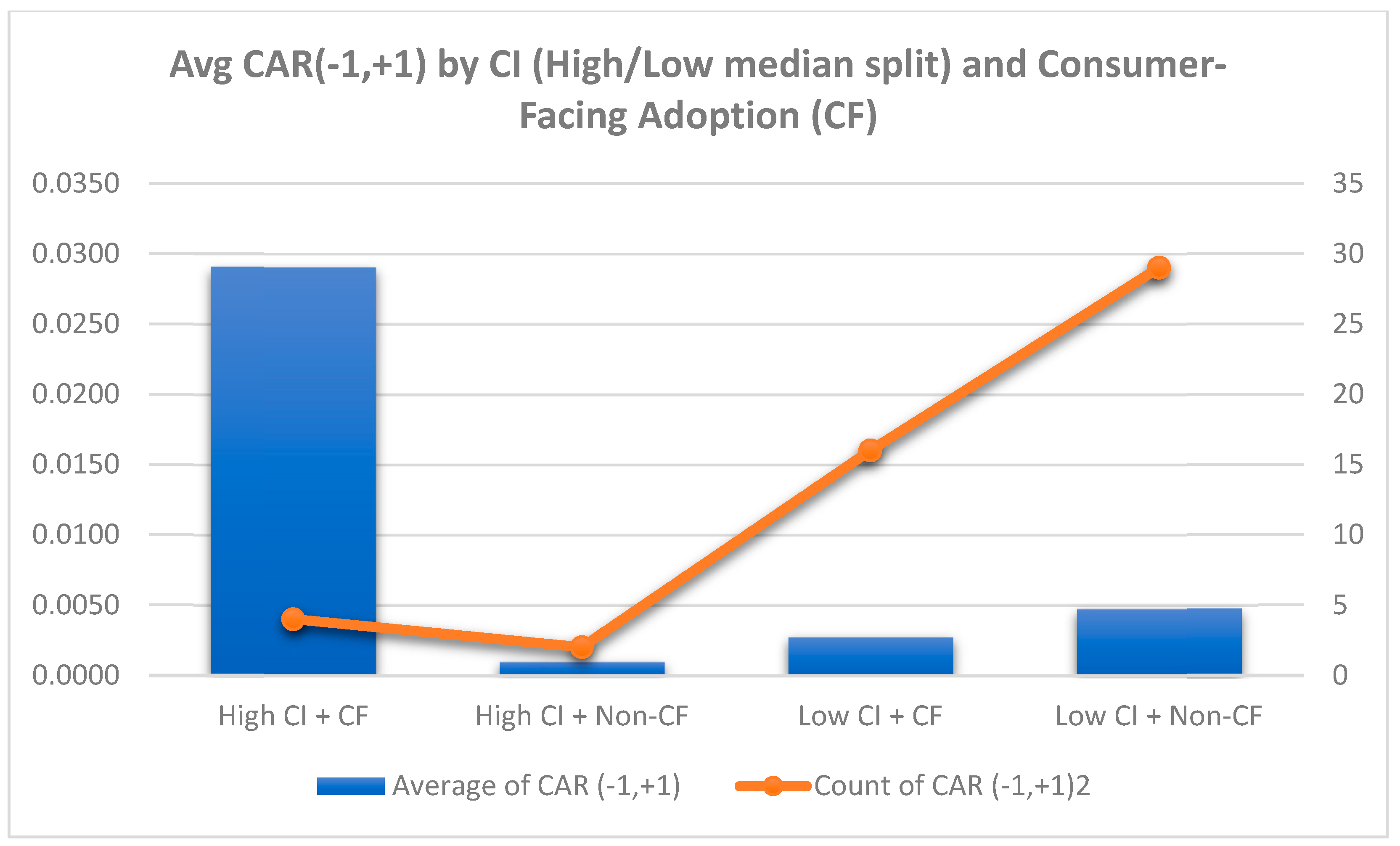
The largest directional separation emerges when communication intensity and customer-facing orientation are considered jointly. Among high-CI announcements, those that are customer-facing exhibit substantially higher average CAR(−1,+1) (0.0291; N = 4) compared to high-CI non-customer-facing initiatives (0.0010; N = 2). In contrast, within the low-CI group, average CARs are more modest and relatively similar across categories (0.0027 for customer-facing, N = 16; 0.0047 for non-customer-facing, N = 29). These patterns suggest that elevated market responses are concentrated in a small subset of announcements that combine high communication intensity with customer-facing positioning, while differences across other groups remain limited.
By contrast, when considered in isolation, customer-facing orientation does not produce statistically meaningful differences in average CAR. Average CARs across customer-facing and back-end initiatives remain relatively close in magnitude within the broader sample, indicating that interpretability alone, as captured by this binary classification, is not sufficient to consistently differentiate market reactions in the short announcement window.
The visual distribution in Figure 1 confirms a rightward shift for more salient announcements.
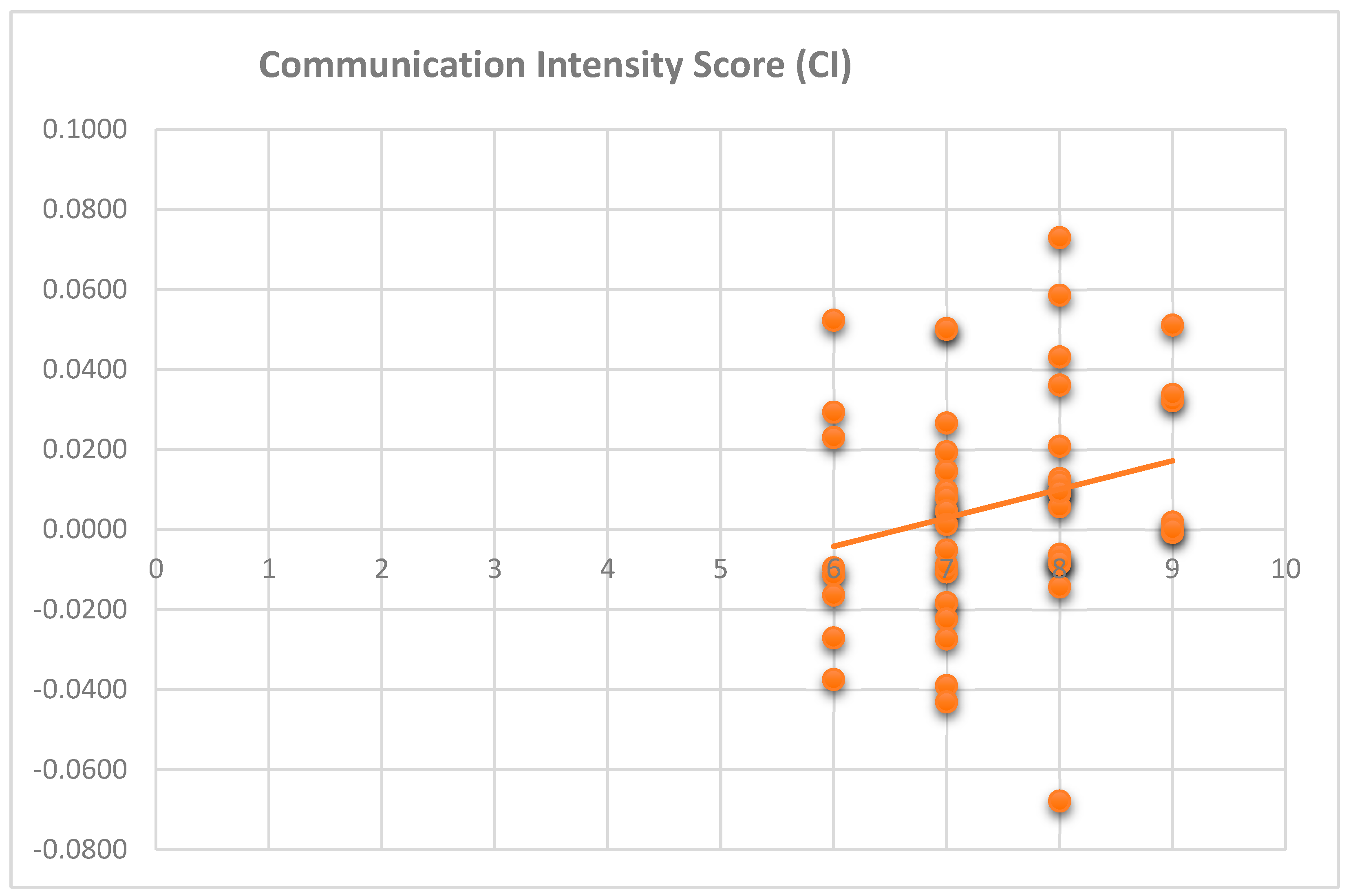
To complement the grouped comparison, Figure 2 plots CAR(−1,+1) against CI at the event level, illustrating dispersion and the direction of association in the full sample.
Table 7 presents cross-sectional regressions of firm-level CAR(−1,+1) on communication intensity, customer-facing orientation, and their interaction, estimated both with and without strategic controls.
Regression results in Table 7 are broadly consistent with the descriptive patterns. In the interaction specification, communication intensity shows a positive but statistically insignificant association with CAR across specifications (e.g., coefficient ≈ 0.0052, p ≈ 0.3813 in the interaction model; ≈ 0.0023, p ≈ 0.7108 with controls), indicating that while the direction aligns with the attention-activation hypothesis, the estimate falls well short of conventional significance thresholds. The customer-facing indicator and the interaction term are likewise estimated with considerable uncertainty (e.g., interaction coefficient ≈ 0.0051; p ≈ 0.5911).
Including additional controls does not materially alter these conclusions. Communication intensity remains positive but statistically insignificant (coefficient ≈ 0.0023; p ≈ 0.7108), and other covariates—including pilot stage, partnership involvement, first-mover claims, and blockchain architecture—do not exhibit reliable associations with announcement-period returns.

4.3. Economic Magnitude

Although the average CAAR is modest, the communication-intensity gradient suggests economically meaningful but statistically imprecise cross-sectional variation. A one-point increase in CI is associated with approximately 0.2–0.5 percentage points higher CAR—based on coefficients of ≈0.0052 without controls and ≈0.0023 with controls—though neither estimate reaches conventional significance thresholds. Given that the realized range of the index spans three points (CI = 6 to CI = 9), a shift across the full observed range implies a cumulative difference of roughly 0.7–1.6 percentage points, which is economically non-trivial relative to the overall mean CAAR of 0.59%, even if small compared with total cross-sectional dispersion.
By contrast, the customer-facing classification contributes limited incremental explanatory power in isolation. Within the short event window, salience appears to be a more immediate correlate of price formation than interpretability proxies alone.
Table 8 reports predicted CAR differentials implied by the regression estimates, along with structured comparisons across communication-intensity tiers and strategic stages.
Panel A shows that the high-CI group exhibits a higher average CAR than the low-CI group, with a difference of approximately 0.0127. While the difference is economically meaningful, it does not reach statistical significance (p = 0.1149). This suggests that communication intensity may influence market reactions, although the evidence remains statistically inconclusive in this sample.
Expansion announcements were not reported as a separate stage because the current event sample contains no expansion-coded observations under the stage classification used (i.e., all events are categorized as either Pilot or First Launch). As a result, Panel C compares Pilot vs. First Launch only.
Across specifications, communication intensity (CI) is positively associated with CAR(−1,+1), with higher average returns observed for the high-CI group (0.0128) relative to the low-CI group (0.0001), although the difference remains statistically insignificant. Customer-facing orientation (CF) does not produce a meaningful distinction, as average CARs remain similar across groups (0.0080 for CF = 1 vs. 0.0045 for CF = 0; p = 0.6687). Likewise, while First Launch announcements exhibit higher average CARs than Pilot initiatives (0.0094 vs. −0.0069), the difference is not statistically significant (t = 1.4805; p = 0.1619).
Overall, these results indicate that while differences in means are directionally consistent with stronger reactions for higher visibility and more advanced implementation stages, statistical evidence remains limited, suggesting that heterogeneity is present but not sharply captured by these univariate splits alone.
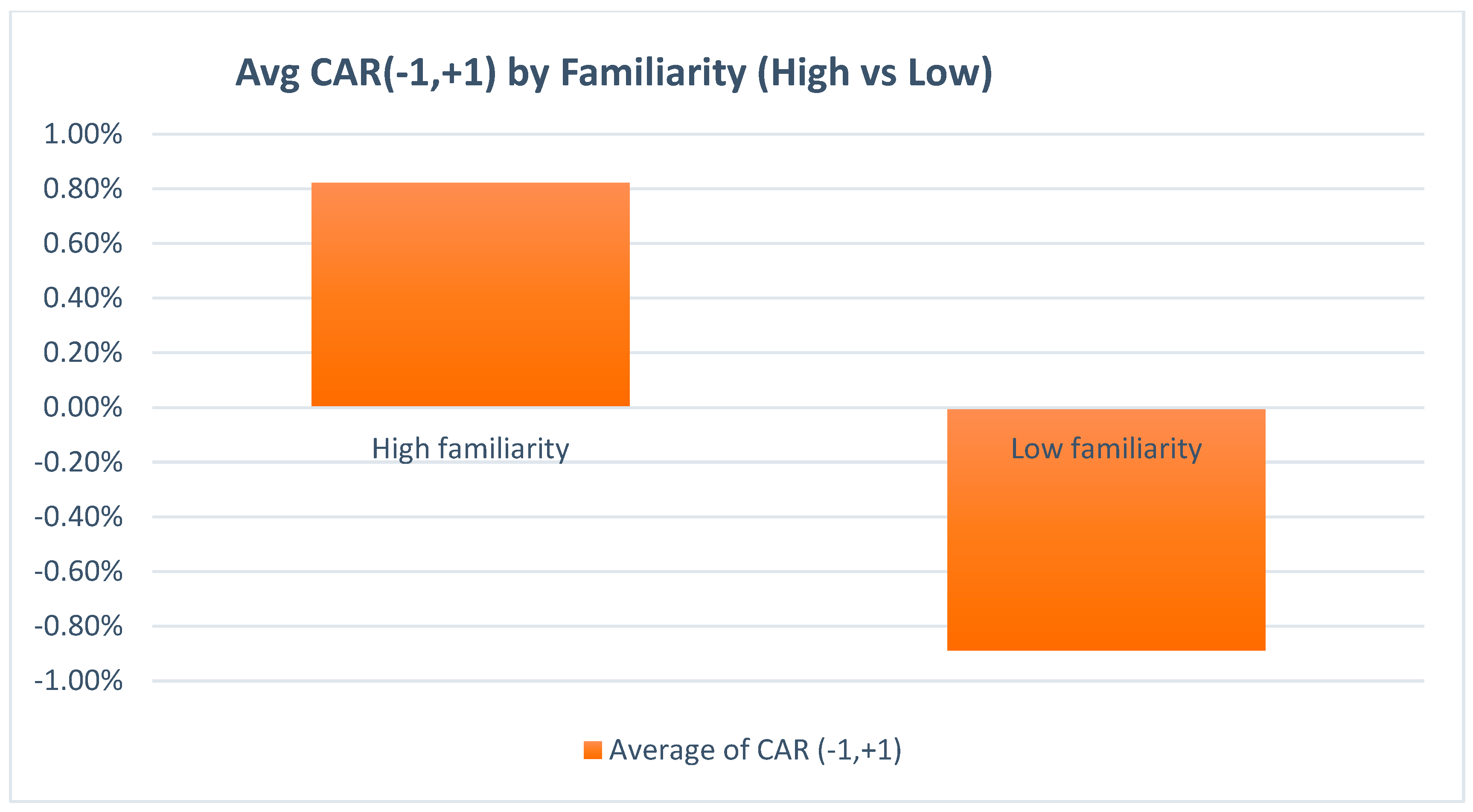
To further probe whether muted average effects reflect differences in investor familiarity and disclosure salience, we also compare CAR(−1,+1) across two supplementary splits. First, dividing the sample by industry familiarity with blockchain (high vs. low), the high-familiarity group exhibits higher average CAR than the low-familiarity group (Figure 3), with mean CAR(−1,+1) of 0.0082 (N = 44) versus −0.0089 (N = 7), respectively. Although this difference is economically noticeable, it is not statistically significant in this sample and should be interpreted cautiously given the relatively small size of the low-familiarity subsample.
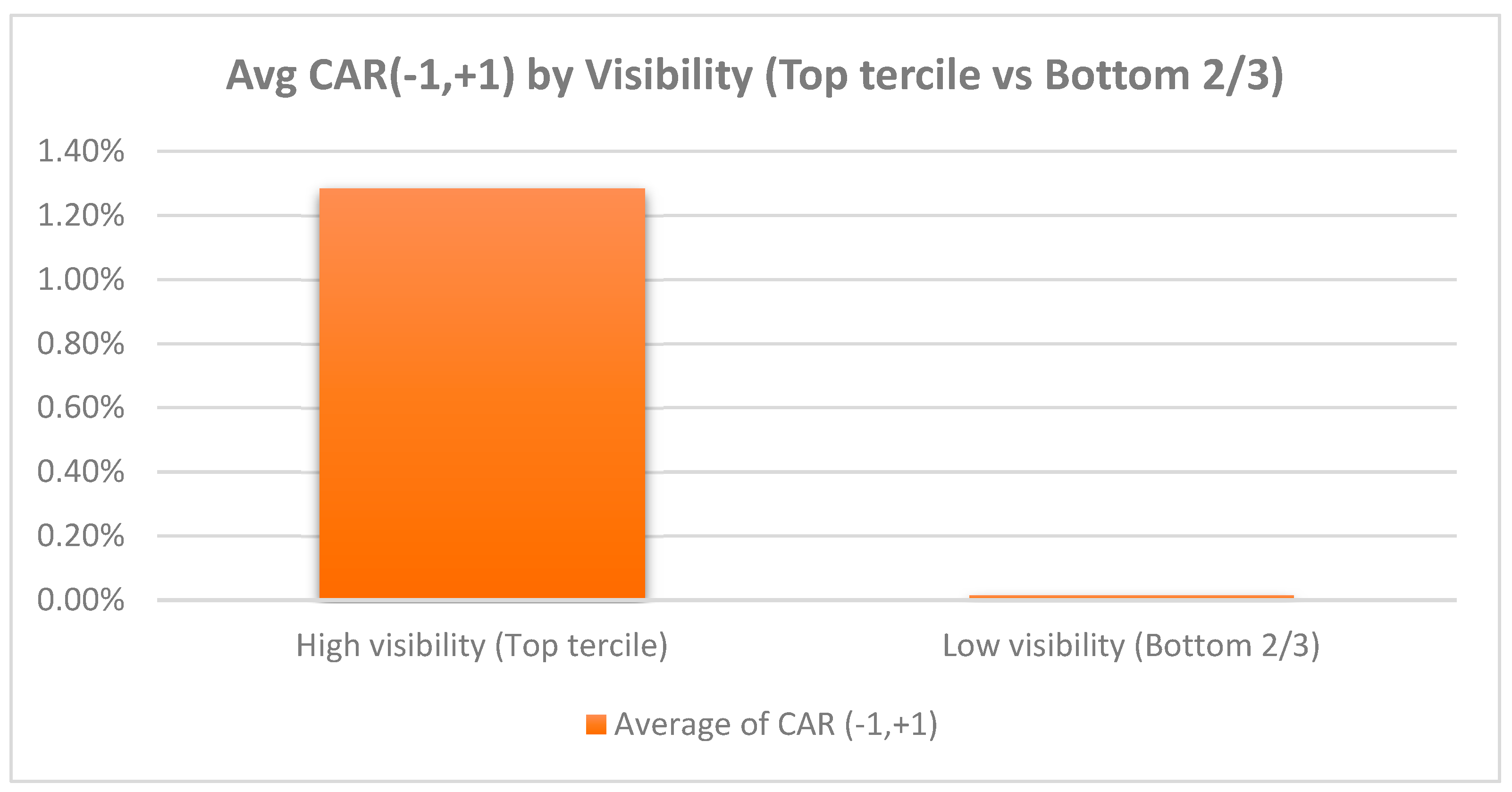
Second, a visibility-tier split yields clearer separation: high-visibility announcements exhibit higher average CAR than low-visibility announcements (Figure 4), with mean CAR(−1,+1) of 0.0128 (N = 23) for the high-visibility group compared to 0.0001 (N = 28) for the low-visibility group. Although the difference is economically meaningful, statistical evidence remains modest in this sample and should be interpreted with caution (Figure 4).
A parsimonious regression using a high-visibility indicator produces a positive coefficient consistent with this pattern. Taken together, these checks suggest that disclosure salience is a more reliable short-window separator than industry familiarity in this dataset. These results reinforce the interpretation that how prominently blockchain initiatives are communicated affects short-window market responses more consistently than adoption type alone.

4.4. Role of Controls

Augmenting the specification with controls for strategic stage and implementation context does not overturn the qualitative visibility pattern. Communication intensity remains positively signed. Pilot initiatives are generally associated with weaker reactions, whereas partnership announcements tend to correspond to more favorable outcomes. A negative association for private blockchain orientation appears in the controlled specification; given the sample size, this estimate is interpreted cautiously but is directionally consistent with perceptions of greater uncertainty in certain corporate applications.
To preserve degrees of freedom, the primary models avoid high-dimensional fixed effects. Supplementary estimations incorporating broader groupings yield similar directional conclusions and do not materially alter inference.

4.5. Robustness Analyses

Table 9 evaluates sensitivity to alternative event windows, expected-return benchmarks, and treatments of influential observations.
Appendix A Table A1 re-estimates all five specifications on the 29 events within Fama–French three-factor data coverage (announcements on or before 31 December 2024); the directional pattern for communication intensity is preserved, confirming that the visibility trend is not driven by post-cutoff event inclusion.
Panel A reports mean CAARs (market model) for alternative event windows available in the current extract: (−1,+1), (0,0), and (−1,0); windows such as (0,+1) and (−2,+2) are not reported because they are not available in the event-level dataset. Panel B uses an alternative communication-intensity measure that excludes media visibility (“CI no media pickup”), which yields a positive and statistically significant association with CAR(−1,+1). Panel C winsorizes CAR(−1,+1) at the 5th and 95th percentiles (values below/above these cutoffs are capped at the cutoff) to reduce the influence of extreme observations; t-statistics and p-values are from two-tailed one-sample tests against zero unless otherwise noted.
The principal conclusions remain stable. Average effects do not concentrate on the announcement day, alternative constructions of communication intensity tend to reinforce rather than weaken the directional association, and tail adjustments to the CAR distribution leave coefficient signs largely intact, though statistical significance remains limited after winsorization. Additional specifications based on absolute CARs indicate that visibility may influence the magnitude of market reactions even when signed averages approach zero. Given the modest sample size and the nonlinear transformation involved, these results are interpreted as suggestive.
Table 10 summarizes the hypotheses, the corresponding empirical tests, and whether the evidence supports each prediction.
This summary is provided for ease of reference; detailed estimates are reported in the main Results tables and figures.

4.6. Interim Summary

Across the sample, the aggregate reaction to corporate blockchain adoption is positive but statistically indistinguishable from zero. The dominant empirical regularity is not a universal premium but variation in response. Announcements communicated with greater intensity tend to be associated with more favorable abnormal returns, whereas the customer-facing distinction does not independently separate outcomes in this short window. These findings suggest that investor processing and framing may influence how market participants interpret emerging-technology disclosures, although the evidence remains exploratory.
Taken together, the results do not provide strong statistical support for visibility-based explanations of market reactions. Rather, they identify directional patterns that are broadly consistent with the proposed attention-activation and interpretability mechanisms. Given the modest sample size, limited statistical power, and the small number of observations in some visibility subgroups, these findings should be viewed as exploratory and hypothesis-generating rather than as definitive evidence of causal visibility effects.

5. Discussion

5.1. Principal Findings

This study examined how capital markets respond to corporate blockchain adoption announcements and whether variation in adoption visibility helps explain differences in investor reaction. The absence of statistically significant average abnormal returns around blockchain adoption announcements suggests that such disclosures do not, on average, constitute strong value-relevant signals for equity markets. From a financial perspective, this result indicates that blockchain adoption announcements do not systematically reduce valuation uncertainty or trigger uniform updating of investor expectations regarding future cash flows or risk. Accordingly, the visibility-related findings should be interpreted as suggestive rather than confirmatory, reflecting directional tendencies that warrant validation in larger samples.
This finding is consistent with the notion that emerging technology disclosures are characterized by high information ambiguity. While blockchain initiatives may signal innovation and strategic positioning, they simultaneously introduce uncertainty related to implementation feasibility, regulatory developments, and economic viability. As a result, investors may face difficulty mapping such announcements into precise valuation implications, leading to muted aggregate price reactions.
In this context, the results align with asset pricing frameworks emphasizing information risk and heterogeneous belief formation, where publicly disclosed information does not necessarily produce immediate or uniform price adjustments when its economic meaning is unclear (Christensen & Qin, 2014; Ottaviani & Sørensen, 2015). Instead, price responses may be dispersed across firms and events, reflecting differences in interpretation rather than a common market-wide signal.

5.2. Interpreting the Results: Attention, Salience, and Uncertainty

The findings are consistent with theoretical perspectives that emphasize investor attention and the difficulty of interpreting complex technological disclosures (Liu et al., 2022; Klöckner et al., 2022). Blockchain initiatives are typically multi-purpose, technically intricate, and often removed from immediate cash-flow realization, which makes it challenging for investors to translate adoption news into precise valuation updates.
Under such conditions, communication intensity can serve as an attention-activating mechanism: more prominent headlines, longer disclosures, and broader dissemination increase the likelihood that market participants notice and process the information, thereby modestly strengthening price responses even when underlying economic implications remain uncertain. This interpretation aligns with evidence that communication strategy and disclosure prominence can shape market outcomes even when the substance of innovation is difficult to evaluate (Eshghi & Farivar, 2024).
At the same time, the limited differentiation we observe between customer-facing and back-end initiatives suggests that investors may struggle to map either type into short-term financial consequences. Prior research shows that innovation announcements often generate muted or heterogeneous reactions when expected payoff pathways are ambiguous (Boyd et al., 2019). Although some studies argue that market-oriented or externally visible applications should be easier to value (Goldfarb & Tucker, 2019), the realization of benefits from digital technologies may depend on complements that delay observable performance effects (Brynjolfsson et al., 2021).
The present evidence implies that interpretability advantages may emerge only gradually rather than within a narrow announcement window. In this sense, the absence of large average effects is itself informative: it points to a market environment in which blockchain adoption is treated less as an immediate transformation shock and more as part of an ongoing process of experimentation and infrastructure development, with investors reacting primarily to cues that raise salience rather than to distinctions whose economic implications are difficult to verify in the short run.

5.3. Managerial and Disclosure Implications

From a managerial perspective, the results underscore that how information is communicated matters as much as what is communicated. Firms seeking to influence investor perceptions through disclosures of technological initiatives should consider both the visibility and clarity of their communication.
High-intensity communication can increase the likelihood that disclosures attract investor attention, but its effectiveness depends on whether the underlying initiative can be understood in economic terms. Overly promotional or ambiguous communication may fail to produce the intended market response or may even be discounted by investors.
Thus, effective disclosure strategies in the context of emerging technologies should balance salience, credibility, and interpretability, ensuring that announcements not only capture attention but also provide sufficient information for valuation.

5.4. Study Limitations and Directions for Future Research

Several limitations should be acknowledged. First, the analysis focuses on short-term market reactions and does not capture longer-term valuation effects, which may be particularly relevant for technologies with extended implementation horizons. Future research could examine whether blockchain adoption announcements influence long-term returns, volatility, or operating performance.
Second, the sample size, while consistent with early-stage research in emerging domains, constrains statistical power and the ability to detect small effects with precision. In addition, some announcements may have occurred in information environments containing other firm-specific disclosures, making it difficult to completely isolate the valuation effect of blockchain adoption from all contemporaneous news. Although short event windows were employed to mitigate contamination, residual overlap with unrelated information cannot be entirely ruled out. Also, while the study introduces a structured measure of adoption visibility, the coding process relies on textual interpretation, which may involve some degree of subjectivity. Although steps were taken to ensure consistency, future work could incorporate larger sample size, automated text analysis or machine learning approaches to enhance scalability and objectivity.
Third, the results suggest that investor responses depend on attention and interpretability, but the study does not directly observe investor behavior. Future research could integrate trading volume, analyst coverage, or investor-level data to further examine the mechanisms underlying attention-driven reactions.
Finally, the broader financial implications of blockchain adoption—such as its effects on firm risk profiles, cost of capital, or exposure to systemic financial risks—remain open areas for investigation.


Supplementary Materials

The following supporting information can be downloaded at: https://doi.org/10.5281/zenodo.20092142, accessed on 24 June 2026. Events records; Statistical data files.

Author Contributions

Conceptualization, A.M.; methodology, A.M. and R.N.; software, R.N.; validation, A.M. and R.N.; formal analysis, R.N.; data curation, R.N.; writing—original draft preparation, A.M.; review and editing, A.M. and R.N.; visualization, R.N.; supervision, A.M.; project administration, A.M. All authors have read and agreed to the published version of the manuscript.

Funding

This research received no external funding.

Institutional Review Board Statement

Not applicable.

Informed Consent Statement

Not applicable.

Data Availability Statement

The original data presented in the study are openly available in Zenodo at DOI: 10.5281/zenodo.20092142.

Acknowledgments

Authors acknowledge administrative and technical support provided by administration of CU Denver Business School and its Advisory Board. During the preparation of this manuscript/study, the authors used ChatGPT 5.5 and Claude Sonnet 4 for the purposes of proofreading. The authors have reviewed and edited the output and take full responsibility for the content of this publication.

Conflicts of Interest

The authors declare no conflicts of interest.

Abbreviations

The following abbreviations are used in this manuscript:
AARAverage Abnormal Return
ARAbnormal Return
CAARCumulative Average Abnormal Return
CARCumulative Abnormal Return
CFCustomer-Facing adoption indicator
CICommunication Intensity index
DeFiDecentralized Finance
FF3Fama–French Three-Factor model
HMLHigh Minus Low (value factor)
OLSOrdinary Least Squares
S&P 500Standard and Poor’s 500 Index
RfRisk-free rate
SMBSmall Minus Big (size factor)

Appendix A

Table A1. Cross-sectional regressions—FF3-covered subsample (N = 29, events ≤ December 2024).
CI OnlyCF OnlyCI + CFCI + CF + InteractionInteraction Full Model
CI0.0050 (0.3521) 0.0058 (0.2599)0.0024 (0.7404)−0.0005 (0.9610)
CF −0.0016 (0.8826)−0.0051 (0.6181)−0.0703 (0.3259)−0.0644 (0.4621)
CF × CI 0.0086 (0.3683)0.0082 (0.4596)
Pilot −0.0116 (0.5697)
Partnership 0.0231 (0.2479)
First Mover 0.0078 (0.6965)
Private Blockchain 0.0049 (0.7800)
Intercept −0.0166 (0.7633)−0.0163 (0.8240)
N2929292929
R20.03480.00090.04300.06530.2151
p-values in parentheses, HC3 robust standard errors. Subsample restricted to the 29 events with announcement dates on or before 31 December 2024, within Fama–French three-factor data coverage. Abnormal returns are estimated using the market model. CAAR(−1,+1) for this subsample = 0.02% (t = 0.031, p = 0.976).
Table A2. 95% Confidence Intervals for Full-Model Regression Coefficients.
VariableCoefficientLower 95% CIUpper 95% CI
CI−0.0555−0.20700.0960
CF0.0023−0.01010.0147
CF × CI0.0070−0.01280.0267
Pilot−0.0148−0.03670.0071
Partnership0.0123−0.00890.0335
First Mover−0.0051−0.02610.0158
Public Blockchain0.0062−0.01310.0255

References

  1. Ali, H. S., Jia, F., Lou, Z., & Xie, J. (2023). Effect of blockchain technology initiatives on firms’ market value. Financial Innovation, 9(1), 48. [Google Scholar] [CrossRef] [PubMed]
  2. Antsipava, D., van Reijmersdal, E. A., Strycharz, J., & van Noort, G. (2025). Can blockchain-based authenticity disclosures increase consumer trust in online advertising? Journal of Advertising, 54(2), 156–183. [Google Scholar] [CrossRef]
  3. Autore, D. M., Clarke, N., & Jiang, D. (2021). Blockchain speculation or value creation? Evidence from corporate investments. Financial Management, 50(3), 727–746. [Google Scholar] [CrossRef]
  4. Barber, B. M., & Odean, T. (2008). All that glitters: The effect of attention and news on the buying behavior of individual and institutional investors. The Review of Financial Studies, 21(2), 785–818. [Google Scholar] [CrossRef]
  5. Bergh, D. D., Connelly, B. L., Ketchen, D. J., Jr., & Shannon, L. M. (2014). Signalling theory and equilibrium in strategic management research: An assessment and a research agenda. Journal of Management Studies, 51(8), 1334–1360. [Google Scholar] [CrossRef]
  6. Binder, J. J. (1998). The event study methodology since 1969. Review of Quantitative Finance and Accounting, 11, 111–137. [Google Scholar] [CrossRef]
  7. Blankespoor, E., Hendricks, B. E., & Miller, G. S. (2020). The role of dissemination in market liquidity: Evidence from firms’ use of TwitterTM. The Accounting Review, 95(3), 79–112. [Google Scholar] [CrossRef]
  8. Boehmer, E., Masumeci, J., & Poulsen, A. B. (1991). Event-study methodology under conditions of event-induced variance. Journal of Financial Economics, 30(2), 253–272. [Google Scholar] [CrossRef]
  9. Bonaparte, Y. (2025). Quantum blockchain: A theoretical framework and applications in cryptocurrency. International Journal of Financial Studies, 13(4), 220. [Google Scholar] [CrossRef]
  10. Botta, M., & Colombo, L. V. A. (2020). The value of voting rights in Italian cooperative banks: A quasi-natural experiment. Managerial Finance, 46(7), 861–882. [Google Scholar] [CrossRef]
  11. Boyd, D. E., Kannan, P. K., & Slotegraaf, R. J. (2019). Branded apps and their impact on firm value: A design perspective. Journal of Marketing Research, 56(2), 266–282. [Google Scholar] [CrossRef]
  12. Brynjolfsson, E., Rock, D., & Syverson, C. (2021). The productivity J-curve: How intangibles complement general purpose technologies. American Economic Journal: Macroeconomics, 13(1), 333–372. [Google Scholar] [CrossRef]
  13. Cahill, D., Baur, D. G., Liu, Z., & Yang, J. W. (2020). I am a blockchain too: How does the market respond to companies’ interest in blockchain? Journal of Banking & Finance, 113, 105740. [Google Scholar] [CrossRef]
  14. Chaney, P., Devinney, T., & Winer, R. W. (1991). The impact of new product introductions on the market value of firms. The Journal of Business, 64(4), 573–610. [Google Scholar] [CrossRef]
  15. Cheng, S., De Franco, G., Jiang, H., & Lin, P. (2019). Riding the blockchain mania: Public firms’ speculative 8-K disclosures. Management Science, 65(12), 5901–5913. [Google Scholar] [CrossRef]
  16. Christensen, P., & Qin, Z. (2014). Information and heterogeneous beliefs: Cost of capital, trading volume, and investor welfare. The Accounting Review, 89(1), 209–242. [Google Scholar] [CrossRef]
  17. Connelly, B. L., Certo, S. T., Ireland, R. D., & Reutzel, C. R. (2011). Signaling theory: A review and assessment. Journal of Management, 37(1), 39–67. [Google Scholar] [CrossRef]
  18. Corrado, C. J. (2011). Event studies: A methodology review. Accounting & Finance, 51(1), 207–234. [Google Scholar] [CrossRef]
  19. DellaVigna, S., & Pollet, J. M. (2009). Investor inattention and Friday earnings announcements. The Journal of Finance, 64(2), 709–749. [Google Scholar] [CrossRef]
  20. Drake, M. S., Roulstone, D. T., & Thornock, J. R. (2015). The determinants and consequences of information acquisition via EDGAR. Contemporary Accounting Research, 32(3), 1128–1161. [Google Scholar] [CrossRef]
  21. Eshghi, K., & Farivar, S. (2024). The addition of new payment method and shareholder value: Evidence from cryptocurrency adoption. Journal of Organizational Computing and Electronic Commerce, 35(3), 89–114. [Google Scholar] [CrossRef]
  22. Fama, E. F. (1970). Efficient capital markets: A review of theory and empirical work. The Journal of Finance, 25(2), 383–417. [Google Scholar] [CrossRef]
  23. Feuerriegel, S., & Pröllochs, N. (2021). Investor reaction to financial disclosures across topics: An application of latent Dirichlet allocation. Decision Sciences, 52(3), 608–628. [Google Scholar]
  24. Goldfarb, A., & Tucker, C. (2019). Digital economics. Journal of Economic Literature, 57(1), 3–43. [Google Scholar] [CrossRef]
  25. Goldstein, I., & Yang, L. (2019). Good disclosure, bad disclosure. Journal of Financial Economics, 131(1), 118–138. [Google Scholar] [CrossRef]
  26. Grewal, J., Riedl, E. J., & Serafeim, G. (2019). Market reaction to mandatory nonfinancial disclosure. Management Science, 65(7), 3061–3084. [Google Scholar] [CrossRef]
  27. Hirshleifer, D., Lim, S. S., & Teoh, S. H. (2009). Driven to distraction: Extraneous events and underreaction to earnings news. The Journal of Finance, 64(5), 2289–2325. [Google Scholar] [CrossRef]
  28. Hirshleifer, D., & Teoh, S. H. (2003). Limited attention, information disclosure, and financial reporting. Journal of Accounting and Economics, 36(1–3), 337–386. [Google Scholar] [CrossRef]
  29. Klöckner, M., Schmidt, C. G., & Wagner, S. M. (2022). When blockchain creates shareholder value: Empirical evidence from international firm announcements. Production and Operations Management, 31(1), 46–64. [Google Scholar] [CrossRef]
  30. Kolari, J. W., & Pynnönen, S. (2010). Event study testing with cross-sectional correlation of abnormal returns. Review of Financial Studies, 23(11), 3996–4025. [Google Scholar] [CrossRef]
  31. Kothari, S. P., & Warner, J. B. (2007). Econometrics of event studies. In Handbook of corporate finance: Empirical corporate finance (Vol. 1, pp. 3–36). Elsevier. [Google Scholar] [CrossRef]
  32. Liu, W., Wang, J., Jia, F., & Choi, T.-M. (2022). Blockchain announcements and stock value: A technology management perspective. International Journal of Operations & Production Management, 42(5), 713–742. [Google Scholar] [CrossRef]
  33. Loughran, T., & McDonald, B. (2016). Textual analysis in accounting and finance: A survey. Journal of Accounting Research, 54(4), 1187–1230. [Google Scholar] [CrossRef]
  34. MacKinlay, A. (1997). Event studies in economics and finance. Journal of Economic Literature, 35, 13–39. [Google Scholar]
  35. Ottaviani, M., & Sørensen, P. N. (2015). Price reaction to information with heterogeneous beliefs and wealth effects: Underreaction, momentum, and reversal. American Economic Review, 105(1), 1–34. [Google Scholar] [CrossRef]
  36. Ramos, S. B., Latoeiro, P., & Veiga, H. (2020). Limited attention, salience of information and stock market activity. Economic Modelling, 87, 92–108. [Google Scholar] [CrossRef]
  37. Rubera, G., & Kirca, A. H. (2012). Firm innovativeness and its performance outcomes: A meta-analytic review and theoretical integration. Journal of Marketing, 76(3), 130–147. [Google Scholar] [CrossRef]
  38. Spence, M. (1973). Job market signaling. The Quarterly Journal of Economics, 87(3), 355–374. [Google Scholar] [CrossRef]
  39. Ugras, Y. J., & Ritter, M. A. (2025). Market reaction to earnings announcements under different volatility regimes. Journal of Risk and Financial Management, 18(1), 19. [Google Scholar] [CrossRef]
  40. Verrecchia, R. E. (2001). Essays on disclosure. Journal of Accounting and Economics, 32, 97–180. [Google Scholar] [CrossRef]
  41. Weingärtner, T., Fasser, F., Reis Sá da Costa, P., & Farkas, W. (2023). Deciphering DeFi: A comprehensive analysis and visualization of risks in decentralized finance. Journal of Risk and Financial Management, 16(10), 454. [Google Scholar] [CrossRef]
Figure 1. Average CAR(−1,+1) by CI (High/Low median split) and Consumer-Facing Adoption (CF). Note: Left axis (bars) refers to average CAR(−1,+1) for each group. Right axis (line) refers to the number of events (N) in each group. Group classifications are based on a median split of the Communication Intensity (CI) score and the customer-facing (CF) indicator.
Jrfm 19 00464 g001
Figure 2. CAR(−1,+1) vs. CI scatterplot (with fitted trend line).
Jrfm 19 00464 g002
Figure 3. Average CAR(−1,+1) by industry familiarity (high vs. low).
Jrfm 19 00464 g003
Figure 4. Average CAR by visibility split (high vs. low).
Jrfm 19 00464 g004
Table 1. Construction of the Communication Intensity (CI) Index.
ComponentCoding RuleScore 1Score 2Score 3
Press-release lengthTotal word count of announcement text≤600 words601–1200 words>1200 words
Headline strengthPromotional intensity of headline languageTechnical or low-prominence wording (e.g., “exploring,” “pilot,” “supports,” “joins”)Neutral-positive wording (e.g., “announces,” “introduces,” “partners”)Strong strategic or promotional wording (e.g., “launches,” “breakthrough,” “industry first,” “new platform”)
Media visibilityCoverage by independent media outlets within the observation windowCompany website onlyCoverage by 1–2 major independent outletsCoverage by 3 or more major independent outlets
Table 2. Model specifications.
ElementPrimary SpecificationKey Robustness Variants
SampleN = 51 firm–eventsSubsamples: FF3-covered dates; industry familiarity splits; first-time vs. repeat
Estimation window 60 , 10 trading daysAlternative estimation windows
Primary event window 1 , + 1 [0,0], [−1,0]
Expected-return modelMarket model R i , t = α i + β i R m , t + ε i , t Market-adjusted; FF3 excess-return model
Abnormal-return aggregation A A R t , C A A R τ 1 , τ 2 Nonparametric sign/Wilcoxon tests (optional)
InferenceCross-sectional t-tests on AAR/CAARStandardized cross-sectional test; cross-correlation adjustment
Main regression DV C A R i 1 , + 1 C A R i 0 , + 1 , C A R i
Main regression IVs C F i , C I i , C F i × C I i Alternative CF/back-end classification; centered CI; industry-group dummies
ControlsStage (pilot/launch), first-mover, partnership, blockchain typeFirm size, pre-event momentum, volatility
FalsificationPlacebo dates (e.g., +10 trading days)
Table 3. Events composition.
2A. Industry Composition
Row LabelsCount of Event ID
Asset/Wealth/Servicing6
Banking11
Energy1
Enterprise/Cloud Tech9
EV1
Exchanges/Market Infrastructure6
FMCG1
Industrial1
Investment Banking1
Logistics3
Payments/FinTech9
Semiconductor2
Grand Total51
2B. CF Composition
Row LabelsCount of Event ID
031
120
Grand Total51
2C. Visibility Composition
Row LabelsCount of Event ID
High visibility (Top tercile)23
Low visibility (Bottom 2/3)28
Grand Total51
Table 4. Descriptive statistics for abnormal returns, visibility measures, and strategic controls.
Panel A: Returns (Main Outcome)
StatisticCAR (−1, +1)AR (−1)AR (0)AR (+1)CFCI
N515151515151
Mean0.00590.00260.0034−0.00010.39227.4118
Std Dev0.02820.01910.01770.01290.49310.8984
Min−0.0678−0.0503−0.0339−0.02830.00006.0000
Max0.07300.07090.06260.02631.00009.0000
Panel B: Explanatory Variables/Controls
StatisticCFCIPilotFirst MoverPartnershipPublic BlockchainFirst Launch
N51515151515151
Mean0.39227.41180.21570.23530.80390.41180.7843
Std Dev0.49310.89840.41540.42840.40100.49710.4154
Min0.00006.00000.00000.00000.00000.00000.0000
Max1.00009.00001.00001.00001.00001.00001.0000
Pilot and First Launch are mutually exclusive indicators.
Table 5. AAR and CAAR around the announcement date.
Panel A—AAR by Day
DayAAR (Mean)t-Statp-ValueN
AAR(−1)0.00260.95940.342051
AAR(0)0.00341.38220.173051
AAR(+1)−0.0001−0.06490.948551
Panel B—CAAR Windows
WindowCAAR (Mean)t-Statp-ValueN
CAAR(−1,+1)0.00591.48510.143851
CAAR(0,0)0.00341.38220.173051
CAAR(−1,0)0.00601.63590.108151
Table 6. Average CAR(−1,+1) by communication-intensity (CI) and customer-facing (CF) groups.
Row LabelsAverage of CAR (−1,+1)Count of CAR (−1,+1)
High CI + CF0.02914
High CI + Non-CF0.00102
Low CI + CF0.002716
Low CI + Non-CF0.004729
Grand Total0.005951
Results for high-CI subgroups should be interpreted cautiously due to small sample sizes. Note: Table 6 reports regression results using the raw communication-intensity (CI) variable. The interaction term is constructed as CF × CI using the original CI scale. Accordingly, the standalone coefficients should be interpreted relative to the raw CI specification.
Table 7. Adoption visibility and cross-sectional variation (regressions).
RowsCI OnlyCF OnlyCI + CFCI + CF + InteractionFull Model with Controls
CI0.0071 (p = 0.1097)0.0071 (p = 0.1271)0.0052 (p = 0.3813)0.0023 (p = 0.7108)
CF0.0035 (p = 0.6698)0.0001 (p = 0.9873)−0.0385 (p = 0.5949)−0.0555 (p = 0.4639)
CF × CI0.0051 (p = 0.5911)0.0070 (p = 0.4804)
Pilot−0.0148 (p = 0.1804)
First launch
First Mover0.0062 (p = 0.5218)
Partnership0.0123 (p = 0.2478)
Private chain−0.0051 (p = 0.6246)
Constant−0.0469 (p = 0.1569)0.0045 (p = 0.3833)−0.0468 (p = 0.1678)−0.0328 (p = 0.4442)−0.0155 (p = 0.7450)
N5151515151
R20.05140.00370.05140.05730.1431
Table 8. Predicted CAR differentials.
Panel A—Communication Intensity Split (High CI vs. Low CI)
GroupMean CARNDifference (High–Low)Std Devt-Statp-Value
Low CI0.0001280.01270.02641.60790.1149
High CI0.012823 0.0294
Panel B—Customer-Facing vs. Back-End (CF = 1 vs. CF = 0)
GroupMean CARNDifference (1–0)Std Devt-Statp-Value
CF = 10.0080200.00350.02810.43100.6687
CF = 00.004531 0.0287
Panel C (Pilot vs. First Launch)
GroupMean CARNDifference (First Launch−Pilot)Std Devt-Statp-Value
Pilot−0.0069110.01630.03391.48050.1619
First Launch0.009440 0.0259
Table 9. Robustness checks.
Panel A—Alternative Windows
WindowMeant-Statp-ValueN
CAAR(−1,+1)0.00591.48510.143851
CAAR(0,0)0.00341.38220.173051
CAAR(−1,0)0.00601.63590.108151
Panel B—Alternative CI construction (No Media Pickup)
SpecCoefficientp-ValueNR2t-Stat
CAR~CI (No Media)0.01070.0485510.07712.0236
Panel C—Outlier Treatment (Winsorized CAR)
ItemValue
Lower cap (5th pct)−0.0382
Upper cap (95th pct)0.0517
Winsorized mean CAR0.0060
Winsorized t-stat1.6743
Winsorized p-value0.1038
Table 10. Summary of hypotheses test results.
HypothesisTesting Method (Empirical Specification)Result/Support
H1. Blockchain adoption announcements generate abnormal returns.Market-model event study using AAR and CAAR over (−1,+1); cross-sectional t-tests.Not supported: CAAR is positive (0.0059) but statistically insignificant (p = 0.1438).
H2. Customer-facing initiatives produce higher CARs than back-end initiatives.Mean comparison and cross-sectional regression (CF indicator).Not supported: Differences are small and not statistically significant (p = 0.6687).
H3. Higher communication intensity increases CARs.Visibility split (high vs. low CI) and regression analysis.Directionally consistent but not statistically insignificant: High-CI group shows higher CAR (0.0128 vs. 0.0001), but not statistically significant (p = 0.1149). Regression coefficients are positive but not statistically significant.
H4. Interaction between visibility and interpretability (CF × CI).OLS regression including interaction term.Positive interaction pattern observed, but statistically insignificant: The interaction term is not statistically significant across specifications (p ≈ 0.5911/0.4804), indicating no reliable interaction effect.
Disclaimer/Publisher’s Note: The statements, opinions and data contained in all publications are solely those of the individual author(s) and contributor(s) and not of MDPI and/or the editor(s). MDPI and/or the editor(s) disclaim responsibility for any injury to people or property resulting from any ideas, methods, instructions or products referred to in the content.