1. Introduction
Financial crises and market shocks are periods in which asset prices, liquidity, credit conditions, or investor confidence deteriorate abruptly, disrupting normal market behaviour and revealing vulnerabilities in the structure of the financial system. Those events are usually identified through large drawdowns, sharp increases in volatility, and sudden changes in returns. These indicators are essential for financial risk management, but they do not fully describe how the underlying structure of market behaviour changes during periods of stress. A crisis is not only a fall in market value, but also a transition in the way in which a financial system evolves through time. During a shock, markets may stop behaving according to patterns observed during calmer periods, or they may enter a new and more constrained trajectory in which price movements become strongly organised around a crisis dynamic. Understanding this structural dimension is important because risk managers, regulators, and researchers need tools that can identify not only the scale of losses but also changes in market regime. In this study, this structural dimension is operationalised as recurrence structure: the extent to which a market series returns to, remains near, or moves through similar regions of its reconstructed state space.
The COVID-19 pandemic provides a particularly important case for examining this problem. The World Health Organization declared the outbreak a Public Health Emergency of International Concern on 30 January 2020 and characterised COVID-19 as a pandemic on 11 March 2020 (
World Health Organization, 2020a,
2020b). Financial markets experienced severe stress during the same period, with sharp equity-market drawdowns and a rapid increase in volatility. Market disruption was not limited to equities, as official analysis of Treasury and foreign exchange markets also documented severe liquidity and trading disruption during the COVID-19-related turmoil of March 2020 (
Dobrev & Meldrum, 2020). This makes the COVID-19 shock a useful test case for methods designed to detect or characterise financial instability, especially methods that aim to go beyond conventional price-based and volatility-based indicators.
Recurrence Quantification Analysis, usually abbreviated as RQA, offers one such approach. RQA is based on recurrence plots, which represent the times at which a system returns to states similar to those previously observed. Recurrence plots were introduced as a visual method for analysing dynamical systems by
Eckmann et al. (
1987), and were later extended into a quantitative framework through measures such as recurrence rate, determinism, entropy, divergence, trend, trapping time, and Laminarity (
Zbilut & Webber, 1992;
Marwan, 2003;
Marwan et al., 2007). These measures are attractive for financial time-series analysis because markets are noisy, nonlinear, and non-stationary, and because conventional linear methods may not fully describe their dynamics.
The use of RQA in financial markets has important precedents in econophysics and nonlinear time-series analysis.
Strozzi et al. (
2007) applied RQA and state-space reconstruction to financial time series, arguing that these methods can contribute to the study of complex dynamics in financial markets, particularly where non-stationarity limits the explanatory power of conventional approaches. Their work focused on high-frequency foreign-exchange data, cross-correlation, and forecasting, and it is relevant here because it established recurrence-based methods as tools for studying financial time series under conditions where linear stochastic models may be insufficient.
Piskun and Piskun (
2011) developed this line of research further by applying RQA directly to financial crashes and crises, including historical stock-market crashes, currency crises, and the 2007 to 2010 global financial crisis. Their study placed particular emphasis on Laminarity as a measure for revealing, monitoring, and analysing critical events in financial markets.
Laminarity is especially important in this context because it is associated with vertical line structures in recurrence plots. In simple terms, vertical structures indicate that a system remains for some time in similar states, or that its evolution becomes temporarily trapped in a region of its reconstructed state space.
Piskun and Piskun (
2011) define Laminarity as the ratio of recurrence points forming vertical lines to all recurrence points in the recurrence plot, and they note, following
Strozzi et al. (
2007), that the inverse of Laminarity can be interpreted as reflecting the level of market volatility. This has led to an intuitive hypothesis: if a market crisis disrupts normal market behaviour, Laminarity might fall, and such a fall might serve as a warning signal or crisis indicator.
Recent work on nonlinear and network-based market diagnostics has also shown that major crises can alter the structure of financial systems in ways that are not captured by single-market volatility measures alone. For example,
Siudak and Świetlik (
2025) analyse the impact of the COVID-19 outbreak and the Russia–Ukraine war on financial network reconfiguration, showing that Black Swan events can change topology, clustering, and market-network organisation. This perspective is complementary to this study. Whereas financial-network methods examine changing relationships between assets, RQA examines changing recurrence structure within the trajectory of an individual market series. Both approaches are motivated by the same broader problem: financial crises are not only periods of large losses or high volatility, but also periods in which market structure can reorganise.
However, this hypothesis requires careful testing. Piskun and Piskun’s findings suggest that Laminarity can reveal periods of instability and relaxation in historical crises, but they also show that different crashes produce different Laminarity patterns, because volatility and market behaviour vary across time and across markets (
Piskun & Piskun, 2011). This means that Laminarity should not be assumed to work as a universal or mechanical crash signal. A further methodological issue is that RQA results are sensitive to choices such as data transformation, recurrence threshold, embedding parameters, and rolling-window length. These choices are not merely technical details, because they can change whether Laminarity appears to rise, fall, or remain stable during a crisis.
This paper therefore revisits the use of Laminarity as a financial crisis indicator by applying RQA to three major United States equity indices during the COVID-19 shock: the Dow Jones Industrial Average, the S&P 500 and the NASDAQ Composite. The study compares conventional financial-risk indicators, including drawdown and rolling volatility, with RQA-based Laminarity measures calculated from both adjusted price series and log-return series. This distinction is central to the paper. Price-based RQA is closer to earlier RQA crisis studies that analysed market quote series, while return-based RQA is closer to standard financial-risk practice, where returns are typically used to analyse volatility, risk, and market stress.
The aim of the paper is not to prove that Laminarity is a deterministic early-warning system for financial crises. Such a claim would be inappropriate, particularly for COVID-19, where the trigger was an exogenous public-health shock rather than an endogenous financial imbalance alone. Instead, the aim is to test whether Laminarity provides a useful complementary diagnostic of market-regime change, and to assess how robust its interpretation is across indices, transformations, window lengths, and recurrence thresholds. This is important for risk management because a useful crisis indicator should not only identify known stress periods retrospectively, but should also behave in a way that can be interpreted consistently and cautiously.
The study asks three questions. First, does Laminarity change during the COVID-19 stress period relative to a pre-crisis baseline? Second, do price-based and return-based RQA produce different interpretations of market stress? Third, are the observed Laminarity patterns robust across rolling-window lengths, recurrence thresholds, and embedding specifications, and are they consistent with related RQA measures?
The analysis is diagnostic rather than predictive. It does not test whether Laminarity can forecast a crisis before it occurs, but whether it can help characterise changes in recurrence structure during a known period of acute market stress.
Theoretical Framing and Contribution
The theoretical basis of this study is that financial crises can be understood not only as periods of large losses or elevated volatility, but also as changes in the dynamical organisation of market behaviour. Conventional indicators such as drawdown and rolling volatility quantify the magnitude of market stress, but they do not directly describe whether the trajectory of a market becomes more persistent, more disrupted, or more constrained during a crisis. Recurrence Quantification Analysis provides a way to study this structural dimension because it examines how often, and in what form, a system returns to states similar to those previously observed.
Laminarity is particularly relevant because it is derived from vertical line structures in recurrence plots. In a financial time series, these vertical structures can be interpreted as evidence that the system remains in, or repeatedly returns to, similar regions of its reconstructed state space. Economically, this can be understood as persistence in a market regime. A crisis may therefore affect Laminarity in more than one way. A Laminarity-loss mechanism may occur when market stress disrupts recurrent fluctuation patterns, especially in returns. A Laminarity-persistence mechanism may occur when prices move into a sustained and coherent crisis trajectory, producing stronger vertical recurrence structures in price-based RQA. This distinction explains why price-based Laminarity can rise while some return-based specifications show Laminarity loss.
This study makes three specific contributions to the literature. First, it extends the recurrence-based financial-crisis literature associated with
Strozzi et al. (
2007) and
Piskun and Piskun (
2011) by applying RQA to the COVID-19 market shock, a short, severe, and externally triggered crisis that differs from many slower endogenous financial crises. Second, it refines earlier work by comparing price-based and return-based RQA explicitly. This is important because earlier RQA crisis studies often analysed market quote or price series, whereas conventional financial-risk analysis normally focuses on returns. This study therefore tests whether Laminarity behaves differently when recurrence is measured in price trajectories rather than daily fluctuations. Third, the paper shows that Laminarity should not be interpreted as a simple mechanical crash-warning signal. Instead, it is better understood as a nonlinear diagnostic of market-regime structure, capable of revealing whether a crisis is associated with persistence, disruption, or reorganisation in the recurrence properties of the series. A supplementary comparison with Recurrence Rate, Determinism, and Trapping Time further clarifies whether the Laminarity result is isolated to a single metric or forms part of a broader recurrence-structure response.
The paper is organised as follows.
Section 2 describes the data, conventional risk benchmarks, RQA procedure, rolling-window design, statistical comparisons, contextual RQA-metric comparison, and reproducibility workflow.
Section 3 presents the empirical results, including drawdown and volatility benchmarks, price-based and return-based Laminarity, robustness across window lengths and recurrence thresholds, the non-overlapping-window sensitivity analysis, and the contextual comparison with additional RQA metrics.
Section 4 discusses the economic meaning and operational relevance of the findings in relation to earlier RQA crisis literature and financial risk management.
Section 5 concludes and outlines directions for future research.
2. Materials and Methods
2.1. Study Design
This study uses an empirical, reproducible time-series design to test whether Laminarity, a measure derived from Recurrence Quantification Analysis, can act as a complementary indicator of financial market stress during the COVID-19 shock. The analysis compares conventional financial-risk indicators with RQA-based Laminarity measures across three major United States equity indices: the Dow Jones Industrial Average, the S&P 500, and the NASDAQ Composite. The study is designed not to develop a trading strategy or to predict crashes, but to assess how Laminarity behaves during a known period of acute market stress, and whether its interpretation is robust across data transformations, rolling-window lengths, and recurrence thresholds.
Two forms of each index series are analysed. The first is the adjusted price series, which is closer to the market quote series used in earlier RQA crisis studies, particularly
Piskun and Piskun (
2011). The second is the log-return series, which is more standard in financial risk analysis because returns are commonly used to study volatility, drawdown, and market stress. Comparing price-based and return-based RQA is central to the design of this paper, because the two transformations may capture different aspects of market behaviour.
2.2. Data
Daily data were collected for the Dow Jones Industrial Average, the S&P 500, and the NASDAQ Composite for the period from 2 January 2018 to 30 December 2022. This period was selected because it includes a pre-crisis baseline, the COVID-19 market shock in early 2020, the subsequent recovery period, and later market conditions through 2022. The use of three indices allows the analysis to test whether Laminarity behaviour is specific to one market proxy or whether similar patterns appear across major United States equity benchmarks.
For each index, the adjusted closing price was used as the primary price variable. Adjusted prices were selected because they provide a standardised price series that accounts for corporate actions where applicable. Daily log returns were calculated as:
where
is the adjusted closing price on trading day
, and
is the corresponding daily log return.
The pre-crisis period was defined as 1 January 2019 to 31 January 2020. The COVID-19 stress period was defined as 12 February 2020 to 23 March 2020. This common stress window was used for all three indices to allow direct cross-index comparison during the same market episode. In the dataset used here, the Dow Jones Industrial Average reached a local peak on 12 February 2020 and a local trough on 23 March 2020. The S&P 500 and NASDAQ Composite reached local peaks on 19 February 2020 and also reached troughs on 23 March 2020, as reported in
Table 1. The common window therefore captures the broad COVID-19 equity sell-off while preserving comparability across indices. This design choice prioritises a shared crisis episode over index-specific crisis windows.
All data-processing and analysis steps were implemented in R (version 4.6.0) using the RQA implementation of the nonlinearTseries (version 0.3.2) package.
2.3. Conventional Financial-Risk Indicators
Drawdown was calculated from the adjusted price series as the percentage decline from the running historical maximum:
where
is the drawdown at time
. This measure captures the cumulative loss from the most recent peak and is widely used in financial risk analysis to identify periods of market stress.
Rolling volatility was calculated from daily log returns. The analysis used annualised rolling volatility over 20-day and 60-day windows. For a given rolling window, annualised volatility was calculated as:
where
is the rolling-window length,
is the standard deviation of daily log returns in the window, and 252 is used as the conventional approximation for the number of trading days in a year. The 20-day and 60-day windows were chosen to capture short-term and medium-term volatility dynamics during the COVID-19 shock.
In this study, drawdown and rolling volatility are used as descriptive benchmarks rather than predictive comparators. Their role is to establish the timing and magnitude of the COVID-19 stress episode using conventional financial-risk measures. Laminarity is then evaluated over the same pre-crisis and crisis windows to test whether it describes a different dimension of the same market-stress episode, namely recurrence structure. The comparison is therefore based on diagnostic complementarity and temporal alignment with the crisis window, not on lead-lag prediction, statistical correlation, or formal crisis-classification performance.
2.4. Recurrence Quantification Analysis
Recurrence Quantification Analysis is based on recurrence plots, which represent the times at which a system returns to states similar to those previously observed. Recurrence plots were introduced by
Eckmann et al. (
1987) and later developed into a quantitative framework by
Zbilut and Webber (
1992) and subsequent authors. RQA has been widely used to study complex, nonlinear, and non-stationary systems, including financial time series (
Strozzi et al., 2007;
Marwan et al., 2007).
For a time series
, a recurrence plot is constructed by identifying pairs of states that are closer than a chosen distance threshold. In general form, the recurrence matrix is given by:
where
is the recurrence matrix,
is the Heaviside function,
is the recurrence threshold,
denotes the chosen norm, and
and
are reconstructed states of the system.
This study focuses on Laminarity, because previous financial-crisis work has identified it as a particularly relevant RQA measure for market instability (
Piskun & Piskun, 2011). Laminarity measures the proportion of recurrence points forming vertical line structures in the recurrence plot. In practical terms, vertical line structures indicate that the system remains in similar states for more than one time step, or that it becomes temporarily trapped in a region of reconstructed state space. Laminarity can therefore be interpreted as a measure of persistence in recurrent behaviour.
Following the financial-crisis framing of
Piskun and Piskun (
2011), this study examines whether Laminarity changes during a market crisis. However, unlike a simple confirmation study, this analysis explicitly tests whether the interpretation of Laminarity is robust to methodological choices, including the use of prices versus returns, shorter versus longer rolling windows, and alternative recurrence thresholds.
2.5. Rolling-Window Laminarity Calculation
Laminarity was calculated using a rolling-window approach. For each index and each transformation, adjusted price, and log return, a moving window was passed through the time series. Within each window, a recurrence plot was constructed and Laminarity was calculated. The resulting Laminarity value was assigned to the final date of the window, producing a time series of Laminarity values aligned with market dates.
The study used the following rolling-window lengths:
The 20-day, 40-day, and 60-day windows were treated as crisis-responsive specifications, because the COVID-19 sell-off occurred over a relatively short period and shorter windows are more sensitive to abrupt changes in market conditions. The 120-day and 250-day windows were included as robustness and comparability checks. In particular, the 250-day window is close to the 250-point window used by
Piskun and Piskun (
2011), but it is less suitable as an immediate crisis detector because it contains approximately one trading year of data and therefore dilutes the effect of a short, sharp shock.
The recurrence thresholds used in the robustness analysis were:
The recurrence thresholds were selected to represent three levels of recurrence density after within-window standardisation. The threshold (r = 0.1) provides a relatively sparse definition of recurrence and identifies only close returns to previously observed states. The threshold (r = 0.25) provides an intermediate recurrence structure, while (r = 0.5) produces denser recurrence plots and tests whether the Laminarity patterns persist when the definition of recurrence is broadened. The purpose of this design is not to identify a single optimal threshold, but to assess whether the interpretation of Laminarity is stable across sparse, intermediate, and denser recurrence assumptions. This is particularly important for financial time series, where volatility clustering and non-stationarity can affect recurrence density and therefore influence RQA measures.
The main analysis used (E = 1) and (tau = 1) to maintain comparability with earlier RQA crisis work and to provide a transparent baseline specification. This choice is not presented as an optimal phase-space reconstruction. Because embedding choices can affect RQA measures, a supplementary robustness analysis was conducted using embedding dimensions (E = 1, 2, 3, 4, 5), with (tau = 1), recurrence threshold (r = 0.1), and rolling-window lengths of 40, 60, 120, and 250 trading days. The results of this analysis are reported in
Supplementary Figure S3 and Supplementary Table S4. This analysis was used to assess whether the main price-versus-return interpretation depended on the simplified embedding specification.
The main rolling-window analysis advanced the window by one trading day. Consecutive Laminarity estimates therefore overlap and should be interpreted as a high-resolution time-local diagnostic rather than as independent observations. To assess the effect of this design choice, a supplementary sensitivity analysis was conducted using non-overlapping windows, with the step size set equal to the window length. A stricter period-contained version was also tested, in which windows were retained only when fully contained within the comparison period.
Although Laminarity remains the principal measure of interest, a supplementary contextual analysis was conducted using three additional RQA metrics: Recurrence Rate, Determinism, and Trapping Time. Recurrence Rate measures the overall density of recurrent points in the recurrence plot. Determinism measures the proportion of recurrence points forming diagonal line structures and is commonly interpreted as evidence of repeated directional evolution. Trapping Time measures the average length of vertical line structures and is closely related to the persistence interpretation underlying Laminarity. These metrics are not used to replace Laminarity, but to test whether the Laminarity findings are isolated to one measure or form part of a broader recurrence-structure response during the COVID-19 shock.
2.6. Price-Based and Return-Based RQA
The use of price series in RQA requires careful interpretation because equity prices are generally non-stationary and trending. In this study, price-based RQA is not treated as a stationary model of return risk. Instead, it is used as a trajectory-level diagnostic, closer to earlier RQA crisis studies that analysed market quote or price series. Price-based Laminarity may therefore partly reflect trend, persistence, and scale effects in the evolving index level. For this reason, price-based and return-based RQA are not treated as interchangeable. Price-based Laminarity is interpreted as evidence about recurrence in the market trajectory, while return-based Laminarity is interpreted as evidence about recurrence in daily fluctuations.
The analysis was conducted separately on adjusted prices and log returns. This distinction is methodologically important. Price-based RQA examines recurrence in the level of the index itself. This approach is closer to earlier RQA studies of market crashes, where market quotes or index levels were analysed directly. Price-based Laminarity may therefore capture persistent movement through a crisis trajectory, for example a sustained market decline or recovery path.
Return-based RQA examines recurrence in daily changes rather than in price levels. This is closer to conventional financial-risk practice, because volatility, risk, and stress are usually studied through returns rather than raw prices. Return-based Laminarity may therefore be more sensitive to changes in the pattern of market fluctuations, including abrupt changes in day-to-day instability.
2.7. Statistical Comparison Between Pre-Crisis and COVID-19 Periods
For each index, transformation, rolling-window length, and recurrence threshold, Laminarity values were compared between the pre-crisis period and the COVID-19 stress period. The following summary statistics were calculated for both periods: mean, median, minimum, and standard deviation.
In addition, the study used the Wilcoxon rank-sum test to compare Laminarity values between the pre-crisis and COVID-19 periods. This non-parametric test was chosen because Laminarity values may not be normally distributed, and because the analysis compares distributions across two periods rather than relying only on mean differences.
The resulting p-values were adjusted using the Benjamini–Hochberg procedure to reduce the false-discovery rate across multiple specifications. Cliff’s delta was also calculated as a non-parametric effect-size measure, allowing the analysis to assess not only whether differences were statistically detectable, but also the direction and relative magnitude of the difference; in other words, the degree to which Laminarity values in the COVID-19 period tended to be higher or lower than those in the pre-crisis period.
Because the main analysis uses rolling windows advanced by one trading day, consecutive Laminarity estimates are intentionally time-local and overlapping. This design is appropriate for tracking the rapid evolution of market structure during the COVID-19 shock, but it also means that adjacent observations should not be treated as fully independent. The Wilcoxon rank-sum tests are therefore interpreted as exploratory and supportive evidence for the observed Laminarity patterns, rather than as confirmatory independent-sample hypothesis tests. To assess this issue, a supplementary non-overlapping-window sensitivity analysis was conducted. Non-overlapping windows reduce dependence between estimates, but they also substantially reduce the number of COVID-period observations available for comparison, especially for the short peak-to-trough crisis window.
2.8. Software and Reproducibility
All analyses were performed in R using reproducible scripts provided as
Supplementary Materials.
Supplementary Script S1 downloads daily adjusted closing prices from Yahoo Finance using the
quantmod (version 0.4.28) package, calculates log returns, computes conventional risk benchmarks, performs rolling-window RQA using the
nonlinearTseries (version 0.3.2) package, exports statistical comparison tables, and generates the manuscript figures.
Supplementary Script S2 performs the embedding-dimension robustness analysis.
Supplementary Script S3 performs the contextual RQA-metric analysis using Recurrence Rate, Determinism, Laminarity, and Trapping Time. The processed datasets, Laminarity values, contextual RQA-metric outputs, robustness tables, and figure-generation outputs are provided as
Supplementary Files. This allows the analysis to be reproduced from the original public data source and from the supplied code.
2.9. Use of Generative Artificial Intelligence
Generative artificial intelligence was used to assist with revising the manuscript text and improve readability. It was not used to generate the financial data, perform the statistical analysis, or fabricate results. All data analyses were performed in R using code that the author personally created, and all interpretations, results, and conclusions are the author’s own work.
3. Results
3.1. Conventional Risk Indicators Confirm the COVID-19 Market Shock
The conventional benchmark indicators identify the COVID-19 shock clearly across all three equity indices.
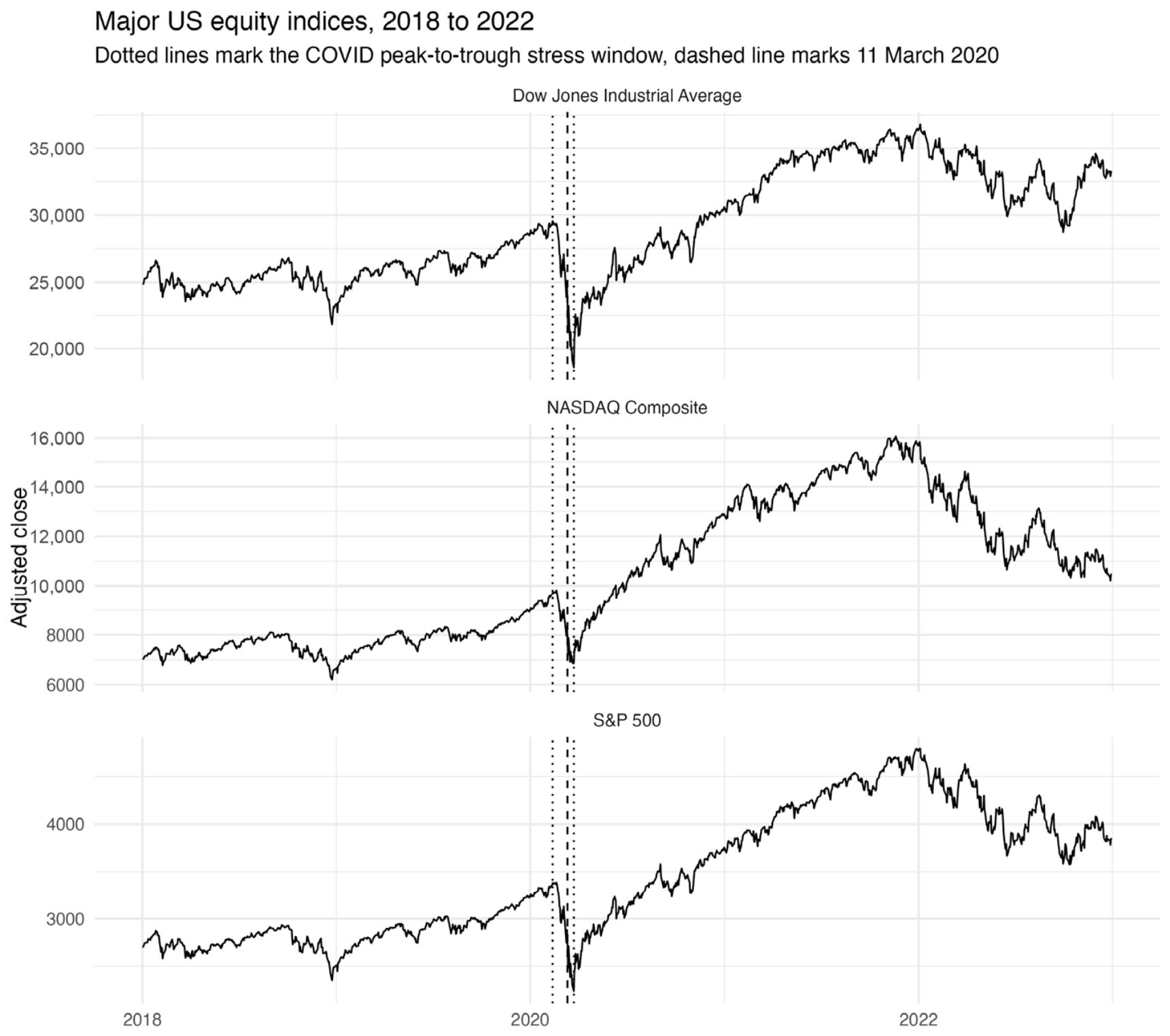
Figure 1 shows the adjusted price series for the Dow Jones Industrial Average, the S&P 500, and the NASDAQ Composite from January 2018 to December 2022. All three indices experienced a sharp decline between February and March 2020, followed by a recovery during the subsequent period.
Table 1 summarises the main conventional risk indicators. The Dow Jones Industrial Average reached a local peak of 29,551.42 on 12 February 2020 and a trough of 18,591.93 on 23 March 2020, corresponding to a peak-to-trough fall of 37.09%. The S&P 500 reached a local peak of 3386.15 on 19 February 2020 and a trough of 2237.40 on 23 March 2020, corresponding to a fall of 33.93%. The NASDAQ Composite reached a local peak of 9817.18 on 19 February 2020 and a trough of 6860.67 on 23 March 2020, corresponding to a fall of 30.12%. For the Dow Jones and the S&P 500, the COVID-19 peak-to-trough movement was also the maximum drawdown observed across the full 2018 to 2022 sample. For the NASDAQ Composite, the maximum drawdown over the full period was larger, at 36.40%, reflecting later market stress after the COVID-19 recovery.
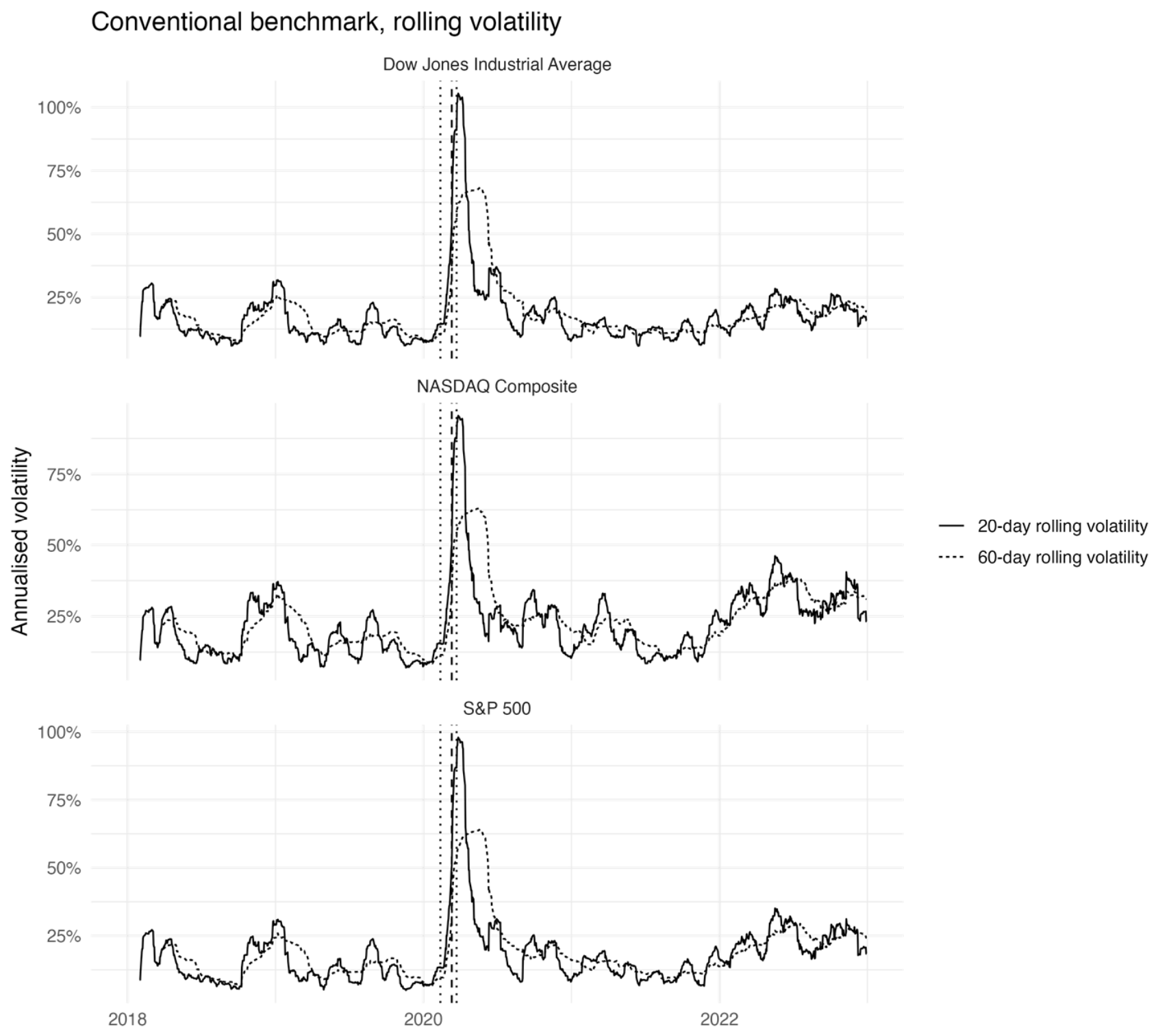
Figure 2 shows the corresponding rolling volatility measures. The COVID-19 stress period is visible as a sharp increase in annualised volatility across all three indices. The maximum 20-day annualised volatility during the COVID-19 window was 91.11% for the Dow Jones Industrial Average, 86.85% for the S&P 500, and 87.75% for the NASDAQ Composite. The corresponding maximum 60-day annualised volatility values were 55.16%, 52.40%, and 52.86%. These results confirm that the selected COVID-19 window captures a period of acute financial stress, and they provide a conventional benchmark against which the Laminarity results can be interpreted.
3.2. Price-Based Laminarity Generally Increases During the COVID-19 Stress Period
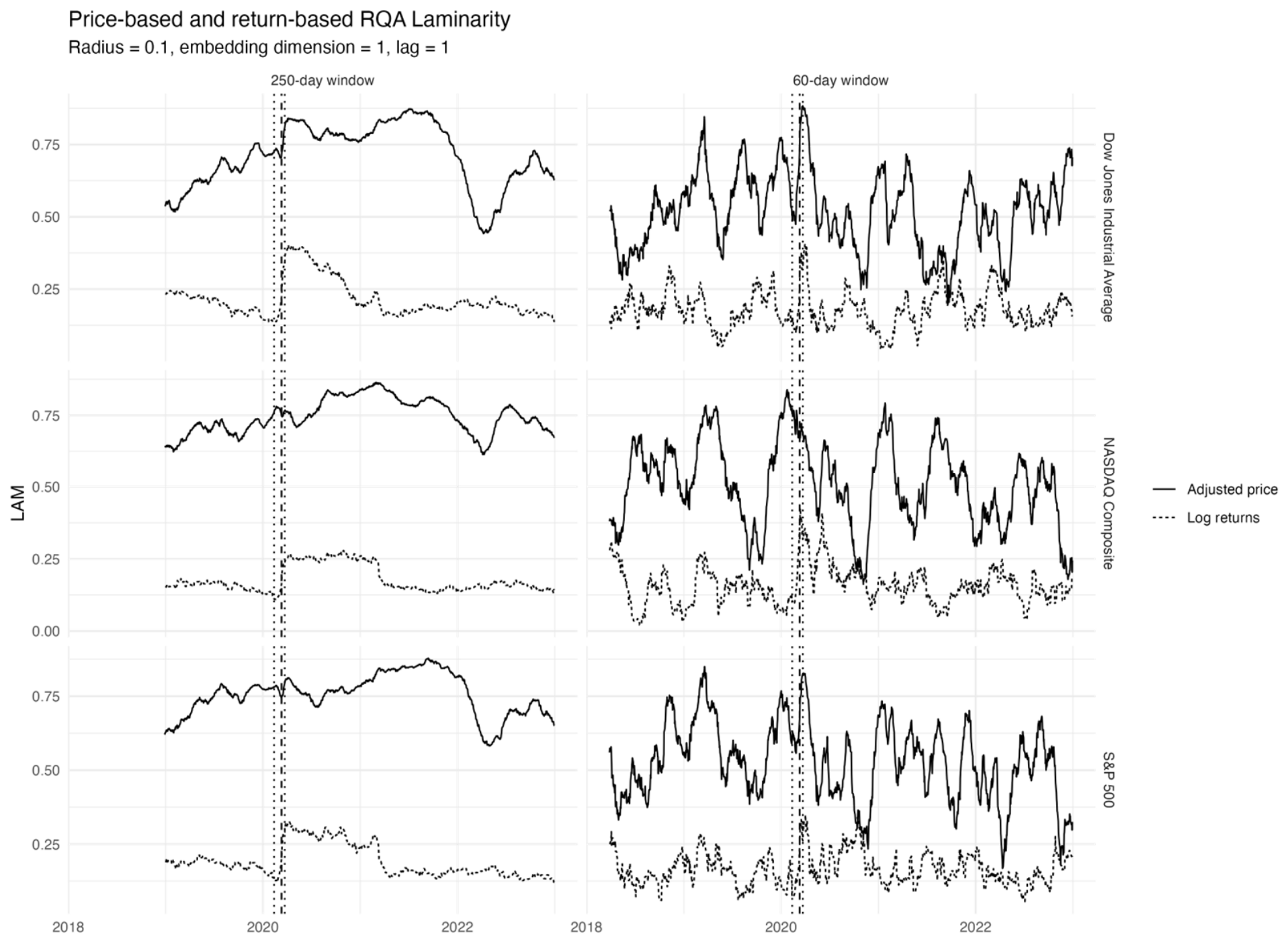
Figure 3 compares price-based and return-based Laminarity for the three indices. The price-based results do not support the simple hypothesis that Laminarity falls during the COVID-19 crisis. Instead, price-based Laminarity generally increases during the COVID-19 window, particularly for the NASDAQ Composite and for the longer rolling windows.
Table 2 reports the main Laminarity comparison using a recurrence threshold of 0.1. For the Dow Jones Industrial Average, price-based Laminarity increased from 0.5638 to 0.6093 in the 40-day window and from 0.6093 to 0.6466 in the 60-day window. These shorter-window increases were not statistically significant after Benjamini–Hochberg adjustment. However, the 120-day and 250-day windows showed larger and statistically significant increases, with mean Laminarity rising from 0.6290 to 0.7475 in the 120-day window and from 0.6465 to 0.7338 in the 250-day window.
For the NASDAQ Composite, price-based Laminarity increased in all reported windows and all differences were statistically significant after adjustment. The increase was particularly clear in the 60-day and 120-day windows, where mean Laminarity increased from 0.5458 to 0.7141 and from 0.5916 to 0.7959, respectively. For the S&P 500, the 40-day price-based result showed a very small decrease, from 0.5607 to 0.5562, but this difference was not statistically significant. The 60-day, 120-day, and 250-day windows all showed statistically significant increases.
These results show that price-based Laminarity does not behave as a simple crisis-loss indicator in this dataset. A cautious interpretation is that price-based RQA is capturing persistence in the price trajectory during the COVID-19 stress period. During the sell-off and subsequent recovery, prices moved through a rapid but coherent path rather than through an entirely unstructured sequence of states. Higher price-based Laminarity is therefore consistent with prices repeatedly occupying or moving through related regions of state space during the crisis trajectory.
From an economic perspective, this suggests that price-based Laminarity captures a dimension of market stress that is different from volatility alone. Volatility measures the intensity of fluctuations, while price-based Laminarity describes recurrence structure in the index trajectory. This interpretation explains why price-based Laminarity can rise even when conventional volatility also rises. It should, however, be understood as a recurrence-based trajectory interpretation, not as formal proof of a structural regime in an econometric sense.
3.3. Return-Based Laminarity Produces Mixed Evidence of Laminarity Loss
The return-based results are more mixed than the price-based results. This distinction is important because returns are the more common object of analysis in financial risk management, whereas price levels are closer to the earlier RQA crisis literature. Return-based Laminarity (
Table 3) is therefore more directly related to changes in the structure of daily market fluctuations.
For the Dow Jones Industrial Average, return-based Laminarity decreased in the 40-day window, from 0.1713 in the pre-crisis period to 0.1550 during COVID-19, a fall of 9.55%. This result was not statistically significant after adjustment. In the 60-day and 120-day windows, mean Laminarity increased, and the 120-day increase was statistically significant. In the 250-day window, the mean difference was small and not statistically significant, although the median Laminarity was lower during the COVID-19 period.
For the S&P 500, the 40-day return-based result provides the clearest evidence of Laminarity loss. Mean Laminarity fell from 0.1612 to 0.1179, a decrease of 26.83%, and this difference remained statistically significant after adjustment. The 250-day window also showed a small but statistically significant decrease, from 0.1825 to 0.1815, although the effect should be interpreted cautiously because the mean difference is very small and the window is long. In the 60-day and 120-day windows, mean return-based Laminarity increased, but the 120-day result did not remain significant after adjustment.
For the NASDAQ Composite, return-based Laminarity increased in the 40-day and 60-day windows, with both differences statistically significant after adjustment. The 250-day window showed a statistically significant decrease, from 0.1558 to 0.1521, although again the absolute difference was small. The 120-day result was not statistically significant.
Statistical significance should be interpreted alongside the size of the mean difference and the effect size. This is particularly important for long-window specifications. For example, the 250-day return-based decreases for the NASDAQ Composite and S&P 500 are statistically detectable, but the absolute mean differences are small. These results are therefore more useful as evidence of parameter sensitivity than as strong evidence of economically large Laminarity loss.
Overall, the return-based results provide only partial support for the Laminarity-loss hypothesis. Some specifications, particularly the S&P 500 with a 40-day window, show a clear reduction in Laminarity during the COVID-19 stress period. However, the direction of the effect is not consistent across indices or window lengths. This suggests that return-based Laminarity may capture aspects of crisis-related instability, but it should not be interpreted as a universal or parameter-independent crisis signal.
Economically, the mixed return-based results suggest that the recurrence structure of daily fluctuations is less uniform than the recurrence structure of price trajectories. Returns capture short-term changes in market value, so return-based Laminarity is more sensitive to abrupt day-to-day instability, reversals, and volatility clustering. The fact that some return-based specifications show Laminarity loss while others show increases indicates that crisis-period return dynamics may involve both disruption and short-term organisation, depending on index and window length.
3.4. Robustness Across Window Lengths and Recurrence Thresholds
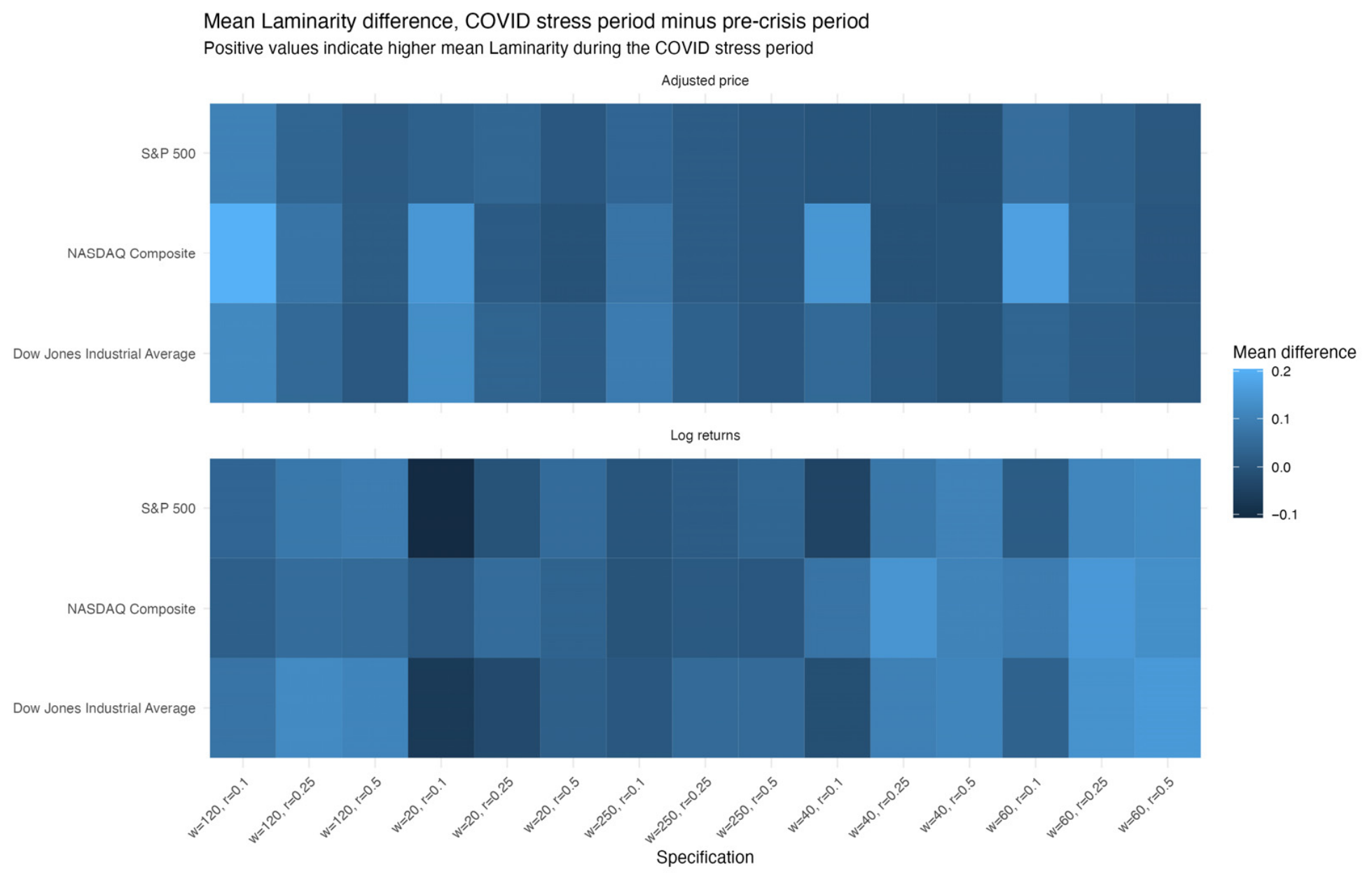
Figure 4 summarises the robustness analysis across alternative rolling-window lengths and recurrence thresholds. The results confirm that the interpretation of Laminarity depends on methodological choices. This is particularly important because Laminarity has sometimes been discussed as a potential crisis indicator, but the results from this study show that its behaviour is not independent of data transformation and parameter selection.
For adjusted prices, the robustness results are relatively consistent. Across most indices, windows, and thresholds, mean Laminarity during the COVID-19 period is higher than in the pre-crisis period. This pattern is strongest for the NASDAQ Composite and for the longer windows. It is weaker for the S&P 500 in the shorter 40-day window, where the difference is small and not statistically significant in the main threshold 0.1 specification.
For log returns, the robustness results are more varied. Some short-window specifications show lower COVID-period Laminarity, particularly for the S&P 500, while other specifications show higher Laminarity. Longer windows sometimes produce statistically significant differences, but these are less suitable for interpreting the immediate COVID-19 shock because they average over a much longer period. The 250-day window is useful for comparability with earlier work, but it should not be treated as the main crisis-detection window for a shock that developed over a few weeks.
These robustness results support two conclusions. First, Laminarity is sensitive to the transformation applied to the data. Price-based RQA and return-based RQA should therefore not be treated as interchangeable. Second, Laminarity is sensitive to rolling-window length and recurrence threshold, which means that it should be used cautiously as a crisis diagnostic and not as a mechanical early-warning rule.
A supplementary embedding-dimension robustness analysis was also conducted to assess whether the main price-versus-return interpretation depended on the baseline (E = 1), (tau = 1) specification. The analysis repeated the main comparison using (E = 1, 2, 3, 4, 5), with (tau = 1), recurrence threshold (r = 0.1), and rolling-window lengths of 40, 60, 120, and 250 trading days. The main price-based finding was robust across embedding dimensions: for adjusted prices, COVID-period Laminarity was higher than pre-crisis Laminarity for almost all index/window combinations at (E = 1), and for all tested index/window combinations at (E = 2, 3, 4, 5), as reported in
Supplementary Figure S3 and Supplementary Table S4. The return-based results remained more heterogeneous and generally weaker, with several higher-embedding specifications producing small or negligible mean differences. This supports the interpretation that the price-based Laminarity result is not simply an artefact of the baseline embedding specification, while also confirming that return-based Laminarity is more sensitive to modelling choices.
3.5. Contextual Comparison with Additional RQA Metrics
A supplementary contextual comparison with Recurrence Rate, Determinism, and Trapping Time was conducted to assess whether the Laminarity result was isolated to one RQA measure. Laminarity remains the principal measure of interest because of its link to vertical recurrence structures, but the additional metrics provide context for interpreting the broader recurrence-structure response.
For adjusted prices, all four RQA metrics are higher during the COVID-19 stress period for all three indices and all tested rolling-window lengths. Recurrence Rate, Determinism, Laminarity, and Trapping Time are each higher in all 12 index/window combinations. The mean COVID-minus-pre-crisis difference is positive for every adjusted price specification, with differences ranging from 0.0009 to 0.0428 for Recurrence Rate, from 0.0628 to 0.1995 for Determinism, from 0.0432 to 0.1998 for Laminarity, and from 0.2214 to 0.6279 for Trapping Time. This shows that the price-based Laminarity increase is not an isolated artefact of one metric, but part of a broader increase in recurrence density, directional regularity, and vertical persistence during the COVID-19 shock.
For log returns, the pattern is more heterogeneous. Recurrence Rate and Determinism are higher in all 12 index/window combinations, while Laminarity is higher in 9 out of 12 and Trapping Time in 10 out of 12. This supports the distinction between price-based and return-based RQA: price-based RQA captures persistence in the crisis trajectory, whereas return-based RQA is more sensitive to abrupt instability, reversals, and volatility clustering. Detailed results are reported in
Supplementary Table S5 and Supplementary Figure S4.
3.6. Summary of Empirical Findings
The empirical results can be summarised in five points. First, conventional indicators identify the COVID-19 stress period clearly through large drawdowns and sharp increases in rolling volatility across all three indices. Second, price-based Laminarity generally increases during the COVID-19 stress period, especially for the NASDAQ Composite and for medium-to-longer windows, and this pattern remains robust in the embedding-dimension analysis. Third, return-based Laminarity is more heterogeneous, with some specifications showing Laminarity loss and others showing increases. Fourth, the results are sensitive to transformation, rolling-window length, recurrence threshold, and embedding specification, indicating that Laminarity should be interpreted as a parameter-sensitive diagnostic rather than as a stand-alone crash-warning indicator. Fifth, the contextual RQA-metric comparison shows that the price-based Laminarity increase forms part of a broader recurrence-structure response, while the return-based results remain more mixed.
4. Discussion
This study tested whether Laminarity, derived from Recurrence Quantification Analysis, can provide a useful diagnostic of financial market stress during the COVID-19 shock. The results support a cautious but positive answer. Conventional risk indicators, including drawdown and rolling volatility, identify the COVID-19 shock clearly across the Dow Jones Industrial Average, the S&P 500, and the NASDAQ Composite. Laminarity does not replace these indicators and is not evaluated here as a predictive or classification tool. Its contribution is descriptive: it measures recurrence structure in the market trajectory or return process, which is not directly measured by drawdown or rolling volatility.
The central empirical result is that price-based Laminarity responds consistently to the COVID-19 stress period. Across the tested indices and specifications, price-based Laminarity generally increases during the crisis window, and the supplementary embedding-dimension robustness analysis shows that this finding is not simply an artefact of the baseline (E = 1), (tau = 1) specification. This result is consistent with the interpretation that equity prices moved through a more persistent crisis trajectory, but it should not be read as formal econometric proof of a structural regime. In other words, the COVID-19 sell-off was not recurrence-free or dynamically featureless under the tested RQA specifications. It produced a pattern of recurrent trajectory behaviour that price-based Laminarity was able to capture.
This result refines the initial Laminarity-loss hypothesis. Earlier work by
Piskun and Piskun (
2011), building on
Strozzi et al. (
2007), suggests that Laminarity can reveal and monitor instability in financial crises, and that the inverse of Laminarity may be related to market volatility. A simple interpretation of this idea might lead one to expect Laminarity to fall during stress. The results from this study show that this is too narrow. Price-based Laminarity does not behave as a direct inverse of volatility. Instead, it appears to capture the persistence of the crisis path itself. During the COVID-19 sell-off, prices moved through a sharp and coherent downward trajectory, followed by a structured recovery. Higher price-based Laminarity is consistent with this kind of constrained movement through a stressed market regime.
This is a constructive result for the use of RQA in financial risk analysis. It suggests that Laminarity can identify a dimension of crisis behaviour that is not fully described by drawdown or rolling volatility. Drawdown measures the scale of losses, and volatility measures the intensity of fluctuations, but Laminarity describes the recurrence structure of the trajectory through which the market evolves. A rise in price-based Laminarity during COVID-19 therefore indicates that the market became more organised around a crisis regime, rather than simply more volatile or more random. This strengthens the case for treating RQA as a complementary diagnostic method for market-regime analysis.
Return-based Laminarity gives a more differentiated picture. This is not a weakness of the method, but an important interpretive finding. Returns describe daily changes in market value rather than the level of the index itself, and they are therefore closer to conventional financial-risk analysis. The return-based results show some cases of Laminarity loss, especially in shorter-window specifications, but they are not uniform across indices or windows. This suggests that recurrence in price levels and recurrence in daily fluctuations capture different aspects of crisis dynamics. Price-based RQA appears to detect persistence within the crisis trajectory, while return-based RQA is more sensitive to disruption or reorganisation in daily market fluctuations.
The distinction between price-based and return-based RQA is one of the main contributions of the paper. Earlier RQA crisis studies often worked with price or quote series, while financial-risk analysis usually focuses on returns. This study shows that these choices are not interchangeable. Applying RQA to prices and applying RQA to returns can lead to different but complementary insights. This means that Laminarity should not be interpreted independently of the financial representation used. Instead, its interpretation should be tied explicitly to whether the analysis is asking about persistence in price trajectories or recurrence in return fluctuations.
The results also refine the earlier RQA crisis literature.
Strozzi et al. (
2007) established recurrence-based approaches as useful tools for analysing nonlinear and non-stationary financial time series, while
Piskun and Piskun (
2011) showed that Laminarity can reveal features of historical crashes and crises. This study confirms that Laminarity is relevant to crisis analysis, but it clarifies the form of that relevance. Laminarity should not be reduced to a single mechanical warning rule. It is better understood as a nonlinear diagnostic of market-regime structure, capable of revealing whether a crisis is associated with persistence, disruption, or reorganisation in the recurrence properties of the series.
The analysis also highlights the importance of rolling-window length. Short and medium windows, such as 40 or 60 trading days, are more responsive to abrupt shocks and are therefore well suited to the COVID-19 sell-off. Longer windows, such as 120 or 250 trading days, are useful for slower regime context and for comparison with earlier studies, particularly because
Piskun and Piskun (
2011) used a 250-point window. However, long windows necessarily smooth short shocks, because the crisis observations are initially combined with many pre-crisis observations. The results therefore support a multi-window approach, where short windows are used to track rapid changes and longer windows are used to provide slower, literature-aligned context.
From a risk-management perspective, the main implication is that Laminarity should be treated as a descriptive complement to standard indicators rather than as evidence of improved crisis prediction. Drawdown and rolling volatility remain clearer and more direct measures of market stress because they quantify cumulative loss and fluctuation intensity. Laminarity contributes a different diagnostic view by describing vertical recurrence structure. Its potential operational value lies in separating three aspects of market stress: the magnitude of loss, measured by drawdown; the intensity of fluctuations, measured by volatility; and the persistence or trapping of the market trajectory, measured by vertical recurrence structure.
This distinction also defines the practical scope of the method. This study does not test whether Laminarity improves crisis/non-crisis classification, predictive accuracy, or incremental explanatory power in a formal risk model. Instead, it shows that Laminarity can help characterise the market transition once stress is present, especially when interpreted alongside drawdown, rolling volatility, and related RQA metrics. In operational monitoring, Laminarity could therefore be used as an additional diagnostic layer, not as a stand-alone alarm. A dashboard-style application could compare loss magnitude, volatility intensity, and recurrence structure, allowing analysts to distinguish between a volatile but weakly structured episode and a more persistent crisis trajectory. This operational interpretation remains a hypothesis for future validation rather than a claim established by this analysis.
The findings also suggest a careful way to communicate nonlinear methods in financial research. It would be inappropriate to claim that Laminarity could have predicted the COVID-19 crash in a deterministic sense, particularly because the trigger was an external public-health shock. The stronger and more defensible claim is that Laminarity helps characterise the market transition once stress emerges. It captures aspects of the crisis trajectory that are not reducible to drawdown or volatility, and it can therefore support monitoring and interpretation when used alongside conventional risk indicators.
Several limitations should be emphasised. First, RQA measures are sensitive to methodological choices, including rolling-window length, recurrence threshold, embedding dimension, delay, distance norm, and minimum vertical-line length. The supplementary embedding-dimension analysis strengthens the price-based result, but it does not remove the broader need for parameter sensitivity testing. The contextual comparison with Recurrence Rate, Determinism, and Trapping Time also strengthens the interpretation of the COVID-19 price-based result, but it does not replace the need for future comparison with alternative nonlinear diagnostics and formal risk models. Second, price-based RQA must be interpreted cautiously because equity index levels are non-stationary and trending. In this study, price-based Laminarity is interpreted as a trajectory-level diagnostic, not as a stationary model of return risk. Third, the main rolling-window design uses overlapping windows. This supports time-local monitoring of a rapid shock, but it introduces dependence between adjacent Laminarity estimates. The Wilcoxon tests and adjusted p-values are therefore exploratory and supportive rather than definitive independent-sample hypothesis tests. Fourth, the analysis is limited to three major United States equity indices and to one major crisis episode. These indices are economically important, but they do not represent global financial markets as a whole, and the COVID-19 shock may differ from slower endogenous crises such as credit bubbles, banking crises, or currency crises. Future work should extend the approach to additional asset classes, global markets, and multiple crisis types, and should test block-bootstrap methods, permutation procedures for dependent time series, formal regime-switching models, and crisis-classification designs.
Overall, the results support a positive but bounded interpretation of Laminarity as a nonlinear crisis diagnostic. The strongest finding is not that Laminarity mechanically falls during crises, but that it responds meaningfully to crisis-period recurrence structure. In the price-based analysis, Laminarity generally increases during the COVID-19 stress period, consistent with equity prices entering a more persistent and constrained trajectory. The contextual comparison with Recurrence Rate, Determinism, and Trapping Time shows that this price-based Laminarity increase is part of a broader recurrence-structure response, rather than an isolated behaviour of one metric. In the return-based analysis, Laminarity provides a more mixed but still informative picture of changes in daily fluctuations. Taken together, these findings show that RQA can enrich financial crisis analysis when it is used transparently, interpreted in relation to the data transformation, and combined with conventional benchmarks.
5. Conclusions
This paper tested whether Laminarity, derived from Recurrence Quantification Analysis, can serve as a diagnostic of financial market stress during the COVID-19 shock. Using the Dow Jones Industrial Average, the S&P 500, and the NASDAQ Composite from 2018 to 2022, the study compared conventional risk indicators with price-based and return-based Laminarity across multiple rolling-window lengths and recurrence thresholds. To address the focus on a single RQA measure, the revised analysis also included a contextual comparison with Recurrence Rate, Determinism, and Trapping Time.
The results show that the COVID-19 shock is clearly identified by conventional measures, especially drawdown and rolling volatility. Laminarity does not replace these indicators, nor is it validated here as a stand-alone crash detector or predictive warning signal. Its value lies in describing recurrence structure, a dimension of market behaviour that conventional measures are not designed to capture directly.
The strongest finding is the consistent increase in price-based Laminarity during the COVID-19 stress period. This result, strengthened by the embedding-dimension robustness analysis and contextualised by the additional RQA-metric comparison, is consistent with the interpretation that equity indices moved through a more persistent crisis trajectory rather than simply losing recurrence structure. The contextual comparison shows that, for adjusted prices, all four RQA metrics increase across all indices and rolling-window lengths, indicating that the price-based Laminarity result is part of a broader recurrence-structure response. Return-based Laminarity gives a more mixed signal, confirming that price-based and return-based RQA should not be treated as interchangeable.
The main conclusion is therefore that Laminarity should be used as a complementary, parameter-sensitive diagnostic of market-regime structure. It can enrich crisis analysis when interpreted alongside drawdown, rolling volatility, and related RQA metrics, but its interpretation depends on the data transformation, rolling-window length, recurrence threshold, and embedding specification. Future work should extend the analysis to additional asset classes, global markets, and different crisis types, and should test formal regime-switching, classification, and dependent-time-series validation methods.