1. Introduction
Environmental, Social, and Governance (ESG) considerations have moved from niche concerns to a significant contemporary issue in business and finance, redirecting how individuals evaluate investment opportunities and business decisions. The growing challenges posed by climate-related risks, social inequality, and governance failures have highlighted the limitations of traditional financial evaluation frameworks and underscored the importance of sustainable and responsible investment practices (
Della Amarta & Hendrawaty, 2025). Recently, individual investors have identified ESG not only as an ethical consideration but also as a key indicator of long-term risk, resilience, and value creation (
Kaakandikar et al., 2025). Empirical evidence indicates that ESG considerations play a significant role in investment decision-making, underscoring the importance of incorporating sustainability criteria into investment strategies (
Iazzolino et al., 2023).
The relative importance of the three ESG pillars is context-dependent. Some markets place emphasis on governance and social factors, while others prioritize environmental issues or social concerns shaped by local political and cultural conditions. Hence, it is important to assess each pillar individually to determine its specific significance (
Dung et al., 2024).
Environmental factors are identified by how companies address climate challenges, mitigate their environmental footprint, and reduce carbon emissions (
Weinhofer & Hoffmann, 2010). Environmental considerations and the importance of environmental issues have become global concerns, prompting regulators to impose fines and pursue legal action against companies with poor environmental practices. Recently, investors have become increasingly attracted to sustainable products and environmentally friendly practices that improve energy efficiency and reduce carbon emissions. These initiatives not only reduce environmental risk but also lower operational costs and enhance long-term business profitability (
Nurhayati et al., 2025).
Social factors, on the other hand, reflect a company’s relationships with its internal and external stakeholders, including employees, suppliers, and customers. Consequently, companies need to address issues such as labor and human rights, community engagement, and diversity, as these contribute to a stronger reputation and long-term business sustainability. Therefore, firms should place greater emphasis on managing their social impact and adhering to high ethical standards to build trust with customers and maintain a loyal customer base, which is essential for sustainable growth (
Eccles & Klimenko, 2019).
Governance factors alternatively focus on the management of companies and on how companies ensure accountability, transparency, and ethical conduct. Good corporate governance is essential to maintaining investor confidence and trust, and it is supported by executive compensation, board diversity, and shareholders’ rights. However, on the other hand, poor corporate governance leads to unethical practices such as manipulation, fraud, and financial misconduct, which result in significant financial and reputational damage. As a result, investors are placing greater emphasis on firms with strong governance frameworks, as these improve risk management and support decision-making that serves the interests of all stakeholders, including shareholders (
Ho, 2010).
Individuals are realizing the long-term importance of the ESG factors in their investment decisions, in both the environmental and the financial sustainability factors (
Tarmuji et al., 2016).
Ellili (
2022) highlighted the importance of ESG factors for a company’s long-term reputation, financial performance, and stakeholder relationships. Accordingly, the objective of this study is to explore the influence of the ESG factors on individuals’ investment decisions, considering personality traits, financial literacy, and risk tolerance as control variables. Behavioral and psychological factors—including moral awareness, empathy, and cognitive biases—also condition how ESG information is perceived and acted upon, sometimes reinforcing and sometimes dampening ESG-oriented choices (
Bihari et al., 2025).
Despite this growing momentum, important conflicts remain. Studies highlight information asymmetry, inconsistent or limited ESG disclosure, and varying levels of financial literacy and ESG knowledge as barriers that weaken the translation of ESG awareness into concrete investment behavior (
Husnah et al., 2023). Against this backdrop, this study explores how different levels and types of ESG awareness influence individual portfolio choices. Focusing on its sources, depth, and variation. It aims to identify when ESG factors shape investment decisions and provide insights for promoting more sustainable and informed investing. This contribution is particularly important given the significant gap between current and required global investments to achieve sustainability goals. Statistics show that current annual investments in key sectors are estimated at around
$4.5 trillion, compared to required levels of
$7.5–
$8 trillion annually from 2021 to 2030 (
IMF, 2025). Moreover, developing countries require an additional
$0.1–
$0.3 trillion annually to support climate adaptation and resilience. This need is further reinforced by the rising exposure to climate-related risks as the number of reported natural disasters increased dramatically from around 70 events in 1970 to around 405 in 2024 (
IMF, 2025). This requires an urgent action towards sustainable investments and highlighting the importance of understanding the factors influencing investors’ decisions, particularly financial literacy and ESG awareness.
To further examine these issues, the rest of this study is structured into four sections following the introduction.
Section 2 reviews the relevant literature and hypotheses development.
Section 3 explains the methodology and model specifications.
Section 4 presents the empirical results and discusses the main findings. Finally,
Section 5 concludes the study and offers policy implications.
2. Literature Review and Hypotheses Development
The present study integrates the stakeholder theory and the theory of planned behavior (TPB) to explain sustainable investment decision-making. Stakeholder theory explains that firms should consider the interests of multiple stakeholders, including environmental and social groups, thereby providing a foundation for ESG investing (
Freeman, 1984;
Freeman & McVea, 2001). In the meantime, TPB (
Ajzen, 1991) explains how individual behavior is driven by attitudes, subjective norms, and perceived behavioral control. Accordingly, stakeholder theory provides the normative foundation that shapes investors’ perceptions of the importance of environmental, social, and governance (ESG) considerations. These stakeholder-oriented beliefs function as key behavioral drivers within the TPB by influencing investors’ attitudes toward ESG investments, thereby increasing the likelihood of sustainable investment behavior. Within this framework, ESG awareness can be viewed as a key mechanism linking stakeholder-oriented beliefs to investment behavior. Hence, greater awareness of ESG issues enables investors to better understand the long-term risks and opportunities associated with corporate sustainability performance. As a result, ESG awareness reinforces positive evaluations of sustainable investments. Consequently, the more the investors are aware of ESG, the more likely they will allocate capital toward sustainable investments, which translates the stakeholder-oriented values into observable investment behavior. This theoretical linkage provides the foundation for the present study, which investigates how ESG literacy enhances investors’ awareness of stakeholder-related issues, thereby shaping their attitudes toward sustainable investment decisions.
The growing global emphasis on sustainable development in recent years, particularly following the United Nations Sustainable Development Goals (SDGs) in 2015, has contributed to increasing attention to ESG investment in the literature, especially in relation to financial literacy and investor behavior. It has been found that individuals with higher levels of sustainability-related financial literacy, higher income levels, and higher levels of awareness of the positive effects of sustainable finance on the environment tend to invest more in sustainable finance instruments (
Yucel et al., 2023).
Financial literacy has an important role in helping investors to make efficient investment decisions in the presence of the microstructure dynamics that shape investment decisions, in addition to the technological innovations and algorithmic trading that add to the complexities of the market microstructure. Despite the fact that these factors contribute to enhancing the market’s efficiency, they can also cause higher market noise and volatility. Thus, there is a crucial need to enhance financial literacy skills to enable investors to make use of the available opportunities, including sustainability-related investment decisions, and recognize the potential threats to mitigate the risks involved (
Sharma et al., 2025). In the meantime, there is an increasing shift towards long-term, sustainability-oriented decision-making that emphasizes the importance of moving beyond short-term investment perspectives and aligning sustainability awareness with actual financial behavior, which is relevant to investment decisions (
Tettamanzi et al., 2022). For business owners, higher financial literacy and awareness of sustainable financial products tend to increase their potential to invest in more sustainable financial products with higher environmental and social considerations and ESG funds (
Aristei et al., 2024). Some studies have also found that programs enhancing sustainable finance literacy increase the funds allocated to green investments and reduce those allocated to brown (i.e., environmentally unfriendly) investments (
Filippini et al., 2026).
In line with this evidence, the literature emphasizes that access to information and perceived financial knowledge significantly shape investors’ information behavior, which in turn influences their risk-taking tendencies (
Shanmugam et al., 2022). In this process, risk propensity and cognitive biases play a key role in determining the likelihood of engaging in sustainable investment decisions, with risk propensity also mediating the relationship between information, behavior, and sustainable investment decisions. These insights underscore the role of both knowledge and psychological factors in promoting responsible investment choices. Similarly,
Anderson and Robinson (
2022) have emphasized that environmentally friendly attitudes and values do not always lead to sustainable investment choices; on the contrary, green financial investments are more associated with a higher level of financial literacy and a lower level of information barriers that prevent prices and returns of financial instruments from fully reflecting the environmental preferences of individuals. In order to examine how ESG awareness influences individuals’ investment behavior toward sustainable investment decisions, the first hypothesis is developed as follows:
H1. ESG awareness has a significant and positive impact on an individual’s sustainable investment decisions.
However, the effectiveness of financial literacy is not always straightforward. Improvements in financial knowledge do not necessarily translate into better financial decisions, because current financial literacy programs lack the required degree of awareness about green finance. As a result, significant literacy gaps and a lack of information among investors about the importance of sustainable investment need to be addressed to affect sustainable investment decisions in a positive way (
Gutsche et al., 2021;
Mittal & Sharma, 2023). This gap can be mitigated by incorporating ESG-focused financial literacy into university curricula, allowing students to have a better understanding of the importance of green finance, which helps them to make better investment decisions (
Kumar & Srinivasa, 2025). At the same time, the literature suggests that financial literacy may not be the most dominant determinant of sustainable investment behavior. Instead, factors such as news, greenwashing, and the degree of trust in the industry affect sustainable investment decisions, and they are considered to have more effect on sustainable finance than financial literacy. The results of these studies reveal that news about sustainable finance and trust in sustainable industries positively affect investors’ potential to invest in sustainable finance instruments, whereas concerns about greenwashing are negatively related to sustainable finance potential (
Strauß et al., 2023). In addition, personal green attitudes also influence sustainable investment behavior, in which consumers who support sustainability in their daily transactions tend to have more potential towards green investments. However, this effect is strengthened when supported by subsidy policies and the promotion of financial and economic literacy as well, which enable attitudes to be more effective in stimulating sustainable finance decisions (
Bethlendi et al., 2022). Despite the importance of education in enhancing financial literacy, previous studies have found that financial literacy enhancements do not always result in improved financial behavior due to cognitive biases such as overconfidence and miscalibration. For instance, individuals who overestimate their financial knowledge tend to make poorer investment and savings decisions and perform weak risk assessment despite higher subjective financial confidence, highlighting the presence of a metacognitive gap that limits learning and behavioral corrections. This justifies why educational programs are sometimes ineffective in improving financial literacy outcomes (
Merter & Balcıoğlu, 2025). To investigate whether different dimensions of financial literacy exert a distinct influence on sustainable behavior, the second hypothesis is formulated as follows:
H2. Subjective financial literacy and objective financial literacy have different effects on an individual’s sustainable investment decisions.
While financial literacy equips investors with the knowledge necessary to assess sustainable investment opportunities, the information they receive regarding firms’ sustainability performance also plays a crucial role in shaping investment decisions. In particular, ESG disclosures provide investors with signals regarding firms’ ESG performance, thereby influencing perceptions of both sustainability and financial risk. The ESG factors disclosed in the sustainability reports published by many corporations play an important role in sustainable investment decisions. However, the effectiveness of ESG information depends on its quality and investors’ ability to interpret it. Variations in the quality of information often make it difficult for investors to distinguish between sustainability initiatives that create value and greenwashing. Much information does not show long-term financial returns that exceed the risk factors, which results in ESG being perceived as risky with no obvious opportunities. In the meantime, the growing availability of ESG information has facilitated the integration of sustainability considerations into investment decisions. Nevertheless, the empirical evidence regarding the financial performance of ESG investments remains mixed. While ESG ratings provide investors with additional information about firms’ sustainability performance, they do not consistently yield superior or inferior financial returns, as such information is already reflected in the stock prices. This suggests that investors may be able to achieve financial and sustainable goals simultaneously. However, periods of underperformance for high ESG portfolios compared to the low ESG ones reflect the weak relationship between the ESG scores and stock returns that may create a potential trade-off between profitability and sustainability considerations (
Vu et al., 2025). In contrast, when there is more attention to global sustainability, such as the sudden increase in attention to climate change, the prices of green stocks increase, which is also associated with a lower discount rate, while the prices of brown stocks decrease and their discount rate increases as individuals at this time perceive them as riskier than the green stocks. In this case, high ESG portfolios may outperform their counterparts (
Ardia et al., 2023).
The mixed evidence regarding the risk–return profile of ESG investments highlights the importance of investors’ risk attitudes in shaping sustainable investment decisions. Although investors may express favorable attitudes toward sustainability, their actual investment choices are often influenced by their risk preferences and return expectations. Existing studies suggest that many investors continue to prioritize financial performance and portfolio stability, leading to a gap between sustainability preferences and actual investment behavior (
Gómez Sánchez & Tobon, 2025). As a result, investors with stronger sustainability preferences do not necessarily allocate a larger share of their portfolios to sustainable assets when concerns about risk, potential losses, or return uncertainty are present (
Brooks & Williams, 2025). Therefore, risk attitudes play a crucial role in determining the extent to which sustainability preferences are translated into actual investment decisions. To analyze the extent to which Individual differences in risk shape sustainable investment preferences; the third hypothesis is proposed as follows:
H3. Individual Risk Attitude has a significant impact on an individual’s sustainable investment decisions.
There is a debate regarding the sustainability and returns tradeoff. Some studies have found that sustainable investment decisions are driven not only by financial considerations but also by non-pecuniary motives such as social preferences, environmental values, and emotional rewards. These findings highlight that investors often face trade-offs between financial returns and sustainability objectives in which their sustainability preferences play an important role in promoting sustainable development (
Gutsche et al., 2023). In addition, it is found that socially responsible investment is more motivated by social preferences and social signaling than financial returns, in which investors are willing to earn lower returns and incur higher management fees than those associated with conventional investments to support their social objectives (
Riedl & Smeets, 2017). Similarly, empirical evidence suggests that investors prioritize sustainability over financial returns. Thus, they are willing to accept lower returns in exchange for investments aligned with SDGs or provided by sustainable banks, indicating that higher-return alternatives are not always the dominant factor in investment decisions (
Harasheh et al., 2024). Furthermore, it is emphasized that investors prefer ESG investments that can generate a positive social impact through their investment choices. This shift also incentivizes firms to adopt more sustainable practices due to improved market valuation and lower cost of capital (
Kräussl et al., 2024). On the contrary, other studies find that the higher the financial returns, the lower the intention of investors to support green investments and sustainability (
Hinrichs & Sobol, 2024). To assess whether investors trade off higher financial returns for sustainable investments, the fourth hypothesis is proposed as follows:
H4. Expected investment returns positively influence sustainable investment decisions.
Beyond financial literacy, risk attitudes, and the return–sustainability trade-off, personality traits represent another factor influencing investment decisions. With reference to the Big Five personality traits (openness, conscientiousness, extraversion, agreeableness, and neuroticism), previous studies show that these personality characteristics influence risk preferences and financial decision-making. Empirical evidence suggests that openness and agreeableness shape social influence on investment behavior, while neuroticism is associated with more negative investment attitudes (
Lai, 2019). Moreover, personality traits significantly shape investors’ willingness to allocate funds to environmentally and socially responsible investments. It was found that investors’ personality traits affect the degree of their willingness to sacrifice financial returns to support SDGs, in which agreeableness was found to be a strong driver of pro-sustainability behavior. (
Muñoz-Muñoz et al., 2025). To explore the influence of personality characteristics on individuals’ sustainable financial decisions, the fifth hypothesis is set as follows:
H5. Personality traits have a significant impact on an individual’s sustainable investment decisions.
The present study aims to contribute to the growing literature about ESG literacy and sustainable investment decisions by adopting an experimental approach to examine the impact of ESG awareness on sustainable investment decisions. This contributes to the literature in different ways. First, while many experimental studies on sustainable finance are conducted in developed countries, few studies are conducted in developing countries. Second, the study captures a set of determinants by examining the impact of ESG awareness alongside key behavioral and psychological factors, including subjective and objective financial literacy, risk attitudes, and personality traits, on sustainable investment decisions. Third, the study contributes by examining whether investment decisions are driven by financial return considerations or whether individuals instead prioritize sustainability investment alternatives.
3. Materials and Methods
3.1. Experimental Setup
The experiment was conducted at the Egypt–Japan University of Science and Technology experimental laboratory. The experiment was conducted in 12 sessions; each session included around 25~30 subjects, with a total of 333 subjects. The subject pool of this study was first-year business students and engineering students; the study intuitively involved these subjects because they had not been exposed to any financial or ESG subjects before the experiment. We used Qualtrics software to randomly assign subjects to control and treatment groups. The average age of the subjects was 19 years old, and the percentage of females was 37% of the subjects. A choice experiment and survey were administered to study the effect of information on investment decisions. Although a formal manipulation check was not conducted, the experimental design relied on randomized assignment and differential information exposure between treatment and control groups, which supports the internal validity of the estimated treatment effects.
3.2. Experimental Procedures
Students were selected randomly to participate in the experiment through a lottery. The subjects read the consent form and were assigned to control and treatment groups through Qualtrics. Qualtrics has a feature that can automatically randomize subjects to control and treatment groups. The subjects were assigned to one of four conditions: (i) control with no return difference, (ii) treatment with no return difference, (iii) control with return difference, and (iv) treatment with return difference. In the control no-return-difference group, subjects were asked to watch a video around 3 min long; the video provides basic investment information (e.g., risk and return, time horizon, and diversification). In the treatment no-return-difference group, the subjects watched a longer video (i.e., 5 min) that included additional information about the meaning of ESG investment. The treatment video was longer than the control video because it incorporated the same investment concepts presented in the control condition, together with the additional ESG-related information necessary to introduce sustainable investing concepts. Accordingly, the difference in duration reflects the inclusion of ESG content required for the awareness intervention.
After the videos, subjects were asked to choose between two options three times. One option represented a company that does not comply with ESG rules, which was company (B) in all the questions, with a return of 5%. The other option represents a company that complies with environmental, social, and governance rules (i.e., E, S, and G companies) with a return of 5%. Each of the ESG-compliant companies was the second option in all the questions asked of the subjects.
The difference between the first and the last two groups was that there was a difference in return between the options the subjects chose from. In the control and treatment with return difference groups, subjects were asked to choose between company B, which usually gives a higher return (i.e., 10%), and companies E, S, and G (with a 5% return). After the experiment, subjects were asked to answer several survey questions. The survey includes a 10-item Big Five personality trait questionnaire, subjective and objective financial knowledge, risk-taking attitudes, and other demographic characteristics.
Each subject spent 30~45 min in the experiment room to finish the experiment, and the subjects were incentivized with money. Each subject knew that there was a probability of winning 200 LE (4 USD), based on their choices. If they chose company (B) with a 5% return, then their probability of winning the 200 LE was 5%. After the experiment, a lottery was conducted in front of the subjects. Each subject was asked to draw a number from 1 to 20, where the number 20 was the winning number for the probability of 5%, and numbers 10 and 20 were the winning numbers for the probability of 10%. A total of 21 subjects won the lottery with a total payout of around 84 USD.
3.3. Model Specifications
Since the dependent variable is binary, taking a value of one when a participant chooses the sustainable investment option and zero otherwise, this study employs logistic regression analysis.
The probability that participant
i chooses the sustainable investment option for ESG dimension
j is estimated as follows:
where
SIDij denotes the sustainable investment decision of participant i for ESG dimension j, where j represents Environmental, Social, and Governance investment decisions. The dependent variable takes a value of one if the participant selects the sustainable investment alternative and zero otherwise.
ESGAWARE is a dummy variable equal to one for participants assigned to the ESG awareness treatment group and zero otherwise. RET is a dummy variable equal to one when the sustainable and conventional investment options offer different returns and zero when returns are equal. SFK and OFK represent subjective and objective financial knowledge, respectively. RT denotes risk attitude. PT represents a vector of personality traits, including Extraversion, Agreeableness, Conscientiousness, Neuroticism, and Openness to Experience. DEMO represents a vector of demographic characteristics, including gender and income. Finally, εi denotes the error term.
Because the dependent variable is dichotomous, logistic regression is employed. For ease of interpretation, the study reports average marginal effects rather than raw logit coefficients. Separate models are estimated for Environmental, Social, and Governance investment decisions. For ease of interpretation, the study reports average marginal effects obtained from the logistic regression models. Therefore, the reported coefficients represent changes in the probability of selecting the sustainable investment option associated with a one-unit change in the explanatory variable.
Table 1 presents the definition of study variables.
4. Results
Table 2 presents summary statistics for the main variables collated by the researchers for participants across the control group (No ESG awareness) and the ESG awareness treatment group, as well as for the full sample. The summary indicates that the characteristics of the control and treatment are comparable. The percentage of female subjects is consistent across control and treatment groups (i.e., 38 and 36 percent, respectively). Likewise, income levels are identical across groups, with an average value of 1.38 on the four-category income scale. The share of participants assigned to the return-difference treatment is also balanced across groups (0.49 in the control group and 0.51 in the treatment group), consistent with the random assignment implemented in the experimental design.
Participants in the sample exhibit moderate levels of the Big Five personality traits, with means ranging from approximately 2.6 to 3.7 on a five-point scale. Conscientiousness has the highest average value in both groups (3.69 in the control group and 3.76 in the treatment group), while neuroticism has the lowest average levels (2.70 and 2.60, respectively). Importantly, the means of these personality traits are very similar across treatment conditions, suggesting that personality differences are unlikely to drive systematic differences in investment behavior between the groups.
Financial literacy measures also appear relatively balanced. Subjective financial knowledge averages 3.28 in the control group and 3.37 in the treatment group, while objective financial knowledge is 2.62 and 2.70, respectively. Similarly, risk attitudes are nearly identical across groups (2.64 vs. 2.68). These similarities further support the internal validity of the experimental design.
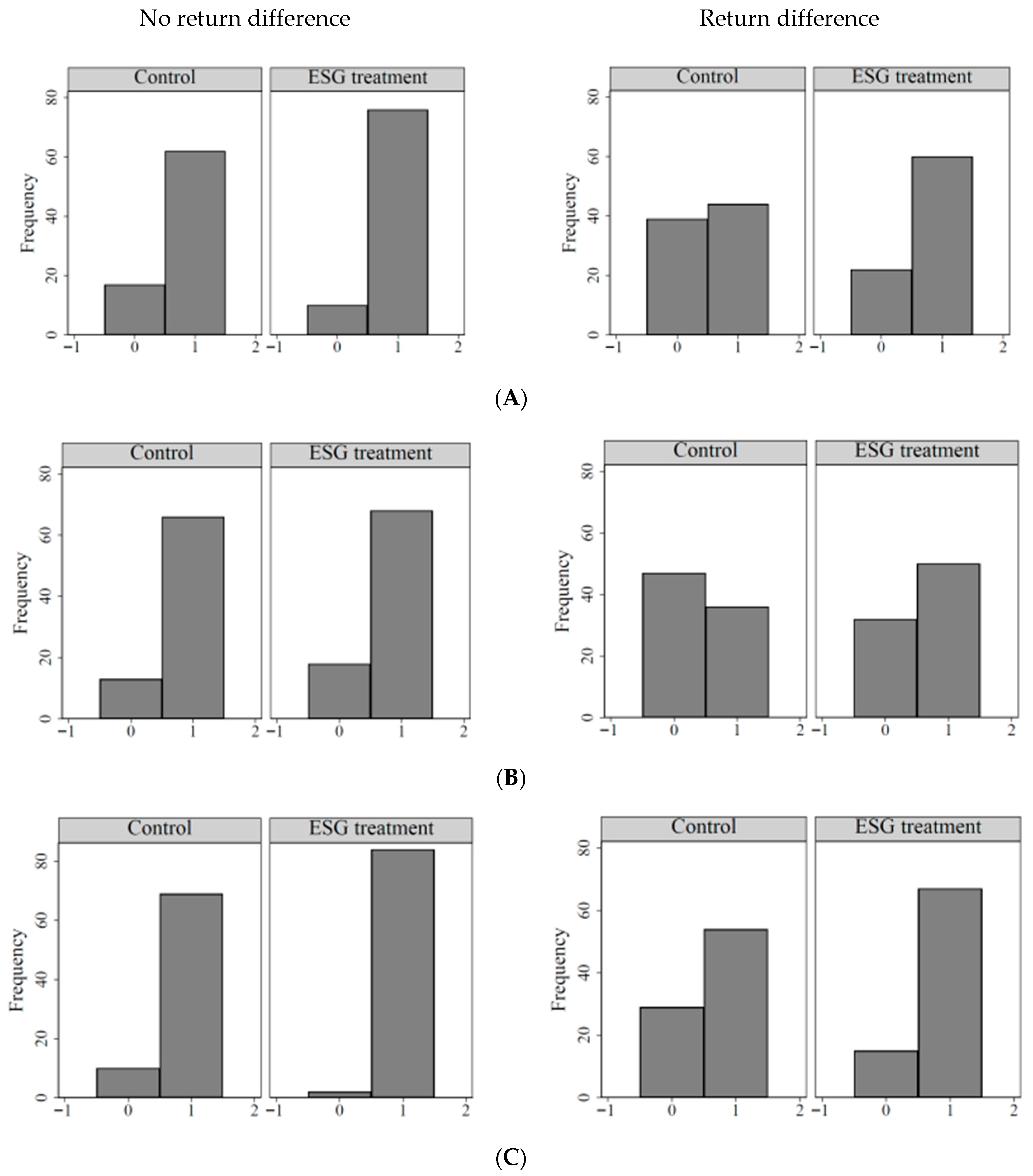
Turning to the ESG investment decisions, the descriptive statistics reveal relatively high baseline rates of sustainable choices across all three ESG dimensions. In the control group, the mean probability of selecting the sustainable option was 0.65 for environmental decisions, 0.63 for social decisions, and 0.76 for governance decisions. In comparison, participants exposed to the ESG-awareness treatment displayed higher rates of sustainable choices: 0.81 for Environmental, 0.70 for Social, and 0.90 for Governance. These differences suggest that ESG awareness may increase the propensity to select sustainable investment options, a pattern that is explored more closely in the distributional evidence presented in
Figure 1 and formally tested in the regression analysis.
The final sample consists of 330 participants, with 162 individuals in the control group and 168 individuals in the ESG awareness treatment. The similarity of the observed characteristics between treatment and control groups provides evidence that the randomization procedure was successful and that systematic pre-treatment differences are unlikely to explain the estimated treatment effects.
Figure 1 provides descriptive evidence on how ESG awareness influences sustainable investment choices across the three ESG dimensions (i.e., environmental, social, and governance) under two financial environments. The figure plots the distribution of participants’ choices between the unsustainable option (0) and the sustainable option (1) separately for the control group and the ESG awareness treatment.
A clear pattern emerges in the no-return difference environment, where the sustainable and unsustainable options yield identical financial returns. In this setting, participants exposed to the ESG awareness treatment exhibit a noticeably higher frequency of sustainable choices relative to those in the control group across all three ESG dimensions. The distributions in Panels A–C shift toward the sustainable option among treated participants, suggesting that when financial incentives do not penalize sustainable behavior, ESG awareness increases the likelihood that individuals will select ESG-consistent investments. This pattern is consistent with the interpretation that improved ESG understanding raises the salience of sustainability considerations in investment decision-making.
The patterns change when participants face the return difference environment, where the sustainable and unsustainable options offer different financial returns. In this case, the distributions become more balanced, with a greater presence of unsustainable choices relative to the equal-return condition. This shift indicates that financial incentives play an important role in shaping investment behavior, as participants appear more willing to select unsustainable options when doing so provides a financial advantage. The presence of return differentials therefore introduces a clear trade-off between financial payoff and sustainability considerations.
Despite this trade-off, ESG awareness continues to influence behavior. Across all three panels, treated participants still display a higher concentration of sustainable choices than those in the control group, even when returns differed between the options. This pattern suggests that ESG awareness partially offsets the effect of financial incentives, increasing the propensity to choose sustainable investments even when they may involve a relative financial disadvantage.
Importantly, the qualitative patterns are broadly consistent across the Environmental, Social, and Governance dimensions, indicating that the influence of ESG awareness on investment decisions is not confined to a single aspect of sustainability. While the magnitude of the differences appears to vary slightly across panels, the direction of the effect remains stable: ESG awareness is associated with a greater likelihood of selecting the sustainable option in both return environments.
Taken together, the descriptive evidence in
Figure 1 suggests two key behavioral mechanisms. First, financial incentives significantly affect sustainable investment decisions, as reflected by the shift toward unsustainable choices when return differences are introduced. Second, ESG awareness increases the salience of sustainability considerations, leading to a higher frequency of sustainable choices in both financial environments. The regression analysis presented in the next section formally tests these patterns and quantifies the magnitude of the treatment effect.
Second, when financial returns differ between the investment options, the distribution of choices becomes more balanced, with a noticeable increase in unsustainable choices relative to the equal-return environment. This pattern suggests that financial incentives influence investment behavior, reducing the relative frequency of sustainable choices.
Third, despite the presence of return differences, participants exposed to the ESG awareness treatment still display a higher proportion of sustainable choices compared with the control group across the Environmental, Social, and Governance panels. This indicates that ESG awareness may partially mitigate the effect of financial return differences on sustainable investment decisions.
Finally, the general pattern is consistent across the three ESG dimensions, although the magnitude of the differences between treatment and control groups appears to vary slightly across environmental, social, and governance decisions. We conduct logistic regression analysis to check the consistency of these results.
Table 3 presents the results of the logit regression model. The results support the first hypothesis, indicating that ESG awareness significantly increases the likelihood of investing in stocks of environmentally friendly firms and stocks of well-governed firms. Consistently,
Helfaya et al. (
2023) find that investors in the Egyptian exchange respond positively to environmental goal disclosures. This result is consistent with the findings of
Cheng and Cao (
2025), who document the positive effect of sustainable investment knowledge on sustainable investment intention using environmental awareness as a moderator and self-efficacy and returns perception as mediators (
Cheng & Cao, 2025;
Filippini et al., 2024;
Yucel et al., 2023). Consistently,
Bihari et al. (
2025) find that ESG factors and behavioral biases significantly affect sustainable investment decisions. These findings are consistent with information asymmetry theory and stakeholder theory. As information disclosure is assumed to reduce uncertainty (
Healy & Palepu, 2001), ESG awareness could play as a cognitive disclosure mechanism through which investors could evaluate the ESG practices and make investment decisions accordingly. On the other hand, stakeholder theory assumes that good management of stakeholder relationships creates durable economic value (
Freeman, 1984). Moreover, there is strong evidence of the positive impact of ESG and corporate financial performance (
Friede et al., 2015). Accordingly, ESG awareness increases investors’ perception that good ESG practices will result in positive financial performance. Consistently,
Paranita et al. (
2025) document that governance, as a mediator, strengthens the positive effect of ESG practices on financial performance.
However, the results indicate the absence of a significant effect of ESG awareness on investing in the stocks of socially responsible firms, indicating that individuals tend to perceive less financial impact of the social practices of firms. Consistently, some empirical studies find that investing in socially responsible firms results in lower abnormal returns than that in firms with sound environmental practices and good corporate governance, implying that investors are more likely to misprice the public information on corporate governance and environmental performance (
Renneboog & Horst, 2008). Partial support is provided by those who find that Bangladeshi investors prefer governance practices over social and environmental issues. Moreover,
Riedl and Smeets (
2017) argue that socially responsible investment decisions are mainly driven by intrinsic social preferences, after controlling for risk preferences, trading activity, financial motive, social signaling, and other characteristics. The choice to prioritize one dimension over the other can be explained by Schwartz’s basic human values theory (
Ivleva et al., 2025), stakeholders theory, where students prioritize the dimension that is expected to have a greater impact on the stakeholders (
Hasan et al., 2024), and social cognitive theory, where students prioritize a dimension according to their capability to react to its practices and disclosures (
Akinlade, 2024). Moreover, the current study argues that the different reactions of Egyptian undergraduate students to the three ESG dimensions reflect perceived knowledge from the ESG awareness video.
Regarding the second hypothesis about the differential impact of financial knowledge, the findings partially support the hypothesis, as they reveal that subjective financial knowledge (SFK) is negatively and significantly associated with environmental and governance investments, while objective financial knowledge (OFK) has an insignificant impact. This result contradicts evidence that financial literacy encourages sustainable investing (
Leong & Cheng, 2025;
Dupuy et al., 2024;
Mittal & Sharma, 2023;
Treu, 2025). However, this result implies that students who perceive themselves as financially knowledgeable are more likely to evaluate the governance and environmental practices of firms aggressively and negatively. Finally, sustainable investing does not differ among individuals with different demographic characteristics, risk tolerances, or objective financial knowledge.
The three coefficients of different returns are significant at the 1% level, as expected, indicating that individuals seek to get higher expected returns on investments. This result supports the fourth hypothesis and is consistent with the expected utility theory of
Markowitz (
1952) and with the study of
Hinrichs and Sobol (
2024). However, if the returns are equal between sustainable and conventional investments, individuals are more likely to invest in sustainable stocks. This implies that students prefer ESG investing as long as it does not conflict with their financial self-interest. Consistently,
Renneboog and Horst (
2008) reviewed a large body of literature and concluded that previous studies did not find strong evidence that socially responsible investors (SRI) are willing to accept lower returns in making sustainable investment decisions. Conversely,
Riedl and Smeets (
2017) document that social preferences and social signaling motivate SRIs to accept lower returns than conventional investments. Likewise, some studies found that investors are willing to trade off high returns to support sustainable investments. (
Gutsche et al., 2023;
Harasheh et al., 2024; and
Kräussl et al., 2024).
The coefficient of the personality traits is insignificant for extraversion, conscientiousness, neuroticism, and openness to experience. Agreeableness is the only personality trait that exhibits a statistically significant positive relationship with investment in socially responsible firms. Although the estimated marginal effect indicates that a one-unit increase in agreeableness increases the probability of investing in socially responsible firms by only 0.6 percentage points, suggesting a relatively small practical effect, the finding remains theoretically meaningful. It indicates that individuals with stronger cooperative and prosocial tendencies are more likely to support socially responsible investments. Nevertheless, the magnitude of this effect is considerably smaller than the effects associated with ESG awareness and return considerations, implying that investment decisions are influenced more strongly by informational and financial factors than by personality characteristics. This finding is consistent with
Muñoz-Muñoz et al. (
2025), who report that personality traits contribute to sustainability preferences but generally exert a limited influence on overall investment behavior.
Muñoz-Muñoz et al. (
2025) found that they have a minimal impact on overall investment behavior, and individuals with a high level of agreeableness tend to invest more in sustainable options compared to those with a low level of agreeableness. These results indicate that some personal traits can be associated with investment decisions.
From a practical perspective, the results suggest that ESG awareness and financial return considerations are the primary drivers of sustainable investment decisions, whereas personality characteristics play a comparatively limited role. The statistically significant but small effect of agreeableness indicates that personality may influence sustainability preferences at the margin but is unlikely to generate substantial behavioral changes on its own. In contrast, the larger effects associated with ESG awareness imply that educational interventions and information campaigns may represent more effective policy tools for promoting sustainable investment behavior. Similarly, the strong influence of return differentials highlights that investors remain highly sensitive to financial incentives, suggesting that policies and financial products that reduce the perceived trade-off between sustainability and profitability may have a greater impact on sustainable investing than attempts to influence individual personality-related factors.
5. Discussion
Overall, these results suggest several initiatives that should be considered at the university, market participant, and regulator levels.
For universities and training units, universities should cooperate with the training unit at the Egyptian financial regulatory authority in designing specialized courses in ESG and sustainable finance to be offered in undergraduate programs. Moreover, both parties can digitalize these courses to be available on their learning and training platforms at a lower cost. For investors, they can enhance their understanding through basic financial education programs that explain ESG principles and the implications of corporate investment decisions. Such knowledge can help reduce uncertainty and improve investors’ ability to assess firm performance and long-term prospects (
Healy & Palepu, 2001). In addition, when entering the market, new investors should conduct basic research on companies’ financial conditions and ESG-related practices in order to make informed decisions. Prior evidence suggests that investors with stronger ESG awareness are more likely to make environmentally and socially responsible investment choices (
Riedl & Smeets, 2017). Collectively, these actions can strengthen ESG awareness and improve sustainable investment decisions.
For market participants, investment services companies can promote ESG investments by enhancing research coverage services, such as preparing periodic ratings of listed firms based on their ESG performance. While such practices are relatively well developed in advanced markets, further progress is still needed in many developing countries. Another effective approach is to introduce financial products with returns comparable to conventional alternatives, thereby reducing the perceived trade-off between sustainability and profitability, such as introducing ESG mutual funds with high profitability screening. In addition, investment firms can offer financial literacy services to raise ESG awareness among young and new investors. These actions by investment firms can substantially stimulate ESG investment behavior and improve investor confidence.
For policymakers and regulators, the most impactful actions can be undertaken through regulation and public policy. A clear priority for regulators, particularly in developing countries, is the enforcement of ESG disclosure standards, which can reduce information asymmetry and improve market efficiency (
Healy & Palepu, 2001). Financial regulators should also frame ESG investment not merely as an ethical objective but as a competitiveness and financial resilience strategy, as evidence indicates predominantly non-negative relationships between ESG performance and corporate financial outcomes (
Friede et al., 2015). Furthermore, regulators can encourage ESG investment behavior through tax incentives, subsidies, and national awareness campaigns. ESG awareness should also be treated as a human-capital priority by integrating sustainability and financial literacy into education systems and public training initiatives. In the context of rules, the Egyptian regulators can standardize ESG disclosures to facilitate research coverage by investment companies in evaluating the ESG practices of firms. Finally, clear penalties for greenwashing should be enforced to restore investor trust in the integrity of social ESG labels.
6. Conclusions
This experimental study seeks to investigate the effect of ESG awareness (via video) on the sustainable investment decisions of undergraduate students. Moreover, it controls the effects of demographic characteristics, personal traits, financial knowledge, and risk tolerance.
The findings reveal that ESG awareness increases the probability of individuals engaging in sustainable investment behavior. More specifically, students tend to invest in stocks of environmentally friendly firms and well-governed firms more than socially responsible firms. Moreover, the findings indicate that sustainable investing among students is conditional on higher or equal returns than conventional investing.
Arguably, results indicate that individuals with high SFK are less likely to invest in stocks of environmentally friendly firms and stocks of well-governed firms. Moreover, sustainable investing does not differ among individuals with different demographic characteristics, personal traits (except for agreeableness, which is significant), risk tolerance, and objective financial knowledge.
The current study suggests important policy implications. Firstly, ESG awareness should not be only incorporated in higher education, but it should also be incorporated in company marketing and advertising activities. Secondly, investment companies should provide research coverage for ESG factors in their valuation and clearly explain their insights. Accordingly, investors will become well-informed about the importance of ESG factors and can evaluate the company’s ESG practices. Thirdly, regulators should improve ESG requirements to maintain standardization in disclosures and to eliminate bad practices such as greenwashing and impression management in ESG disclosures.
This study has several limitations that need to be recognized. First, the experiment involved first-year business and engineering students from a single university in Egypt. This choice aimed to reduce differences in prior exposure to finance and ESG-related concepts, which could strengthen its validity. However, it could limit how widely the findings apply to other groups, such as students from different academic levels, working professionals, and experienced investors. Second, the study was conducted only in Egypt, where cultural, economic, institutional, and regulatory factors affecting ESG awareness and sustainable investment behavior are common. This limitation may restrict the findings’ relevance to other countries. Third, ESG awareness was measured using a short educational video, and investment decisions were assessed right after the intervention. While this approach allows for identifying causal relationships under controlled conditions, it does not capture the long-term effects of ESG awareness. Future research can be extended by conducting the experiments in various universities with different demographic groups and in different countries. It should also use long-term designs to evaluate the lasting impact of ESG awareness, apply more complete measures of ESG literacy, and include portfolio allocation experiments. Moreover, it can also use qualitative follow-up methods to better capture the long-term effect of ESG awareness on actual investment decisions.