


Abstract
Behavioral finance challenges classical rational-investor models by demonstrating that psychological biases shape financial decisions. Evidence indicates that overconfidence, herding, loss aversion, and the disposition effect are not uniformly distributed but are shaped by gender, age, financial literacy, income, and investment experience. However, the literature remains fragmented across contexts and geographies. This PRISMA 2020 systematic review synthesizes 57 empirical studies (2010–2025) screened from 172 Scopus records and appraised against eight quality criteria. Findings confirm overconfidence (31 studies) and herding (26) as the most prevalent biases, concentrated among younger, male, and less experienced investors, whereas loss and risk aversion are more common among female, older, and financially insecure investors. Financial literacy emerges as the strongest moderator, reducing most biases while paradoxically amplifying overconfidence at moderate levels, consistent with the Dunning–Kruger effect. Formal moderation analyses (14 studies) support literacy as a significant boundary condition, and investment experience exhibits a non-linear pattern favoring moderate levels. This review contributes a structured, quality-appraised synthesis and a research agenda addressing intersectionality, longitudinal designs, and geographic diversity.
1. Introduction
Rational choice theory has long served as the cornerstone of traditional finance, holding that investors make decisions by systematically weighing risk and return. Expected Utility Theory (EUT), one of the foundational models, posits that investors maximize the expected utility of wealth under uncertainty, expressed as , where pi represents the probability of outcome i and it utility u(xi). The Efficient Market Hypothesis (EMH; Fama, 1970) builds upon this logic, asserting that asset prices reflect all available information at any given time.
However, decades of empirical investigation have fundamentally challenged these assumptions. Investors do not always make rational decisions due to cognitive limitations, emotional responses, and social influences. These systematic departures gave rise to behavioral finance, an interdisciplinary field that explains decision-making errors under uncertainty through insights from psychology, economics, and neuroscience (Kahneman & Tversky, 1979; Thaler, 1980; Simon, 1955). A central theoretical contribution of behavioral finance is prospect theory (Kahneman & Tversky, 1979), which models decisions relative to reference points, incorporates loss aversion (λ > 1), and captures diminishing sensitivity to outcomes through the value function , where α, β ∈ (0, 1).
Behavioral biases, including overconfidence, herding, availability heuristics, anchoring, representativeness, loss aversion, regret aversion, and the disposition effect, have been documented across nearly every financial setting. Odean (1998) showed that overconfident investors trade more than is optimal, because they believe that they have better information. This has been found to be especially strong for men and produces lower net returns, as demonstrated by Barber and Odean (2001). Shiller (2000) associated herding behavior and irrational exuberance with asset bubbles.
One of the newer studies in the literature provides the critical insight that biases are not uniform. Demographic factors such as age, gender, financial literacy, income, and investment experience act as moderating variables in the size and type of biases. Lusardi and Mitchell (2014) provide evidence that financial literacy helps to mitigate cognitive biases. Older investors are more likely to be status quo-oriented and to preserve their capital, whereas young investors are more likely to be impulsive and to follow herding behavior, which can be amplified by social media (Grable & Joo, 2004). The evidence is strong that men have higher confidence in their investment skills than women and trade more and diversify less, as suggested by Barber and Odean (2001) and Biais et al. (2005).
These demographic moderators not only have academic relevance but also have practical applications for portfolio management, financial literacy programs, regulatory frameworks, and investment counseling. This is because demographic-based interventions are more effective than universal interventions since the cognitive structure of financial decision-making is systematically different between genders, ages, experiences, and socioeconomic statuses.
Although there has been a tremendous amount of research conducted in the field of behavioral finance, the literature is still divided. Very few studies consider multiple demographic factors or a broad range of biases together, thus limiting understanding. There are few cross-cultural and cross-country comparisons and there is variation in measurements and methodology that hinders synthesis. To our knowledge, no previous systematic review has included a quality-appraised sample of all the 57 studies with formal evidence of moderation and a full bias taxonomy across all major demographic dimensions.
To address these gaps, the present study performs a systematic literature review of empirical studies related to behavioral finance and demographic research in the context of investment decision-making by using the PRISMA 2020 methodology. In particular, this review aims to (1) identify and categorize the most common behavioral biases that impact investors in different contexts; (2) synthesize the effects of demographic characteristics, gender, age, financial literacy, investment experience and income on these biases; (3) review the formal moderation evidence from 14 studies; (4) systematically assess the quality of the studies; and (5) identify thematic patterns and contradictions that can guide future empirical research, financial advisory practices, and policy interventions.
2. Materials and Methods
This systematic review is conducted in accordance with the Preferred Reporting Items for Systematic Reviews and Meta-Analyses (PRISMA 2020) framework (Page et al., 2021), providing transparency, repeatability and rigor in the search, screening, quality assessment and synthesis of empirical research into the role of behavioral finance and demographic factors in the context of investment decision-making. The PRISMA checklist used is provided as Supplementary Materials.
2.1. Research Question
The guiding research question of this review is “How do demographic characteristics, including gender, age, financial literacy, income, and investment experience, moderate the expression of behavioral biases in investment decision-making, and what patterns and contradictions emerge across empirical contexts?”
Three subsidiary questions structure the analysis: (a) What behavioral biases are most prevalent across empirical studies, and with what frequency? (b) Which demographic variables function as moderators, determinants, or contextual factors in the bias-decision relationship? (c) What is the quality of the evidence base, and where do contradictions emerge?
2.2. Eligibility Criteria
Inclusion criteria were established prior to the search and applied at all screening stages. Studies were included if they (1) were empirical (quantitative, experimental, or mixed methods) and reported primary data; (2) examined at least one behavioral bias or behavioral construct in the context of investment or financial decision-making; (3) incorporated at least one demographic or sociodemographic variable (gender, age, education, income, financial literacy, or investment experience); (4) were published in peer-reviewed academic journals; and (5) were written in English. Excluded were conceptual papers, literature reviews, book chapters, conference papers, studies with no quantifiable behavioral construct, and studies without English full-text access.
2.3. Data Sources and Search Strategy
The literature search was conducted in the Scopus database. The Boolean search string was structured as follows:
TITLE-ABS-KEY (“behavioral finance” OR “investment biases” OR “investor psychology”) AND TITLE-ABS-KEY (“investment decision” OR “financial decision-making” OR “risk perception”) AND TITLE-ABS-KEY (“demographics” OR “age” OR “gender” OR “financial literacy” OR “income level” OR “education”).
The search covered publications from 2010 to 2025 to capture the development of behavioral finance as an empirical field while maintaining focus on contemporary findings. The final search yielded 172 records.
2.4. Screening and Selection Process
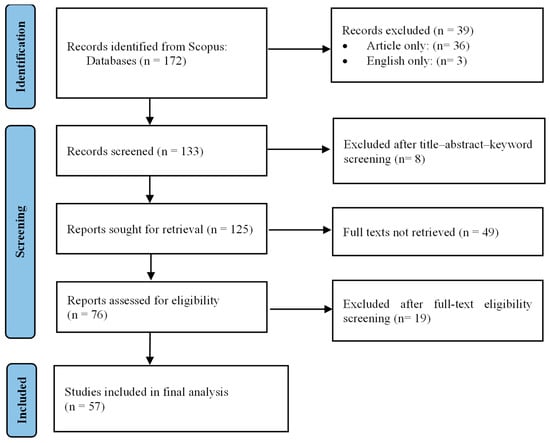
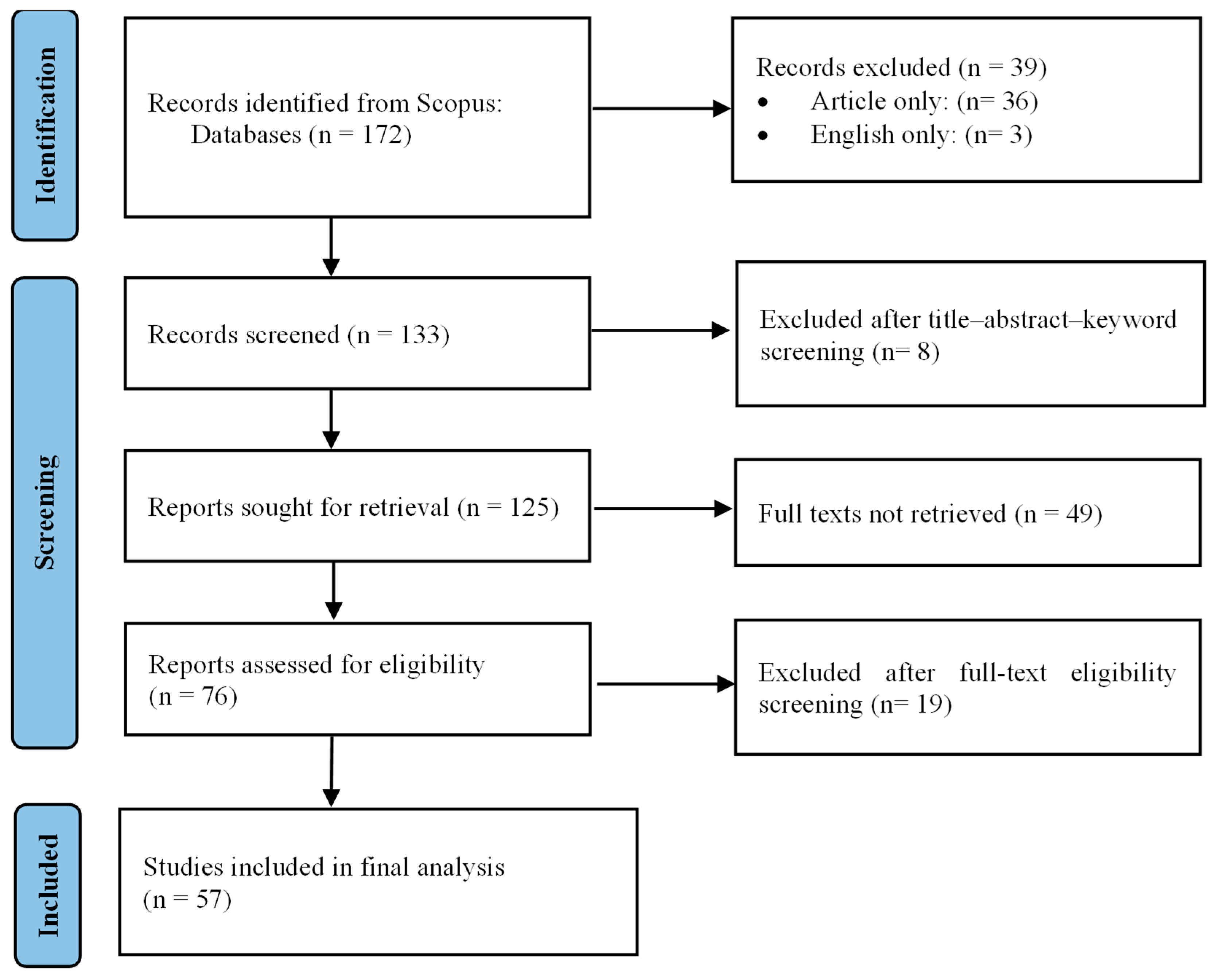
Screening followed the PRISMA 2020 four-stage process. Stage 1 (Identification): 172 records were identified from Scopus. After applying article-type filter (journal articles only), 136 records remained. After restricting to English-language publications, 133 records remained. Stage 2 (Title-Abstract-Keyword screening): 125 records remained after removing 8 for being irrelevant. Stage 3 (Retrieval): 49 records could not be retrieved for full-text review due to institutional access limitations after accounting for all available access channels; 76 records proceeded to full-text eligibility assessment. Stage 4 (Eligibility assessment): Full-text review applying the inclusion/exclusion criteria and quality appraisal resulted in the exclusion of 19 additional records, yielding a final sample of 57 studies. The PRISMA 2020 flow diagram is presented in Figure 1.
Figure 1.
Prisma 2020 flow diagram for influence of demographics on behavioral finance review.
2.5. Quality Appraisal
This review includes a formal quality appraisal of all 57 included studies. Each study was assessed against eight criteria adapted from the Mixed Methods Appraisal Tool (MMAT) and the Newcastle–Ottawa Scale for observational studies:
Each criterion was rated as Clearly Met (CM), Partially Met (PM), or Not Reported (NR). Studies were assigned an overall quality rating of High (CM on 7–8 criteria), Moderate–High (CM on 5–6), Moderate (CM on 4, PM on others), or Moderate–Low (CM on fewer than 4). Table 1 presents the quality appraisal results for all 57 studies.
Table 1.
Quality appraisal of all 57 included studies.
2.6. Data Extraction and Thematic Synthesis
Data extraction followed a pre-specified structured form capturing study ID (author, year), country, market classification, sample size and type, data collection method, analytical technique(s), behavioral biases examined (with measurement approach), demographic variables included, type of demographic analysis (descriptive, predictor, formal moderation), and key statistical findings.
3. Results
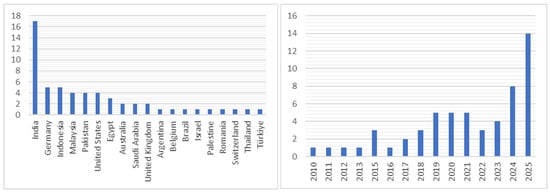
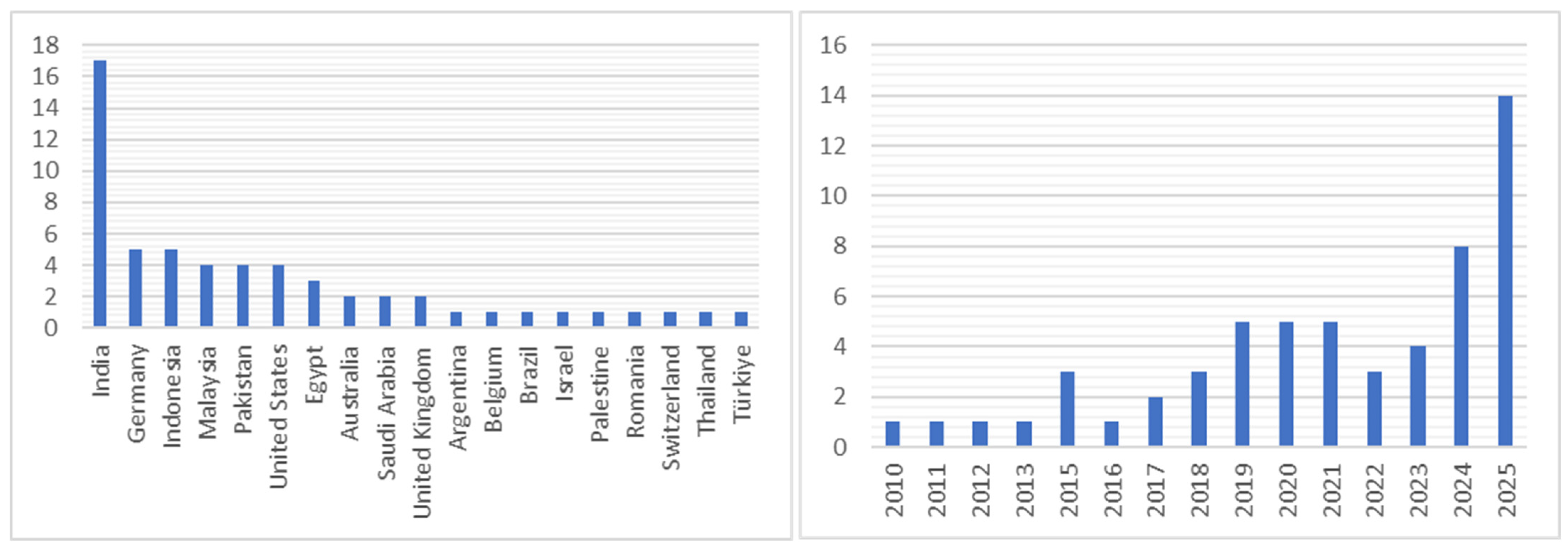
The final sample comprised 57 empirical study records spanning 19 countries and 7 global regions. Geographically, the literature was concentrated in South Asia (n = 21, 36.8%), driven primarily by studies from India and Pakistan. When combined with Southeast Asia (n = 10, 17.5%), South and Southeast Asia accounted for 31 studies (54.4%) of the sample. Europe contributed 11 studies (19.3%), followed by the Middle East and North Africa (n = 7, 12.3%), North America (n = 4, 7.0%), and Oceania and South America (n = 2 each, 3.5%). At the country level, India was the most frequently represented setting (n = 17, 29.8%), followed by Germany and Indonesia (n = 5 each, 8.8%). Malaysia, Pakistan, and the United States each contributed four studies (7.0%), while Egypt contributed three studies (5.3%). Australia, Saudi Arabia, and the United Kingdom each contributed two studies, and the remaining countries were represented by one study each, reflecting a broad but uneven global distribution.
Temporal analysis indicated a marked acceleration in research output over time. Publication years ranged from 2010 to 2025, with all study records reporting a clear publication year. Output remained modest from 2010 to 2018 (n = 13, 22.8%), then increased substantially from 2019 onward (n = 44, 77.2%). The years 2024 (n = 8) and 2025 (n = 14) alone accounted for 22 studies (38.6%) of the total sample, reflecting the rapid recent growth of this field. A two-panel figure was generated summarizing (a) country-level contributions and (b) temporal trends (Figure 2).
Figure 2.
Publication count summary.
Sample sizes ranged from 68 participants (Döbeli & Vanini, 2010) to 3740 participants (van Dolder & Vandenbroucke, 2024), with a median of approximately 360–365 participants. The most common study designs were cross-sectional surveys (n = 38), laboratory experiments (n = 10), and mixed designs or field experiments (n = 9). For full transparency, Appendix A Table A1 provides complete bibliographic, methodological, and demographic details for all 57 included studies.
3.1. Quality of Included Studies
Quality appraisal results are presented in Table 1. Of the 57 studies, 14 (24.6%) were rated High quality, 18 (31.6%) Moderate–High, 23 (40.4%) Moderate, and 2 (3.5%) Moderate–Low. Laboratory experiments and large-scale field studies consistently achieved higher quality ratings, as they more often reported sampling procedures, inter-rater reliability, and validity measures. Cross-sectional surveys from emerging markets frequently received Moderate ratings due to incomplete reporting of sampling methods, response rates, and ethical approval procedures.
The most common quality concern across studies was incomplete reporting of sampling method (Q3, Partially Met in 30 studies) and data collection rigor, including response rates and inter-rater agreement (Q4, Partially Met in 18 studies, Not Reported in 7 studies). Risk of selective reporting (Q8) was Partially Met in 43 studies, reflecting the absence of pre-registration and limited conflict-of-interest disclosure in the behavioral finance empirical literature generally.
These quality findings are reported transparently and are used to weigh the discussion: where findings rest predominantly on Moderate-quality studies, we flag this and distinguish them from conclusions supported by High or Moderate–High-quality evidence.
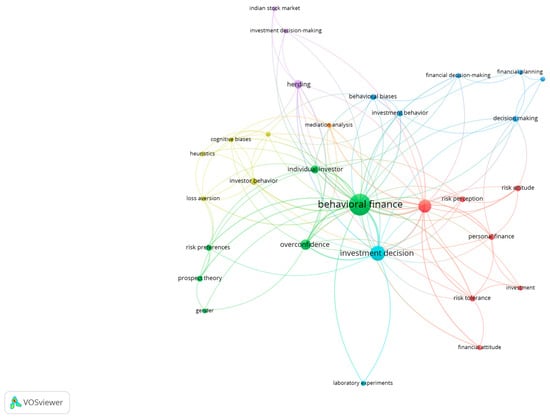
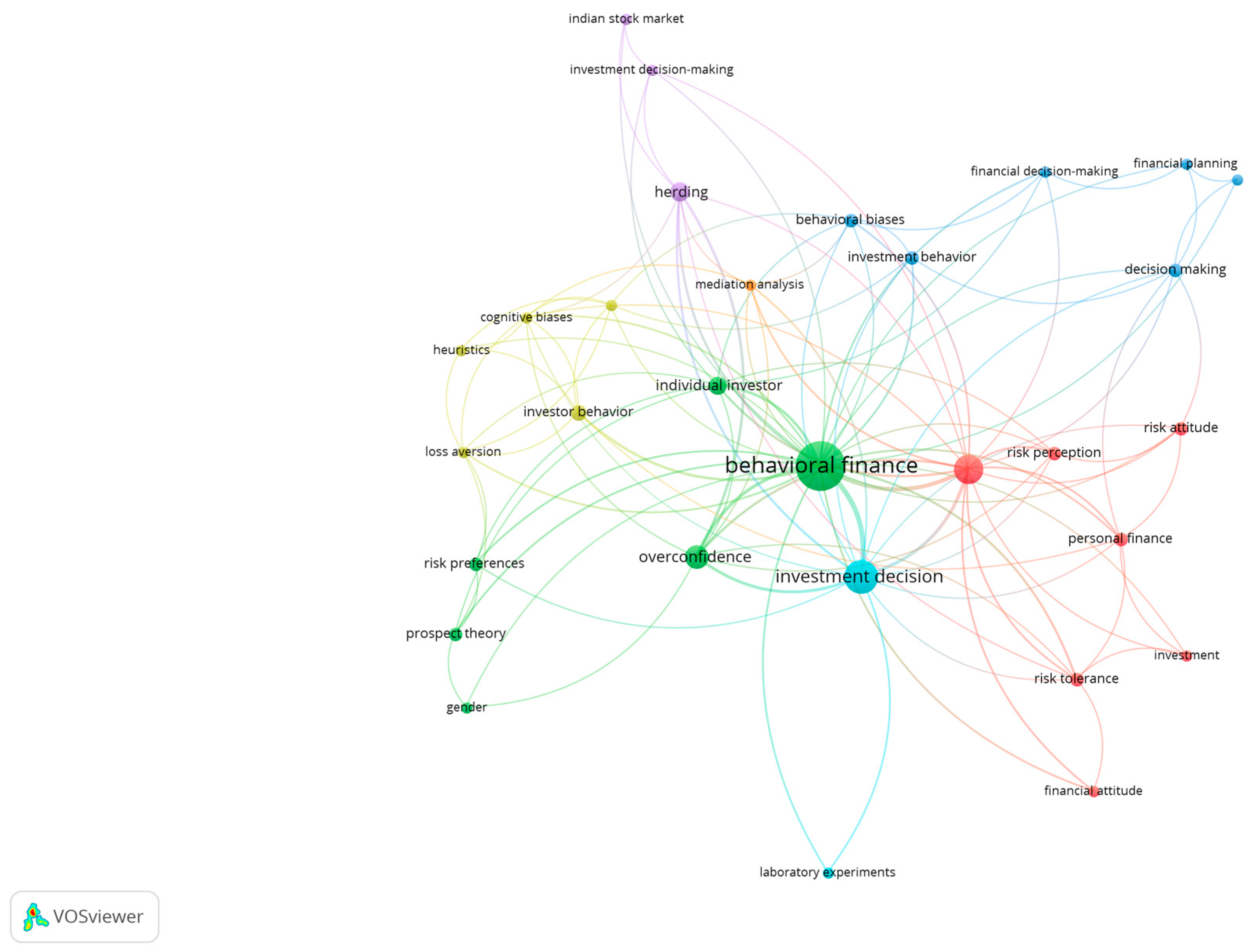
To complement the quality appraisal and provide a macro-level view of the conceptual architecture of this literature, a keyword co-occurrence network was generated from author-assigned keywords of all 57 included studies (Figure 3). The network reveals seven distinct thematic clusters that align closely with the overarching themes identified in this review, while also exposing structural features of the field that have implications for future research.
Figure 3.
Keyword co-occurrence network of 57 included studies (author keywords; minimum co-occurrence = 2; N = 30 nodes).
Behavioral finance is in the gravitational center. The largest node in the network is “behavioral finance”, which is connected with the nodes “gender”, “individual investor”, “overconfidence”, “prospect theory” and “risk preferences” in Cluster 2 (green). This centrality is also indicative of the organizing function of the field, yet the co-location of individual-difference variables suggests that behavioral finance is structurally embedded in demographic and psychological heterogeneity and does not exist as a separate meta-construct. The node acts as the main link between all other clusters, linking risk perception constructs (Cluster 1), applied decision research (Cluster 3), cognitive–heuristic processes (Cluster 4), market-level herding (Cluster 5), experimental methods (Cluster 6) and analytical techniques (Cluster 7).
The evaluative cluster is made up of risk and financial attitude. The key evaluative and perceptual constructs from the literature are grouped together in Cluster 1 (red: financial attitude, financial literacy, investment, personal finance, risk attitude, risk perception, risk tolerance). The concentration of risk-related terms alongside financial literacy and personal finance reflects the continued emphasis of the field on how investors assess uncertainty. Financial literacy in this configuration is not a cross-cutting moderator across all cognitive domains but rather operates within a risk calibration nexus. It appears to be related to both theoretical and applied dimensions through its connections with behavioral finance and investment decision, while its embedding in the structure of risk perception suggests that literacy effects are likely to be mediated by subjective risk judgments.
Decision research for emerging markets combines behavioral and contextual constructs. The applied survey-based stream of research, focused on emerging markets, falls under Cluster 3 (blue: behavioral biases, decision-making, financial decision-making, financial planning, investment behavior, Malaysia). The term “behavioral biases” was included in this cluster and not in the theoretically oriented cognitive cluster, indicating that in the current literature, the term is used more as an applied description of observed deviations, rather than as a well-theorized construct. The geographic concentration of empirical work in the emerging Southeast Asian economies is reflected in the presence of Malaysia. The cluster shows a methodological separation between survey-based applied research and theoretically driven experimental work, which is emphasized by the separation of “investment decision” (Cluster 6) from “cognitive biases” (Cluster 4).
The core of the cognitive–behavioral approach is a unique psychological cluster known as the cognitive–behavioral core. Theoretically grounded cognitive constructs are combined with investor behavior research in Cluster 4 (yellow green: cognitive biases, heuristics, investor behavior, loss aversion, psychological factors). The distinction of “cognitive biases” and “heuristics” from the more general “behavioral biases” term in Cluster 3 suggests a terminological and methodological split: Cluster 3 encompasses the more general topic of applied survey research while Cluster 4 contains the literature on mental shortcuts and loss-driven behavior. Loss aversion’s appearance here ensures its theoretical connection to prospect theory in Cluster 2, through risk preferences, but also keeps it separate from the applied bias literature.
Overconfidence and gender are tightly linked in the cluster of individual differences, as is the case for prospect theory. In Cluster 2 (green: behavioral finance, gender, individual investor, overconfidence, prospect theory, risk preferences), the demographic and theoretical constructs are at the center of the network. A closer theoretical fit between overconfidence, prospect theory and gender is apparent when these individual differences are co-located within the same cluster, more than is visible in the broader applied clusters. Only a small number of studies formally tested gender as a moderator, as it is structurally an “input” variable linked to the core and rarely used as an interactive boundary condition across the clusters.
Herding is methodologically isolated in a market-specific group. Cluster 5 (purple: herding, Indian stock market, investment decision-making) maintains its tight coupling with emerging-market contexts. The separation between herding (Cluster 5) and overconfidence (Cluster 2) provides a visual representation of a key finding in the synthesis: the study of herding is mostly at the market-level or social level in emerging markets while overconfidence is grouped with individual-level demographic and theoretical constructs. This is because there is a limited direct link between these clusters, as there is very little research that has directly tested the interaction between herding and overconfidence.
There are still methodological and terminological differences. The constructs in Cluster 6 (teal: investment decision, laboratory experiments) differ from those in Cluster 3 (financial decision-making constructs) and map to the methodological distinction between experimental designs and survey-based, cross-sectional studies. The co-occurrence of investment decision and laboratory experiments confirms that this combination is the most dominant in theoretically driven experimental research, while financial decision-making is the most important in applied survey research in emerging markets. There was a lack of conceptual linkage between these terms, signifying limited conceptual integration across methodological traditions.
Mediation analysis is a unique methodological bridge. Cluster 7 (orange: mediation analysis) forms a one-node cluster around the center of the network, and is connected to the cognitive–behavioral (Cluster 4), applied decision (Cluster 3), and individual difference clusters (Cluster 2). The structural isolation of this is analytically meaningful: mediation analysis has been growing in popularity within the behavioral finance research community, especially in SEM-based papers, but is not yet as connected with other methodological keywords as it could be. Its links to other clusters suggest that it is a technical bridge, but its absence from the other methodological terms suggests that analytical techniques are still not fully represented as keywords in the literature.
Implications for the field. The network is consolidated in seven clusters indicating some thematic refinement in the research on behavioral finance moderators, but there is still a lot of structural fragmentation. The central bridging role of behavioral finance is one of its strengths, but the separation of herding from overconfidence, embedding financial literacy in risk perception instead of as a universal moderator and peripheral isolation of mediation analysis suggest that theory-driven integration is still incomplete. The tighter coupling of overconfidence with prospect theory and gender (Cluster 2) and the separation of cognitive biases (Cluster 4) from applied behavioral biases (Cluster 3) suggest that researchers should attend more carefully to terminological precision and to methodological integration across experimental and survey paradigms. The limited inter-cluster density between experimental and survey traditions supports the call for pre-registered interaction-term models that would strengthen the theoretical core of the network.
3.2. Behavioral Biases Identified
Across the 57 reviewed studies, 17 distinct behavioral biases and behavioral constructs were identified. Table 2 summarizes bias frequencies and primary demographic associations.
Table 2.
Behavioral biases, frequency and demographic associations.
Overconfidence was the most prevalent bias, appearing in 31 studies (53% of the sample). It was most consistently associated with younger investors, male investors, and those with moderate rather than low or high financial literacy, consistent with the Dunning–Kruger effect. Herding behavior appeared in 26 studies (45%) and was particularly prevalent among novice investors, younger cohorts, and in emerging-market contexts where information asymmetry and social influence are heightened.
Loss aversion (18 studies) and risk aversion (17 studies) exhibited a distinct demographic profile, predominantly older investors, female investors, and those in financially insecure positions, consistent with prospect theory predictions regarding reference-point sensitivity and the steeper slope of the value function in the loss domain. The disposition effect (13 studies) overlapped substantially with loss aversion and was more prevalent in experienced investor samples.
Anchoring (11 studies) and availability bias (10 studies) were common across demographic groups but particularly pronounced in low-literacy samples. Confirmation bias (8 studies) showed an intriguing demographic pattern: rather than declining with education, it was more frequently observed in older and highly educated investors, consistent with motivated reasoning theory (Nickerson, 1998). This finding runs counter to the assumption that education protects against all biases.
Framing effects (seven studies) were largely context-dependent and strongly influenced by how financial products and decisions were presented, with simplified communication reducing gender gaps in financial product uptake (Döbeli & Vanini, 2010). Social influence or community-driven behavior (four studies) was predominantly observed among Gen Z investors interacting with digital platforms and online investment communities.
3.3. Demographic Moderators of Behavioral Biases
A critical contribution of this review is the explicit distinction between studies that the explicit distinction between studies that (a) treat demographic variables as descriptive background characteristics; (b) test demographics as predictors of biases or investment outcomes; and (c) conduct formal moderation analyses using interaction terms, multi-group analysis (MGA), or equivalent approaches. Of the 57 studies, 27 (47%) treated demographics primarily descriptively, 16 (28%) modeled demographics as predictors, and 14 (25%) conducted formal moderation analyses. Table 3, Table 4, Table 5, Table 6 and Table 7 synthesize findings across all five demographic dimensions with contradictions flagged.
Table 3.
Impact of gender on behavioral biases and investment decisions.
Table 4.
Impact of age on behavioral biases and investment decisions.
Table 5.
Impact of financial literacy on behavioral biases and investment decisions.
Table 6.
Impact of investment experience on behavioral biases and investment decisions.
Table 7.
Impact of income on behavioral biases and investment decisions.
3.3.1. Gender
Gender was the most widely examined demographic variable, featuring in 45 of the 57 studies. The dominant finding, supported by 23 High- and Moderate–High-quality studies, is that male investors display significantly higher levels of overconfidence and take more risk than female investors. This pattern is consistent with Barber and Odean’s (2001) foundational finding and is robust across emerging markets (e.g., Ahmad & Shah, 2022; Rasool & Ullah, 2020) and developed markets (e.g., Israel et al., 2019; Papadovasilaki et al., 2018; Bateman et al., 2011).
Female investors display greater risk aversion and loss aversion (17 studies) and in some contexts greater herding (11 studies). However, the herding pattern among women is context-dependent and may reflect adaptive risk-sharing rather than irrational information-following. Ladrón de Guevara Cortés et al. (2023) found that females were more conservative in gain domains but more aggressive in certain loss-domain choices, a prospect theory-consistent finding that complicates the simple narrative of female risk aversion.
Critically, nine studies found gender effects non-significant after controlling for financial literacy, income, or experience. Döbeli and Vanini (2010) demonstrated that simply presenting financial products in plain language eliminated the gender gap in structured-product ownership. This suggests that observed gender differences may partly reflect differential access to financial information rather than innate preferences, an important distinction for policy implications. Formal gender moderation was tested in five studies (Papadovasilaki et al., 2018; Sachdeva & Lehal, 2024; Kumar et al., 2023; Israel et al., 2019; Bartholomae et al., 2019), with mixed results.
3.3.2. Age
Age was examined in 42 studies. Younger investors (predominantly Gen Z and Millennials) showed higher overconfidence (24 studies), greater impulsivity, and stronger herding tendencies, patterns amplified by social media exposure and online trading platforms (Syukur et al., 2025; R. Chandra et al., 2025). Older investors showed greater loss aversion (19 studies) and risk aversion, consistent with a shift toward capital preservation as the investment horizon shortens and wealth accumulation approaches goals.
An important nuance emerging from this review is the non-linear relationship between age and bias. Moderate-aged investors (roughly 35–55 years) in several studies showed the most balanced risk-taking behavior and best investment performance (Hafez, 2021; Bateman et al., 2011). Older investors with extended experience were more likely to exhibit confirmation bias and status quo effects, representing a qualitative shift in bias type rather than a reduction in irrationality.
A key contradiction: the direction of the age-literacy relationship reversed across cultural contexts. Kumar et al. (2023) found that older investors had superior financial literacy in South Asian contexts, consistent with experience-driven learning. However, Walia and Kiran (2012) and studies from digital-access-enabled contexts found younger cohorts demonstrating higher financial literacy, a pattern consistent with the digital native advantage. These opposing patterns suggest that age effects on bias are mediated by access to financial information, which varies by technology penetration and educational infrastructure.
Syukur et al. (2025) provide the review’s most methodologically rigorous evidence on age and bias, using a multi-group PLS-SEM with 1293 participants across Gen X, Gen Y, and Gen Z. Investment experience moderated the herding effect significantly for Gen X (β = −0.059, p < 0.001) but not for Gen Y or Gen Z, suggesting that experience-based learning operates differently across generational cohorts.
3.3.3. Financial Literacy
Financial literacy was the most analytically complex demographic dimension, appearing in 43 studies. Its role is multifaceted and context-dependent, functioning variously as a predictor, mediator, and moderator, and sometimes producing paradoxical effects.
At low levels, financial literacy was consistently associated with stronger herding, greater availability bias, and more impulsive decision-making (21 studies). This relationship was strongest and most consistent in emerging-market contexts (Rasool & Ullah, 2020; Khatik et al., 2021; Sabir et al., 2019). At high levels, financial literacy reduced most biases and improved investment decision quality (22 studies), supporting the theoretical prediction that informed investors are better calibrated (Lusardi & Mitchell, 2014; Agarwal et al., 2025; Hamurcu et al., 2025).
The most theoretically interesting finding, and the most important contradiction in this literature, is the positive relationship between financial literacy and overconfidence in some contexts. Wang and Zou (2024), using a large UK sample (n = 2000), found that higher financial literacy was positively associated with overconfidence (β = 0.19, p < 0.001). Murhadi et al. (2024) found a similar pattern in Indonesia. This is consistent with the Dunning–Kruger dynamic: partial knowledge breeds confidence that exceeds competence, while truly high expertise eventually calibrates confidence downward. The implication is that financial literacy interventions may have non-linear effects, while initial literacy improvements could paradoxically increase overconfidence before eventually reducing it.
Regarding formal moderation, eight studies tested financial literacy as a formal moderator. The results were mixed. Ahmad and Shah (2022) found that financial literacy buffered overconfidence-to-investment-decision and overconfidence-to-performance links (both p < 0.05). Sabir et al. (2019) found that financial literacy amplified the overconfidence–herding relationship while buffering the experience–herding link. Kulkarni et al. (2025) found that financial literacy significantly intensified the negative effects of both loss aversion and overconfidence on robo-advisor decisions (OB × FL: β = −0.529, p < 0.001). In contrast, Mahmood et al. (2024) found no significant moderation for six biases (all p > 0.20). This heterogeneity reflects genuine complexity: financial literacy’s moderating role depends on the specific bias, the investment context, and the level and type of literacy measured.
3.3.4. Investment Experience
Investment experience appeared in 34 studies. Like age, its relationship with bias is non-linear. Novice investors show higher overconfidence, greater herding, and more reliance on social cues and recency, a pattern documented consistently across emerging (Djuachiriaty et al., 2024; Almansour et al., 2025) and developed markets (Weiss-Cohen et al., 2022; Safford et al., 2018). Moderate experience (approximately 5–10 years) was associated with improved decision quality and balanced risk-taking in several studies (Hafez, 2021; Bateman et al., 2011).
However, high experience does not guarantee rationality. Experienced investors in multiple studies showed stronger disposition effects and confirmation bias, suggesting that extensive experience reinforces established heuristics and cognitive commitments rather than eliminating them (Shefrin & Statman, 1985). Murhadi et al. (2024) found a positive relationship between investment experience and herding, suggesting that past success creates overconfidence that feeds information-cascade behavior.
The most rigorous moderation evidence comes from Syukur et al. (2025), who found that investment experience moderated the herding-to-decision-making relationship significantly for Gen X (β = −0.059, p < 0.001, using multi-group PLS-SEM with 1293 participants) but not for Gen Y or Gen Z. Safford et al. (2018) showed in a randomized experiment that crash experience reduced stock allocation by approximately 6 percentage points even after controlling for gender, financial literacy, and risk attitude, providing causal evidence for experience effects absent in most survey-based studies.
3.3.5. Income Level
Income appeared in 32 studies, typically as a demographic descriptor rather than a formally modeled predictor. Higher income was associated with lower herding and overconfidence in 14 studies (e.g., Walia & Kiran, 2012; Murhadi et al., 2024), likely mediated by greater financial literacy and access to professional advice. Lower-income investors showed greater susceptibility to availability bias and herding, patterns partly attributable to information deficits and reliance on social networks as information sources.
An important income-specific finding concerns the middle-income bracket, where loss aversion and the disposition effect were most pronounced (Hamurcu et al., 2025; van Dolder & Vandenbroucke, 2024). This is consistent with the theoretical prediction that loss aversion intensifies when wealth preservation is the dominant psychological motive, a pattern more pronounced in the middle-income range than among the very wealthy or very poor. High-income investors in several studies showed value-driven investment tendencies, including preference for ESG and renewable energy investments (Schall, 2020; Hafenstein & Bassen, 2016; Kleffel & Muck, 2024), suggesting that economic surplus enables the expression of psychological and ethical preferences in investment choices.
Income was non-significant in seven studies after controlling for financial literacy and education, suggesting that part of the income effect is mediated through these variables. This has methodological implications: studies that do not include financial literacy alongside income may overestimate income’s direct effect.
3.4. Formal Moderation Analyses: Consolidated Evidence
Fourteen studies in the final sample conducted formal moderation or interaction analyses (Table 8). This section synthesizes their findings, with attention given to moderator type, direction, and statistical robustness.
Table 8.
Formal moderation analyses: summary of interaction-term and MGA studies.
Financial literacy was the most commonly tested moderator (tested in 8 of the 14 studies), with results ranging from strong significant buffering effects (Ahmad & Shah, 2022; Kulkarni et al., 2025; Sabir et al., 2019) to complete non-significance (Mahmood et al., 2024). The direction of financial literacy moderation also varied: in most studies it buffered bias effects, but Sabir et al. (2019) found that it amplified the overconfidence–herding relationship, consistent with the paradox identified in Section 3.3.3.
Gender was tested as a formal moderator in five studies. Papadovasilaki et al. (2018) found that early crash experience had a significantly stronger effect on males than females (p < 0.01). Israel et al. (2019) found a three-way interaction between music group, gender, and subjective music evaluation for diversification behavior (F = 4.553, p = 0.034). However, Sachdeva and Lehal (2024), Kumar et al. (2023), and Bartholomae et al. (2019) found gender moderation to be largely non-significant, suggesting that gender’s influence may be more pronounced in experimental settings than in real-world survey data.
Investment experience moderated herding behavior in Syukur et al. (2025) with a heterogeneous generational pattern. Social risk (specifically, polygamy risk as a proxy for marital instability) significantly moderated both financial literacy and risk tolerance effects on investment allocation in Putri Pa et al. (2022), a novel finding suggesting that institutional and social risk contexts can override individual financial knowledge.
3.5. Thematic Synthesis
Drawing across all 57 studies, four overarching themes emerge that synthesize the behavioral and demographic evidence at a level beyond frequency tabulation.
Theme 1.
Financial Literacy as a Non-Linear and Context-Dependent Moderator.
The most widespread and theoretically significant conclusion from this review is that financial literacy does not directly reduce behavioral biases. It works in a non-linear, context-specific and bias-specific way. Financial literacy is always associated with a decrease in herding and availability bias at low levels. At moderate levels, it can lead to overconfidence, as is consistent with the Dunning–Kruger effect and is well documented by Wang and Zou (2024) and Murhadi et al. (2024). Most biases are diminished at high levels, but overconfidence might remain with the highly confident experts. The non-linear nature has a critical implication for financial literacy interventions, as financial literacy programs that increase awareness but do not lead to the development of deep competence could result in an increase in overconfidence and its associated costs.
Theme 2.
Gender Differences Are Real but Partially Socially Constructed.
The evidence for gender differences in behavioral biases is robust across multiple high-quality studies, with males showing greater overconfidence and risk-taking and females showing greater risk aversion and loss aversion. However, the observation from Döbeli and Vanini (2010) that simplified product communication eliminated the gender gap in structured-product uptake, combined with evidence that gender effects disappear after controlling for financial literacy (Kumar et al., 2023; Sachdeva & Lehal, 2024), suggests that gender differences in investment behavior are partly mediated by differential access to financial information and cultural norms regarding financial agency. This has important policy implications: targeting financial literacy programs toward women may be more effective than assuming that gender represents an immutable behavioral boundary.
Theme 3.
Context Moderates Everything.
In nearly every relationship between demographics and behavioral biases, context is important. The direction and magnitude of the effects depend on the level of market development (emerging markets vs. developed markets), penetration of the technology and digital access, financial decision-making and financial norms of men and women, institutional quality and investor protection, and the specific investment product or decision being analyzed. The literature is concentrated in emerging markets in South Asia and Southeast Asia, and the sample consists of about 53% from India, Pakistan, Indonesia, and Malaysia, so many results may not be applicable to developed markets, North American markets, East Asian markets or Sub-Saharan African markets. This is an important geographical limitation to the field that needs to be rectified in the future.
4. Discussion
This review combines the findings of 57 quality-assessed empirical studies to offer a comprehensive PRISMA-based analysis of the influence of demographic characteristics on behavioral biases in investment decision-making. There are some observations that demand further comment.
4.1. Reconciling Contradictions in the Financial Literacy–Overconfidence Relationship
Financial literacy and overconfidence are positively associated in the UK (Wang & Zou, 2024) and Indonesia (Murhadi et al., 2024), which seems counterintuitive to what many would expect: a negative association between financial literacy and bias. There are two mechanisms that provide some reconciliation. The Dunning–Kruger explanation is that investors who have advanced from “no knowledge” to “moderate knowledge” are more likely to view their competence as greater than it truly is, based on their level of calibration. Second is the selection explanation: investors who are more financially literate are more likely to be active investors in the financial markets, and this is related to overconfidence (Barber & Odean, 2001). These mechanisms are not mutually exclusive, and can both account for the paradox. Future research employing longitudinal designs might examine the possibility that the positive literacy–overconfidence relationship represents a developmental stage that reverses at high levels of literacy.
4.2. Geographic and Cultural Heterogeneity
It is difficult to generalize because of the geographic focus of this literature in South and Southeast Asian emerging markets. Some institutional characteristics of the markets in India, Pakistan, Indonesia and Malaysia may differ from North America, Europe and East Asia and influence investor behavior, such as how investors are protected as retail investors, the degree of maturity of the stock market, cultural attitudes to risk and authority, and the informal social network involvement in financial decision-making. Due to the scarcity of developed-market studies in this review (Bateman et al., 2011; van Dolder & Vandenbroucke, 2024; Döbeli & Vanini, 2010; Kleffel & Muck, 2024), some of these studies yield strikingly different patterns, further underscoring the need to include geographically diverse future studies.
4.3. Practical Implications
The identified thematic patterns have concrete implications for three groups of stakeholders. The evidence supports a demographic approach to investing: for financial advisors and wealth managers, overconfident young male novice investors will need to have their overconfidence corrected, whereas older female conservative investors may benefit from some framing around loss avoidance and goal certainty. For policy makers and financial regulators, financial literacy disclosures should be tailored to literacy level, with special attention given to interventions for intermediately literate investors who are especially susceptible to overconfidence. Regulators could consider product-specific literacy thresholds for high-risk investment products. For financial educators, financial education programs need to go beyond awareness of financial competency development, making sure to tackle the overconfidence trap linked to partial knowledge.
4.4. Limitations of This Review
This review has several important limitations that should inform the interpretation of the findings and the design of future research.
First, the search was restricted to the Scopus database. While Scopus provides broad coverage of peer-reviewed behavioral finance research, studies indexed only in Web of Science, PsycINFO, SSRN, or Google Scholar may have been missed. The addition of a second database in future updates would reduce this selection risk.
Second, 49 records (37% of the screened sample) could not be retrieved for full-text assessment, primarily due to institutional access limitation. Some relevant studies may have been excluded as a result.
Third, although a formal quality appraisal was conducted, this review did not perform a quantitative meta-analysis due to the extreme heterogeneity in bias operationalization, demographic measurement, and statistical reporting across studies. Effect sizes are not directly comparable across studies reporting regression coefficients, ANOVA F-statistics, OR from logistic regression, and SEM path coefficients, making pooled effect estimation unreliable without individual study data.
Fourth, the geographic distribution of included studies is heavily weighted toward South and Southeast Asian emerging markets. Conclusions about financial literacy moderation, gender effects, and experience effects may not generalize to Western developed markets or other cultural contexts.
Fifth, the absence of longitudinal studies prevents causal inference about the direction of demographic-biased relationships. Cross-sectional correlations, which dominate this literature, cannot distinguish whether financial literacy reduces bias or whether less-biased investors seek out financial knowledge.
5. Conclusions
Several conclusions are supported across the evidence base. Overconfidence and herding are the two most prevalent behavioral biases, predominantly affecting younger, male, and less experienced investors. Loss aversion and risk aversion are more consistently observed among older, female, and financially insecure investors, consistent with prospect theory predictions. Financial literacy is the most important demographic moderator, but its effect is non-linear: low literacy amplifies herding and impulsive decisions, moderate literacy may paradoxically amplify overconfidence, and high literacy generally reduces most biases. Investment experience transforms rather than eliminates bias, shifting the dominant bias type from social-influence-driven to commitment-driven patterns.
Among the 14 studies that conducted formal moderation analyses, financial literacy was the most frequently supported moderator, though with important heterogeneity in direction and magnitude. The finding that gender differences largely disappear after controlling financial literacy and that simplified communication eliminated gender gaps in product uptake suggests that the gender bias relationship is partially mediated by information access rather than fixed preference.
Future research priorities emerging from this review include (1) longitudinal experimental designs capable of establishing causal direction; (2) studies from North America, East Asia, and Sub-Saharan Africa to address geographic imbalance; (3) intersectionality analyses examining how multiple demographic variables jointly moderate bias; (4) pre-registered interaction-term moderation models to move beyond subgroup comparisons; and (5) replication studies in developed-market contexts to test the generalizability of emerging-market findings.
The behavioral heterogeneity of investors documented in this review has a clear practical implication: behavioral finance interventions, whether financial literacy programs, regulatory disclosures, or advisory services, must be designed with demographic specificity. A universal approach to investor protection and education will systematically underserve the investors who are most vulnerable to cognitive and emotional bias.
Supplementary Materials
The following supporting information can be downloaded at: https://www.mdpi.com/article/10.3390/jrfm19060418/s1, The PRISMA checklist used is provided as Supplementary Material. Page et al. (2021) is cited in the Supplementary Materials.
Author Contributions
Conceptualization, E.M.D. and Z.D.; methodology, E.M.D.; software, E.M.D.; validation, Z.D.; formal analysis, E.M.D.; investigation, E.M.D.; resources, E.M.D.; data curation, E.M.D.; writing—original draft preparation, E.M.D.; writing, review and editing, E.M.D. and Z.D.; visualization, E.M.D.; supervision, Z.D.; project administration, E.M.D. All authors have read and agreed to the published version of the manuscript.
Funding
The first author benefits from the PhD Associate Scholarship provided by the National Centre for Scientific and Technical Research (N* = 38USMBA2024).
Institutional Review Board Statement
Not applicable.
Informed Consent Statement
Not applicable.
Data Availability Statement
The study is based on a systematic review of the literature. The bibliographic data used in the analysis originate from licensed databases (Scopus) and are publicly shared. The search strategy, inclusion criteria, and data processing methods are described in the article. The studies included in the analysis are marked in the list of references.
Acknowledgments
This work was supported by the National Center for Scientific and Technical Research (CNRST) through the PhD-Associate Program (for the first author, El Mehdi Douhabi), grant number 38USMBA2024.
Conflicts of Interest
The authors declare no conflicts of interest.
Abbreviations
The following abbreviations are used in this manuscript:
| AMOS | Analysis of Moment Structures |
| ANOVA | Analysis of Variance |
| CFA | Confirmatory Factor Analysis |
| CM | Clearly Met |
| DV | Dependent Variable |
| EFA | Exploratory Factor Analysis |
| EMH | Efficient Market Hypothesis |
| ESG | Environmental, Social, and Governance |
| EUT | Expected Utility Theory |
| F | F-statistic |
| FC | Financial Capability |
| FDM | Financial Decision-Making |
| FL | Financial Literacy |
| FTP | Future Time Perspective |
| Gen X/Y/Z | Generation X/Y/Z |
| GLS | Generalized Least Squares |
| IMP | Impulsivity |
| IV | Independent Variable |
| KMO | Kaiser–Meyer–Olkin |
| LA | Loss Aversion |
| MANOVA | Multivariate Analysis of Variance |
| MGA | Multi-Group Analysis |
| MICOM | Measurement Invariance of Composite Models |
| MMAT | Mixed-Methods Appraisal Tool |
| NR | Not Reported |
| OB | Overconfidence Bias |
| OLS | Ordinary Least Squares |
| OR | Odds Ratio |
| p | Probability value (significance level) |
| PLS-SEM | Partial Least Squares Structural Equation Modeling |
| PM | Partially Met |
| PRISMA | Preferred Reporting Items for Systematic Reviews and Meta-Analyses |
| Q1–Q8 | Quality Criteria 1 through 8 |
| R2 | Coefficient of Determination |
| RPB | Retirement Planning Behavior |
| RGC | Retirement Goal Clarity |
| SEM | Structural Equation Modeling |
| SRI | Socially Responsible Investment |
| SPSS | Statistical Package for the Social Sciences |
| WTP | Willingness to Pay |
| β | Standardized Regression Coefficient |
Appendix A
Table A1.
Summary of all 57 included studies.
References
- Agarwal, A., Rao, N. V. M., & Nogueira, M. C. (2025). Financially savvy or swayed by biases? The impact of financial literacy on investment decisions: A study on Indian retail investors. Journal of Risk and Financial Management, 18(6), 322. [Google Scholar] [CrossRef] [Scilit]
- Ahmad, M., & Shah, S. Z. A. (2022). Overconfidence heuristic-driven bias in investment decision-making and performance: Mediating effects of risk perception and moderating effects of financial literacy. Journal of Economic and Administrative Sciences, 38(1), 60–90. [Google Scholar] [CrossRef] [Scilit]
- Almansour, B. Y., Almansour, A. Y., Elkrghli, S., & Shojaei, S. A. (2025). The investment puzzle: Unveiling behavioral finance, risk perception, and financial literacy. Economics-Innovative and Economics Research Journal, 13(1), 131–151. [Google Scholar] [CrossRef] [Scilit]
- Barber, B. M., & Odean, T. (2001). Boys will be boys: Gender, overconfidence, and common stock investment. The Quarterly Journal of Economics, 116(1), 261–292. [Google Scholar] [CrossRef] [Scilit]
- Bartholomae, S., Kiss, D. E., Jurgenson, J. B., O’Neill, B., Worthy, S. L., & Kim, J. (2019). Framing the human capital investment decision: Examining gender bias in student loan borrowing. Journal of Family and Economic Issues, 40(1), 132–145. [Google Scholar] [CrossRef] [Scilit]
- Bateman, H., Islam, T., Louviere, J., Satchell, S., & Thorp, S. (2011). Retirement investor risk tolerance in tranquil and crisis periods: Experimental survey evidence. Journal of Behavioral Finance, 12(4), 201–218. [Google Scholar] [CrossRef] [Scilit]
- Biais, B., Hilton, D., Mazurier, K., & Pouget, S. (2005). Judgemental overconfidence, self-monitoring, and trading performance in an experimental financial market. The Review of Economic Studies, 72(2), 287–312. [Google Scholar] [CrossRef] [Scilit]
- Budsaratragoon, P., Hillier, D., Hodgson, A., & Lhaopadchan, S. (2015). Asset allocations in a Thai defined contribution fund: A behavioural experiment conditioned by financial expertise. International Journal of Economics and Management, 10(Specialissue2), 319–339. [Google Scholar] [CrossRef] [Scilit]
- Chandra, A., Sanningammanavara, K., & Nandini, A. S. (2017). Does individual heterogeneity shape retail investor behaviour? International Journal of Social Economics, 44(5), 578–593. [Google Scholar] [CrossRef] [Scilit]
- Chandra, R., Antonio, F., & Kaluge, L. (2025). Strategic financial decision-making among young Indonesian investors: A behavioral perspective on cryptocurrency reinvestment. Qubahan Academic Journal, 5(3), 209–227. [Google Scholar] [CrossRef] [Scilit]
- Darwish, F. S. M. (2025). Financial literacy and investment decision: An empirical study from the Palestine stock exchange. Frontiers in Behavioral Economics, 4, 1444022. [Google Scholar] [CrossRef] [Scilit]
- Djuachiriaty, Y., Jamaliah, Putra, W., Rosyadi, & Bustami. (2024). Economic and psychological determination in civil servants’ investment decisions ahead of retirement: Empirical evidence from Indonesia. Economic Annals-XXI, 212(11–12), 51–55. [Google Scholar] [CrossRef] [Scilit]
- Döbeli, B., & Vanini, P. (2010). Stated and revealed investment decisions concerning retail structured products. Journal of Banking and Finance, 34(6), 1400–1411. [Google Scholar] [CrossRef] [Scilit]
- Fama, E. F. (1970). Efficient capital markets: A review of theory and empirical work. The Journal of Finance, 25(2), 383–417. [Google Scholar] [CrossRef] [Scilit]
- Gopal, S., Munuswamy, J., & Prakash, M. (2025). Financial decision-making power and risk-taking behaviour in Indian households. Financial and Credit Activity: Problems of Theory and Practice, 2(61), 544–553. [Google Scholar] [CrossRef] [Scilit]
- Grable, J. E., & Joo, S.-H. (2004). Environmental and biopsychosocial factors associated with financial risk tolerance. Financial Counseling and Planning, 15(1), 73–88. [Google Scholar]
- Hafenstein, A., & Bassen, A. (2016). Influences for using sustainability information in the investment decision-making of non-professional investors. Journal of Sustainable Finance and Investment, 6(3), 186–210. [Google Scholar] [CrossRef] [Scilit]
- Hafez, H. M. (2021). Investigating the psychological factors that affect Egyptian investors’ behaviour and decisions before and after the pandemic. Journal of Governance and Regulation, 10(4), 113–129. [Google Scholar] [CrossRef] [Scilit]
- Hamurcu, Ç., Hazar, A., & Babuşcu, Ş. (2025). A portfolio-focused behavioral model linking financial literacy and risk tolerance: Evidence from mutual fund investors in Türkiye. Borsa Istanbul Review, 25, 119–127. [Google Scholar] [CrossRef] [Scilit]
- Israel, A., Lahav, E., & Ziv, N. (2019). Stop the music? The effect of music on risky financial decisions: An experimental study. Journal of Behavioral and Experimental Finance, 24, 100231. [Google Scholar] [CrossRef] [Scilit]
- Jamaludin, N., & Gerrans, P. (2015). Retirement savings investment decisions: Evidence from Malaysia. Journal of the Asia Pacific Economy, 20(4), 644–657. [Google Scholar] [CrossRef] [Scilit]
- Kahneman, D., & Tversky, A. (1979). Prospect theory: An analysis of decision under risk. Econometrica, 47(2), 263–291. [Google Scholar] [CrossRef] [Scilit]
- Khatik, S. K., Joshi, R., & Adwani, V. K. (2021). Inferring the role of social media on Gen Z’s investments decisions. Journal of Content, Community and Communication, 14(7), 309–317. [Google Scholar] [CrossRef] [Scilit]
- Khawaja, M. J., & Alharbi, Z. N. (2021). Factors influencing investor behavior: An empirical study of Saudi stock market. International Journal of Social Economics, 48(4), 587–601. [Google Scholar] [CrossRef] [Scilit]
- Khilar, R. P., & Singh, S. (2019). Influence of behavioural biases on investment decision-making in Bhubaneswar region. International Journal of Recent Technology and Engineering, 8(3), 8297–8301. [Google Scholar] [CrossRef] [Scilit]
- Kleffel, P., & Muck, M. (2024). The confusion of taste and consumption: Evidence from a stated-choice experiment. Journal of Behavioral and Experimental Finance, 43, 100964. [Google Scholar] [CrossRef] [Scilit]
- Kulkarni, M. S., Patil, K. P., & Pramod, D. (2025). The role of robo-advisors in behavioural finance, shaping investment decisions. Cogent Economics and Finance, 13(1), 2571403. [Google Scholar] [CrossRef] [Scilit]
- Kumar, P., Islam, M. A., Pillai, R., & Sharif, T. (2023). Analysing the behavioural, psychological, and demographic determinants of financial decision-making of household investors. Heliyon, 9(2), e13085. [Google Scholar] [CrossRef] [Scilit] [PubMed]
- Ladrón de Guevara Cortés, R., Tolosa, L. E., & Rojo, M. P. (2023). Prospect theory in the financial decision-making process: An empirical study of two Argentine universities. Journal of Economics, Finance and Administrative Science, 28(55), 116–133. [Google Scholar] [CrossRef] [Scilit]
- Lim, T. S., Mail, R., Karim, M. R. A., Ulum, Z. K. A. B., Mifli, M., & Jaidi, J. (2020). An investigation of financial investment intention using covariance-based structural equation modelling. Global Business and Finance Review, 25(2), 37–50. [Google Scholar] [CrossRef] [Scilit]
- Linge, A. A., Jiwani, A., & Kakde, B. B. (2024). Factors affecting risk attitude and investors’ happiness of newly employed individuals. Indian Journal of Finance, 18(5), 66–80. [Google Scholar] [CrossRef] [Scilit]
- Lusardi, A., & Mitchell, O. S. (2014). The economic importance of financial literacy: Theory and evidence. Journal of Economic Literature, 52(1), 5–44. [Google Scholar] [CrossRef] [Scilit]
- Mahmood, F., Arshad, R., Khan, S., Afzal, A., & Bashir, M. (2024). Impact of behavioral biases on investment decisions and the moderation effect of financial literacy; an evidence of Pakistan. Acta Psychologica, 247, 104303. [Google Scholar] [CrossRef] [Scilit]
- McCannon, B. C., & Peterson, J. (2015). Born for finance? Experimental evidence of the impact of finance education. Journal of Behavioral Finance, 16(3), 199–205. [Google Scholar] [CrossRef] [Scilit]
- Metawa, N., Hassan, M. K., Metawa, S., & Safa, M. F. (2019). Impact of behavioral factors on investors’ financial decisions: Case of the Egyptian stock market. International Journal of Islamic and Middle Eastern Finance and Management, 12(1), 30–55. [Google Scholar] [CrossRef] [Scilit]
- Murhadi, W. R., Frederica, D., & Marciano, D. (2024). The effect of financial literacy and demographic variable on behavioral biases. Asian Economic and Financial Review, 14(4), 312–325. [Google Scholar] [CrossRef] [Scilit]
- Nga, J. K. H. (2020). Investigating the influence of Asian cultural value and financial knowledge on investment behaviours. Malaysian Journal of Consumer and Family Economics, 24, 173–206. [Google Scholar]
- Nga, J. K. H., & Ken Yien, L. (2013). The influence of personality trait and demographics on financial decision-making among Generation Y. Young Consumers, 14(3), 230–243. [Google Scholar] [CrossRef] [Scilit]
- Nickerson, R. S. (1998). Confirmation bias: A ubiquitous phenomenon in many guises. Review of General Psychology, 2(2), 175–220. [Google Scholar] [CrossRef]
- Odean, T. (1998). Volume, volatility, price, and profit when all traders are above average. The Journal of Finance, 53(6), 1887–1934. [Google Scholar] [CrossRef] [Scilit]
- Oehler, A., Wendt, S., Wedlich, F., & Horn, M. (2018). Investors’ personality influences investment decisions: Experimental evidence on extraversion and neuroticism. Journal of Behavioral Finance, 19(1), 30–48. [Google Scholar] [CrossRef] [Scilit]
- Okumura, B. U., Pimenta Júnior, T., Maemura, M. M. D., Gaio, L. E., & Gatsios, R. C. (2023). Behavioural finance: The decoy effect on stock investment decisions. Journal of Economics, Finance and Administrative Science, 28(56), 335–351. [Google Scholar] [CrossRef] [Scilit]
- Page, M. J., McKenzie, J. E., Bossuyt, P. M., Boutron, I., Hoffmann, T. C., Mulrow, C. D., Shamseer, L., Tetzlaff, J. M., Akl, E. A., Brennan, S. E., Chou, R., Glanville, J., Grimshaw, J. M., Hróbjartsson, A., Lalu, M. M., Li, T., Loder, E. W., Mayo-Wilson, E., McDonald, S., … Moher, D. (2021). The PRISMA 2020 statement: An updated guideline for reporting systematic reviews. BMJ, 372, n71. [Google Scholar] [CrossRef] [Scilit]
- Papadovasilaki, D., Guerrero, F., & Sundali, J. (2018). The effect of early and salient investment experiences on subsequent asset allocations—An experimental study. Journal of Behavioral and Experimental Finance, 19, 1–19. [Google Scholar] [CrossRef] [Scilit]
- Prakash, N., & Alagarsamy, S. (2022). Does gender and family income impact stock trading of B-school students? Findings from a stock simulation exercise. Vision, 26(4), 454–460. [Google Scholar] [CrossRef] [Scilit]
- Putri Pa, A. N., Wiksuana, I., Suartana, I. W., & Sri Artini, L. G. (2022). The influence of social and personal factors in individual investment decision-making. Quality-Access to Success, 23(191), 80–88. [Google Scholar] [CrossRef] [Scilit]
- R, S. D., Perumandla, S., & Bhattacharyya, S. S. (2025). Integrating rational and irrational factors towards explicating investment satisfaction and reinvestment intentions: A study in the context of direct residential real estate. International Journal of Housing Markets and Analysis, 18(4), 938–965. [Google Scholar] [CrossRef] [Scilit]
- Rad, D., Cuc, L. D., Croitoru, G., Gomoi, B. C., Mazuru, L., Bilți, R. S., Rusu, S., Sinaci, M., & Barbu, F. S. (2025). Modeling investment decisions through decision tree regression: A behavioral finance theory approach. Electronics, 14(8), 1505. [Google Scholar] [CrossRef] [Scilit]
- Raghu, T., Murthy, K. V. R., & Mandala, G. N. (2025). Psychological factors and investment decision-making. International Journal of Accounting and Economics Studies, 12(4), 541–545. [Google Scholar] [CrossRef] [Scilit]
- Rasool, N., & Ullah, S. (2020). Financial literacy and behavioural biases of individual investors: Empirical evidence of Pakistan stock exchange. Journal of Economics, Finance and Administrative Science, 25(50), 261–278. [Google Scholar] [CrossRef] [Scilit]
- Raut, R. K. (2020). Past behaviour, financial literacy and investment decision-making process of individual investors. International Journal of Emerging Markets, 15(6), 1243–1263. [Google Scholar] [CrossRef] [Scilit]
- Renerte, B., Hausfeld, J., & Twardawski, T. (2023). Male and overconfident groups overinvest due to inflated perceived ability to beat the odds. Frontiers in Behavioral Economics, 2, 1111317. [Google Scholar] [CrossRef] [Scilit]
- Sabir, S. A., Mohammad, H. B., & Shahar, H. B. K. (2019). The role of overconfidence and past investment experience in herding behaviour with a moderating effect of financial literacy: Evidence from Pakistan stock exchange. Asian Economic and Financial Review, 9(4), 480–490. [Google Scholar] [CrossRef] [Scilit]
- Sachdeva, M., & Lehal, R. (2024). Contextual factors influencing investment decision-making: A multi group analysis. PSU Research Review, 8(3), 592–608. [Google Scholar] [CrossRef] [Scilit]
- Safford, A., Sundali, J., & Guerrero, F. (2018). Does experiencing a crash make all the difference? An experiment on the depression babies hypothesis. SAGE Open, 8(2). [Google Scholar] [CrossRef] [Scilit]
- Schall, D. L. (2020). More than money? An empirical investigation of socio-psychological drivers of financial citizen participation in the German energy transition. Cogent Economics and Finance, 8(1), 1777813. [Google Scholar] [CrossRef] [Scilit]
- Shefrin, H., & Statman, M. (1985). The disposition to sell winners too early and ride losers too long: Theory and evidence. The Journal of Finance, 40(3), 777–790. [Google Scholar] [CrossRef]
- Shiller, R. J. (2000). Irrational exuberance. Princeton University Press. [Google Scholar]
- Simon, H. A. (1955). A behavioral model of rational choice. The Quarterly Journal of Economics, 69(1), 99–118. [Google Scholar] [CrossRef] [Scilit]
- Srivastava, H., Moid, S., & Rushdi, N. J. (2025). Impact of anchoring, herding and loss-aversion on working women’s investment decision-making. Finance: Theory and Practice, 29(5), 90–99. [Google Scholar] [CrossRef] [Scilit]
- Strydom, M., Scally, A., & Watson, J. (2018). Impact of mood and gender on individual investors’ reactions to retractions and corrections of earnings forecasts. Applied Economics, 51(9), 941–955. [Google Scholar] [CrossRef] [Scilit]
- Syukur, A., Amron, A., Riyanto, F., Putra, F. I. F. S., & Pangemanan, R. R. (2025). Generational insights into herding behavior: The moderating role of investment experience in shaping decisions among generations X, Y, and Z. International Journal of Financial Studies, 13(3), 176. [Google Scholar] [CrossRef] [Scilit]
- Thaler, R. H. (1980). Toward a positive theory of consumer choice. Journal of Economic Behavior & Organization, 1(1), 39–60. [Google Scholar] [CrossRef] [Scilit]
- Tomar, S., Kent Baker, H., Kumar, S., & Hoffmann, A. O. I. (2021). Psychological determinants of retirement financial planning behavior. Journal of Business Research, 133, 432–449. [Google Scholar] [CrossRef] [Scilit]
- Uma, B., & Maheswari, V. (2025). The psychological and behavioural determinants of mutual fund investment decisions in Bengaluru: A mixed-method approach. International Journal of Accounting and Economics Studies, 12(sI-1), 230–238. [Google Scholar] [CrossRef] [Scilit]
- van Dolder, D., & Vandenbroucke, J. (2024). Behavioral risk profiling: Measuring loss aversion of individual investors. Journal of Banking and Finance, 168, 107293. [Google Scholar] [CrossRef] [Scilit]
- Wahba, H., Abdulhamid, A., & Pasha, R. (2025). The psychology of the market: Are cognitive illusions driving risk-related investor behaviour? Risk Governance and Control: Financial Markets and Institutions, 15(4), 97–108. [Google Scholar] [CrossRef] [Scilit]
- Walia, N., & Kiran, R. (2012). Understanding the risk anatomy of experienced mutual fund investors. Journal of Behavioral Finance, 13(2), 119–125. [Google Scholar] [CrossRef] [Scilit]
- Wang, D., & Zou, T. (2024). Financial literacy, cognitive bias, and personal investment decisions: A new perspective in behavioral finance. Environment and Social Psychology, 9(11), 3050. [Google Scholar] [CrossRef] [Scilit]
- Weiss-Cohen, L., Newall, P. W. S., & Ayton, P. (2022). Persistence is futile: Chasing of past performance in repeated investment choices. Journal of Experimental Psychology: Applied, 28(2), 341–359. [Google Scholar] [CrossRef] [Scilit]

Disclaimer/Publisher’s Note: The statements, opinions and data contained in all publications are solely those of the individual author(s) and contributor(s) and not of MDPI and/or the editor(s). MDPI and/or the editor(s) disclaim responsibility for any injury to people or property resulting from any ideas, methods, instructions or products referred to in the content. |
© 2026 by the authors. Licensee MDPI, Basel, Switzerland. This article is an open access article distributed under the terms and conditions of the Creative Commons Attribution (CC BY) license.