


Bridging the Last Mile: A Transmission Channel Framework for Derivatives Stress Testing Under Climate Scenarios
Abstract
1. Introduction
2. Literature Review
2.1. Macro Climate–Economy Models
2.2. Asset Pricing- and Market-Based Models
2.3. Climate Risk Stress-Testing Frameworks
3. Extension of ISDA Climate Scenarios to Granular Market Shocks
3.1. ISDA Three Climate Scenarios for Trading Books
- (i)
- The physical risk scenario considers an abrupt climate event, such as the thawing of Arctic permafrost, which releases a significant amount of CO2 into the atmosphere. This scenario is realistic and grounded in scientific evidence. Boreal permafrost is estimated to contain approximately twice the amount of CO2e currently found in the atmosphere. McKay et al. (2022) identified 15 climate tipping points, several of which are already active. Among these, Boreal permafrost collapse is a tipping point with a median timescale of approximately 50 years.
- (ii)
- The transition risk scenario models a sudden and a concerted effort to combat climate change, in which governments impose a global tax of $200 per tonne of CO2e worldwide. Given the current lack of global coordination in decarbonization and the geopolitical division surrounding the climate change agenda, such a scenario would represent a policy U-turn that would undoubtedly surprise the markets.
- (iii)
- The combined scenario links these two areas, where a physical climate event triggers an immediate and unexpected global policy response. While this provides a comprehensive narrative of interacting risks, we exclude the “combined scenario” from this paper as our focus is on a very short risk horizon of 1–2 days. Within such a horizon, it is unlikely that a physical climate event and a coordinated global policy response would materialize simultaneously. In practice, physical events can occur abruptly, whereas transition risk typically involves institutional processes, consultations, and implementations. As a result, policy responses are more likely to materialize with a lag of several weeks after the initial physical catastrophe.
3.2. The Transmission Channel Framework for ISDA Climate Scenarios
- (i)
- Scaling method for assets that are country-specific (such as equities);
- (ii)
- Inference method using stressed correlation for assets that are international in nature (such as commodities and foreign exchange);
- (iii)
- Direct calculation of loss for assets whose valuation is affected by carbon taxation or physical loss.
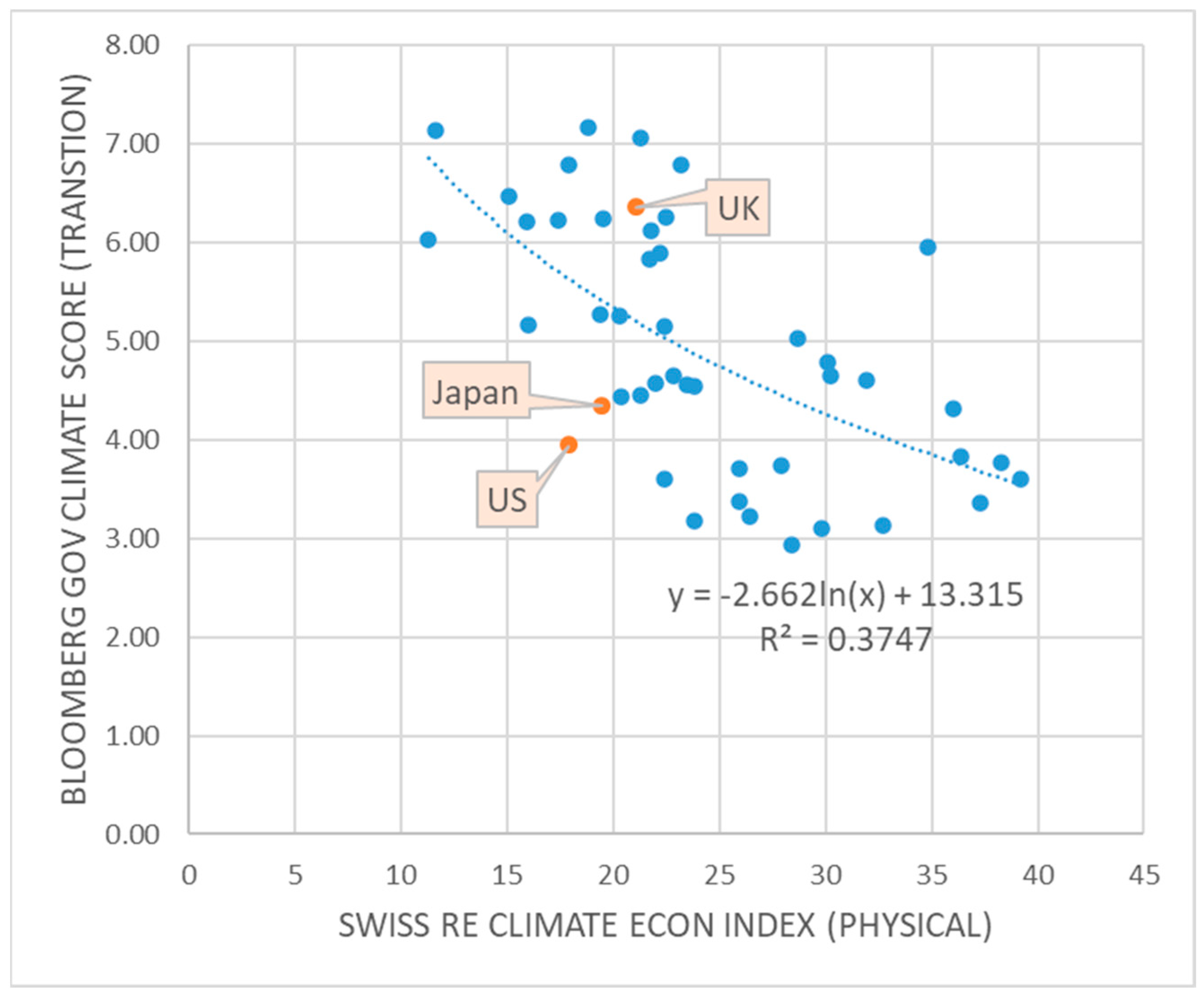
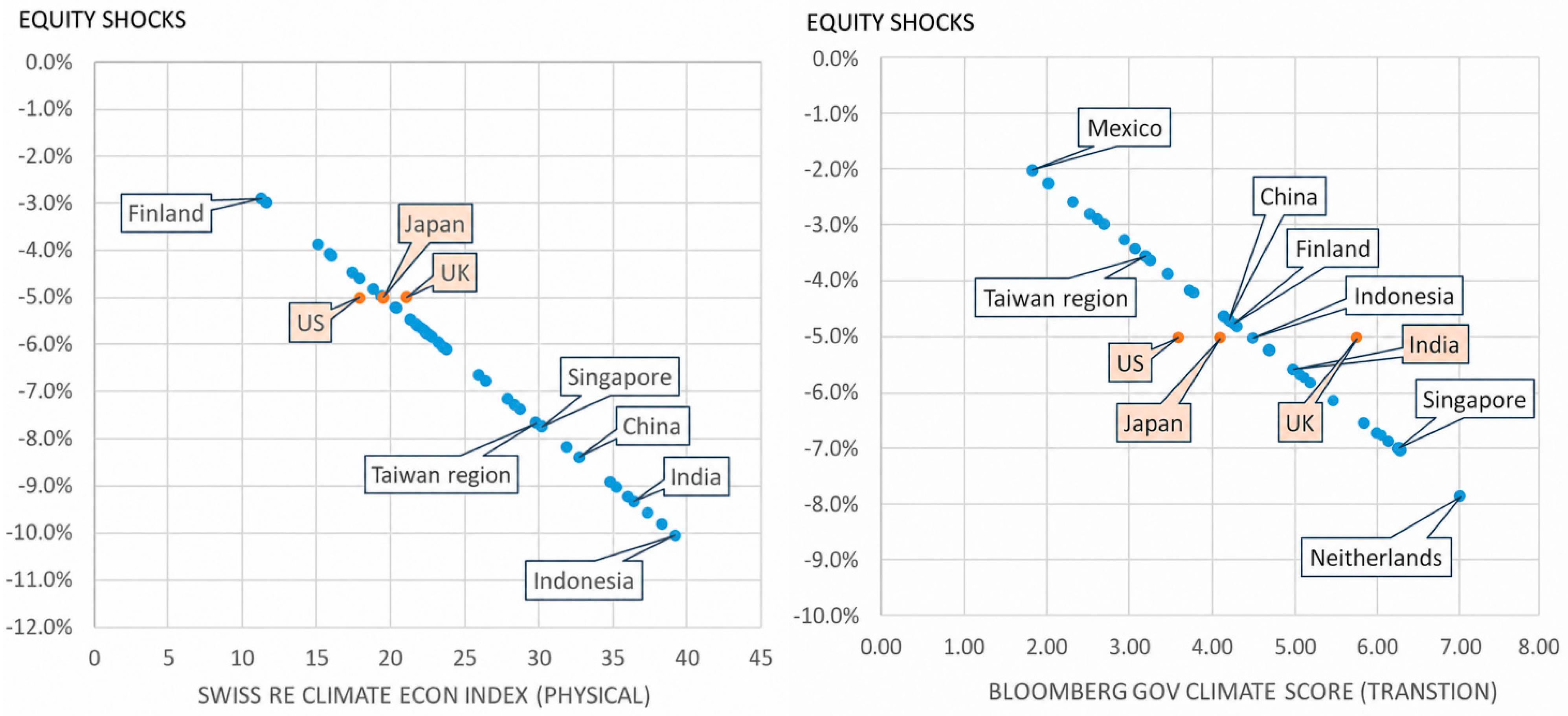
4. Scaling Shocks Using Country Sensitivity to Climate Risk
- is the equity shock of country ;
- is the score for country .
- is the score of country ;
- .
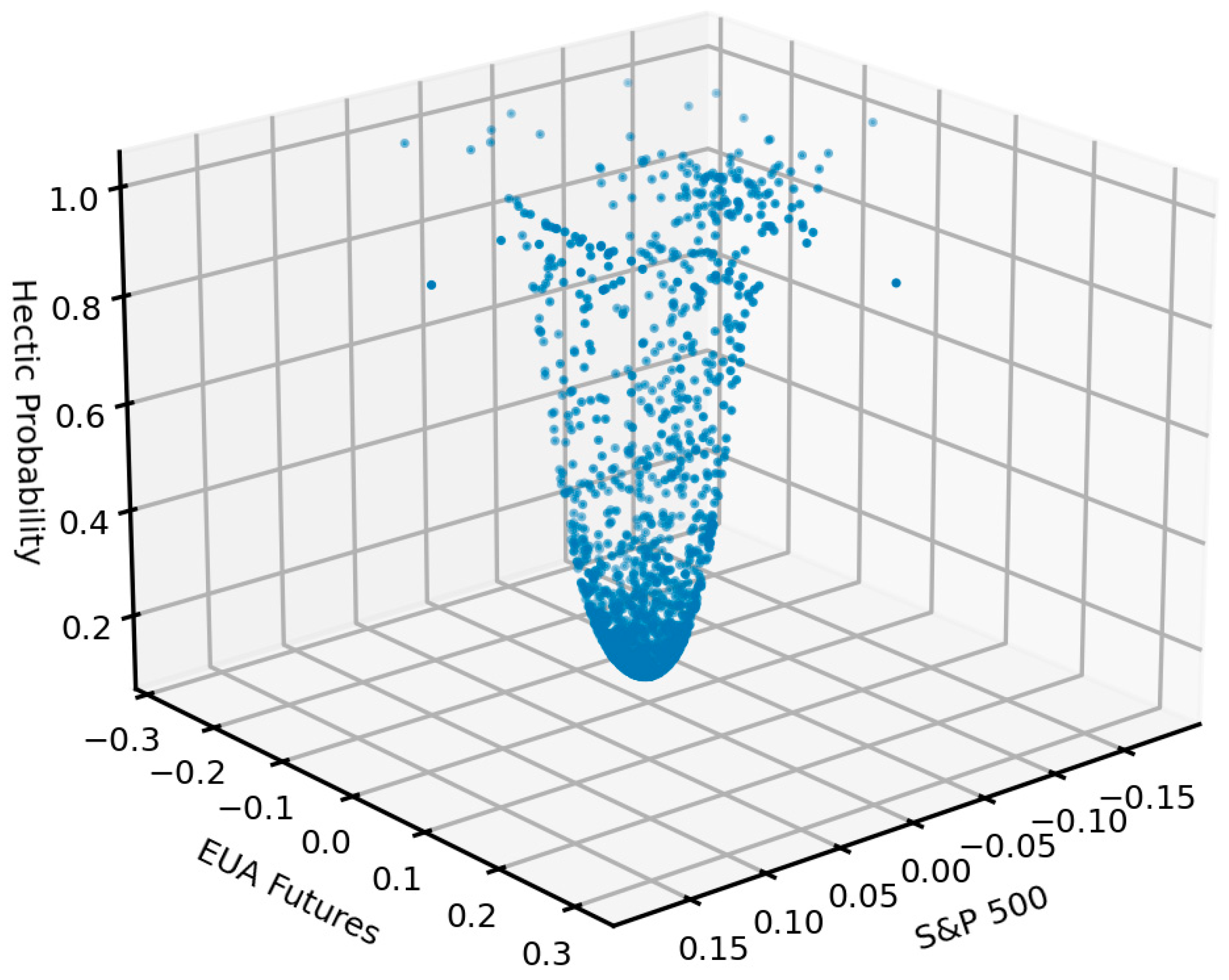
5. Inference Using Broken Arrow Stress Test Model
5.1. Two Regime Specification
5.2. Linear Inference Model
- denotes the vector of the estimated number of peripheral asset shocks .
- denotes the vector of the number of core asset shocks .
- denotes the matrix of transmission coefficients.
- denotes the vector of residuals with mean zero and covariance matrix .
- denotes the multivariate normal distribution on quiet days.
- denotes the multivariate normal distribution on hectic days.
- denotes the mean, denotes the standard deviation, and denotes the correlation.
- is a diagonal matrix containing weights that are the reciprocal of each error variance.
- is the weight of hectic multivariate normal distribution in the Gaussian Mixture Model.
- denotes the multivariate normal density, e.g., hectic-regime density :
- is the covariance matrix, and is the matrix determinant.
- is the mean vector.
5.3. Numerical Example
6. Direct Impact Calculation for Freight Markets
6.1. Transition Risk (Carbon Cost Calculation)
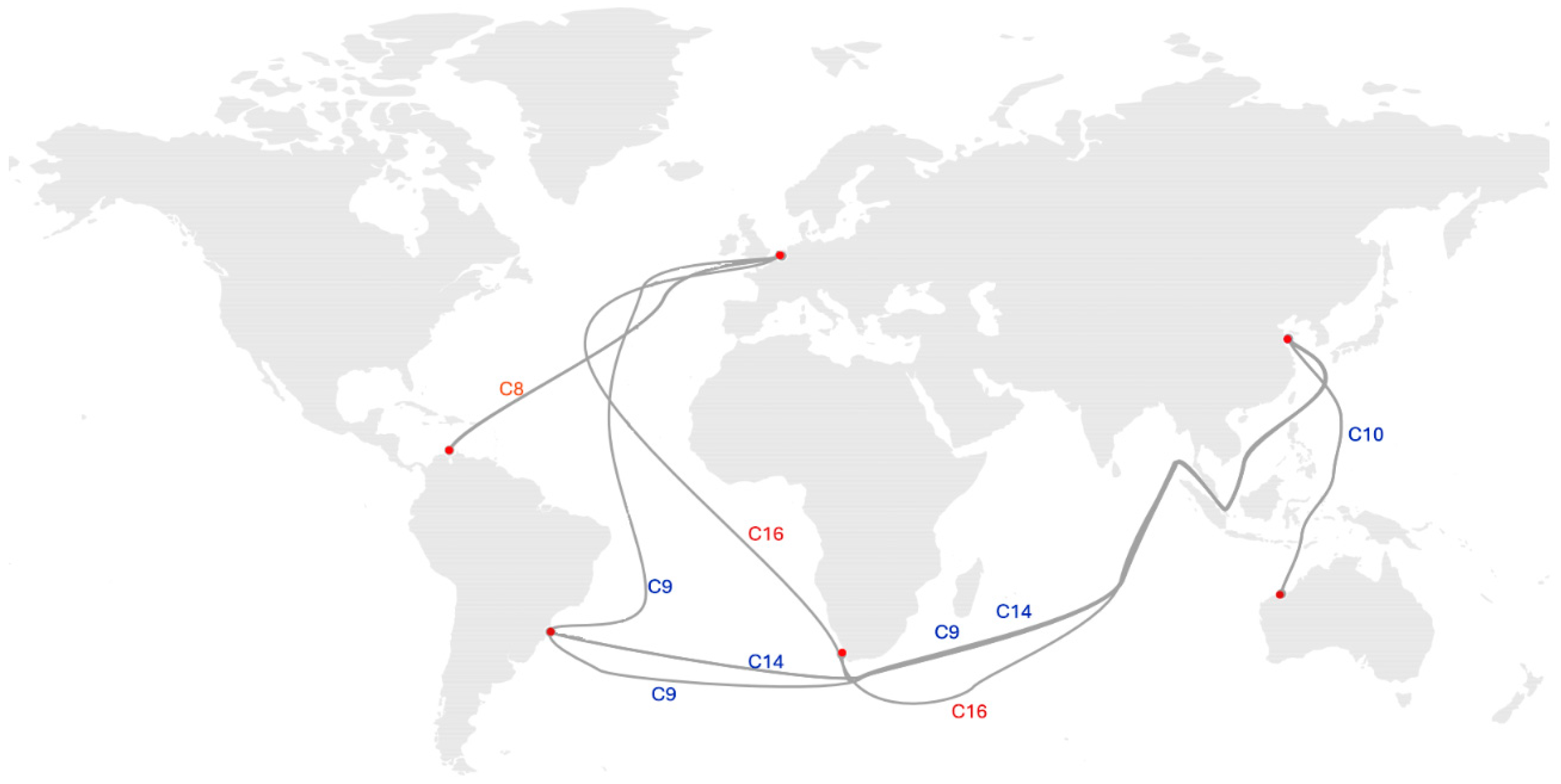
- The weights and voyage durations of each route in the Baltic indices were sourced from Baltic Exchange Information Services Ltd. (2025);
- CO2 emission for each route5 (https://emissions.balticexchange.com/en/calculators.html, accessed on 3 February 2026);
- EUA Futures price and rules for EU ETS guidelines for maritime transport (https://climate.ec.europa.eu/, accessed on 1 October 2024).
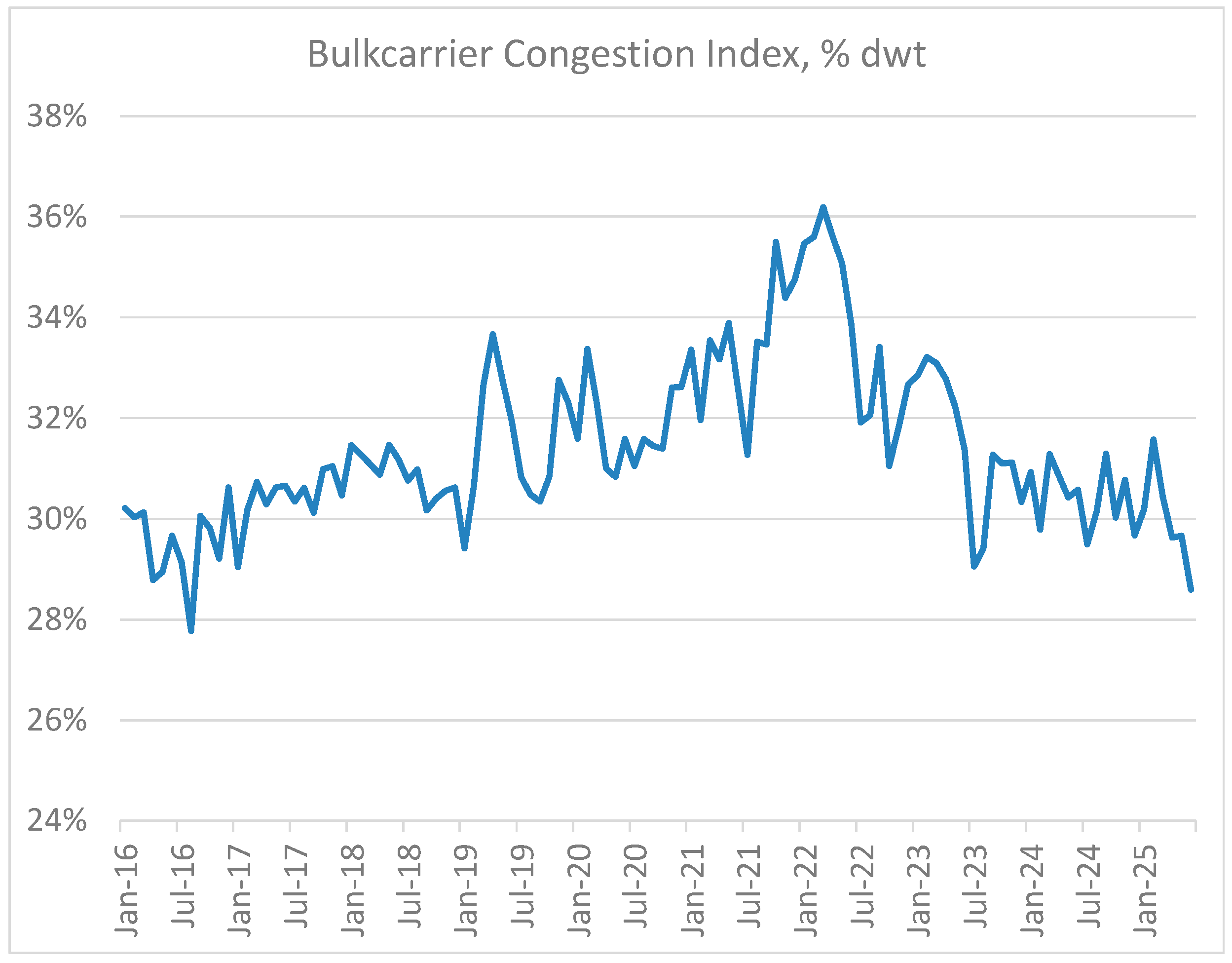
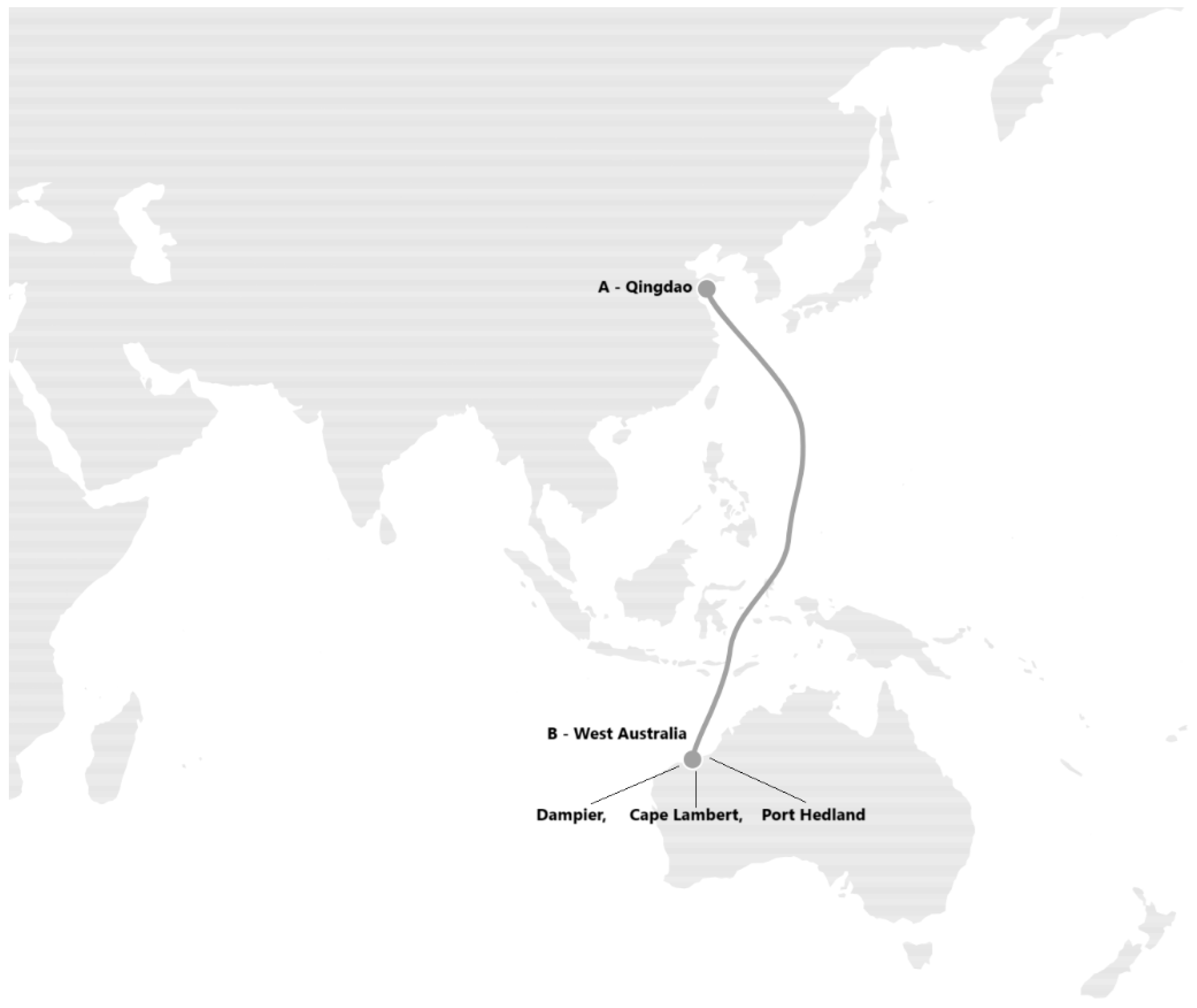
6.2. Physical Risk (Congestion Modelling)
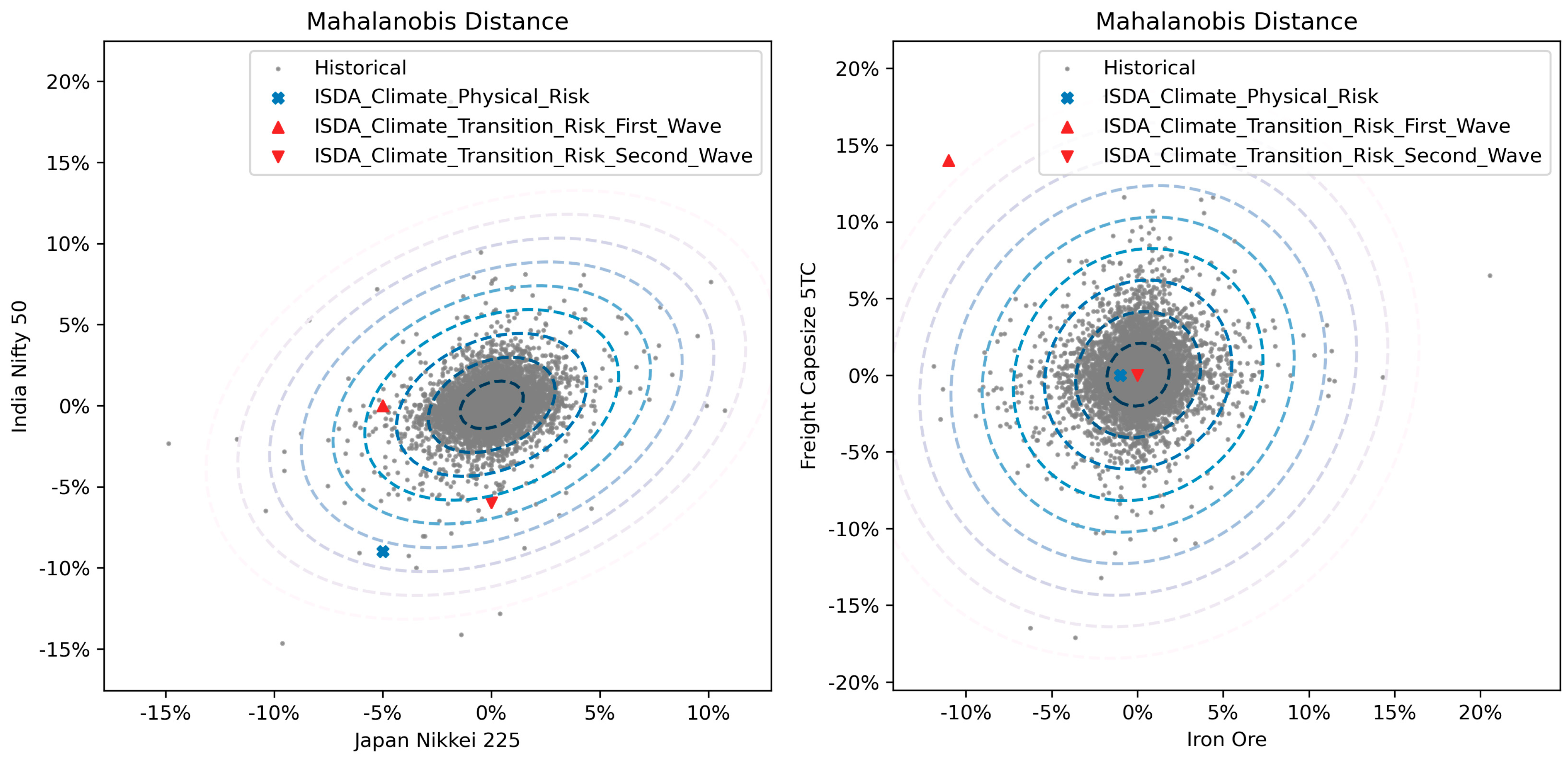
7. Intensity of Climate Stress Scenarios
- (i)
- A global extreme weather catastrophe (physical risk);
- (ii)
- A coordinated policy response by climate-ready countries (transition risk, first wave);
- (iii)
- A delayed policy response by other countries (transition risk, second wave).
8. Further Discussion: Portfolio Aggregation of Climate Risks
Author Contributions
Funding
Institutional Review Board Statement
Informed Consent Statement
Data Availability Statement
Acknowledgments
Conflicts of Interest
Appendix A. Climate Risk Scores

| PHYSICAL RISK | TRANSITION RISK | |||||||||
|---|---|---|---|---|---|---|---|---|---|---|
| COUNTRY/ REGION | GDP Impact | Dry Index | Wet Index | Adaptive Capacity | Swiss Re Climate Econ Index | Bloomberg Government Climate Score | Carbon Transition Score | Power Sector Transition Score | Climate Policy Score | Bloomberg Government Climate Score 2024 |
| Finland | 3 | 8 | 32 | 8 | 11.3 | 5.92 | 5.74 | 8.42 | 4.24 | 6.03 |
| Switzerland | 4 | 12 | 37 | 2 | 11.6 | 7.03 | 8.10 | 7.56 | 5.83 | 7.13 |
| Austria | 7 | 15 | 41 | 6 | 15.1 | 6.41 | 6.04 | 8.33 | 5.19 | 6.46 |
| Portugal | 9 | 21 | 30 | 10 | 15.9 | 6.12 | 8.27 | 7.74 | 3.23 | 6.21 |
| Canada | 12 | 18 | 20 | 16 | 16 | 4.71 | 4.86 | 6.00 | 4.67 | 5.16 |
| Norway | 6 | 29 | 34 | 10 | 17.4 | 6.2 | 5.93 | 7.85 | 5.05 | 6.23 |
| United States | 13 | 34 | 12 | 16 | 17.9 | 3.95 | 3.55 | 4.72 | 3.59 | 3.94 |
| Sweden | 10 | 28 | 36 | 7 | 17.9 | 6.67 | 6.53 | 8.54 | 5.46 | 6.79 |
| Denmark | 1 | 40 | 48 | 3 | 18.8 | 7.06 | 6.93 | 8.86 | 5.85 | 7.17 |
| Germany | 17 | 25 | 45 | 1 | 19.4 | 5.26 | 4.25 | 5.34 | 6.28 | 5.26 |
| Japan | 22 | 35 | 16 | 9 | 19.5 | 4.3 | 4.76 | 4.19 | 4.09 | 4.34 |
| Spain | 14 | 17 | 31 | 19 | 19.5 | 6.06 | 6.85 | 6.83 | 5.11 | 6.24 |
| Greece | 28 | 3 | 25 | 21 | 20.3 | 5.18 | 5.77 | 6.81 | 3.45 | 5.26 |
| Australia | 33 | 16 | 17 | 13 | 20.4 | 4.39 | 4.99 | 4.17 | 4.17 | 4.43 |
| United Kingdom | 11 | 36 | 47 | 4 | 21.1 | 6.13 | 6.66 | 6.66 | 5.76 | 6.35 |
| Turkey | 15 | 4 | 26 | 36 | 21.3 | 4.46 | 4.69 | 4.91 | 3.78 | 4.45 |
| Netherlands | 5 | 26 | 46 | 18 | 21.3 | 6.94 | 7.33 | 6.83 | 7.00 | 7.06 |
| New Zealand | 29 | 2 | 27 | 24 | 21.7 | 5.47 | 6.60 | 6.71 | 4.31 | 5.83 |
| Italy | 31 | 7 | 33 | 15 | 21.8 | 6.06 | 6.65 | 5.67 | 6.04 | 6.12 |
| Korea, Republic Of (South) | 24 | 30 | 14 | 20 | 22 | 4.53 | 5.18 | 3.91 | 4.68 | 4.58 |
| Hungary | 19 | 9 | 39 | 23 | 22.2 | 5.74 | 6.45 | 5.15 | 6.13 | 5.90 |
| Romania | 21 | 5 | 35 | 27 | 22.4 | 5.13 | 5.89 | 5.42 | 4.22 | 5.16 |
| United Arab Emirates | 41 | 6 | 1 | 29 | 22.4 | 3.7 | 3.50 | 4.71 | 2.68 | 3.59 |
| Belgium | 8 | 27 | 42 | 21 | 22.5 | 6.14 | 6.71 | 6.22 | 5.85 | 6.26 |
| Hong Kong | 35 | 39 | 2 | 13 | 22.6 | N/A | 6.75 | 3.38 | N/A | N/A |
| Ukraine | 2 | 10 | 38 | 42 | 22.8 | 4.68 | 6.06 | 5.20 | 2.93 | 4.64 |
| France | 26 | 19 | 40 | 12 | 23.2 | 6.68 | 6.97 | 7.42 | 6.00 | 6.78 |
| Argentina | 20 | 22 | 10 | 37 | 23.5 | 4.56 | 4.29 | 5.17 | 4.26 | 4.56 |
| Mexico | 25 | 20 | 15 | 31 | 23.8 | 3.17 | 3.32 | 4.65 | 1.81 | 3.18 |
| Egypt | 23 | 11 | 3 | 47 | 23.8 | 4.87 | 7.53 | 4.15 | 2.51 | 4.54 |
| Russian Federation | 27 | 13 | 28 | 32 | 25.9 | 3.32 | 1.85 | 4.74 | 3.78 | 3.37 |
| Poland | 16 | 24 | 44 | 25 | 25.9 | 3.63 | 3.46 | 3.93 | 3.72 | 3.70 |
| Czech Republic | 18 | 23 | 43 | 26 | 26.4 | 3.04 | 3.74 | 4.09 | 2.01 | 3.23 |
| Saudi Arabia | 43 | 14 | 4 | 38 | 27.9 | 4.19 | 3.82 | 4.97 | 2.59 | 3.74 |
| South Africa | 37 | 1 | 18 | 45 | 28.4 | 2.9 | 2.80 | 2.74 | 3.24 | 2.93 |
| Chile | 39 | 31 | 9 | 30 | 28.7 | 4.9 | 5.03 | 6.01 | 4.13 | 5.03 |
| Taiwan region | 40 | 41 | 6 | 28 | 29.8 | 3.02 | 2.27 | 3.94 | 3.17 | 3.10 |
| Brazil | 34 | 42 | 8 | 33 | 30.1 | 4.74 | 4.20 | 7.38 | 3.16 | 4.79 |
| Singapore | 47 | 44 | 29 | 5 | 30.2 | 4.53 | 4.31 | 3.57 | 6.24 | 4.65 |
| Peru | 30 | 46 | 7 | 41 | 31.9 | 4.56 | 5.00 | 5.97 | 3.06 | 4.61 |
| China | 38 | 33 | 21 | 35 | 32.7 | 3.16 | 1.44 | 4.11 | 4.18 | 3.13 |
| Colombia | 36 | 38 | 22 | 40 | 34.8 | 5.88 | 4.60 | 7.11 | 6.26 | 5.95 |
| Venezuela | 32 | 32 | 24 | 48 | 35.2 | N/A | N/A | N/A | N/A | N/A |
| Thailand | 45 | 43 | 11 | 39 | 36 | 4.31 | 5.69 | 3.20 | 4.19 | 4.31 |
| India | 42 | 37 | 13 | 46 | 36.4 | 3.9 | 3.12 | 3.50 | 4.98 | 3.83 |
| Philippines | 46 | 48 | 5 | 43 | 37.3 | 3.36 | 4.51 | 3.39 | 2.31 | 3.36 |
| Malaysia | 48 | 47 | 23 | 33 | 38.3 | 3.72 | 4.42 | 3.47 | 3.44 | 3.77 |
| Indonesia | 44 | 45 | 19 | 44 | 39.2 | 3.58 | 3.66 | 2.72 | 4.49 | 3.59 |
| 1 | COP 21 refers to the 21st annual Conference of the Parties to the United Nations Framework Convention on Climate Change (UNFCCC). This significant event was held in Paris, France, from 30 November to 12 December 2015. |
| 2 | Carbon pricing is a policy tool used to internalize the external costs of carbon emissions by assigning a monetary value to each tonne of CO2 emitted, thereby reflecting the cost to society from carbon emissions. This mechanism also serves to represent climate transition risk by incentivizing businesses and individuals to reduce their carbon footprint, thus mitigating the financial impacts associated with transitioning to a low-carbon economy. |
| 3 | Circular 30/23-Market Announcement: Panellist Guidance for EU ETS (Dry Routes). |
| 4 | EU ETS imposes an obligation on EU Member States to implement necessary measures to enable a shipping company to seek reimbursement of the costs arising out of the surrender of EUAs for a ship from a third party who, pursuant to a contractual arrangement, is responsible for purchasing the fuel or “operating the ship” (Article 3gc, EU ETS), i.e., the time charterer and, in some cases, a voyage charterer. |
| 5 | Based on the source reference, we have selected the total CO2 emission data for Standard Baltic Vessels travelling at Eco speed which is common nowadays. |
| 6 | Mahalanobis distance, introduced by Mahalanobis (1936), is a measure of the distance between a data point and the mean of a multivariate distribution. This unitless and scale-invariant metric is particularly useful for scoring extreme events by quantifying the extent to which a given scenario deviates from historical norms. |
References
- Acharya, V. V., Berner, R., Engle, R., Jung, H., Stroebel, J., Zeng, X., & Zhao, Y. (2023). Climate stress testing. Annual Review of Financial Economics, 15, 291–326. [Google Scholar] [CrossRef]
- Alessi, L., & Battiston, S. (2022). Two sides of the same coin: Green taxonomy alignment versus transition risk in financial portfolios. International Review of Financial Analysis, 84, 102319. [Google Scholar] [CrossRef]
- Baltic Exchange Information Services Ltd. (2025). Guide to market benchmarks (Version 7.01). Baltic Exchange. [Google Scholar]
- Bank of England. (2021). Key elements of the 2021 biennial exploratory scenario: Financial risks from climate change (Report). Bank of England. Available online: https://www.bankofengland.co.uk/stress-testing/2021/key-elements-2021-biennial-exploratory-scenario-financial-risks-climate-change (accessed on 1 October 2024).
- Barnett, M., Brock, W., & Hansen, L. P. (2023). Climate change uncertainty spillover in the macroeconomy. NBER Macroeconomics Annual, 36(1), 253–320. [Google Scholar] [CrossRef] [PubMed]
- Barro, R. J. (2015). Environmental protection, rare disasters and discount rates. Economica, 82(325), 1–23. [Google Scholar] [CrossRef]
- Board of Governors of the Federal Reserve System. (2023). Pilot climate scenario analysis exercise. Participation Instructions. Available online: https://www.federalreserve.gov/publications/files/csa-instructions-20230117.pdf (accessed on 1 October 2024).
- Bolton, P., & Kacperczyk, M. T. (2023). Firm commitments (NBER Working Paper, 31244). National Bureau of Economic Research. [Google Scholar]
- European Commission. (2024). Guidance document: The EU ETS and MRV maritime general guidance for shipping companies. European Commission. [Google Scholar]
- Giglio, S., Kelly, B., & Stroebel, J. (2024). Climate finance. Annual Review of Financial Economics, 13(1), 15–36. [Google Scholar] [CrossRef]
- International Swaps and Derivatives Association (ISDA). (2024). Climate risk scenario analysis for the trading book (phase 2). ISDA. Available online: https://www.isda.org/2023/07/12/a-conceptual-framework-for-climate-scenario-analysis-in-the-trading-book/ (accessed on 1 October 2024).
- Kim, J., & Finger, C. C. (2000). A stress test to incorporate correlation breakdown. Journal of Risk, 2(3), 5–19. [Google Scholar] [CrossRef]
- Mahalanobis, P. C. (1936). On the generalized distance in statistics. Proceedings of the National Institute of Sciences of India, 2, 49–55. [Google Scholar]
- McKay, D. I., Staal, A., Abrams, J. F., Winkelmann, R., Sakschewski, B., Loriani, S., Fetzer, I., Cornell, S. E., Rockström, J., & Lenton, T. M. (2022). Exceeding 1.5 °C global warming could trigger multiple climate tipping points. Science, 377, eabn7950. [Google Scholar] [CrossRef] [PubMed]
- Michail, N. A., & Melas, K. D. (2025). Measuring the impact of port congestion on containership freight rates. Maritime Transport Research, 8, 100130. [Google Scholar] [CrossRef]
- Network for Greening the Financial System (NGFS). (2019). Origin and purpose (Fact Sheet). NGFS. Available online: https://www.ngfs.net/en/about-us/governance/origin-and-purpose (accessed on 1 October 2024).
- Network for Greening the Financial System (NGFS). (2025). NGFS short-term climate scenarios technical documentation V1.0 (Report). NGFS. [Google Scholar]
- Nordhaus, W. D., & Boyer, J. (2000). Warming the world. MIT Press. [Google Scholar]
- Pankratz, N., Bauer, R., & Derwall, J. (2023). Climate change, firm performance, and investor expectations. Journal of Environmental Economics and Management, 104, 102362. [Google Scholar]
- Stroebel, J., & Wurgler, J. (2021). What do you think about climate finance? Journal of Financial Economics, 142(2), 487–498. [Google Scholar] [CrossRef]
- Swiss Re Institute. (2021). The economics of climate change. Available online: https://www.swissre.com/institute/research/topics-and-risk-dialogues/climate-and-natural-catastrophe-risk/expertise-publication-economics-of-climate-change.html (accessed on 1 October 2024).
- Verschuur, J., Koks, E. E., & Hall, J. W. (2020). Port disruptions due to natural disasters: Insights into port and logistics resilience. Transportation Research Part D: Transport and Environment, 85, 102393. [Google Scholar] [CrossRef]
- Verschuur, J., Koks, E. E., Li, S., & Hall, J. W. (2023). Multi-hazard risk to global port infrastructure and resulting trade and logistics losses. Communications Earth & Environment, 4, 5. [Google Scholar] [CrossRef]
- Weitzman, M. L. (2012). Rare disasters, tail-hedged investments, and risk-adjusted discount rates (NBER Working Paper, 18496). National Bureau of Economic Research. [Google Scholar]
- Weitzman, M. L. (2014). Fat tails and the social cost of carbon. American Economic Review, 104(5), 544–546. [Google Scholar] [CrossRef]


| Asset Class | Product | Financial Model |
|---|---|---|
| Equity | Japan Nikkei 225 | [by ISDA] Fama French 5 Factor Model |
| US S&P 500 | ||
| UK FTSE 100 | ||
| FTSE China A50 Index | [by this paper] Scaling of ISDA shocks using country sensitivity to climate risk | |
| FTSE Taiwan RIC Capped Index * | ||
| India Nifty 50 Index | ||
| MSCI Singapore Index | ||
| FX | USD/INR, USD/JPY, USD/BRL | [by ISDA] XGBoost Regressor–GBP Purchasing Power Parity |
| USD/CNH, USD/SGD, etc. | [by this paper] Inference using Broken Arrow Stress Test | |
| Commodities | Coal | [by ISDA] Regression on agent-based model macroeconomic outputs |
| WTI Crude | ||
| Iron Ore | [by this paper] Inference using Broken Arrow Stress Test | |
| Petrochemical, e.g., Paraxylene | [by this paper] Inference using Broken Arrow Stress Test | |
| Dairy Product | [by this paper] Inference using Broken Arrow Stress Test | |
| Freight Futures (also for FFA) | [by this paper] Congestion modelling, carbon tax calculation |
| Robustness Test | Change to Assumption | Result |
|---|---|---|
| Climate score perturbation | ±10%, ±20% | Ranking broadly unchanged |
| Alternative core weights | Equal-weight vs. leave-one-out | Similar shock magnitudes |
| Log scaling | Log(1 + x) transformation | Reduced tail magnitude |
| Percentile scaling | Rank-based scaling | Preserves relative ordering |
| Model | Weight, | Mean, | Covariance Matrix, | Log-Likelihood |
|---|---|---|---|---|
| Unconditional, | 1.00 | [0.2985, 0.4457] | [6.6609, 2.9267] [2.9267, 28.3043] | −8374.21 |
| Conditional on quiet days, | 0.81 | [0.6995, 0.3506] | [1.9454, 1.3539] [1.3539, 17.7022] | −8203.29 |
| Conditional on hectic days, | 0.19 | [−0.3474, 0.5988] | [13.5813, 5.6208] [5.6208, 45.3461] |
| Unconditional Correlation | Correlation Conditional on Hectic Days | |||||||||||
|---|---|---|---|---|---|---|---|---|---|---|---|---|
| EUA | USDINR | Nikkei | S&P | Brent Crude | Coal | EUA | USDINR | Nikkei | S&P | Brent Crude | Coal | |
| Iron Ore | 0.002 | −0.022 | −0.002 | 0.082 | 0.050 | 0.045 | −0.075 | −0.003 | 0.066 | 0.133 | 0.090 | −0.010 |
| USDCNH | −0.011 | 0.015 | −0.023 | −0.110 | −0.045 | −0.023 | −0.035 | 0.030 | −0.078 | −0.161 | −0.069 | 0.039 |
| USDSGD | −0.033 | −0.008 | −0.074 | −0.181 | −0.079 | 0.018 | −0.064 | 0.011 | −0.215 | −0.284 | −0.178 | 0.095 |
| KRWUSD | 0.030 | 0.018 | 0.030 | 0.119 | 0.003 | −0.026 | 0.051 | 0.036 | 0.095 | 0.175 | 0.042 | −0.067 |
| Marine Oil | −0.034 | −0.031 | 0.031 | 0.101 | 0.249 | 0.021 | −0.095 | −0.020 | 0.053 | 0.145 | 0.279 | 0.029 |
| Paraxylene | −0.039 | −0.063 | 0.033 | 0.104 | 0.219 | 0.025 | −0.103 | −0.017 | 0.083 | 0.165 | 0.285 | 0.039 |
| Rubber | 0.030 | −0.054 | 0.026 | 0.137 | 0.123 | 0.004 | 0.049 | −0.050 | 0.104 | 0.224 | 0.187 | 0.002 |
| Lithium | 0.042 | 0.013 | 0.037 | 0.024 | 0.059 | 0.077 | 0.015 | 0.043 | 0.056 | 0.052 | 0.124 | 0.151 |
| Milk Powder | −0.009 | 0.000 | 0.012 | 0.032 | 0.089 | 0.070 | −0.028 | 0.004 | 0.049 | 0.099 | 0.162 | 0.032 |
| Routes | Index Weight (a) | CO2 Ton per Day (b) | EU ETS Accounting (c) | CO2 Cost/Day = (a) (b) (c) USD 82.5 |
|---|---|---|---|---|
| C8_14: Gibraltar/Hamburg transatlantic round voyage | 25.0% | 111.56 | 50% | USD 1150 |
| C9_14: Continent/Mediterranean trip China–Japan | 12.5% | 107.35 | 50% | USD 553 |
| C10_14: China–Japan transpacific round voyage | 25.0% | 97.27 | 0% | - |
| C14: China–Brazil round voyage | 25.0% | 118.52 | 0% | - |
| C16: Revised backhaul | 12.5% | 106.01 | 50% | USD 547 |
| Total weight 100% | Total CO2 cost/day = USD 2250 |
| Port Closure Scenario | g = 10% | g = 30% | g = 50% Baseline | g = 70% | g = 90% |
|---|---|---|---|---|---|
| Amsterdam/Antwerp/ Rotterdam/Hamburg | +0.28% | +0.84% | +1.40% | +1.96% | +2.52% |
| Qingdao | +0.61% | +1.83% | +3.05% | +4.27% | +5.49% |
| South Korea: Pohang/Yeosu/Busan | +0.20% | +0.60% | +1.00% | +1.40% | +1.80% |
| Japan: Kobe/Nagoya | +0.20% | +0.60% | +1.00% | +1.40% | +1.80% |
| Index Weight | Routes | Description of Route | Delivery Ports | Passthrough or Loading Ports | Redelivery Ports |
|---|---|---|---|---|---|
| 0.25 | C8_14: Gibraltar/ Hamburg transatlantic round voyage | Delivery Gibraltar– Hamburg range, laydays/cancelling 3/10 days from index date, 1 transatlantic round voyage, of 30/45 days, redelivery Gibraltar–Hamburg range. Basis: Baltic capesize vessel. Total commission: 5%. | Amsterdam/ Antwerp/ Rotterdam/Hamburg | Columbia–Puerto Bolivar/Puerto Drummond | Redelivery same as delivery |
| Brazil–Tubarao/ Ponta Da Madeira | |||||
| East Coast Canada–Seven Islands/Port Cartier/Pointe Noire | |||||
| 0.125 | C9_14: Continent/ Mediterranean trip China–Japan trip | Delivery Amsterdam– Rotterdam–Antwerp range or passing Passero, laydays/cancelling 3/10 days from index date, redelivery China–Japan range, duration about 65 days. Basis: Baltic capesize vessel. Total commission: 5%. | Amsterdam/ Antwerp/ Rotterdam/Hamburg | East Coast Canada–Seven Islands/Port Cartier/Pointe Noire | China–Qingdao/ Rizhao/ Lianyungang/ Caofeidian |
| Norway–Narvik | South Korea– Pohang/Yeosu/Busan | ||||
| Japan–Kobe/Nagoya | |||||
| 0.25 | C10_14: China–Japan transpacific round voyage | Delivery China–Japan range, laydays/cancelling 3/10 days from index date, redelivery China–Japan range, duration 30–40 days. Basis: Baltic capesize vessel. Total commission: 5%. | China–Qingdao/ Rizhao/ Lianyungang/ Caofeidian | West Australia–Dampier/ Port Walcott/ Port Hedland/ Stanley Point | Redelivery ports same as delivery |
| South Korea– Pohang/Yeosu/Busan | East Australia– Newcastle/ Abbot Point/ Gladstone | ||||
| Japan–Kobe/Nagoya | |||||
| 0.25 | C14: China–Brazil round voyage | Delivery Qingdao 15–25 days after sailing Qingdao, round voyage via Brazil or West Africa, redelivery China–Japan range, duration 80–90 days. Basis: Baltic capesize vessel. Total commission: 5%. | Qingdao | Brazil–Tubarao/Sudeste/Itaguai/CSN | China–Qingdao/ Rizhao/ Lianyungang/ Caofeidian |
| West Africa–Freetown/Kamsar/Pepel | South Korea–Pohang/Yeosu/Busan | ||||
| Japan–Kobe/Nagoya | |||||
| 0.125 | C16: Revised backhaul | Delivery North China–South Japan range, 3–10 days from index date for a trip via Australia, Indonesia, US West Coast, South Africa or Brazil, redelivery UK-Cont-Med within Skaw–Passero range, duration to be adjusted to 65 days. Basis: Baltic capesize vessel. Total commission: 5%. | Australia–Haypoint/ Newcastle | ||
| China–Qingdao/ Rizhao/ Lianyungang/ Caofeidian | Indonesia–Taboneo/ Samarinda/Tanjong Bara | Amsterdam/ Antwerp/ Rotterdam/Hamburg | |||
| South Korea– Pohang/Yeosu/Busan | US West Coast–Long Beach | Djen-Djen/El Dekheila | |||
| Japan–Kobe/Nagoya | South Africa–Saldanha Bay/Richards Bay Coal Terminal | ||||
| Brazil–Tubarao/ Ponta Ubu |
| Routes | Index Weight | Voyage Days | Amsterdam/Antwerp/Rotterdam/Hamburg | Qingdao | South Korea–Pohang/Yeosu/Busan | Japan–Kobe/Nagoya |
|---|---|---|---|---|---|---|
| C8_14: Gibraltar/Hamburg transatlantic round voyage | 0.25 | 55 | 3.80% | |||
| C9_14: Continental/Mediterranean trip China–Japan | 0.125 | 68 | 2.00% | 0.90% | 0.90% | 0.90% |
| C10_14: China–Japan transpacific round voyage | 0.25 | 37 | 2.10% | 2.10% | 2.10% | |
| C14: China–Brazil round voyage | 0.25 | 93 | 9.00% | 1.00% | 1.00% | |
| C16: Revised backhaul | 0.125 | 49 | 1.90% | 1.30% | 1.30% | 1.30% |
| Impact on index | 1.40% | 3.05% | 1.00% | 1.00% |
| Methodology | Asset | 1. Physical Risk Scenario | 2. Transition Risk Tier 1 | 3. Transition Risk Tier 2 |
|---|---|---|---|---|
| Scaling method (using Country Climate Index) | Japan equities | −5% | −5% | |
| China equities | −8% | −5% | ||
| India equities | −9% | −6% | ||
| Singapore equities | −8% | −7% | ||
| Taiwan region equities | −8% | −4% | ||
| Inference (using Broken Arrow Stress Test) | INR against USD | Appreciate by 5% | Appreciate by 5% | |
| JPY against USD | +0% | 0% | ||
| CNH against USD | Appreciate by 1% | Appreciate by 1.5% | ||
| Thermal and coking coal | −10% | −10% | ||
| Iron ore, all grades | −1% | −11% | ||
| Marine oil | +0% | −11% | ||
| Paraxylene | +0% | −9% | ||
| Rubber | +0% | +5% | ||
| Lithium | −1% | +2% | ||
| Milk powder | +0% | −1% | ||
| Carbon cost direct calculation | Capesize CW 5-route | +3% | +20% | |
| Panamax PW 5-route | +3% | +12.4% | ||
| Panamax PV 4-route | +3% | +22.7% | ||
| Supramax SW 10-route | +3% | +6.6% |
| Stress Scenario | Mahalanobis Distance |
|---|---|
| Global_Financial_Crisis_Oct_2008 | 19.25 |
| ISDA_Climate_Transition_Risk_First_Wave | 19.02 |
| Asian_Crisis_Jan_1998 | 15.24 |
| ISDA_Climate_Physical_Risk | 13.63 |
| Carry_Trade_Unwinding_Aug_2024 | 12.54 |
| China_Stock_Market_Stress_Jul_2015 | 12.08 |
| COVID_19_Pandemic_Mar 2020 | 11.88 |
| ISDA_Climate_Transition_Risk_Second_Wave | 9.99 |
Disclaimer/Publisher’s Note: The statements, opinions and data contained in all publications are solely those of the individual author(s) and contributor(s) and not of MDPI and/or the editor(s). MDPI and/or the editor(s) disclaim responsibility for any injury to people or property resulting from any ideas, methods, instructions or products referred to in the content. |
© 2026 by the authors. Licensee MDPI, Basel, Switzerland. This article is an open access article distributed under the terms and conditions of the Creative Commons Attribution (CC BY) license.
Share and Cite
Wong, M.; Ge, P. Bridging the Last Mile: A Transmission Channel Framework for Derivatives Stress Testing Under Climate Scenarios. J. Risk Financial Manag. 2026, 19, 417. https://doi.org/10.3390/jrfm19060417
Wong M, Ge P. Bridging the Last Mile: A Transmission Channel Framework for Derivatives Stress Testing Under Climate Scenarios. Journal of Risk and Financial Management. 2026; 19(6):417. https://doi.org/10.3390/jrfm19060417
Chicago/Turabian StyleWong, Max, and Patrick Ge. 2026. "Bridging the Last Mile: A Transmission Channel Framework for Derivatives Stress Testing Under Climate Scenarios" Journal of Risk and Financial Management 19, no. 6: 417. https://doi.org/10.3390/jrfm19060417
APA StyleWong, M., & Ge, P. (2026). Bridging the Last Mile: A Transmission Channel Framework for Derivatives Stress Testing Under Climate Scenarios. Journal of Risk and Financial Management, 19(6), 417. https://doi.org/10.3390/jrfm19060417