1. Introduction
Islamic banking has developed as a distinctive financial system grounded in Sharia principles, ethical intermediation, and the broader objectives of Maqasid al-Shariah. Unlike conventional banking, Islamic banking is not only expected to achieve financial efficiency but also to promote justice, transparency, risk sharing, and social welfare. These normative foundations make Islamic banks closely aligned with the global sustainability agenda, particularly because Maqasid al-Shariah emphasizes the protection of faith, life, intellect, lineage, and wealth, while the Sustainable Development Goals (SDGs) promote inclusive, responsible, and sustainable economic development (
Jan et al., 2021;
Mergaliyev et al., 2021;
Rahim et al., 2024).
The growing importance of sustainability in financial markets has increased pressure on banks to integrate environmental, social, economic, and governance considerations into their business models. Sustainable banking is no longer treated merely as a voluntary disclosure practice but as part of institutional legitimacy, risk governance, stakeholder accountability, and long-term financial resilience (
Mir & Bhat, 2022;
Weber & Chowdury, 2020). For Islamic banks, this development creates both an opportunity and a challenge. On the one hand, sustainability principles are conceptually compatible with Islamic financial ethics. On the other hand, the practical implementation of sustainability in Islamic banking remains uneven, particularly when sustainability commitments must be translated into financing decisions, disclosure practices, and measurable performance outcomes.
Previous studies have examined various aspects of Islamic banking sustainability, including Maqasid-based performance, ESG disclosure, green banking practices, and the financial implications of sustainability-oriented strategies (
Alam et al., 2022;
Ammar et al., 2023;
Mohd Zain et al., 2024;
Shalhoob, 2025). These studies provide important insights into the ethical and institutional foundations of sustainability in Islamic finance. However, much of the existing literature still treats sustainability either as a direct determinant of bank performance or as a separate disclosure practice. Less attention has been given to whether sustainability operates as an intermediary mechanism through which Islamic financing structures influence financial performance.
This gap is important because the financing composition of Islamic banks reflects both their operational strategy and their commitment to Sharia-based intermediation. Profit-sharing financing, such as mudharabah and musyarakah, represents the ideal principle of risk and return sharing, but it is often associated with higher monitoring costs, information asymmetry, and agency risk. Debt-based financing, particularly murabahah, ijarah, and istishna, is generally easier to implement and offers more predictable returns, but its dominance may reduce the transformative role of Islamic banking as a risk-sharing and sustainability-oriented financial institution (
Budiman et al., 2021;
Saleem et al., 2024;
Widarjono & Rafik, 2023). Therefore, understanding how these financing structures interact with sustainability practices is essential for explaining the performance dynamics of Islamic banks.
The relationship between Islamic financing and sustainability is also likely to vary across institutional contexts. Indonesia and Malaysia are two major Islamic banking jurisdictions in Southeast Asia, but they differ in regulatory orientation, market maturity, sustainability reporting practices, and Islamic finance governance. These differences may shape how Islamic banks disclose sustainability practices, allocate financing, manage liquidity, and convert sustainability initiatives into profitability. A cross-country comparison is therefore necessary to identify whether the relationships among financing structure, Islamic Sustainable Banking, and bank performance are consistent across jurisdictions or conditioned by national institutional environments.
This study addresses these issues by examining the mediating role of Islamic Sustainable Banking (ISB) in the relationship between Islamic financing structures and bank performance in Indonesia and Malaysia. ISB is measured using an Islamic Sustainable Banking Disclosure Index (ISBDI), which integrates Maqasid al-Shariah principles and SDG-oriented indicators. Using panel data from Islamic banks during 2018–2023 and applying PLS-SEM, mediation analysis, PLS-MGA, and permutation tests, this study evaluates the direct and indirect associations of profit-sharing financing, debt-based financing, and liquidity conditions on bank performance, measured by return on assets and net profit margin.
The theoretical contribution of this study lies in conceptualizing Islamic Sustainable Banking (ISB) as a banking-specific sustainability construct that connects Sharia-based financial intermediation, Maqasid al-Shariah, SDG-oriented disclosure, and bank performance within a single empirical framework. Unlike previous Maqasid-based banking studies that mainly assess ethical performance, Sharia compliance, or sustainability disclosure as separate dimensions, this study positions ISB as an intermediary construct that reflects how Islamic banks translate financing activities, governance responsibilities, and sustainability commitments into disclosed institutional practices. Accordingly, ISB is not treated merely as an extension of a conventional sustainability disclosure index, but as a distinct construct that captures the operational interface between Islamic financing structures and sustainability-oriented value creation.
This framework provides a new theoretical insight by suggesting that the financial relevance of sustainability in Islamic banking is conditional rather than automatic. Sharia-compliant financing does not necessarily produce stronger sustainability outcomes unless it is supported by governance capacity, disclosure quality, institutional commitment, and strategic alignment with Maqasid al-Shariah and the SDGs. Therefore, the study extends the Islamic banking sustainability literature by showing that ISB can function as a transmission mechanism through which financing structures are associated with bank performance. This perspective moves beyond a direct-effect approach and offers a more nuanced explanation of how Islamic financing, sustainability disclosure, and profitability are connected in different institutional settings.
This study contributes to the literature in three ways. First, it develops an integrated ISB framework that links Maqasid al-Shariah and SDG-oriented sustainability disclosure within Islamic banking. Second, it clarifies the transmission mechanism through which financing structures affect financial performance by positioning ISB as a mediating construct rather than merely as a direct predictor. Third, it provides cross-country evidence from Indonesia and Malaysia, showing how institutional settings may condition the relationship between Islamic financing, sustainability practices, and bank performance. The findings indicate that sustainability in Islamic banking functions as a conditional transmission mechanism, suggesting that sustainability disclosure can support profitability only when it is aligned with financing composition, governance capacity, and regulatory design.
2. Literature Review and Hypotheses Development
2.1. Maqasid al-Shariah, Sustainability, and Islamic Sustainable Banking
Islamic banking is rooted in Sharia principles that emphasize justice, transparency, risk sharing, and the protection of public welfare. These principles are closely related to Maqasid al-Shariah, which provides an ethical foundation for financial intermediation by promoting the preservation of faith, life, intellect, lineage, and wealth. In this context, Islamic banks are expected not only to generate financial returns but also to support broader socio-economic objectives through responsible financing, ethical governance, and stakeholder-oriented practices (
Mergaliyev et al., 2021;
Nik Abdullah & Haron, 2022;
Rahim et al., 2024).
The sustainability agenda provides a complementary framework for Islamic banking because the Sustainable Development Goals (SDGs) also emphasize inclusive growth, poverty reduction, responsible consumption, institutional accountability, and environmental protection. The integration of Maqasid al-Shariah and SDG-oriented indicators therefore offers a relevant basis for assessing Islamic banking practices beyond conventional financial performance. Previous studies have shown that sustainability practices in Islamic banking can enhance legitimacy, strengthen stakeholder trust, and improve institutional resilience when they are embedded into governance, disclosure, and financing strategies (
Ammar et al., 2023;
Jan et al., 2021;
Mohd Zain et al., 2024).
Islamic Sustainable Banking (ISB) in this study is conceptualized as a disclosure-based construct that reflects the extent to which Islamic banks report economic, social, environmental, and governance practices aligned with Maqasid al-Shariah and the SDGs. Unlike general ESG disclosure, ISB incorporates faith-based accountability and Sharia-oriented ethical objectives. This approach allows sustainability to be examined not merely as a reputational instrument, but as a mechanism through which Islamic banking values are operationalized in financial intermediation.
It is important to distinguish Islamic Sustainable Banking disclosure from actual sustainability performance. In this study, ISB is measured through the Islamic Sustainable Banking Disclosure Index (ISBDI), which captures the extent to which Islamic banks report policies, practices, governance mechanisms, and implementation evidence related to Maqasid al-Shariah and SDG-oriented sustainability. Therefore, ISBDI reflects disclosed sustainability practices rather than the full realized impact of sustainability implementation. This distinction is important because sustainability reporting may contain both substantive and symbolic elements. Substantive disclosure refers to reporting supported by identifiable policies, quantitative indicators, governance mechanisms, implementation evidence, or performance outcomes. Symbolic disclosure, by contrast, may be used primarily to signal legitimacy without necessarily indicating deep operational integration.
From this perspective, ISB disclosure should be interpreted as an observable representation of sustainability commitment rather than as a complete measure of sustainability impact. Nevertheless, disclosure remains theoretically relevant because banks operate in a highly regulated and stakeholder-sensitive environment where transparency, accountability, and governance communication are important components of institutional legitimacy. In Islamic banking, such disclosure is also connected to Sharia accountability because banks are expected to demonstrate how their activities support ethical intermediation, social welfare, and responsible financial conduct. This study therefore uses ISBDI as a disclosure-based proxy for the institutionalization of Islamic sustainability practices, while acknowledging that future studies may complement disclosure measures with impact-based sustainability indicators.
Building on the conceptual link between Maqasid al-Shariah and sustainability, the next issue concerns how Islamic banks operationalize these principles through financing activities. Financing structure is central to Islamic banking because it reflects not only income generation and risk allocation, but also the extent to which Islamic banks translate Sharia-based intermediation into economic and social outcomes. Therefore, examining profit-sharing and debt-based financing provides an important basis for understanding how Islamic banking practices are connected to sustainability disclosure and financial performance.
2.2. Islamic Financing Structures and Bank Performance
Financing structure is a central feature of Islamic banking because it reflects the way Islamic banks allocate funds, manage risk, and generate income. Profit-sharing financing, particularly mudharabah and musyarakah, represents the ideal form of Islamic financial intermediation because it is based on risk and return sharing. In theory, profit-sharing financing can support real-sector development, entrepreneurial participation, and equitable wealth distribution. However, in practice, this type of financing is often associated with information asymmetry, agency problems, intensive monitoring costs, and uncertainty in income realization (
Budiman et al., 2021;
Kulmie & Omar, 2024;
Saleem et al., 2024).
Debt-based financing, particularly murabahah, ijarah, and istishna, is more widely used in Islamic banking because it offers more predictable returns, clearer contractual structures, and lower operational complexity. Murabahah financing, in particular, has become dominant in many Islamic banking markets due to its simplicity, fixed-margin structure, and relatively lower risk exposure compared with participatory financing. This dominance may improve short-term profitability, but it may also raise questions about the extent to which Islamic banks remain aligned with the risk-sharing ideal of Islamic finance (
Billah et al., 2024;
Ibrahim & Salam, 2021;
Widarjono & Rafik, 2023).
Bank performance in this study is represented by return on assets (ROA) and net profit margin (NPM). ROA reflects the ability of banks to generate profit from total assets, whereas NPM indicates the ability to convert operating income into net earnings. Because profit-sharing and debt-based financing have different risk, monitoring, and income characteristics, both financing structures may influence bank performance differently. Considering the mixed theoretical and empirical expectations, the hypotheses are formulated in a non-directional form:
H1. Profit-sharing financing is significantly associated with ROA.
H2. Profit-sharing financing is significantly associated with NPM.
H3. Debt-based financing is significantly associated with ROA.
H4. Debt-based financing is significantly associated with NPM.
2.3. Islamic Financing Structures and Islamic Sustainable Banking
The relationship between financing structure and Islamic Sustainable Banking is theoretically important because financing activities represent the operational core of Islamic banks. Profit-sharing financing is normatively consistent with Maqasid al-Shariah because it promotes risk sharing, productive investment, and economic participation. However, the practical implementation of profit-sharing contracts may require stronger monitoring systems, more intensive Sharia supervision, and greater transparency in project evaluation. These operational demands may affect the ability of banks to systematically document and disclose sustainability-related practices.
Debt-based financing also has implications for ISB disclosure. Although debt-based contracts such as murabahah and ijarah are Sharia-compliant, their dominance may shift the focus of Islamic banks toward transaction-based income and short-term asset growth. This condition may limit the integration of sustainability considerations into financing design, risk assessment, and impact-based reporting. Banks with higher dependence on debt-based financing may therefore show different levels of ISB disclosure compared with banks that have more diversified financing structures.
Previous studies suggest that the connection between Islamic finance and sustainability is not automatic. Sharia compliance provides an ethical foundation, but sustainability integration requires governance capacity, disclosure infrastructure, regulatory support, and strategic alignment. Therefore, financing structures may either support or constrain the implementation of ISB, depending on how banks translate financing activities into broader sustainability commitments. Based on this reasoning, the following hypotheses are proposed:
H5. Profit-sharing financing is significantly associated with Islamic Sustainable Banking.
H6. Debt-based financing is significantly associated with Islamic Sustainable Banking.
2.4. Islamic Sustainable Banking and Bank Performance
Sustainability practices may affect bank performance through several mechanisms. First, sustainability disclosure can improve stakeholder trust by signaling transparency, accountability, and long-term orientation. Second, sustainability integration can strengthen governance quality and reduce reputational risk. Third, sustainability-oriented practices may improve operational efficiency when they are embedded into risk management, product development, and resource allocation. In Islamic banking, these mechanisms are reinforced by the ethical expectations attached to Sharia-based financial intermediation (
Alam et al., 2022;
Izcan & Bektas, 2022;
Liu & Xie, 2024).
However, the financial effect of sustainability may differ across performance indicators. Sustainability practices may not immediately improve asset-based profitability because their benefits often require time to materialize. Costs related to disclosure, governance, monitoring, and sustainability program implementation may also reduce short-term gains. In contrast, sustainability disclosure may have a stronger relationship with net profit margin when it enhances customer trust, improves reputation, and supports income stability. Therefore, the effect of ISB on performance should be tested separately for ROA and NPM.
H7. Islamic Sustainable Banking is significantly associated with ROA.
H8. Islamic Sustainable Banking is significantly associated with NPM.
2.5. The Mediating Role of Islamic Sustainable Banking
Islamic Sustainable Banking may function as a mediating mechanism because financing structures can influence how banks implement and disclose sustainability practices, while sustainability practices may subsequently affect financial performance. This mediation logic is relevant because the relationship between Islamic financing and bank performance may not be purely direct. Instead, financing structures may shape the level of sustainability integration, and sustainability integration may then transmit the effect of financing composition to profitability.
Profit-sharing financing is theoretically consistent with Sharia-based sustainability because it supports productive activities and shared economic participation. Nevertheless, its operational complexity may weaken sustainability disclosure when banks allocate managerial resources to monitoring and contract enforcement rather than to systematic sustainability reporting. Debt-based financing may also affect ISB because its standardized and transaction-based nature can support income stability but may not necessarily promote broader sustainability integration. These mechanisms suggest that ISB may explain how financing structures are translated into performance outcomes.
This study focuses on NPM as the mediated performance outcome because sustainability disclosure is expected to influence margin-based profitability more directly than asset-based profitability. ISB may improve NPM through reputational effects, stakeholder confidence, customer loyalty, and governance credibility. At the same time, financing structures may either strengthen or weaken ISB disclosure. Therefore, ISB is expected to mediate the relationship between financing structures and profitability.
H9. Islamic Sustainable Banking mediates the association between profit-sharing financing and NPM.
H10. Islamic Sustainable Banking mediates the association between debt-based financing and NPM.
2.6. Liquidity Conditions as Control Paths
Liquidity conditions are included in this study through the financing-to-deposit ratio (FDR). FDR reflects the extent to which deposits are converted into financing activities. A higher FDR may indicate stronger intermediation, but it may also increase liquidity pressure when financing expansion is not supported by adequate funding stability. In Islamic banking, liquidity management is particularly important because banks must balance financing growth, Sharia-compliant liquidity instruments, and risk exposure. Although FDR is not the main theoretical variable in this study, it is included as a control path because liquidity conditions may influence profitability. Banks with efficient liquidity allocation may generate stronger returns, whereas excessive liquidity pressure may reduce financial flexibility and increase risk. Therefore, FDR is controlled in the structural model to ensure that the effects of financing structures and ISB on performance are not confounded by liquidity conditions.
Control path 1. FDR is included as a control variable for ROA.
Control path 2. FDR is included as a control variable for NPM.
2.7. Cross-Country Differences Between Indonesia and Malaysia
The relationship among financing structures, ISB, and bank performance may differ across countries because Islamic banking operates within different regulatory, market, and institutional environments. Indonesia and Malaysia are two important Islamic banking jurisdictions in Southeast Asia, but both countries have different levels of market maturity, sustainability reporting development, Sharia governance structures, and regulatory approaches. These differences may affect how Islamic banks allocate financing, disclose sustainability practices, and convert sustainability commitments into financial performance.
Malaysia has a relatively mature Islamic finance ecosystem with stronger institutionalization of Islamic banking and sustainability-related frameworks. Indonesia, meanwhile, has shown rapid development in Islamic banking consolidation and sustainable finance regulation. These institutional differences may lead to heterogeneous effects of financing structures and ISB on bank performance. Therefore, this study examines whether the structural relationships differ between Islamic banks in Indonesia and Malaysia using PLS-MGA and permutation tests.
Research proposition. The structural relationships among financing structures, Islamic Sustainable Banking, liquidity conditions, and bank performance differ between Islamic banks in Indonesia and Malaysia.
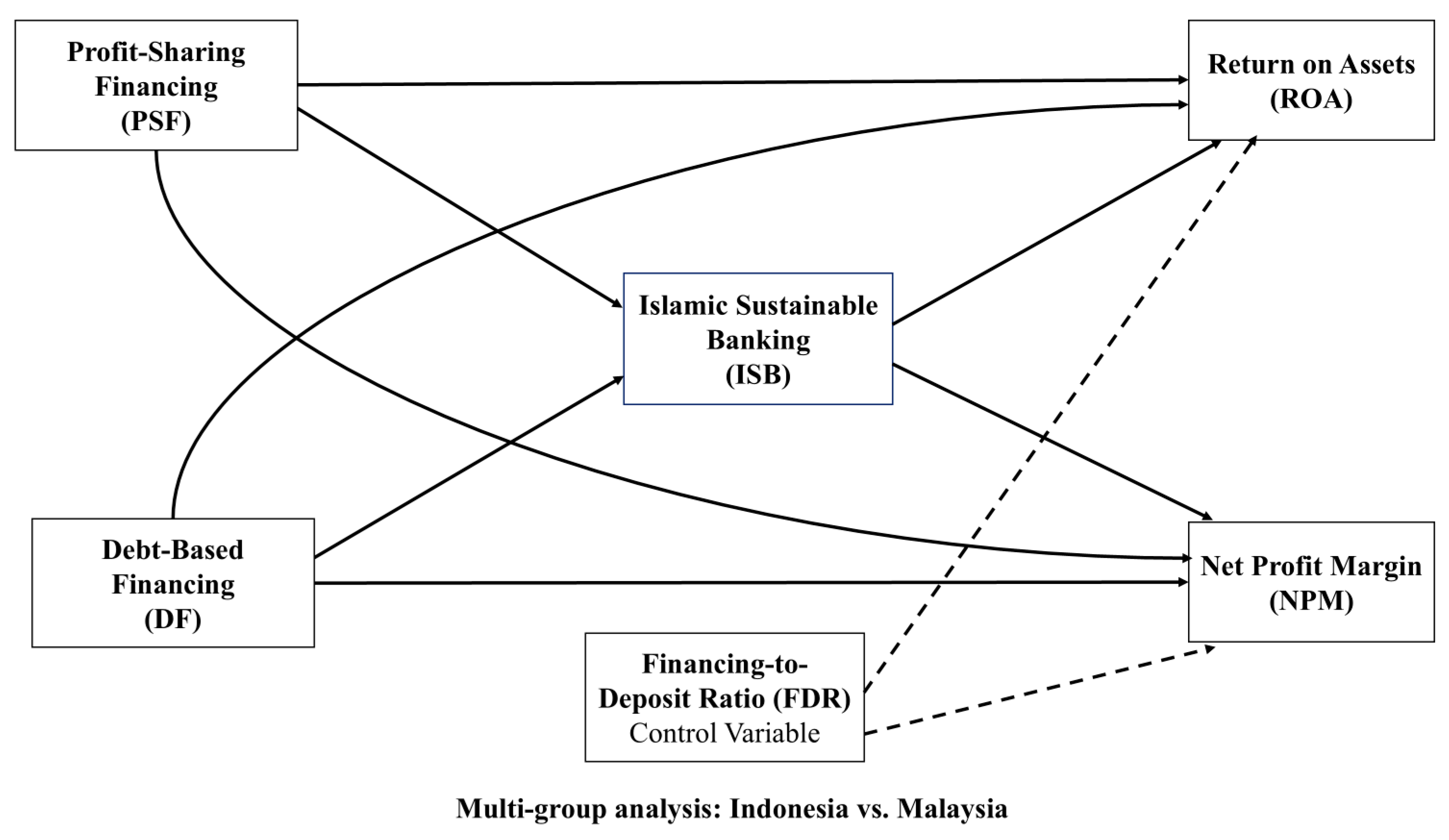
Figure 1 presents the conceptual framework of the study at the construct level. The model shows the direct associations between financing structures and bank performance, the mediating role of Islamic Sustainable Banking, and the control paths of the financing-to-deposit ratio. The framework is further examined across Indonesia and Malaysia using multi-group analysis.
3. Materials and Methods
3.1. Research Design and Sample
This study employed a quantitative explanatory design to examine how Islamic Sustainable Banking (ISB) mediates the relationship between Islamic financing structures and bank performance. The empirical setting consists of Islamic banks operating in Indonesia and Malaysia, two major Islamic finance jurisdictions in Southeast Asia with different regulatory, market, and sustainability disclosure environments. The study period covers 2018–2023, allowing the analysis to capture recent developments in Islamic banking sustainability practices before and after the acceleration of sustainability reporting in the financial sector.
The sample comprises 23 Islamic banks, consisting of 10 Islamic banks from Indonesia and 13 Islamic banks from Malaysia. The unit of analysis is the bank-year observation. The data were collected from annual reports, sustainability reports, financial statements, regulatory disclosures, and official bank publications. Banks were included when the relevant financial and disclosure information required to construct the variables was available for the observation period.
3.2. Data Sources and Variable Measurement
The study uses secondary data derived from publicly available bank reports. Financial data were obtained from annual reports and financial statements, while sustainability-related data were extracted from annual reports, sustainability reports, corporate governance reports, and official bank disclosures. This approach is appropriate because Islamic Sustainable Banking is assessed based on disclosed institutional practices rather than survey-based perceptions.
Bank performance is measured using two indicators: return on assets (ROA) and net profit margin (NPM). ROA captures the ability of a bank to generate profit from its total assets, while NPM reflects the extent to which operating income is converted into net earnings. Profit-sharing financing (PSF) is measured using the proportion of mudharabah and musyarakah financing to total financing. Debt-based financing (DF) is measured using the proportion of murabahah, ijarah, and istishna financing to total financing.
Debt-based financing was initially specified as a composite of murabahah, ijarah, and istishna because these contracts represent non-profit-sharing financing arrangements that generally provide more predictable contractual returns than participatory financing. This baseline specification was intended to preserve the conceptual breadth of debt-based financing in Islamic banking. However, the empirical structure of the sample indicates that murabahah is the dominant debt-based contract, while ijarah and istishna contribute more weakly to the composite measure. This pattern is consistent with the practical structure of Islamic banking in which murabahah is widely used because of its fixed-margin characteristics, lower operational complexity, and clearer contractual structure.
Financing-to-deposit ratio (FDR) is included as a control variable to capture liquidity-based intermediation conditions.
The operational definitions of the main variables are as follows:
PSF = mudharabah and musyarakah financing/total financing;
DF = murabahah, ijarah, and istishna financing/total financing;
FDR = total financing/third-party funds;
ROA = net income/total assets;
NPM = net income/operating income.
3.3. Measurement of Islamic Sustainable Banking Disclosure Index
Islamic Sustainable Banking is measured using the Islamic Sustainable Banking Disclosure Index (ISBDI), which integrates Maqasid al-Shariah principles and the Sustainable Development Goals (SDGs). The index was developed by adapting sustainability and Islamic banking disclosure indicators from prior studies on Maqasid-based banking, Islamic sustainability performance, SDG alignment, financial inclusion, governance, and anti-corruption disclosure. The ISBDI uses a dichotomous scoring procedure. Each disclosure item receives a score of 1 when the bank provides clear narrative evidence, quantitative information, policy disclosure, implementation evidence, or performance-related information. A score of 0 is assigned when the item is not disclosed or when the disclosure is too general to indicate implementation. Items that are not applicable to a specific bank-year observation are excluded from the denominator to avoid measurement bias.
The ISBDI for bank b in year t is calculated as follows:
where d
btk represents the disclosure score for item k for bank b in year t, with a value of 1 if the item is disclosed and 0 otherwise. n
bt denotes the number of applicable disclosure items for bank b in year t. The ISBDI indicators were selected through a structured review of prior studies on Islamic banking sustainability, Maqasid-based performance, SDG alignment, governance disclosure, financial inclusion, environmental responsibility, social responsibility, and anti-corruption disclosure. Each indicator was retained when it met three criteria. First, the indicator had to be relevant to Islamic banking activities and observable in publicly available bank reports. Second, the indicator had to have a clear conceptual linkage with at least one dimension of Maqasid al-Shariah. Third, the indicator had to be reasonably aligned with the SDG-oriented sustainability agenda. This procedure ensured that the index was not developed as a generic ESG checklist, but as an Islamic banking-specific disclosure instrument.
The index applies an equal-weighting approach because the study does not assume that one sustainability dimension is universally more important than another across different institutional and national contexts. Equal weighting also reduces researcher-imposed prioritization and allows the index to capture the breadth of sustainability disclosure across economic, social, environmental, and governance dimensions. To minimize scoring subjectivity, explicit coding rules were applied. A score of 1 was assigned only when the bank provided identifiable evidence, such as policy statements, quantitative information, program descriptions, governance mechanisms, implementation evidence, assurance statements, or performance-related disclosures. A score of 0 was assigned when the item was not disclosed or when the disclosure was too general to indicate implementation. Items that were not applicable to a specific bank-year observation were excluded from the denominator to avoid measurement bias.
Although this procedure improves transparency and consistency, the study acknowledges that disclosure-based measurement has limitations. ISBDI may not fully capture the quality, intensity, or real impact of sustainability implementation. A bank may disclose sustainability practices to strengthen legitimacy, while another bank may implement substantive practices but provide limited disclosure. Therefore, the ISBDI should be interpreted as a measure of disclosed Islamic sustainability practices rather than as a direct measure of actual sustainability impact.
The index consists of economic, social, environmental, and governance dimensions. The detailed indicators, operational evidence, Maqasid linkage, and SDG alignment are presented in
Appendix A, while the summary of the index construction is shown in
Table 1.
3.4. Analytical Method
Partial least squares structural equation modeling (PLS-SEM) was applied to test the proposed relationships among financing structures, ISB, liquidity condition, and bank performance. PLS-SEM was selected because the model combines observed financial ratios, disclosure-based constructs, mediation paths, and group comparison analysis. This method is also suitable for predictive and explanatory models that include composite indicators and formative measurement elements.
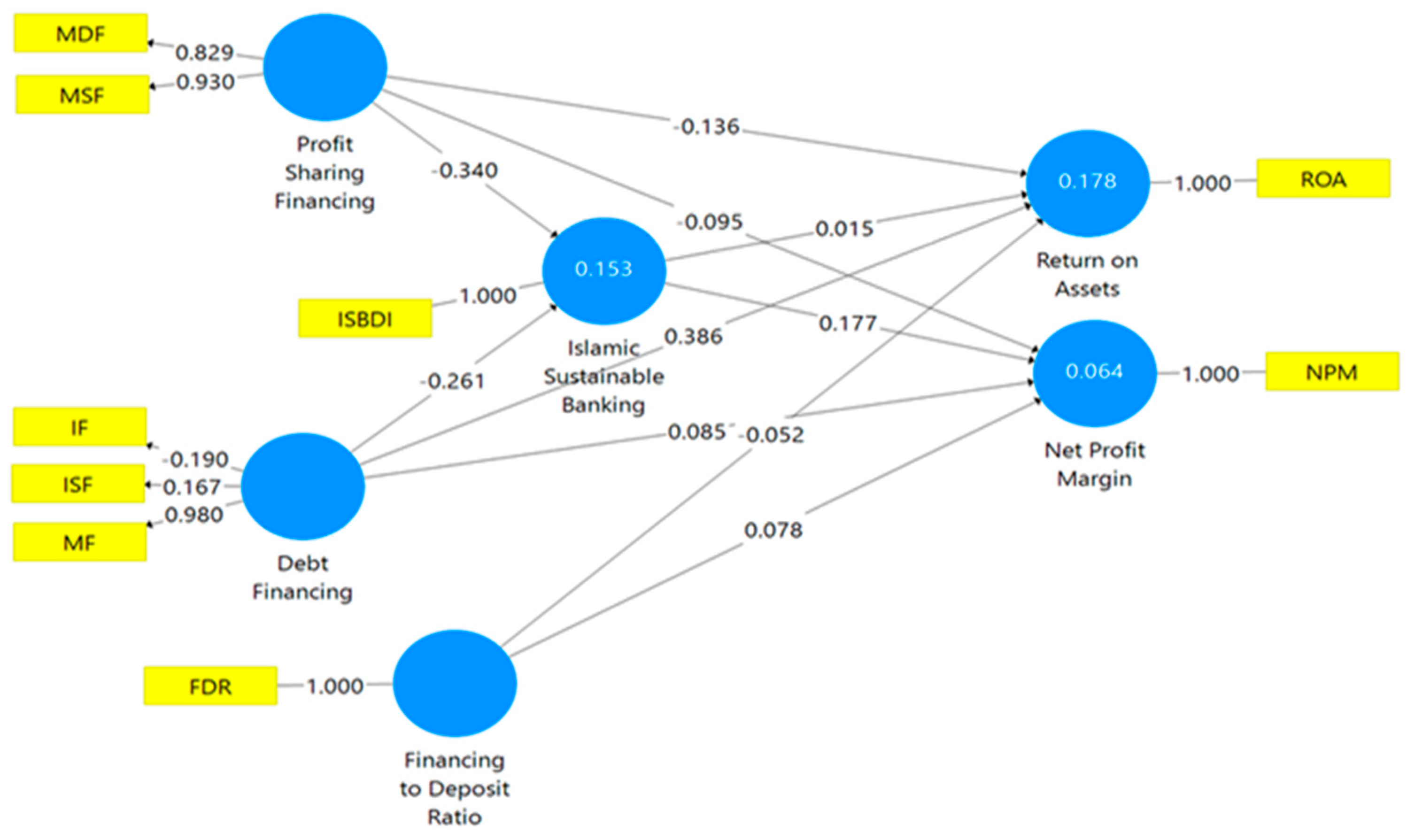
The analysis proceeded in two stages. First, the measurement model was assessed to evaluate indicator reliability, convergent validity, discriminant validity, and collinearity. Constructs based on financial ratios, such as ROA, NPM, FDR, and ISBDI, were treated as single-item observed variables. Profit-sharing financing was represented by mudharabah and musyarakah financing, while debt-based financing was represented by murabahah, ijarah, and istishna financing. Because financing components represent the composition of bank financing rather than interchangeable manifestations of a latent construct, the measurement specification was evaluated carefully to ensure that collinearity and indicator contribution did not distort the structural estimates.
Second, the structural model was assessed by estimating path coefficients, t-statistics, p-values, and the explanatory power of endogenous constructs. Bootstrapping was used to assess the statistical significance of the direct and indirect associations. The direct associations tested the relationships between PSF, DF, ISB, and bank performance, while FDR was included as a control path for ROA and NPM. Mediation analysis was conducted by examining the specific indirect associations of PSF and DF on NPM through ISB.
Given the observational nature of the data and the use of PLS-SEM, the findings should be interpreted as model-based associations rather than causal effects. The mediation analysis identifies whether ISB statistically transmits the relationship between financing structures and bank performance within the specified structural model. It does not establish causality in an experimental or quasi-experimental sense. Accordingly, the terms “effect” and “mediation” are used in a model-based sense to describe statistically estimated structural associations obtained through bootstrapping procedures. This interpretation is consistent with the predictive and explanatory orientation of PLS-SEM.
3.5. Mediation and Group-Difference Analysis
The mediation test focused on whether ISB statistically links the association between Islamic financing structures and bank performance. The indirect associations were evaluated using bootstrapped confidence estimates and p-values. A mediation effect was considered statistically significant when the specific indirect effect was significant at the 5% level. The interpretation of mediation considered both the significance and the direction of the coefficients, particularly because financing structures may reduce ISB disclosure while ISB may positively affect profitability.
To examine whether the structural relationships differ between Indonesia and Malaysia, the study applied multi-group analysis using PLS-MGA and permutation testing. PLS-MGA was used to identify significant differences in path coefficients between the two country groups. The permutation test was used as a robustness procedure to confirm whether the observed group differences remained statistically reliable under a non-parametric comparison. A group difference was interpreted only when the relevant p-value and confidence interval supported a statistically significant difference between the Indonesian and Malaysian samples.
3.6. Robustness Procedure
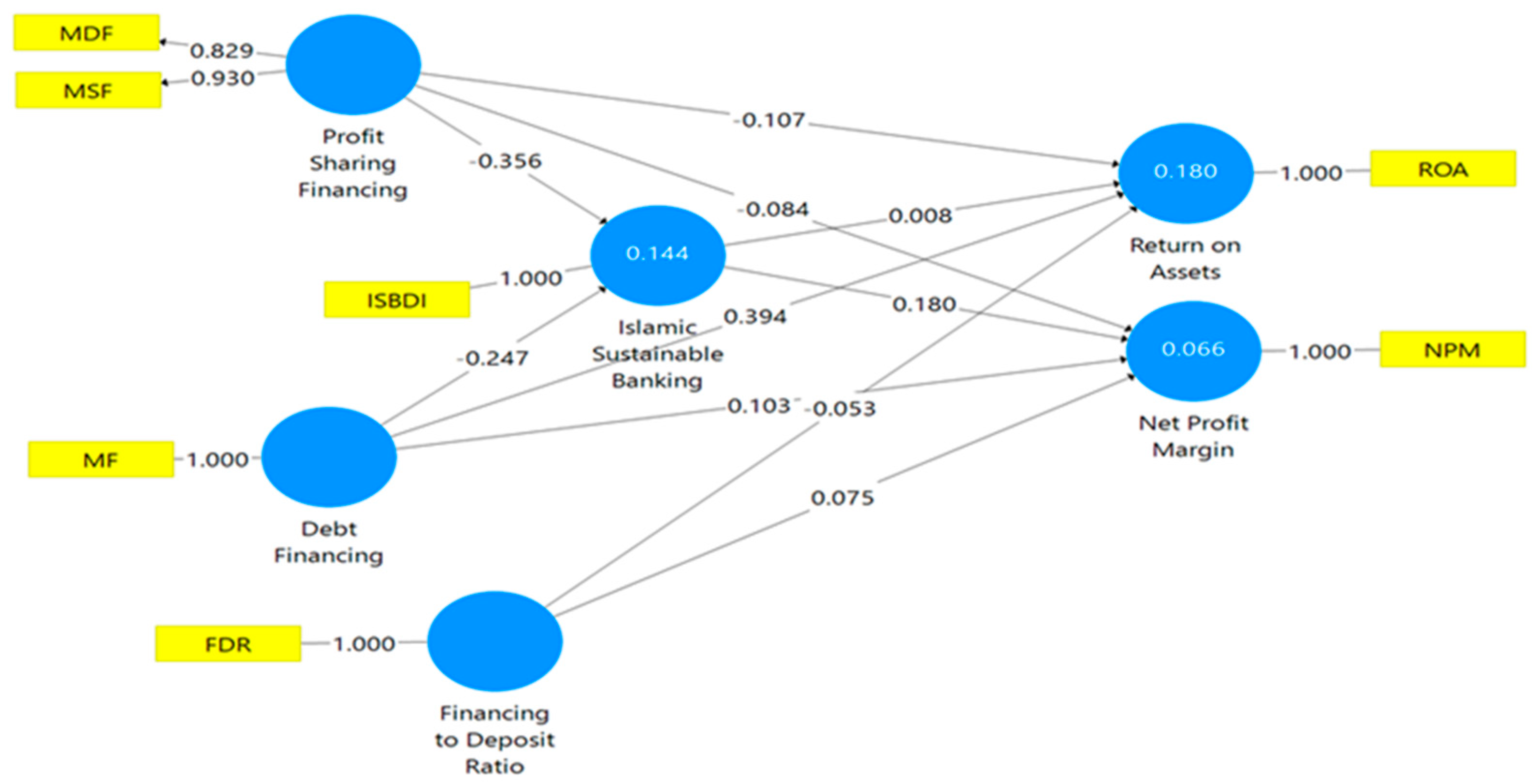
A robustness analysis was conducted to evaluate whether the main findings were sensitive to the specification of debt-based financing. The baseline model treated debt-based financing as a composite of murabahah, ijarah, and istishna financing. This specification was retained for theoretical reasons because these contracts represent non-profit-sharing financing arrangements that generally provide more predictable contractual returns than participatory financing contracts. Retaining the three components in the baseline model allows the analysis to capture the broader debt-based financing orientation of Islamic banks rather than restricting the construct to a single contract type.
However, the empirical structure of the sample indicates that murabahah is the dominant debt-based contract, while ijarah and istishna contribute more weakly to the composite measure. This pattern is consistent with the practical structure of Islamic banking, where murabahah is widely used because of its fixed-margin characteristics, lower operational complexity, and clearer contractual structure. Therefore, an alternative robustness specification was tested by retaining murabahah financing as the main proxy for debt-based financing.
The robustness model was then compared with the baseline composite model to assess whether the structural conclusions remained stable after modifying the debt-based financing specification. This comparison helps determine whether the results are driven by the broader debt-based financing orientation or by the dominant murabahah component. The consistency of the findings across both specifications provides additional support for the robustness of the structural interpretation.
5. Discussion
The findings provide a nuanced explanation of how Islamic financing structures, sustainability disclosure, and bank performance interact in Islamic banks. The results show that Islamic Sustainable Banking (ISB) is positively associated with net profit margin but not significantly associated with return on assets. This indicates that sustainability-oriented banking practices are more closely related to margin-based profitability than to asset-based profitability. In the context of Islamic banking, sustainability disclosure may be linked to profitability through stakeholder trust, reputational legitimacy, customer confidence, and governance credibility. These mechanisms are consistent with the view that sustainability practices can improve institutional resilience and financial outcomes when they are embedded in governance and accountability systems (
Alam et al., 2022;
Mohd Zain et al., 2024;
Shalhoob, 2025).
The non-significant association between ISB and ROA indicates that sustainability disclosure may not immediately be reflected in asset-based profitability. ROA is strongly influenced by asset structure, financing quality, operational efficiency, and risk exposure. Sustainability initiatives may require time before they generate measurable asset-based returns, especially when they involve disclosure systems, governance improvement, monitoring mechanisms, and stakeholder engagement. This finding implies that the financial benefits of sustainability in Islamic banking may emerge gradually and may be more visible in profit margin than in asset productivity. This interpretation is consistent with studies suggesting that the sustainability–performance relationship in banking is not always linear and may depend on institutional capacity, disclosure quality, and implementation costs (
Liu & Xie, 2024;
Weber & Chowdury, 2020).
The positive association between ISB and NPM can be explained through several theoretical mechanisms. From a stakeholder perspective, sustainability disclosure may improve depositor and customer confidence because it signals that Islamic banks are not only financially oriented but also accountable to ethical, social, and governance expectations. From a legitimacy perspective, ISB disclosure helps banks demonstrate conformity with Sharia principles, sustainability norms, and regulatory expectations. These legitimacy and trust-building mechanisms may support margin-based profitability through stronger customer retention, reputational credibility, and stakeholder confidence. From a resource-based perspective, banks with stronger disclosure systems, governance capacity, and sustainability-related routines may develop intangible capabilities that support more stable income generation. These mechanisms help explain why ISB is more closely associated with NPM than with ROA.
The absence of a statistically significant association between ISB and ROA should also be interpreted with caution. One possible explanation is that ROA is more sensitive to asset structure, financing quality, cost efficiency, and risk exposure than to disclosure-based sustainability practices. Sustainability disclosure may enhance trust and legitimacy, but these benefits may not immediately translate into asset productivity. Another explanation is that sustainability initiatives may involve short-term costs related to reporting systems, governance improvement, monitoring, and stakeholder engagement. In addition, differences in asset composition, regulatory environments, and implementation capacity across banks may weaken the direct association between ISB and ROA. Therefore, the ROA result does not necessarily indicate that sustainability lacks financial relevance; rather, it suggests that the financial benefits of ISB may be more visible through margin-based channels than through asset-based profitability.
The findings can be further interpreted through institutional theory, legitimacy theory, stakeholder theory, and Islamic governance perspectives. From an institutional perspective, Islamic banks operate under regulatory, market, Sharia governance, and sustainability reporting pressures that shape how they disclose sustainability-related practices. These pressures may encourage banks to align their reporting practices with broader expectations regarding responsible finance, ethical intermediation, and sustainable development. From a legitimacy perspective, ISB disclosure allows Islamic banks to demonstrate conformity with societal expectations, regulatory norms, Sharia principles, and sustainability commitments. However, such disclosure may become symbolic when it is not supported by measurable implementation, governance mechanisms, and financing strategies.
From a stakeholder perspective, ISB disclosure may be positively associated with net profit margin because transparent sustainability practices can strengthen trust among depositors, customers, regulators, investors, Sharia supervisory bodies, and the wider community. In Islamic banking, stakeholder accountability is not limited to financial stakeholders but also includes ethical and social accountability. This broader accountability reflects the Maqasid al-Shariah orientation of Islamic finance, which emphasizes the protection of faith, life, intellect, lineage, and wealth. Therefore, the positive association between ISB and NPM suggests that sustainability disclosure may support profitability through reputation, stakeholder confidence, and governance credibility rather than through immediate asset productivity.
From an Islamic governance perspective, the findings suggest that Maqasid al-Shariah should be operationalized beyond formal Sharia compliance. Islamic banks may comply with contract-level Sharia requirements while still facing challenges in translating Maqasid objectives into sustainability-oriented financing, risk assessment, disclosure systems, and performance evaluation. The observed association between financing concentration and lower ISB disclosure may therefore indicate a gap between contractual compliance and broader sustainability integration. This finding reinforces the argument that Islamic Sustainable Banking requires not only Sharia-compliant products but also governance structures capable of linking financing decisions with measurable social, environmental, and economic outcomes.
The result for profit-sharing financing provides a more specific illustration of this issue. In theory, profit-sharing financing reflects the core ethical logic of Islamic finance because it promotes risk sharing, productive investment, and equitable distribution of returns. However, the empirical results show that a higher proportion of profit-sharing financing is associated with lower ISB disclosure. This finding does not necessarily contradict the normative ideals of Islamic finance. Rather, it suggests that the operational complexity of profit-sharing contracts may limit the capacity of banks to document and disclose sustainability practices systematically. Profit-sharing contracts require stronger monitoring, more intensive project evaluation, and higher governance involvement due to information asymmetry and agency risk. These conditions may shift managerial attention toward contract supervision and risk control rather than sustainability reporting.
Debt-based financing is also negatively associated with ISB, while being positively associated with ROA. This finding reflects the dual role of debt-based financing in Islamic banking. On the one hand, instruments such as murabahah provide predictable income, clearer contractual arrangements, and lower operational uncertainty, which can support asset profitability. On the other hand, the dominance of debt-based financing may reduce the extent to which Islamic banks integrate broader sustainability objectives into their financing strategy. This result is consistent with the practical dominance of murabahah in Islamic banking and with the argument that Islamic banks often rely on low-risk and transaction-based contracts to maintain financial stability (
Billah et al., 2024;
Saleem et al., 2024;
Widarjono & Rafik, 2023).
The negative associations between financing concentration and ISB disclosure require careful interpretation. These findings should not be read as evidence that profit-sharing or debt-based contracts are inconsistent with Islamic sustainability. Rather, they suggest that the concentration of financing in particular contract types may create operational, monitoring, and reporting pressures that constrain the systematic disclosure of sustainability practices. Profit-sharing contracts require intensive project monitoring, governance involvement, and risk-sharing oversight, while debt-based contracts often prioritize predictable margins and transaction-based income stability. When managerial resources are concentrated on contract administration, risk control, and financing expansion, banks may have limited capacity to translate financing activities into comprehensive sustainability disclosure. This explains why sustainability disclosure functions as a conditional transmission mechanism: its financial relevance depends on whether financing structures are supported by governance capacity, disclosure infrastructure, and Maqasid-oriented strategic alignment.
The mediation results further clarify the mechanism through which financing structures affect profitability. ISB significantly mediates the associations of both profit-sharing financing and debt-based financing with NPM. The indirect associations are negative because both financing structures reduce ISB disclosure, while ISB itself is positively associated with NPM. Therefore, the negative indirect associations should not be interpreted as evidence that sustainability weakens profitability. Instead, they indicate that the performance-enhancing potential of sustainability is constrained when financing composition is not aligned with sustainability-oriented governance, reporting, and strategic implementation. This supports the view that sustainability in Islamic banking functions as a conditional transmission mechanism rather than an automatic driver of financial performance.
These mediation findings reinforce the distinction between formal Sharia compliance and substantive sustainability integration. While Sharia-compliant contracts provide the ethical and legal foundation of Islamic banking, they do not automatically ensure that Maqasid al-Shariah objectives are embedded in sustainability disclosure, financing governance, risk assessment, and performance monitoring. Therefore, the results suggest that Islamic Sustainable Banking requires a stronger operational link between contract-level compliance and measurable social, environmental, governance, and financial outcomes (
Jan et al., 2021;
Mergaliyev et al., 2021;
Rahim et al., 2024).
The cross-country findings provide additional insight into how institutional environments shape the financial implications of Islamic financing structures. The PLS-MGA and permutation results indicate significant differences between Indonesia and Malaysia, particularly in the associations between financing structures and profitability. These findings suggest that Islamic financing contracts do not generate uniform financial outcomes across jurisdictions. Instead, their performance relevance is conditioned by regulatory design, market maturity, Sharia governance structures, product composition, and sustainability reporting regimes.
In Indonesia, the stronger association between debt-based financing and profitability may reflect the role of murabahah-oriented financing in supporting income predictability within a rapidly developing Islamic banking market. Murabahah financing provides clearer payment schedules, lower monitoring intensity, and more stable margin-based income, which may be particularly important in a market that has experienced consolidation and progressive sustainable finance regulation. In Malaysia, the more mature Islamic finance ecosystem, stronger institutionalization of Sharia governance, and more developed sustainability reporting expectations may create different pressures. Financing contracts, especially profit-sharing contracts, may require stronger governance, more intensive monitoring, and more sophisticated disclosure systems, which can affect their relationship with profitability.
The findings contribute to the literature in three main ways. First, the study extends Islamic banking sustainability research by positioning ISB as a mediating mechanism that connects financing structures with bank performance. Second, it shows that Maqasid al-Shariah and SDG-oriented disclosure can be integrated into a measurable Islamic Sustainable Banking framework. Third, it provides comparative evidence from Indonesia and Malaysia, demonstrating that the association between Islamic financing structures and profitability depends on institutional context. These contributions respond to calls for more context-sensitive and empirically grounded studies on Islamic sustainability performance (
Ammar et al., 2023;
Harahap et al., 2023;
Kashi et al., 2024).
The findings provide several practical implications for Islamic bank managers. First, the positive association between ISB and NPM suggests that sustainability disclosure can support profitability when it strengthens stakeholder trust, customer confidence, and governance credibility. Bank managers should therefore treat ISB not merely as a reporting requirement but as part of strategic intermediation. This can be operationalized by integrating Maqasid-oriented sustainability criteria into financing product design, customer evaluation, project screening, and performance monitoring. For profit-sharing financing, banks should strengthen monitoring systems, project evaluation procedures, and Sharia governance documentation so that the ethical value of risk-sharing contracts can be translated into clearer sustainability disclosure. For debt-based financing, especially murabahah, banks should ensure that predictable-margin financing is also linked to measurable social, environmental, and governance outcomes.
Second, the non-significant association between ISB and ROA implies that sustainability initiatives may not immediately improve asset-based profitability. Managers should therefore evaluate sustainability performance using both short-term and long-term indicators. In the short term, ISB may contribute through reputation, customer retention, and margin stability. In the longer term, sustainability integration should be linked to asset quality, credit risk management, operational efficiency, and capital allocation. This means that Islamic banks should not evaluate sustainability only through disclosure scores, but also through its integration into risk assessment, financing decisions, and portfolio monitoring.
The findings also offer policy implications for regulators and policymakers. Regulators may strengthen Islamic banking sustainability by developing Sharia-governed sustainability reporting standards, enhanced disclosure requirements, ESG integration guidelines, and supervisory frameworks for Islamic Sustainable Banking. These standards should connect Maqasid-based objectives with measurable economic, social, environmental, governance, and financial indicators. In Indonesia, policy support may focus on helping Islamic banks strengthen sustainability governance, disclosure infrastructure, and capacity building as the Islamic banking sector continues to develop. In Malaysia, where the Islamic finance ecosystem is more mature, regulatory efforts may focus on improving the quality, assurance, and comparability of sustainability reporting and linking disclosure more directly with financing impact. Therefore, different regulatory approaches may be required across jurisdictions to ensure that Islamic Sustainable Banking becomes a substantive governance mechanism rather than merely a reporting instrument.
6. Conclusions
This study examined how Islamic Sustainable Banking (ISB) mediates the relationship between Islamic financing structures and bank performance in Indonesia and Malaysia. By integrating Maqasid al-Shariah principles with the Sustainable Development Goals, the study developed an Islamic Sustainable Banking Disclosure Index to capture sustainability-oriented practices in Islamic banks. The findings show that ISB is positively associated with net profit margin, whereas its association with return on assets is not statistically significant. This indicates that sustainability disclosure is more closely associated with margin-based profitability than with asset-based profitability.
The results also reveal that both profit-sharing financing and debt-based financing are negatively associated with ISB disclosure. These findings suggest that Sharia-compliant financing structures do not automatically lead to stronger sustainability integration. Rather, the financial and operational characteristics of Islamic financing may influence how banks allocate resources, manage disclosure practices, and institutionalize sustainability within their business models. The mediation results further show that ISB transmits negative indirect associations from both financing structures to profitability, indicating that sustainability functions as a conditional transmission mechanism rather than an automatic driver of financial performance.
The cross-country analysis provides additional evidence that the relationship between financing structures and bank performance differs between Indonesia and Malaysia. The PLS-MGA and permutation results indicate significant differences in selected profitability paths, particularly those involving profit-sharing financing and debt-based financing. These findings suggest that regulatory design, market maturity, financing composition, and disclosure practices shape how Islamic banks transform financing activities and sustainability commitments into financial outcomes.
This study contributes to Islamic banking and sustainable finance literature in three ways. First, it offers an integrated ISB framework that links Maqasid al-Shariah and SDG-oriented disclosure within a single empirical index. Second, it clarifies the mediating role of sustainability disclosure in the relationship between Islamic financing structures and bank performance. Third, it provides comparative evidence from Indonesia and Malaysia, showing that the financial implications of Islamic financing and sustainability practices are context-dependent rather than uniform across jurisdictions.
The findings have practical implications for Islamic banks, regulators, and policymakers. Islamic banks should integrate sustainability principles into financing design, risk assessment, Sharia governance, and performance evaluation rather than treating sustainability as a separate reporting activity. Bank managers may use ISB disclosure to strengthen stakeholder trust and margin-based profitability, while also developing longer-term indicators related to asset quality, risk management, and financing impact. Regulators may support this process by strengthening Sharia-governed sustainability reporting standards, ESG integration guidelines, assurance mechanisms, and supervisory frameworks that connect Maqasid-based objectives with measurable sustainability and financial outcomes. Such policy support is particularly important because the findings indicate that the financial relevance of Islamic Sustainable Banking differs across Indonesia and Malaysia.
Several limitations should be acknowledged when interpreting the findings. First, the study uses a six-year observation period; therefore, the financial implications of sustainability disclosure may not be fully captured because sustainability-related benefits may emerge over a longer horizon. Second, the ISB measure is based on disclosed information. Although the ISBDI was constructed using explicit coding criteria, disclosure-based indicators may not fully capture the actual quality, intensity, or impact of sustainability implementation. Third, because the study relies on observational data and PLS-SEM, the estimated relationships should be interpreted as associative and model-based rather than as definitive causal effects.
Potential endogeneity may arise from reverse causality, omitted variables, and unobserved heterogeneity. For example, more profitable banks may have greater resources and stronger incentives to disclose sustainability practices, while unobserved factors such as governance quality, managerial capability, risk culture, or regulatory compliance intensity may simultaneously influence financing composition, ISB disclosure, and financial performance. Although the robustness analysis provides additional evidence regarding the stability of the debt-based financing specification, it does not fully eliminate these endogeneity concerns.
Future studies may address these limitations by extending the observation period, applying dynamic panel models, generalized method of moments, panel mediation analysis, or quasi-experimental research designs to strengthen causal inference. Future research may also incorporate additional risk-related channels, such as asset quality, capital adequacy, operational efficiency, credit risk, and governance quality. In addition, outcome-based ISB measures supported by third-party assurance or impact indicators may be developed to complement disclosure-based measurement. Further comparative studies across additional Islamic finance jurisdictions would also help explain when and how sustainability disclosure becomes financially meaningful in Islamic banking.