Article

Applied Financial Learning as a Key Predictor of Financial Self-Management in Higher Education Evidence from Peruvian University Students

by
Pedro Eche-Querevalú
,
Amador Grover Mejía-Osorio
,
Emilio Javier Rojas-Villanueva
,
Fiorella Helka Vega-Lazo
and
Jorge Miguel Chávez-Díaz
*
Faculty of Administrative Sciences, Universidad Nacional Mayor de San Marcos, Lima 15081, Peru
*
Author to whom correspondence should be addressed.
J. Risk Financial Manag. 2026, 19(6), 415; https://doi.org/10.3390/jrfm19060415 (registering DOI)
Submission received: 1 May 2026 / Revised: 5 June 2026 / Accepted: 7 June 2026 / Published: 9 June 2026
(This article belongs to the Section Financial Technology and Innovation)

Abstract

Financial literacy among university students is increasingly important in contexts marked by digital payments, accessible credit and growing financial-product complexity. This study analyzes the explanatory relationships between technical-financial knowledge (TFK), perception/attitude toward financial education (PS), practical application of financial knowledge (PAK), and financial self-management (PFS) among Peruvian university students. A total of 422 surveys were collected, and the final PLS-SEM analysis was conducted with 358 complete cases. The model was estimated in ADANCO using consistent PLS for reflective constructs and Mode B for PFS as a formative construct, with 5000 bootstrap replicates. The results show that TFK positively predicts PS (β = 0.711; p < 0.001) and PAK (β = 0.709; p < 0.001). PFS is explained by both PS (β = 0.282; p < 0.001) and, more strongly, PAK (β = 0.558; p < 0.001), with moderate-to-high explanatory power (R2 = 0.568). The total indirect effect of TFK on PFS was significant (β = 0.596; p < 0.001), and the TFK → PAK → PFS pathway was the dominant mechanism. These findings suggest that university financial education should move beyond conceptual content and prioritize practice-oriented learning strategies, including budgeting, savings planning, product comparison and digitally mediated decision-making.

1. Introduction

Financial literacy (FL) has become a key competency for university students facing increasingly digitalized and complex financial environments (Chávez-Díaz et al., 2024; Viteri et al., 2022). The expansion of digital payments, mobile banking, and readily accessible consumer credit has intensified the need for students to make informed decisions about budgeting, saving, borrowing, and comparing financial products (Adnan et al., 2023; Bhat et al., 2025; Widyastuti et al., 2024). In this context, financial self-management is not only an educational outcome, but also a protective capability that may reduce exposure to personal financial risk and contribute to financial well-being (Choung et al., 2023; Xiao & Porto, 2022).
Although recent studies have examined financial literacy among young and university populations, two gaps remain particularly relevant for the Latin American context. First, much of the literature continues to treat FL as an aggregate construct, without explicitly modeling the mechanisms through which financial knowledge is converted into everyday financial behavior (Méndez Prado et al., 2022; Rehman & Mia, 2024). Second, empirical evidence from Peru remains limited, especially regarding models that distinguish technical-financial knowledge, attitudes toward financial education, practical application, and financial self-management using multidimensional instruments with validity evidence (Bastidas-Guerrón et al., 2025).
To address these gaps, this study analyzes the explanatory relationships between technical-financial knowledge (TFK), perception/attitude toward financial education (PS), practical application of financial knowledge (PAK), and financial self-management (PFS) among Peruvian university students. Using partial least squares structural equation modeling (PLS-SEM), the study assesses both direct and indirect effects, with particular attention to whether technical knowledge contributes to self-management mainly through attitudinal or applied behavioral pathways.
The contribution of this study is threefold. First, it provides evidence from a developing Latin American country where financial inclusion and digital financial services are expanding rapidly (Méndez Prado et al., 2022; Widyastuti et al., 2024). Second, it applies a multidimensional measurement approach that differentiates knowledge, attitudes, application, and self-management, consistent with recent student-based financial literacy measurement models (Bastidas-Guerrón et al., 2025; Warmath & Zimmerman, 2019). Third, it identifies the dominant pathway through which financial knowledge contributes to financial self-management, offering practical implications for university-based financial education and curriculum design (Choi et al., 2024; Gallardo-Vázquez et al., 2024).

2. Literature Review

2.1. Conceptual Foundations of Financial Literacy

Financial literacy (FL) is understood as a form of human capital that integrates the knowledge, skills, and dispositions necessary for informed economic decision-making and effective personal financial management in contexts of uncertainty and a growing supply of financial products (Finke & Huston, 2014; Huston, 2010). In university populations, this construct is particularly relevant because it coincides with a transition toward economic autonomy, where decisions regarding budgeting, saving, borrowing, and product selection can generate trajectories of financial well-being or vulnerability (Choi et al., 2024; Rehman & Mia, 2024). Evidence from Latin America and the Caribbean has documented persistent gaps associated with socioeconomic and educational factors, reinforcing the need for robust measurements and explanatory models that distinguish mechanisms across dimensions (Méndez Prado et al., 2022).
Accordingly, FL is approached in this study as a multidimensional capability that includes cognitive, attitudinal, and behavioral components. This perspective allows the analysis to move beyond the possession of financial knowledge and examine how such knowledge is converted into applied financial practices and self-management behaviors (Rehman & Mia, 2024; Warmath & Zimmerman, 2019).

2.2. Theoretical Frameworks for Explaining the Development of Financial Literacy

From a human capital perspective, financial knowledge constitutes an accumulable investment—partly through schooling—that improves the ability to evaluate intertemporal costs and benefits, with implications for saving, borrowing, and investment decisions (Lusardi & Mitchell, 2014; van Rooij et al., 2011). Complementarily, financial socialization theory proposes that FL is shaped by socializing agents (family, school, peers) and, among young people, the university serves as a key institutional space for consolidating knowledge and habits (Gudmunson & Danes, 2011). In behavioral terms, the Theory of Planned Behavior holds that attitudes and perceived behavioral control influence intentions and behaviors, which helps explain why training and perceptions toward financial education may (or may not) translate into everyday management practices (Ajzen, 1991). Together, these frameworks suggest that technical-financial knowledge and perceptions/attitudes can activate application and self-management behaviors, especially when there are opportunities and resources to put such competencies into practice (Xiao & Porto, 2022).

2.3. Operational Dimensions of the Financial Literacy Model

The present study organizes FL into four dimensions consistent with recent evidence in student populations: technical-financial knowledge (TFK), perception/attitude toward financial education (PS), practical application of knowledge (PAK), and financial self-management (PFS) (Bastidas-Guerrón et al., 2025). This operationalization is consistent with approaches that distinguish declarative knowledge, attitudinal dispositions, and behavioral components, emphasizing that effective FL goes beyond conceptual understanding and is expressed in concrete decisions and practices (Warmath & Zimmerman, 2019).

2.3.1. Technical-Financial Knowledge (TFK)

Technical-financial knowledge includes understanding of basic concepts (e.g., interest, inflation, risk), familiarity with financial instruments, and notions that allow for comparing alternatives and anticipating consequences over time (Finke & Huston, 2014). Among university students, the literature shows that higher levels of knowledge are associated with more informed decisions and, in some cases, with more sophisticated or prudent financial behaviors, reinforcing its role as the foundation for other FL components (Lusardi & Mitchell, 2014; van Rooij et al., 2011).

2.3.2. Perception/Attitude Toward Financial Education (PS)

The attitudinal dimension captures the value placed on financial education and the disposition to learn and apply financial content (Phung et al., 2023). Rehman and Mia (2024) note that, beyond sociodemographic factors, psychological and attitudinal variables contribute to FL development, meaning that measuring knowledge alone is insufficient. In the university context, digital and curricular interventions show that improvements in self-efficacy and attitudes can accompany changes in well-being indicators and behaviors, though with magnitudes that depend on program design and intensity (Choi et al., 2024).

2.3.3. Practical Application of Knowledge (PAK)

Practical application refers to the translation of knowledge into action: budgeting, comparing credit/savings alternatives, purchasing decisions, and financial planning. The literature suggests that financial education programs tend to produce more consistent effects when they incorporate sustained practical components, enabling the conversion of abstract content into applied skills (Choi et al., 2024; Galarza Arellano, 2023). In addition, studies on responsible consumption among university students support the finding that financial training is associated with more reflective habits and better decision-making in everyday contexts (Galarza Arellano, 2023; Gallardo-Vázquez et al., 2024).

2.3.4. Financial Self-Management (PFS)

Financial self-management represents a set of everyday management behaviors, such as monitoring income, maintaining savings habits, planning investment goals, and comparing financial product terms. In a digital environment, these practices are also influenced by competencies for operating with online services and managing risks, which is why digital financial literacy emerges as a critical complement to traditional FL among university students (Adnan et al., 2023). From an applied standpoint, self-management synthesizes the behavioral component most directly associated with financial well-being and vulnerability reduction (Xiao & Porto, 2022).

2.4. Expected Relationships Among Dimensions and Integrative Synthesis

Taken together, these perspectives support a sequential interpretation of financial literacy development. Technical-financial knowledge provides a cognitive foundation for evaluating alternatives and understanding financial consequences (Finke & Huston, 2014; Lusardi & Mitchell, 2014). However, its behavioral effect is expected to depend on intermediate mechanisms, particularly favorable perceptions toward financial education and the practical application of knowledge in everyday decisions (Ajzen, 1991; Choi et al., 2024; Warmath & Zimmerman, 2019). Therefore, financial self-management is expected to be explained primarily by applied financial practices and, secondarily, by attitudes toward financial education, while the effect of technical knowledge on self-management is expected to operate indirectly through these dimensions.

2.5. Research Hypotheses

H1. 
Technical-financial knowledge (tfk) is positively and significantly associated with perception/attitude toward financial education (ps).
H2. 
Technical-financial knowledge (tfk) is positively and significantly associated with the practical application of financial knowledge (pak).
H3. 
Perception/attitude toward financial education (ps) is positively and significantly associated with financial self-management (pfs).
H4. 
The practical application of financial knowledge (pak) is positively and significantly associated with financial self-management (pfs).
H5. 
Technical-financial knowledge (tfk) indirectly influences financial self-management (pfs) through perception/attitude (ps) and practical application (pak).

3. Data and Methodology

3.1. Design and Analytical Approach

The study adopted a quantitative approach, with a non-experimental, cross-sectional design aimed at explaining the relationships among financial literacy dimensions in university students. To test the theoretical model, variance-based structural equation modeling (PLS-SEM) was employed, given its emphasis on explaining the variance of endogenous variables and its suitability for models with constructs represented as composites, including formative specifications (Gudergan et al., 2025; Hair et al., 2024). Likewise, the differential weighting approach inherent in PLS-SEM was used, avoiding the equal-weighting assumption, which has been questioned for its limitations in measurement precision and composite equivalence (Hair et al., 2024).

3.2. Population, Sample, and Data Collection

The target population consisted of Peruvian university students from public and private institutions. Data were collected via a self-administered questionnaire on Google Forms, with voluntary participation, informed consent, anonymity, and confidentiality. A total of 422 surveys were collected; however, model estimation was conducted on an analytical sample of 358 cases with complete information on all model indicators. Consequently, 64 records were excluded by applying complete-case deletion (casewise deletion), a criterion used when estimation requires matrices without missing values and internal consistency of the analytical set is prioritized (Hair et al., 2024).

3.3. Instrument and Operationalization of Variables

Financial literacy was measured using the multidimensional scale validated by Bastidas-Guerrón et al. (2025) in a Latin American student population. The original instrument comprises four dimensions: technical-financial knowledge, perception of the socioeconomic value of financial education, practical application of knowledge, and personal financial self-management. For the Peruvian university context, the adaptation focused on lexical and contextual equivalence. Because the source instrument was developed in Spanish-speaking Latin America, no substantive change was made to the conceptual meaning of the items; however, terms referring to financial institutions, credit products, and everyday financial practices were reviewed to ensure clarity for Peruvian respondents.
The retained analytical instrument included 29 items: 10 indicators for technical-financial knowledge (tfk1–tfk10), 9 indicators for perception/attitude toward financial education (ps1–ps9), 6 indicators for practical application of knowledge (pak3–pak8), and 4 indicators for financial self-management (pfs2, pfs3, pfs4, and pfs6). Items were answered on a five-point Likert scale (1 = strongly disagree; 5 = strongly agree). Indicator retention was based on three criteria: (a) theoretical correspondence with the intended construct, (b) contribution to measurement quality, considering standardized loadings, reliability, AVE, outer weights and collinearity depending on the measurement specification, and (c) preservation of content validity. The indicators pak1, pak2, pfs1 and pfs5 were not retained in the final analytical model because they showed weaker or context-specific contribution to the corresponding construct and their exclusion improved parsimony without eliminating the substantive domains represented by the constructs. In particular, the retained PAK indicators still captured budgeting, use of financial tools, informed decision-making, application of basic concepts, knowledge of financial education services, and differentiation among financial institutions. The retained PFS indicators captured complementary self-management behaviors: income monitoring, saving, long-term financial planning, and comparison of financial product conditions.
Financial self-management (PFS) was modeled as an emergent/formative construct because its indicators represent complementary behaviors that together define the construct rather than interchangeable manifestations of a single latent trait. A student may monitor income, save regularly, plan long-term goals, or compare financial product conditions at different levels; each behavior contributes a distinct component to the overall self-management profile. Therefore, high inter-item covariance is not required as a conceptual condition. Under this specification, the key evaluation criteria are content validity, absence of problematic collinearity, and the relevance and significance of indicator weights.
The wording of the items was reviewed to ensure linguistic clarity and contextual adequacy for Peruvian university students, without altering the conceptual meaning of the original scale. Appendix A presents the complete list of retained items used in the questionnaire. Because the survey was administered in Spanish to Peruvian university students, the appendix reports the original Spanish wording of each item together with its English translation for international readers.

3.4. Analysis Strategy (ADANCO)

Analysis was conducted in ADANCO using consistent PLS (PLSc) for reflective constructs (Mode A consistent) and composite estimation for the emergent/formative construct (Mode B). Parameter significance was assessed via bootstrapping with 5000 replicates and 95% confidence intervals, following current recommendations for inference and transparent reporting in PLS-SEM (Gudergan et al., 2025; Guenther et al., 2025).

3.5. Measurement Model Evaluation

For the reflective constructs (tfk, ps, and pak), the following were evaluated: (a) internal consistency via Cronbach’s alpha, rho A, and composite reliability; (b) convergent validity via standardized loadings and average variance extracted (AVE); and (c) discriminant validity via the HTMT index, recommended as a more sensitive criterion than traditional approaches for inter-construct discrimination (Henseler et al., 2015).
For the emergent/formative construct (pfs), evaluation focused on: (a) collinearity among indicators via the variance inflation factor (VIF), and (b) indicator contribution relevance through outer weights and their bootstrap significance. This evaluation is consistent with formative logic, where the decisive criterion is each indicator’s incremental contribution and the absence of severe redundancy, while preserving the content validity of the behavioral domain (Gudergan et al., 2025; Hair et al., 2024).

3.6. Structural Model Evaluation

The structural model was evaluated via: (a) standardized path coefficients, t-values, p-values, and bootstrap confidence intervals; (b) coefficients of determination (R2) for endogenous variables; (c) effect sizes f2; and (d) indirect effects for mediation analysis. As complementary evidence of approximate fit, SRMR was reported for both the estimated and saturated models, interpreted within the framework of PLS-SEM reporting best practices (Gudergan et al., 2025). Finally, alignment was maintained between reflective specification and corresponding evaluation, addressing recent methodological discussions on the treatment of reflective constructs in PLS-SEM and the need for consistency between theory, measurement, and evaluation criteria (Gudergan et al., 2025).
Because all variables were measured using a self-administered questionnaire, common method bias was considered as a potential methodological concern. Following Podsakoff et al. (2003), both procedural and statistical remedies were considered. In addition, common method bias was statistically assessed using the full collinearity VIF approach proposed by Kock (2015), which is appropriate for PLS-SEM models. Under this approach, common method bias is considered unlikely when the full collinearity VIF values remain below the recommended threshold of 3.3.
Given that financial knowledge and financial self-management may be influenced by accumulated life and financial experience, an additional robustness analysis was conducted using an age-restricted subsample of students aged 19–25 years. This age range represents a more homogeneous group of traditional university-age students and reduces the potential influence of older participants’ accumulated exposure to employment, credit, savings products, and other financial decisions.
Missing data were handled through casewise deletion. Although 422 questionnaires were initially collected, the final PLS-SEM analysis was conducted with 358 complete cases, while 64 incomplete observations were excluded. This procedure ensured that all measurement and structural estimates were based on the same analytical sample. The model was estimated in ADANCO using consistent PLS for the reflective constructs and Mode B for the emergent formative construct PFS. Statistical inference was based on 5000 bootstrap samples, and 95% bootstrap confidence intervals were reported for the main measurement and structural parameters.

4. Results

4.1. Sociodemographic Characteristics

From the 422 collected surveys, model estimation was conducted on an analytical sample of 358 cases with complete information on all indicators (tfk1–tfk10, ps1–ps9, pak3–pak8, and pfs2, pfs3, pfs4, pfs6). Consequently, 64 records were excluded because they had at least one missing value, applying the complete-case deletion criterion. To rule out potential exclusion bias, included versus excluded cases were compared on sociodemographic variables and construct means; no statistically significant differences were found for sex (χ2 = 0.571; p = 0.450), age (χ2 = 3.314; p = 0.652) or university type (χ2 = 0.000; p = 1.000), nor in the mean scores of tfk, ps, pak, and pfs (Welch’s t-tests; p ≥ 0.116). Therefore, no evidence of exclusion bias was found in the analytical sample used for the SEM.
According to Table 1, in the sample, male respondents predominated (59.5%) and the largest proportion fell within the 19–25 age group (82.4%). Likewise, the majority reported attending a public university (97.5%). In terms of central tendency, construct means (Likert scale 1 to 5) were high for tfk (mean = 4.04) and ps (mean = 4.16), and moderate for pak (mean = 3.58) and pfs (formative index mean = 3.89).
University type is reported only as a descriptive characteristic of the sample and as a control variable in the assessment of exclusion bias after complete-case deletion. Given the very small number of private-university respondents (n = 9), no inference is made regarding differences between public and private institutions.

4.2. Measurement Model

The model was estimated in ADANCO using consistent PLS for reflective constructs (Mode A consistent) and an emergent/formative approach for pfs (Mode B), with 358 observations and bootstrapping with 5000 replicates. Table 2 presents the reflective constructs tfk, ps, and pak showed adequate internal consistency levels: tfk (Cronbach’s alpha = 0.916; rho A = 0.920; composite reliability = 0.916), ps (alpha = 0.905; rho A = 0.906; composite reliability = 0.905), and pak (alpha = 0.899; rho A = 0.903; composite reliability = 0.899). Convergent validity was satisfactory, with average variance extracted (AVE) values above 0.50 for tfk (0.523), ps (0.514), and pak (0.599).
Standardized loadings of the reflective indicators were in acceptable ranges: tfk showed loadings between 0.607 and 0.834; ps between 0.669 and 0.824; and pak between 0.676 and 0.842. Although some items exhibited moderate loadings (below 0.70), they were retained because the AVE and composite reliability of each construct met recommended criteria, also preserving content validity.
Table 3 shows that the discriminant validity among reflective constructs was assessed using the HTMT criterion, yielding values below the conservative threshold of 0.85: tfk–ps = 0.712, tfk–pak = 0.698, and ps–pak = 0.557, supporting empirical differentiation among constructs.
Table 4 presents for the emergent/formative construct pfs (comprising pfs2, pfs3, pfs4, and pfs6), the evaluation focused on collinearity and indicator contribution relevance. Variance inflation factors (VIFs) ranged between 1.461 and 1.706, indicating an absence of problematic collinearity. Formative weights were significant: pfs2 (w = 0.221; t = 3.185; p = 0.001), pfs3 (w = 0.145; t = 2.227; p = 0.026), pfs4 (w = 0.422; t = 6.191; p < 0.001), and pfs6 (w = 0.472; t = 7.181; p < 0.001). Together, this evidence supports the specification of pfs as a formative index of financial self-management behaviors.
The retained PFS indicators covered four non-redundant domains of financial self-management: income monitoring, saving, long-term financial planning, and comparison of financial product conditions. All VIF values were below conventional thresholds, indicating absence of problematic collinearity, and all formative weights were statistically significant. Thus, the formative specification is supported both conceptually and empirically: the indicators do not merely reflect an underlying trait; rather, they jointly compose the behavioral index of financial self-management.
Because the data were collected using a self-administered questionnaire, common method bias was assessed through the full collinearity VIF approach. Each construct was regressed on the remaining constructs using the standardized construct scores, and the resulting VIF values were examined. The full collinearity VIF values were TFK = 2.302, PS = 1.890, PAK = 2.232, and PFS = 2.171. Since all values were below the recommended threshold of 3.3, common method bias does not appear to be a critical concern in the present model.

4.3. Structural Model

The model’s approximate fit was acceptable, with SRMR of 0.066 for the estimated model and 0.064 for the saturated model. Explanatory power was moderate-to-high. In particular, pfs (the main dependent variable) reached an R-squared of 0.568 (adjusted R-squared = 0.565). Additionally, ps and pak showed R-squared values of 0.506 and 0.503, respectively, indicating that the model explains a substantial proportion of variance in the endogenous variables, according to Table 5.
Structural relationships were statistically significant based on bootstrapping (5000 replicates). tfk positively predicted ps (beta = 0.711; t = 16.565; p < 0.001; 95% confidence interval: 0.622 to 0.791) and pak (beta = 0.709; t = 20.311; p < 0.001; 95% interval: 0.639 to 0.773). In turn, ps was positively associated with pfs (beta = 0.282; t = 5.598; p < 0.001; 95% interval: 0.188 to 0.388), and pak also predicted pfs (beta = 0.558; t = 10.738; p < 0.001; 95% interval: 0.453 to 0.655).
Regarding effect sizes, tfk had a very large impact on ps (f-squared = 1.023) and on pak (f-squared = 1.013). For explaining pfs, the effect of pak was large (f-squared = 0.492), while the effect of ps was small to medium (f-squared = 0.126). This pattern suggests that financial self-management is primarily explained by the practical application of knowledge, with an additional contribution from perceptual or attitudinal factors.
Table 6 shows bootstrap confidence intervals supported the stability of the structural estimates. The 95% confidence intervals were positive and did not include zero for all hypothesized direct effects: TFK → PS, β = 0.711, 95% CI [0.622, 0.791]; TFK → PAK, β = 0.709, 95% CI [0.639, 0.773]; PS → PFS, β = 0.282, 95% CI [0.188, 0.388]; and PAK → PFS, β = 0.558, 95% CI [0.453, 0.655]. Likewise, the total indirect effect of TFK on PFS remained positive and statistically significant, β = 0.596, 95% CI [0.532, 0.671].

4.4. Indirect Effects and Mediation

Since no direct path from tfk to pfs was specified, the effect of tfk on financial self-management was transmitted entirely indirectly through ps and pak. The total indirect effect tfk → pfs was significant (beta = 0.596; t = 16.770; p < 0.001; 95% confidence interval: 0.531 to 0.671), supporting a robust mediation mechanism.
Decomposition of the indirect effect shows that the tfk → pak → pfs pathway concentrates the largest share of the total effect: the product of coefficients was 0.709 times 0.558, equivalent to an approximate indirect effect of 0.396. In comparison, the tfk → ps → pfs pathway showed an approximate indirect effect of 0.201 (0.711 times 0.282). Substantively, technical-financial knowledge increases self-management primarily by strengthening practical application, and to a lesser extent by improving perception or disposition toward financial management.
The decomposition of the indirect effect further showed that both indirect pathways were statistically supported. The TFK → PS → PFS pathway showed an indirect effect of β = 0.201, 95% CI [0.129, 0.289], whereas the TFK → PAK → PFS pathway showed a stronger indirect effect of β = 0.396, 95% CI [0.311, 0.488], according to Table 7. This confirms that the practical application of knowledge constitutes the dominant mechanism linking technical-financial knowledge to financial self-management.
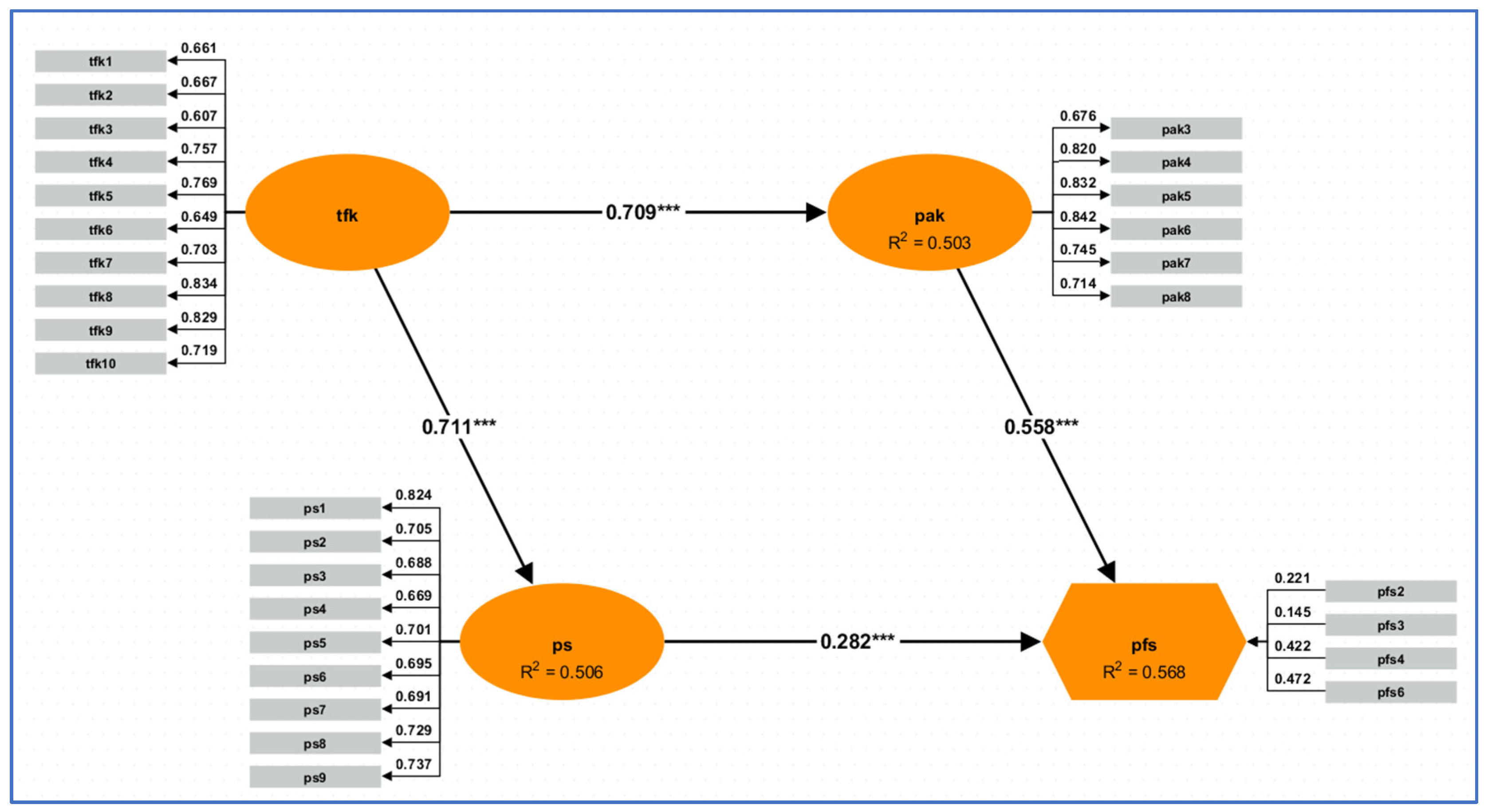
Figure 1 presents the structural model estimated in ADANCO, which illustrates the relationships between the constructs tfk, pak, ps, and pfs. The path coefficients show positive effects between the variables, highlighting the influence of tfk on pak and ps, as well as the effect of pak and ps on pfs. Likewise, the R2 values indicate the proportion of variance explained in the model’s endogenous constructs.

4.5. Robustness Analysis Among Students Aged 19–25 Years

Given that financial knowledge and self-management behaviors may be influenced by accumulated life experience, an additional robustness analysis was conducted using only students aged 19–25 years. This age-restricted subsample included 294 complete cases. The same PLS-SEM specification used in the main model was re-estimated: TFK, PS, and PAK were modeled as reflective constructs using consistent Mode A, whereas PFS was specified as an emergent formative construct and estimated in Mode B.
The results were consistent with those obtained in the full sample. TFK positively predicted PS, β = 0.653, p < 0.001, and PAK, β = 0.715, p < 0.001. In turn, both PS, β = 0.229, p < 0.001, and especially PAK, β = 0.602, p < 0.001, positively predicted PFS. The model retained substantial explanatory capacity for PFS, R2 = 0.546, adjusted R2 = 0.543.
The indirect effect of TFK on PFS also remained positive and statistically significant, β = 0.580, p < 0.001. The decomposition of this indirect effect confirmed that the TFK → PAK → PFS pathway was predominant, β ≈ 0.430, accounting for approximately 74.2% of the total indirect effect, whereas the TFK → PS → PFS pathway was smaller, β ≈ 0.149, accounting for approximately 25.8%. Overall, these findings indicate that the main conclusions remain stable when the sample is restricted to younger students, reinforcing the role of practical application as the main mechanism linking technical-financial knowledge to financial self-management. Detailed measurement and structural results for the age-restricted model are reported in Appendix B.

5. Discussion

The results support a multidimensional and mechanistic understanding of financial literacy among university students, wherein technical-financial knowledge translates into self-management primarily through its capacity to activate applied behaviors (Lone & Bhat, 2024). First, technical-financial knowledge showed positive and robust effects on perception/attitude toward financial education (H1) and on the practical application of knowledge (H2). This pattern is consistent with the human capital framework, according to which knowledge acquisition increases the ability to evaluate alternatives and thereby strengthens both the perceived value of financial education and the disposition to operate with specific instruments and decisions (Finke & Huston, 2014; Lusardi & Mitchell, 2014). Substantively, knowledge does not appear as a merely declarative resource, but rather as an antecedent that reorganizes beliefs and enables behaviors in everyday money management.
Second, the findings show that financial self-management (pfs) is explained by two complementary pathways: perception/attitude toward financial education (H3) and, with greater intensity, the practical application of knowledge (H4). The larger effect size of practical application on self-management suggests that the behavioral core of university-level financial literacy depends primarily on “in-action” skills (Dare et al., 2023): recording and controlling income, maintaining savings habits, planning goals, and identifying financial product terms. This evidence is consistent with research that, in university populations, emphasize that the most effective programs are those that sustain training over time and link it to concrete practices, reinforcing self-efficacy and financial health outcomes (Choi et al., 2024). Furthermore, the recent synthesis by Negi and Jaiswal (2024) concludes that the financial literacy–financial behavior relationship typically operates through intermediate mechanisms (attitudes, self-efficacy, contextual mediators), reinforcing the value of explicitly modeling pathways rather than limiting analysis to bivariate associations.
Third, the effect of technical-financial knowledge on self-management was entirely indirect (H5), channeled through perception/attitude and, above all, practical application. This result is conceptually compatible with the Theory of Planned Behavior: attitudes and perceived behavioral control constitute proximal antecedents of behavior; accordingly, knowledge tends to “work” to the extent that it becomes a favorable disposition and applied repertoires (Ajzen, 1991; Warmath & Zimmerman, 2019). In other words, even when knowledge is a necessary condition, it is insufficient unless accompanied by practice opportunities and educational environments that reduce implementation frictions (including budgeting exercises, rate comparisons, and credit and savings decision simulations).
An additional contribution of the study is the decision to model financial self-management as an emergent/formative construct, rather than treating it as a homogeneous trait. This specification is coherent with the idea that self-management synthesizes heterogeneous behaviors that, taken together, constitute the capacity to manage personal finances. In the current context, this approach is especially pertinent because self-management practices are increasingly mediated by digital channels. Along these lines, recent evidence shows that digital financial literacy is associated with better financial well-being outcomes and that components such as the ability to avoid digital fraud may have even larger marginal effects than general financial knowledge (Choung et al., 2023, 2025). This suggests that future extensions of the model should explicitly incorporate indicators of digital financial skills, given the expansion of electronic payments, mobile banking, and investment platforms that amplify both opportunities and risks.
For Peruvian higher education institutions, these findings suggest that financial education should be designed as an applied competency rather than as an exclusively theoretical course. Universities could incorporate short practice-based modules across curricula, including guided budgeting exercises, monitored savings goals, comparison of credit and savings products, simulations of interest-rate decisions, and activities for identifying risks in digital financial services. Assessment should also include observable outputs—such as a personal budget, a savings plan, or a product-comparison matrix—because the strongest pathway identified in this study is the conversion of technical knowledge into practical application. Such interventions would be especially relevant for students transitioning toward economic autonomy and facing expanding access to digital payments, mobile banking, and consumer credit.
The findings should also be interpreted in relation to behavioral vulnerabilities commonly observed among young people. Recent evidence indicates that financial literacy is associated with compulsive purchasing and debt propensity among university students (Ahamed et al., 2025; Khan et al., 2024; Perry et al., 2024). From this perspective, financial self-management may operate as a protective mechanism against consumption pressures and behavioral biases. In addition, social and self-regulation variables, such as peer influence and self-control, may mediate the relationship between financial literacy and specific financial behaviors, particularly in cultural contexts where group pressure is relevant (Abdul Ghafoor & Akhtar, 2024; Yürük, 2025). Future studies could therefore incorporate socio-psychological mediators to explain why some students fail to sustain self-management habits despite having financial knowledge.
Finally, certain limitations must be acknowledged. First, the cross-sectional design precludes strict causal inferences; longitudinal or experimental studies would allow evaluation of whether increases in knowledge generate sustained changes in practical application and self-management. Second, self-report measures may introduce social desirability bias; objective measures of knowledge or behavioral indicators (e.g., actual budget or savings records) would strengthen external validity (Merter & Balcıoğlu, 2025). Third, the sample was highly concentrated in public universities (97.5%), and therefore the findings should be interpreted primarily as evidence from public-university students. The study does not support conclusions about differences between public and private universities, nor should the estimates be generalized without caution to private institutions or to regions not adequately represented in the sample. Future research should employ stratified or quota-based sampling to ensure a more balanced institutional and geographic distribution, enabling multi-group comparisons across public/private institutions and regions. Despite these limitations, the proposed model offers a parsimonious and empirically consistent explanation of the transition from knowledge to self-management via attitudinal and, above all, behavioral mechanisms, contributing to the regional agenda that calls for robust measurement and clear pathways for interventions in higher education (Méndez Prado et al., 2022; Rehman & Mia, 2024).

6. Conclusions

The results confirm that financial literacy among Peruvian college students is a multidimensional phenomenon in which technical-financial knowledge (TFK) is positively associated with perceptions/attitudes toward financial education (PS) and, even more strongly, with the practical application of knowledge (PAK). Taken together, this suggests that conceptual learning is a relevant input, but its impact materializes to the extent that it is linked to concrete practices.
Financial self-management (pfs), understood as an emerging index of behaviors (recording income, saving, planning, and comparing product terms), is explained primarily by the practical application of knowledge, and secondarily by perceptions/attitudes toward financial education. In substantive terms, it is not enough to “know”; effective money management depends on “doing” in a systematic manner.
The effect of technical-financial knowledge on self-management is entirely indirect: it operates through perception/attitude and, above all, through practical application. This finding reinforces the importance of university training programs that integrate active methodologies and performance-based assessment, since the critical path to strengthening self-management is the conversion of knowledge into applied habits and competencies.
In the Peruvian context, characterized by the growing digitization of financial services (mobile banking, digital wallets, and readily accessible credit offerings), the identified framework takes on practical relevance: financial self-management can act as a protective mechanism against impulsive consumption or debt decisions, especially among young university students in the process of achieving economic autonomy.

Author Contributions

Conceptualization, P.E.-Q. and J.M.C.-D.; methodology, J.M.C.-D. and A.G.M.-O.; software, J.M.C.-D.; validation, P.E.-Q., A.G.M.-O., E.J.R.-V. and F.H.V.-L.; formal analysis, J.M.C.-D. and E.J.R.-V.; investigation, P.E.-Q., A.G.M.-O. and F.H.V.-L.; resources, P.E.-Q.; data curation, A.G.M.-O. and F.H.V.-L.; writing—original draft preparation, P.E.-Q., A.G.M.-O. and J.M.C.-D.; writing—review and editing, J.M.C.-D., E.J.R.-V. and F.H.V.-L.; visualization, E.J.R.-V.; supervision, J.M.C.-D.; project administration, J.M.C.-D. All authors have read and agreed to the published version of the manuscript.

Funding

This research received no external funding.

Institutional Review Board Statement

The authors’ institution does not operate a formal IRB process for minimal-risk survey research. The study involved an anonymous, minimal-risk survey of university students, collected no sensitive personal identifiers, and was conducted in accordance with recognized ethical standards for research involving human participants.

Informed Consent Statement

Informed consent was obtained from all participants involved in the study.

Data Availability Statement

The dataset contains human-participant survey responses and is not publicly available due to privacy considerations. De-identified data and the analysis files (e.g., model specification/output) may be made available from the corresponding author upon reasonable request and subject to institutional restrictions.

Acknowledgments

During the preparation of this study, the authors used Alfred GPT version 1 for the purposes of refining language. The views expressed in this research are those of the authors.

Conflicts of Interest

The authors declare no conflicts of interest.

Appendix A. Retained Items

ConstructCodeItem in Spanish as AdministeredEnglish Translation
TFKtfk1Conozco las consecuencias legales y crediticias del impago de una deudaI know the legal and credit consequences of defaulting on debt.
TFKtfk2Comprendo la importancia de mantener un buen historial crediticioI understand the importance of maintaining a good credit history.
TFKtfk3Cumplir con mis obligaciones (deudas) es una prioridadFulfilling my obligations/debts is a priority.
TFKtfk4Entiendo el impacto de los tipos de interés en mis préstamos y ahorrosI understand the impact of interest rates on my loans and savings.
TFKtfk5Conozco los derechos y responsabilidades de los financierosI know the rights and responsibilities of financial consumers.
TFKtfk6Conozco la importancia de tener un fondo de emergencia para gastos imprevistosI know the importance of having an emergency fund for unexpected expenses.
TFKtfk7Entiendo cómo pueden afectar a mi presupuesto los gastos imprevistosI understand how unplanned expenses can affect my budget.
TFKtfk8Entiendo los conceptos financieros básicosI understand basic financial concepts.
TFKtfk9Conozco conceptos financieros básicos (ahorro e inversiones, tipos de interés, planificación financiera)I know basic financial concepts such as savings, investments, interest rates, and financial planning.
TFKtfk10Conozco la diferencia entre activo y pasivoI know the difference between assets and liabilities.
PSps1La educación financiera me ayuda a identificar y aprovechar las oportunidades del mercadoFinancial education helps me identify and take advantage of market opportunities.
PSps2La educación financiera influye en mi capacidad de innovarFinancial education influences my ability to innovate.
PSps3La educación financiera mejora mis relaciones (familia, amigos, inversores)Financial education improves my financial relationships with family, friends, or investors.
PSps4La educación financiera es importante para desarrollar una cultura empresarial e innovadoraFinancial education is important for developing an entrepreneurial and innovative culture.
PSps5La educación financiera puede aumentar la eficiencia de mis recursosFinancial education can increase the efficiency of my resources.
PSps6La educación financiera contribuye a reducir la pobreza y la desigualdad en el paísFinancial education contributes to reducing poverty and inequality in the country.
PSps7Creo que la educación financiera sobre el uso de tecnologías financieras es suficiente para gestionar mis recursosFinancial education on the use of financial technologies is sufficient to manage my resources.
PSps8Creo que la normativa actual es adecuada para proteger a los usuarios de tecnologías financierasCurrent regulations are adequate to protect users of financial technologies.
PSps9Me siento cómodo tomando decisiones (como inversiones o compra de propiedades)I feel comfortable making important financial decisions, such as investments or property purchases.
PAKpak3Utilizo regularmente herramientas financieras (presupuestos, productos y servicios financieros, etc.) para gestionar mis finanzas.I regularly use financial tools, budgets, financial products or services to manage my finances.
PAKpak4Creo que mis conocimientos financieros actuales son suficientes para tomar decisiones con conocimiento de causa.I believe my current financial knowledge is sufficient to make informed decisions.
PAKpak5Aplico conceptos financieros básicosI apply basic financial concepts.
PAKpak6Conozco los servicios de educación financieraI know about financial education services provided by different institutions.
PAKpak7Soy capaz de crear un presupuesto de finanzas personalesI am capable of creating a personal finance budget.
PAKpak8Conozco las diferencias entre bancos y cooperativasI know the differences between banks and cooperatives.
PFSpfs2Llevo la cuenta de mis ingresos personalesI keep track of my personal income.
PFSpfs3Destino una parte de mis ingresos mensuales al ahorroI allocate a portion of my monthly income to savings.
PFSpfs4Tengo un plan de inversión para alcanzar mis objetivos financieros a largo plazo.I have an investment plan to achieve my long-term financial goals.
PFSpfs6Comparo las comisiones y condiciones de diferentes productos financieros antes de contratarlos.I compare fees and conditions of different financial products before contracting them.
Note. Items PAK1, PAK2, PFS1, and PFS5 were not retained in the final model due to insufficient psychometric performance.

Appendix B. Detailed Robustness Analysis for Students Aged 19–25 Years

To further examine the stability of the proposed model, an additional robustness analysis was conducted using only students aged 19–25 years. This age-restricted subsample included 294 complete cases. The same PLS-SEM specification used in the main analysis was re-estimated. Technical-financial knowledge (TFK), perception/attitude toward financial education (PS), and practical application of financial knowledge (PAK) were modeled as reflective constructs using consistent Mode A, whereas personal financial self-management (PFS) was specified as an emergent formative construct and estimated in Mode B. The model was estimated using casewise deletion and 5000 bootstrap samples. The iterative algorithm converged after seven iterations.
Table A1. Reliability and convergent validity of reflective constructs (n = 294).
ConstructρAComposite ReliabilityCronbach’s AlphaAVE
TFK0.9220.9170.9170.528
PS0.9210.9170.9190.553
PAK0.9060.9020.9020.608
Note. Reliability and AVE are reported only for the reflective constructs. PFS was specified as an emergent formative construct; therefore, its evaluation is based on indicator weights, outer loadings, and collinearity diagnostics rather than internal consistency.
The results indicate adequate internal consistency for the reflective constructs, with ρA, composite reliability, and Cronbach’s alpha values above conventional thresholds. Convergent validity was also supported, since all AVE values exceeded 0.50. Discriminant validity was maintained, with HTMT values ranging from 0.469 to 0.703, remaining below commonly accepted thresholds.
Table A2. Formative assessment of PFS in the age-restricted model (n = 294).
IndicatorOuter WeightOuter LoadingVIF
PFS20.2630.7651.781
PFS30.1390.6351.545
PFS40.420.8371.590
PFS60.4330.831.512
Note. For the formative emergent construct PFS, the retained indicators showed acceptable outer loadings and no evidence of problematic collinearity. The VIF values ranged from 1.512 to 1.781, which supports the stability of the formative specification. Conceptually, these indicators represent complementary dimensions of financial self-management rather than interchangeable manifestations of a single latent trait.
Table A3. Structural and indirect effects in the age-restricted model (n = 294).
Relationship/Effectβt-Valuep-Value95% CIR2/Share
TFK → PS0.65311.727<0.001[0.541, 0.758]R2 PS = 0.426
TFK → PAK0.71519.215<0.001[0.641, 0.785]R2 PAK = 0.511
PS → PFS0.2294.396<0.001[0.136, 0.342]
PAK → PFS0.60210.91<0.001[0.485, 0.701]R2 PFS = 0.546
TFK → PS → PFS0.14925.80%
TFK → PAK → PFS0.4374.20%
Total indirect effect
TFK → PFS
0.5814.03<0.001[0.503, 0.664]100.00%
Note. The structural model remained consistent with the full-sample results. TFK positively predicted both PS and PAK. In turn, both PS and PAK positively predicted PFS, although the effect of PAK on PFS was substantially stronger. This result supports the central role of practical financial application in explaining students’ financial self-management. The model retained substantial explanatory capacity in the age-restricted subsample. In particular, the model explained 54.6% of the variance in PFS, indicating that the proposed relationships remain meaningful among students aged 19–25 years. The indirect effect of TFK on PFS remained positive and statistically significant, β = 0.580, t = 14.030, p < 0.001, 95% CI [0.503, 0.664]. The decomposition of this effect shows that the TFK → PAK → PFS pathway was predominant, accounting for approximately 74.2% of the total indirect effect. Therefore, even in the younger subsample, financial self-management appears to depend primarily on the conversion of technical-financial knowledge into practical financial applications.
Overall, the robustness analysis confirms that the main conclusions of the study remain stable when the sample is restricted to students aged 19–25 years. This finding suggests that the observed relationships are not mainly attributable to accumulated financial experience among older students. Rather, the results reinforce the argument that applied financial learning constitutes the principal mechanism through which technical-financial knowledge contributes to financial self-management.

References

  1. Abdul Ghafoor, K., & Akhtar, M. (2024). Parents’ financial socialization or socioeconomic characteristics: Which has more influence on Gen-Z’s financial wellbeing? Humanities and Social Sciences Communications, 11(1), 522. [Google Scholar] [CrossRef]
  2. Adnan, M. F., Rahim, N. M., & Ali, N. (2023). Determinants of digital financial literacy from students’ perspective. Corporate Governance and Organizational Behavior Review, 7(2), 168–177. [Google Scholar] [CrossRef]
  3. Ahamed, A. F. M. J., Jakubowska, D., & Sadílek, T. (2025). Financial anxiety of university students in Poland and Czechia: fsQCA analysis. International Journal of Bank Marketing, 43(4), 757–779. [Google Scholar] [CrossRef]
  4. Ajzen, I. (1991). The theory of planned behavior. Organizational Behavior and Human Decision Processes, 50(2), 179–211. [Google Scholar] [CrossRef]
  5. Bastidas-Guerrón, J. L., Cárdenas-Fierro, G. M., Mora-Lucero, A. C., Quinde-Sari, F. R., Sabando-García, A. R., & Moreira-Choez, J. S. (2025). Financial literacy and educational level in Ecuadorian students: A structural analysis. Frontiers in Education, 10, 1596635. [Google Scholar] [CrossRef]
  6. Bhat, S. A., Lone, U. M., SivaKumar, A., & Krishna, U. M. G. (2025). Digital financial literacy and financial well-being—Evidence from India. International Journal of Bank Marketing, 43(3), 522–548. [Google Scholar] [CrossRef]
  7. Chávez-Díaz, J. M., Aquiño-Perales, L., De-Velazco-Borda, J. L., Villagómez-Chinchay, J. A., & Flores-Sotelo, W. S. (2024). Artificial intelligence in accounting and auditing: Bibliometric analysis in Scopus 2020–2023. Indonesian Journal of Electrical Engineering and Computer Science, 36(2), 1319–1328. [Google Scholar] [CrossRef]
  8. Choi, A., Stoutland, D., & Blanco, L. (2024). An evaluation of a digital financial education program and the impact of COVID-19 on financial well-being among college students. Journal of American College Health, 72(9), 3690–3702. [Google Scholar] [CrossRef] [PubMed]
  9. Choung, Y., Chatterjee, S., & Pak, T.-Y. (2023). Digital financial literacy and financial well-being. Finance Research Letters, 58, 104438. [Google Scholar] [CrossRef]
  10. Choung, Y., Pak, T.-Y., & Chatterjee, S. (2025). Digital financial literacy and life satisfaction: Evidence from South Korea. Behavioral Sciences, 15(1), 94. [Google Scholar] [CrossRef] [PubMed]
  11. Dare, S. E., van Dijk, W. W., van Dijk, E., van Dillen, L. F., Gallucci, M., & Simonse, O. (2023). How executive functioning and financial self-efficacy predict subjective financial well-being via positive financial behaviors. Journal of Family and Economic Issues, 44(2), 232–248. [Google Scholar] [CrossRef]
  12. Finke, M. S., & Huston, S. J. (2014). Financial literacy and education. In Investor behavior (pp. 63–82). Wiley. [Google Scholar] [CrossRef]
  13. Galarza Arellano, F. B. (2023). The effect of financial education on college students’ knowledge and skills. Economia, 46(92), 9–61. [Google Scholar] [CrossRef]
  14. Gallardo-Vázquez, D., Miralles-Quirós, J. L., & Miralles-Quirós, M. M. (2024). Financial education and responsible consumption in undergraduate management students. The International Journal of Management Education, 22(3), 101071. [Google Scholar] [CrossRef]
  15. Gudergan, S. P., Moisescu, O. I., Radomir, L., Ringle, C. M., & Sarstedt, M. (2025). Special issue editorial: Advanced partial least squares structural equation modeling (PLS-SEM) applications in business research. Journal of Business Research, 188, 115087. [Google Scholar] [CrossRef]
  16. Gudmunson, C. G., & Danes, S. M. (2011). Family financial socialization: Theory and critical review. Journal of Family and Economic Issues, 32(4), 644–667. [Google Scholar] [CrossRef]
  17. Guenther, P., Guenther, M., Ringle, C. M., Zaefarian, G., & Cartwright, S. (2025). PLS-SEM and reflective constructs: A response to recent criticism and a constructive path forward. Industrial Marketing Management, 128, 1–9. [Google Scholar] [CrossRef]
  18. Hair, J. F., Sharma, P. N., Sarstedt, M., Ringle, C. M., & Liengaard, B. D. (2024). The shortcomings of equal weights estimation and the composite equivalence index in PLS-SEM. European Journal of Marketing, 58(13), 30–55. [Google Scholar] [CrossRef]
  19. Henseler, J., Ringle, C. M., & Sarstedt, M. (2015). A new criterion for assessing discriminant validity in variance-based structural equation modeling. Journal of the Academy of Marketing Science, 43(1), 115–135. [Google Scholar] [CrossRef]
  20. Huston, S. J. (2010). Measuring financial literacy. Journal of Consumer Affairs, 44(2), 296–316. [Google Scholar] [CrossRef]
  21. Khan, M. S., Azad, I., Moosa, S., & Javed, M. Y. (2024). Do we really need financial literacy to access the behavioral dynamics of generation Z? A case of Oman. Heliyon, 10(13), e32739. [Google Scholar] [CrossRef]
  22. Kock, N. (2015). Common method bias in PLS-SEM. International Journal of E-Collaboration, 11(4), 1–10. [Google Scholar] [CrossRef]
  23. Lone, U. M., & Bhat, S. A. (2024). Impact of financial literacy on financial well-being: A mediational role of financial self-efficacy. Journal of Financial Services Marketing, 29(1), 122–137. [Google Scholar] [CrossRef]
  24. Lusardi, A., & Mitchell, O. S. (2014). The economic importance of financial literacy: Theory and evidence. Journal of Economic Literature, 52(1), 5–44. [Google Scholar] [CrossRef]
  25. Merter, A. K., & Balcıoğlu, Y. S. (2025). Financial literacy and decision-making: The impact of knowledge gaps on financial outcomes. Borsa Istanbul Review, 25, 101–108. [Google Scholar] [CrossRef]
  26. Méndez Prado, S. M., Zambrano Franco, M. J., Zambrano Zapata, S. G., Chiluiza García, K. M., Everaert, P., & Valcke, M. (2022). A systematic review of financial literacy research in Latin America and The Caribbean. Sustainability, 14(7), 3814. [Google Scholar] [CrossRef]
  27. Negi, P., & Jaiswal, A. (2024). Impact of financial literacy on consumer financial behavior: A systematic review and research agenda using TCCM framework. International Journal of Consumer Studies, 48(3), e13053. [Google Scholar] [CrossRef]
  28. Perry, J. M., Ravat, H., Bridger, E. K., Carter, P., & Aldrovandi, S. (2024). Determinants of UK students’ financial anxiety amidst COVID-19: Financial literacy and attitudes towards debt. Higher Education Quarterly, 78(3), 625–639. [Google Scholar] [CrossRef]
  29. Phung, T. M. T., Tran, Q. N., Nguyen-Hoang, P., Nguyen, N. H., & Nguyen, T. H. (2023). The role of learning motivation on financial knowledge among Vietnamese college students. Journal of Consumer Affairs, 57(1), 529–563. [Google Scholar] [CrossRef]
  30. Podsakoff, P. M., MacKenzie, S. B., Lee, J.-Y., & Podsakoff, N. P. (2003). Common method biases in behavioral research: A critical review of the literature and recommended remedies. Journal of Applied Psychology, 88(5), 879–903. [Google Scholar] [CrossRef]
  31. Rehman, K., & Mia, M. A. (2024). Determinants of financial literacy: A systematic review and future research directions. Future Business Journal, 10(1), 75. [Google Scholar] [CrossRef]
  32. van Rooij, M., Lusardi, A., & Alessie, R. (2011). Financial literacy and stock market participation. Journal of Financial Economics, 101(2), 449–472. [Google Scholar] [CrossRef]
  33. Viteri, A. E., Cruzado, J. G., & Huaman, L. A. (2022). Methodology for business intelligence solutions in Internet banking companies. International Journal on Advanced Science, Engineering and Information Technology, 12(3), 1173–1181. [Google Scholar] [CrossRef]
  34. Warmath, D., & Zimmerman, D. (2019). Financial literacy as more than knowledge: The development of a formative scale through the lens of bloom’s domains of knowledge. Journal of Consumer Affairs, 53(4), 1602–1629. [Google Scholar] [CrossRef]
  35. Widyastuti, U., Respati, D. K., Dewi, V. I., & Soma, A. M. (2024). The nexus of digital financial inclusion, digital financial literacy and demographic factors: Lesson from Indonesia. Cogent Business & Management, 11(1), 2322778. [Google Scholar] [CrossRef]
  36. Xiao, J. J., & Porto, N. (2022). Financial capability and wellbeing of vulnerable consumers. Journal of Consumer Affairs, 56(2), 1004–1018. [Google Scholar] [CrossRef]
  37. Yürük, M. F. (2025). Mediating roles of financial literacy, self-control, and peer influence on investment behavior: Turkish university students. Social Sciences & Humanities Open, 12, 102238. [Google Scholar] [CrossRef]
Figure 1. Estimated PLS-SEM model with standardized path coefficients and explained variance (n = 358). Note. TFK = technical-financial knowledge; PS = perception/attitude toward financial education; PAK = practical application of financial knowledge; PFS = personal financial self-management. Standardized coefficients are shown on structural paths. R2 values are reported inside endogenous constructs. TFK, PS, and PAK were modeled as reflective constructs, whereas PFS was specified as an emergent/formative construct. *** indicates statistical significance at the p < 0.001 level.
Jrfm 19 00415 g001
Table 1. Sample Characteristics (n = 358).
VariableCategoryn%
SexMale21359.5
Female14540.5
Age18 or younger349.5
19–2529482.4
26–35236.4
36–4510.3
Over 4561.7
University TypePublic34997.5
Private92.5
Table 2. Measurement Model—Reflective Constructs (n = 358).
ConstructIndicatorOuter LoadingαρAρcAVE
TFKtfk10.6610.9160.9200.9160.523
tfk20.667
tfk30.607
tfk40.757
tfk50.769
tfk60.649
tfk70.703
tfk80.834
tfk90.829
tfk100.719
PSps10.8240.9050.9060.9050.514
ps20.705
ps30.688
ps40.669
ps50.701
ps60.695
ps70.691
ps80.729
ps90.737
PAKpak30.6760.8990.9030.8990.599
pak40.820
pak50.832
pak60.842
pak70.745
pak80.714
Note. TFK = technical-financial knowledge; PS = perception/attitude toward financial education; PAK = practical application of financial knowledge. α = Cronbach’s alpha; ρA = Dijkstra–Henseler’s rho; ρc = composite reliability; AVE = average variance extracted. Reliability and AVE values are reported at the construct level; therefore, they are shown only in the first row of each construct.
Table 3. Discriminant Validity—HTMT (n = 358).
Constructtfkpspak
tfk1.0000.7120.698
ps0.7121.0000.557
pak0.6980.5571.000
Table 4. Formative measurement model assessment for PFS (n = 358).
ConstructIndicatorOuter LoadingOuter Weighttp95% CI (2.5%)95% CI (97.5%)VIF
pfspfs20.7180.2213.1850.0010.0780.3451.706
pfspfs30.6420.1452.2270.0260.0200.2781.600
pfspfs40.8350.4226.191<0.0010.2910.5571.588
pfspfs60.8390.4727.181<0.0010.3400.5971.461
Note. PFS = personal financial self-management. PFS was specified as an emergent/formative construct. Therefore, the main assessment criteria are outer weights, their bootstrap significance, and collinearity diagnostics. Outer loadings are also reported to show the absolute contribution of each indicator. t-values, p-values, and confidence intervals were obtained via bootstrapping with 5000 replicates. VIF = variance inflation factor.
Table 5. Explained Variance (n = 358).
Endogenous VariableR2Adjusted R2
ps0.5060.504
pak0.5030.502
pfs0.5680.565
Table 6. Structural Model—Direct Effects (n = 358).
RelationshipBetatp95% CI (2.5–97.5%)f2
tfk → ps0.71116.565<0.0010.622–0.7911.023
tfk → pak0.70920.311<0.0010.639–0.7731.013
ps → pfs0.2825.598<0.0010.188–0.3880.126
pak → pfs0.55810.738<0.0010.453–0.6550.492
Notes. Standardized betas. t and p values obtained via bootstrapping with 5000 replicates. 95% CI corresponds to percentile intervals (2.5% and 97.5%). Effect sizes f2 correspond to Cohen’s f2 for direct effects.
Table 7. Structural Model—Indirect Effects (n = 358).
Indirect EffectBetatp95% CI (2.5–97.5%)
tfk → ps → pfs0.2014.933<0.0010.129–0.289
tfk → pak → pfs0.3968.742<0.0010.311–0.488
tfk → pfs (total indirect)0.59616.770<0.0010.531–0.671
Disclaimer/Publisher’s Note: The statements, opinions and data contained in all publications are solely those of the individual author(s) and contributor(s) and not of MDPI and/or the editor(s). MDPI and/or the editor(s) disclaim responsibility for any injury to people or property resulting from any ideas, methods, instructions or products referred to in the content.