Applied Financial Learning as a Key Predictor of Financial Self-Management in Higher Education Evidence from Peruvian University Students



Abstract
1. Introduction
2. Literature Review
2.1. Conceptual Foundations of Financial Literacy
2.2. Theoretical Frameworks for Explaining the Development of Financial Literacy
2.3. Operational Dimensions of the Financial Literacy Model
2.3.1. Technical-Financial Knowledge (TFK)
2.3.2. Perception/Attitude Toward Financial Education (PS)
2.3.3. Practical Application of Knowledge (PAK)
2.3.4. Financial Self-Management (PFS)
2.4. Expected Relationships Among Dimensions and Integrative Synthesis
2.5. Research Hypotheses
3. Data and Methodology
3.1. Design and Analytical Approach
3.2. Population, Sample, and Data Collection
3.3. Instrument and Operationalization of Variables
3.4. Analysis Strategy (ADANCO)
3.5. Measurement Model Evaluation
3.6. Structural Model Evaluation
4. Results
4.1. Sociodemographic Characteristics
4.2. Measurement Model
4.3. Structural Model
4.4. Indirect Effects and Mediation
4.5. Robustness Analysis Among Students Aged 19–25 Years
5. Discussion
6. Conclusions
Author Contributions
Funding
Institutional Review Board Statement
Informed Consent Statement
Data Availability Statement
Acknowledgments
Conflicts of Interest
Appendix A. Retained Items
| Construct | Code | Item in Spanish as Administered | English Translation |
| TFK | tfk1 | Conozco las consecuencias legales y crediticias del impago de una deuda | I know the legal and credit consequences of defaulting on debt. |
| TFK | tfk2 | Comprendo la importancia de mantener un buen historial crediticio | I understand the importance of maintaining a good credit history. |
| TFK | tfk3 | Cumplir con mis obligaciones (deudas) es una prioridad | Fulfilling my obligations/debts is a priority. |
| TFK | tfk4 | Entiendo el impacto de los tipos de interés en mis préstamos y ahorros | I understand the impact of interest rates on my loans and savings. |
| TFK | tfk5 | Conozco los derechos y responsabilidades de los financieros | I know the rights and responsibilities of financial consumers. |
| TFK | tfk6 | Conozco la importancia de tener un fondo de emergencia para gastos imprevistos | I know the importance of having an emergency fund for unexpected expenses. |
| TFK | tfk7 | Entiendo cómo pueden afectar a mi presupuesto los gastos imprevistos | I understand how unplanned expenses can affect my budget. |
| TFK | tfk8 | Entiendo los conceptos financieros básicos | I understand basic financial concepts. |
| TFK | tfk9 | Conozco conceptos financieros básicos (ahorro e inversiones, tipos de interés, planificación financiera) | I know basic financial concepts such as savings, investments, interest rates, and financial planning. |
| TFK | tfk10 | Conozco la diferencia entre activo y pasivo | I know the difference between assets and liabilities. |
| PS | ps1 | La educación financiera me ayuda a identificar y aprovechar las oportunidades del mercado | Financial education helps me identify and take advantage of market opportunities. |
| PS | ps2 | La educación financiera influye en mi capacidad de innovar | Financial education influences my ability to innovate. |
| PS | ps3 | La educación financiera mejora mis relaciones (familia, amigos, inversores) | Financial education improves my financial relationships with family, friends, or investors. |
| PS | ps4 | La educación financiera es importante para desarrollar una cultura empresarial e innovadora | Financial education is important for developing an entrepreneurial and innovative culture. |
| PS | ps5 | La educación financiera puede aumentar la eficiencia de mis recursos | Financial education can increase the efficiency of my resources. |
| PS | ps6 | La educación financiera contribuye a reducir la pobreza y la desigualdad en el país | Financial education contributes to reducing poverty and inequality in the country. |
| PS | ps7 | Creo que la educación financiera sobre el uso de tecnologías financieras es suficiente para gestionar mis recursos | Financial education on the use of financial technologies is sufficient to manage my resources. |
| PS | ps8 | Creo que la normativa actual es adecuada para proteger a los usuarios de tecnologías financieras | Current regulations are adequate to protect users of financial technologies. |
| PS | ps9 | Me siento cómodo tomando decisiones (como inversiones o compra de propiedades) | I feel comfortable making important financial decisions, such as investments or property purchases. |
| PAK | pak3 | Utilizo regularmente herramientas financieras (presupuestos, productos y servicios financieros, etc.) para gestionar mis finanzas. | I regularly use financial tools, budgets, financial products or services to manage my finances. |
| PAK | pak4 | Creo que mis conocimientos financieros actuales son suficientes para tomar decisiones con conocimiento de causa. | I believe my current financial knowledge is sufficient to make informed decisions. |
| PAK | pak5 | Aplico conceptos financieros básicos | I apply basic financial concepts. |
| PAK | pak6 | Conozco los servicios de educación financiera | I know about financial education services provided by different institutions. |
| PAK | pak7 | Soy capaz de crear un presupuesto de finanzas personales | I am capable of creating a personal finance budget. |
| PAK | pak8 | Conozco las diferencias entre bancos y cooperativas | I know the differences between banks and cooperatives. |
| PFS | pfs2 | Llevo la cuenta de mis ingresos personales | I keep track of my personal income. |
| PFS | pfs3 | Destino una parte de mis ingresos mensuales al ahorro | I allocate a portion of my monthly income to savings. |
| PFS | pfs4 | Tengo un plan de inversión para alcanzar mis objetivos financieros a largo plazo. | I have an investment plan to achieve my long-term financial goals. |
| PFS | pfs6 | Comparo las comisiones y condiciones de diferentes productos financieros antes de contratarlos. | I compare fees and conditions of different financial products before contracting them. |
| Note. Items PAK1, PAK2, PFS1, and PFS5 were not retained in the final model due to insufficient psychometric performance. | |||
Appendix B. Detailed Robustness Analysis for Students Aged 19–25 Years

| Construct | ρA | Composite Reliability | Cronbach’s Alpha | AVE |
|---|---|---|---|---|
| TFK | 0.922 | 0.917 | 0.917 | 0.528 |
| PS | 0.921 | 0.917 | 0.919 | 0.553 |
| PAK | 0.906 | 0.902 | 0.902 | 0.608 |
| Indicator | Outer Weight | Outer Loading | VIF |
|---|---|---|---|
| PFS2 | 0.263 | 0.765 | 1.781 |
| PFS3 | 0.139 | 0.635 | 1.545 |
| PFS4 | 0.42 | 0.837 | 1.590 |
| PFS6 | 0.433 | 0.83 | 1.512 |
| Relationship/Effect | β | t-Value | p-Value | 95% CI | R2/Share |
|---|---|---|---|---|---|
| TFK → PS | 0.653 | 11.727 | <0.001 | [0.541, 0.758] | R2 PS = 0.426 |
| TFK → PAK | 0.715 | 19.215 | <0.001 | [0.641, 0.785] | R2 PAK = 0.511 |
| PS → PFS | 0.229 | 4.396 | <0.001 | [0.136, 0.342] | — |
| PAK → PFS | 0.602 | 10.91 | <0.001 | [0.485, 0.701] | R2 PFS = 0.546 |
| TFK → PS → PFS | 0.149 | — | — | — | 25.80% |
| TFK → PAK → PFS | 0.43 | — | — | — | 74.20% |
| Total indirect effect TFK → PFS | 0.58 | 14.03 | <0.001 | [0.503, 0.664] | 100.00% |
References
- Abdul Ghafoor, K., & Akhtar, M. (2024). Parents’ financial socialization or socioeconomic characteristics: Which has more influence on Gen-Z’s financial wellbeing? Humanities and Social Sciences Communications, 11(1), 522. [Google Scholar] [CrossRef]
- Adnan, M. F., Rahim, N. M., & Ali, N. (2023). Determinants of digital financial literacy from students’ perspective. Corporate Governance and Organizational Behavior Review, 7(2), 168–177. [Google Scholar] [CrossRef]
- Ahamed, A. F. M. J., Jakubowska, D., & Sadílek, T. (2025). Financial anxiety of university students in Poland and Czechia: fsQCA analysis. International Journal of Bank Marketing, 43(4), 757–779. [Google Scholar] [CrossRef]
- Ajzen, I. (1991). The theory of planned behavior. Organizational Behavior and Human Decision Processes, 50(2), 179–211. [Google Scholar] [CrossRef]
- Bastidas-Guerrón, J. L., Cárdenas-Fierro, G. M., Mora-Lucero, A. C., Quinde-Sari, F. R., Sabando-García, A. R., & Moreira-Choez, J. S. (2025). Financial literacy and educational level in Ecuadorian students: A structural analysis. Frontiers in Education, 10, 1596635. [Google Scholar] [CrossRef]
- Bhat, S. A., Lone, U. M., SivaKumar, A., & Krishna, U. M. G. (2025). Digital financial literacy and financial well-being—Evidence from India. International Journal of Bank Marketing, 43(3), 522–548. [Google Scholar] [CrossRef]
- Chávez-Díaz, J. M., Aquiño-Perales, L., De-Velazco-Borda, J. L., Villagómez-Chinchay, J. A., & Flores-Sotelo, W. S. (2024). Artificial intelligence in accounting and auditing: Bibliometric analysis in Scopus 2020–2023. Indonesian Journal of Electrical Engineering and Computer Science, 36(2), 1319–1328. [Google Scholar] [CrossRef]
- Choi, A., Stoutland, D., & Blanco, L. (2024). An evaluation of a digital financial education program and the impact of COVID-19 on financial well-being among college students. Journal of American College Health, 72(9), 3690–3702. [Google Scholar] [CrossRef] [PubMed]
- Choung, Y., Chatterjee, S., & Pak, T.-Y. (2023). Digital financial literacy and financial well-being. Finance Research Letters, 58, 104438. [Google Scholar] [CrossRef]
- Choung, Y., Pak, T.-Y., & Chatterjee, S. (2025). Digital financial literacy and life satisfaction: Evidence from South Korea. Behavioral Sciences, 15(1), 94. [Google Scholar] [CrossRef] [PubMed]
- Dare, S. E., van Dijk, W. W., van Dijk, E., van Dillen, L. F., Gallucci, M., & Simonse, O. (2023). How executive functioning and financial self-efficacy predict subjective financial well-being via positive financial behaviors. Journal of Family and Economic Issues, 44(2), 232–248. [Google Scholar] [CrossRef]
- Finke, M. S., & Huston, S. J. (2014). Financial literacy and education. In Investor behavior (pp. 63–82). Wiley. [Google Scholar] [CrossRef]
- Galarza Arellano, F. B. (2023). The effect of financial education on college students’ knowledge and skills. Economia, 46(92), 9–61. [Google Scholar] [CrossRef]
- Gallardo-Vázquez, D., Miralles-Quirós, J. L., & Miralles-Quirós, M. M. (2024). Financial education and responsible consumption in undergraduate management students. The International Journal of Management Education, 22(3), 101071. [Google Scholar] [CrossRef]
- Gudergan, S. P., Moisescu, O. I., Radomir, L., Ringle, C. M., & Sarstedt, M. (2025). Special issue editorial: Advanced partial least squares structural equation modeling (PLS-SEM) applications in business research. Journal of Business Research, 188, 115087. [Google Scholar] [CrossRef]
- Gudmunson, C. G., & Danes, S. M. (2011). Family financial socialization: Theory and critical review. Journal of Family and Economic Issues, 32(4), 644–667. [Google Scholar] [CrossRef]
- Guenther, P., Guenther, M., Ringle, C. M., Zaefarian, G., & Cartwright, S. (2025). PLS-SEM and reflective constructs: A response to recent criticism and a constructive path forward. Industrial Marketing Management, 128, 1–9. [Google Scholar] [CrossRef]
- Hair, J. F., Sharma, P. N., Sarstedt, M., Ringle, C. M., & Liengaard, B. D. (2024). The shortcomings of equal weights estimation and the composite equivalence index in PLS-SEM. European Journal of Marketing, 58(13), 30–55. [Google Scholar] [CrossRef]
- Henseler, J., Ringle, C. M., & Sarstedt, M. (2015). A new criterion for assessing discriminant validity in variance-based structural equation modeling. Journal of the Academy of Marketing Science, 43(1), 115–135. [Google Scholar] [CrossRef]
- Huston, S. J. (2010). Measuring financial literacy. Journal of Consumer Affairs, 44(2), 296–316. [Google Scholar] [CrossRef]
- Khan, M. S., Azad, I., Moosa, S., & Javed, M. Y. (2024). Do we really need financial literacy to access the behavioral dynamics of generation Z? A case of Oman. Heliyon, 10(13), e32739. [Google Scholar] [CrossRef]
- Kock, N. (2015). Common method bias in PLS-SEM. International Journal of E-Collaboration, 11(4), 1–10. [Google Scholar] [CrossRef]
- Lone, U. M., & Bhat, S. A. (2024). Impact of financial literacy on financial well-being: A mediational role of financial self-efficacy. Journal of Financial Services Marketing, 29(1), 122–137. [Google Scholar] [CrossRef]
- Lusardi, A., & Mitchell, O. S. (2014). The economic importance of financial literacy: Theory and evidence. Journal of Economic Literature, 52(1), 5–44. [Google Scholar] [CrossRef]
- Merter, A. K., & Balcıoğlu, Y. S. (2025). Financial literacy and decision-making: The impact of knowledge gaps on financial outcomes. Borsa Istanbul Review, 25, 101–108. [Google Scholar] [CrossRef]
- Méndez Prado, S. M., Zambrano Franco, M. J., Zambrano Zapata, S. G., Chiluiza García, K. M., Everaert, P., & Valcke, M. (2022). A systematic review of financial literacy research in Latin America and The Caribbean. Sustainability, 14(7), 3814. [Google Scholar] [CrossRef]
- Negi, P., & Jaiswal, A. (2024). Impact of financial literacy on consumer financial behavior: A systematic review and research agenda using TCCM framework. International Journal of Consumer Studies, 48(3), e13053. [Google Scholar] [CrossRef]
- Perry, J. M., Ravat, H., Bridger, E. K., Carter, P., & Aldrovandi, S. (2024). Determinants of UK students’ financial anxiety amidst COVID-19: Financial literacy and attitudes towards debt. Higher Education Quarterly, 78(3), 625–639. [Google Scholar] [CrossRef]
- Phung, T. M. T., Tran, Q. N., Nguyen-Hoang, P., Nguyen, N. H., & Nguyen, T. H. (2023). The role of learning motivation on financial knowledge among Vietnamese college students. Journal of Consumer Affairs, 57(1), 529–563. [Google Scholar] [CrossRef]
- Podsakoff, P. M., MacKenzie, S. B., Lee, J.-Y., & Podsakoff, N. P. (2003). Common method biases in behavioral research: A critical review of the literature and recommended remedies. Journal of Applied Psychology, 88(5), 879–903. [Google Scholar] [CrossRef]
- Rehman, K., & Mia, M. A. (2024). Determinants of financial literacy: A systematic review and future research directions. Future Business Journal, 10(1), 75. [Google Scholar] [CrossRef]
- van Rooij, M., Lusardi, A., & Alessie, R. (2011). Financial literacy and stock market participation. Journal of Financial Economics, 101(2), 449–472. [Google Scholar] [CrossRef]
- Viteri, A. E., Cruzado, J. G., & Huaman, L. A. (2022). Methodology for business intelligence solutions in Internet banking companies. International Journal on Advanced Science, Engineering and Information Technology, 12(3), 1173–1181. [Google Scholar] [CrossRef]
- Warmath, D., & Zimmerman, D. (2019). Financial literacy as more than knowledge: The development of a formative scale through the lens of bloom’s domains of knowledge. Journal of Consumer Affairs, 53(4), 1602–1629. [Google Scholar] [CrossRef]
- Widyastuti, U., Respati, D. K., Dewi, V. I., & Soma, A. M. (2024). The nexus of digital financial inclusion, digital financial literacy and demographic factors: Lesson from Indonesia. Cogent Business & Management, 11(1), 2322778. [Google Scholar] [CrossRef]
- Xiao, J. J., & Porto, N. (2022). Financial capability and wellbeing of vulnerable consumers. Journal of Consumer Affairs, 56(2), 1004–1018. [Google Scholar] [CrossRef]
- Yürük, M. F. (2025). Mediating roles of financial literacy, self-control, and peer influence on investment behavior: Turkish university students. Social Sciences & Humanities Open, 12, 102238. [Google Scholar] [CrossRef]

| Variable | Category | n | % |
|---|---|---|---|
| Sex | Male | 213 | 59.5 |
| Female | 145 | 40.5 | |
| Age | 18 or younger | 34 | 9.5 |
| 19–25 | 294 | 82.4 | |
| 26–35 | 23 | 6.4 | |
| 36–45 | 1 | 0.3 | |
| Over 45 | 6 | 1.7 | |
| University Type | Public | 349 | 97.5 |
| Private | 9 | 2.5 |
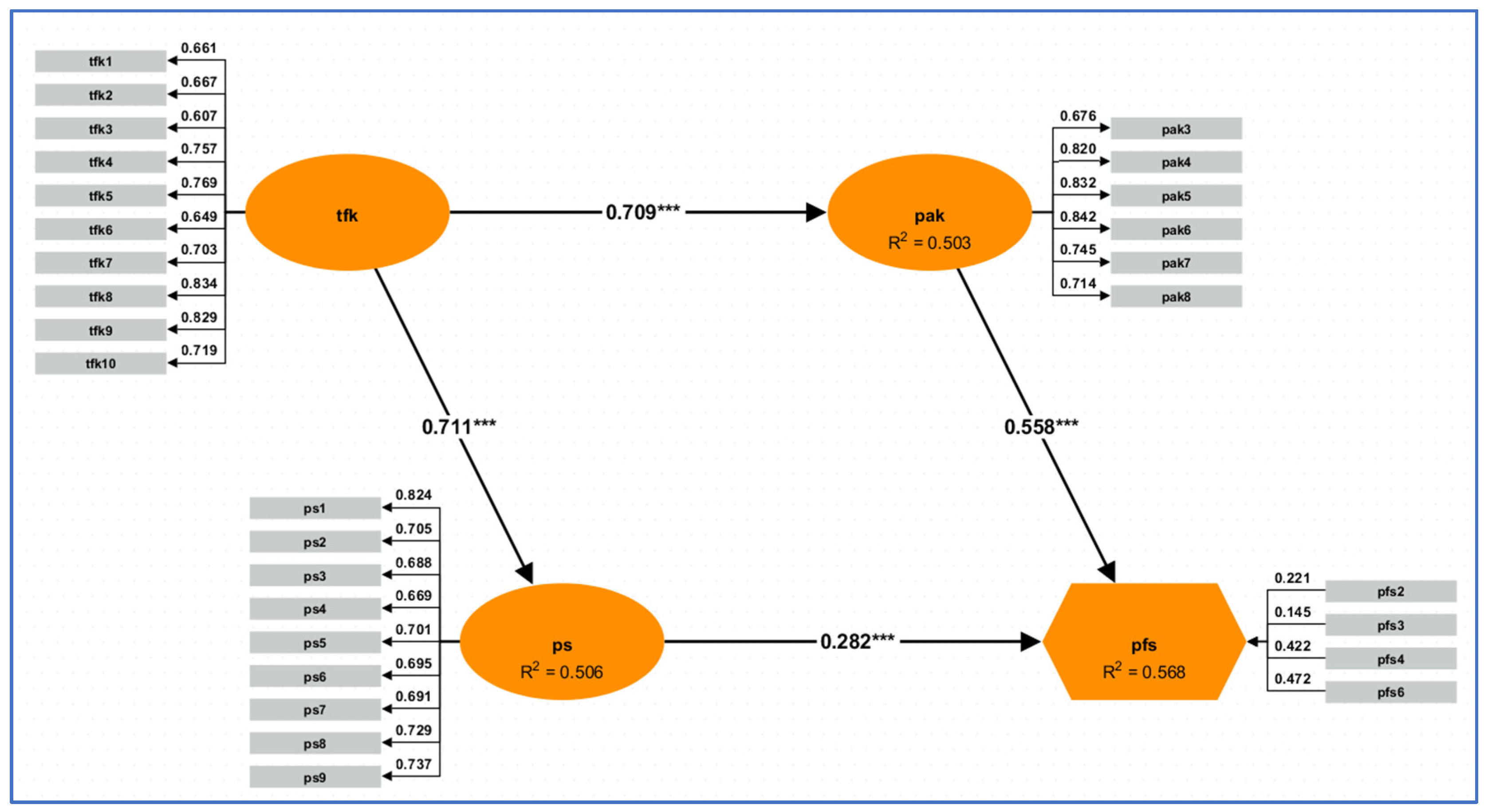
| Construct | Indicator | Outer Loading | α | ρA | ρc | AVE |
|---|---|---|---|---|---|---|
| TFK | tfk1 | 0.661 | 0.916 | 0.920 | 0.916 | 0.523 |
| tfk2 | 0.667 | |||||
| tfk3 | 0.607 | |||||
| tfk4 | 0.757 | |||||
| tfk5 | 0.769 | |||||
| tfk6 | 0.649 | |||||
| tfk7 | 0.703 | |||||
| tfk8 | 0.834 | |||||
| tfk9 | 0.829 | |||||
| tfk10 | 0.719 | |||||
| PS | ps1 | 0.824 | 0.905 | 0.906 | 0.905 | 0.514 |
| ps2 | 0.705 | |||||
| ps3 | 0.688 | |||||
| ps4 | 0.669 | |||||
| ps5 | 0.701 | |||||
| ps6 | 0.695 | |||||
| ps7 | 0.691 | |||||
| ps8 | 0.729 | |||||
| ps9 | 0.737 | |||||
| PAK | pak3 | 0.676 | 0.899 | 0.903 | 0.899 | 0.599 |
| pak4 | 0.820 | |||||
| pak5 | 0.832 | |||||
| pak6 | 0.842 | |||||
| pak7 | 0.745 | |||||
| pak8 | 0.714 |
| Construct | tfk | ps | pak |
|---|---|---|---|
| tfk | 1.000 | 0.712 | 0.698 |
| ps | 0.712 | 1.000 | 0.557 |
| pak | 0.698 | 0.557 | 1.000 |
| Construct | Indicator | Outer Loading | Outer Weight | t | p | 95% CI (2.5%) | 95% CI (97.5%) | VIF |
|---|---|---|---|---|---|---|---|---|
| pfs | pfs2 | 0.718 | 0.221 | 3.185 | 0.001 | 0.078 | 0.345 | 1.706 |
| pfs | pfs3 | 0.642 | 0.145 | 2.227 | 0.026 | 0.020 | 0.278 | 1.600 |
| pfs | pfs4 | 0.835 | 0.422 | 6.191 | <0.001 | 0.291 | 0.557 | 1.588 |
| pfs | pfs6 | 0.839 | 0.472 | 7.181 | <0.001 | 0.340 | 0.597 | 1.461 |
| Endogenous Variable | R2 | Adjusted R2 |
|---|---|---|
| ps | 0.506 | 0.504 |
| pak | 0.503 | 0.502 |
| pfs | 0.568 | 0.565 |
| Relationship | Beta | t | p | 95% CI (2.5–97.5%) | f2 |
|---|---|---|---|---|---|
| tfk → ps | 0.711 | 16.565 | <0.001 | 0.622–0.791 | 1.023 |
| tfk → pak | 0.709 | 20.311 | <0.001 | 0.639–0.773 | 1.013 |
| ps → pfs | 0.282 | 5.598 | <0.001 | 0.188–0.388 | 0.126 |
| pak → pfs | 0.558 | 10.738 | <0.001 | 0.453–0.655 | 0.492 |
| Indirect Effect | Beta | t | p | 95% CI (2.5–97.5%) |
|---|---|---|---|---|
| tfk → ps → pfs | 0.201 | 4.933 | <0.001 | 0.129–0.289 |
| tfk → pak → pfs | 0.396 | 8.742 | <0.001 | 0.311–0.488 |
| tfk → pfs (total indirect) | 0.596 | 16.770 | <0.001 | 0.531–0.671 |
Disclaimer/Publisher’s Note: The statements, opinions and data contained in all publications are solely those of the individual author(s) and contributor(s) and not of MDPI and/or the editor(s). MDPI and/or the editor(s) disclaim responsibility for any injury to people or property resulting from any ideas, methods, instructions or products referred to in the content. |
© 2026 by the authors. Licensee MDPI, Basel, Switzerland. This article is an open access article distributed under the terms and conditions of the Creative Commons Attribution (CC BY) license.
Share and Cite
Eche-Querevalú, P.; Mejía-Osorio, A.G.; Rojas-Villanueva, E.J.; Vega-Lazo, F.H.; Chávez-Díaz, J.M. Applied Financial Learning as a Key Predictor of Financial Self-Management in Higher Education Evidence from Peruvian University Students. J. Risk Financial Manag. 2026, 19, 415. https://doi.org/10.3390/jrfm19060415
Eche-Querevalú P, Mejía-Osorio AG, Rojas-Villanueva EJ, Vega-Lazo FH, Chávez-Díaz JM. Applied Financial Learning as a Key Predictor of Financial Self-Management in Higher Education Evidence from Peruvian University Students. Journal of Risk and Financial Management. 2026; 19(6):415. https://doi.org/10.3390/jrfm19060415
Chicago/Turabian StyleEche-Querevalú, Pedro, Amador Grover Mejía-Osorio, Emilio Javier Rojas-Villanueva, Fiorella Helka Vega-Lazo, and Jorge Miguel Chávez-Díaz. 2026. "Applied Financial Learning as a Key Predictor of Financial Self-Management in Higher Education Evidence from Peruvian University Students" Journal of Risk and Financial Management 19, no. 6: 415. https://doi.org/10.3390/jrfm19060415
APA StyleEche-Querevalú, P., Mejía-Osorio, A. G., Rojas-Villanueva, E. J., Vega-Lazo, F. H., & Chávez-Díaz, J. M. (2026). Applied Financial Learning as a Key Predictor of Financial Self-Management in Higher Education Evidence from Peruvian University Students. Journal of Risk and Financial Management, 19(6), 415. https://doi.org/10.3390/jrfm19060415