


Climate Finance Architecture: Disaster Loss, Policy Uncertainty and Adaptation Investment Across the Global South



Abstract
1. Introduction
2. Literature Review: The Architecture of Climate Finance: Instruments, Mechanisms, and Theoretical Foundations
2.1. Blended Finance as a Foundational Mechanism
2.2. Parametric Insurance and Catastrophe Bonds
2.3. Insurance-Backed Debt and Debt-for-Nature Mechanisms
2.4. The Reactive Finance Problem and the Case for Risk Layering
2.5. Policy Uncertainty and Climate Finance Allocation
3. Materials and Methods
3.1. Data Sources
3.2. Data Harmonisation
3.3. Analytical Methods
4. Results
4.1. Reactive Financing Pattern (H1)
4.2. Geographic Distribution
4.3. Policy Uncertainty and Private Climate Finance Mobilisation (H2)
4.4. Instrument Leverage and Private Finance Mobilisation (H3)
5. Discussion
5.1. Reactive Finance, Fiscal Exposure, and the Corporate Risk Nexus
5.2. Policy Uncertainty as a Conditional Barrier
5.3. Risk-Layering as an Organising Framework
5.4. Geographic Equity and the Deployment Gap in Risk-Finance Instruments
5.5. Policy Recommendations for a Risk-Layered Adaptation Finance Architecture
5.5.1. Governments and Multilateral Donors
5.5.2. Financial Institutions and Banks
5.5.3. Institutional Investors
5.5.4. Insurance and Reinsurance Sector
6. Conclusions
Author Contributions
Funding
Institutional Review Board Statement
Informed Consent Statement
Data Availability Statement
Acknowledgments
Conflicts of Interest
Abbreviations
| A&R | Adaptation and Resilience |
| ARC | African Risk Capacity |
| CAGR | Compound Annual Growth Rate |
| CCRIF | Caribbean Catastrophe Risk Insurance Facility |
| CPI | Climate Policy Initiative |
| DAC | Development Assistance Committee |
| DFI | Development Finance Institution |
| EM-DAT | Emergency Events Database |
| EWS | Early Warning Systems |
| GCF | Green Climate Fund |
| IMF | International Monetary Fund |
| IPCC | Intergovernmental Panel on Climate Change |
| LDC | Least Developed Countries |
| OECD | Organisation for Economic Co-operation and Development |
| PCRIC | Pacific Catastrophe Risk Insurance Company |
| SIDS | Small Island Developing States |
| UNFCCC | United Nations Framework Convention on Climate Change |
| WUI | World Uncertainty Index |
| WGI | World Governance Indicators |
References
- Ahir, H., Bloom, N., & Furceri, D. (2022). The world uncertainty index (No. W29763, p. w29763). National Bureau of Economic Research. [Google Scholar] [CrossRef] [Scilit]
- AON. (2024). Climate and catastrophe insight 2024 (Global catastrophe & climate risk analytics report, 118p). AON. Available online: https://assets.aon.com/-/media/files/aon/reports/2024/climate-and-catastrophe-insights-report.pdf (accessed on 25 April 2026).
- Artemis. (n.d.). Catastrophe bond & insurance-linked securities deal directory (Version Continuously updated) [Database/Deal-level dataset; Web database]. Artemis. Available online: https://www.artemis.bm/deal-directory/ (accessed on 25 April 2026).
- Artemis. (2025). Catastrophe bond & ILS market report Q4 2024. Available online: https://www.artemis.bm/wp-content/uploads/2025/01/catastrophe-bond-ils-market-report-q4-2024.pdf (accessed on 12 May 2026).
- Atamuratova, S., Boudreau, L. E., Clarke, D. J., Olivier, M., Signe, B. L., White, E. J., & Yi, H. J. (2014). Financial protection against natural disasters: From products to comprehensive strategies—An operational framework for disaster risk financing and insurance (Working Paper No. 94988). World Bank Group. Available online: http://documents.worldbank.org/curated/en/523011468129274796 (accessed on 12 May 2026).
- Bangalore, M., Hallegatte, S., Vogt-Schilb, A., & Rozenberg, J. (2017). Unbreakable: Building the resilience of the poor in the face of natural disasters. World Bank. [Google Scholar] [CrossRef] [Scilit]
- Battiston, S., Dafermos, Y., & Monasterolo, I. (2021). Climate risks and financial stability. Journal of Financial Stability, 54, 100867. [Google Scholar] [CrossRef] [Scilit]
- Battiston, S., Mandel, A., Monasterolo, I., Schütze, F., & Visentin, G. (2017). A climate stress-test of the financial system. Nature Climate Change, 7(4), 283–288. [Google Scholar] [CrossRef] [Scilit]
- Betzold, C., & Weiler, F. (2017). Allocation of aid for adaptation to climate change: Do vulnerable countries receive more support? International Environmental Agreements: Politics, Law and Economics, 17(1), 17–36. [Google Scholar] [CrossRef] [Scilit]
- Bhandary, R. R., Gallagher, K. S., & Zhang, F. (2021). Climate finance policy in practice: A review of the evidence. Climate Policy, 21(4), 529–545. [Google Scholar] [CrossRef] [Scilit]
- Biffis, E., Chavez, E., Louaas, A., & Picard, P. (2022). Parametric insurance and technology adoption in developing countries. The Geneva Risk and Insurance Review, 47(1), 7–44. [Google Scholar] [CrossRef] [Scilit]
- Bonazzi, A., Lowes, B., Candian, I., Solana, M., & Carter, L. (2024). Parametric insurance to build financial resilience (p. 79). [Technical/Policy Report]. United Nations Development Programme (UNDP). Available online: https://www.undp.org/publications/parametric-insurance-build-financial-resilience (accessed on 25 April 2026).
- Boston Consulting Group (BCG). (2026). Climate adaptation and resilience: The $100–130 billion opportunity for banks. White Paper. Available online: https://www.bcg.com/assets/2026/white-paper-climate-adaptation-and-resilience-financing.pdf (accessed on 25 April 2026).
- Brandon, C., Aggarwal, A., Kratzer, B., Carter, R., Laxton, V., & Ross, K. (2025). From bonds to blended finance: How a Diverse range of financial instruments are financing climate adaptation and resilience. World Resources Institute. [Google Scholar] [CrossRef] [Scilit]
- Broccolini, C., Lotti, G., Maffioli, A., Presbitero, A., & Stucchi, R. (2020). Mobilization effects of multilateral development banks. World Bank. [Google Scholar] [CrossRef] [Scilit]
- Buuren, S. V., & Groothuis-Oudshoorn, K. (2011). mice: Multivariate Imputation by Chained Equations in R. Journal of Statistical Software, 45(3), 1–67. [Google Scholar] [CrossRef] [Scilit]
- Campiglio, E., Daumas, L., Monnin, P., & Von Jagow, A. (2023). Climate-related risks in financial assets. Journal of Economic Surveys, 37(3), 950–992. [Google Scholar] [CrossRef] [Scilit]
- CCRIF SPC. (2025). Annual report 2024–2025. Available online: https://www.ccrif.org/publications/annual-report/ccrif-spc-annual-report-2024-2025 (accessed on 12 May 2026).
- Clarke, D. J., & Dercon, S. (2016). Dull disasters?: How planning ahead will make a difference (1st ed.). Oxford University Press. [Google Scholar] [CrossRef] [Scilit]
- Convergence Blended Finance. (2024, October 30). State of blended finance 2024: Climate edition [Convergence Report]. Convergence. Available online: https://www.convergence.finance/resource/state-of-blended-finance-2024-climate-edition/view (accessed on 25 April 2026).
- CPI. (2024). Global landscape of climate finance 2024: Insights for COP 29. Available online: https://www.climatepolicyinitiative.org/wp-content/uploads/2024/10/Global-Landscape-of-Climate-Finance-2024.pdf (accessed on 12 May 2026).
- Cummins, J. D., & Weiss, M. A. (2009). Convergence of insurance and financial markets: Hybrid and securitized risk-transfer solutions. Journal of Risk and Insurance, 76(3), 493–545. [Google Scholar] [CrossRef] [Scilit]
- Delforge, D., Wathelet, V., Below, R., Sofia, C. L., Tonnelier, M., Van Loenhout, J. A. F., & Speybroeck, N. (2025). EM-DAT: The emergency events database. International Journal of Disaster Risk Reduction, 124, 105509. [Google Scholar] [CrossRef] [Scilit]
- Dietz, S., Bowen, A., Dixon, C., & Gradwell, P. (2016). ‘Climate value at risk’ of global financial assets. Nature Climate Change, 6(7), 676–679. [Google Scholar] [CrossRef] [Scilit]
- Driscoll, J. C., & Kraay, A. C. (1998). Consistent covariance matrix estimation with spatially dependent panel data. The Review of Economics and Statistics, 80(4), 549–560. [Google Scholar] [CrossRef] [Scilit]
- EM-DAT. (2024). EM-DAT: The emergency events database (Version Continuously updated) [Disaster database]. UCLouvain. Available online: https://www.emdat.be/ (accessed on 25 April 2026).
- Green Climate Fund (GCF). (2026). GCF open data library. Green Climate Fund (GCF). Available online: https://data.greenclimate.fund/public/data/projects (accessed on 10 May 2026).
- Hochrainer-Stigler, S., Mechler, R., Pflug, G., & Williges, K. (2014). Funding public adaptation to climate-related disasters. Estimates for a global fund. Global Environmental Change, 25, 87–96. [Google Scholar] [CrossRef] [Scilit]
- Hoechle, D. (2007). Robust standard errors for panel regressions with cross-sectional dependence. The Stata Journal: Promoting Communications on Statistics and Stata, 7(3), 281–312. [Google Scholar] [CrossRef] [Scilit]
- Huang, T., & Sun, Z. (2024). Climate policy uncertainty and firm investment. International Journal of Finance & Economics, 29(4), 4358–4371. [Google Scholar] [CrossRef] [Scilit]
- Islam, M. M. (2022). Distributive justice in global climate finance—Recipients’ climate vulnerability and the allocation of climate funds. Global Environmental Change, 73, 102475. [Google Scholar] [CrossRef] [Scilit]
- Kaufmann, D., Kraay, A., & Mastruzzi, M. (2010). The worldwide governance indicators: Methodology and analytical issues. World Bank. [Google Scholar] [CrossRef] [Scilit]
- Kellett, J., & Caravani, A. (2013). Financing disaster risk reduction: A 20-year story of international aid [Research Report]. Overseas Development Institute; GFDRR (World Bank). Available online: https://media.odi.org/documents/8574.pdf (accessed on 28 April 2026).
- Krueger, P., Sautner, Z., & Starks, L. T. (2020). The importance of climate risks for institutional investors. The Review of Financial Studies, 33(3), 1067–1111. [Google Scholar] [CrossRef] [Scilit]
- Linnerooth-Bayer, J., & Mechler, R. (2006). Insurance for assisting adaptation to climate change in developing countries: A proposed strategy. Climate Policy, 6(6), 621–636. [Google Scholar] [CrossRef]
- Mallucci, E. (2022). Natural disasters, climate change, and sovereign risk. Journal of International Economics, 139, 103672. [Google Scholar] [CrossRef] [Scilit]
- Mandel, A., Battiston, S., & Monasterolo, I. (2025). Mapping global financial risks under climate change. Nature Climate Change, 15(3), 329–334. [Google Scholar] [CrossRef] [Scilit]
- Monasterolo, I. (2020). Climate change and the financial system. Annual Review of Resource Economics, 12(1), 299–320. [Google Scholar] [CrossRef] [Scilit]
- Morana, C., & Sbrana, G. (2019). Climate change implications for the catastrophe bonds market: An empirical analysis. Economic Modelling, 81, 274–294. [Google Scholar] [CrossRef] [Scilit]
- Munich Re. (2025, January 9). Climate change is showing its claws: The world is getting hotter, resulting in severe hurricanes, thunderstorms and floods. Munich Re. Available online: https://www.munichre.com/en/company/media-relations/media-information-and-corporate-news/media-information/2025/natural-disaster-figures-2024.html (accessed on 16 May 2026).
- Nedopil, C., Yue, M., & Hughes, A. C. (2024). Are debt-for-nature swaps scalable: Which nature, how much debt, and who pays? Ambio, 53(1), 63–78. [Google Scholar] [CrossRef] [Scilit] [PubMed]
- Nor, M. I. (2025). Investigating the dynamics of climate finance disbursements: A panel data approach from 2003 to 2022. PLoS ONE, 20(3), e0318170. [Google Scholar] [CrossRef] [Scilit]
- Ocampo, D. G., & Moreira, C. L. (2024). Uncertain waters: Can parametric insurance help bridge NatCat protection gaps? BIS. Available online: https://www.bis.org/fsi/publ/insights62.htm (accessed on 30 April 2026).
- OECD. (2025a). Consolidated text of the common reporting standard (2025): Standard for automatic exchange of financial account information in tax matters. OECD Publishing. [Google Scholar] [CrossRef] [Scilit]
- OECD. (2025b). Creditor reporting system (CRS) [Dataset]. OECD.Stat. Available online: https://stats.oecd.org/Index.aspx?DataSetCode=CRS1 (accessed on 17 May 2026).
- OECD & UNCDF. (2020). Blended finance in the least developed countries 2020: Supporting a resilient COVID-19 recovery. OECD Publishing. [Google Scholar] [CrossRef] [Scilit]
- Pacific Catastrophe Risk Insurance Company (PCRIC). (2024). PCRIC: Annual report 2023 [Annual Report]. Pacific Catastrophe Risk Insurance Company (PCRIC). Available online: https://pcric.org/wp-content/uploads/2024/11/PCRIC-AR-2023_EXPORT-Web1.pdf (accessed on 10 May 2026).
- Pleterski, N. (2025). Parametric insurance for sustainable disaster risk finance: Legal, data, and governance pathways in Slovenia and Croatia. Sustainability, 17(21), 9643. [Google Scholar] [CrossRef] [Scilit]
- Prasad, R., & Singhania, M. (2026). Impact of climate vulnerability on the allocation of climate finance: Global evidence. Journal of Environmental Management, 397, 128307. [Google Scholar] [CrossRef] [Scilit]
- Ranger, N., Mahul, O., & Monasterolo, I. (2021). Managing the financial risks of climate change and pandemics: What we know (and don’t know). One Earth, 4(10), 1375–1385. [Google Scholar] [CrossRef] [Scilit]
- Robinson, S. (2020). Climate change adaptation in SIDS: A systematic review of the literature pre and post the IPCC Fifth Assessment Report. WIREs Climate Change, 11(4), e653. [Google Scholar] [CrossRef] [Scilit]
- Steele, P., & Patel, S. (2020). Tackling the triple crisis: Using debt swaps to address debt, climate and nature loss post-COVID-19 [Issue Paper]. International Institute for Environment and Development (IIED). Available online: https://www.iied.org/16674iied (accessed on 28 April 2026).
- Surminski, S., & Oramas-Dorta, D. (2014). Flood insurance schemes and climate adaptation in developing countries. International Journal of Disaster Risk Reduction, 7, 154–164. [Google Scholar] [CrossRef] [Scilit]
- Swiss Re. (2024, March 26). sigma 1/2024: Natural catastrophes in 2023. Swiss Re Institute. Available online: https://www.swissre.com/institute/research/sigma-research/sigma-2024-01.html (accessed on 10 May 2026).
- Taylor, O. G. (2023). The policy landscape and challenges of disaster risk financing: Navigating risk and uncertainty. Disasters, 47(3), 745–765. [Google Scholar] [CrossRef] [Scilit]
- UNDRR. (2022). Global assessment report on disaster risk reduction 2022: Our world at risk: Ransforming governance for a resilient future. United Nations Office for Disaster Risk Reduction. Available online: https://www.undrr.org/gar2022 (accessed on 11 May 2026).
- United Nations Framework Convention on Climate Change (UNFCCC). (2024). Sixth biennial assessment and overview of climate finance flows—Summary and recommendations. UNFCCC Standing Committee on Finance. Available online: https://unfccc.int/sites/default/files/resource/UNFCCC_BA6_Summary_Web_Final.pdf (accessed on 11 May 2026).
- United Nations Office for Disaster Risk Reduction. (2023). GAR special report 2023: Mapping resilience for the sustainable development goals. UNDRR. Available online: https://www.undrr.org/gar/gar2023-special-report (accessed on 26 April 2026).
- University of Notre Dame. (n.d.). Notre dame global adaptation initiative country index (ND-GAIN) [Dataset]. Notre Dame Global Adaptation Initiative. Available online: https://gain.nd.edu/our-work/country-index/download-data/ (accessed on 10 May 2026).
- U.S. Bureau of Labor Statistics. (2025). Consumer price index for all urban consumers: All items in U.S. city average (Series CUUR0000SA0) [Dataset]. Available online: https://www.bls.gov/cpi/data.htm (accessed on 9 February 2026).
- Weiler, F., Klöck, C., & Dornan, M. (2018). Vulnerability, good governance, or donor interests? The allocation of aid for climate change adaptation. World Development, 104, 65–77. [Google Scholar] [CrossRef] [Scilit]
- World Bank. (2025a). World development indicators [Dataset]. World Bank Open Data. Available online: https://data.worldbank.org (accessed on 26 April 2026).
- World Bank. (2025b). Worldwide governance indicators [Dataset]. World Bank Open Data. Available online: https://www.govindicators.org (accessed on 26 April 2026).
- World Bank Group. (2014). Financial protection against natural disasters: An operational framework for disaster risk financing and insurance. World Bank. [Google Scholar] [CrossRef] [Scilit]

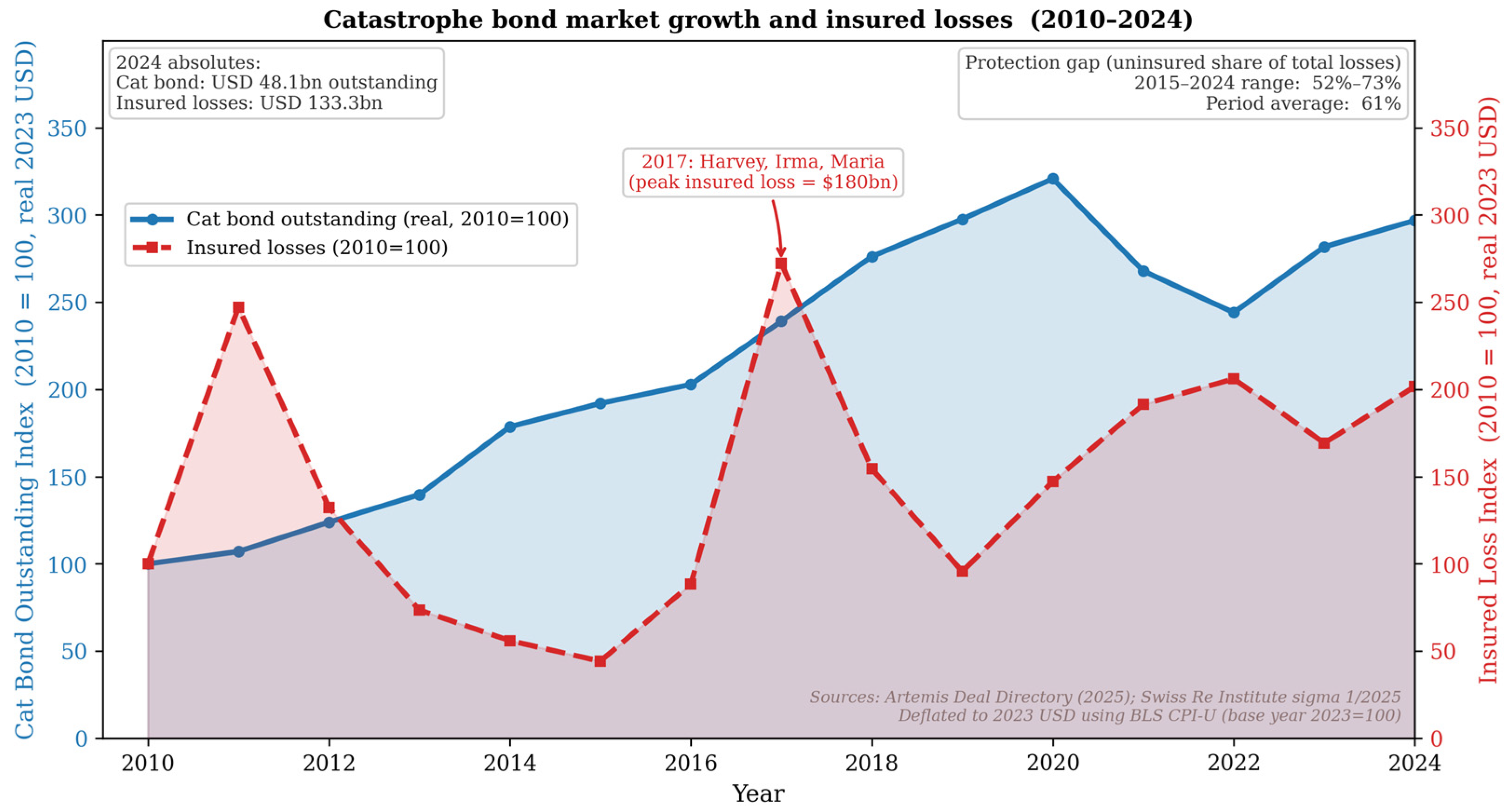

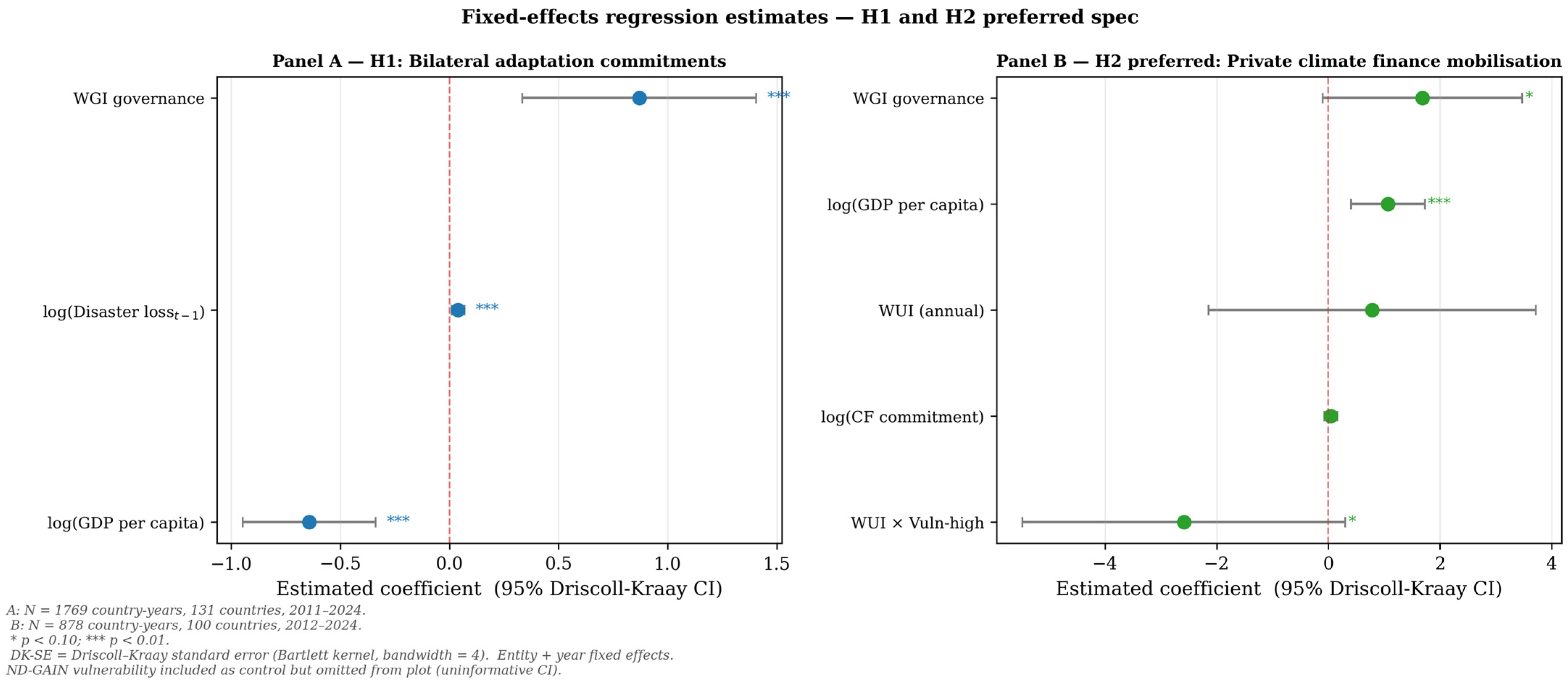


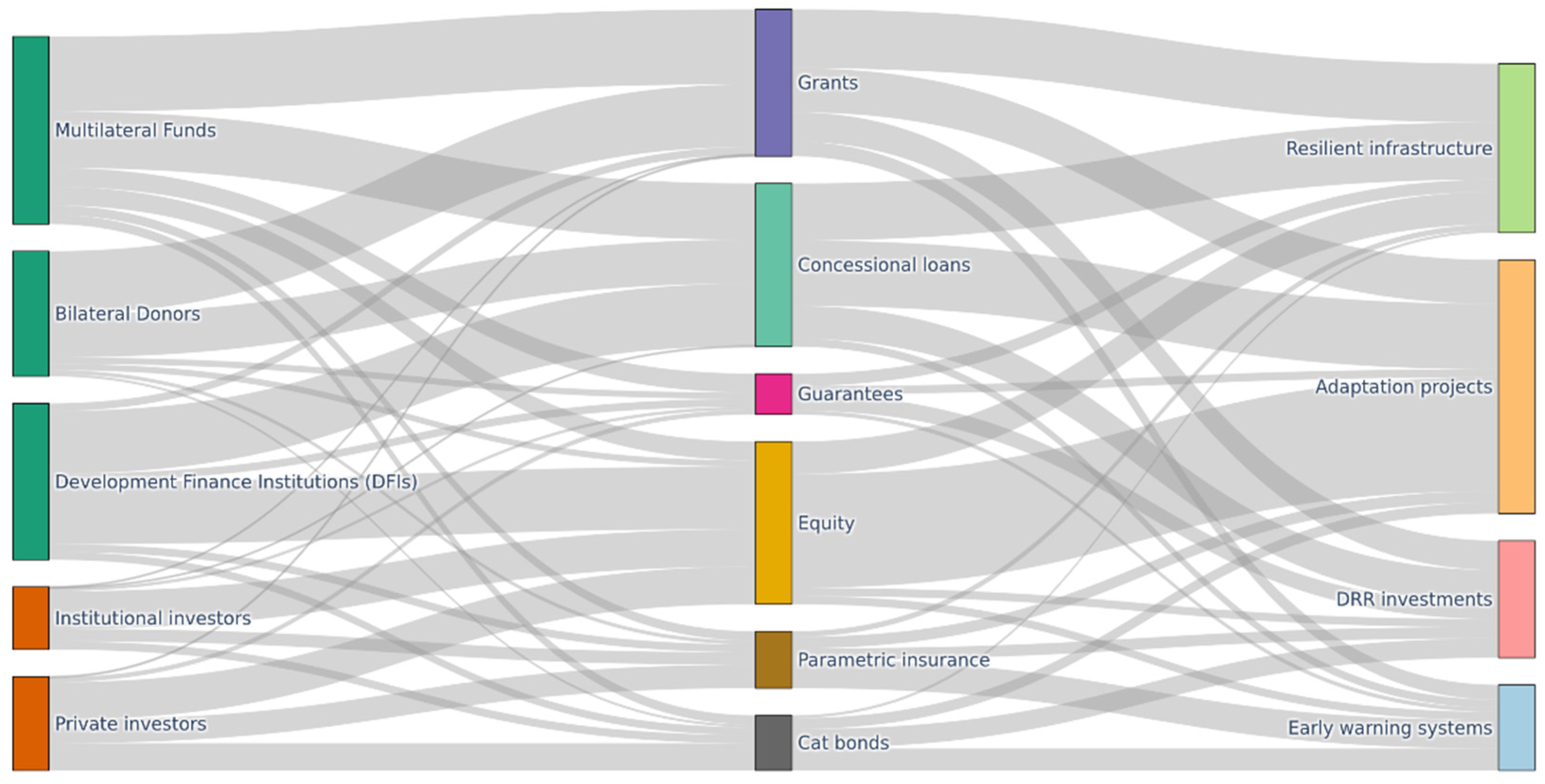

| Variable | H | N | Mean | SD | Min | Max |
|---|---|---|---|---|---|---|
| log(CF commitment) | H1 | 1769 | 5.568 | 2.097 | 0.003 | 10.136 |
| log(Disaster loss, t − 1) | 1769 | 1.068 | 2.319 | 0 | 11.225 | |
| log(GDP per capita) | 1769 | 8.118 | 0.997 | 5.263 | 10.086 | |
| WGI governance composite | 1769 | −0.46 | 0.63 | −2.19 | 1.198 | |
| ND-GAIN vulnerability | 1736 | 0.473 | 0.08 | 0.307 | 0.655 | |
| ND-GAIN readiness | 1739 | 0.353 | 0.088 | 0.115 | 0.631 | |
| WUI (annual) | H2 | 918 | 0.076 | 0.054 | 0 | 0.343 |
| log(Private mob. % GDP + eps) | 918 | −3.8 | 2.515 | −12.904 | 2.807 | |
| WUI × Vuln-high (interaction) | 918 | 0.035 | 0.053 | 0 | 0.327 |
| Variable | H1 | H2 Column 1 | H2 Column 2 | H2 Column 3 (Preferred) |
|---|---|---|---|---|
| Dependent variable | log(CF commit + 1) | log(Priv mob % GDP) | log(Priv mob % GDP) | log(Priv mob % GDP) |
| log(Disaster loss, t − 1) | 0.040 *** | — | — | — |
| (0.015) | ||||
| WUI annual | — | −0.409 | −0.444 | 0.785 |
| (1.580) | (1.608) | (1.496) | ||
| WUI × Vuln-high | — | — | — | −2.587 * |
| (1.475) | ||||
| log(GDP per capita) | −0.643 *** | 1.045 *** | 1.064 *** | 1.068 *** |
| (0.155) | (0.349) | (0.334) | (0.337) | |
| WGI composite | 0.870 *** | 1.620 * | 1.638 * | 1.685 * |
| (0.273) | (0.908) | (0.904) | (0.911) | |
| ND-GAIN vulnerability | — | — | 4.779 | 5.494 |
| (5.592) | (5.706) | |||
| log(CF commitment) | — | 0.044 | 0.043 | 0.044 |
| (0.059) | (0.060) | (0.059) | ||
| Country FE | Yes | Yes | Yes | Yes |
| Year FE | Yes | Yes | Yes | Yes |
| N | 1769 | 878 | 878 | 878 |
| Countries | 131 | 97 | 97 | 97 |
| Period | 2011–2024 | 2012–2024 | 2012–2024 | 2012–2024 |
| R2 (within) | 0.025 | 0.016 | 0.011 | 0.012 |
Disclaimer/Publisher’s Note: The statements, opinions and data contained in all publications are solely those of the individual author(s) and contributor(s) and not of MDPI and/or the editor(s). MDPI and/or the editor(s) disclaim responsibility for any injury to people or property resulting from any ideas, methods, instructions or products referred to in the content. |
© 2026 by the authors. Licensee MDPI, Basel, Switzerland. This article is an open access article distributed under the terms and conditions of the Creative Commons Attribution (CC BY) license.
Share and Cite
Fakhruddin, B.S.; Gandhi, S. Climate Finance Architecture: Disaster Loss, Policy Uncertainty and Adaptation Investment Across the Global South. J. Risk Financ. Manag. 2026, 19, 412. https://doi.org/10.3390/jrfm19060412
Fakhruddin BS, Gandhi S. Climate Finance Architecture: Disaster Loss, Policy Uncertainty and Adaptation Investment Across the Global South. Journal of Risk and Financial Management. 2026; 19(6):412. https://doi.org/10.3390/jrfm19060412
Chicago/Turabian StyleFakhruddin, Bapon Shm, and Shaily Gandhi. 2026. "Climate Finance Architecture: Disaster Loss, Policy Uncertainty and Adaptation Investment Across the Global South" Journal of Risk and Financial Management 19, no. 6: 412. https://doi.org/10.3390/jrfm19060412
APA StyleFakhruddin, B. S., & Gandhi, S. (2026). Climate Finance Architecture: Disaster Loss, Policy Uncertainty and Adaptation Investment Across the Global South. Journal of Risk and Financial Management, 19(6), 412. https://doi.org/10.3390/jrfm19060412



