1. Introduction
Accounting professionals constantly contribute to connecting the financial and non-financial factors of an organization. Resource management and evaluation are important issues that managers must address with the utmost care. It is believed that social practices, through the contribution of intellectual capital (IC) and technology, will connect companies with communities, and if the people of a country are happy and collaborate transparently, then productivity at the company level will also be better (
Aich et al., 2021). It is the responsibility of intellectual capital to select and implement the optimal algorithms that could present a picture that is as transparent and realistic as possible, but above all to interpret and adapt the predictions offered by AI so that they correspond to reality and the specific nature of the company. The contribution of accountants, but also of the board of directors, is decisive in filtering and presenting non-financial information, which has been increasingly requested in recent years (
Hoang, 2018). When companies respond to the needs of their employees, the latter in turn invest in the company’s bottom line. It is a mutual exchange of services and attitude, and fairness on both sides plays an essential role. All the information made available to stakeholders, processed by intellectual capital, helps them make decisions about relationships and investments, but more than that, it can create new directions for development and competitive advantages through constant monitoring of the environment in order to achieve performance.
Sustainability has become a topic of interest for various categories of participants in the economic market. For some companies, these reports are not only a means of aligning with standards, but also a strategic way of communicating with potential employees or investors. In this context, there is a pressing need to create an integrative conceptual framework that clarifies how non-financial indicators, processed by digital algorithms and monitored by accounting professionals, can capture the organizational performance of sustainable companies. The challenge for the entity is to develop internal intellectual capital, to develop policies that support innovation, to create opportunities for development, and to leverage the ability of financial indicators to contribute to performance.
Intellectual capital and ESG reporting are increasingly studied in the academic literature in the context of financial risk analysis and company performance (
Pham et al., 2024). Through the disclosure of this information, companies provide investors with a more complete and qualitative view of sources of risk and opportunity, facilitating a more realistic assessment of organizational performance. Thus, the components of intellectual capital become determining elements of financial sustainability, with a major influence on risk management capacity and long-term stability (
D’Amato, 2021).
The research question focuses on examining the extent to which the process of preparing sustainability reports contributes to leveraging global intellectual capital. The study approaches intellectual capital through its three components and incorporates the professional judgment of the accounting professional within a unified and integrative framework of analysis and application.
The research is based on three hypotheses: the contribution of extra-financial factors in determining the value of the global intellectual capital of sustainable companies listed on the Bucharest Stock Exchange is significant; in the sustainability reporting process, assessment policies and techniques offer a much more relevant way of comparing IC data; accounting professionals play an important role through their ability to guarantee the reliability and certification of information, especially when IC is measured using intangibles. The proposed hypotheses are aligned with the objectives of the study outlined in the methodology section, such that each of the three hypotheses is analyzed in relation to its corresponding objective.
In this study, global intellectual capital encompasses intangible resources that play a stimulating role in the process of creating sustainable value. It is segmented into three interconnected components, namely: human capital (CU)—intellectual resources and experience; structural capital (CS)—organizational infrastructure and innovation capacity; and relational capital (CR)—external relationships and market credibility. In the context of this research, the notion of “global” can be explained through the comprehensive nature of intellectual capital, resulting from the integration of human, structural, and relational capital into a unified analytical construct. This term is not used in a geographical sense, since all companies included in the sample are listed on the same stock exchange, within the same country.
Non-financial factors are presented in this research as both qualitative and quantitative variables that describe relevant aspects of the company’s organizational performance. These aspects are not directly captured by financial indicators. In this paper, we treat non-financial factors as elements with an integrative function in organizational analysis, which facilitate the creation of links between the three components of intellectual capital and support the transformation of IC into sustainable performance. Digital technologies enhance the efficiency of collecting, processing, and organising non-financial information, but they do not substitute the professional judgement of the accountant, which remains fundamental to the interpretation and validation of the reported data. We believe that digital technologies do not replace the professional’s reasoning but represent a complementary approach that enhances the ability to examine and interpret relevant information.
The relationship between the analyzed concepts is characterized by mutual functional interdependence. Global intellectual capital is the primary source of value; non-financial factors are the tools through which this value is reflected and assessed. The 2024 reports published by the 30 companies listed on the Bucharest Stock Exchange, including Corporate Governance Statements or documents such as Compliance with the Trading Venue’s Corporate Governance Code, have highlighted that non-financial elements such as competencies, process digitization, or innovation potential underscore the direct link to the essential components of IC. The accounting professional ensures the transfer of information from one stage to another, thereby guaranteeing the accuracy and coherence of the non-financial data used in the context of evaluating overall intellectual capital (IC), through the use of digital tools. The company’s financial performance is the main goal of its administrators. The integration of non-financial factors has begun to be seen as a major opportunity to achieve objectives. The development of technologies was a prerequisite for the digitization of companies. But this change also emphasized the role that intangibles play in the company’s progress. Investors do not only analyze financial reports, but also follow with interest information on customer satisfaction or product quality, and the company’s focus on innovation. Some of the non-financial indicators are based on balanced scorecard indicators. These are based on four perspectives: financial, customer, internal processes, innovation, and learning (
Kotane & Kuzmina-Merlino, 2011). The latter perspective has been adapted and currently covers three categories: human, informational, and organizational capital. There is no structure or content generally accepted by specialists in the field regarding non-financial indicators. Therefore, assumptions and information related to this topic are highly topical.
An analysis of the main components of intellectual capital has shown that the training and value-added subcomponent of human capital and the services subcomponent of structural capital affect asset profitability (
Corvo et al., 2022). On the one hand, material resources are used more efficiently, generating added value, and on the other hand, well-trained human capital requires additional investments that have a high impact on return on assets. A correct understanding of the role of IC leads, in the long term, to a differentiation of companies in terms of achieving more efficient financial sustainability (
Jordão & Almeida, 2017). A company with limited tangible assets but with trained human capital can achieve performance. Intellectual capital evolves over time, and its interaction with regulatory changes strengthens the organization’s capacity to adapt and remain resilient under conditions of uncertainty or instability (
Morea et al., 2026).
Integrating all three components and sustainability components into intellectual capital can increase financial stability (
Ahmad, 2025). Data provided by 414 respondents in Indonesia showed that intellectual capital offers competitive advantages when assessed by integrating information on sustainability policies. It positively influences financial and non-financial performance (
Suryantini et al., 2024). Integrated capital explores green products, technology integration for process optimization, and intellectual capital, with an emphasis on research and development. In this context, the greatest contribution of intellectual capital in this equation is to connect the resources generated by each component factor. The integration of ESG considerations into reporting processes can enhance corporate profitability, attract customers and investors, and contribute to greater progress toward sustainability (
Treepongkaruna & Suttipun, 2026). A higher level of sustainability disclosure in published reports does not affect financial risk and has a significant influence on operational, financial, and market performance (
Grassa et al., 2026).
Some authors consider government involvement in integrated capital development to be important for achieving a modern business strategy (
Abdelfattah et al., 2024). With regard to digitization, a study of 118 Vietnamese companies listed on the stock exchange showed that when a company uses intellectual capital and digital technology together, its performance improves. The situation appears to be different when the two are used separately: digital transformation has a negative effect, while investments in intellectual capital have a positive effect (
Vo & Tran, 2025). A presentation of global intellectual capital will provide information for parties assessing a company’s potential not only from financial data, but also from non-financial data. It will be possible to track how the value of the component capitals was created. Moreover, global intellectual capital reporting can provide sufficient information about the company’s future strategies, not just its past achievements. Companies will disclose information about gross gas emissions and green certificate offsets. There are studies that describe six components of integrated reporting: financial, manufacturing, social and relational capital, intellectual capital, human capital, and natural capital (
Villiers et al., 2025). The same study describes the advantages of disclosing information on intellectual capital linked to sustainability information: improving internal and investor decision-making, taking leadership, and ensuring compliance with sustainability regulations. Such reporting would allow for comparability between companies, and investors would be able to predict future risks or opportunities more realistically.
Although technology has become indispensable in most activities, human resources remain a vital link in society. Regarding sustainability reporting, accounting professionals play an essential role in measuring and reporting it, but their involvement is limited (
Rinaldi et al., 2018). Greater involvement could lead to standardization of accounting practices and the harmonization of information in published reports, which would ensure comparability among companies. The investors could more accurately forecast future risks or opportunities; however, this also requires the development of new skills and the acquisition of new knowledge regarding the use of advanced technology or information on sustainability (
Ascani et al., 2021). Regulatory bodies should provide as much specific information as possible to practitioners in this field, so that managers can better understand the importance of adopting ESG practices and reporting on them, because countries that delay the implementation of these sustainability practices may have to invest more in training accountants (
Krasodomska et al., 2025). Higher-quality information also means a better future and a more protected planet; therefore, the primary role of accounting is to highlight what entities are and are not doing and to present accurate and relevant information (
Tettamanzi et al., 2022). It is predicted that the issue of intellectual capital vulnerability will receive more attention as it interacts with the latest technologies (
Užienė, 2020).
The literature highlights the contribution of each element, yet current approaches treat these topics separately from one another. There are few studies that comprehensively analyze the relationship between global intellectual capital and non-financial factors in sustainability reporting; through this paper, we aim to integrate these elements into a single approach using data from 30 companies listed on the Bucharest Stock Exchange.
2. Materials and Methods
The methodological approach is built taking into account investigative and integrative aspects, focusing on examining the mechanism through which the new paradigms regarding sustainability reporting have the potential to highlight and capitalize on the integrative intellectual capital of listed sustainable companies. The research is based on a mix of qualitative and semi-quantitative methods, combining content analysis with descriptive frequency analysis of non-financial indicators.
Our sample comprises 30 companies listed on the Bucharest Stock Exchange. The selection criterion was based on the availability of non-financial information published both on the BVB website and on each company’s website, such as annual reports, sustainability reports, non-financial statements, and governance disclosures. The construction of the sample relied on companies that made available information related to intangible resources, providing detailed descriptions of governance practices as well as sustainability areas within the entity. Thus, the components of intellectual capital could be analyzed and presented. Content analysis, as the primary research method, was conducted through the systematic examination of company reports and the extraction of relevant information for each established category. The grouping of this information was carried out according to the components of intellectual capital. Romanian listed companies publish annually on their websites and on the official website of the Bucharest Stock Exchange non-financial data and information, as well as sustainability reports, which formed the basis of our sample. The three main elements of intellectual capital, namely human, structural, and relational capital, formed the basis for the presentation of the concept of global intellectual capital, so that non-financial determinants were structured based on their ability to enhance the connection between elements and contribute to increased operational sustainability.
The reports published by the companies for the 2024 financial year were subjected to a content analysis based on a manual coding procedure. The aim was to identify the presence or absence of predefined non-financial indicators associated with the three components of intellectual capital (IC). Coding was performed on a binary basis as follows: the explicit presence of relevant information was assigned a value of 1, while the absence or non-reporting of such information was assigned a value of 0. The criteria for classifying the indicators were established according to their functional role in the process of leveraging intellectual capital. The same coding criteria were consistently applied to all reports included in the sample, namely sustainability reports, annual reports, non-financial statements, and corporate governance statements, with the aim of ensuring methodological transparency and consistency.
The coding process was carried out by the authors and subsequently verified in order to ensure consistency across documents and reduce the risk of subjective interpretation. To prevent potential inconsistencies, the coding criteria were applied uniformly and discussed within the research team. Non-financial indicators were selected following an analysis of the reports published on the Bucharest Stock Exchange website, as well as on the companies’ own websites, based on two criteria: frequency of occurrence within the sample, used as an indicator of practical relevance for the companies analyzed, and functional significance. The second criterion refers to the ability of each indicator to capture one of the components of intellectual capital.
In order to highlight the role of the accounting professional, the reports were examined from the perspective of the coherence, structure, and quality of the information disclosed. The involvement of the accounting professional was assessed indirectly by examining the degree of structuring, certification, and compliance of the information presented, these constituting indicators of a professionally supervised reporting process. This approach made it possible to distinguish the stages of the reporting process, namely data collection, processing, interpretation, and extraction of non-financial information. In this way, the essential contribution of the accounting professional to ensuring the quality and relevance of the information disclosed was identified.
The results obtained were interpreted based on their frequency of occurrence within the sample. Non-financial factors were considered representative if they were disclosed by the majority of companies in their reports and if they revealed connections between the components of intellectual capital. This approach enabled the identification of factors with an integrative function and the determination of how they contribute to presenting the level of sustainable performance.
The paper is designed around three main objectives: identifying the non-financial factors that contribute to the integrated evaluation of global intellectual capital in companies listed on the Bucharest Stock Exchange (BVB); examining how these factors contribute to the comparability of information in sustainability reports, taking into account the three components of intellectual capital; and analyzing the role of the accounting professional in the validation and processing of non-financial information.
The published reports were a reliable source for extracting those factors that have a considerable impact on overall IC. The elements with a high contribution that stood out are: skills (both individual and team skills, coordination between departments, technical and operational skills), the organizational culture specific to each branch of the company, ethics and fairness in decision-making, governance and transparency, and the company’s potential to create new things and innovate. Stakeholder relationship management also makes a significant contribution because it directly contributes to developing trust, promotes fair collaboration, and facilitates access to resources. Computerized processes and digital transformation are a real way to transfer knowledge, and at the entity level, the possibility for innovation increases. All these factors, which have been extracted from the reports under study, represent an important link connecting the two concepts: intellectual capital, with its three components, and the recording of sustainable performance at the entity level. The idea we can glean from this observation is that these factors should not be treated and presented as indicators from a list to be presented to interested parties, but as tools for global IC insertion.
To substantiate the comparative examinations, at this stage, we used tabular processing software solutions to process the collected data. Even though the current paper has highlighted conclusive results that provide a reference framework for a quantitative study, the investigative and methodological orientation could also be perceived as a limitation of our research that could be overcome in a future paper by applying an operational validation of the correlations found.
3. Results
The published reports of the analyzed entities emphasize that intellectual capital is treated in pieces, addressing its basic elements separately: CU, CS, and CR. There are also situations in which all three components are treated as a whole, but these are rare. The non-financial factors described are perceived as integrative variables that balance the relationships between the components of intellectual capital (IC) and sustainable performance, while the use of digital tools significantly enhances the efficiency of the analysis and presentation of information. This perspective is supported by the results which indicate the absence of balance in entities’ reporting on non-financial factors. Companies disclose information in different ways, with varying degrees of complexity, and this situation influences their ability to effectively leverage overall intellectual capital. According to the results presented in
Table 1, most of the information is specific to human capital because companies describe in detail the skills of their employees (communication, coordination), provide information about the professional training courses they attend (directors, managers, regional teams), and present the human resources policies applied in the company. Information regarding specific internal processes, its ability to create new initiatives, and details about its information infrastructure are described in sustainability reports, but only briefly. Relational capital is formulated in such a way as to respond to potential investor information. The study of the 30 companies partially validates our first hypothesis, namely that non-financial elements have a significant capacity in the process of determining the value of global intellectual capital. At the same time, the publication of fragmented information signals the need to present information in a more complex manner and, above all, to present the causal links established between the three IC structures at the level of each company. The results obtained from the analysis of the 30 listed companies were organized according to the three components of IC: human, structural, and relational capital (
Table 1). This classical approach is well-known in the literature because it capitalizes on the multidimensional nature of IC (
Yahaya, 2025), enables an understanding of how non-financial factors are an integral part of sustainability reporting, and contributes significantly to the process of assessing overall IC.
The selected indicators were assigned to the three components of intellectual capital (IC) based on their predominant role within the company, in accordance with established classifications in the academic literature (
Andriessen, 2004;
Yahaya, 2025). Human capital was associated with indicators reflecting the organization’s human resources, namely the number of employees, workforce structure, professional training programs, skills development, and human resource policies. Structural capital was assigned indicators describing the organizational infrastructure and internal innovation capacity, including process digitalization, the use of IT systems, investments in technology, innovation capacity, development projects, and the optimization of internal processes. Relational capital was associated with indicators reflecting the company’s external relationships and the way it is perceived by stakeholders, namely stakeholder relations, investor relations, social responsibility, organizational reputation, and corporate governance.
It is important to note that the proposed analysis measures the frequency of occurrence of non-financial indicators in published reports, without assessing the quality, comparability, or level of detail of the information disclosed. This approach is characteristic of qualitative and exploratory studies; however, it represents a recognized limitation of the research, which may be reduced in future studies through the introduction of more precise instruments for evaluating reporting quality.
With regard to human capital, the number of employees is reported by all companies, particularly since this indicator is mandatory within the balance sheet and other financial statements, unlike information concerning employee competencies and access to professional training programs. The high level of reporting indicates a consistent interest among companies in human capital, which, according to the literature, plays a central role in achieving organizational performance and generating revenue (
Woessmann, 2025).
Regarding structural capital, reporting is not as consistent. In total, 27 of the companies provide information on the use of IT systems at a rate of 90%, while aspects related to process optimization stand at 60%. This result demonstrates that even though companies invest in technology or infrastructure, these investments are not integrated into a strategic approach to intellectual capital. The literature also highlights that there are challenges related to quantifying structural capital because it represents a unique approach, and it is difficult for competing companies to replicate it (
Purnamawati et al., 2022).
Aspects related to investor relations represent an element of relational capital with the highest level of reporting: 30 companies at 100%, followed by information on corporate governance, with 29 companies. These results indicate that for listed firms, it is very important for information to be considered credible and to ensure compliance in stakeholder relations. Research in the field emphasizes that if companies are committed to developing relational capital, they will maintain their competitiveness and adapt much more easily to change (
Fan & Liu, 2025).
Classical intellectual capital models identified in the academic literature, such as the Skandia Navigator (
Edvinsson, 1997), the Value-Added Intellectual Coefficient—a tool that monitors the efficiency of value creation within the company based on accounting data (
Pulic, 2000)—and the conceptual framework explicitly structured around the three components of intellectual capital (
Bontis, 1998), have made major contributions to the understanding and measurement of intellectual capital. However, these models analyze the components of intellectual capital largely independently of one another, do not integrate sustainability reporting as a mechanism for leveraging intellectual capital, and do not assign a decisive role to the accounting professional in the stages of collecting, interpreting, and validating non-financial information.
The model proposed in this paper simultaneously integrates intellectual capital, non-financial factors, and the contribution of the accounting professional as a mediator in the information chain, and is grounded in the analysis of Romanian listed companies (
Figure 1). This represents the essential characteristic that differentiates the proposed framework from existing models in the academic literature. In the context of increasingly stringent ESG reporting requirements, such integration becomes essential for a realistic assessment of the company’s value creation potential.
The proposed model differs from existing approaches, which generally analyze the dimensions of intellectual capital separately. Within the framework of this research, an integrative perspective is highlighted, focusing on the functional relationships between non-financial factors, sustainability reporting, and the role of the accounting professional. The model captures the uneven integration of intellectual capital into sustainability reports published by companies listed on the Bucharest Stock Exchange, which may affect the comparability of information and the ability of stakeholders to realistically assess the company’s potential to create value through intangible resources.
The results obtained through the application of this model indicate that indicators associated with human and relational capital are reported more frequently, as they are more visible and more closely aligned with compliance requirements, compared to information related to internal processes, innovation, and structural development, which are presented in a less uniform manner.
Therefore, the proposed model does not serve merely a descriptive role, but also highlights the current limitations and imbalances of corporate sustainability reporting and signals the need for a more integrated approach to the process of leveraging intellectual capital.
The results indicate that non-financial factors significantly contribute to the evaluation of global intellectual capital, depending on its components. Thus, human capital, through know-how, organizational culture, and competencies, is reflected in sustainability reporting and is associated with the validation and interpretation of non-financial information. The benefit of this approach lies in enhancing operational efficiency and increasing the company’s ability to respond effectively to change. The findings suggest that companies pay particular attention to human resource-related aspects, especially in terms of skills development and organizational structure.
With regard to structural capital, the presentation of information is less consistent. Although companies report on innovation and technological development, these aspects are not always systematically integrated into sustainability reporting. In this context, the accounting professional plays an important role in verifying data accuracy and ensuring the proper flow of information.
Concerning relational capital, the emphasis is placed on stakeholder relationships and governance practices, as entities show increased concern for how they are perceived in the market. The accounting professional contributes to enhancing credibility by ensuring the accuracy of the information included in sustainability reports, while also supporting transparency and trust.
Overall, the results indicate that managers tend to focus primarily on information required for compliance purposes. While reporting is more developed in relation to certain components of intellectual capital, non-financial factors are integrated unevenly, particularly in the case of structural capital and internal processes. This imbalance does not support a strategic integration of intellectual capital within sustainability reporting.
4. Discussion
In contrast to the general perspectives found in the academic literature, which describe a relatively uniform contribution of non-financial factors, the results of this research highlight a non-uniform reporting of information among companies listed on the Bucharest Stock Exchange (BVB). The content analysis of published reports indicates that elements specific to relational capital and governance-related information are the most frequently disclosed, whereas information associated with the structural capital dimension—such as data on workflow transformation and innovation—is less comprehensively presented. This situation suggests that managers tend to provide superficial or insufficient non-financial disclosures, often aimed primarily at meeting compliance requirements rather than at reflecting the intrinsic value of the entity’s overall intellectual capital.
Compliance-oriented reporting aims to provide a minimal response to regulatory requirements, without detailing the relationships between the components of intellectual capital and without strategically highlighting the intangible value created. By contrast, strategically integrated reporting is based on the selection of non-financial indicators according to their capacity to reflect long-term value creation processes. In this way, stakeholders receive a coherent picture, and information regarding organizational performance can be compared across entities.
Therefore, our analysis indicates that technological capabilities are not fully leveraged in the reporting process. From the perspective of the accounting professional’s role in this context, non-financial reporting remains predominantly descriptive, highlighting the need for specialized interpretation that such professionals can provide. Their involvement could significantly enhance the relevance and usefulness of information in the decision-making process.
Uneven reporting of non-financial indicators limits investors’ ability to anticipate future risks and opportunities, with direct implications for the financial evaluation of the company (
Postiglione et al., 2024). In this context, the involvement of the accounting professional in the process of selecting, interpreting, and validating non-financial information becomes essential for ensuring the coherence and credibility of published reports. The strategic use of intellectual capital assessment and reporting improves corporate management, reduces information asymmetry, and strengthens the organization’s image (
Ascani et al., 2021;
Paoloni et al., 2023).
Certain extra-financial factors have a limited contribution to the valorisation of IC, such as occupational health and safety policies, because in most cases they are implemented more to comply with the law than to contribute to the development of IC. Environmental protection policies have a low contribution when they are implemented solely to avoid fines, without presenting future strategies for ecological innovation. When companies present their number of employees as linear, without providing much information about fluctuations in terms of the departure of some employees and the hiring of the same number, this does not mean that we can consider it a company with a stable workforce. Employee stability must be motivated by the continuous transfer of know-how and a focus on the constant development of professional skills.
In this context, we discuss the role of the professional accountant as a mediator, a point of convergence from which information is transmitted by uploading data to intelligent databases, but also as a recipient of information. Digital technologies can facilitate the collection and organisation of non-financial information, but the interpretation, validation, and adaptation of that information to the specific organisational context cannot be automated and remain grounded in the professional judgement of the accountant. At the operational level, the automated collection of ESG data, the processing of complex volumes of non-financial information, the harmonization of reporting structures, and the identification of relevant patterns are facilitated by digital technologies through advanced data analysis and information processing tools.
This validates the third hypothesis, which states that the accounting professional plays an important role in the transfer, reception, and interpretation of information when intellectual capital is evaluated based on intangible assets.
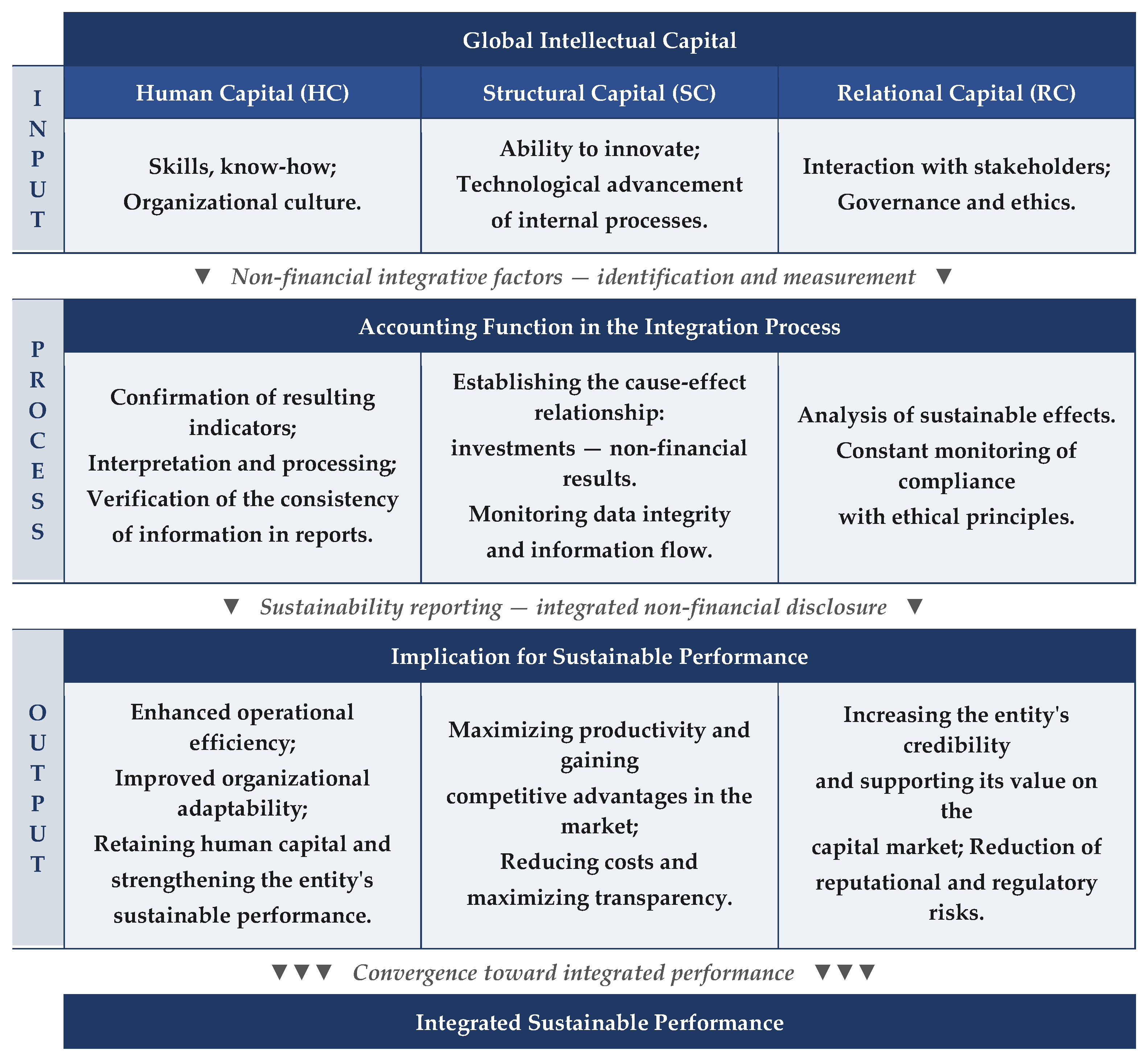
The analytical framework presented illustrates the imbalances identified based on the published reports. The specificity and contribution of the model lie in its integrated approach, as it brings together—within a single, unified framework rather than a fragmented one—the dimensions of overall intellectual capital, non-financial factors while assigning the accounting professional the role of ensuring connectivity and facilitating the transfer of information from one stage to another.
The conceptual model,
Figure 2, highlights the relationship between the dimensions of global intellectual capital, non-financial factors, and the contribution of the accounting professional. When these elements are efficiently integrated, they enable a proper valuation of intellectual capital within the ESG context.
These factors ensure the connection between intangible resources and the way they are incorporated and presented in sustainability reporting. The role of the accounting professional becomes essential in both the reporting and decision-making processes, as they can ensure the accurate presentation of information through its validation and interpretation.
5. Conclusions
The purpose of the research was to examine, based on the published reports of 30 sustainable companies listed on the Bucharest Stock Exchange, how the global intellectual capital of these companies is enhanced by including non-financial factors of human, relational, and structural capital, as well as the role of the professional accountant in the process of collecting, processing, validating, and transmitting information in the context of advanced digitization. The results obtained highlighted the need for a single mechanism to interconnect the concepts, without delimiting or treating them separately, in order to better illustrate the relationships established at their level, so that operational performance can be maximized.
The study of the reports published by the 30 companies revealed that non-financial factors are presented separately, with specific positive effects, without describing the connections and causal links. Therefore, the development of modern mechanisms integrated between the three dimensions of global intellectual capital is necessary in order to have an overview of the determinants of IC. The information published in the reports of the companies included in the sample validated the three hypotheses: extra-financial factors have a substantial impact on overall IC; the evaluation practices reflected by the selected non-financial indicators allow for the comparability of information, but not in a uniform manner. In the case of human capital, indicators such as the number of employees (reported by all 30 companies) and professional training programs (80%) support comparability due to their relatively standardized nature. In contrast, structural capital indicators tend to reduce comparability, as they lack a balanced structure and are reported with varying frequencies across companies. Regarding relational capital, indicators such as investor relations are easier to compare, whereas organizational reputation is more difficult to quantify, making it less comparable across entities; the accounting profession is the essential link, ensuring a balance between technology and perception of information so that reports are prepared in the most reliable and compliant manner possible.
The results of the study suggest that regulatory authorities could contribute to the development of more coherent sustainability reporting frameworks, capable of enabling a more uniform integration of non-financial indicators specific to intellectual capital. In the case of companies, the findings highlight the need for a transition from reporting oriented exclusively toward compliance to strategic reporting, in which intangible resources are presented in an integrated and comparable manner. Furthermore, the results confirm that the involvement of the accounting professional in the process of validating, selecting, and interpreting non-financial information is essential for ensuring the coherence and credibility of the information reported. In this way, stakeholders’ capacity to make informed decisions and to assess more realistically the company’s value creation potential is strengthened.
The proposed model argues that a unified approach to the main concepts analyzed can lead to enhanced sustainable performance and innovation. The information included in reporting should not be selected solely to provide favorable responses to investors, but rather to reflect an integrative system.
One of the limitations of the study relates to the number of companies included in the sample. In addition, the focus on a single national sample may limit the generalizability of the findings. At the same time, future research will consider the inclusion of a larger number of indicators, which will allow for a more comprehensive analysis of the influence of non-financial factors on global intellectual capital. Organizational culture, the regulatory framework in each country, and the level of development of the capital market generate significant variation in reporting practices at present. Therefore, it should be noted that the results of this research should be interpreted as being specific to companies in Romania; however, they provide a starting point for future comparative research across multiple countries or similar emerging markets.