1. Introduction
The global economy is increasingly confronted with the systemic challenges posed by climate change, as the frequency and intensity of extreme weather events, such as floods and heatwaves, continue to rise (
Arshad et al., 2025;
Y. Wang et al., 2025). These developments generate significant risks for financial markets and institutions, potentially affecting asset valuations, creditworthiness, and overall financial stability (
Carney, 2015;
D’Orazio, 2025;
Nguyen, 2025). Foundational contributions in the climate-finance literature increasingly emphasize that climate change represents a systemic source of financial instability capable of generating contagion effects across interconnected financial markets and institutions (
Battiston et al., 2017). As a result, climate change is no longer solely an environmental concern but has become a central issue in financial risk management and economic resilience.
In response, the transition toward a low-carbon economy requires substantial investment and a reallocation of capital toward sustainable activities. Financial institutions play a critical role in this process by directing resources toward green investments, including renewable energy projects, green bonds, and sustainability-linked financial instruments (
Kumar et al., 2025). Through these mechanisms, the financial sector acts as a key enabler of the transition to sustainable economic systems aligned with global climate objectives, such as those outlined in the Paris Agreement.
Despite the rapid expansion of literature on climate-related financial risks, important limitations remain in the existing research. Much of the current literature and institutional reporting focuses either on descriptive overviews of climate-risk categories or on isolated dimensions such as disclosure regulation, stress testing, or sustainable finance frameworks. While institutions such as the European Central Bank (ECB) and the Network for Greening the Financial System (NGFS) have significantly advanced the policy discussion, limited research has critically examined how governance structures, climate-risk measurement frameworks, and regulatory mechanisms interact within financial institutions in the European context.
In addition, existing studies often analyze governance, measurement tools, and regulatory initiatives separately, leading to fragmented analytical perspectives. Limited attention has also been given to the institutional and methodological barriers that constrain the effective integration of climate-related risks into strategic financial decision-making processes. Climate risks are characterized by deep uncertainty, long-term horizons, and non-linear impacts, which complicate their incorporation into traditional financial risk management frameworks. Existing models often rely on backward-looking assumptions and may not adequately capture forward-looking climate scenarios, highlighting the need for more adaptive and integrated approaches to governance and risk assessment (
Kovalchuk, 2025;
Trotta et al., 2025).
Against this background, the purpose of this study is to provide a structured analysis of how financial institutions manage climate-related financial risks within evolving regulatory and governance frameworks in the European financial system. To support this objective, the study develops a conceptual framework that explains how climate-related risk drivers are translated into traditional financial risk categories and how financial institutions respond through governance structures, risk management practices, and analytical tools.
This paper contributes to the literature in several ways. First, it provides a structured, integrated review of climate-related financial risks across the European financial system by linking climate-risk drivers, governance mechanisms, measurement frameworks, and regulatory developments within a unified analytical framework. Second, the study strengthens the theoretical discussion by applying financial stability theory and institutional theory to explain how climate-related risks influence institutional behavior, governance structures, and risk-management practices within financial institutions. Third, the paper critically evaluates the limitations of existing climate-risk assessment approaches, particularly the challenges of modeling long-term, nonlinear climate uncertainty within conventional financial risk frameworks. Finally, the study identifies persistent structural and regulatory barriers that limit effective climate-risk integration and discusses policy implications for supervisory practices, disclosure standardization, and sustainable financial governance.
Accordingly, the paper addresses the following research questions:
How are climate-related financial risks integrated into governance and strategic decision-making processes within European financial institutions?
What are the main methodological limitations of current climate-risk measurement and assessment frameworks used by financial institutions?
How do European regulatory and supervisory frameworks influence the integration of climate-related risks into financial governance and risk-management practices?
This study is positioned as a structured narrative literature review with a conceptual contribution, aiming to synthesize existing knowledge and provide an integrated analytical framework for understanding the interaction among climate-related risks, financial governance, and regulatory systems.
2. Methodology
2.1. Research Design
This study adopts a structured narrative literature review approach to examine how financial institutions manage climate-related financial risks and integrate sustainability considerations into governance, risk management, and regulatory practices. This approach is particularly appropriate for interdisciplinary fields such as climate finance, where academic research is closely interconnected with evolving regulatory frameworks, supervisory practices, and policy developments. Unlike purely systematic reviews that focus primarily on quantitative aggregation, a structured narrative review enables a more flexible and conceptually integrated synthesis of diverse forms of evidence while maintaining methodological transparency and analytical coherence.
The study is positioned as a structured narrative literature review with a conceptual contribution, aiming to synthesize fragmented strands of literature and provide an integrated analytical framework for understanding the interaction between climate-related risks, financial governance, risk-management practices, and regulatory systems within the European financial context.
2.2. Search Strategy and Data Sources
The literature review draws on both academic and institutional sources to reflect the hybrid, policy-oriented nature of climate-related financial risk research. Peer-reviewed academic publications were identified through 2 major scientific databases, Scopus and Web of Science. The search process used combinations of keywords and Boolean operators related to climate-related financial risks and sustainable finance.
The search string used in Scopus is as follows:
(“climate risk” OR “climate-related financial risk” OR “transition risk” OR “physical risk”) AND (“financial institutions” OR banks OR banking OR “financial system”) AND (“sustainable finance” OR ESG OR “climate stress testing” OR “green finance”)
In addition to peer-reviewed articles, the study incorporates institutional reports, supervisory publications, and policy documents issued by organizations such as the European Central Bank (ECB), the Network for Greening the Financial System (NGFS), the Basel Committee on Banking Supervision, the European Commission, and the United Nations Environment Programme Finance Initiative (UNEP FI). These sources were included because of their important role in shaping climate-risk governance, disclosure standards, supervisory expectations, and sustainable finance regulation within the European financial system.
The literature search focused primarily on publications issued between 2015 and 2026, reflecting the rapidly evolving nature of climate-related financial risk research and recent developments in sustainable finance regulation, climate-risk modeling, and supervisory frameworks.
2.3. Inclusion and Exclusion Criteria
To ensure relevance and analytical consistency, predefined inclusion and exclusion criteria were applied during the literature selection process. The review focused on studies addressing climate-related financial risks, sustainable finance, governance mechanisms, risk measurement approaches, and regulatory or supervisory frameworks within financial institutions.
Peer-reviewed journal articles, institutional reports, regulatory publications, and policy documents published between 2015 and 2026 were considered eligible for inclusion. The review prioritized studies related to the European financial context while also incorporating internationally relevant literature where necessary for conceptual or methodological discussion. Only English-language publications available in full text and directly relevant to the research questions were included.
Sources unrelated to financial systems, climate-risk management, or sustainable finance were excluded. In addition, publications that were not relevant to the study’s analytical scope, non-academic opinion pieces, and outdated or duplicate sources were omitted from the final review sample.
The inclusion and exclusion criteria applied in the review process are summarized in
Table 1.
2.4. Screening and Selection Process
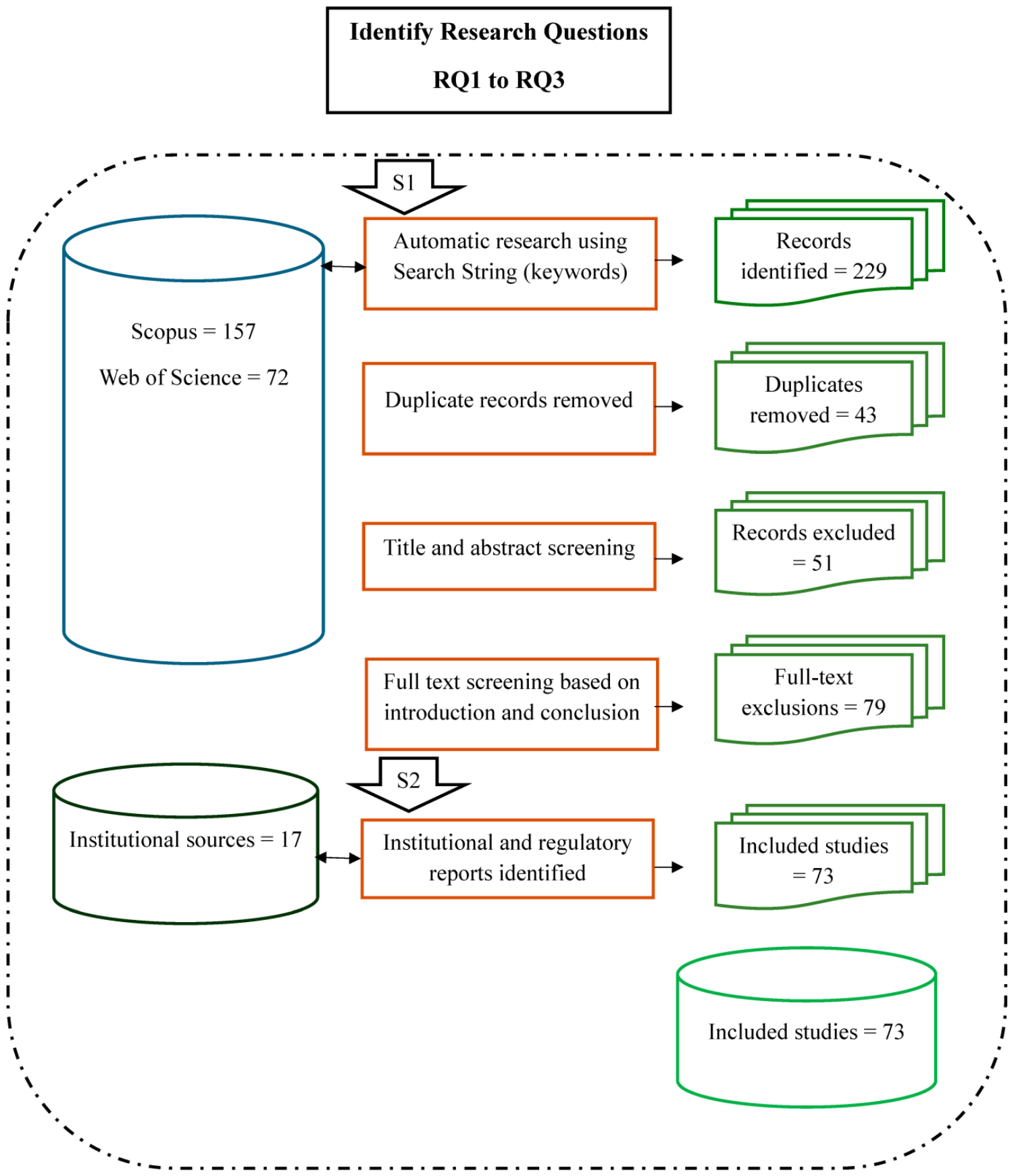
The literature selection process followed a multi-stage screening procedure designed to improve methodological transparency and replicability. Following the initial database search, duplicate records were identified and removed. The remaining studies were subsequently screened based on titles and abstracts to assess their relevance to climate-related financial risks, governance mechanisms, risk-management practices, and regulatory frameworks.
Full-text documents were then evaluated according to the predefined inclusion and exclusion criteria. Studies were retained if they directly addressed climate-risk integration within financial institutions, climate-risk measurement methodologies, governance structures, sustainable finance frameworks, or supervisory and regulatory developments. Publications that lacked direct relevance to financial systems or climate risk integration were excluded from the final review sample.
To further improve transparency, the study distinguishes between peer-reviewed academic publications and institutional or regulatory reports.
Figure 1 presents the PRISMA-style flowchart summarizing the identification, screening, eligibility assessment, and final inclusion stages of the literature selection process.
2.5. Analytical Approach
The selected literature was analyzed using a thematic synthesis approach structured around three core analytical dimensions:
- (i)
Climate-risk typologies and transmission channels;
- (ii)
Climate-risk measurement and assessment methodologies;
- (iii)
Governance, regulatory, and supervisory frameworks.
This analytical structure enabled the identification of key patterns, converging findings, methodological limitations, and emerging debates across the literature. Particular attention was given to the interaction between governance structures, climate-risk measurement approaches, and regulatory mechanisms within financial institutions.
Based on this synthesis, the study develops a conceptual framework that integrates climate-risk drivers, financial-system transmission channels, institutional responses, and financial outcomes. This framework provides the analytical foundation for structuring the subsequent discussion and interpreting the relationship between climate-related risks, financial stability, and sustainable finance governance.
3. Conceptual Framework
This study develops a conceptual framework to systematically capture the relationships between climate-related risks, financial system dynamics, and institutional responses. Given the complexity and multidimensional nature of climate finance, the framework provides an analytical structure that integrates insights from the literature and supports the interpretation of interactions among climate-risk drivers, governance mechanisms, and financial system outcomes.
3.1. Theoretical Foundations of the Conceptual Framework
The conceptual framework is analytically grounded in financial stability theory and institutional theory, which together explain how climate-related risks generate systemic financial vulnerabilities and shape institutional responses within financial systems.
Financial stability theory emphasizes how shocks originating from climate-related events and transition processes can propagate through financial markets and institutions, affecting credit conditions, asset valuations, liquidity, and broader financial resilience. Recent climate-finance literature further emphasizes that climate-related risks may generate systemic vulnerabilities capable of propagating across interconnected financial institutions, markets, and macro-financial systems (
Battiston et al., 2021). From this perspective, climate-related risks are understood not solely as environmental concerns but as systemic financial risks capable of generating macro-financial instability and contagion effects across interconnected financial institutions and markets (
Battiston et al., 2017).
Institutional theory complements this perspective by explaining how governance structures, regulatory environments, organizational norms, and legitimacy pressures shape financial institutions’ responses to climate-related risks. Financial institutions operate in an evolving regulatory and social environment that increasingly requires integrating climate considerations into governance and risk-management processes. However, institutional responses often remain uneven due to organizational silos, limited technical expertise, path dependency, and resistance to changes that may conflict with established business models or short-term financial objectives. Consequently, some institutions adopt substantive climate-risk integration strategies, while others engage primarily in compliance-driven or symbolic sustainability practices.
By integrating these theoretical perspectives, the framework moves beyond a descriptive categorization of climate risks and provides an analytical basis for understanding how climate-related shocks interact with governance structures, regulatory pressures, and institutional behavior within the European financial system.
3.2. Climate Risk Transmission Framework
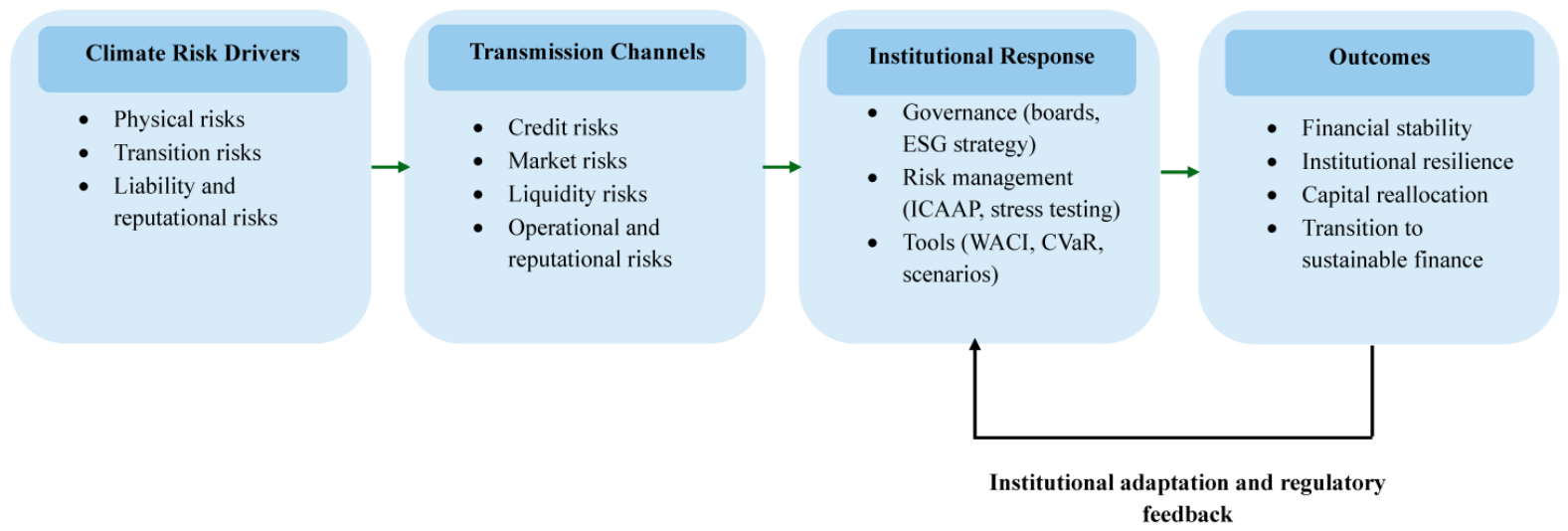
As illustrated in
Figure 2, climate-related risks originate from multiple sources, primarily categorized as physical risks, transition risks, and liability and reputational risks. These risks act as exogenous shocks that affect economic systems and financial markets through both direct and indirect channels.
These climate-risk drivers are transmitted to the financial system through traditional risk categories, including credit, market, liquidity, and operational and reputational risks. This transmission mechanism represents a critical link between environmental dynamics and financial stability, as climate-related events, technological transitions, and policy changes can significantly alter asset values, borrower solvency, investment behavior, and market conditions.
Financial institutions respond to these risks through a combination of governance structures, risk-management frameworks, and analytical tools. Governance mechanisms involve integrating climate considerations into board-level oversight, strategic planning, and institutional decision-making processes, while risk-management frameworks incorporate climate risks into processes such as the Internal Capital Adequacy Assessment Process (ICAAP), climate stress testing, and scenario analysis. In parallel, financial institutions employ quantitative tools, including Weighted Average Carbon Intensity (WACI), Climate Value-at-Risk (CVaR), and forward-looking climate scenarios to assess exposure and support decision-making under uncertainty (
Dietz et al., 2016).
These institutional responses ultimately shape broader financial and economic outcomes, including financial stability, institutional resilience, capital reallocation, and the transition toward sustainable finance. Importantly, the framework incorporates a feedback mechanism through which regulatory developments, market adjustments, institutional learning, and supervisory expectations continuously influence the evolution of governance practices and climate-risk management approaches within financial institutions.
The conceptual framework, therefore, serves not only as an organizing structure for the review but also as an analytical tool for interpreting how climate-risk transmission channels, institutional incentives, governance structures, and regulatory mechanisms interact within financial systems. Accordingly, the subsequent sections are structured around the framework’s core components, which are used to synthesize findings and explain the interconnected relationships among climate-related risks, financial governance, and sustainable finance in the European context.
4. Climate-Related Financial Risks
Climate-related financial risks are commonly categorized into three main types: physical risks, transition risks, and liability and reputational risks. As illustrated in the conceptual framework (
Figure 2), these risks act as primary drivers that affect financial systems through multiple transmission channels. Climate-related financial risks are increasingly recognized as systemic risks capable of generating broad macro-financial instability and contagion effects across interconnected financial systems (
Battiston et al., 2017;
Carney, 2015).
Physical risks arise from both acute events, such as floods, storms, and heatwaves, and chronic changes, including rising temperatures, sea-level rise, and prolonged droughts (
D’Orazio, 2025). Transition risks emerge from the structural adjustment toward a low-carbon economy, driven by regulatory developments, technological innovation, and shifts in market expectations (
Pata et al., 2024). In addition, liability and reputational risks act as amplifying mechanisms, increasing legal exposure and stakeholder pressure on firms and financial institutions.
These climate-related risks are transmitted into traditional financial risk categories, including credit risks, market risks, liquidity risks, and operational and reputational risks. This transmission process represents a key link between environmental dynamics and financial stability, as climate-related shocks can alter borrower solvency, asset values, and market conditions.
4.1. Physical Risks
Physical risks refer to the direct impact of climate change on economic and financial systems. These risks are typically classified into acute events, such as extreme weather events, and chronic changes, which reflect long-term environmental shifts (
Li et al., 2025).
Acute physical risks can generate immediate financial losses by damaging infrastructure, disrupting economic activity, and increasing default rates among affected borrowers.
Recent empirical evidence from European financial markets suggests that climate-related disasters may significantly increase insurance losses, reduce collateral values, and heighten sectoral credit vulnerabilities, particularly in real estate, agriculture, and energy-intensive industries.
For instance, extreme weather events can reduce the value of collateral and weaken borrowers’ repayment capacity, thereby increasing credit risks for financial institutions (
Szemerédi & Remsei, 2024). They may also lead to higher insurance claims and capital pressures, affecting the solvency of financial intermediaries.
In contrast, chronic physical risks gradually affect economic productivity and asset values. Long-term changes such as rising temperatures, sea-level rise, and prolonged droughts can reduce the profitability of key sectors, including agriculture, real estate, and infrastructure. These developments weaken borrowers’ financial positions, increase non-performing loans, and reduce the resilience of financial institutions.
4.2. Transition Risks
Transition risks arise from economic and financial adjustments required to transition toward a low-carbon economy. These risks are driven by policy and regulatory changes, technological innovation, and shifts in investor and consumer preferences (
D’Orazio, 2025;
Li et al., 2025).
Regulatory measures, such as carbon pricing mechanisms and stricter emissions standards, can increase compliance costs and reduce the profitability of carbon-intensive firms. At the same time, technological advancements may render existing assets obsolete, resulting in stranded assets.
These transition pressures have become particularly visible in carbon-intensive sectors where regulatory tightening, changing investor preferences, and decarbonization policies increasingly affect asset pricing, financing conditions, and long-term firm valuations.
Recent studies highlight that digital innovation and circular business models play a critical role in facilitating decarbonization processes while simultaneously reshaping risk exposure across industries (
Kamal et al., 2026;
J. Wang et al., 2026).
Market dynamics also play a key role, as changes in investor sentiment can trigger capital reallocation and volatility in asset prices.
These developments have direct implications for financial institutions. Transition risks increase credit risks through declining borrower solvency, affect market risks through asset revaluations and volatility, and generate liquidity risks through funding pressures and portfolio adjustments. As highlighted in the conceptual framework (
Figure 2), these transmission channels illustrate the systemic nature of transition risks within financial systems.
4.3. Liability and Reputational Risks
Liability and reputational risks represent additional channels through which climate-related risks are transmitted into financial systems. Liability risks arise from legal actions brought against firms for their contribution to environmental damage, while reputational risks stem from negative public perception and stakeholder pressure related to environmentally harmful activities.
These risks can have significant financial consequences. Legal liabilities and compliance costs may directly affect firm profitability, while reputational damage can lead to reduced investor confidence, higher cost of capital, and limited access to financing. Empirical evidence suggests that firms with weaker environmental performance and higher carbon emissions tend to experience lower valuations and increased financial risk exposure (
Arian & Sands, 2024;
Ginglinger & Moreau, 2023;
Yildiz & Temiz, 2024).
Furthermore, inadequate disclosure and misrepresentation of climate-related risks can exacerbate these effects by undermining trust among investors and stakeholders. As shown in the conceptual framework (
Figure 2), liability and reputational risks reinforce the mechanisms that link climate risk drivers to financial vulnerabilities.
4.4. Synthesis of Climate-Related Financial Risks
The reviewed literature highlights three key insights. First, climate-related risks are increasingly recognized as systemic risks, with the potential to affect multiple sectors and financial institutions simultaneously. Second, these risks are transmitted through interconnected financial channels, particularly credit, market, and liquidity risks, thereby amplifying their impact on financial stability. Although physical, transition, and liability risks are often categorized separately in the literature, in practice, they frequently interact and reinforce one another through complex financial and economic transmission channels. For example, escalating physical climate events may trigger abrupt regulatory responses or shifts in investor expectations, thereby intensifying transition-related financial risks across carbon-intensive sectors. Similarly, delayed transition policies can increase long-term physical risks and amplify future financial instability. This interconnectedness highlights the systemic nature of climate-related financial risks and complicates their integration into conventional financial risk-management frameworks, which often assess these risks independently rather than as mutually reinforcing processes. Third, although the classification of climate-related risks is well established, their measurement and integration into financial decision-making remain uneven across institutions and regulatory environments, highlighting the need for more standardized, forward-looking, and comparable approaches.
From a financial stability perspective, these findings reinforce the view that climate-related risks should be understood not as isolated environmental events but as interconnected systemic shocks that can propagate across financial institutions and markets.
5. The Role of Financial Institutions in Climate Risk Management
Financial institutions play a central and systemic role in climate risk management, as they are both exposed to and instrumental in transmitting climate-related risks within the financial system (
D’Orazio, 2025). As highlighted in the conceptual framework (
Figure 2), climate-related risks are increasingly reflected in traditional financial risk categories, including credit risks, market risks, liquidity risks, and operational and reputational risks, thereby requiring comprehensive and forward-looking risk management approaches (
D’Orazio, 2025;
Nguyen, 2025).
Beyond their exposure to risk, financial institutions also act as key enablers of the low-carbon transition by directing capital toward sustainable investments such as renewable energy, green bonds, and sustainability-linked financial instruments (
Dev et al., 2025;
Tan et al., 2025;
Xu et al., 2025). This intermediation role positions banks as critical actors in financing large-scale climate initiatives and supporting the transition toward climate-neutral economies (
Kumar et al., 2025;
Shtjefni et al., 2024). Consequently, regulators and central banks increasingly emphasize the integration of climate considerations into financial governance and strategic decision-making (
Carney, 2022).
5.1. Integration of Climate Risk into Governance and Strategy
The integration of climate-related risks into governance and strategic decision-making has become a key priority for financial institutions, driven by the need to safeguard financial stability against the growing impact of physical and transition risks (
Bringas-Fernández et al., 2025;
D’Orazio, 2025). Effective governance structures, particularly at the board level, play a critical role in ensuring that climate risks are systematically embedded into institutional strategies and operational processes (
Asibey et al., 2024).
Financial institutions are increasingly formalizing their commitment to sustainability through the establishment of Corporate Social Responsibility (CSR) departments, sustainability committees, and dedicated ESG functions within governance structures (
Muhammad et al., 2024;
Rega et al., 2025). These mechanisms support enhanced transparency and alignment with responsible investment practices, including green financial instruments such as green bonds (
Kovalchuk, 2025).
In practice, integrating climate risk into strategy requires incorporating climate considerations into risk appetite frameworks, strategic planning, and capital allocation decisions. Financial institutions are also expected to embed climate risks into key regulatory processes, including the Internal Capital Adequacy Assessment Process (ICAAP) and broader risk management frameworks (
European Banking Authority, 2025;
European Central Bank, 2020;
Trotta et al., 2025).
Despite these developments, empirical evidence suggests that the integration of climate risks into long-term business strategies remains incomplete, with many institutions still facing challenges in translating climate scenarios into actionable strategic decisions (
ECB Banking Supervision, 2022).
5.2. Incorporation of Climate Risk into Risk Management Frameworks
The incorporation of climate-related risks into risk management frameworks is essential for ensuring the resilience of financial institutions. As reflected in the conceptual framework (
Figure 2), climate risks are transmitted into core financial risk categories, requiring their integration into established risk management processes.
Climate risks have a particularly strong impact on credit risks, as they affect borrowers’ creditworthiness and asset values (
D’Orazio, 2025;
Nguyen, 2025). Transition risks, for example, may reduce the profitability of carbon-intensive firms and contribute to the emergence of stranded assets, thereby increasing default probabilities and credit exposure (
Mirza et al., 2024;
Shtjefni et al., 2024). In response, financial institutions are adjusting lending practices by incorporating climate-related criteria into credit assessments and pricing mechanisms (
Ehlers et al., 2022;
Javadi & Masum, 2021).
In addition, climate risks affect liquidity risks, as market disruptions and capital reallocation can create funding pressures and operational risks, particularly through physical disruptions and supply chain vulnerabilities. Furthermore, inadequate management of climate risks may result in legal liabilities and reputational damage, increasing compliance costs and overall risk exposure (
Battiston et al., 2021).
5.3. Institutional Implementation of Climate Disclosure and Risk Governance
Financial institutions increasingly incorporate climate-related disclosure and ESG governance practices into their operational and strategic frameworks in response to evolving regulatory expectations, market pressures, and investor demands for greater sustainability transparency. Within the European context, disclosure requirements and sustainability reporting standards have become important mechanisms through which institutions improve transparency, assess climate exposure, and integrate climate considerations into governance and risk-management processes (
Battiston et al., 2021;
Nieto & Papathanassiou, 2024).
Transparency plays a critical role in supporting the identification of climate-related risks and opportunities while strengthening confidence in sustainable financial instruments such as green bonds and sustainability-linked investments (
Kovalchuk, 2025). Frameworks such as the Task Force on Climate-related Financial Disclosures (TCFD), the Sustainable Finance Disclosure Regulation (SFDR), the Corporate Sustainability Reporting Directive (CSRD), and the European Sustainability Reporting Standards (ESRS) increasingly require financial institutions to enhance climate-related disclosures and integrate ESG considerations into governance and risk-management systems (
European Commission, Directorate-General for Economic and Financial Affairs, 2024;
Task Force on Climate-Related Financial Disclosures, 2017).
In practice, financial institutions operationalize these requirements through expanded sustainability reporting, climate-risk assessments, internal governance adjustments, and the integration of ESG metrics into strategic planning, portfolio management, and lending processes. These developments improve the comparability and reliability of climate-related information, supporting more informed financial decision-making and institutional resilience.
However, the effectiveness of these disclosure and governance mechanisms ultimately depends on whether institutions translate reporting obligations into substantive changes in lending practices, portfolio allocation, and long-term transition strategies rather than treating sustainability disclosures primarily as compliance requirements. In some cases, climate-related reporting and ESG integration remain driven more by reputational considerations and regulatory pressure than by fundamental changes in business models or capital allocation decisions, raising concerns regarding symbolic implementation and the persistence of greenwashing practices within segments of the financial sector.
5.4. Synthesis of Financial Institutions’ Role
The reviewed literature highlights three key insights. First, financial institutions play a dual role as both transmitters and mitigators of climate-related risks, reflecting their central position within financial systems. Second, the integration of climate risks into governance, risk management, and disclosure frameworks is progressing but remains uneven across institutions and jurisdictions. Despite the growing adoption of climate-risk management tools and sustainability frameworks, the effectiveness of these measures in substantially reallocating capital toward sustainable activities remains debated. In some cases, climate-related disclosures and ESG integration practices appear primarily driven by regulatory compliance and reputational considerations rather than substantive changes in lending, investment, or portfolio-allocation strategies. This raises concerns regarding symbolic adoption and the persistence of greenwashing practices within segments of the financial sector. Third, regulatory initiatives, particularly within the European context, have significantly advanced the standardization of climate risk management practices, although challenges related to data availability, methodological consistency, and long-term integration persist.
6. Measurement and Assessment of Climate-Related Financial Risks
Measuring climate-related financial risks is essential for central banks and supervisory authorities in fulfilling their mandate to preserve financial stability (
Battiston et al., 2021;
Carney, 2015). However, the assessment of these risks is particularly challenging due to their non-linear dynamics, long-term horizon, and high degree of uncertainty (
Battiston et al., 2021;
Dietz et al., 2016). As a result, financial institutions increasingly rely on forward-looking methodologies to better capture the potential impact of climate-related shocks (
Basel Committee on Banking Supervision, 2021;
ECB European Central Bank, 2024).
As highlighted in the conceptual framework (
Figure 2), measurement tools play a critical role in translating climate risk drivers into quantifiable financial impacts. Current approaches combine scenario-based models, stress testing frameworks, and portfolio-level metrics to assess exposure to both physical and transition risks.
Despite these advances, the measurement of climate-related financial risks remains constrained by data limitations, a lack of methodological standardization, and uncertainty regarding long-term climate scenarios (
Battiston et al., 2021;
Carney, 2015).
6.1. Climate Stress Testing and Scenario Analysis
Climate stress testing and scenario analysis are among the most widely used tools for assessing climate-related financial risks. These approaches provide a forward-looking perspective by evaluating how different climate scenarios may affect financial institutions’ balance sheets and business models (
Basel Committee on Banking Supervision, 2021;
Carney, 2015). Typically, these methodologies involve four main steps: (i) defining climate scenarios, (ii) mapping exposures to affected sectors, (iii) assessing vulnerabilities, and (iv) estimating potential financial impacts. Central banks and supervisory authorities, including the European Central Bank, have implemented large-scale climate stress testing exercises to evaluate the resilience of financial institutions under different transition and physical risk scenarios (
ECB European Central Bank, 2024;
European Supervisory Authorities, 2024).
While these tools provide valuable insights, their effectiveness is limited by data gaps, modeling uncertainties, and the difficulty of incorporating long-term climate dynamics into financial decision-making (
Jung et al., 2025). As a result, their integration into strategic planning remains incomplete.
6.2. Quantitative Metrics and Risk Assessment Tools
In addition to scenario-based approaches, financial institutions increasingly rely on quantitative metrics to assess climate risk exposure. Among the most widely used indicators is Weighted Average Carbon Intensity (WACI), which measures portfolio exposure to carbon-intensive activities and serves as a proxy for transition risk (
ECB European Central Bank, 2024).
These tools enable financial institutions to move toward more forward-looking and data-driven risk assessment practices. However, their application remains subject to methodological limitations, including scenario dependence, data inconsistency, and limited comparability across institutions (
Berg et al., 2021).
6.3. The Green Asset Ratio and Alignment with the EU Taxonomy: Quantitative Tools for Measuring Sustainability and Circularity
Regulatory frameworks have introduced new metrics to assess the alignment of financial activities with sustainability objectives. A key example is the Green Asset Ratio (GAR), which measures the proportion of taxonomy-aligned assets within financial institutions’ portfolios under the EU Taxonomy framework (
Yin, 2023).
The GAR is designed to enhance transparency and support the evaluation of banks’ contributions to sustainable finance. However, empirical evidence suggests that current GAR levels remain relatively low, reflecting the early stage of the transition and the EU Taxonomy’s strict criteria.
Moreover, the GAR alone is insufficient to capture the full complexity of climate-related financial risks. It must therefore be complemented by additional metrics and analytical tools to provide a more comprehensive assessment of sustainability and risk exposure (
Battiston et al., 2021).
6.4. Synthesis of Measurement Approaches
The reviewed literature highlights three key insights. First, the measurement of climate-related financial risks is increasingly based on forward-looking methodologies, particularly scenario analysis and stress testing. Second, quantitative metrics such as WACI and CVaR provide useful tools for assessing exposure but remain subject to data and methodological limitations. A fundamental limitation of existing climate-risk measurement approaches lies in the tension between conventional probabilistic financial models and the deep uncertainty associated with long-term climate dynamics. Traditional Value-at-Risk and scenario-based models are generally designed for historical market behavior and short- to medium-term volatility, whereas climate-related risks involve non-linear tipping points, cascading effects, and uncertain policy trajectories that may not be adequately captured through backward-looking statistical assumptions. Third, despite significant methodological progress, climate-risk measurement frameworks continue to face structural limitations in translating long-term climate uncertainty into actionable financial decision-making. In practice, many existing models remain heavily dependent on simplifying assumptions, historical correlations, and scenario-specific projections that may underestimate systemic climate tipping points, cascading market disruptions, and the interconnected nature of climate-related financial shocks. Consequently, the integration of climate-risk assessment into capital allocation, prudential supervision, and long-term strategic planning remains uneven across institutions and regulatory environments.
7. Regulatory Frameworks for Climate Risk Management
Regulatory frameworks play a central role in integrating climate-related risks into financial systems and ensuring financial stability. As highlighted in the conceptual framework (
Figure 2), regulation is a key driver shaping how financial institutions incorporate climate risks into their governance, risk management, and disclosure practices. In recent years, policymakers and supervisory authorities have increasingly developed regulatory approaches to strengthen resilience to climate-related financial risks (
Dev et al., 2025).
Within the European context, regulatory authorities increasingly incorporate climate-related risks into prudential supervision, disclosure requirements, and macro-financial stability frameworks (
Nieto & Papathanassiou, 2024). These initiatives aim to enhance transparency, reduce information asymmetries, and promote the integration of climate considerations into financial decision-making processes.
7.1. EU Regulatory and Supervisory Framework
Within the EU, regulatory efforts focus on embedding climate-related risks into prudential supervision and institutional risk management practices. The European Central Bank (ECB) has played a leading role by defining supervisory expectations for the management of climate-related and environmental risks, emphasizing their integration into governance structures, internal controls, and strategic planning (
Dikau & Volz, 2021;
European Central Bank, 2020).
These expectations have been reinforced through supervisory reviews and stress-testing exercises, requiring financial institutions to incorporate climate risks into key processes such as the Internal Capital Adequacy Assessment Process (ICAAP) and broader risk management frameworks (
Battiston et al., 2021;
European Central Bank, 2020). In parallel, the European Banking Authority (EBA) has introduced guidelines mandating the identification, measurement, management, and monitoring of ESG risks within financial institutions, with increasing emphasis on disclosure and transparency requirements (
Battiston et al., 2021;
Dietz et al., 2016).
Together, these initiatives reflect a shift toward integrating climate risks into prudential regulation, moving from voluntary approaches to more structured, mandatory frameworks.
7.2. International Coordination and European Regulatory Alignment
Although the European Union remains the primary focus of climate-related financial regulation in this study, international coordination initiatives continue to influence the development of European supervisory approaches. Organizations such as the Basel Committee on Banking Supervision (BCBS) and the Network for Greening the Financial System (NGFS) contribute to the development of standardized climate-risk principles, supervisory expectations, and scenario-analysis methodologies that support regulatory convergence across jurisdictions (
Basel Committee on Banking Supervision, 2022;
Network for Greening the Financial System, 2021). Within the European context, these international initiatives reinforce the integration of climate-related risks into prudential supervision, stress-testing frameworks, and macro-financial stability assessments. They also support harmonizing the climate-risk methodologies used by European supervisory authorities and financial institutions. Nevertheless, differences in implementation approaches, regulatory priorities, and institutional capacities continue to limit the full convergence of climate-related financial regulation across jurisdictions.
7.3. Synthesis of Regulatory Frameworks
The reviewed literature highlights three key insights. First, regulatory frameworks have become a central driver in integrating climate-related risks into financial systems, particularly within the European Union. Second, supervisory authorities increasingly require financial institutions to incorporate climate risks into governance, risk management, and disclosure processes. Despite significant progress in developing sustainable finance regulations within the European Union, several criticisms remain regarding the scope and implementation of these frameworks. The EU Taxonomy and Green Asset Ratio (GAR), while important for improving transparency and comparability, have been criticized for their complexity, limited sectoral coverage, and reliance on disclosure-based compliance mechanisms. In addition, the implementation of EU sustainable finance regulations has faced resistance from segments of the financial and corporate sectors concerned about reporting burdens, regulatory costs, competitive pressures, and the potential implications of stricter sustainability requirements for profitability, portfolio composition, and capital allocation decisions. Third, despite significant progress, challenges remain regarding regulatory complexity, data availability, and the consistent implementation of climate-related requirements across jurisdictions.
These findings suggest that the effectiveness of climate-related regulatory frameworks depends not only on expanding disclosure obligations but also on supervisory authorities’ ability to ensure consistent implementation, methodological harmonization, and substantive institutional adaptation across financial systems.
8. Discussion and Policy Implications
8.1. Climate-Related Risks and Institutional Governance
The findings of this study indicate that climate-related financial risks have become increasingly significant for the governance and strategic decision-making processes of financial institutions. Physical, transition, and liability risks are now widely recognized as systemic risks that can affect asset valuations, capital allocation, financial resilience, and long-term financial stability (
Battiston et al., 2021;
Carney, 2015). As a result, financial institutions are progressively integrating climate-related considerations into governance structures, risk management systems, and strategic planning processes.
In practice, this integration has led to the incorporation of climate considerations into board-level oversight, risk appetite frameworks, internal control systems, and long-term investment strategies (
European Banking Authority, 2025;
Rega et al., 2025). In addition, forward-looking tools such as climate scenario analysis and stress testing are increasingly used to assess institutional resilience under alternative climate pathways and regulatory transition scenarios (
ECB Banking Supervision, 2022). These developments reflect a broader shift toward recognizing climate change as a material financial risk rather than solely an environmental or reputational concern.
However, the extent of integration remains uneven across institutions. While some organizations have adopted more comprehensive climate governance frameworks, others continue to face significant organizational and operational constraints. Organizational silos frequently limit cross-departmental coordination, reducing the effectiveness of integrated climate-risk strategies (
Ulpiani et al., 2023). Similarly, many institutions face capacity limitations in technical expertise, analytical capabilities, and understanding of complex sustainability frameworks (
Desalegn & Tangl, 2022;
Kumar et al., 2025).
A further challenge concerns the tension between short-term profitability objectives and long-term sustainability goals. These persistent tensions reflect broader structural incentives within financial systems, where short-term performance metrics, quarterly profitability expectations, and market competition may discourage institutions from fully internalizing long-term climate-related risks into their strategic decision-making. Climate-related investments and transition strategies often involve substantial upfront costs and uncertain long-term returns, which may discourage institutions from fully integrating climate considerations into strategic decision-making processes (
Dafermos & Nikolaidi, 2021). In some cases, climate-risk management remains primarily driven by regulatory compliance requirements rather than substantive institutional transformation, increasing the risk of symbolic implementation and greenwashing (
Berg et al., 2021).
These findings suggest that effective climate governance depends not only on regulatory pressure but also on institutional incentives, organizational culture, and internal governance capacity.
From an institutional theory perspective, these findings demonstrate how organizational norms, path dependency, and legitimacy pressures influence the uneven adoption of climate-risk governance practices across financial institutions.
8.2. Limitations of Climate Risk Measurement Frameworks
The literature demonstrates that financial institutions increasingly employ both qualitative and quantitative methodologies to assess climate-related financial risks. Common approaches include scenario analysis, climate stress testing, Weighted Average Carbon Intensity (WACI), Climate Value-at-Risk (CVaR), and market-based systemic risk models such as CRISK (
Basel Committee on Banking Supervision, 2021;
Delta, 2017;
Dietz et al., 2016). These tools provide important mechanisms for evaluating potential exposure to physical and transition risks under different climate scenarios.
Despite these methodological advances, significant limitations continue to constrain the effectiveness of climate-risk assessment frameworks. One of the most persistent challenges relates to data availability, consistency, and comparability. Financial institutions frequently face difficulties in obtaining granular, standardized ESG and emissions data, particularly for small and medium-sized enterprises and for indirect emissions across supply chains (
Kovalchuk, 2025). Divergent ESG rating methodologies and inconsistent disclosure practices further reduce comparability across institutions and increase the risk of greenwashing and misclassification of sustainable activities (
Berg et al., 2021;
Ottenstein et al., 2021).
Beyond data limitations, climate-related financial risks are inherently difficult to model due to their long-term, non-linear, and uncertain nature. Many traditional financial risk models rely on backward-looking assumptions derived from historical market behavior, whereas climate risks are characterized by deep uncertainty, structural breaks, and potentially irreversible tipping points (
Battiston et al., 2021;
Carney, 2015). As a result, conventional probabilistic approaches may underestimate tail risks and fail to fully capture the systemic and interconnected effects of climate change on financial systems.
This reflects a broader tension between traditional Value-at-Risk-based financial modeling and the radical uncertainty associated with climate-related systemic shocks, where historical probability distributions may no longer provide reliable guidance for future risk estimation.
Methodological uncertainty also remains significant in relation to climate scenario design and stress-testing approaches. The absence of universally accepted modeling standards reduces comparability across institutions and jurisdictions while limiting the predictive reliability of existing assessment frameworks. Consequently, although current climate-risk tools represent important progress, their integration into strategic financial decision-making remains incomplete due to uncertainty regarding both data quality and model assumptions.
From a financial stability theory perspective, these methodological limitations are particularly important because systemic climate-related shocks may propagate through interconnected financial markets in ways that conventional financial risk models are not fully designed to capture.
8.3. Regulatory Frameworks and Supervisory Implications
In addition, prudential and supervisory authorities increasingly incorporate climate considerations into financial oversight mechanisms. Climate stress testing, supervisory expectations, and portfolio-level indicators such as the Green Asset Ratio (GAR) encourage financial institutions to improve transparency, assess transition exposure, and align investment activities with sustainability objectives (
Basel Committee on Banking Supervision, 2022;
ECB Banking Supervision, 2022). Central banks and regulators have also expanded the integration of climate-related risks into monetary policy discussions and macroprudential supervision frameworks (
Campiglio et al., 2025;
Dikau & Volz, 2021).
Nevertheless, important implementation challenges remain. Regulatory fragmentation, methodological inconsistency, and uneven institutional readiness continue to limit the effectiveness of climate-related supervisory frameworks. These persistent implementation challenges suggest that regulatory expansion alone does not automatically translate into substantive institutional transformation, particularly where financial incentives and supervisory enforcement remain only partially aligned with long-term decarbonization objectives.
In practice, some institutions adopt disclosure and reporting mechanisms primarily to satisfy regulatory compliance obligations rather than to fundamentally reorient lending, investment, and capital allocation strategies toward decarbonization (
Berg et al., 2021;
Ottenstein et al., 2021). This raises concerns regarding symbolic compliance and the persistence of greenwashing risks, particularly where disclosure obligations are not accompanied by standardized methodologies or substantive supervisory enforcement.
Furthermore, the effectiveness of regulatory initiatives remains closely dependent on the quality of underlying climate data and on institutions’ ability to operationalize climate-risk frameworks within their internal governance and risk-management processes. These findings suggest that regulatory expansion alone is insufficient unless accompanied by stronger institutional capacity, methodological harmonization, and consistent supervisory implementation.
The findings further demonstrate how regulatory pressures influence institutional adaptation processes, reinforcing the role of governance and supervisory frameworks in shaping climate-risk integration across financial systems.
8.4. Policy and Institutional Implications
The findings of this study highlight several important policy implications for financial institutions, regulators, and supervisory authorities. First, improving climate-risk management requires greater standardization of ESG disclosures, emissions reporting, and climate-related data infrastructure. Developing harmonized reporting frameworks and centralized climate data repositories would improve comparability, reduce information asymmetries, and strengthen the reliability of climate risk assessments (
Berg et al., 2021;
Ottenstein et al., 2021).
Second, regulatory frameworks should move beyond disclosure-oriented approaches and incorporate more substantive prudential mechanisms that directly integrate climate-related risks into financial decision-making. This includes expanding mandatory climate stress testing, integrating climate considerations into Pillar 2 supervisory processes, and developing prudential tools that encourage financial institutions to align capital allocation decisions with sustainability objectives (
Dafermos & Nikolaidi, 2021;
D’Orazio & Popoyan, 2019;
Lamperti et al., 2021).
Beyond conventional disclosure and reporting frameworks, emerging policy debates increasingly emphasize the need for more interventionist macroprudential approaches to climate-risk management. Proposed measures include climate-adjusted capital requirements, dynamic capital buffers linked to carbon-intensive exposures, mandatory transition planning, and supervisory mechanisms to limit the accumulation of stranded asset risks within financial systems. These approaches reflect a broader recognition that climate-related financial risks may require structural adjustments to existing prudential frameworks rather than relying solely on transparency and market-based discipline. At a broader level, these debates also raise questions about the long-term compatibility between carbon-intensive growth models and financial-system stability in the context of climate-transition objectives.
Third, strengthening institutional governance and organizational capacity remains essential for effective climate-risk integration. Financial institutions should invest in technical expertise, analytical capabilities, and cross-departmental coordination mechanisms to improve the implementation of climate-risk strategies (
Desalegn & Tangl, 2022). Embedding climate considerations within board-level oversight structures, executive incentives, and internal risk-management systems may further support the transition from compliance-driven approaches toward substantive strategic integration (
Asibey et al., 2024;
Desalegn & Tangl, 2022).
Overall, the findings demonstrate that climate-related financial risks are reshaping governance structures, risk-management practices, and regulatory frameworks across financial systems. Although substantial progress has been made in integrating climate considerations into financial decision-making, persistent challenges related to data quality, methodological uncertainty, institutional capacity, and regulatory implementation continue to constrain the effectiveness of existing approaches. Addressing these limitations will require coordinated efforts among financial institutions, regulators, and policymakers to strengthen analytical tools, improve supervisory consistency, and enhance the long-term resilience of financial systems in the context of climate change.
Taken together, these findings reinforce the conceptual framework developed in this study by demonstrating how climate-risk transmission channels, institutional governance structures, and regulatory adaptation processes interact to shape financial-system resilience and sustainable finance outcomes.
9. Conclusions
This study provides a structured analysis of climate-related financial risks and highlights the central role of financial institutions in managing these risks within evolving regulatory and governance frameworks. By integrating insights from the literature, the study contributes to a better understanding of how climate-related risk drivers are transmitted into traditional financial risk categories and how financial institutions respond through governance, risk management, and regulatory mechanisms.
The findings show that, despite significant progress in regulatory frameworks, particularly within the European Union, important challenges remain in the effective implementation of climate risk management practices. While tools such as the Green Asset Ratio (GAR), Pillar 3 disclosures, and supervisory guidelines have strengthened transparency and accountability, their practical integration into financial decision-making remains uneven (
European Banking Authority, 2025;
European Central Bank, 2020).
A key conclusion of this study is that climate risk management is constrained by persistent data limitations and methodological uncertainty. The lack of standardized, high-quality data and the reliance on backward-looking financial models limit the ability of institutions to capture the forward-looking and non-linear nature of climate-related risks (
Battiston et al., 2021;
Carney, 2015). These limitations are particularly important because climate-related shocks may propagate across interconnected financial systems in ways that conventional probabilistic risk models are not fully designed to capture. In addition, organizational and cultural barriers, particularly the misalignment between short-term profitability objectives and long-term sustainability goals, continue to hinder effective implementation (
Ulpiani et al., 2023). These persistent challenges suggest that climate-risk integration is constrained not only by technical limitations but also by structural incentives and institutional resistance within financial systems.
To address these challenges, the study identifies three key priorities for advancing climate risk management. First, improving data infrastructure and analytical capabilities is essential to enhance the accuracy and comparability of climate risk assessments. This requires greater standardization of ESG data and the development of forward-looking analytical tools (
Berg et al., 2021;
Ottenstein et al., 2021).
Second, strengthening regulatory frameworks and market incentives is critical to ensuring that climate risks are effectively integrated into financial decision-making. Policymakers should promote regulatory consistency and design incentive mechanisms that encourage financial institutions to align capital allocation with sustainability objectives (
Campiglio et al., 2025;
Dafermos & Nikolaidi, 2021;
D’Orazio & Popoyan, 2019;
Neszveda & Siket, 2025). Beyond disclosure-oriented approaches, emerging policy discussions increasingly emphasize the need for more interventionist macroprudential mechanisms, including climate-adjusted capital requirements, transition-oriented supervisory frameworks, and prudential measures targeting stranded-asset exposure.
Third, enhancing institutional capacity and governance structures is necessary to support the implementation of climate risk management practices. This includes investing in technical expertise, improving internal coordination, and embedding long-term sustainability considerations into strategic decision-making (
Desalegn & Tangl, 2022;
Grijalvo & García-Wang, 2023;
Kumar et al., 2025). Overall, this study underscores that addressing climate-related financial risks requires a systemic and coordinated approach that integrates data, regulation, and institutional capabilities. Financial institutions are not only exposed to climate risks but also play a critical role in shaping the transition toward a sustainable economy. Strengthening the ability of financial institutions to manage climate-related risks will therefore require not only improved analytical tools and regulatory frameworks but also deeper structural adjustments in governance practices, capital-allocation strategies, and long-term financial-system resilience.




 ,
,