Article

Capital Without Context: Governance Contingency and Bank Performance in Asia

College of Management, National Sun Yat-sen University, Kaohsiung 80424, Taiwan
J. Risk Financial Manag. 2026, 19(5), 329; https://doi.org/10.3390/jrfm19050329
Submission received: 4 March 2026 / Revised: 16 April 2026 / Accepted: 26 April 2026 / Published: 3 May 2026

Abstract

Bank performance depends not only on capital strength but on the governance environment in which that capital operates. Yet existing studies treat capital buffers and institutional quality as parallel, additive drivers, thereby underexploiting their interaction. This study examines how capital adequacy and governance quality jointly shape bank performance across five Asian banking systems, Hong Kong, South Korea, Taiwan, Malaysia, and Vietnam, using 1628 bank-year observations from 123 deposit-taking institutions between 2010 and 2022. Return on assets, net interest margins, non-performing loans, and loan-to-deposit ratios capture performance. System GMM estimation with Bayesian diagnostics addresses endogeneity and dynamic persistence. Stronger Tier 1 capital reliably enhances profitability while compressing margins, consistent with a resilience–spread trade-off. Governance quality exhibits conditional and non-linear effects, beneficial in mid-capacity systems such as Malaysia and Vietnam, but plateauing or attenuating in mature regimes. Islamic banks demonstrate weaker responsiveness to governance reforms, reflecting contractual distinctiveness that standard prudential frameworks overlook. Post-COVID-19 interventions further attenuate capital’s profitability effect, underscoring the context-dependence of regulatory mechanisms. Integrating the Resource-Based View with Institutional Theory, the study advances a contingent resource-in-context framework in which capital functions as a portable safeguard while governance acts as an institution-dependent multiplier, offering regulators a basis for calibrating capital and governance policy asymmetrically.

1. Introduction

The decade following the global implementation of Basel III exposed a persistent anomaly: banks operating under comparable capital requirements produced divergent performance outcomes across Asia, with high-capital institutions in some jurisdictions sustaining profitability while similarly capitalized peers elsewhere saw margins compress and risk accumulate (BIS, 2011, 2017). A large body of research links capital strength to resilience and profitability through the Resource-Based View (Barney, 1991; Berger, 1995; Demirgüç-Kunt & Huizinga, 2010). At the same time, a parallel literature highlights the role of governance, rule of law, regulatory quality, and supervisory capacity in shaping stability and discipline (Atta & Sharifi, 2024; Beck et al., 2013; Porta et al., 1998). Yet these literatures often advance separately, leaving unresolved a fundamental empirical puzzle: why do identical capital ratios predict earnings stability in some jurisdictions but not in others? If capital buffers were uniformly predictive of performance, governance quality would matter less; if governance were the dominant force, capital standards would be redundant. The persistence of both in prudential design suggests their interaction is consequential, but how they combine and whether their effects are symmetric remains insufficiently examined.
Research has established that stronger capital can stabilize earnings while narrowing margins (Casciello et al., 2025; Demirgüç-Kunt & Huizinga, 2010; Gropp & Heider, 2010), and that institutions capable of enforcing contracts reduce fragility, sometimes at the expense of profitability once compliance costs are taken into account (Beck et al., 2013; Boussaada et al., 2023; Brigham & Houston, 2017; Lin et al., 2012). What prior work has largely overlooked, particularly in Asia, is whether these effects are symmetric. The Resource-Based View treats capital as a valuable, rare, and inimitable resource whose rents accrue regardless of setting, though the value and rarity of such resources are themselves contingent on broader economic and interventionist-state factors. Conversely, Institutional Theory positions governance as an external condition that shapes how resources are deployed and rewarded. Integrating these frameworks suggests a more differentiated picture: capital may function as a relatively transferable safeguard whose payoff is broadly consistent, while governance operates as a contextual multiplier whose returns depend on institutional maturity, economic cycles, and bank type (Barth et al., 2013; Li & Tong, 2024). Without examining this asymmetry directly, regulators risk treating capital and governance as interchangeable levers when they operate on fundamentally different logics.
This study addresses this gap by examining 1628 bank-year observations from 123 deposit-taking institutions across five Asian banking systems, Hong Kong, South Korea, Taiwan, Malaysia, and Vietnam, between 2010 and 2022. These cases are selected because they span the full range of institutional maturity relevant to the asymmetry hypothesis: from mature, high-capacity regulatory regimes to consolidating, mid-capacity systems where governance reforms are still producing measurable returns. Malaysia’s dual structure, where Islamic and conventional banks coexist, provides an additional test of whether governance effects are refracted through contractual logics. Bank performance is captured through return on assets, net interest margin, non-performing loans, and the loan-to-deposit ratio (Beck et al., 2013; BIS, 2011; Yuan et al., 2022). Capital strength is proxied by the Tier 1 leverage ratio, and governance quality by the World Bank’s Rule of Law indicator with principal component composites for robustness (Barth et al., 2013; Kaufmann et al., 2011). System GMM estimation with Bayesian diagnostics addresses endogeneity and dynamic persistence.
The findings contribute to the literature in three specific ways, organized around the central asymmetry between capital and governance. First, and most critically for regulatory design, capital and governance are not symmetrically associated with performance: a one percentage-point increase in Tier 1 leverage is consistently associated with a 0.022 percentage-point improvement in return on assets while compressing net interest margins by 0.43 percentage points, a resilience–spread trade-off that holds across systems. Governance quality, by contrast, exhibits conditional and non-linear effects: beneficial in mid-capacity systems such as Malaysia and Vietnam, where enforcement credibility is still being established and compliance overhead remains low, but plateauing or attenuating in mature regimes such as Hong Kong and South Korea, where additional reform layers impose costs without commensurate gains, consistent with diminishing marginal returns to institutional investment (Beck et al., 2013; Boot et al., 1991; Casciello et al., 2025). Second, this asymmetry is further differentiated by bank type: Islamic banks show markedly weaker responsiveness to governance reforms than conventional peers, reflecting contractual distinctiveness and Shariah oversight that standard prudential frameworks do not capture (Abedifar et al., 2013; Beck et al., 2013; Hasan et al., 2022). Third, the post-COVID-19 period reveals that even capital’s performance advantage is contingent: extraordinary government interventions, liquidity surpluses, and fiscal transfers temporarily socialized stability and diluted capital’s rarity, attenuating its return on assets association from approximately 3.47 to 1.87 percentage points in ways that challenge RBV’s assumption of sustained resource inimitability (Demirgüç-Kunt & Huizinga, 2010; Financial Stability Board, 2020). Together, these findings advance a contingent resource-in-context framework in which capital is broadly portable but governance requires tailoring to institutional capacity and banking model, with implications for how similar asymmetries may be diagnosed in other dual-banking or transitional systems such as those in the Gulf Cooperation Council or Eastern Europe (Mietule et al., 2025).
The remainder of the paper proceeds as follows. Section 2 develops the theoretical framework by situating the Resource-Based View within Institutional Theory and formalizing the resource-in-context perspective that motivates the asymmetry hypotheses. Section 3 synthesizes the empirical literature on capital adequacy and governance quality in banking and derives the study’s hypotheses. Section 4 describes the data, variable construction, and estimation strategy, including the System GMM approach and robustness procedures. Section 5 presents and discusses the results, with particular attention to the post-COVID-19 attenuation and Islamic bank heterogeneity. Section 6 concludes with implications for regulatory design and directions for future research.

2. Literature Review and Theoretical Foundation

Understanding bank performance requires integrating firm-level resources with the institutional environments in which banks operate. The Resource-Based View (RBV) emphasizes internal strategic assets, such as capital strength, that underpin resilience and competitive advantage (Barney, 1991; Martens, 2025). Institutional Theory highlights the role of external governance, including regulatory oversight and legal enforcement, in conditioning how these resources are deployed and rewarded (Martens, 2024). Together, these perspectives frame the literature on capital adequacy and governance quality, where research provides valuable insights but often remains fragmented. The review establishes the foundations for evaluating how capital strength and governance jointly influence profitability, liquidity, and stability by synthesizing these contributions and situating them within Asia’s diverse banking systems.

2.1. Theoretical Foundations: Resource-Based View and Institutional Theory

This study draws on the Resource-Based View (RBV) and Institutional Theory as complementary perspectives on bank performance. RBV argues that firms derive advantage from resources that are valuable, rare, inimitable, and non-substitutable (Barney, 1991; Wernerfelt, 1984). In banking, capital itself does not meet these conditions because it is mandated, observable, and replicable. What may be strategically distinctive, however, is the capability to mobilize, structure, and signal capital buffers under regulatory and market pressure. Effective capital management absorbs losses, sustains intermediation, and lowers funding costs by reassuring depositors and investors (Allen et al., 2021; Berger, 1995; Demirgüç-Kunt & Huizinga, 2010). Beyond Basel III minima, banks differ in how credibly they accumulate and deploy Tier-1 capital buffers, creating discretion in lending and investment that shapes outcomes such as ROA, NIM, NPL, and LDR. At the same time, maintaining high buffers can constrain leverage and income growth, generating a trade-off between stability and profitability (Bachtijeva et al., 2024; Gropp & Heider, 2010; Miles et al., 2013; Suu et al., 2020). RBV therefore suggests that advantage derives not from the stock of capital itself, but from how banks manage and deploy it under uncertainty.
Institutional Theory situates these capabilities within governance environments (DiMaggio et al., 1983; North, 1990; Scott, 1995). Institutional quality encompasses prudential regulation, supervisory capacity, and legal enforcement that condition how capital management practices operate (Barth et al., 2013; Beck et al., 2013; Porta et al., 1998). Strong institutions stabilize expectations and enable banks to translate capital buffers into improved performance, whereas weak enforcement may render compliance largely symbolic (Bacchiocchi et al., 2022; Kaufmann et al., 2011). Institutional demands may also impose reporting and compliance costs that offset these gains (Boot et al., 1991; Lin et al., 2012). The returns to capital management are therefore amplified when governance is robust and attenuated when it is weak.
Integrating RBV and Institutional Theory yields a contingent resource-in-context framework. Under credible enforcement, capital management supports profitability and stability; in weaker institutional contexts, capital may be absorbed into compliance or hoarded as precaution, dampening performance (Alaoui Mdaghri et al., 2026; Beck et al., 2013). Capital strength is proxied by the Tier-1 leverage ratio, governance quality by the World Bank’s Rule of Law and PCA-based robustness indices, and outcomes by ROA, NIM, NPL, and LDR. The Tier-1 leverage ratio is an imperfect proxy for the capability construct emphasized here, capturing the stock of capital rather than the skill with which buffers are mobilized and signaled. Nevertheless, it provides the most consistent and theoretically grounded measure of capital strength available across the five banking systems and the thirteen-year panel. Interaction terms between governance, growth, and bank type test whether institutional quality conditions the returns to capital management across diverse systems.

2.2. Capital and Governance in a Broader Context

Debates on bank performance center on the interplay between capital adequacy and governance. Since Basel I in 1988, international accords have progressively tightened standards, reaching a peak with the leverage and capital reforms of Basel III (BIS, 2011, 2017). Stronger capital serves as a critical buffer to absorb losses, reassure creditors, and sustain lending during systemic crises. Empirical studies confirm that well-capitalized banks face a lower probability of distress and enjoy more stable funding costs (Berger, 1995; Laeven & Levine, 2009). However, higher requirements can also compress interest margins, limit intermediation capacity, and erode profitability in highly competitive financial systems (Demirgüç-Kunt & Huizinga, 2010; Dempster, 2015).
Governance operates at two distinct levels. Proximate governance refers to the specific prudential regulation and supervision that directly shape bank balance sheets, specifically capital ratios, liquidity standards, resolution regimes, deposit insurance, and supervisory intensity (Bank of England Prudential Regulation Authority, 2023; Barth et al., 2013). Contextual governance encompasses broader institutional qualities, such as the rule of law, regulatory quality, and judicial capacity, which determine whether these formal rules are actually enforced (Kaufmann et al., 2011; Porta et al., 1998). In environments where institutions are strong, regulations are effective; conversely, in weak institutional settings, compliance may be merely cosmetic, which leads to muted effects on bank performance.
Global evidence highlights a persistent tension in these relationships. While capital is generally associated with stronger returns on assets and lower non-performing loans, findings for net interest margins and loan-to-deposit ratios remain mixed (Feyen et al., 2021; Sunaryo, 2020). Governance quality generally reduces fragility, yet its effect on profitability varies. In some contexts, stronger institutions enhance efficiency, while in others, the associated compliance costs reduce overall returns (Beck et al., 2013; Brigham & Houston, 2017). A significant methodological oversight in existing studies is that most treat capital and governance separately or include governance only as a control variable. For instance, Laeven and Levine (2009) examine capital and risk-taking without modeling governance as a moderator, and Barth et al. (2013) treat regulatory quality as an additive determinant of stability rather than as a condition that amplifies or attenuates the returns on capital. Studies that do include governance typically enter it as a country-level control alongside capital rather than integrating the two variables (Beck et al., 2013; Sunaryo, 2020). This lack of integration leaves unexplained why identical capital ratios stabilize banks in certain contexts but fail to do so in others.
Recent research has begun to address this gap through two primary lenses: institutional dominance and regional heterogeneity. Regarding institutional dominance, Kumar et al. (2023) analyze 21 emerging economies using System GMM and finds that rule-of-law quality is the primary governance driver of bank profitability. This is supported by Rabby et al. (2026), whose meta-analysis spanning 11 emerging economies from 2011 to 2024 documents that a one-standard-deviation improvement in the rule of law reduces non-performing loans by 2.84 percentage points. Regarding regional heterogeneity, studies focusing on the ASEAN region show that governance effects are highly diverse. Salem et al. (2025) demonstrate that governance quality effects on return on assets are heterogeneous across the Indonesian, Malaysian, and Philippine banking systems, while Ul Rehman et al. (2024) find that intellectual capital efficiency moderates the relationship between capital and performance across 37 ASEAN banks. Furthermore, Gutiérrez-Ponce and Wibowo (2024) document similar heterogeneity across Southeast Asian sub-regions. Collectively, these studies confirm that governance conditions the payoff of capital, yet none jointly model the specific threshold at which governance amplification begins to diminish, which represents the central contribution of this paper.

2.3. Asian Banking Systems: From Adoption to Comparative Performance

Asian banking systems provide a natural laboratory for evaluating capital and governance. Advanced jurisdictions such as Hong Kong, South Korea, and Taiwan have implemented Basel III on schedule, with final components due in 2025 (Bank for International Settlements [BIS], 2025; Hong Kong Monetary Authority, 2022). Banks in these markets entered conservatively capitalized, limiting profitability shocks. Malaysia and Vietnam illustrate uneven adoption. Malaysia’s leading banks meet liquidity and capital standards, but full compliance is not expected until 2026. Vietnam’s State Bank introduced Basel-aligned capital adequacy rules under Circular 41/2016/TT-NHNN in 2016, with further alignment toward Basel III reflected in Circular 14/2025 (Indochine Counsel, 2025; State Bank of Vietnam, 2016).
Performance outcomes reflect these contrasts. Based on 2024 sector estimates, Vietnamese banks recorded returns on assets of approximately 1.55–1.60 percent and net interest margins of approximately 3.4 percent, while non-performing loan ratios reached approximately 4.56 percent in the first half of 2024 (Vietnam Banks Association, 2024; Vietnam Development Bank, 2025). Taiwan exhibits modest profitability (ROA 0.6–1.0 percent, NIM 1.2 percent) but exceptionally low NPLs (0.17 percent). Malaysia’s dual system combines robust Islamic growth with questions over regulatory alignment. South Korea balances strong capital with vulnerabilities among mutual savings banks. Hong Kong combines high governance quality with conservative capitalization, producing stable outcomes. Governance indicators corroborate this stratification (Mathuva & Nyangu, 2022). World Bank data place Hong Kong, South Korea, and Taiwan above the 80th percentile for Rule of Law and Government Effectiveness, Malaysia in the 60–70th range, and Vietnam near the 50th. Prudential rules thus operate differently across contexts: strong governance ensures discipline and credible enforcement, while weaker governance risks cosmetic compliance.
Structural features amplify these dynamics. Malaysia’s dual banking requires prudential frameworks to cover conventional and Islamic contracts. Vietnam’s state-owned banks transmit political risks to balance sheets (Martens et al., 2021). Korea’s mutual savings banks highlight vulnerabilities within subsectors despite strong national oversight. Taiwan’s restrictions on foreign banks reflect a cautious stability strategy.
The literature remains fragmented. Studies of Malaysia emphasize Islamic resilience (Abedifar et al., 2013; Hasan et al., 2022), work on Vietnam stresses governance gaps (Trung, 2019), and analyses of Hong Kong, Taiwan, and Korea often focus narrowly on Basel compliance or profitability (Basel Committee on Banking Supervision, 2023; Jiang et al., 2003). A comparative framework is missing. Without it, we cannot assess whether capital yields consistent benefits across Asia or whether governance fundamentally conditions its effectiveness. This study addresses that gap by examining capital and governance jointly across multiple systems, linking national experiences to broader theoretical debates.

2.4. Measuring Bank Performance: Dependent Variables in Context

Bank performance is measured across profitability, stability, and liquidity dimensions. Four indicators dominate research and prudential monitoring: ROA, NIM, NPL, and LDR (Beck et al., 2013; BIS, 2011; Pradnyawati & Widhiastuti, 2020).
ROA reflects efficiency in converting assets into earnings and is linked to capital adequacy and managerial effectiveness (Berger, 1995; Demirgüç-Kunt & Huizinga, 2010). Higher capital generally raises ROA by lowering funding costs, though competition can mute the effect (Berger & Bouwman, 2015; Miles et al., 2013). NIM captures the spread between interest income and funding costs, shaped by both capital cushions (RBV) and regulatory context (Institutional Theory) (Beck et al., 2013; Begum et al., 2024). Together, ROA and NIM provide a dimension of profitability.
NPL ratios measure stability by tracking loan quality. Through contract enforcement and creditor rights, governance quality directly shapes NPL outcomes (Barth et al., 2013; Beck et al., 2013; Martins Pereira et al., 2021). LDR reflects liquidity transformation: a balanced ratio signals effective intermediation, while excessive reliance on deposits raises fragility, especially where supervision is weak (Demirgüç-Kunt & Huizinga, 2010; Martins Pereira et al., 2021).
Market-based measures such as Tobin’s Q or stock returns are less suitable here. Data coverage is uneven in Asia, sensitivity to shocks is high, and alignment with prudential objectives is weak (Begenau et al., 2026; Porta et al., 1998; Zada et al., 2023). Accounting-based measures are consistently reported, widely adopted, and closely tied to supervisory priorities.
The study employs ROA, NIM, NPL, and LDR to operationalize the RBV–Institutional Theory synthesis. ROA and NIM capture profitability, NPL measures stability, and LDR indicates liquidity. Together, they provide theoretically robust, empirically tractable, and policy-relevant measures.

2.5. Purpose of Study and Hypotheses

While prior research confirms that capital buffers stabilize earnings and that governance quality shapes institutional discipline, these contributions are rarely integrated (Barth et al., 2013; Beck et al., 2013). Studies examining capital typically treat governance as a control variable, and studies of governance seldom model its interaction with internal resources. This is a particularly costly omission in Asia, where the five systems examined here span the full spectrum of institutional maturity: from Vietnam and Malaysia, where governance credibility is still consolidating, to Hong Kong, South Korea, and Taiwan, where enforcement is well-established and Basel III implementation is complete or near complete. The empirical anomaly this study seeks to resolve is evident in the performance data: Vietnam records a median ROA of 1.79% and an NPL ratio of 4.80%, while Taiwan records a median NPL of just 0.17% despite an ROA of only 0.53%. If capital were uniformly effective, this divergence would not persist; that it does suggests governance fundamentally conditions the returns to capital, and that the interaction between them is asymmetric across institutional contexts.
As Table 1 confirms, the contrasts in governance capacity and regulatory adoption are accompanied by markedly different performance profiles. Vietnam and Malaysia, where governance capacity is still developing, show higher ROA and NIM but also elevated credit risk, while Hong Kong and Taiwan combine strong governance with compressed but stable margins. This pattern motivates a design in which Tier 1 leverage is treated as the focal internal resource, governance quality (primarily Rule of Law) as the external conditioning factor, and bank type and growth context as moderators. The study’s aim is to test whether these elements jointly explain variation in ROA, NIM, NPL, and LDR across Asian banking systems, and whether their interaction is asymmetric in the ways the resource-in-context framework predicts.
Building on this foundation, the study proposes three testable hypotheses. The first two address the direct effects of capital, reflecting RBV’s prediction that well-managed buffers enhance profitability while generating a resilience–spread trade-off:
Hypothesis 1a (Capital Primacy).
Higher Tier 1 leverage is positively associated with ROA.
Hypothesis 1b (Capital Primacy).
Higher Tier 1 leverage is negatively associated with NIM.
The second hypothesis operationalizes this conditional institutional effect. Following reviewer guidance, it is stated in two parts to distinguish the direction of moderation from its non-linearity:
Hypothesis 2a (Governance Moderation).
Institutional quality positively moderates the effect of Tier 1 capital on bank profitability (ROA and NIM), such that the capital–performance relationship is stronger in higher-governance environments where enforcement credibility amplifies the returns to internal capital resources.
Hypothesis 2b (Non-Linear Governance Effect).
The moderating effect of institutional quality on the capital–performance relationship exhibits diminishing returns: governance amplifies capital’s payoff where institutional credibility is still being consolidated, but this amplification attenuates and may reverse in fully established, high-capacity systems where compliance overhead and institutional saturation compress marginal returns to capital.
The third hypothesis addresses bank type heterogeneity. Islamic banks operate under distinct contractual logics and Shariah governance structures that may attenuate or redirect the effects of conventional prudential governance (Abedifar et al., 2013; Beck et al., 2013; Hasan et al., 2022):
Hypothesis 3 (Bank-Type Heterogeneity).
The association between governance quality and bank performance is weaker for Islamic banks than for commercial and savings banks.
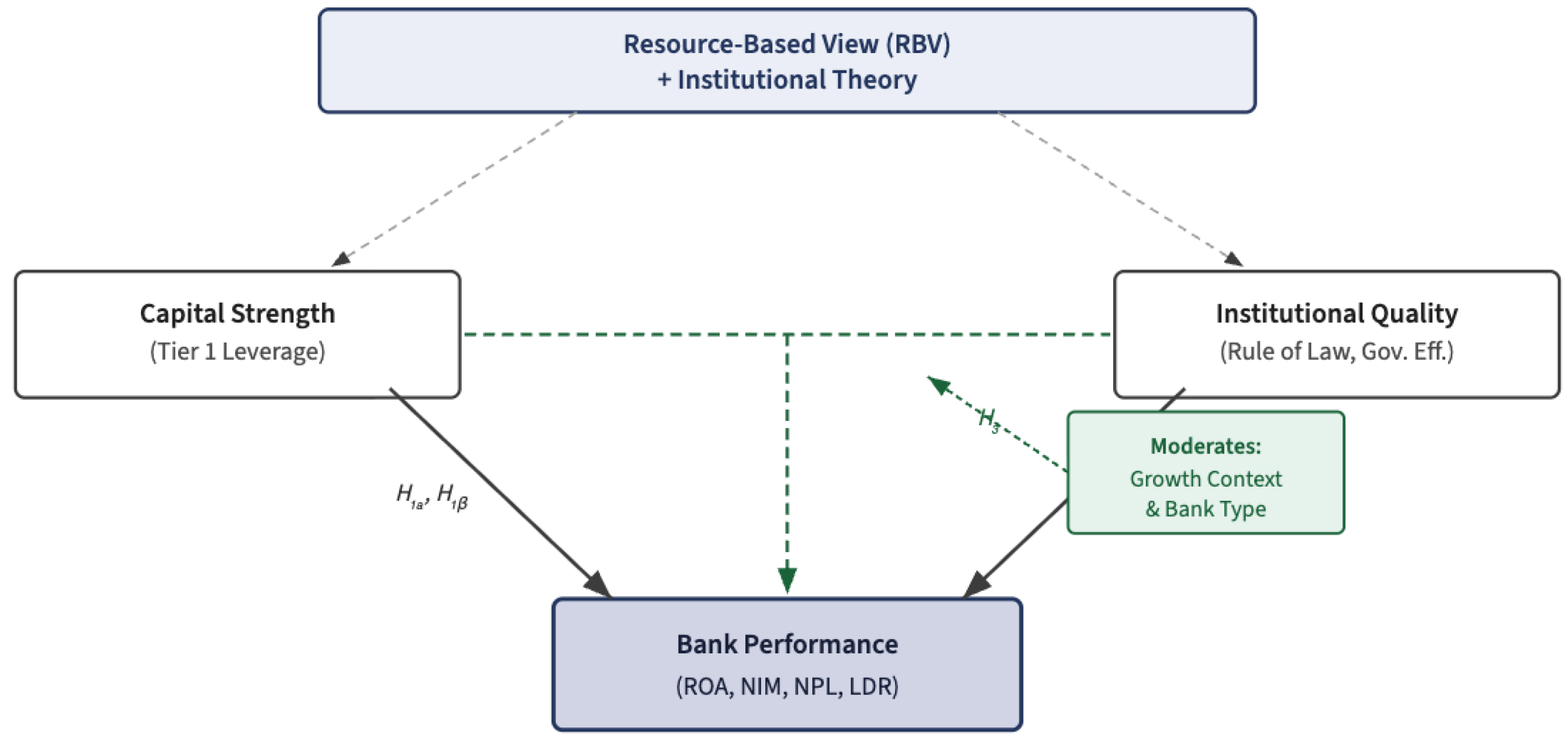
Figure 1 presents the conceptual framework, showing how internal capital resources and external governance environments combine to shape bank outcomes, with growth context and bank type serving as moderators.

3. Research Design and Methodology

3.1. Research Design

This study adopts a quantitative, comparative panel design across five Asian banking systems. The design is appropriate for two reasons. First, bank performance is dynamic: profitability, credit risk, and liquidity exhibit strong temporal persistence, requiring longitudinal analysis to separate genuine performance effects from mean reversion. Second, governance quality is inherently cross-country: its effects can only be identified by comparing institutions operating under meaningfully different institutional regimes. By integrating these two dimensions, the design addresses the gap identified in Section 2, where prior research has largely been confined to single-country studies or has treated governance as a control rather than a moderating force. Two-step system GMM is the primary estimator for hypothesis testing; pooled OLS, random-effects GLS, and fixed-effects models serve as benchmarks and robustness checks, as detailed in Section 4.

3.2. Data and Sample

The empirical analysis draws on an unbalanced panel of 1628 bank-year observations from 123 deposit-taking institutions in Hong Kong, South Korea, Taiwan, Malaysia, and Vietnam between 2010 and 2022. The sample includes commercial banks (1488 observations), savings banks (98, concentrated in South Korea), and Islamic banks (42, primarily in Malaysia). The panel is unbalanced because not all institutions report complete data in every year; this reflects data availability in the Orbis Bank Focus database rather than systematic attrition, and results are robust to balanced subsamples, as reported in the robustness checks.
Bank-level financial and performance data are drawn from Orbis Bank Focus. Governance measures are sourced from the World Bank’s Worldwide Governance Indicators (WGIs), and macroeconomic data, real GDP growth and consumer price inflation are obtained from the World Development Indicators (WDIs). Observations with missing Tier 1 capital, total assets, or governance indicators are excluded to mitigate survivorship and reporting bias. Table 2 reports descriptive profiles by country and specialization.

3.3. Variables and Measurement

Dependent Variables. Bank performance is captured through four accounting-based indicators widely used in research and supervisory practice: return on assets (ROA), net interest margin (NIM), non-performing loans (NPL), and the loan-to-deposit ratio (LDR). ROA measures profitability, NIM intermediation efficiency, NPL credit risk, and LDR liquidity transformation. All four are winsorized prior to estimation, ROA, NIM, and NPL at the 1st and 99th percentiles and LDR at the 5th and 95th percentiles, to limit the influence of extreme observations without discarding potentially informative tail values.
Independent Variables. Capital strength is proxied by the Tier 1 leverage ratio, defined as Tier 1 capital over total exposures and entered in decimal form in all estimations (e.g., 0.08 represents an 8% ratio); reported coefficients should therefore be scaled by 0.01 to obtain the marginal effect per one percentage-point change in the ratio. Governance quality is proxied by the WGI Rule of Law indicator. Although governance indicators are macro-level and change gradually, they are the most authoritative cross-country measures of institutional capacity available (Kaufmann et al., 2011; Magnusson & Tarverdi, 2020; Rahi et al., 2023). They capture the stability of the legal and regulatory environment that conditions how banks deploy capital, making them an appropriate proxy for institutional quality in annual micro-level panels. To ensure robustness, a principal component analysis (PCA) composite of Rule of Law, Government Effectiveness, and Regulatory Quality is also employed, capturing a broader dimension of governance quality.
Controls. Bank-level controls include the debt-to-equity ratio, efficiency ratio (operating expenses over income), and size proxies (log of total assets and log of total equity). Macroeconomic controls include GDP growth and consumer price inflation. Dummy variables capture bank specialization (Islamic and savings banks), enabling heterogeneity tests through interactions with governance indicators.

3.4. Model Specification

The baseline model estimated via two-step system GMM is
Perf i , c , t { ROA , NIM , NPL , LDR } = α + ρ Perf i , c , t 1 + β 1 Cap i , t 1 + β 2 Gov c , t 1 + β 3 Cap i , t 1 · Gov c , t 1 + β 4 Gov c , t 1 · Islamic i + β 5 Gov c , t 1 · Savings i + k γ k X k , i , c , t + μ i + λ t + ε i , c , t
Here, Perf i , c , t denotes one of the four dependent variables for bank i in country c at time t. μ i represents bank fixed effects and λ t captures year effects. The lagged dependent variable Perf i , c , t 1 accounts for performance persistence; the Tier 1 leverage ratio is treated as potentially endogenous. Both are instrumented using lagged levels and lagged differences in the System GMM framework, with instrument sets collapsed and restricted to short lags to guard against instrument proliferation (Roodman, 2009). Hansen J tests and AR(2) diagnostics assess instrument validity and the absence of second-order autocorrelation, respectively.
The interaction terms link directly to the study’s hypotheses. H1a and H1b test the linear associations of Tier 1 leverage with ROA and NIM, respectively, identified through β 1 . H2a tests whether governance quality moderates the association between Tier 1 leverage and bank performance, operationalized through β 3 . H2b tests whether this moderation is non-linear: to assess whether returns to governance conditioning diminish at high institutional capacity, the sample is split into high-growth and low-growth periods based on median GDP growth, and β 3 is estimated separately for each subsample; attenuation in high-capacity systems would be consistent with H2b. H3 tests bank-type heterogeneity through β 4 and β 5 , examining whether the governance–performance association is weaker for Islamic and savings banks than for commercial banks. A joint F-test on β 4 and β 5 provides an omnibus assessment of bank-type heterogeneity.

4. Findings

4.1. Descriptive Statistics and Correlations

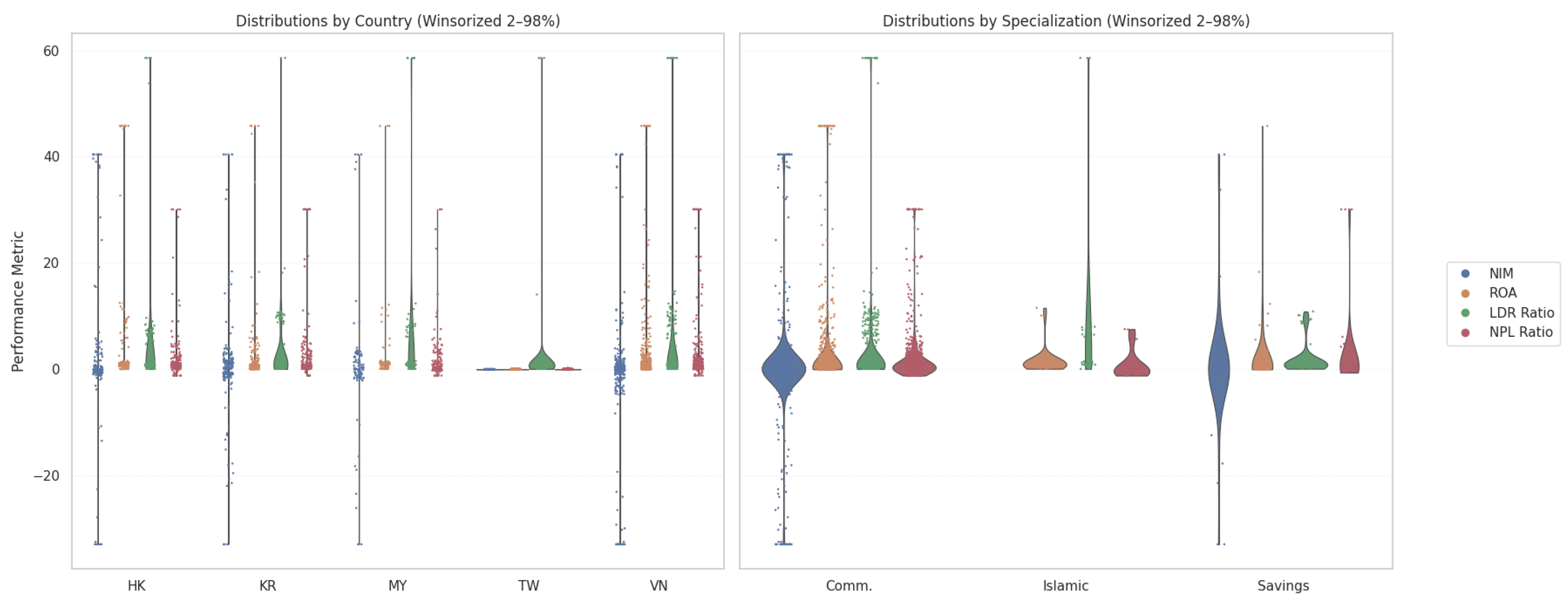
Table 2 reports the distribution of banks by specialization alongside summary performance metrics. Figure 2 complements these summary statistics by illustrating the underlying distributions across countries and bank specializations. Cross-country contrasts are immediately evident. Vietnam exhibits the riskiest but also one of the most profitable profiles, with a median ROA of 1.79% and an NPL ratio of 4.80%. Taiwan presents a markedly different pattern, combining modest profitability (median ROA 0.53%) with exceptionally low credit risk (median NPL 0.17%). Malaysia’s dual system, comprising both conventional and Islamic banks, underscores its institutional distinctiveness, while Korea’s savings banks account for roughly one-quarter of its banking sector. Hong Kong stands out for comparatively strong profitability with moderate risk levels. These descriptive patterns foreshadow the heterogeneity further explored in the subsequent econometric analysis.
Governance indicators (Table A2) are highly correlated, with Rule of Law and Government Effectiveness exceeding 0.95. This multicollinearity justifies the PCA-based robustness checks reported in Section 4.5. Variance Inflation Factors (Table A4) confirm that collinearity is not prohibitive in the bank-level specifications, though governance estimates require careful interpretation given their macro-level, slow-moving nature.

4.2. Baseline Models: OLS and Fixed Effects

Pooled OLS and fixed-effects models (Table A5) provide benchmarks against which the dynamic panel estimates can be evaluated. Both estimators show that Tier 1 leverage is positively associated with ROA and negatively associated with NIM, consistent with the resilience–spread trade-off predicted by H1a and H1b. Governance quality is associated with lower NPLs but shows weak and imprecise profitability effects under both estimators. However, the lagged dependent variable coefficients are unstable under OLS and RE, a symptom of dynamic panel bias that arises when the time dimension is short relative to the number of groups, and Hausman tests reject random effects in favor of fixed effects. These diagnostics confirm that static estimators are insufficient for capturing performance persistence and motivate the use of System GMM as the primary estimator.

4.3. Dynamic Panel Estimates: Capital, Governance, and Bank-Type Heterogeneity

System GMM results (Table 3) provide the primary evidence for the study’s hypotheses. H1a and H1b are supported: a one percentage-point increase in Tier 1 leverage is associated with a 0.022 percentage-point improvement in ROA ( p < 0.01 ) and a 0.43 percentage-point compression in NIM ( p < 0.01 ), consistent with the resilience–spread trade-off. NPLs exhibit strong corrective dynamics (lag coefficient 0.51 , p < 0.01 ), while LDR is highly persistent (lag coefficient 2.74 , p < 0.01 ). Hansen J statistics and AR(2) tests are broadly acceptable across specifications, supporting instrument validity.
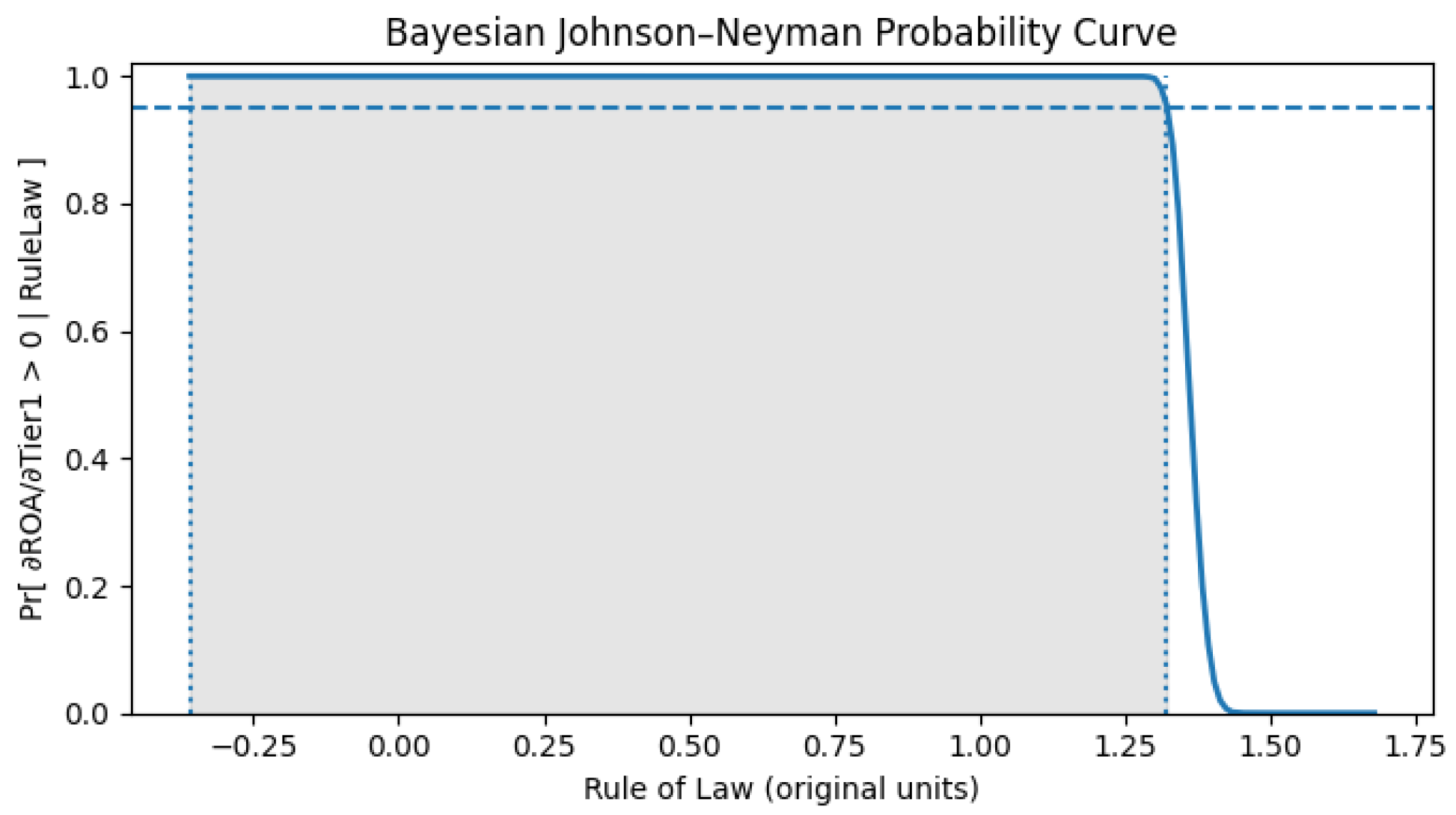
H2a and H2b both receive conditional support, consistent with the asymmetry hypothesis. Governance indicators alone are generally insignificant in the pooled specification, but the interaction between Tier 1 leverage and Rule of Law is significant in mid-capacity systems and insignificant in high-capacity ones, supporting H2a. The Bayesian Johnson–Neyman diagnostics (Figure 3) sharpen this finding in support of H2b: Tier 1 leverage has a credibly positive association with ROA only when the Rule of Law index lies between 0.36 and 1.32 . This bounded interval captures Vietnam and Malaysia but excludes Hong Kong, South Korea, and Taiwan. The governance–capital complementarity is therefore not absent but conditional: it operates where institutional credibility is still being consolidated and fades precisely where the asymmetry hypothesis predicts it should.
H3 receives directional support, though with an important qualification that must be stated explicitly. The Bayesian multilevel and System GMM estimates (Table A9) show that Islamic bank interaction terms are consistently attenuated relative to those for commercial bank peers across all three governance specifications, Rule of Law, Government Effectiveness, and Regulatory Quality, with coefficients pointing in the direction predicted by the contractual distinctiveness argument: that Shariah governance structures and profit-and-loss sharing arrangements partially displace the reach of conventional prudential governance. However, the Islamic bank subsample comprises only 42 observations, concentrated in Malaysia, and the posterior intervals produced by both estimation approaches are too wide to support precise inference. The directional pattern is consistent with H3 and with the theoretical logic advanced in Section 2, but the finding should be treated as indicative rather than confirmatory, and is better understood as a hypothesis warranting replication in samples with greater Islamic bank representation than as a settled empirical result.

4.4. Country-Specific Comparisons

Country-level estimates in Table A7 provide the definitive empirical evidence for the asymmetry hypothesis underlying H2a and H2b. The contrast across systems is sharp: in Vietnam, both Tier 1 leverage and its interaction with the Rule of Law are statistically significant, and in Malaysia, the interaction is positive and substantive, consistent with governance environments in which enforcement credibility continues to yield measurable returns to capital. In Hong Kong, by contrast, significance lies solely in the Rule of Law rather than in capital interaction, indicating that at high institutional capacity, governance operates as an independent performance driver rather than a multiplier of capital. Korea’s interaction coefficients are muted and Taiwan’s are negligible, consistent with the prediction that marginal governance gains diminish once institutional credibility is fully established. This Vietnam/Malaysia versus Hong Kong/Taiwan contrast is not a residual finding but the central evidence that governance conditions capital’s payoff asymmetrically across institutional contexts. In the pooled sample, capital remains strongly and positively associated with ROA, whereas the governance interaction is imprecise, underscoring that the complementarity is conditional rather than universal. Robustness checks for Malaysia (Table A8) confirm consistent signs across RE, FE, and difference GMM, though wide confidence intervals indicate that country-specific inferences should be treated with appropriate caution.

4.5. Robustness and Validity Checks

System GMM performs better than GLS benchmarks (Table A5), with instrument sets deliberately kept parsimonious: collapsed lags and fewer instruments than cross-sectional units in all specifications. Hansen J and AR(2) diagnostics confirm instrument validity and the absence of second-order autocorrelation across most specifications. One exception is the pre-COVID-19 NPL sub-model (Table A12), where the AR(2) statistic yields p = 0.009 , indicating potential second-order autocorrelation that may compromise instrument validity for that sub-model; pre-COVID-19 NPL estimates should therefore be interpreted with caution and are not used to draw substantive conclusions about credit risk dynamics in the pre-2020 period. Governance effects remain directionally stable across individual WGIs and PCA composites (Table A11), supporting the robustness of the institutional quality proxy. The loan-to-deposit ratio exhibits high persistence, with a lag coefficient of 2.742; as this exceeds unity, liquidity results are interpreted conservatively and are not used as the basis for causal claims about intermediation dynamics. To assess whether the governance–capital complementarity varies with growth conditions, as H2b predicts, the sample is split at the pre- and post-COVID-19 threshold (Table A12). The pre-2020 period, characterized by broadly positive GDP growth across the five systems, shows a Tier 1 leverage coefficient of 3.47 percentage points on ROA, while the post-2020 period yields a coefficient of 1.87 percentage points. This attenuation is consistent with the prediction that returns to capital are contingent on growth conditions: during the post-COVID-19 period, extraordinary fiscal and monetary interventions compressed the performance differential between high- and low-capital banks, temporarily socializing stability and thereby diluting capital’s rarity. While the pre-/post-COVID-19 split is a proxy for the growth-conditioning mechanism rather than a clean high-growth versus low-growth experiment, it provides directional evidence consistent with H2b. Bayesian multilevel estimates align closely with GMM throughout (Table A9), providing consistent evidence across estimation approaches.

5. Discussion

5.1. Contextualizing Findings Within the Literature

The results advance a literature that has largely treated capital and governance as parallel, additive drivers of bank performance. RBV-inspired work consistently links capital buffers to resilience and profitability (Barney, 1991; Berger, 1995; Demirgüç-Kunt & Huizinga, 2010), while Institutional Theory emphasizes governance quality as an external conditioning force (Barth et al., 2013; Beck et al., 2013; Porta et al., 1998). The present findings complicate both accounts. Capital’s payoff is not uniform but bounded: it is consistently associated with improved ROA and compressed NIM across systems, yet its complementarity with governance is conditional on institutional maturity, and its profitability advantage attenuates markedly under crisis-era intervention. Governance, meanwhile, is not a linear performance driver but a threshold-dependent one, beneficial where credibility is consolidating and subject to diminishing or reversed returns where it is already established. These patterns are not anomalies in the existing literature but theoretically meaningful refinements of what RBV and Institutional Theory each predict in isolation. Prior studies that found inconsistent governance effects across contexts (Beck et al., 2013; Boussaada et al., 2023; Casciello et al., 2025) were likely capturing different positions on this threshold, rather than evidence of governance’s irrelevance. By situating RBV within Institutional Theory and applying this integrated lens to five Asian systems spanning the full range of institutional maturity, the present study provides a framework for reconciling those inconsistencies.

5.2. Relating Findings to Hypotheses and Prior Research

H1a and H1b are supported, but the findings complicate their theoretical interpretation. The baseline association is substantively meaningful: a one percentage-point increase in Tier 1 leverage is associated with a 0.022 percentage-point improvement in ROA, establishing the magnitude of capital primacy before considering governance conditioning. While RBV predicts that capital buffers are valuable, rare, and inimitable, the results show that these properties are not inherent but contingent. In high-liquidity or heavily backstopped environments, most visibly in the post-COVID-19 period, capital is no longer rare and its profitability advantage erodes. The resilience–spread trade-off, where higher Tier 1 leverage improves ROA while compressing NIM, is consistent with Gropp and Heider (2010) and Demirgüç-Kunt and Huizinga (2010), but the post-COVID-19 attenuation extends their findings by showing that the trade-off itself is regime-dependent. When state interventions socialize stability, the cross-sectional variance in capital adequacy loses its signaling value.
H2a and H2b receive conditional support that is theoretically more informative than a simple confirm or reject. H2a is supported by the pattern of governance moderation across systems: governance amplifies capital’s returns in Vietnam and Malaysia, where institutional credibility continues to generate measurable payoffs to capital, consistent with the expectation that governance quality conditions the deployment of internal resources. H2b is supported by the non-linear character of this relationship: governance indicators are insignificant in the pooled specification, which might appear to contradict Institutional Theory’s core claim. However, the country-level and Johnson–Neyman results show that this pooled insignificance masks a threshold dynamic: governance amplifies capital’s returns where the Rule of Law index falls within the credibly positive range of 0.36 to 1.32 , but adds little or attenuates in Hong Kong, South Korea, and Taiwan, where the index exceeds 1.32 and institutional credibility is already fully established. This pattern is consistent with Boot et al. (1991), who argue that credibility generates its largest gains during the consolidation phase, and with Beck et al. (2013), who document diminishing governance returns in mature systems. The non-linearity documented here extends both accounts by providing a bounded empirical estimate of the point at which the governance payoff transitions from amplifying to attenuating.
H3 provides directional evidence consistent with the contractual distinctiveness hypothesis, though the precision of the estimates requires honest qualification. Studies of Malaysian banking typically emphasize Islamic resilience in terms of lower NPLs and stable funding structures (Abedifar et al., 2013; Hasan et al., 2022), but rarely examine whether Islamic banks respond differently to external governance reforms. The governance interaction terms for Islamic banks are consistently attenuated relative to those for commercial peers across Rule of Law, Government Effectiveness, and Regulatory Quality specifications, pointing in the direction the hypothesis predicts: that Shariah governance structures and profit-and-loss sharing arrangements function as a partially autonomous institutional layer that partially displaces the reach of conventional prudential governance. These patterns are consistent across specifications, lending credibility to the directional claim. However, the Islamic bank subsample of 42 observations produces posterior intervals that are too wide to support confirmatory inference, and the finding is better understood as indicative rather than settled. Prior work on Islamic banking heterogeneity (Abedifar et al., 2013) similarly notes that small subsample sizes in dual-banking systems limit the precision with which contractual effects can be identified. The practical implication remains valid regardless: supervisors in dual-banking systems should not assume that conventional governance reforms will have symmetric effects across bank types, and the directional evidence here supports differentiated oversight frameworks even where precise effect magnitudes cannot yet be established.

5.3. Interpreting the Post-COVID-19 Attenuation of Capital Effects

A particularly novel finding is that the association between Tier 1 capital and profitability weakens markedly in the post-2020 period, with the coefficient declining from approximately 3.47 to 1.87 percentage points on ROA. This is not a statistical anomaly but evidence of resource–institution substitution under extraordinary policy regimes, consistent with the moral hazard literature showing that explicit government guarantees reduce the cross-sectional signaling value of private capital buffers (Acharya et al., 2019; Demirgüç-Kunt & Huizinga, 2010). The primary driver was government and regulatory intervention: moratoria, guarantees, and fiscal transfers displaced banks’ own capital as the buffer of last resort (Demirgüç-Kunt & Huizinga, 2010; Financial Stability Board, 2020). This intervention muted capital’s signaling role by making stability effectively state-supplied. Monetary easing and deposit surpluses reinforced this substitution by compressing spreads and flattening cross-sectional funding premia (Airaudo, 2023; Dursun-de Neef & Schandlbauer, 2022). Structural shifts, including liquidity hoarding and rapid digitalization, further reduced the link between capital and profitability, as operational agility rather than capitalization shaped competitive outcomes (Bressan et al., 2022; Feyen et al., 2021; Martens, 2025).
These mechanisms were mutually reinforcing. State guarantees lowered downside risk, liquidity abundance erased funding advantages, and digital acceleration redirected performance drivers. Theoretically, this challenges RBV’s assumption of rarity. Capital remained valuable, but its inimitability was diluted when all institutions could rely on public backstops and cheap liquidity. Institutional Theory complements this interpretation by showing how governance can temporarily overshadow internal resources during crisis regimes. Historical parallels exist in the Global Financial Crisis, but the simultaneity of fiscal, monetary, and structural interventions during the COVID-19 period created a uniquely interventionist environment where capital’s traditional payoff was unusually muted. This finding positions the post-COVID-19 attenuation not as an exception to the resource-in-context framework but as its most direct empirical demonstration: when external institutions substitute for internal resources, the rarity condition that underpins RBV rents is temporarily dissolved. The temporal split cannot adjudicate among the three mechanisms identified here, since state guarantees, monetary easing, and digital acceleration operated simultaneously; isolating the dominant channel would require cross-sectional variation in forbearance intensity or bank-level digital adoption data that lies beyond the scope of the present study.

5.4. Theoretical Implications: Refining RBV and Institutional Theory

The findings advance theory in three specific respects that prior studies have not jointly established. First, RBV rents in banking are not inherent properties of capital but context-contingent payoffs that depend on whether external conditions preserve or dilute rarity. The standard VRIN framework (Barney, 1991) treats resource value as an attribute of the resource itself; the present results suggest it is better understood as a function of the institutional environment in which the resource is deployed. Capital that is rare in one regime becomes commoditized in another when public backstops remove the cross-sectional advantage.
Second, Institutional Theory’s treatment of governance as a linear performance enhancer requires qualification. The threshold dynamics documented here, where governance amplifies capital’s returns below a credibility threshold and imposes diminishing or negative returns above it, suggest that the governance–performance relationship follows an inverted logic at high institutional capacity. This extends Boot et al. (1991) by specifying where the transition occurs empirically, and complements Casciello et al. (2025) by showing that the reversal is not confined to specific national contexts but is a systematic feature of institutional maturity.
Third, the Islamic banking heterogeneity demonstrates that institutional context operates at multiple levels simultaneously: across countries with differing governance maturity, and within systems divided by contractual and religious models. This multilevel contingency is absent from most RBV applications in banking and from most comparative governance studies, which typically treat national institutional quality as the sole moderating layer. The present framework accommodates both levels and establishes a basis for theoretical extension, the empirical scope and practical implications of which are taken up in the conclusion.

6. Conclusions

This study examined whether capital adequacy and governance quality jointly and asymmetrically shape bank performance across Asian banking systems. The answer is affirmative and consequential for both theory and regulatory design. A one percentage-point increase in Tier 1 leverage is consistently associated with a 0.022 percentage-point improvement in ROA and a 0.43 percentage-point compression in NIM, confirming the resilience–spread trade-off predicted by RBV. Governance quality, however, does not operate uniformly: it amplifies capital’s returns in mid-capacity systems such as Vietnam and Malaysia, where the Rule of Law index falls within the credibly positive range, but plateaus or attenuates in high-capacity systems such as Hong Kong, South Korea, and Taiwan, where institutional credibility is already established. Islamic banks add a further layer of heterogeneity, as their weaker responsiveness to conventional governance reforms reflects contractual and religious logics that standard prudential frameworks do not capture. Together, these findings support a contingent resource-in-context framework in which capital is broadly portable but governance requires calibration to institutional capacity and banking model.

6.1. Theoretical Contributions

The study advances theory in three respects. First, it demonstrates that RBV rents are not inherent properties of capital but context-contingent payoffs whose stability depends on whether external conditions preserve capital’s rarity and signaling value. The post-COVID-19 attenuation, where the Tier 1 leverage coefficient on ROA declined from 3.47 to 1.87 percentage points, provides the most direct evidence: when fiscal and monetary interventions socialize stability, the cross-sectional advantage of well-capitalized banks temporarily dissolves.
Second, the threshold dynamics documented here extend Institutional Theory by showing that governance effects are non-linear, with a bounded transition from amplifying to attenuating returns that can be estimated empirically rather than assumed.
Third, the directional evidence from Islamic banks raises the theoretical possibility that institutional context operates at multiple levels simultaneously, across national governance regimes and within systems divided by contractual and religious models. This multilevel contingency is consistent across all governance specifications but cannot be confirmed with the available subsample of 42 observations; it is therefore advanced as a proposition warranting replication in larger dual-banking samples rather than as an empirical contribution.

6.2. Policy and Practical Implications

The asymmetry between capital and governance carries direct implications for prudential design. Capital standards remain broadly portable across jurisdictions and should continue to anchor regulatory frameworks, but the compression of margins associated with higher capitalization requires supervisors to monitor competitive dynamics and guard against unintended credit rationing. Governance reforms, by contrast, must be calibrated to context rather than applied uniformly. In high-capacity systems such as Hong Kong, Taiwan, and South Korea, additional compliance layers risk imposing costs without commensurate performance gains; reform energy is better directed toward supervisory efficiency and crisis preparedness. In mid-capacity systems such as Malaysia and Vietnam, strengthening enforcement and regulatory follow-through can still enhance profitability and stability, provided reforms are paired with supportive growth conditions. The Johnson–Neyman diagnostics provide a concrete benchmark for this guidance: the governance–capital complementarity is credibly positive when the Rule of Law index falls between 0.36 and 1.32 , a range that currently encompasses Vietnam and Malaysia but not Hong Kong, South Korea, or Taiwan. Regulators in mid-capacity systems can use this interval as a diagnostic threshold, prioritizing enforcement reforms that move their Rule of Law score toward the upper bound of the credibly positive range rather than applying uniform compliance upgrades irrespective of their current institutional position. Islamic banks require differentiated oversight. Their weaker responsiveness to conventional governance reforms indicates that Shariah boards, profit-and-loss sharing arrangements, and contract-specific compliance burdens must be explicitly integrated into prudential frameworks rather than treated as peripheral features.
The framework developed here also has implications beyond Asia. In Gulf Cooperation Council banking systems, where Shariah compliance mandates generate contractual distinctiveness similar to Malaysia’s dual system, the same asymmetric governance logic is likely to apply. Conventional prudential reforms may have attenuated effects on Islamic institutions, and the governance–capital interaction will depend on the GCC country’s position on the institutional maturity spectrum. In Eastern European transitional systems, where enforcement credibility is still consolidating, the mid-capacity logic suggests that governance investment should yield meaningful returns to capital, provided reforms are sustained through economic cycles rather than reversed during downturns.

6.3. Limitations and Future Research

The use of WGIs as a proxy for governance captures broad institutional quality but lacks the micro-level detail of supervisory intensity. Because governance data are recorded at the country-year level while bank metrics are firm-specific, identification depends primarily on cross-country variation; results therefore reflect institutional differences between nations rather than temporal shifts within them. Future research utilizing bank-level regulatory examination data could better distinguish whether threshold dynamics operate through formal enforcement or broader credibility signals. The dataset ends in 2022, which precludes observation of post-COVID-19 normalization and the final stages of Basel III implementation; extending the analysis through 2025 would clarify whether the observed attenuation of capital’s profitability advantage reflects a permanent structural shift or a temporary response to extraordinary policy interventions. The Islamic bank subsample of 42 observations, concentrated in Malaysia, is insufficient to support precise estimation of the governance interaction terms that H3 requires; expanding the analysis to Gulf Cooperation Council banking systems would provide the sample depth needed to determine whether attenuated governance responsiveness is a general property of Islamic banking or an artifact of the Malaysian context. Finally, while the five-country sample is theoretically motivated, replicating the framework in other transitional systems, including Eastern Europe, would establish the broader generalizability of the governance–capital interaction identified here.


Funding

This research received no external funding.

Institutional Review Board Statement

Not applicable.

Informed Consent Statement

Not applicable.

Data Availability Statement

The data supporting the findings of this study are available upon reasonable request from the corresponding author.

Conflicts of Interest

The author declares no conflicts of interest.

Appendix A. Control Variable Descriptives

Table A1. Control variable descriptives.
VariableMeanSDMinMaxQ1p50Q3
Bank Characteristics
Leverage Ratio2.0692.583−0.10015.4720.0870.7293.250
Debt to Equity Ratio8.3625.194−1.00020.5830.9131.30410.465
Efficiency Ratio62.58315.47230.000120.00045.25050.19475.362
Log of Total Equity13.5890.48812.92015.95413.26713.44813.788
Log of Total Assets12.4043.1336.59615.9958.11014.29014.533
Regulatory Characteristics
Rule of Law1.0710.446−0.5801.8600.9001.1301.260
Government Effectiveness1.2840.347−0.2401.8801.0301.3201.490
Voice and Accountability0.4590.572−1.5001.100−0.0500.6800.900
Regulatory Quality1.2340.532−0.6302.2200.9901.1501.470
Macro Characteristics
Log GDP (Millions)26.6771.58319.70428.51225.32626.46928.194
CPI112.79215.25789.270171.88099.000113.051120.663
Notes: Statistics are based on the full sample of 1628 bank-year observations.

Appendix B. Correlation Matrix

Table A2. Pairwise correlations of main and control variables.
1234567891011121314
1. NIM1.000
2. ROA0.0831.000
3. NPL−0.397−0.0601.000
4. LDR0.095−0.056−0.1121.000
5. Lev Ratio0.2060.031−0.060−0.1101.000
6. D/E Ratio0.0010.077−0.033−0.097−0.1871.000
7. Eff Ratio0.2180.1200.1170.0600.160−0.2551.000
8. L. Equity0.346−0.190−0.2470.112−0.046−0.563 *−0.0191.000
9. L. Assets0.1480.1630.1040.0780.181−0.390 *0.665 *0.718 *1.000
10. RuleLaw−0.262−0.290−0.069−0.108−0.2010.055−0.0740.100−0.360 *1.000
11. GovEff−0.217−0.299−0.095−0.049−0.2210.032−0.0310.095−0.3260.978 *1.000
12. VoiceAcct−0.265−0.284−0.002−0.142−0.1840.100−0.1480.046−0.458 *0.982 *0.935 *1.000
13. RegQual−0.243−0.296−0.119−0.079−0.2240.060−0.0810.123−0.370 *0.993 *0.990 *0.960 *1.000
14. GDP−0.226−0.0730.278−0.1190.088−0.2230.370 *−0.0760.356 *0.296 *0.2620.291 *0.2151.000
15. CPI0.1800.1350.1080.213−0.409 *0.663 *0.1500.985 *−0.595 *−0.527 *−0.676 *−0.602 *0.430 *0.190
Note: * indicates significance at the 0.01 level.

Appendix C. Unit Root and VIF Diagnostics

Table A3. Im–Pesaran–Shin Panel Unit Root Tests.
VariableIPS Statisticp-Value
ROA−67.1670.000
NIM−18.3010.000
NPL (non-performing loans)−39.7830.000
LDR (loan-to-deposit ratio)17.0241.000
Rule of Law−3.0980.001
GDP growth−32.649 ***0.000
Notes: Im–Pesaran–Shin (IPS) test (Im & Pesaran, 2003). *** denotes statistical significance at the 1% level. Null hypothesis: all panels contain a unit root (non-stationary). The Levin–Lin–Chu (LLC) test requires a balanced panel and is not applicable here (unbalanced panel, T = 1–13 years). LDR does not reject the unit-root null; high persistence is accommodated by the lagged dependent variable in the dynamic GMM framework, and instrument validity is confirmed by the AR(2) (p = 0.893) and Hansen (p = 0.128) tests.
Table A4. Multicollinearity diagnostics (Variance Inflation Factor).
VariableL. EquityL. AssetsDebt/EquityLev. RatioEff. RatioMean VIF
VIF Value8.078.071.011.011.013.83
Notes: Variance Inflation Factor (VIF) measures multicollinearity. Statistics are based on the full sample of 1628 bank-year observations.

Appendix D. Pooled RE–GLS vs. System GMM

Table A5. Pooled RE–GLS vs. two-step system GMM.
Model 1—Random-Effects GLSModel 2—System GMM (Two Step)
NIMROANPLLDRNIMROANPLLDR
Lag DependentN/AN/AN/AN/A−0.000.00−0.010.00
(−0.11)(0.44)(−0.84)(0.55)
Leverage Ratio0.010.21 ***−0.11−0.590.060.10−0.080.05
(0.13)(2.79)(−0.40)(−0.26)(1.02)(0.47)(−1.80)(0.12)
Debt/Equity−0.02−0.020.01−0.130.00−0.01−0.04−0.04
(−0.51)(−0.80)(0.11)(−0.14)(−0.10)(−1.12)(−1.38)(−0.44)
Efficiency Ratio0.000.000.000.00 ***0.000.000.000.00
(0.35)(0.20)(−0.53)(4.71)(0.64)(−0.45)(−0.53)(1.43)
Lg. Equity−0.110.32−1.84−4.540.23−0.21−1.52−1.99
(−0.13)(0.39)(−0.65)(−0.19)(0.30)(−0.27)(−1.01)(−0.30)
Lg. Assets0.68−1.311.902.340.310.032.020.72
(0.71)(−1.33)(0.61)(0.09)(0.40)(0.03)(1.36)(0.07)
Rule of Law1.15−0.111.38165.01 **3.330.08−0.19103.41 **
(0.47)(−0.04)(0.17)(2.37)(1.50)(0.05)(−0.03)(2.15)
Gov Eff−1.99−1.67−5.74−18.13−2.07−3.91 ***−8.37−3.83
(−0.70)(−0.60)(−0.59)(−0.22)(−0.83)(−2.76)(−0.84)(−0.26)
Voice and Acct−2.50−2.540.8820.590.01−0.150.2215.86
(−1.36)(−1.40)(0.14)(0.38)(0.00)(−0.13)(0.08)(1.15)
Reg Qual2.583.531.93−130.55 *−1.542.755.92−88.25 **
(1.02)(1.42)(0.21)(−1.71)(−0.71)(1.79)(0.93)(−2.06)
GDP0.000.000.000.000.000.000.000.00
(−0.26)(0.05)(0.70)(−1.20)(−0.64)(0.36)(0.69)(−1.82)
CPI−0.00−0.00−0.010.190.010.000.010.17
(−0.15)(−0.09)(−0.21)(0.56)(0.84)(−0.49)(0.69)(1.60)
Islamic Bank−1.70−1.21−1.387.04−0.62−0.410.0915.37
(−0.74)(−0.45)(−0.22)(0.14)(−1.05)(−0.53)(0.04)(1.54)
Savings Bank2.102.148.461.590.780.836.831.72
(1.03)(0.90)(1.47)(0.03)(0.52)(0.46)(0.89)(0.17)
Constant−6.0614.91 ***3.8539.41−5.15 **5.35−4.1516.31
(−0.94)(2.08)(0.20)(0.25)(−1.97)(0.50)(−0.89)(0.19)
Model Statistics
Obs/Groups/Instruments749/82/–749/82/–728/82/–749/82/–705/82/26672/82/26640/82/26672/82/26
R 2 (W/B/O)0.01/0.12/0.020.03/0.03/0.020.00/0.16/0.010.04/0.03/0.04— (GMM models)
σ u / σ e / ρ 2.65/8.12/0.103.59/7.77/0.180/28.98/00/251.23/0— (GMM models)
Wald χ 2 (p-value)129.12 ***1645.42 ***27.46 ***18.87 **
AR(2)/Hansen0.25/11.55−1.31/13.140.52/12.35−0.77/3.69
Notes: * p < 0.10 , ** p < 0.05 , *** p < 0.01 . Random-effects sample: 82 banks, 749 observations (NIM/ROA/LDR) and 728 (NPL). System GMM uses the same bank set with 26 instruments. Instrument sets are collapsed and restricted to short lags for the lagged dependent variable and Tier-1 leverage, while governance and macro variables enter IV-style. Instruments remain fewer than the number of banks in all specifications. Hansen J p-values are interpreted as diagnostic given finite-T panels. “–” indicates the coefficient is not estimated in that model.

Appendix E. System GMM: Main Results

Table A6. System GMM results for ROA, NIM, NPL, and LDR with key covariates and diagnostics.
Variable(1) ROA(2) NPL(3) NIM(4) LDR
Panel A: Coefficient Estimates
L_ROA−0.014---
(0.017)
L_NPL-−0.507 ***--
(0.051)
L_NIM--−0.066-
(0.045)
L_LDR---2.742 ***
(0.003)
RegQual−0.445---
(1.457)
Savings × RegQual−1.384---
(5.149)
RuleLaw-0.051418.01-
(0.766)(751.51)
Savings × RuleLaw-33.36--
(42.88)
GovEff---23.35 *
(13.71)
Savings × GovEff---−8.88
(15.79)
log(_Ttl_assets)_0.1210.537 ***−22.69−4.43
(0.252)(0.185)(41.35)(2.74)
Tier_1_Leverage_Ratio2.158 ***2.0 × 10⁻⁵ *−43.13 ***−4.0 × 10⁻⁴ ***
(0.013)(1.0 × 10⁻⁵)(0.66)(1.0 × 10⁻⁴)
GDP_growth0.3500.068−35.77−2.23 *
(0.441)(0.099)(52.65)(1.35)
Constant−2.626−4.620 **−65.9845.78
(3.398)(2.076)(367.85)(42.04)
Panel B: Model Diagnostics
Observations120411599781204
Groups123123113123
Instruments28281628
AR(2) p-value0.520.010.360.31
Hansen p-value0.310.470.110.51
Notes: Robust standard errors in parentheses. *** p < 0.01, ** p < 0.05, * p < 0.1. Models estimated using two-step system GMM with Windmeijer-corrected standard errors. Endogenous regressors (lagged dependent variable and Tier 1 leverage) are instrumented using collapsed GMM-style lags (depths 2–3). Governance indicators, interaction terms, GDP growth, and log total assets enter as exogenous instruments via iv(). Instrument counts (28 for ROA, NPL, and LDR; 16 for NIM) remain below the number of cross-sectional groups in all specifications. The NIM specification retains 113 groups due to missing lagged observations for ten banks. Tier 1 leverage is expressed in decimal form; coefficients should be multiplied by 0.01 for interpretation per one percentage-point change (e.g., 2.158 × 0.01 = 0.022 pp improvement in ROA per one percentage-point increase in Tier 1 leverage; −43.13 × 0.01 = −0.431 pp compression in NIM). AR(2) p = 0.01 for NPL indicates potential second-order autocorrelation; NPL estimates should be interpreted with caution.

Appendix F. Country-Specific ROA Estimates

Table A7. Country-specific ROA estimates: Tier-1 leverage and Rule of Law.
VariableHong KongKoreaMalaysiaTaiwanVietnamFull Sample
L.ROA0.053 **−0.086 **−0.154 ***0.1010.0000.000
(0.021)(0.041)(0.052)(0.071)(0.000)(0.000)
Rule of Law85.942 **1.13546.503 *0.015−24.687 *−16.897
(35.774)(6.024)(27.842)(0.019)(14.919)(13.879)
Tier 1 Leverage−4.4490.5421.0720.0991.493 ***2.179 ***
(5.315)(0.402)(2.197)(0.087)(0.257)(0.025)
Tier1 × RuleLaw3.1170.158−0.751−0.09816.886 ***−0.220
(3.161)(0.413)(3.970)(0.088)(6.426)(0.645)
Log(Total Assets)−14.615 **−0.218−10.196 *−0.005−8.39318.687
(6.044)(0.903)(5.843)(0.007)(9.217)(16.687)
GDP Growth1.573 **0.8240.708 *0.0017.366 *0.143
(0.692)(0.801)(0.373)(0.002)(4.434)(0.150)
Constant76.339 **3.461111.249 *0.01457.300
(31.146)(6.045)(62.615)(0.019)(110.509)
Model fit
Observations1561831174173311204
R 2 (Adj.)0.5770.3780.4930.7301.000
R 2 (Within/Between/Overall)1.000/0.983/0.999
Notes: Bank and year fixed effects; SEs clustered by bank. Full sample: entity and time FE (PanelOLS). *** p < 0.01, ** p < 0.05, * p < 0.10. The full-sample column omits a constant due to fixed effects; reported R2 are Within/Between/Overall.

Malaysia: Robustness (RE, FE, Diff–GMM)

Table A8. Malaysia ROA robustness: RE, FE, Diff–GMM.
(1) RE(2) FE(3) Diff–GMM
L.ROA0.1219
Tier 1 Leverage Ratio0.8094−0.37570.0201
(2.5234)(0.9039)
Rule of Law27.006647.31640.0082
(17.7598)(43.8649)
Tier 1 × Rule of Law0.04461.75570.0183
(4.4575)(1.5468)
Log(Total Assets)−2.4259−4.5798−0.0030
(1.5403)(4.0377)
Debt/Equity Ratio−0.0025−0.0061−0.0121
(0.0021)(0.0075)
Efficiency Ratio0.52440.4737−0.0001
(0.3402)(0.3929)
GDP Growth0.39570.8133−0.0530
(0.1865)(0.6488)
CPI−0.0462
Observations168168168
Year FE includedYesYesNo
Notes: Columns (1) and (2) report Malaysia RE (pooled OLS + year FE, clustered by bank) and FE (bank and year FE, clustered by bank) with robust standard errors in parentheses. Column (3) shows one-step diff–GMM fallback coefficients only (no SEs/AR(2)/Hansen).

Appendix G. Bank-Type Heterogeneity (BML vs. System GMM)

Table A9. Bayesian multilevel and system GMM estimates of ROA with Islamic interaction terms.
VariableBML (No Year Dummies)BML (With Year Dummies)System GMM
Panel A: Coefficient Estimates
RegQual−3.290−7.85510.530
(88.104)(90.262)(15.933)
GovEff−22.813−11.920−17.529
(89.132)(91.225)(23.379)
RuleLaw−17.136−21.1101.761
(88.522)(89.871)(5.426)
log10 Assets0.6661.1610.563
(0.750)(0.951)(0.355)
Tier 1 Ratio2.169 ***2.169 ***2.158 ***
(0.0004)(0.0004)(0.014)
GDP Growth−0.1440.0250.051
(0.287)(0.377)(0.442)
CPI−0.055−0.085
(0.039)(0.052)
Islamic × RegQual−0.8090.466−88.427
(100.159)(99.616)(514.058)
Islamic × GovEff−7.574−10.397−14.121
(99.084)(100.429)(461.160)
Islamic × RuleLaw865.131870.384116.858
(99.997)(101.058)(1257.645)
Islamic × L.ROA8.228
(94.843)
Constant−4.990−9.0240.063
(6.663)(15.744)(8.136)
Panel B: Model Fit
Obs/Groups1287/1241287/1241204/123
Bayesian DIC13,404.5113,418.76
F/Wald/Prob17.87/0.085
AR(2)/Hansen p-val0.472/0.950
Notes: Standard deviations in parentheses. *** indicates narrow posterior intervals with negligible variance. BML = Bayesian Multilevel Model with random intercepts for firm. System GMM estimates use two-step estimation with robust standard errors and collapsed instruments. Year dummies included only in the second BML model. DIC = Deviance Information Criterion.

COVID-19 Robustness Analysis

Table A10. System GMM with COVID-19 control variable.
ROANIMNPLLDR
VariableBaseline+COVIDBaseline+COVIDBaseline+COVIDBaseline+COVID
Tier 1 ratio 0.057 0.112 0.277 0.466 0.571 0.306 −3.224 **−4.352 **
COVID-19 dummy 0.108 0.425 0.655 *−1.240
Rule of Law 0.308 0.242 3.031 1.435 2.339 2.089 36.375 ***24.424 ***
AR(2) p-val 0.485 0.326 0.331 0.412 0.109 0.102 0.893 0.792
Hansen p-val 0.064 0.061 0.185 0.141 0.536 0.475 0.128 0.093
Notes: The COVID-19 dummy (=1 for 2020–2022) is not significant for ROA, NIM, or LDR, but is marginally significant for NPL (p = 0.091), reflecting pandemic-period asset quality deterioration (Dursun-de Neef & Schandlbauer, 2022; Financial Stability Board, 2020). *, **, and *** denote significance at the 10%, 5%, and 1% levels. Baseline results remain robust to the inclusion of this control.

Appendix H. Governance: Individual vs. PCA (GMM)

Table A11. System GMM estimates: individual vs. composite governance measures (two-step, Windmeijer-corrected standard errors).
VariableModel 1—Individual GovernanceModel 2—Composite Governance (PCA)
ROANIMNPLROANIMNPL RatioLDR
L. Dependent var.<0.01 ***–0.920.16–0.021–0.035–0.1892.744 ***
(<0.01)(1.22)(0.45)(0.024)(0.045)(0.134)(0.003)
Tier 1 Leverage Ratio2.18 ***<0.01<0.012.154 ***–43.590 ***0.000013 ***–0.00049 ***
(0.01)(<0.01)(<0.01)(0.017)(0.655)(0.000005)(0.00010)
log10 (Assets)4.770.40−1.990.109−7.4830.458 ***−5.099 **
(4.21)(0.68)(2.62)(0.323)(17.621)(0.122)(2.428)
GDP Growth<0.01<0.01<0.010.494−16.7460.082−2.458
(<0.01)(<0.01)(<0.01)(0.559)(39.886)(0.064)(1.549)
Rule of Law–2922 **27.93714.49
(1451)(282.70)(617.14)
Government Effectiveness1945−174.12−326.45
(1632)(441.60)(488.53)
Regulatory Quality1597−25.22−724.39
(1174)(425.23)(614.91)
Rule of Law × GDP0.64 **0.22 **0.05
(0.31)(0.11)(0.18)
Islamic bank−6.214 *−2.042 **−6.869
(3.398) (0.933)(9.631)
PC Regulation−1.00763.8520.0451.564
(1.458)(103.018)(0.232)(2.260)
Constant−69.710.2628.83−2.267144.644−3.832 ***77.347 *
(52.81)(8.72)(31.91)(3.387)(150.220)(1.199)(39.627)
Model Statistics
Obs/Groups/Instruments1204/123/151279/124/151159/123/151204/123/17978/113/161159/123/171204/123/17
Wald χ 2 /Prob > χ 2 2.76 × 10⁹/0.0002.35 × 109/0.00028.89/0.0001.53 × 106/0.000
AR(2)/Hansen p-value0.86/0.710.27/0.860.73/0.870.508/0.0030.521/0.5200.379/0.1650.313/0.300
Notes: Model 1 uses individual governance indicators (Rule of Law, Government Effectiveness, Regulatory Quality). Model 2 uses PC Regulation (first principal component of governance indicators). Two-step system GMM with Windmeijer-corrected standard errors in parentheses. Collapsed instruments use lags 2–3 of endogenous regressors. Hansen J and AR(2) diagnostics confirm instrument validity and the absence of second-order autocorrelation across most specifications. One exception is the pre-COVID-19 NPL model (Table A12), where the AR(2) statistic yields p = 0.009 , indicating potential second-order autocorrelation that may compromise instrument validity for that sub-model; pre-COVID-19 NPL estimates should therefore be interpreted with caution and are not used to draw substantive conclusions about credit risk dynamics in the pre-2020 period. “—” indicates variable not included in model specification. *** p < 0.01 , ** p < 0.05 , * p < 0.10 .

Appendix I. Pre– vs. Post–COVID-19 (GMM)

Table A12. System GMM estimation results—pre- and post-COVID-19 comparison.
VariableROANIMNPL RatioLDR
PrePostPrePostPrePostPrePost
L.Dependent Variable0.017−0.0890.150 *0 −0.719 ***−0.538 **0.177 ***0
(0.020)(0.570)(0.077)(omit)(0.029)(0.226)(0.067)(omit)
Main IV 13.4681.098−498.4711.8510.2891.162−7.7880
(2.422)(1.054)(591.122)(7.622)(0.805)(2.138)(7.180)(omit)
Main IV 24.590−0.86060.940−8.9161.7630
(7.182)(0.886) (46.616)(10.328)(12.683)(omit)
log10_Ttl_assets_−0.5100.20838.8120.9660.5031.144 ***0.2630.083
(0.422)(0.296)(57.584)(0.873)(0.361)(0.368)(0.293)(.)
Tier 1 Ratio2.181 ***1.866 ***−46.305 ***−7.981 *0.000012−0.577 ***−0.00008 **0
(0.015)(0.696)(1.123)(4.365)(0.000017)(0.204)(0.00003)(omit)
GDP growth−0.6830.053 *63.5990.441 *0.2410.015−0.1030
(0.424)(0.029)(72.943)(0.236)(0.321)(0.034)(0.411)(omit)
Constant1.651−3.44557.714−12.831−4.986 *−9.518 **9.6010
(3.112)(3.545)(370.025)(16.679)(2.680)(4.345)(7.381)(omit)
Model Statistics
Obs/Groups/Instruments905/123/22176/122/7721/108/13152/104/5862/123/22175/121/7905/123/22176/122/7
Wald χ 2 /Prob > χ 2 3.24 × 10⁸/0.00027.37/0.0005.90× 108/0.0006.08/0.2991303.56/0.00042.69/0.00052.88/0.0000.00/1.000
AR(2)/Hansen p-value0.407/0.257—/—0.273/0.900—/—0.009 ***/0.639—/—0.342/0.533—/—
Notes: Two-step GMM estimates with Windmeijer-corrected errors in parentheses. *** p < 0.01, ** p < 0.05, * p < 0.10, omitted. All models use collapsed instruments. Instrument sets vary: ROA uses RegQual and Savings × RegQual; NIM uses RuleLaw and Islamic × RuleLaw (dropped); NPL uses RuleLaw and Savings × RuleLaw; LDR uses GovEff and Savings × GovEff.

References

  1. Abedifar, P., Molyneux, P., & Tarazi, A. (2013). Risk in Islamic banking. Review of Finance, 17(6), 2035–2096. [Google Scholar] [CrossRef]
  2. Acharya, V. V., Eisert, T., Eufinger, C., & Hirsch, C. (2019). Whatever it takes: The real effects of unconventional monetary policy. The Review of Financial Studies, 32(9), 3366–3411. [Google Scholar] [CrossRef]
  3. Airaudo, F. S. (2023). Exit strategies from quantitative easing: The role of the fiscal-monetary policy mix (Tech. Rep.). mimeo. [Google Scholar]
  4. Alaoui Mdaghri, A., Raghibi, A., & Ait Bihi, A. (2026). Does credit risk drive liquidity hoarding in African banks? The influence of institutional quality and global uncertainty. Journal of Financial Economic Policy, 1–24. [Google Scholar] [CrossRef]
  5. Allen, F., Gu, X., & Jagtiani, J. (2021). A survey of fintech research and policy discussion. Review of Corporate Finance, 1, 259–339. [Google Scholar] [CrossRef]
  6. Atta, N., & Sharifi, A. (2024). A systematic literature review of the relationship between the rule of law and environmental sustainability. Sustainable Development, 32(6), 7051–7068. [Google Scholar] [CrossRef]
  7. Bacchiocchi, A., Bischi, G. I., & Giombini, G. (2022). Non-performing loans, expectations and banking stability: A dynamic model. Chaos, Solitons & Fractals, 157, 111906. [Google Scholar] [CrossRef]
  8. Bachtijeva, D., Tamulevičienė, D., & Subačienė, R. (2024). The impact of corporate social responsibility on the use of earnings management in the context of internal financial and macroeconomic factors: The case of Lithuania. Economies, 12(12), 329. [Google Scholar] [CrossRef]
  9. Bank for International Settlements [BIS]. (2025). Annual report 2024/25. Available online: https://www.bis.org/about/areport/areport2025.pdf (accessed on 15 April 2026).
  10. Bank of England Prudential Regulation Authority. (2023). The prudential regulation authority’s approach to banking supervision and regulation (Tech. Rep.). Bank of England. Available online: https://www.bankofengland.co.uk/-/media/boe/files/prudential-regulation/approach/banking-approach-2023.pdf (accessed on 15 April 2026).
  11. Barney, J. B. (1991). Firm resources and sustained competitive advantage. Journal of Management, 17(1), 99–120. [Google Scholar] [CrossRef]
  12. Barth, J. R., Caprio, G., Jr., & Levine, R. (2013). Bank regulation and supervision in 180 countries from 1999 to 2011. Journal of Financial Economic Policy, 5(2), 111–219. [Google Scholar] [CrossRef]
  13. Basel Committee on Banking Supervision. (2023). Assessment of basel iii liquidity coverage ratio (lcr) regulations—Korea (Tech. Rep.). Bank for International Settlements. Available online: https://www.bis.org/bcbs/publ/d586.pdf (accessed on 15 April 2026).
  14. Beck, T., Demirgüç-Kunt, A., & Merrouche, O. (2013). Islamic vs. conventional banking: Business model, efficiency and stability. Journal of Banking & Finance, 37(2), 433–447. [Google Scholar] [CrossRef]
  15. Begenau, J., Bigio, S., Majerovitz, J., & Vieyra, M. (2026). A q-theory of banks. Review of Economic Studies, 93(1), 106–143. [Google Scholar] [CrossRef]
  16. Begum, M., Rahman, M. M., & Faruq, M. O. (2024). Impact of regulatory capital on bank interest margins: Moderating role of default risk. Heliyon, 10(10), e30554. [Google Scholar] [CrossRef]
  17. Berger, A. N. (1995). The relationship between capital and earnings in banking. Journal of Money, Credit and Banking, 27(2), 432–456. [Google Scholar] [CrossRef]
  18. Berger, A. N., & Bouwman, C. (2015). Bank liquidity creation and financial crises. Academic Press. [Google Scholar]
  19. BIS. (2011). Basel iii: A global regulatory framework for more resilient banks and banking systems (revised version) (Tech. Rep.). Bank for International Settlements. Available online: https://www.bis.org/bcbs/basel3.htm (accessed on 15 April 2026).
  20. BIS. (2017). Basel iii: Finalising post-crisis reforms (Tech. Rep.). Bank for International Settlements. Available online: https://www.bis.org/bcbs/publ/d424.htm (accessed on 15 April 2026).
  21. Boot, A. W., Thakor, A. V., & Udell, G. F. (1991). Credible commitments, contract enforcement problems and banks: Intermediation as credibility assurance. Journal of Banking & Finance, 15(3), 605–632. [Google Scholar] [CrossRef]
  22. Boussaada, R., Hakimi, A., & Karmani, M. (2023). Non-performing loans and bank performance: What role does corporate social responsibility play? A system GMM analysis for European banks. Journal of Applied Accounting Research, 24(5), 859–888. [Google Scholar] [CrossRef]
  23. Bressan, A., Duarte Alonso, A., Vu, O. T. K., Do, L. T. H., & Martens, W. (2022). The role of tradition for food and wine producing firms in times of an unprecedented crisis. British Food Journal, 124(4), 1170–1186. [Google Scholar] [CrossRef]
  24. Brigham, E. F., & Houston, J. F. (2017). Financial management: Theory and practice. Cengage Learning. [Google Scholar]
  25. Casciello, R., Maffei, M., & Meucci, F. (2025). Bank accounting conservatism and capital management. Journal of Applied Accounting Research, 26(3), 708–731. [Google Scholar] [CrossRef]
  26. Demirgüç-Kunt, A., & Huizinga, H. (2010). Bank activity and funding strategies: The impact on risk and returns. Journal of Financial Economics, 98(3), 626–650. [Google Scholar] [CrossRef]
  27. Dempster, M. (2015). The bankers’ new clothes, what’s wrong with banking and what to do about it. Taylor & Francis. [Google Scholar]
  28. DiMaggio, P. J., & Powell, W. W. (1983). The iron cage revisited: Institutional isomorphism and collective rationality in organizational fields. American Sociological Review, 48(2), 147–160. [Google Scholar] [CrossRef]
  29. Dursun-de Neef, H. Ö., & Schandlbauer, A. (2022). COVID-19, bank deposits, and lending. Journal of Empirical Finance, 68, 20–33. [Google Scholar] [CrossRef]
  30. Feyen, E., Frost, J., Gambacorta, L., Natarajan, H., & Saal, M. (2021). Fintech and the digital transformation of financial services: Implications for market structure and public policy. BIS Papers. Available online: https://documents1.worldbank.org/curated/en/099735304212236910/pdf/P17300608cded602c0a6190f4b8caaa97a1.pdf (accessed on 15 April 2026).
  31. Financial Stability Board. (2020). Global monitoring report on non-bank financial intermediation 2020. Available online: https://www.fsb.org/wp-content/uploads/P161220.pdf (accessed on 15 April 2026).
  32. Gropp, R., & Heider, F. (2010). The determinants of bank capital structure. Review of Finance, 14(4), 587–622. [Google Scholar] [CrossRef]
  33. Gutiérrez-Ponce, H., & Wibowo, S. A. (2024). Do sustainability practices contribute to the financial performance of banks? An analysis of banks in Southeast Asia. Corporate Social Responsibility and Environmental Management, 31(2), 1418–1432. [Google Scholar] [CrossRef]
  34. Hasan, I., Liu, L., Saunders, A., & Zhang, G. (2022). Explicit deposit insurance design: International effects on bank lending during the global financial crisis✩. Journal of Financial Intermediation, 51, 100958. [Google Scholar] [CrossRef]
  35. Hong Kong Monetary Authority. (2022). Leverage ratio: Key functions. Available online: https://www.hkma.gov.hk/eng/key-functions/banking/banking-legislation-policies-and-standards-implementation/leverage-ratio/ (accessed on 15 April 2026).
  36. Im, K. S., & Pesaran, M. H. (2003). On the panel unit root tests using nonlinear instrumental variables. Available online: https://ssrn.com/abstract=482463 (accessed on 15 April 2026).
  37. Indochine Counsel. (2025). Standardizing capital adequacy ratio aligning with basel iii standards: A milestone in vietnam banking reform. Available online: https://indochinecounsel.com/weekly-debrief-standardizing-capital-adequacy-ratio-aligning-with-basel-iii-standards-a-milestone-i (accessed on 15 April 2026).
  38. Jiang, G., Tang, N., Law, E., & Sze, A. (2003). The profitability of the banking sector in Hong Kong. Hong Kong Monetary Authority Quarterly Bulletin, 3(36), 5–14. [Google Scholar]
  39. Kaufmann, D., Kraay, A., & Mastruzzi, M. (2011). The worldwide governance indicators: Methodology and analytical issues. Hague Journal on the Rule of Law, 3(2), 220–246. [Google Scholar] [CrossRef]
  40. Kumar, A., Ahmed, K., Bhayo, M.-u.-R., & Kalhoro, M. R. (2023). Banking performance and institutional quality: Evidence from dynamic panel data analysis. International Journal of Finance & Economics, 28(4), 4717–4737. [Google Scholar] [CrossRef]
  41. Laeven, L., & Levine, R. (2009). Bank governance, regulation and risk taking. Journal of Financial Economics, 93(2), 259–275. [Google Scholar] [CrossRef]
  42. Li, X., & Tong, X. (2024). Fostering green growth in Asian developing economies: The role of good governance in mitigating the resource curse. Resources Policy, 90, 104724. [Google Scholar] [CrossRef]
  43. Lin, J.-R., Chung, H., Hsieh, M.-H., & Wu, S. (2012). The determinants of interest margins and their effect on bank diversification: Evidence from Asian banks. Journal of Financial Stability, 8(2), 96–106. [Google Scholar] [CrossRef]
  44. Magnusson, L. M., & Tarverdi, Y. (2020). Measuring governance: Why do errors matter? World Development, 136, 105061. [Google Scholar] [CrossRef]
  45. Martens, W. (2024). Beyond the barriers: Institutional strength as a shield in curbing earnings manipulation. Qeios. preprint. [CrossRef]
  46. Martens, W. (2025). Strategic insights: The paradox of intellectual capital’s role in bank efficiency. Asian Journal of Technology & Management Research, 14(2), 55–63. [Google Scholar]
  47. Martens, W., Yapa, P., & Safari, M. (2021). Earnings management in frontier market: Do institutional settings matter? Economies, 9(1), 17. [Google Scholar] [CrossRef]
  48. Martins Pereira, C., Menezes, A., & Muro, S. (2021, January). How insolvency and creditor/debtor regimes can help address nonperforming loans (Policy Note No. 156258). World Bank. [Google Scholar] [CrossRef]
  49. Mathuva, D. M., & Nyangu, M. N. (2022). Revisiting earnings quality and bank efficiency among East African developing economies: Do systemic banking and financial crises matter? Journal of Applied Accounting Research, 23(3), 650–685. [Google Scholar] [CrossRef]
  50. Mietule, I., Subaciene, R., Liksnina, J., & Viskers, E. (2025). Sustainability and profitability of large manufacturing companies. Journal of Risk and Financial Management, 18(8), 439. [Google Scholar] [CrossRef]
  51. Miles, D., Yang, J., & Marcheggiano, G. (2013). Optimal bank capital. The Economic Journal, 123(567), 1–37. [Google Scholar] [CrossRef]
  52. North, D. C. (1990). Institutions, institutional change and economic performance. Cambridge University Press. [Google Scholar]
  53. Porta, R. L., Lopez-de Silanes, F., Shleifer, A., & Vishny, R. W. (1998). Law and finance. Journal of Political Economy, 106(6), 1113–1155. [Google Scholar] [CrossRef] [PubMed]
  54. Pradnyawati, S. O., & Widhiastuti, N. L. P. (2020). THE effects of NIM, LDR and BOPO on balinese people’s credit bank (bpr) profitability of tabanan. American Journal of Humanities and Social Sciences Research (AJHSSR), 3(11), 196–203. [Google Scholar]
  55. Rabby, S. M., Rahaman, M. M., Tanim, G. M. S., & Bushra Chowdhury, A. R. (2026). Refurbished institutional quality and good governance for bank stability: A meta-analysis of emerging economies. Journal of Risk and Financial Management, 19(2), 144. [Google Scholar] [CrossRef]
  56. Rahi, A. F., Chowdhury, M. A. F., Johansson, J., & Blomkvist, M. (2023). Nexus between institutional quality and corporate sustainable performance: European evidence. Journal of Cleaner Production, 382, 135188. [Google Scholar] [CrossRef]
  57. Roodman, D. (2009). A note on the theme of too many instruments. Oxford Bulletin of Economics and Statistics, 71(1), 135–158. [Google Scholar] [CrossRef]
  58. Salem, M. R., Shahimi, S., Alma‘amun, S., Hafizh Mohd Azam, A., & Ghazali, M. F. (2025). ESG and banking performance in ASEAN-5: Disaggregated analysis using system GMM and LSDVC. Sage Open, 15(4), 21582440251382564. [Google Scholar] [CrossRef]
  59. Scott, P. (1995). The meanings of mass higher education. McGraw-Hill Education (UK). [Google Scholar]
  60. State Bank of Vietnam. (2016, December). Circular no. 41/2016/tt-nhnn prescribing prudential ratios for operations of banks and foreign bank branches. Available online: https://www.sbv.gov.vn/documents/d/sbv_portal/286146?download=true (accessed on 15 April 2026).
  61. Sunaryo, D. (2020). The effect of capital adequacy ratio (CAR), net interest margin (NIM), non-performing loan (NPL), and loan to deposit ratio (LDR) against return on asset (ROA) in general banks in southeast Asia 2012–2018. Ilomata International Journal of Management, 1(4), 149–158. [Google Scholar] [CrossRef]
  62. Suu, N. D., Luu, T. Q., Pho, K. H., & McAleer, M. (2020). Net interest margin of commercial banks in Vietnam. Advances in Decision Sciences, 24(1), 1–27. [Google Scholar] [CrossRef]
  63. Trung, N. K. Q. (2019). Determinants of non-performing loan in commercial banks: Evidence in Vietnam. Journal of Science and Technology-IUH, 37(01). [Google Scholar] [CrossRef]
  64. Ul Rehman, W., Saltik, O., Degirmen, S., Ocak, M., & Shabbir, H. (2024). Dynamics of intellectual capital and financial performance in ASEAN banks. Arab Gulf Journal of Scientific Research, 42(4), 1426–1443. [Google Scholar] [CrossRef]
  65. Vietnam Banks Association. (2024). Bad debts remained a challenge for banks in h1. Available online: https://vnba.org.vn/en/bad-debts-remained-a-challenge-for-banks-in-h1-15196.htm (accessed on 15 April 2026).
  66. Vietnam Development Bank. (2025). Outlook for vietnam’s banks in 2025 remains stable. Available online: https://en.vdb.gov.vn/news13145/-outlook-for-vietnams-banks-in-2025-remains-stable (accessed on 15 April 2026).
  67. Wernerfelt, B. (1984). A resource-based view of the firm. Strategic Management Journal, 5(2), 171–180. [Google Scholar] [CrossRef]
  68. Yuan, D., Gazi, M. A. I., Harymawan, I., Dhar, B. K., & Hossain, A. I. (2022). Profitability determining factors of banking sector: Panel data analysis of commercial banks in South Asian countries. Frontiers in Psychology, 13, 1000412. [Google Scholar] [CrossRef] [PubMed]
  69. Zada, H., Maqsood, H., Ahmed, S., & Khan, M. Z. (2023). Information shocks, market returns and volatility: A comparative analysis of developed equity markets in Asia. SN Business & Economics, 3(1), 37. [Google Scholar] [CrossRef]
Figure 1. Conceptual framework. Solid black arrows indicate direct hypothesized effects on bank performance. Dashed grey arrows denote overarching theoretical linkages from RBV and Institutional Theory. Dashed green arrows represent moderating influences of growth context and bank type on the main relationships.
Jrfm 19 00329 g001
Figure 2. Performance distributions by country (left) and specialization (right).
Jrfm 19 00329 g002
Figure 3. Bayesian Johnson–Neyman curve for Tier 1 leverage and Rule of Law; shaded region indicates 95% credible positive association with ROA. Dashed line shows the probability threshold; dotted lines show the Johnson–Neyman bounds.
Jrfm 19 00329 g003
Table 1. Banking systems in five Asian economies.
VietnamMalaysiaHong KongS. KoreaTaiwan
Basel III aPartial implementationPhased, complete 2026Full by 2025Full by 2023Full by 2019
Governance bLow–moderateMid-rangeHighHighHigh
StructureSOCB dominanceDual system (Islamic 45%)ConventionalCommercial + savingsConventional, limited foreign
Performance cROA 1–2.5% NPL 4.8%ROA ≈ 1.2% mixed NIMStable, robust metricsModerate ROA, strong capitalROA 0.6–1.0% NPL 0.17%
a Basel III adoption milestones: HKMA 2025, FSC Korea 2023, CBC Taiwan 2019, BNM Malaysia 2026, SBV Vietnam partial as of 2024. b Governance quality reflects World Bank WGI Rule of Law, Government Effectiveness, and Regulatory Quality percentile ranks. c Performance metrics drawn from supervisory statistics, IMF reports, and central bank data for ROA, NIM, NPL, and LDR.
Table 2. Bank counts and performance metrics by country.
Panel A: Bank SpecializationPanel B: Performance Metrics (%)
CountryTotalComm.IslamicSavingsNIMROANPLLDR
Hong Kong196196001.50 [0.90–2.10]0.99 [0.73–1.32]0.98 [0.30–2.26]78.13 [71.03–91.90]
South Korea2802100701.80 [1.20–2.40]0.62 [0.42–1.48]0.80 [0.44–2.86]90.00 [86.28–96.46]
Malaysia1681264202.20 [1.60–2.80]1.02 [0.69–1.21]0.87 [0.04–3.07]91.58 [88.96–127.00]
Taiwan6165880281.20 [0.80–1.60]0.53 [0.31–0.69]0.17 [0.10–0.24]74.30 [67.74–80.17]
Vietnam368368003.40 [2.80–4.00]1.79 [1.20–2.50]4.80 [3.50–6.10]88.64 [75.12–104.31]
Total1628148842981.90 [1.20–2.60]0.76 [0.44–1.58]1.50 [0.28–3.50]86.00 [72.00–98.00]
Notes: Panel A shows counts of bank-year observations by specialization. Panel B reports medians with interquartile ranges [IQRs] in brackets. All metrics are standardized to percentage points; ROA, NIM, and NPL are winsorized at the 1st and 99th percentiles, LDR at the 5th and 95th percentiles. Data sourced from Orbis Bank Focus, 2010–2022.
Table 3. System GMM: main results (ROA, NIM, NPL, LDR).
Variable(1) ROA(2) NPL(3) NIM(4) LDR
Panel A: Coefficient Estimates
L_ROA−0.014---
(0.017)
L_NPL-−0.507 ***--
(0.051)
L_NIM--−0.066-
(0.045)
L_LDR---2.742 ***
(0.003)
RegQual−0.445---
(1.457)
Savings × RegQual−1.384---
(5.149)
RuleLaw-0.051418.01-
(0.766)(751.51)
Savings × RuleLaw-33.36--
(42.88)
GovEff---23.35 *
(13.71)
Savings × GovEff---−8.88
(15.79)
log(_Ttl_assets)_0.1210.537 ***−22.69−4.43
(0.252)(0.185)(41.35)(2.74)
Tier_1_Leverage_Ratio2.158 ***2.0 × 10⁻⁵ *−43.13 ***−4.0 × 10⁻⁴ ***
(0.013)(1.0 × 10⁻⁵)(0.66)(1.0 × 10⁻⁴)
GDP_growth0.3500.068−35.77−2.23 *
(0.441)(0.099)(52.65)(1.35)
Constant−2.626−4.620 **−65.9845.78
(3.398)(2.076)(367.85)(42.04)
Panel B: Model Diagnostics (System GMM)
Observations120411599781204
Groups123123113123
Instruments28281628
AR(2) p-value0.520.010.360.31
Hansen p-value0.310.470.110.51
Notes: Robust standard errors in parentheses. *** p < 0.01, ** p < 0.05, * p < 0.1. Models estimated using two-step system GMM with Windmeijer-corrected standard errors. Endogenous regressors (lagged dependent variable and Tier 1 leverage) are instrumented using collapsed GMM-style lags (depths 2–3). Governance indicators, interaction terms, GDP growth, and log total assets enter as exogenous instruments via iv(). Instrument counts (28 for ROA, NPL, and LDR; 16 for NIM) remain below the number of cross-sectional groups in all specifications. The NIM specification retains 113 groups because lagged observations are missing for 10 banks. Tier 1 leverage is expressed in decimal form; to interpret per one percentage-point change, multiply coefficients by 0.01 (e.g., 2.158 × 0.01 = 0.022 percentage-point improvement in ROA per one percentage-point increase in Tier 1 leverage; −43.13 × 0.01 = −0.431 percentage-point compression in NIM). AR(2) p = 0.01 for the NPL model indicates potential second-order autocorrelation; NPL estimates should therefore be interpreted with caution.
Disclaimer/Publisher’s Note: The statements, opinions and data contained in all publications are solely those of the individual author(s) and contributor(s) and not of MDPI and/or the editor(s). MDPI and/or the editor(s) disclaim responsibility for any injury to people or property resulting from any ideas, methods, instructions or products referred to in the content.