Article

Financing Post-War Circular Reconstruction: Digital Tools and Investment Pathways for Ukraine’s Industrial Regions

by
Tetiana Gorokhova
1,2,* and
Žaneta Simanavičienė
3
1
Centre for Advanced Internet Studies (CAIS), 44789 Bochum, Germany
2
Department of Management and Marketing, Pryazoskyi State Technical University, 49044 Dnipro, Ukraine
3
Sustainable Innovation Laboratory, Mykolo Romerio University, LT-08303 Vilnius, Lithuania
*
Author to whom correspondence should be addressed.
J. Risk Financ. Manag. 2026, 19(4), 293; https://doi.org/10.3390/jrfm19040293
Submission received: 12 March 2026 / Revised: 30 March 2026 / Accepted: 2 April 2026 / Published: 18 April 2026

Abstract

Ukraine’s reconstruction, estimated at $524 billion over the next decade, presents an unprecedented opportunity to embed circular economy principles into industrial rebuilding, but the financial architecture currently deployed for reconstruction is structurally blind to circular outcomes. This paper examines how digital tools and innovative financing mechanisms can channel investment toward circular industrial reconstruction in Ukraine, drawing on Germany’s National Circular Economy Strategy (NCES, adopted December 2024) as a reference model. A comparative institutional analysis combines a documentary review of Ukrainian reconstruction policy frameworks (Ukraine Plan 2024–2027, RDNA4, Ukraine Facility) and German NCES instruments with the construction of a financing−technology pathway typology. Five pathways are proposed: circular bond issuance with Digital Product Passport integration; blended finance with blockchain impact verification; EU Facility conditionality with AI-driven resource management; war risk insurance with circular construction standards; and SME digitalisation credit with circular economy competency building. Each pathway is assessed against five criteria: investment scale, risk mitigation, circular measurement, digital readiness, and institutional feasibility, and applied to four industrial corridors (Dnipro region, Zaporizhzhia region, Kharkiv region, and Donetsk region). The analysis reveals that no single pathway is sufficient; a layered strategy differentiating by region is required. Digital tools, particularly the Digital Product Passport and blockchain traceability, serve as partial substitutes for institutional trust in post-conflict settings, reducing information asymmetry between investors and project operators. The paper contributes a practically oriented framework at the under-theorised intersection of post-conflict reconstruction finance and circular economy scholarship.

1. Introduction

Four years into Russia’s full-scale war, the scale of Ukraine’s reconstruction challenge has no modern precedent in Europe. The fourth Rapid Damage and Needs Assessment (RDNA4), released jointly by the World Bank, the European Commission, and the United Nations in February 2025, places the total cost of recovery and reconstruction at $524 billion over the coming decade, a figure equivalent to roughly 2.8 times Ukraine’s estimated 2024 GDP (World Bank et al., 2025). Direct physical damage alone has reached $176 billion, with 72% of losses concentrated in six frontline oblasts: Donetsk, Kharkiv, Luhansk, Zaporizhzhia, Kherson, and Kyiv (UNDP, 2025). Among the hardest-hit sectors, commerce and industry accounts for over $64 billion in estimated reconstruction needs, trailing only housing, transport, and energy.
These numbers, staggering as they are, tell only part of the story. The financing gap, the distance between what is needed and what has been committed, remains a stubborn problem. In 2025, the Ukrainian government and its partners allocated $7.37 billion toward priority recovery areas, yet a gap of nearly $10 billion persists for that year alone (World Bank et al., 2025). International financial assistance has been significant, exceeding $77 billion since the start of the war, but it falls far short of long-term reconstruction needs. Mobilising private capital, as both the RDNA4 and the OECD’s (2025) Economic Survey of Ukraine make clear, is no longer optional; it is a structural precondition for recovery.
What makes this reconstruction challenge distinct from previous post-conflict rebuilding efforts is its temporal overlap with two other transformative agendas. The first is Ukraine’s path toward EU accession. Granted candidate status in June 2022, Ukraine completed the screening of all 33 acquis chapters by September 2025 and has met the conditions to open three negotiation clusters (European Commission, 2025). The accession process requires progressive alignment with EU standards across the economy, including the Circular Economy Action Plan, the Ecodesign for Sustainable Products Regulation, and the forthcoming Digital Product Passport (DPP) requirements. Reconstruction and EU convergence are, in effect, the same project, and the financial architecture for rebuilding must reflect this.
The second agenda is the global push toward a circular economy (CE), which has gained particular momentum in the EU through the European Green Deal and its associated legislative programme. The logic is straightforward: an economy that minimises waste, retains value in materials and products, and regenerates natural systems is more resource-efficient, less dependent on volatile raw material imports, and better positioned for long-term competitiveness. Germany’s adoption of its National Circular Economy Strategy (NCES) in December 2024, with its ambitious target to halve per capita raw material consumption by 2045 and double the circular material share by 2030, illustrates the direction in which Europe’s largest industrial economy is heading (BMUV, 2024). For Ukraine, the question is whether reconstruction will lock the country into a linear industrial model, replicating pre-war patterns of resource extraction and waste, or whether it can serve as a window for building circular industrial systems from the outset.
This question is not merely theoretical. Ukraine’s industrial regions, particularly the Donetsk, Dnipro, Zaporizhzhia, and Kharkiv corridors, which historically anchored the country’s metallurgical, machine-building, and agro-processing sectors, face a paradoxical situation. The destruction of existing industrial assets, while devastating in human and economic terms, also removes the path dependency that otherwise makes CE transitions in established industrial economies so difficult. There is no legacy infrastructure to retrofit; what is rebuilt will define industrial trajectories for decades. Yet the financial instruments currently deployed for reconstruction, sovereign lending, bilateral grants, the €50 billion Ukraine Facility, and war risk insurance mechanisms were not designed with circularity in mind. They are, for the most part, sector-blind regarding circular outcomes: a loan to rebuild a factory carries the same terms whether the factory operates on linear or circular principles. This represents a missed opportunity of considerable proportions.
At the same time, a new generation of digital tools is reshaping both how circular economies operate and how they are financed. The Digital Product Passport, mandated under the EU Batteries Regulation from 2027 and being piloted across sectors under Germany’s NCES, creates a standardised data layer for material composition, repairability, and recyclability throughout a product’s lifecycle. Blockchain-based traceability systems are being deployed to verify environmental claims and reduce the greenwashing risk that erodes investor confidence in green finance. AI-driven resource management, already supported through Germany’s Green-AI Hub Mittelstand initiative, enables predictive maintenance and waste stream optimisation that improve the financial viability of circular operations. In May 2025, the International Finance Corporation (IFC) released the first globally applicable Harmonised Circular Economy Finance Guidelines, offering a practical framework for identifying and quantifying CE-eligible transactions across six sectors (IFC, 2025). Taken together, these developments suggest that the technical and financial infrastructure for circular investment is maturing rapidly, but its application to post-conflict reconstruction contexts remains largely unexplored.
This paper addresses that gap. It examines how digital tools and innovative financing mechanisms can be configured to channel investment toward circular industrial reconstruction in Ukraine, drawing on Germany’s NCES as a reference model for institutional and digital infrastructure. Three research questions guide the analysis:
RQ1. 
What financing mechanisms and investment pathways can direct capital toward circular industrial reconstruction in Ukraine?
RQ2. 
What roles do digital tools, particularly the Digital Product Passport, blockchain traceability, and AI-based resource management, play in enabling, verifying, and de-risking these financing pathways?
RQ3. 
What lessons from Germany’s National Circular Economy Strategy and its Mittelstand digitalisation programmes are transferable to Ukraine’s reconstruction context?
The paper employs a comparative institutional analysis, combining documentary analysis of Ukrainian reconstruction policy frameworks and German NCES instruments with a typology of financing-technology pathways assessed against five criteria: investment scale potential, risk mitigation capacity, circular outcome measurement, digital integration readiness, and institutional feasibility. This contribution provides three key outcomes. It links post-conflict reconstruction finance with circular economy scholarship, connecting two previously separate research areas. It offers a practical typology for policymakers, investors, and development institutions to evaluate circular reconstruction opportunities. Finally, it establishes the knowledge transfer between Germany and Ukraine as a concrete, evidence-based mechanism.
The remainder of the paper is structured as follows. Section 2 reviews the relevant literature and establishes the theoretical framework. Section 3 describes the methodology. Section 4 presents the findings, including the financing-technology typology and its regional application to Ukraine’s industrial corridors. Section 5 discusses the implications, limitations, and transferability conditions. Section 6 concludes the paper.

2. Theoretical Framework and Literature Review

2.1. Circular Economy in Post-Conflict and Transitional Contexts

The circular economy has attracted sustained scholarly attention over the past decade, evolving from a niche concept rooted in industrial ecology into a major policy framework, most visibly through the EU’s Circular Economy Action Plan and its legislative instruments (Kirchherr et al., 2017; Geissdoerfer et al., 2017). Yet for all this growth, the literature remains heavily concentrated on stable, industrialised economies. The dominant research settings are Western Europe, China, and, to a lesser extent, North America, where institutional infrastructure, regulatory predictability, and established financial markets provide a favourable backdrop for CE experimentation (Ghisellini et al., 2016; Korhonen et al., 2018). Transitional economies appear occasionally, typically in the context of EU accession or development aid. War-affected and post-conflict settings are almost entirely absent.
Post-conflict reconstruction represents arguably the single largest-scale industrial building programme a country can undertake, and the choices made during reconstruction define industrial trajectories for decades. The post-conflict reconstruction literature, while extensive on questions of governance, institutional design, and macroeconomic stabilisation (Collier, 2009; del Castillo, 2008), has shown limited interest in environmental sustainability as a design criterion for rebuilding. Where sustainability does appear, as in the UN’s “Build Back Better” framework, it tends to function as an aspirational principle rather than an operational requirement embedded in financing conditions (UNDRR, 2015). The financial architecture of reconstruction, with its emphasis on speed of disbursement, absorption capacity, and macroeconomic stability, rarely incorporates resource efficiency or material circularity as investment criteria.
A small but growing body of work has begun to address this gap. Çetin and Kirchherr (2025) developed a “Build Back Circular” framework based on the 2023 Kahramanmaraş earthquakes in Türkiye, proposing ten action strategies for integrating CE principles into post-disaster reconstruction. Their work is valuable for establishing the conceptual link between crisis response and circularity, though it focuses on natural disasters rather than protracted armed conflict and does not address the financing dimension in depth. More directly relevant is the dual circular strategies hierarchy proposed for Ukraine’s post-war recovery, which introduces a two-vector operationalisation of the 6Rs (reduce, reuse, recycle, recover, redesign, and remanufacture) that accounts for both the legacy of destroyed assets and the forward-looking design of new ones (Shevchenko et al., 2025; Gorokhova et al., 2024). UNIDO (2024) published case studies on circular economy implementation in Ukraine, while IISD and SEI have produced policy briefs on green reconstruction pathways, including a National Comprehensive Green Transition Assessment released in mid-2025 (SEI, 2025). These contributions establish that circular reconstruction is technically feasible and policy-relevant, but they do not systematically examine how it should be financed.

2.2. Financing the Circular Economy: Instruments, Barriers, and Emerging Frameworks

The literature on financing the circular economy has expanded considerably since 2020, driven partly by the growth of sustainable finance markets and partly by the growing recognition that CE transitions require dedicated financial instruments rather than generic green finance (Schröder & Raes, 2021). Several instrument categories have been identified. Green bonds, whose cumulative global issuance exceeded $1.5 trillion between 2021 and 2023, represent the most established mechanism, though the majority of issuances target climate mitigation (primarily renewable energy and clean transport) rather than circularity objectives (Naran et al., 2024). Sustainability-linked loans tie borrowing costs to the achievement of predefined environmental targets, offering flexibility but requiring robust KPI definition. Blended finance, which combines concessional public funds with commercial capital to de-risk investments, has gained traction, particularly for emerging markets where perceived risk premiums deter private investors (WRI, 2025). Impact investing and CE-focused venture capital have expanded steadily: across the broader circular economy sector, cumulative startup funding has reached $46.2 billion globally, with the United States alone accounting for $23.8 billion over the past decade (Tracxn, 2025). In 2024, circular economy solutions attracted 17.9% of all climate technology funding with an environmental objective (Net Zero Insights, 2025). Yet both capital flows and fund management remain heavily concentrated in Western Europe and North America, a geographic imbalance that leaves post-conflict and transitional economies underserved.
A persistent challenge across all these instruments is the absence of standardised circular KPIs. Unlike carbon emissions, which benefit from well-established measurement protocols, registries, and verification systems, circularity lacks an equivalent infrastructure. Material recovery rates, product lifetime extension metrics, and circular return on investment (C-ROI) are used by individual firms and funds, but there is no globally accepted taxonomy that allows investors to compare circular performance across sectors or geographies (Saidani et al., 2019). This measurement problem has a direct financing consequence: it increases information asymmetry between CE ventures and potential investors, raising the cost of capital.
The release of the IFC Harmonised Circular Economy Finance Guidelines in May 2025 represents a significant step toward closing this gap. Co-developed with the World Bank and aligned with the EU Taxonomy and ICMA Green Bond Principles, the Guidelines provide the first globally applicable framework for identifying and quantifying CE-eligible transactions across six sectors: electronics, packaging, textiles, construction, automotive, and agribusiness (IFC, 2025). For the purposes of this paper, the Guidelines are important for two reasons. First, they create a common language that donors, development finance institutions, and private investors can use when evaluating circular reconstruction projects. Second, they implicitly reinforce the role of data and digital verification, since demonstrating compliance with CE eligibility criteria requires granular product- and process-level information, which is precisely what digital tools like the DPP are designed to provide.
The European Investment Bank (EIB) expanded its circular economy financing portfolio. It provides capital and technical advice to make circular projects bankable. This approach addresses the non-traditional risks inherent in circular ventures (EIB, 2024). At the national level, Germany’s KfW development bank offers credit lines to SMEs investing in circular production. The BMUV’s funding programs for circular economy innovation, such as the Green-AI Hub Mittelstand, co-finance firms that adopt AI-driven resource efficiency tools (BMUV, 2024; ETC-CE, 2024).
What is missing from this landscape is a systematic treatment of CE financing in post-conflict contexts. War-affected economies face specific obstacles that hinder investment in the Circular Economy. These include high country risk premiums, weak regulatory enforcement, and disrupted supply chains. Limited domestic financial markets and, in Ukraine, ongoing military operations further increase physical risks for investors (OECD, 2025). These conditions also offer unique opportunities. The destruction of legacy infrastructure removes technological lock-in. Large-scale reconstruction spending allows policymakers to embed circular conditions. International donors and development finance institutions introduce circular economy standards that domestic actors might otherwise resist. Analysing the tension between increased risk and opportunity requires a framework that accounts for the institutional context of financing decisions.

2.3. Digital Tools as Enablers of Circular Finance

The relationship between digitalisation and the circular economy has attracted growing attention, with a broad consensus that digital technologies act as enablers, though not guarantors, of circular outcomes (Kristoffersen et al., 2020; Antikainen et al., 2018). Three categories of digital tools are particularly relevant for the financing dimension.
The Digital Product Passport (DPP) is the most institutionally advanced of these. Anchored in the EU’s Ecodesign for Sustainable Products Regulation (ESPR, in force since July 2024), the DPP creates a standardised digital data container for product-specific sustainability and lifecycle information: material composition, repairability scores, recyclability potential, and records of repairs over time, ownership transfers, and end-of-life processing (European Commission, 2024; Zhang & Seuring, 2024). The EU Batteries Regulation mandates DPP implementation for industrial and electric vehicle batteries from February 2027, with other product categories to follow via delegated acts between 2027 and 2028. Germany’s NCES positions the DPP as a central element of its digital circular economy vision, linking it to the Manufacturing-X data space initiative and planning DPP “lighthouse projects” in key sectors including construction, plastics, electronics, and vehicles (Kreislaufwirtschaft Deutschland, 2024).
For financing, the DPP matters because it addresses a root cause of investor hesitancy, information asymmetry. Investors and insurers use DPP data to evaluate the residual value of building components. This information clarifies how easily workers can disassemble and reuse parts or recover materials at the end of a facility’s life. Most current construction projects lack these specific data points. Company surveys from 2021 to 2023 indicate, however, that only one in three German firms is currently able to manage data efficiently enough to issue DPPs, with SMEs lagging significantly behind larger enterprises (Büchel & Neligan, 2025; Bakalis & Büchel, 2024). This readiness gap is relevant for the Germany−Ukraine comparison: if German SMEs face DPP implementation challenges, Ukrainian enterprises operating in a war-disrupted environment will require even more targeted support.
Blockchain-based traceability systems represent a second digital enabler. By creating tamper-resistant records of material flows and environmental claims, the blockchain can reduce the greenwashing risk that has undermined investor trust in segments of the green finance market. Material passport systems built on blockchain architectures have demonstrated high accuracy in tracking component histories, enabling recyclers and remanufacturers to assess residual value with confidence (Antikainen et al., 2018). For reconstruction contexts, blockchain verification is particularly relevant because it can partially compensate for weak institutional trust, which is a recurring problem in post-conflict settings where government reporting capacity is constrained, and corruption risks are elevated (del Castillo, 2008). If a donor or private investor cannot fully rely on government monitoring to verify that reconstruction funds were used for circular-compliant purposes, a blockchain-verified audit trail provides an independent verification layer.
The third category is AI-driven resource management, which operates at the operational rather than transactional level, but has indirect financing implications. AI systems optimise waste stream routing, predict maintenance needs for industrial equipment (extending product lifetimes), and identify opportunities for industrial symbiosis where one firm’s waste stream becomes another’s input. Germany’s Green-AI Hub Mittelstand, an initiative of the Federal Environment Ministry, supports SMEs in deploying AI for resource efficiency and material savings, effectively using public funds to reduce the operational cost gap between linear and circular production (ETC-CE, 2024). The financing relevance is that AI-driven efficiency gains improve the cash flow profile of circular ventures, making them more attractive to conventional lenders who evaluate loan applications based on projected revenues and operating costs.

2.4. Institutional Theory as an Analytical Lens

Reconstruction is, at its core, an exercise in institution-building. It involves not merely the physical replacement of destroyed assets but the creation (or recreation) of the regulatory frameworks, financial norms, market structures, and organisational routines that determine how an economy functions. Institutional theory, particularly the variant articulated by North (1990) and further developed by Scott (2014), provides a useful analytical framework for understanding both the barriers to and opportunities for embedding circularity in reconstruction finance.
Scott’s (2014) three-pillar model distinguishes between regulative, normative, and cultural-cognitive institutions. Regulative institutions comprise laws, regulations, and enforcement mechanisms. Normative institutions include professional standards, industry codes, and shared expectations regarding appropriate behavior. Cultural-cognitive institutions consist of taken-for-granted assumptions and interpretive frameworks that shape how actors understand their situation. Applied to the topic at hand, these three pillars map onto distinct dimensions of the CE financing challenge.
At the regulative level, the most important institution shaping Ukraine’s reconstruction is the EU accession process itself. The acquis communautaire serves as a comprehensive institutional template. It requires Ukraine to adopt EU standards across all economic sectors, specifically in waste management, product design, environmental impact assessment, and circular economy practices. The European Commission completed the screening of all 33 acquis chapters by September 2025. The Ukraine Facility links €50 billion in financial support to a reform agenda that includes environmental alignment. Consequently, the EU accession framework anchors circularity regulations externally and creates pressure for reform independent of domestic political intent.
At the normative level, the picture is more complex. Professional norms in Ukraine’s construction, metallurgy, and manufacturing sectors were shaped by Soviet-era industrial practices and, more recently, by two decades of market transition that prioritised cost minimisation over resource efficiency. Most companies lack familiarity with circular design principles, lifecycle thinking, and extended producer responsibility. Germany’s experience demonstrates that even a mature institutional framework does not guarantee uniform preparedness. The NCES notes that SMEs require targeted capacity-building to implement circular economy practices and the DPP. The normative gap in Ukraine is wider but not fundamentally different in kind.
At the cultural-cognitive level, the “reconstruction default” constitutes the central concept. Planners, contractors, and financiers assume that rebuilding requires restoring the previous state as quickly as possible. This assumption is deeply embedded in post-conflict practice and reinforced by the political pressure to show visible reconstruction results. Challenging it requires not only regulatory requirements and professional standards but also a shift in the cognitive frame: from reconstruction-as-restoration to reconstruction-as-transformation. The circular economy literature advocates for integrating circularity into systems at the design stage instead of retrofitting it. This paper outlines the institutional architecture necessary to apply this principle to financial decision-making.
The circular economy literature advocates for integrating circularity into systems at the design stage instead of retrofitting it. This paper outlines the institutional architecture necessary to apply this principle to financial decision-making. The classic example is mobile banking in East Africa, where the absence of branch banking infrastructure enabled a direct transition to mobile payment systems. Applied to Ukraine’s reconstruction, the hypothesis is that the destruction of existing industrial infrastructure removes the path dependency that makes CE transitions difficult in established economies. If new factories, logistics networks, and energy systems are being built from scratch, they can be designed to circular specifications from the outset, provided the financial instruments and digital tools are in place to incentivise and verify this. Whether this hypothesis holds in practice depends on the specific institutional conditions in Ukraine’s industrial regions, which Section 4 examines in detail.
This paper’s theoretical framework combines post-conflict reconstruction, circular economy financing, and digital innovation. Institutional theory links these fields and highlights the regulative, normative, and cognitive conditions that enable circular reconstruction finance. This framework guides the comparative analysis of German and Ukrainian institutional contexts and the construction of financing-technology pathways presented in the Results.

3. Materials and Methods

3.1. Research Design

This study uses comparative institutional analysis. This qualitative, conceptual, and analytical approach combines documentary analysis with comparative case logic to create a typology of financing-technology pathways for circular industrial reconstruction. The choice of methodology follows from the nature of the research questions. RQ1 and RQ2 focus on the mechanisms that exist and how they can be configured; RQ3—what is transferable between institutional contexts. These are questions of institutional mapping, typology construction, and conditional generalisation, not of causal hypothesis testing. A quantitative approach is premature because circular reconstruction finance lacks large datasets. Relevant policy instruments remain under development, following the release of key documents in 2024 and 2025. Additionally, the post-conflict setting creates complexities that prevent standardized measurement.
Comparative institutional analysis has an established pedigree in political economy and innovation studies for examining how different institutional configurations shape economic outcomes (Hall & Soskice, 2001; Amable, 2003). We adapt this tradition to the specific problem of CE financing by treating financing-technology configurations, that is, specific combinations of financial instruments and digital tools applied to circular reconstruction, as the unit of analysis. The comparison between Germany and Ukraine is not a symmetric case comparison in the classical sense. The two countries differ fundamentally in economic maturity, institutional stability, and exposure to armed conflict. Rather, Germany’s NCES serves as a reference model—a well-documented example of how a major industrial economy is coupling digital infrastructure with CE financing incentives against which the opportunities and constraints in Ukraine’s reconstruction context are assessed.

3.2. Data Sources

This study relies on publicly available policy documents, institutional reports, and academic publications, which is a choice dictated both by the research design and by the practical reality that much of the relevant evidence exists in grey literature rather than peer-reviewed journals. The policy landscape around Ukraine’s reconstruction and Germany’s CE strategy is evolving so rapidly that the most current and substantive information is found in government strategy papers, international assessment reports, and EU institutional documentation rather than in the academic literature, which inevitably lags.
Ukrainian reconstruction policy corpus includes: the Ukraine Plan 2024–2027 (Government of Ukraine, 2024), which sets out the reform and investment agenda linked to the €50 billion Ukraine Facility; the Rapid Damage and Needs Assessments (RDNA3, February 2024; RDNA4, February 2025), co-authored by the World Bank, European Commission, and United Nations; documentation from the Ukraine Recovery Conferences in Lugano (2022), London (2023), Berlin (2024), and Rome (2025); the Ukraine Facility framework and disbursement conditions published by the European Commission; and the OECD Economic Survey of Ukraine (2025). These documents provide both quantitative data on reconstruction needs and financing flows, and qualitative data on the policy frameworks governing reconstruction investment.
The primary source of the German NCES corpus is the National Circular Economy Strategy adopted by the Federal Cabinet on 4 December 2024 (BMUV, 2024), including its summary and the accompanying Roadmap 2030 materials. Supporting documents include the European Topic Centre on Circular Economy (ETC-CE) Germany Country Profile 2024; the Bertelsmann Stiftung report on advancing the circular economy in Germany and the EU (2025); KfW programme documentation on circular economy and digitalisation credit lines; the BMUV Green-AI Hub Mittelstand initiative description; and the NCES section on digitalisation and circular economy, including DPP pilot project specifications and the Manufacturing-X data space concept (Kreislaufwirtschaft Deutschland, 2024).
Key documents of international CE finance frameworks are the IFC Harmonised Circular Economy Finance Guidelines (May 2025); the EIB circular economy financing overview (2024); the EU Taxonomy Regulation (Regulation 2020/852) and its delegated acts on circular economy activities; the ICMA Green Bond Principles (2021, updated); the ESPR (Regulation 2024/1781); and the EU Batteries Regulation (Regulation 2023/1542) with its DPP provisions. Policy documents from IISD, UNIDO, and SEI on Ukraine’s green reconstruction complement this corpus.
A targeted secondary academic literature search was conducted in Scopus and Web of Science using the query strings (“circular economy” AND (“financing” OR “investment” OR “green bonds” OR “blended finance”)) and (“circular economy” AND (“reconstruction” OR “post-war” OR “post-conflict” OR “post-disaster”)). The first query returned a substantial body of work that was consistent with the growing CE finance literature, while the second yielded fewer than twenty relevant results, confirming the gap identified in Section 2. Additional sources were identified through backward citation tracking from the most relevant articles, particularly Çetin and Kirchherr (2025), Shevchenko et al. (2025), and Schröder and Raes (2021).

3.3. Analytical Framework

The analysis proceeded in four steps, each building on the previous one.
Step 1: Mapping Ukraine’s reconstruction-financing landscape. We systematically reviewed the Ukrainian policy corpus to identify the principal financing instruments currently deployed or planned for reconstruction: sovereign and concessional lending (World Bank, IBRD, EBRD), the EU Ukraine Facility (grants and loans), bilateral donor programmes, the G7 frozen Russian assets mechanism, war risk insurance (MIGA trust fund, bilateral schemes), the Ukraine Business Compact, and emerging private investment channels. For each instrument, we assessed whether it incorporates explicit circular economy eligibility criteria, circular performance conditions, or digital verification requirements. The output of this step is shown in Table 1.
Step 2: Mapping Germany’s NCES financing and digital infrastructure. Using the German NCES corpus, we catalogued the instruments and mechanisms that the strategy deploys across four categories: regulatory measures (waste legislation, product standards, and extended producer responsibility), financial instruments (KfW credit lines, BMUV funding programmes, and co-financing for CE innovation), digital tools (DPP pilot projects, Manufacturing-X data spaces, Green-AI Hub, and digital resource passports for buildings), and capacity-building initiatives (Circular Rural Regions programme, standardisation via DIN, training, and knowledge transfer). The output is shown in Table 2.
Step 3: Constructing the financing-technology typology. Drawing on the institutional mapping from Steps 1 and 2 and informed by the IFC Harmonised CE Finance Guidelines and the academic literature on CE financing barriers, we constructed a typology of five financing-technology pathway types. Each pathway represents a distinct configuration of a financial instrument and a digital enabler, designed to channel investment toward circular reconstruction outcomes. The five pathways were assessed against a matrix of five criteria:
  • Investment scale potential: Can this pathway mobilise capital at a scale relevant to Ukraine’s reconstruction needs (i.e., billions rather than millions)?
  • Risk mitigation capacity: Does this pathway address the elevated risk profile of investments in a war-affected economy (country risk, regulatory uncertainty, and physical security)?
  • Circular outcome measurement: Does this pathway generate verifiable data on circular performance (material recovery, lifecycle extension, and waste diversion)?
  • Digital integration readiness: What level of digital infrastructure is required, and is it feasible in Ukraine’s current context?
  • Institutional feasibility: Does this pathway align with existing or planned institutional arrangements in Ukraine (EU accession framework, Ukraine Facility conditions, and domestic regulatory capacity)?
These five criteria were derived inductively from the literature review, where they recur as persistent barriers or enablers of CE investment. Each pathway was assessed qualitatively on a three-point scale (high/medium/low) for each criterion, with the assessment grounded in evidence from the documentary sources. The output is shown in Table 3.
Step 4: Regional application and transferability analysis. The typology was applied to three priority industrial regions: Donetsk, Dnipro, Zaporizhzhia, and Kharkiv, selected based on their pre-war industrial significance (metallurgy, machine-building, agro-processing, and energy), their documented war damage (RDNA4 identifies these oblasts among those sustaining 72% of total damage), and their relevance to Ukraine’s post-war industrial strategy. For each region, we assessed which pathways are most applicable given the regional industrial profile, the extent of infrastructure destruction, the proximity to active conflict zones, and the existing institutional capacity. The output is shown in Table 4. The transferability of German NCES instruments to the Ukrainian context was then analysed through the institutional theory lens established in Section 2.4, examining conditions at the regulative, normative, and cultural−cognitive levels.

3.4. Limitations

Several limitations should be acknowledged. First, the analysis relies exclusively on documentary sources and secondary literature. No primary empirical data (surveys of Ukrainian firms, interviews with reconstruction policymakers, or financial institution assessments) were collected. This limits our ability to capture informal practices, on-the-ground implementation challenges, and stakeholder perspectives that may diverge from official policy documents. We consider this a priority for future research and discuss it further in Section 5.
Second, the Germany-Ukraine comparison is inherently asymmetric. Germany is a stable, high-income EU member state with decades of environmental regulation and an established financial system. Ukraine is a war-affected middle-income country with an economy under severe stress and institutions in active transformation. We do not claim that German instruments can be transplanted directly. The comparison is designed to identify elements that may be transferable under specific institutional conditions, a more modest but realistic analytical goal.
Third, the policy landscape for both Ukrainian reconstruction and EU circular economy regulation is evolving rapidly. Key documents used in this analysis, the RDNA4 (February 2025), the German NCES (December 2024), the IFC Guidelines (May 2025), and the ESPR delegated acts (expected 2027–2028), represent a snapshot of a moving target. Findings should be interpreted with this temporal limitation in mind.
Fourth, the qualitative assessment of pathways against the five criteria, while grounded in documentary evidence, involves analytical judgement. Different researchers might weigh the criteria differently or arrive at different assessments for specific pathways. We have aimed for transparency by documenting the evidence base for each assessment in the results but acknowledge that a degree of interpretive latitude is inherent in this type of analysis.
Finally, the ongoing armed conflict introduces a fundamental uncertainty that no analytical framework can fully resolve. The security situation, the pace of territorial changes, and the trajectory of international financial support are all contingent on geopolitical developments that lie outside the scope of scholarly prediction. Our analysis assumes a scenario broadly consistent with the RDNA4 baseline of continued conflict alongside gradual recovery in government-controlled areas, but alternative scenarios would require different analytical conclusions.

4. Results

4.1. Ukraine’s Reconstruction-Financing Landscape: Circular Gaps

Ukraine’s reconstruction is financed through a layered architecture involving multilateral lending, EU budgetary support, bilateral donor programmes, and nascent private investment channels. The largest single instrument is the EU Ukraine Facility (2024–2027), which provides up to €50 billion in grants (€17 billion) and loans (€33 billion), with disbursements conditional on reform implementation under the Ukraine Plan. By December 2025, Ukraine had received six regular payments totalling approximately €21.1 billion, having fulfilled 63 of 68 required reform steps (Council of the EU, 2025). The Ukraine Investment Framework, a second pillar of the Facility, deploys €9.5 billion in guarantees and grants, with the stated ambition of mobilising up to €40 billion in public and private investment. The World Bank provides multilateral support through IBRD concessional lending, while the EBRD offers project finance. Bilateral channels also contribute to these flows. Total foreign financial assistance has exceeded $77 billion since February 2022.
On the risk mitigation side, war risk insurance has emerged as a critical instrument. The MIGA Ukraine Trust Fund, capitalised through G7 contributions (Japan: $23 million; UK: £20 million), provides political risk insurance for private investors. The London 2023 Ukraine Recovery Conference launched the Ukraine Business Compact, which by early 2024 had attracted nearly 500 companies from 42 countries. The G7 and EU have also explored mechanisms to channel income from frozen Russian sovereign assets (over $300 billion held abroad) toward reconstruction, with a first tranche operationalized through the Extraordinary Revenue Acceleration Loans for Ukraine (ERA) in 2024.
What is striking, however, is the near-complete absence of circular economy criteria across this financing architecture. The Ukraine Facility links disbursements to specific reforms. These requirements include public finance management, judicial changes, anti-corruption efforts, and decentralization. Later tranches require environmental measures, such as the National Waste Management Plan until 2033 and the second Nationally Determined Contribution under the Paris Agreement (Council of the EU, 2025). These are relevant but generic environmental steps; none specifically target circular economy outcomes such as material recovery rates, design-for-disassembly standards, or extended producer responsibility. The Ukraine Plan’s reference to circular economy principles remains at the level of aspiration, embedded in “do no significant harm” language, rather than operational conditionality.
Table 1 maps the principal reconstruction-financing instruments against five circular economy eligibility criteria, drawn from the IFC (2025) Harmonised CE Finance Guidelines: (1) explicit CE use-of-proceeds definition; (2) circular performance conditions or KPIs; (3) digital verification requirements; (4) CE-specific risk assessment; and (5) alignment with the EU’s CE regulatory framework.
The pattern revealed in Table 1 is unambiguous: the financial architecture for Ukraine’s reconstruction was not designed with circularity as a variable. The EBRD stands out as a partial exception, given its green economy transition approach, which incorporates resource efficiency considerations at the project level. But even here, the circular economy is one component of a broader sustainability framework rather than a structuring principle for investment design. The implication is that a factory rebuilt with World Bank funds or Ukraine Facility guarantees carries no formal incentive, financial or conditional, to adopt circular production principles, use DPP-compliant materials, or design for end-of-life material recovery.
This is not to suggest that reconstruction decision-makers are unaware of sustainability considerations. The Ukraine Plan explicitly references the green transition, and the EU accession process will progressively require transposition of CE-relevant directives. But there is a temporal mismatch, the bulk of reconstruction investment is being committed now, while the regulatory alignment with EU CE standards will take years. If financing conditions exclude circular economy criteria, reconstruction risks establishing linear industrial infrastructure. This outcome necessitates expensive future modifications to comply with the EU standards Ukraine aims to adopt.

4.2. Germany’s NCES: Digital−Financial Infrastructure for Circularity

Germany’s National Circular Economy Strategy, adopted by the Federal Cabinet on 4 December 2024, provides a contrasting case. The NCES is the product of a multi-year consultation process involving industry, civil society, and federal agencies, and it represents the most comprehensive national CE strategy in Europe. Its headline targets, halving per capita raw material consumption by 2045 (from approximately 15 to 8 tonnes) and doubling the circular material share by 2030, are backed by a structured package of regulatory, financial, digital, and capacity-building measures.
Three features of the NCES that are particularly relevant for our research are given below.
First, the NCES explicitly couples digitalisation with circular economy policy. The strategy dedicates an entire action area to “Digitalisation and Circular Economy,” centred on the DDP and the objective of establishing information and data systems for a fully developed digital circular economy by 2030. The DPP is positioned not as a standalone compliance tool but as a central node in a data ecosystem linked to the Manufacturing-X initiative and Industry 4.0 data spaces. DPP “lighthouse projects” are planned in key sectors (plastics, textiles, electronics, packaging, batteries, vehicles, construction, and buildings) to gather practical experience and build firm-level competencies (Kreislaufwirtschaft Deutschland, 2024). This is significant because it creates a digital infrastructure layer that financial instruments can reference: a loan conditioned on DPP compliance is enforceable when the DPP system exists, and firms know how to use it.
Second, the NCES integrates public financing mechanisms specifically targeted at circular outcomes. KfW, Germany’s state development bank, has introduced credit lines for SMEs investing in circular production processes and digital transformation. The BMUV’s Green-AI Hub Mittelstand supports SMEs in deploying artificial intelligence for resource efficiency and material savings, a programme that directly links digital tool adoption to CE performance. The “Circular Rural Regions” initiative (2024–2027) funds selected model regions in developing and implementing CE concepts, with European peer regions providing transferable good practices. Taken together, these instruments create a financing ecosystem in which public money de-risks private CE investment while simultaneously building the digital and institutional capacity needed for circular operations.
Third, the NCES addresses the construction sector, the single most relevant sector for reconstruction, with specific instruments. A digital resource passport for buildings is planned, extending DPP logic to the built environment. The strategy promotes the preservation of existing buildings before new construction (“Bestandserhalt”) and the creation of buildings designed for disassembly. Separate collection of construction waste is to be optimised, and the use of recycled materials in construction is to be incentivised. For Ukraine’s reconstruction context, where construction and buildings represent a major share of both damage and investment, these instruments offer a directly relevant template. Table 2 catalogues the NCES instruments across four categories.
What emerges from this mapping is a mature institutional ecosystem in which regulatory requirements, financial incentives, digital infrastructure, and capacity-building initiatives are mutually reinforcing. The DPP creates the data layer; public financing rewards firms that use it; regulatory standards make it progressively mandatory; and training programmes build the human capital to operate within this framework. Germany did not arrive at this ecosystem overnight; it is the product of decades of environmental policy layering, from the 1996 Closed Substance Cycle and Waste Management Act through successive EU waste and product directives to the 2024 NCES. Ukraine’s reconstruction depends on selectively adopting specific elements of this ecosystem rather than replicating it entirely, which is impossible within the reconstruction period. Success requires identifying the necessary conditions for these elements to function. This is what the financing-technology typology in the next subsection addresses.

4.3. Typology of Financing−Technology Pathways for Circular Reconstruction

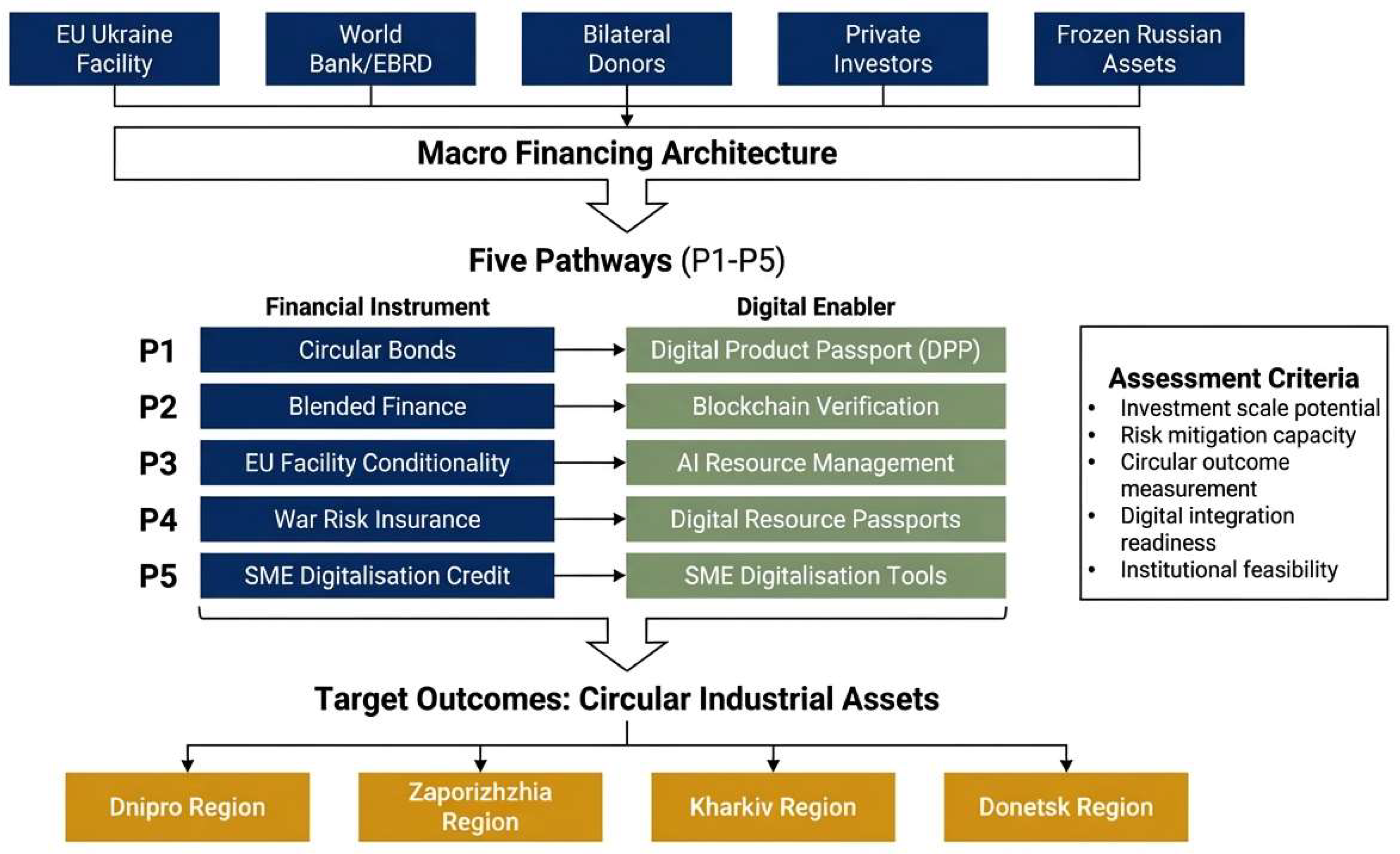
Drawing on the institutional mapping in Section 4.1 and Section 4.2, we now construct a typology of five financing-technology pathways, each combining a financial instrument with a digital enabler, designed to channel investment toward circular industrial reconstruction in Ukraine. Figure 1 presents the conceptual framework linking these pathways to the broader reconstruction-financing ecosystem.
Below we describe the five pathways of realisation.
Pathway 1. Circular Bond Issuance and Digital Product Passport Integration
This pathway combines sovereign or municipal green/circular bond issuance with DPP compliance as a use-of-proceeds condition. Under this model, Ukraine, a Ukrainian municipal authority, or a state-owned enterprise issue bond. These bonds fund projects that meet circular economy criteria as defined by the IFC (2025) Harmonized CE Finance Guidelines and align with the EU Taxonomy. The funded assets must generate DPP-compliant data. A steel plant rebuilt with circular bond proceeds, for instance, would need to document material composition, recyclability potential, and lifecycle data in a DPP-compatible format.
The IFC Guidelines provide the taxonomic foundation for defining eligible transactions across six sectors, including construction and automotive, which are both critical for Ukraine’s industrial regions. The EU Taxonomy’s circular economy delegated act establishes technical screening criteria that can serve as a benchmark for bond frameworks. Integrating DPPs solves the verification problem in circular bond markets. Investors use standardized, machine-readable data to confirm that proceeds fund circular activities instead of relying on self-reported impact metrics.
Ukraine’s domestic bond market is underdeveloped, and sovereign borrowing is constrained by wartime fiscal pressures. International issuance would require a credible circular bond framework, a document that does not yet exist for any post-conflict economy. DPP infrastructure is nascent in Ukraine, and firms would need substantial technical support to generate compliant data. Yet the pathway has a high ceiling: green bond markets have demonstrated the capacity to mobilise capital at scale (IISD, 2024), and early mover advantage in circular bond issuance could position Ukraine favourably with ESG-conscious investors.
Pathway 2. Blended Finance Vehicles and Blockchain Impact Verification
Blended finance combines concessional public or philanthropic capital with commercial investment to de-risk projects in challenging markets. It serves as an effective mechanism for mobilizing private capital in conflict-affected settings (WRI, 2025). This model combines blended finance with blockchain-based impact verification to create a circular reconstruction investment vehicle. Donor capital covers initial losses, which reduces risk for commercial investors. Distributed ledger records verify environmental outcomes to prevent data tampering.
The EU, the World Bank, or bilateral donors capitalize a blended finance facility as a concessional tranche. Commercial banks or impact investors provide market-rate capital to finance circular industrial projects, including reverse logistics networks, remanufacturing facilities, industrial symbiosis parks, and circular construction material plants. Project operators record material flows, waste diversion rates, and material recovery metrics on a blockchain platform. Donors and investors access real-time dashboards showing verified circular outcomes against predefined KPIs. This addresses the information asymmetry and accountability concerns that are particularly acute in post-conflict settings, where both corruption risk and limited state capacity for monitoring undermine conventional reporting mechanisms.
The Ukraine Investment Framework, with its €9.5 billion in guarantees and grants designed to mobilise up to €40 billion in investment, provides the institutional container for such a vehicle. MIGA war risk insurance could be layered on top, covering political risk while the blended structure covers financial risk. Blockchain verification adds a transparency layer that neither instrument currently provides.
Pathway 3. EU Facility Conditionality and AI-Driven Resource Management
This pathway embeds circular economy performance targets directly into the conditionality framework of the Ukraine Facility, with AI-driven resource management tools deployed in reconstructed industrial facilities as both an operational tool and a verification mechanism. The reform-for-funding logic of the Facility, under which disbursements are conditional on fulfilment of predefined indicators, provides a ready-made vehicle for CE conditionality. Currently, the 130 reform indicators and 16 investment indicators in the Ukraine Plan do not include circular economy-specific metrics. Adding requirements for minimum material recovery rates in industrial reconstruction or recycled content targets in public procurement necessitates a procedural amendment to the Plan. While complex, this process follows existing precedents.
AI systems for resource management, based on Germany’s Green-AI Hub Mittelstand, optimize waste streams and predict maintenance needs in reconstructed factories. These systems extend equipment lifetimes and identify opportunities for industrial symbiosis between neighbouring facilities. These systems generate granular operational data that can serve double duty: improving the facility’s financial performance through resource efficiency gains and providing the evidence base for EU Facility compliance reporting. A factory that demonstrates AI-verified material efficiency improvements meets both its operational objectives and its reconstruction conditionality requirements.
The advantage of this pathway is its institutional embeddedness, the Ukraine Facility is the single largest reconstruction instrument, and its reform conditionality is already established. The barrier is political, adding CE conditions in a context where the priority is speed of disbursement and macroeconomic stabilisation may face resistance from Ukrainian authorities managing competing reform demands. The sixth Facility payment (December 2025) already included green transition steps, adoption of the National Waste Management Plan, and the second NDC, suggesting that environmental conditionality is expanding, even if it has not yet reached CE-specific granularity.
Pathway 4. War Risk Insurance and Circular Construction Standards
War risk insurance is the binding constraint for private investment in Ukraine: without it, commercial investors cannot obtain board-level approval for capital deployment in an active conflict zone. This pathway links war risk insurance coverage to the adoption of circular construction standards, creating a financial incentive for circular building practices. Under this model, investors who commit to building circular-compliant infrastructure, using design-for-disassembly principles, specifying material composition through digital resource passports, and meeting minimum recycled content thresholds, receive preferential access to war risk insurance or reduced premium rates.
The logic mirrors the emerging practice in commercial insurance, where companies demonstrating robust circular economy practices receive premium reductions of 8-12% based on reduced operational risk. In a conflict zone, the risk calculus is that different political and security risks dominate, but the principle of linking insurance terms to project design quality is sound. MIGA, the principal provider of war risk insurance for Ukraine, could introduce circular design criteria as part of its project assessment without fundamentally altering its risk model. Bilateral schemes (such as the UK’s £20 million MIGA contribution) could be earmarked for circular-compliant projects.
The digital component here is the digital resource passport for buildings, adapted from Germany’s NCES. Material passports document composition and disassembly potential during construction. This record allows insurers and investors to assess recovery values even if conflict damages the building. This is not a theoretical concern in Ukraine, and the dual circular strategies hierarchy proposed by Shevchenko et al. (2025) explicitly addresses the recovery of materials from war-damaged structures as a circular strategy.
Pathway 5. SME Digitalisation Credit and CE Competency Building
The final pathway targets the enterprise level rather than the project or instrument level. It combines KfW-style digitalisation credit for Ukrainian SMEs with mandatory circular economy competency-building, creating an integrated programme in which firms receive concessional loans for digital transformation on the condition that they participate in CE training and adopt circular practices in their production processes.
Germany’s experience is instructive: the NCES acknowledges that only one in three German SMEs can manage data efficiently enough for DPP compliance, and that targeted support is needed to close this readiness gap (Büchel & Neligan, 2025). Ukrainian SMEs face a wider gap as they operate in a war-disrupted economy. These businesses encounter limited access to finance, damaged infrastructure, and workforce shortages caused by mobilization and emigration. A combined credit and training programme removes financial and knowledge barriers. It provides affordable capital for digital equipment and circular production processes. Simultaneously, it teaches participants how to operate in circular value chains, use DPP systems, and enter EU markets that require circular compliance.
Ukraine’s existing SME infrastructure can administer the programme. The Ukraine Investment Framework finances the initiative, as it reserves at least 15% of guarantees for micro, small, and medium-sized enterprises. EU accession programmes provide technical assistance. The Fraunhofer Reman-Lab model is a training factory for remanufacturing, which offers a template for practical, hands-on CE skills transfer that could be adapted to Ukrainian manufacturing hubs.
Table 3 presents the assessment of all five pathways against the five criteria defined in the methodology.
No single pathway is sufficient. Pathway 2 scores highest overall by combining high investment scale with high-risk mitigation and strong measurement capacity. Pathway 3 has the largest potential scale but faces political feasibility constraints. Pathway 4 addresses the binding constraint for private investment most directly. Pathway 5 operates at a different scale (firm-level rather than infrastructure-level) but is the most immediately implementable given existing institutional arrangements. A realistic strategy for circular reconstruction would deploy all five pathways in a layered fashion, with each addressing a different segment of the investment spectrum.

4.4. Regional Application: Dnipro, Zaporizhzhia, Kharkiv, and Donetsk Industrial Corridors

The typology gains practical relevance when applied to specific regional contexts. Ukraine’s industrial geography is concentrated in several corridors, of which four, Dnipro (Dnipropetrovsk Oblast), Zaporizhzhia, Kharkiv, and Donetsk, are simultaneously among the most industrially significant and the most war-affected. According to the RDNA4, these oblasts are part of the six frontline regions that have sustained 72% of total direct damage (UNDP, 2025). Their pre-war industrial profiles, the nature and extent of war damage, and their institutional conditions differ in ways that affect pathway applicability.
Dnipro (Dnipropetrovsk Oblast) was Ukraine’s metallurgical and heavy industry heartland before the full-scale war, home to major steel, iron ore, and machine-building enterprises. Energy infrastructure suffered massive damage in January 2026 attacks, with thermal power plants destroyed and over 800,000 consumers left without electricity (OSW, 2026). The region’s industrial profile is capital-intensive, resource-heavy, and energy-dependent, which makes it the strongest candidate for Pathways 1 and 2, which can mobilise the scale of capital needed for large metallurgical and energy infrastructure projects. Circular bond proceeds could finance the transition from blast furnace to electric arc steelmaking using scrap inputs, which is a paradigmatic circular industrial strategy. Blended finance combined with blockchain verification supports industrial symbiosis parks that connect metallurgical waste streams to downstream manufacturers. AI-driven resource management optimizes material flows in reconstructed steel and chemical plants.
Zaporizhzhia combines heavy industry (the Zaporizhstal metallurgical plant suspended production after the January 2026 energy attacks), nuclear energy (the seized Zaporizhzhia Nuclear Power Plant), and agro-processing. Ongoing combat near the site poses a continuous threat. In January 2025, aerial glide bombs struck industrial facilities, killing 13 civilians and injuring 110 at one location (HRMMU, 2025). This security situation makes war risk insurance (Pathway 4) the primary requirement for private investment. The pathway linking insurance to circular construction standards is therefore the priority entry point. Reconstruction of the agro-processing sector lends itself to Pathway 5, given the prevalence of small- and medium-sized enterprises in food processing and agricultural services. Long-term, as the security situation stabilises, the larger-scale pathways (1–3) become applicable for metallurgical reconstruction.
Before the war, Kharkiv possessed the most diversified industrial base of the three regions, focusing on machine-building, aerospace, IT, pharmaceuticals, and food processing. Glide bomb attacks starting in early 2024 damaged extensive infrastructure, yet the region maintains a stronger knowledge economy and higher education system than the other two areas. This makes it the most promising location for Pathway 5, leveraging the city’s university and IT sector capacity for CE training and digitalisation. Kharkiv’s machine-building sector qualifies for Pathway 1. Compliance with DPP requirements provides a competitive advantage for entering EU industrial supply chains. The updated DCFTA and the European Commission’s (2025) strategy to integrate enlargement partners into industrial value chains support this objective.
Donetsk was Ukraine’s largest industrial oblast by output before the war, anchoring the country’s coal, steel, and chemical industries, including the Azovstal and Ilyich steel plants in Mariupol, both of which sustained catastrophic damage during the 2022 siege. As of early 2026, significant portions of the oblast remain under Russian occupation, and the government-controlled areas face continuous shelling, making any near-term private investment contingent on security conditions that do not yet exist. This places Donetsk in a distinct analytical category: all five pathways are relevant in principle, but their temporal applicability differs sharply from the other three corridors. Pathway 4 is not merely a priority but a precondition; without it, no private capital will enter. Pathway 3 is applicable for publicly funded reconstruction in government-controlled areas, where the Facility’s reform-for-funding logic can embed CE standards into energy and infrastructure projects already underway. Pathways 1 and 2 become viable only in a post-liberation scenario, when the scale of metallurgical and chemical infrastructure rebuilding, potentially the largest single reconstruction programme in all of Ukraine, could justify dedicated circular bond issuance or blended finance vehicles. The paradox is that the region with the greatest need for circular reconstruction is also the one where institutional and security preconditions are furthest from being met. Planning for circular Donetsk reconstruction should begin now, even if implementation lies in the future. Table 4 summarises the regional applicability assessment.
The regional analysis reveals that no single pathway dominates across all four corridors. Dnipro’s capital-intensive heavy industry favours the large-scale financial pathways (1–3); Zaporizhzhia’s security exposure makes war risk insurance (Pathway 4) the necessary first step; Kharkiv’s knowledge economy strengths position it for the competency-building pathway (5) and DPP-enabled EU market access (Pathway 1); and Donetsk is the most damaged and is a partly occupied region, requiring war risk insurance as an absolute precondition, with large-scale circular pathways applicable only in a post-liberation scenario. A national circular reconstruction strategy would need to differentiate by region, deploying pathway combinations that match each corridor’s industrial profile, security conditions, and institutional readiness rather than applying a uniform approach.

5. Discussion

The results of this study reveal a structural disconnect between the financial architecture of Ukraine’s reconstruction and the circular economy objectives that both the EU accession process and the global sustainability agenda demand. This section interprets these findings in the context of prior research, examines their broader implications, and identifies directions for future investigation.

5.1. Reconstruction Finance as Sector-Blind: Interpreting the Gap

The mapping of Ukraine’s reconstruction instruments (Table 1) reveals a gap in academic literature. None of the primary financing tools, including the €50 billion EU Ukraine Facility and MIGA war risk insurance, requires circular economy eligibility or performance conditions. This result echoes the observation by Schröder and Raes (2021) that CE-specific financing remains marginal within the broader green finance landscape but does so in a novel context. Previous research identifies this gap in stable economies with functional capital markets. Our analysis demonstrates that this gap persists and widens during large-scale post-conflict reconstruction, despite the significant potential for circular design in these settings.
The post-conflict reconstruction literature has long argued that rebuilding should not merely restore pre-war conditions but use the reconstruction window to introduce structural reforms (Collier, 2009; del Castillo, 2008). Our findings suggest that this principle, while well-established in governance and macroeconomic domains, has not been operationalised for environmental and resource efficiency objectives. The Ukraine Plan 2024–2027 references circular economy and green transition principles, and the sixth Facility disbursement (December 2025) included environmental reform steps such as the National Waste Management Plan and the second Nationally Determined Contribution. Yet these remain generic environmental measures rather than CE-specific investment conditions. The temporal mismatch we identify, reconstruction capital committed now while CE regulatory alignment is years away, mirrors the broader tension that Kirchherr et al. (2017) described between CE aspirations and implementation realities, transposed here to the financing domain.

5.2. Germany’s NCES as Reference Model: Transferability and Its Limits

The comparative mapping of Germany’s NCES instruments (Table 2) aligns with institutional theory. A mature circular economy financing ecosystem requires the simultaneous development of regulatory standards, financial incentives, digital infrastructure, and professional capacity (North, 1990; Scott, 2014). In Germany, the DPP generates data, while KfW credit lines provide financial rewards for adoption. Simultaneously, regulatory standards enforce compliance, and training programs develop necessary skills. This structure demonstrates the institutional complementarity that Hall and Soskice (2001) define in their varieties of capitalism framework.
The question, then, is what this means for Ukraine. The analysis supports the hypothesis that destroying legacy industrial infrastructure enables Ukraine to adopt circular frameworks directly, bypassing intermediate stages. The hypothesis holds for technology-embedded standards, particularly the DPP. When a factory is built from scratch, integrating DPP-compliant data systems from the outset is less costly than retrofitting them into an existing production process. Company surveys from Germany confirm this logic. Büchel and Neligan (2025) report that only one-third of German SMEs manage data efficiently enough to comply with DPP requirements, as they need to adapt existing systems. A newly constructed Ukrainian facility faces no such legacy burden.
However, the hypothesis encounters limits at the normative and cognitive levels of institutional analysis. Professional norms in Ukraine’s industrial sectors, shaped by Soviet-era practices and two decades of cost-minimisation-oriented market transition, cannot be changed by regulation alone. The “reconstruction default” we identified in Section 2.4, the shared assumption that rebuilding means restoring what existed before, as quickly as possible, operates as a cognitive institution that resists CE conditionality. Germany’s own experience is instructive, even with decades of environmental policy layering; the NCES acknowledges persistent gaps in SME readiness and the need for targeted capacity-building. If the challenge exists in Germany, it will be more acute in Ukraine, though not fundamentally different in kind.
These findings align with the Build Back Circular framework by Çetin and Kirchherr (2025), which identifies awareness-raising and knowledge expansion as one of ten action strategies for circular post-disaster reconstruction. They also support the emphasis by Shevchenko et al. (2025) on methodological preparation for circularity assessment before reconstruction begins. Our contribution extends their work by specifying the financial mechanisms through which these strategies can be operationalised and incentivised.

5.3. The Five Pathways: Complementarity Rather than Competition

The pathway typology (Table 3, Figure 1 and its regional application (Table 4) demonstrate that no single financing−technology configuration is sufficient for circular reconstruction. This finding resonates with the broader sustainable finance literature, which has increasingly emphasised the need for “blended” and “layered” approaches rather than single-instrument solutions (WRI, 2025; Naran et al., 2024).
Pathway 2 scored highest across the five assessment criteria, combining high investment scale with strong risk mitigation and circular measurement capacity. This is consistent with the growing consensus in the development finance literature that blended finance is the most appropriate mechanism for mobilising private capital in high-risk environments (IFC, 2025). Blockchain-based impact verification addresses the lack of standardized circular KPIs noted by Saidani et al. (2019). Although no global KPI standard exists, blockchain verifies individual projects and thereby partially compensates for the missing systemic framework.
Pathway 3 has the largest potential scale but faces the most significant political feasibility constraints. The tension between integrating circular economy (CE) conditions into the primary reconstruction instrument and the political pressure for rapid disbursement reflects a core dilemma in post-conflict assistance. del Castillo (2008) describes this as the trade-off between reconstruction efficiency and reform ambition. Our analysis suggests that expanding conditionality incrementally, based on the environmental reform steps already within Facility disbursements, offers greater political viability than introducing a comprehensive CE conditionality framework immediately.
Pathway 4 addresses what the regional analysis identified as the binding constraint for private investment, particularly in Zaporizhzhia and Donetsk. The logic of linking insurance terms to project design quality has precedent in commercial insurance markets, where circular economy practices are associated with reduced operational risk and premium reductions. Applying this logic to political risk insurance in a conflict zone is novel and represents one of this paper’s more speculative proposals, but one grounded in the established principle that insurance pricing can incentivise risk-reducing behaviour.
The regional application (Table 4) adds an important dimension that is absent from most CE finance scholarship, spatial differentiation. Dnipro’s capital-intensive metallurgy calls for large-scale pathways (1–3); Zaporizhzhia and Donetsk’s security exposure makes war risk insurance (Pathway 4) the necessary gateway; Kharkiv’s knowledge economy favours competency-building (Pathway 5) and DPP-enabled EU market access. Donetsk presents a distinct temporal challenge as the region with the greatest reconstruction needs and as being the one where the preconditions are furthest from being met. This finding has implications beyond Ukraine, any post-conflict circular reconstruction strategy must account for the uneven geography of conflict, damage, and institutional capacity.
Beyond spatial differentiation, the five pathways also exhibit a temporal sequencing logic that becomes visible when they are considered as a layered deployment strategy rather than as independent options. In regions where active conflict or high security risk persists, war risk insurance (Pathway 4) functions not merely as one pathway among five but as a gateway condition. Without it, private capital cannot enter, and the remaining pathways lack the investor base to operate. Once insurance coverage establishes a minimum threshold of investability, blended finance vehicles (Pathway 2) become viable, using concessional capital to absorb the residual risks that insurance alone does not cover. Simultaneously, SME digitalization credit with CE competency building (Pathway 5) prepares firms for further steps. It develops the digital literacy and circular economy awareness that Pathways 1 and 3 require but do not generate. A factory cannot generate DPP-compliant data if its workforce has never encountered the concept. An AI-driven resource management system requires operators trained to interpret and act on its outputs. EU Facility conditionality (Pathway 3) serves as a regulatory framework. It makes large-scale capital mobilisation via circular bonds (Pathway 1) or blended finance credible for institutional investors. These investors require assurance that projects maintain circular standards after the initial cycle ends. The resulting deployment logic moves, in broad terms, from risk mitigation to capacity building to scaled financing, though the specific entry point and pace of progression will differ across regions, as Table 4 illustrates.

5.4. Digital Tools as Trust Substitutes in Weak Institutional Environments

A cross-cutting finding across the pathways is the role of digital tools (DPP, blockchain, and AI) in partially substituting for institutional trust. This function is particularly relevant in post-conflict settings where conventional trust mechanisms (regulatory enforcement, judicial recourse, and government monitoring capacity) are weakened. Blockchain-verified impact data reduces dependence on government reporting credibility for investors. The DPP creates a standardised information layer embedded in the product rather than in a government database. AI-driven resource management generates operational data that serves as a proxy for CE compliance even when formal reporting systems are incomplete.
This finding connects to a broader debate in the digital governance literature about whether technology can compensate for institutional deficits. EU Facility conditionality (Pathway 3) serves as a regulatory framework. It makes large-scale capital mobilisation via circular bonds (Pathway 1) or blended finance credible for institutional investors. These investors require assurance that projects maintain circular standards after the initial cycle ends. A DPP is worthless without a market that recognises it, blockchain verification means nothing if the data entered at the source is fabricated. Digital tools provide a practical interim solution during institutional development. This applies specifically to reconstruction financing, where significant information asymmetry and limited monitoring capacity exist.
The findings carry implications that extend beyond the Ukrainian case. First, for the circular economy field, the near-total absence of CE criteria in reconstruction-financing instruments suggests that the CE community has not yet engaged effectively with the post-conflict reconstruction policy community. The IFC (2025) Harmonised CE Finance Guidelines represent a step forward, but their application to conflict-affected settings requires deliberate effort; it will not happen by default.
Second, for the post-conflict reconstruction field, the concept of “building back better” has remained largely aspirational regarding environmental sustainability. Digital tools provide a practical interim solution during institutional development. This applies specifically to reconstruction financing, where significant information asymmetry and limited monitoring capacity exist.
Third, the pathways demonstrate that digital verification technologies expand the range of investable CE opportunities. These technologies reduce information asymmetry where traditional monitoring proves insufficient. This has relevance for any emerging market or fragile state seeking to attract circular investment.

6. Conclusions

This research set out to examine how digital tools and innovative financing mechanisms can channel investment toward circular industrial reconstruction in Ukraine, drawing on Germany’s National Circular Economy Strategy as a reference model. Three research questions guided the analysis.
In response to RQ1, we identified a systematic gap: the principal financing instruments for Ukraine’s reconstruction (the EU Ukraine Facility, World Bank lending, MIGA war risk insurance, the Ukraine Business Compact, and bilateral programmes) do not incorporate circular economy eligibility criteria, circular performance conditions, or digital verification requirements. Reconstruction finance is, as currently structured, sector-blind regarding circularity. To address this, we constructed a typology of five financing−technology pathways: circular bond issuance with DPP integration; blended finance with blockchain impact verification; EU Facility conditionality with AI-driven resource management; war risk insurance with circular construction standards; and SME digitalisation credit with CE competency building. Each pathway combines a financial instrument with a digital enabler to create an investment configuration that incentivises circular outcomes.
Regarding RQ2, the analysis identifies three functions of digital tools, the DPP, blockchain traceability, and AI-based resource management, within circular reconstruction finance. They reduce information asymmetry between investors and project operators, enabling better-informed capital allocation. They provide verification infrastructure for circular claims, addressing the greenwashing risk and accountability concerns that are particularly acute in post-conflict settings. And they improve the operational financial performance of circular ventures through resource efficiency gains, making CE projects more attractive to conventional lenders. These functions provide the greatest value where institutional trust is low. This finding applies to post-conflict or transitional economies that integrate sustainability into reconstruction.
In response to RQ3, Germany’s NCES provides specific, transferable instruments, particularly DPP pilot project methodologies, KfW-style SME credit structures, and the Green-AI Hub model for AI-driven resource management, but the transferability is conditional. Regulatory and digital instruments are more readily transferable than normative and cognitive institutions. Institutional leapfrogging is feasible for technology-embedded standards (DPP, digital resource passports) but requires sustained competency-building to change professional practices. The EU accession process functions as a convergence mechanism that exerts progressive pressure toward CE alignment, creating a regulative anchor for circular reconstruction.
The broader implication of this analysis is that circular reconstruction is not a luxury supplement to the core task of rebuilding; it is a strategic necessity. Ukraine’s reconstruction will define the country’s industrial trajectories for decades. Locking in linear infrastructure now will create costly retrofitting obligations later, increase resource dependency in an economy already stressed by conflict, and undermine the EU accession alignment that Ukraine is pursuing with remarkable determination. The financial architecture exists, the digital tools are maturing, and the policy frameworks are converging. What is missing is the deliberate institutional design that connects them, the specific, practical, evidence-grounded configurations that this paper has sought to provide.
Future research should test the typology empirically: pilot projects, firm-level readiness surveys, and longitudinal outcome tracking will determine whether the pathways proposed here translate from analytical framework to operational reality. The stakes for Ukraine, for the circular economy field, and for the broader question of how post-conflict reconstruction can be aligned with sustainability are high enough to warrant the effort.

Author Contributions

Conceptualization, T.G. and Ž.S.; methodology, T.G.; formal analysis, T.G. and Ž.S.; investigation, T.G. and Ž.S.; data curation, T.G.; writing—original draft preparation, T.G. and Ž.S.; writing—review and editing, T.G.; visualisation, T.G. All authors have read and agreed to the published version of the manuscript.

Funding

This research was partly conducted within the framework of the Philipp Schwartz Initiative fellowship at the Centre for Advanced Internet Studies (CAIS) PSI 111000, Bochum, Germany, funded by the Alexander von Humboldt Foundation, and partly within the HEI-TRAIN: HEI Transformation for Entrepreneurship and AI-Driven Innovation. Project (KAVA) Number 250749, funded by the European Union.

Institutional Review Board Statement

Not applicable.

Informed Consent Statement

Not applicable.

Data Availability Statement

No new data were created or analysed in this study. Data sharing is not applicable to this article. The analysis is based on publicly available policy documents and secondary academic literature, all of which are cited in the reference list.

Acknowledgments

The authors gratefully acknowledge the Centre for Advanced Internet Studies (CAIS), Bochum, Germany, for providing the institutional environment, research infrastructure, and collegial support that made this work possible. During the preparation of this manuscript, the authors used Claude (Anthropic, Claude Opus 4) and SCISPACE (web platform, https://typeset.io/, accessed 2025) for the purposes of literature search support, Scite.ai (web platform, https://scite.ai/, accessed 2025) for data visualisation, and Grammarly (web version, https://www.grammarly.com/, accessed 2025–2026) for grammar improvement. The authors have reviewed and edited all output and take full responsibility for the content of this publication.

Conflicts of Interest

The authors declare no conflicts of interest. The authors served as Guest Editors of the JRFM Special Issue “Financing the Digital Circular Economy: Business Models, Risk, and Economic Perspectives in Industry 5.0”, in which this article is published. The editorial process was handled independently, and the authors had no involvement in the peer review or editorial decision-making for this manuscript.

Abbreviations

The following abbreviations are used in this manuscript:
AIArtificial intelligence
BMUVFederal Ministry for the Environment, Nature Conservation, Nuclear Safety and Consumer Protection (Germany)
CAISCentre for Advanced Internet Studies
CECircular economy
C-ROICircular return on investment
DCFTADeep and comprehensive free trade area
DINGerman Institute for Standardisation
DPPDigital product passport
EBRDEuropean Bank for Reconstruction and Development
EIBEuropean Investment Bank
EPRExtended producer responsibility
ERAExtraordinary Revenue Acceleration Loans for Ukraine
ESGEnvironmental, social, and governance
ESPREcodesign for Sustainable Products Regulation
ETC-CEEuropean Topic Centre on Circular Economy
EUEuropean Union
GDPGross domestic product
HRMMUUN Human Rights Monitoring Mission in Ukraine
IBRDInternational Bank for Reconstruction and Development
ICMAInternational Capital Markets Association
IFCInternational Finance Corporation
IISDInternational Institute for Sustainable Development
IoTInternet of Things
KfWKreditanstalt für Wiederaufbau (German Development Bank)
KPIKey performance indicator
MIGAMultilateral Investment Guarantee Agency
NCESNational Circular Economy Strategy (Germany)
NDCNationally determined contribution
OECDOrganisation for Economic Co-operation and Development
OSWCentre for Eastern Studies (Poland)
RDNARapid damage and needs assessment
SDGsSustainable Development Goals
SEIStockholm Environment Institute
SMESmall- and medium-sized enterprises
UNDPUnited Nations Development Programme
UNDRRUnited Nations Office for Disaster Risk Reduction
UNIDOUnited Nations Industrial Development Organisation
URCUkraine Recovery Conference
VCVenture capital
WRIWorld Resources Institute

References

  1. Amable, B. (2003). The diversity of modern capitalism. Oxford University Press. [Google Scholar]
  2. Antikainen, M., Uusitalo, T., & Kivikytö-Reponen, P. (2018). Digitalisation as an enabler of circular economy. Procedia CIRP, 73, 45–49. [Google Scholar] [CrossRef] [Scilit]
  3. Bakalis, D., & Büchel, J. (2024). Datennutzung und data sharing: Zwischen potenzial und realität in Deutschen unternehmen. IW-Trends, 51(2), 25–43. [Google Scholar]
  4. BMUV. (2024). The National Circular Economy Strategy (NCES): Summary. Available online: https://www.bundesumweltministerium.de/en/download/the-national-circular-economy-strategy-summary (accessed on 15 January 2026).
  5. Büchel, J., & Neligan, A. (2025). Digitaler produktpass: Ready to go? IW-Kurzbericht 32/2025. Institut der deutschen Wirtschaft (IW). [Google Scholar]
  6. Collier, P. (2009). Post-conflict recovery: How should strategies be distinctive? Journal of African Economies, 18(Suppl. S1), i99–i131. [Google Scholar] [CrossRef] [Scilit]
  7. Council of the EU. (2025). Ukraine facility: Council approves sixth payment of around €2.3 billion to Kyiv. Available online: https://www.consilium.europa.eu/en/press/press-releases/2025/12/11/ukraine-facility-council-approves-sixth-payment-of-around-23-billion-to-kyiv/ (accessed on 15 January 2026).
  8. Çetin, S., & Kirchherr, J. (2025). The build back circular framework: Circular economy strategies for post-disaster reconstruction and recovery. Circular Economy and Sustainability, 5(3), 1689–1726. [Google Scholar] [CrossRef] [Scilit]
  9. del Castillo, G. (2008). Rebuilding war-torn states: The challenge of post-conflict economic reconstruction. Oxford University Press. [Google Scholar]
  10. EIB. (2024). Circular economy: Overview 2024. Available online: https://circulareconomy.europa.eu/platform/en/financing/circular-economy-overview-2024 (accessed on 12 January 2026).
  11. ETC-CE. (2024). Circular economy country profile 2024—Germany. Available online: https://www.eea.europa.eu/en/topics/in-depth/circular-economy/country-profiles-on-circular-economy (accessed on 10 January 2026).
  12. European Commission. (2024). Regulation (EU) 2024/1781 of the European Parliament and of the council establishing a framework for setting ecodesign requirements for sustainable products (ESPR). Official Journal of the European Union, L 2024/1781. [Google Scholar]
  13. European Commission. (2025). 2025 Enlargement package shows progress towards EU membership for key enlargement partners. Available online: https://enlargement.ec.europa.eu/news/2025-enlargement-package-shows-progress-towards-eu-membership-key-enlargement-partners-2025-11-04_en (accessed on 20 January 2026).
  14. Geissdoerfer, M., Savaget, P., Bocken, N. M. P., & Hultink, E. J. (2017). The circular economy—A new sustainability paradigm? Journal of Cleaner Production, 143, 757–768. [Google Scholar] [CrossRef] [Scilit]
  15. Ghisellini, P., Cialani, C., & Ulgiati, S. (2016). A review on circular economy: The expected transition to a balanced interplay of environmental and economic systems. Journal of Cleaner Production, 114, 11–32. [Google Scholar] [CrossRef] [Scilit]
  16. Gorokhova, T., Firstenko, O., Chopyk, Y., Voitsitska, K., & Petrukha, N. (2024). Strategies for Ukraine’s Post-War Economic Recovery within the Framework of Sustainable Development Goals. Journal of Lifestyle and SDGs Review, 5(1), e03350. [Google Scholar] [CrossRef] [Scilit]
  17. Government of Ukraine. (2024). Ukraine plan 2024–2027. Available online: https://www.ukrainefacility.me.gov.ua (accessed on 5 January 2026).
  18. Hall, P. A., & Soskice, D. (2001). Varieties of capitalism: The institutional foundations of comparative advantage. Oxford University Press. [Google Scholar]
  19. HRMMU. (2025). Zaporizhzhia attack marks highest civilian casualties in two years; Glide bombs drive 30% rise in 2024. Available online: https://ukraine.ohchr.org (accessed on 15 January 2026).
  20. IFC. (2025). Harmonized circular economy finance guidelines. Available online: https://www.ifc.org/en/insights-reports/2025/harmonized-circular-economy-finance-guidelines (accessed on 20 January 2026).
  21. IISD. (2024). Green reconstruction of Ukraine. Available online: https://www.iisd.org/projects/green-reconstruction-of-ukraine (accessed on 10 January 2026).
  22. Kirchherr, J., Reike, D., & Hekkert, M. (2017). Conceptualizing the circular economy: An analysis of 114 definitions. Resources, Conservation and Recycling, 127, 221–232. [Google Scholar] [CrossRef] [Scilit]
  23. Korhonen, J., Honkasalo, A., & Seppälä, J. (2018). Circular economy: The concept and its limitations. Ecological Economics, 143, 37–46. [Google Scholar] [CrossRef] [Scilit]
  24. Kreislaufwirtschaft Deutschland. (2024). Digitalisation and circular economy: Action area of the national circular economy strategy. Available online: https://www.kreislaufwirtschaft-deutschland.de/en/the-national-circular-economy-strategy-nces/action-areas/digitalisation-and-circular-economy (accessed on 15 January 2026).
  25. Kristoffersen, E., Blomsma, F., Mikalef, P., & Li, J. (2020). The smart circular economy: A digital-enabled circular strategies framework for manufacturing companies. Journal of Business Research, 120, 241–261. [Google Scholar] [CrossRef] [Scilit]
  26. Naran, B., Buchner, B., Price, M., Stout, S., Taylor, M., & Zabeida, D. (2024). Global landscape of climate finance 2024. Available online: https://www.climatepolicyinitiative.org/publication/global-landscape-of-climate-finance-2024/ (accessed on 10 January 2026).
  27. Net Zero Insights. (2025). State of climate tech 2025. Available online: https://netzeroinsights.com/resources/state-of-climate-tech-2025 (accessed on 10 March 2026).
  28. North, D. C. (1990). Institutions, institutional change and economic performance. Cambridge University Press. [Google Scholar]
  29. OECD. (2025). OECD economic surveys: Ukraine 2025. Available online: https://www.oecd.org/en/publications/oecd-economic-surveys-ukraine-2025_940cee85-en.html (accessed on 16 January 2026).
  30. OSW. (2026). Russia destroys energy infrastructure in Kyiv and Dnipro. Day 1420 of the war. Available online: https://www.osw.waw.pl/en/publikacje/analyses/2026-01-13/russia-destroys-energy-infrastructure-kyiv-and-dnipro-day-1420-war (accessed on 22 January 2026).
  31. Saidani, M., Yannou, B., Leroy, Y., Cluzel, F., & Kendall, A. (2019). A taxonomy of circular economy indicators. Journal of Cleaner Production, 207, 542–559. [Google Scholar] [CrossRef] [Scilit]
  32. Schröder, P., & Raes, J. (2021). Financing an inclusive circular economy: De-risking investments for circular business models and the SDGs. Available online: https://www.chathamhouse.org (accessed on 10 January 2026).
  33. Scott, W. R. (2014). Institutions and organizations: Ideas, interests, and identities (4th ed.). SAGE Publications. [Google Scholar]
  34. SEI. (2025). Green transition report for Ukraine shows paths to green recovery and EU integration. Available online: https://www.sei.org/features/ukraine-green-transition-assessment/ (accessed on 15 January 2026).
  35. Shevchenko, T., Çetin, S., Yannou, B., Kirchherr, J., & Saidani, M. (2025). A dual circular strategies hierarchy as a guiding framework for post-disaster recovery and reconstruction: Focus on Ukraine. Journal of Cleaner Production, 526, 146478. [Google Scholar] [CrossRef] [Scilit]
  36. Tracxn. (2025). Circular economy—Market & investments trends report. Available online: https://tracxn.com/d/sectors/circular-economy/__e4vRqN7q2dKWejliKeKEw2FB2FARWJ5HOFYfYwWB1_s/feed-report (accessed on 16 March 2026).
  37. UNDP. (2025). Updated damage assessment finds $524 billion needed for recovery in Ukraine over next decade. Available online: https://www.undp.org/ukraine/press-releases/updated-damage-assessment-finds-524-billion-needed-recovery-ukraine-over-next-decade (accessed on 1 March 2026).
  38. UNDRR. (2015). Sendai framework for disaster risk reduction 2015–2030. United Nations Office for Disaster Risk Reduction. [Google Scholar]
  39. UNIDO. (2024). Case studies: Circular economy implementation in Ukraine. Available online: https://www.unido.org/green-recovery-vision-ukraine (accessed on 10 January 2026).
  40. World Bank, European Commission & United Nations. (2025). Ukraine: Fourth Rapid Damage and Needs Assessment (RDNA4), February 2025. Available online: https://www.worldbank.org/en/news/press-release/2025/02/25/updated-ukraine-recovery-and-reconstruction-needs-assessment-released (accessed on 1 March 2026).
  41. WRI. (2025). From bonds to blended finance: How a diverse range of financial instruments are financing climate adaptation and resilience. Available online: https://www.wri.org/research/bonds-blended-finance-how-diverse-range-financial-instruments-are-financing-climate (accessed on 15 January 2026).
  42. Zhang, A., & Seuring, S. (2024). Digital product passport for sustainable and circular supply chain management: A structured review of use cases. International Journal of Logistics Research and Applications, 27(12), 2513–2540. [Google Scholar] [CrossRef] [Scilit]
Figure 1. Conceptual framework: financing-technology pathways for circular industrial reconstruction in Ukraine (developed by author).
Jrfm 19 00293 g001
Table 1. Ukraine’s reconstruction-financing instruments assessed against circular economy eligibility criteria.
Financing InstrumentCE Use-of-ProceedsCircular KPIsDigital VerificationCE Risk AssessmentEU CE Alignment
EU Ukraine Facility (Pillar I)No (sector-agnostic reform conditions)No (environmental steps are generic (waste plan, NDC)Partial—digital reconstruction management tool existsNoIndirect (accession alignment will eventually require CE transposition
Ukraine Investment Framework (Pillar II)No (broad investment guarantee)NoNoNoIndirect
World Bank/IBRD lendingNo (reconstruction and budget support)No (environmental safeguards are project-level, not CE-specific)NoPartial (E&S risk framework)No
EBRD project financeEmerging (green economy transition approach includes resource efficiency)Partial (some projects include resource efficiency metrics)NoPartialPartial (EBRD green economy transition approach)
MIGA war risk insuranceNo (covers political risk, not project design)NoNoNoNo
Bilateral donor programmesVariable (some Nordic/German) programmes include green conditionalityRareRareNoVariable
Ukraine Business CompactNo (voluntary corporate pledges)NoNoNoNo
G7 frozen assets mechanism (ERA)No (general budget support)NoNoNoNo
Source: Authors’ analysis based on documentary review of instrument documentation (2024–2025). Assessment reflects formal instrument design, not individual project-level variations.
Table 2. German NCES instruments by type.
CategoryInstrumentDescriptionRelevance to Reconstruction
RegulatoryEcodesign/ESPR alignmentNational implementation of EU ESPR, including DPP requirementsSets product standards that Ukrainian exports to the EU must meet
Extended producer responsibilityTightened obligations for vehicles, batteries, electronics, and packagingTemplate for Ukrainian EPR legislation under accession
Construction waste separationOptimised separate collection and recycling of demolition materialsDirectly applicable to debris management and circular rebuilding
FinancialKfW circular economy credit linesLoans for SMEs investing in circular production and digital transformationModel for Ukrainian reconstruction SME credit programmes
BMUV CE innovation fundingCo-financing for firms adopting circular processes and business modelsTemplate for donor-funded CE innovation in Ukraine
Green-AI Hub MittelstandPublic support for SMEs deploying AI for resource efficiencyTransferable model for AI-driven resource management in reconstruction
Circular rural regions (2024–2027)Funding for model regions to develop and implement CE conceptsRegional CE pilot model applicable to Ukrainian industrial corridors
DigitalDigital Product Passport (DPP) pilotsLighthouse projects in 7+ sectors, linked to Manufacturing-XCore digital infrastructure for verifying circular compliance
Digital resource passport for buildingsMaterial composition and recyclability data for built environmentEssential tool for circular construction in reconstruction
Integrated corporate planning toolboxSoftware integration for CE planning with Industry 4.0 systemsOperational tool for newly built Ukrainian enterprises
Capacity-buildingDIN standardisation leadershipLeading EU DPP standardisation request (standards due end-2025)Standards that Ukraine must align with under accession
PREVENT Waste AllianceInternational CE network with pilot projects in 15 countriesChannel for German−Ukrainian CE knowledge transfer
Fraunhofer Reman-LabTraining factory for remanufacturing (e-bike motors, Bayreuth)Skills transfer model for Ukrainian remanufacturing facilities
Source: Authors’ compilation based on BMUV (2024), Kreislaufwirtschaft Deutschland (2024), and ETC-CE (2024).
Table 3. Financing−technology pathway typology: assessment against five criteria.
PathwayInvestment ScaleRisk MitigationCircular MeasurementDigital Readiness RequiredInstitutional Feasibility
P1: Circular Bonds and DPPHigh (bond markets can mobilise billions)Medium (depends on creditworthiness and market appetite)High (DPP provides standardised lifecycle data)High (requires DPP infrastructure and firm-level data capacity)Medium (requires circular bond framework; no precedent in post-conflict settings)
P2: Blended finance and blockchainHigh (blended structures designed for large-scale mobilisation)High (first-loss protection plus blockchain transparency)High (real-time blockchain-verified KPIs)Medium (blockchain platforms are deployable with moderate infrastructure)High (Ukraine Investment Framework provides institutional container)
P3: EU Facility Conditionality and AIVery high (Facility is € 50 billion instrument)High (EU institutional backing reduces sovereign risk)Medium (AI generates operational data, but CE-specific metrics need definition)Medium (AI deployment feasible in new facilities)Medium (requires Ukraine Plan amendment; political will uncertain)
P4: War Risk Insurance and Circular ConstructionMedium (insurance unlocks private investment, but indirectly)Very high (directly addresses the binding constraint for private capital)Medium (resource passport documents material composition)Medium (resource passport is a focused, manageable tool)High (MIGA framework allows project-level criteria adjustment)
P5: SME Credit and CE CompetencyLow-Medium (targets individual firms, not large infrastructure)Low (does not address macro security risk)Low-Medium (training improves practices, but verification is firm-level)Low-Medium (basic digital equipment and training sufficient)High (fits existing SME support and EU accession assistance frameworks)
Source: Authors’ assessment based on documentary analysis. Scale: Low/Low-Medium/Medium/High/Very High.
Table 4. Regional applicability of financing−technology pathways.
PathwayDniproZaporizhzhiaKharkivDonetsk
P1: Circular Bonds and DPP★★★—metallurgical scale, export orientation★★—applicable post-stabilisation for heavy industry★★★—machine-building, EU supply chain integration★★—post-liberation; metallurgical scale
P2: Blended Finance and Blockchain★★★—industrial symbiosis parks, large CE projects★★—agro-processing clusters post-stabilisation★★—pharmaceutical and food processing clusters★★—post-liberation; industrial symbiosis potential
P3: EU Facility Conditionality and AI★★★—reconstructed steel/chemical plants★★—energy and agro-processing facilities★★—diversified manufacturing★★—govt-controlled areas; energy and infrastructure
P4: War Risk Insurance and Circular Construction★★—relevant but not binding constraint★★★—security risk highest; insurance is priority gateway★★—relevant for construction sector★★★—absolute precondition for private investment
P5: SME Credit and CE Competency★★—SME ecosystem less dominant★★★—agro-processing SMEs, food sector★★★—IT sector, universities, diversified SME base★—SME base severely disrupted
★★★ = high applicability; ★★ = moderate applicability; ★ = limited applicability. Source: Authors’ assessment based on regional industrial profiles (pre-war), RDNA4 damage data, and security situation as of early 2026.
Disclaimer/Publisher’s Note: The statements, opinions and data contained in all publications are solely those of the individual author(s) and contributor(s) and not of MDPI and/or the editor(s). MDPI and/or the editor(s) disclaim responsibility for any injury to people or property resulting from any ideas, methods, instructions or products referred to in the content.