

Evaluating the Impact of Intelligent Data Processing for Corporate Finance with the Use of Real Options Analysis


Abstract
1. Introduction
2. Literature Review
- -
- Improvements in valuation accuracy over standard methods like net present value and simple sensitivity analysis.
- -
- Improvements in understanding and estimating risks and building adequate decision paths.
- -
- Highlighting strategic options and new opportunities.
Use of Real Options Analysis with Intelligent Data Processing
- -
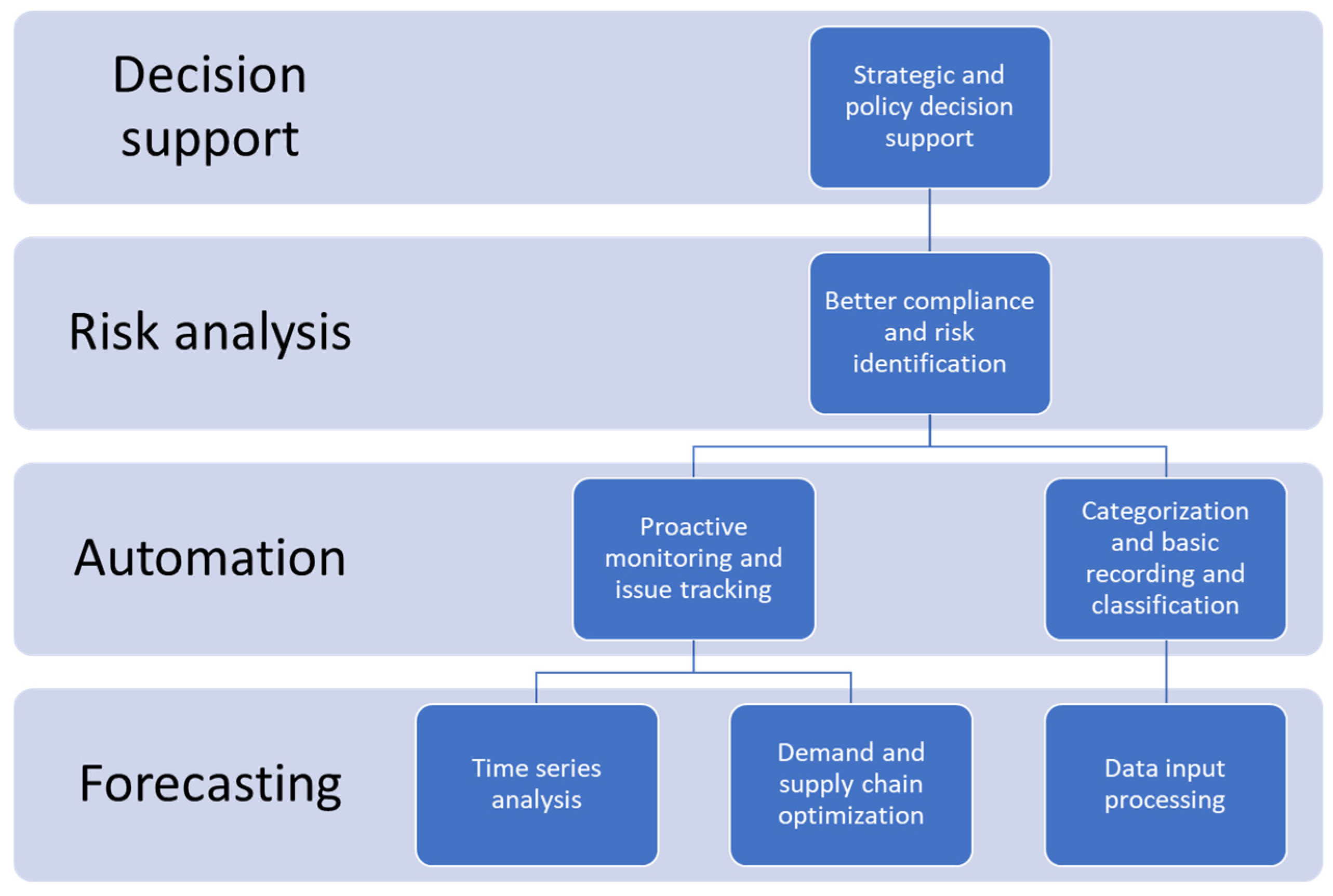
- The layering of AI and intelligent data processing applications, seen in Figure 1, allows us to address each level with different types of options, to ensure that they are most suitable to its immediate and long-term effects.
- -
- Special attention is paid to side effects and the indirect impact of intelligent data processing, which widens as the scope of introduced solutions.
- -
- The indirect impact of intelligent data processing can span over long periods, often surpassing the life time or planning period for a particular solution or project.
3. Methods and Analytical Tools
- -
- Real option valuations allow organizations to have more than a source of uncertainty. When corporate finance analysis relies on intelligent processing methods, it is especially valuable since one needs to account for market uncertainty in addition to technological complexity and potential risks related to the use of new solutions.
- -
- Option analysis fits very well into the step-by-step introduction of new methods and support tools. Even though reports (KPMG, 2024) indicate that the adoption rate for AI tools, for example, is high, it is worth pointing out that covered use cases are different and of various maturities.
- -
- Various solutions for the Black–Scholes equation, as in (1),
- -
- Variations in binomial option pricing models, as in (2),
- -
- The use of higher-order trees to model complex scenarios, which means that organiziations typically have to deal with more than one major source of uncertainty (Kabaivanov et al., 2013).
- -
- The use of Monte Carlo simulations for the evaluation of complex options.
- ○
- Estimation of variance: This is needed for closed-form solutions, like Black–Scholes, for example.
- ○
- The estimation of option value directly, with the use of certain company development projections.
4. Applications and Results
4.1. Numerical Example 1
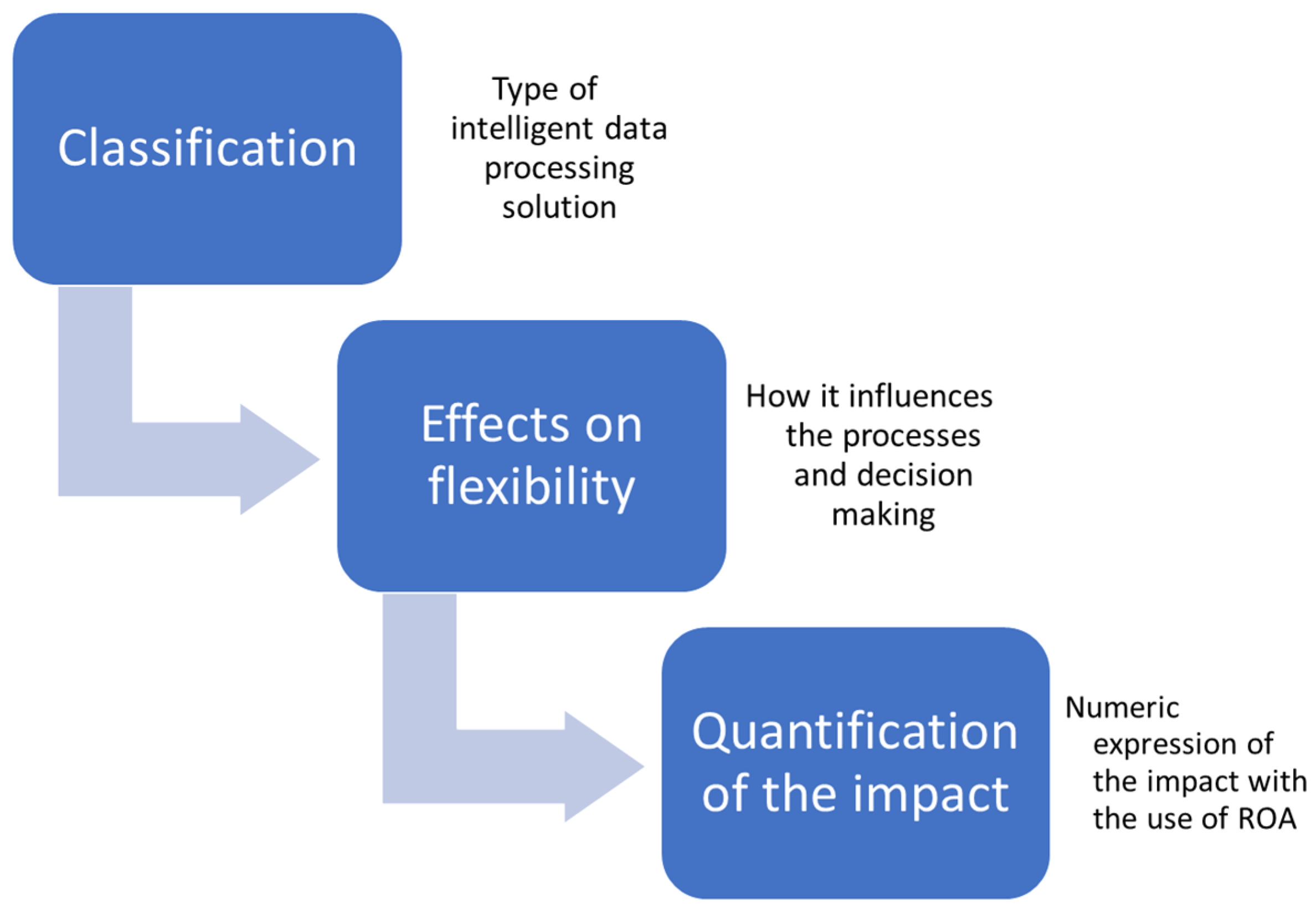
4.2. Estimation of Indirect Impact with the Use of Real Options
- -
- With option valuation methods, as we have talked about, the option value is considered to be for calls and for put variants, which implies the option intrinsic value should be zero or positive.
- -
- In line with traditional option use, an opportunity that is not paying off is not considered to be of use, when its maturity is reached.
5. Discussion
- -
- While there are many appealing characteristics of automated and intelligent data processing, there are also drawbacks related to transparency in argumentation and reasoning.
- -
- With the suggested ROA approach, indirect impact assessment is estimated as a whole, which does not give full feedback where the changes are most relevant and empowering.
6. Conclusions
Author Contributions
Funding
Institutional Review Board Statement
Informed Consent Statement
Data Availability Statement
Conflicts of Interest
Abbreviations
| AI | Artificial intelligence |
| ROA | Real options analysis |
| KPI | Key performance indicators |
| ROI | Return on investment |
References
- Adorm-Takyi, C., & Asare, A. F. (2026). Intelligent robo-advisors and personalized financial planning. In Foundations of artificial intelligence in finance (p. 10). Chapman and Hall/CRC. [Google Scholar]
- Alghalith, M. (2018). Pricing the American options using the black–scholes pricing. Physica A, 507, 443–445. [Google Scholar] [CrossRef]
- Androniceanu, A., & Sabie, O. M. (2022). Overview of green energy as a real strategic option for sustainable development. Energies, 15(22), 8573. [Google Scholar] [CrossRef]
- Antikarov, V. (2025). Valuing the invisible shield: A guide to real options analysis for emergency management investments. Pracademic Affairs, 5, 1–12. [Google Scholar]
- Barone-Adesi, G. (2005). The saga of the American put. Journal of Banking & Finance, 29, 2909–2918. [Google Scholar] [CrossRef]
- Barry, M., & Haitham, Y. (2026). A study of digital transformation for banking and finance industry. In Lecture notes in networks and systems: Information system design: Sustainable computing (pp. 1–19). ISDIA 2025. Springer. [Google Scholar]
- Bhati, I., Joshi, A., Mishra, V., & Jain, R. (2025). Impact of augmented and virtual reality on the financial landscape. In The metaverse era: Reinventing customer engagement and digital marketing (pp. 143–161). Bentham Science Publisher. [Google Scholar]
- Black, F., & Scholes, M. (1973). The pricing of options and corporate liabilities. Journal of Political Economy, 81(3), 637–654. [Google Scholar] [CrossRef]
- Chaplygina, E. I., Kruglova, L. V., & Glavina, S. G. (2025). The role of intelligent data processing in optimizing companies’ financial efficiency. RUDN Journal of Engineering Research, 26(4), 481–490. [Google Scholar] [CrossRef]
- Crowther, D., & Hamdan, H. (2024). The mediocrity of AI. Technological Sustainability, 3(2), 113–122. [Google Scholar] [CrossRef]
- de Mello-Sampayo, F. (2023). Strategic flexibility in healthcare: An exploration of real options. Journal of Economic Studies, 51, 177–199. [Google Scholar] [CrossRef]
- Füller, J., Tekic, Z., & Hutter, K. (2024). Rethinking innovation management—How AI Is changing the way we innovate. The Journal of Applied Behavioral Science, 60(4), 603–612. [Google Scholar] [CrossRef]
- Gary, G., Tahir, M. N., Guru, P., Royston, M., & Sadia, M. (2025). Chatbots in customer service within banking and finance: Do chatbots herald the start of an AI revolution in the corporate world? Computers in Human Behavior, 165, 108570. [Google Scholar] [CrossRef]
- Janney, J. J., & Dess, G. G. (2004). Can real-options analysis improve decision-making? Promises and pitfalls. Academy of Management Perspectives, 18(4), 60–75. [Google Scholar] [CrossRef]
- Kabaivanov, S., Markovska, V., & Milev, M. (2013). Using real options analysis to support strategic management decisions. In AIP Conference Proceedings (pp. 87–96). AIP. [Google Scholar]
- KPMG. (2024). KPMG survey: AI adoption across US finance functions reaches highest levels, with ROI exceeding expectations. KPMG. Available online: https://kpmg.com/us/en/media/news/ai-adoption-across-us-finance-functions-reaches-highest-levels.html (accessed on 25 March 2026).
- Lee, S.-C. (2011). Using real option analysis for highly uncertain technology investments: The case of wind energy technology. Renewable and Sustainable Energy Reviews, 15(9), 4443–4450. [Google Scholar] [CrossRef]
- Li, M., Garrison, L., Jr., Lee, W., Kowal, S., Wong, W., & Veenstra, D. (2022). A pragmatic guide to assessing real option value for medical technologies. Value in Health, 25(11), 1878–1884. [Google Scholar] [CrossRef]
- Lioui, A. (2006). Black-Scholes-Merton revisited under stochastic dividend yields. Journal of Futures Markets: Futures, Options, and Other Derivative Products, 26(7), 703–732. [Google Scholar] [CrossRef]
- Liu, Y. Y., Zheng, Z., Zhang, F., Feng, J. C., Fu, Y. Y., Zhai, J. D., He, B. S., Zhang, X., & Du, X. Y. (2025). A comprehensive taxonomy of prompt engineering techniques for large language models. Frontiers of Computer Science, 20, 2003601. [Google Scholar] [CrossRef]
- Miller, K. D., & Waller, G. H. (2003). Scenarios, real options and integrated risk management. Long Range Planning, 36(1), 93–107. [Google Scholar] [CrossRef]
- Ouyang, J. (2025). AI based financial text classification optimizing annual report risk identification with BERT model. In Proceedings of 2025 international symposium on machine learning and social computing, MLSC 2025 (pp. 277–280). ACM. [Google Scholar] [CrossRef]
- Papadimitriou, V., Polyzos, S., & Tsiotas, D. (2023). Renewable energy project appraisal using the real options methodology. Regional Science Inquiry, 15(1), 85–96. [Google Scholar]
- Petri, H., Kallio, M., & Kallio, M. (2007). Real option analysis of a technology portfolio. Review of Financial Economics, 16(2), 127–147. [Google Scholar] [CrossRef]
- Qiang, W., Siqi, Z., & Rongrong, L. (2026). Artificial intelligence in the renewable energy transition: The critical role of financial development. Renewable and Sustainable Energy Reviews, 226(A), 116280. [Google Scholar] [CrossRef]
- Qidi, Y., Chen, X., Yanjing, H., Sunghee, A., & Hyung, J. N. (2026). Intelligent information processing for corporate performance prediction: A hybrid Natural Language Processing (NLP) and deep learning approach. Electronics, 15(2), 443. [Google Scholar] [CrossRef]
- Rihab, N., Ayoub, B., Meryem, F. A., & Mohamed, T. (2025). Advanced AI and big data techniques in E-finance: A comprehensive survey. Discover Artificial Intelligence, 5, 102. [Google Scholar] [CrossRef]
- Smith, J. L., & Thompson, R. (2008). Managing a portfolio of real options: Sequential exploration of dependent prospects. The Energy Journal, 29(1), 43–62. [Google Scholar] [CrossRef]
- Stone, M., Aravopoulou, E., Ekinci, Y., Evans, G., Hobbs, M., Labib, A., & Machtynger, L. (2020). Artificial intelligence (AI) in strategic marketing decision-making: A research agenda. The Bottom Line, 33(2), 183–200. [Google Scholar] [CrossRef]
- Stroombergen, A., & Lawrence, J. (2022). A novel illustration of real options analysis to address the problem of probabilities under deep uncertainty and changing climate risk. Climate Risk Management, 38, 100458. [Google Scholar] [CrossRef]



| Approach | Remarks and Special Characteristics |
|---|---|
| Technology-based | This is one of the most frequently used approaches, which was used, for example, in Liu et al. (2025), Adorm-Takyi and Asare (2026), Chaplygina et al. (2025) and Bhati et al. (2025). Such an approach may be very well justified when a special case or individual implementation is considered, where technology plays a crucial role and the major source of uncertainty and risk can be attributed to such implementation details. However, focusing on instruments is rarely sufficient to understand the game changing innovations that influence the various aspects of organizational processes. |
| Algorithm and/or area of application | Due to the large number of possible applications, the algorithmic or implementation area approach is very useful when addressing highly specialized improvements—as in Qidi et al. (2026), Ouyang (2025) and Gary et al. (2025). As the name of the approach suggests, these research efforts are focused mostly on the implementation and improvement of existing solutions; thus, their relevance is highest with regard to the specific algorithm or area use cases. When it comes to estimating the overall impact of intelligent methods on organizational behavior and company development, assessments consider the importance of the respective application and method. |
| Market and competitiveness | The impact on market share and competitiveness approach uses sound financial logic to estimate the impact of innovative technologies and intelligent data processing—as shown in Qiang et al. (2026) and Barry and Haitham (2026). As the focus is the overall results, it is less likely that you will get caught in addressing a local maximization and miss the whole picture. Yet, the same focus on the big picture makes it hard to link to specific decisions, as multiple factors influence market positioning and competitiveness. The application of intelligent data processing for financial data is certainly contributing to future company growth, but such estimates are typically forward-looking and very uncertain. In addition, due to the fact that new methods and technologies are changing fast, the assessment of their influence may be highly speculative. For example, forecasts on artificial intelligence applications vary from “total transformation of workforce and economy” to much more modest estimates for “increasing productivity by 1.5% by 2035”. |
| Estimation Methods | Special Remarks |
|---|---|
| Cash flow and return-based methods | Cash flow and return-based estimation relies on common metrics like return of investment, calculated as net benefits divided by total investment. Despite the solid logical and economic background of such metric, it is not well-suited for applications that may result in significant side effects, spanning over a very large period and carrying the promise to completely disrupt important processes in the organization. The core reason for such an argument is that ROI and its derivatives are simply not able to capture precisely the full impact of intelligent solutions because they do not account for indirect impacts and the long-term competitiveness/efficiency improvements that may go beyond the time scope of initial new intelligent methods implementation. |
| Performance-based methods | Performance-driven analysis often relies on changes in speed when carrying out specific operations, or improvements in the total output from a given activity. While such an approach does not require explicit monetary estimate of the impact, it is still vulnerable to an incorrect assessment of the side effects and a misinterpretation of the potential of new technologies. |
| Combination of methods | Combinations of performance and return-based methods can solve some of the issues highlighted in the previous sections. However, the main obstacle with the valuation of flexibility and overall impact still remains, as none of the methods discussed in this table is designed to account for the potential big side effects that can lead, in time, to strategic shifts in organization behavior. |
| Solution Characteristics | Suggested Techniques | Remarks |
|---|---|---|
| Limited in scope solutions that target an individual step or analytical operation. Typically, such solutions would map to either forecasting and/or automation level in Figure 1. | ROI, KPI and physical time savings (speed improvements) | Due to their localized impact, such solutions can be evaluated and monitored with standard financial success indicators and performance metrics. |
| Intelligent data processing that affects multiple aspects of corporate finance practices. Such solutions can aim at risk analysis support as well as at the automation of complex tasks and workflows. | ROI and ROA analysis | As the number of affected processes grows, so does the number of possible outcomes. |
| Data processing solutions that have long-term impact and side effects across organizations. Typically, these belong to strategic decision support systems and complex risk analysis. | ROA with limited application of standard metrics. | With the increased uncertainty and spreading of additional effects on the whole organization, the ROA is better able to capture uncertainty and results from future decisions. |
| Option Parameter | AI/Intelligent Processing Parameter | Financial Option Counterpart |
|---|---|---|
| Underlying asset value | Present value of the cash flows generated by the implementation or estimation of the savings generated with it. | Value of the underlying asset—for example a security. |
| Exercise/strike price | Financial resources required to back up the implementation of the respective solution. | Exercise price |
| Time to maturity | Planned testing period (in case a decision is expected whether to keep the solution or not) or time span till next step in the implementation. | Time to maturity of the option |
| Volatility of the underlying asset value/price | Uncertainty about the overall impact of the solution and the cash flows/savings it will lead to. | Volatility of the underlying asset |
| Additional cash flows | Additional in/out cash flows associated with implementation lifetime. | Dividends paid |
| Option Parameter | Remarks on Estimation/Calculation |
|---|---|
| Underlying asset value | Underlying asset value is derived from the expected gains and benefits relevant to introducing the new technology. It represents the expected value of savings in terms of time, effort, manpower and other resources that intelligent data processing brings. Underlying asset value can be estimated in a number of ways, but, essentially, one can follow the good practices associated with other common financial indicators, since this parameter is also the mean/expected value in effect. |
| Exercise / Strike price | The strike price is estimated based on the need of financing in order to introduce and put in operation the respective intelligent solution. While it is often considered to be a constant value, there is no strict requirement for this and the exercise price may vary, depending on the real option context. |
| Time to maturity | Time to maturity is determined by the implementation and use time of the respective intelligent data processing solution. Based on the rapid development of AI technologies, we can expect that the lifetime of individual tools will be relatively short, which makes it easier to split implementation into separate parts and figure out the time taken for each one to mature. |
| Volatility of the underlying asset | The volatility of the underlying asset can be estimated with regard to how impact of the used tools evolves. This can be done either with the use of expert analysis or by running dedicated Monte Carlo simulation. Proper estimation of this parameter is crucial in order to make sure that further analysis is well justified and not biased by too high expectations. |
Associated cash flows:
| Associated cash flows are one of the most important inputs for the real option valuation when applied to AI and intelligent data processing algorithms. The reason is that with these extra costs and revenues, one can represent the indirect impact of analyzed solutions. Positive side effects will result in extra savings or the higher efficiency of other processes, thus resulting in positive associated cash flows. On the other hand, negative indirect impact can be represented with value outflows, thus reducing the estimated real option value. |
| Option type | Although listed last in this table, option type is the very first input that has to be clarified in order to continue with the analysis. Many of the well-known real option types can be applied for intelligent data processing implementations, like the following:
|
| Option Parameter | Parameter Value |
|---|---|
| Underlying asset value | The underlying asset value is the estimated savings from introducing the technology, initially set at 2400 EUR. |
| Exercise/strike price | With an initial investment of 2748 EUR (which we treat as a sunk cost) and a termination option for the experiment (switching to another use), we have an exercise price of 1200 EUR. |
| Time to maturity | Assuming one-year test period. |
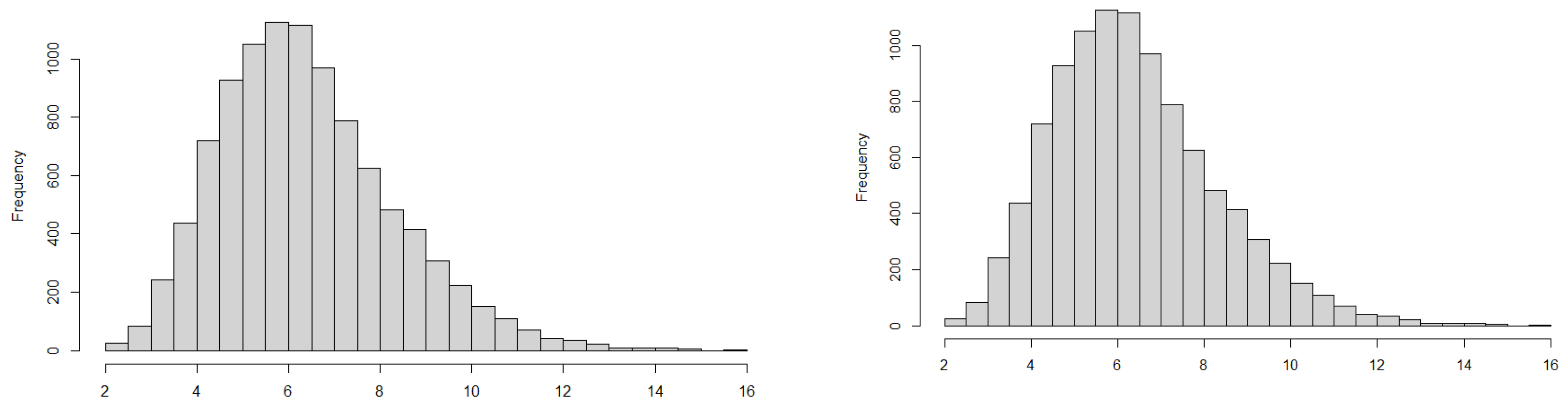
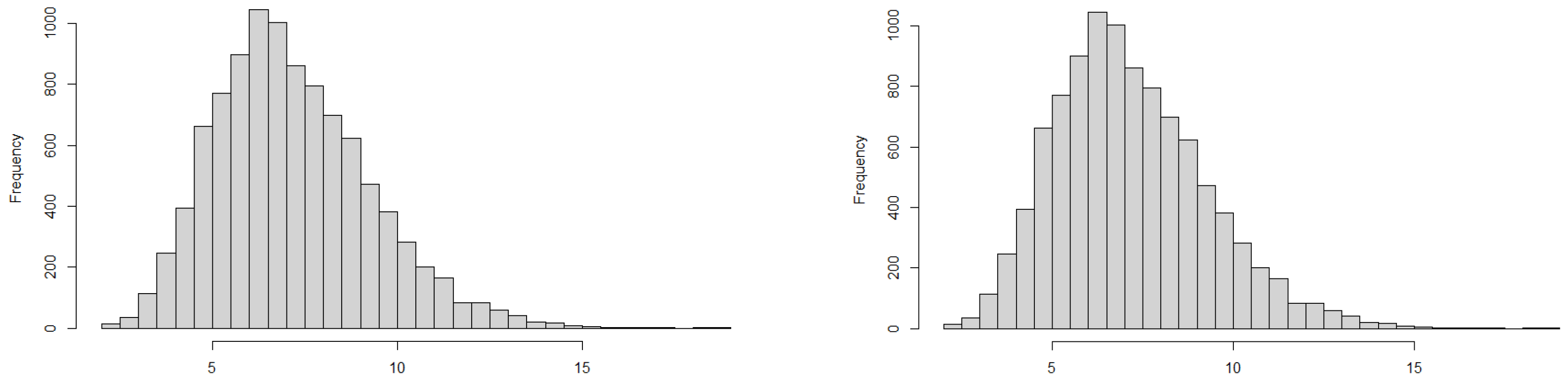
| Volatility of the underlying asset value/price | Volatility set at 35% (0.35) at the initial experiment. For the Monte Carlo simulation, we allow the volatility to change with log-normal distribution~Lognormal (0.35, 0.1). |
| Additional cash flows | No additional cash flows have been included in the example. |
Disclaimer/Publisher’s Note: The statements, opinions and data contained in all publications are solely those of the individual author(s) and contributor(s) and not of MDPI and/or the editor(s). MDPI and/or the editor(s) disclaim responsibility for any injury to people or property resulting from any ideas, methods, instructions or products referred to in the content. |
© 2026 by the authors. Licensee MDPI, Basel, Switzerland. This article is an open access article distributed under the terms and conditions of the Creative Commons Attribution (CC BY) license.
Share and Cite
Kabaivanov, S.I.; Markovska, V.M. Evaluating the Impact of Intelligent Data Processing for Corporate Finance with the Use of Real Options Analysis. J. Risk Financial Manag. 2026, 19, 292. https://doi.org/10.3390/jrfm19040292
Kabaivanov SI, Markovska VM. Evaluating the Impact of Intelligent Data Processing for Corporate Finance with the Use of Real Options Analysis. Journal of Risk and Financial Management. 2026; 19(4):292. https://doi.org/10.3390/jrfm19040292
Chicago/Turabian StyleKabaivanov, Stanimir Ivanov, and Veneta Metodieva Markovska. 2026. "Evaluating the Impact of Intelligent Data Processing for Corporate Finance with the Use of Real Options Analysis" Journal of Risk and Financial Management 19, no. 4: 292. https://doi.org/10.3390/jrfm19040292
APA StyleKabaivanov, S. I., & Markovska, V. M. (2026). Evaluating the Impact of Intelligent Data Processing for Corporate Finance with the Use of Real Options Analysis. Journal of Risk and Financial Management, 19(4), 292. https://doi.org/10.3390/jrfm19040292