Article

Financing Post-War Circular Reconstruction: Digital Tools and Investment Pathways for Ukraine’s Industrial Regions

by
Tetiana Gorokhova
1,2,* and
Žaneta Simanavičienė
3
1
Centre for Advanced Internet Studies (CAIS), 44789 Bochum, Germany
2
Department of Management and Marketing, Pryazoskyi State Technical University, 49044 Dnipro, Ukraine
3
Sustainable Innovation Laboratory, Mykolo Romerio University, LT-08303 Vilnius, Lithuania
*
Author to whom correspondence should be addressed.
J. Risk Financ. Manag. 2026, 19(4), 293; https://doi.org/10.3390/jrfm19040293
Submission received: 12 March 2026 / Revised: 30 March 2026 / Accepted: 2 April 2026 / Published: 18 April 2026

Abstract

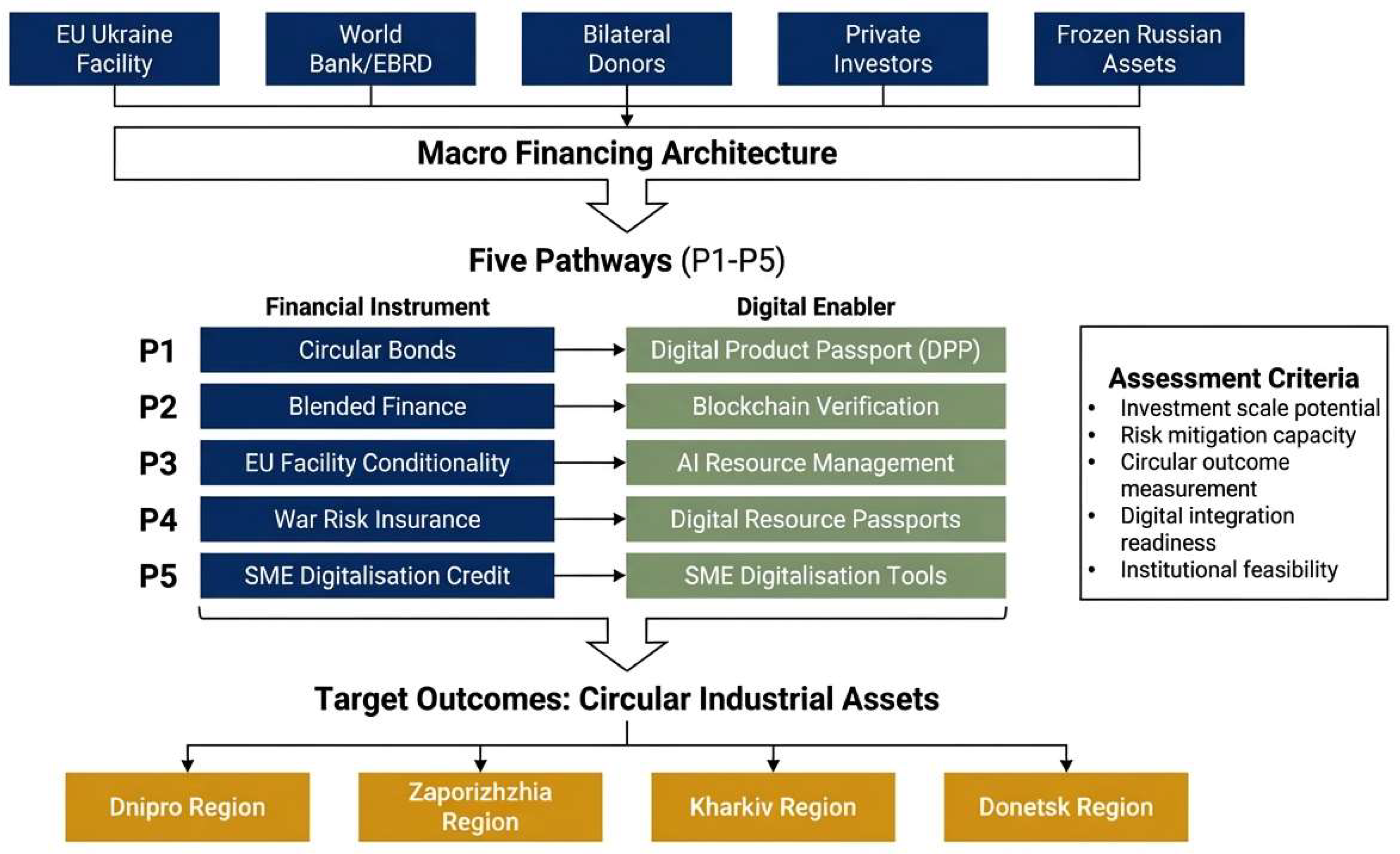
Ukraine’s reconstruction, estimated at $524 billion over the next decade, presents an unprecedented opportunity to embed circular economy principles into industrial rebuilding, but the financial architecture currently deployed for reconstruction is structurally blind to circular outcomes. This paper examines how digital tools and innovative financing mechanisms can channel investment toward circular industrial reconstruction in Ukraine, drawing on Germany’s National Circular Economy Strategy (NCES, adopted December 2024) as a reference model. A comparative institutional analysis combines a documentary review of Ukrainian reconstruction policy frameworks (Ukraine Plan 2024–2027, RDNA4, Ukraine Facility) and German NCES instruments with the construction of a financing−technology pathway typology. Five pathways are proposed: circular bond issuance with Digital Product Passport integration; blended finance with blockchain impact verification; EU Facility conditionality with AI-driven resource management; war risk insurance with circular construction standards; and SME digitalisation credit with circular economy competency building. Each pathway is assessed against five criteria: investment scale, risk mitigation, circular measurement, digital readiness, and institutional feasibility, and applied to four industrial corridors (Dnipro region, Zaporizhzhia region, Kharkiv region, and Donetsk region). The analysis reveals that no single pathway is sufficient; a layered strategy differentiating by region is required. Digital tools, particularly the Digital Product Passport and blockchain traceability, serve as partial substitutes for institutional trust in post-conflict settings, reducing information asymmetry between investors and project operators. The paper contributes a practically oriented framework at the under-theorised intersection of post-conflict reconstruction finance and circular economy scholarship.
Keywords: circular economy; digital transformation; post-war reconstruction; Ukraine; Germany; green finance; Industry 5.0; blended finance; Digital Product Passport; institutional leapfrogging circular economy; digital transformation; post-war reconstruction; Ukraine; Germany; green finance; Industry 5.0; blended finance; Digital Product Passport; institutional leapfrogging