1. Introduction
Financial inclusion is widely recognized as an important dimension of economic development and social well-being. Expanding both access to and the effective use of formal financial services can support poverty reduction, improve risk management, and facilitate productive investment (
World Bank, 2014;
Demirgüç-Kunt et al., 2022). Over the past decade, substantial progress has been made worldwide in increasing account ownership and the availability of basic financial instruments. However, significant disparities persist across countries and regions, particularly among low-income populations and geographically isolated communities (
World Bank Group, 2022;
Klapper et al., 2025). However, it remains unclear whether the expansion of financial inclusion occurs uniformly across different channels or whether distinct forms of access influence economic outcomes through different adjustment processes.
A growing empirical literature documents positive association between financial inclusion and outcomes such as economic growth, business formation, and household resilience (
Sarma & Pais, 2011;
Giday, 2023). Much of this evidence relies on aggregate measures of inclusion, including composite indices or indicators of financial infrastructure density. While these approaches capture overall patterns of financial deepening, they tend to treat inclusion as a uniform process and pay limited attention to the possibility that different channels of access and use may affect economic activity through distinct mechanisms (
Demirgüç-Kunt et al., 2022;
Klapper et al., 2025;
Ozili, 2020,
2025;
Elsaid Elmaasrawy et al., 2025).
Recent technological change has further reshaped the process of fina 2025ncial inclusion. The diffusion of mobile banking and digital payment systems has extended the reach of financial services beyond traditional branch-based infrastructure, particularly in emerging economies (
Asongu & Odhiambo, 2017;
Lee et al., 2023). By lowering geographic and transaction costs, digital channels may allow participation in formal finance to expand more rapidly and at lower cost (
Duncombe & Boateng, 2009). However, existing empirical evidence remains inconclusive about the relationship between digital services and economic performance (
Ha et al., 2025). In particular, there is still limited within-country evidence on the temporal evolution of different inclusion channels and on how their diffusion is associated with regional economic activity. However, it remains unclear whether financial inclusion expands uniformly across channels or follows a sequential path shaped by digital adoption (
Hasan et al., 2022). This paper asks whether different channels of financial inclusion exhibit distinct dynamic relationships with regional economic activity within a country experiencing rapid digital transformation.
Mexico provides a particularly informative context for examining these issues. Despite sustained policy efforts to expand access to formal financial services, levels of inclusion remain uneven across states and population groups, reflecting differences in financial literacy, labor-market conditions, infrastructure availability, and digital connectivity (
Cassimon et al., 2022;
López, 2023). These regional disparities generate substantial variation in the environment in which financial services are adopted and used. As a result, Mexico offers a suitable setting for analyzing how different forms of financial inclusion diffuse across regions over time and relate to local economic outcomes (
CNBV, 2024;
INEGI, 2025a,
2025b).
This paper examines how different channels of financial inclusion relate dynamically to regional economic activity in Mexico. Rather than relying on aggregate indicators, the analysis distinguishes between traditional banking infrastructure, card-based financial products, and digital inclusion through mobile banking. Using a combination of fixed-effects models with heterogeneous trends, bias-corrected dynamic panel estimation, placebo-lead tests, and panel vector autoregression, we study the temporal ordering between financial inclusion and economic performance. The results point to a sequential “mobile-first” pattern of financial deepening, in which the expansion of digital financial services precedes both subsequent increases in regional economic activity and the later diffusion of more complex credit instruments.
Beyond the Mexican setting, the analysis contributes to a broader understanding of financial inclusion as a dynamic and differentiated development process. The findings suggest that the expansion of digital financial services can play an enabling role in early stages of financial deepening, shaping the subsequent diffusion of more complex financial instruments and their economic effects. This perspective points to financial inclusion not as a uniform expansion of access, but as a staged process in which different channels contribute unevenly to economic participation and development outcomes.
The remainder of the paper is organized as follows.
Section 2 reviews the related literature and positions the analysis within existing empirical work on financial inclusion and economic development.
Section 3 describes the data and methodological framework.
Section 4 presents the empirical strategy.
Section 5 reports the results and robustness analyses.
Section 6 discusses the implications of the findings.
Section 7 concludes the paper.
2. Literature Review
2.1. Financial Inclusion, Development, and Measurement Challenges
Financial inclusion refers to the availability and effective use of affordable financial services, payments, savings, credit, and insurance that enable risk management, asset accumulation, and productive investment. It is commonly associated with economic growth, poverty reduction, employment, and women’s empowerment (
World Bank, 2023).
A central limitation lies in the access–use distinction. Although both dimensions define inclusive systems (
World Bank, 2019;
Demirgüç-Kunt & Klapper, 2013;
Demirgüç-Kunt et al., 2022), evidence shows that access alone does not ensure effective participation, as many accounts remain inactive. As a result, measurement frameworks tend to overemphasize ownership while underestimating the quality, intensity, and outcomes of usage, limiting analysis of how financial inclusion translates into economic activity over time.
In Mexico, financial inclusion is defined through a multidimensional regulatory framework encompassing access, use, consumer protection, and financial education (
CNBV, 2024;
CONAIF, 2016). However, empirical studies often rely on partial proxies such as account ownership, creating a gap between policy definitions and measurement.
Determinants of inclusion can be grouped into supply-side and demand-side factors. Access depends on the availability and affordability of financial infrastructure, while adoption is shaped by socioeconomic characteristics such as income, education, employment, and age (
Sotomayor et al., 2018;
García et al., 2020). However, these factors are often treated as static and independent, with limited attention to their interactions.
Behavioral and structural constraints further restrict participation. Cognitive burdens associated with poverty, as well as barriers such as documentation requirements or geographic distance, play a significant role (
Mullainathan & Shafir, 2009;
Le et al., 2019). Empirical evidence identifies education, income, financial literacy, age, internet access, and household characteristics as key drivers of financial participation (
Han & Sherraden, 2009;
Sanderson et al., 2018;
Peña et al., 2014;
Rhine & Greene, 2013;
Cole & Greene, 2016).
Nevertheless, these variables are typically modeled as exogenous, with limited attention to causal mechanisms. In Mexico, structural inequalities further condition financial participation. Access is closely linked to formal employment, income, education, and age, while heterogeneity across regions, informal workers, and vulnerable populations remains underexplored. The growing use of alternative data in credit markets also raises concerns about bias and exclusion, underscoring the importance of accounting for regional heterogeneity (
Cassimon et al., 2022).
The expansion of digital financial services (DFS) illustrates this tension. ICTs have transformed financial service delivery and are widely viewed as key drivers of inclusion (
Kanjo, 2020;
Aranda-Jan & Qursum, 2023). The rapid diffusion of digital payments reflects this trend. These developments suggest that digital channels may play a more prominent role than traditional infrastructure in shaping economic outcomes.
However, digital adoption is often equated with effective inclusion, overlooking user capabilities, trust, and security constraints. Persistent digital divides reinforce these limitations. Inequalities in connectivity, digital skills, and trust continue to exclude segments of the population, with disparities across gender, income, education, and geography (
Boyd & Stacey, 2016;
ITU, 2022).
Overall, financial inclusion emerges as a multidimensional and context-dependent process shaped by the interaction of socioeconomic conditions, institutional frameworks, financial infrastructure, and digital. Existing research highlights persistent challenges in distinguishing access from effective use, in identifying causal mechanisms, and in understanding how different financial channels interact over time. In particular, limited attention has been paid to the sequencing of financial adoption processes and to regional heterogeneity within national contexts. These gaps complicate the assessment of how digital and traditional forms of inclusion contribute to economic activity and motivate further empirical investigation. The main empirical contributions in this broader literature are summarized in the summary tables presented at the end of this section.
2.2. Digital Financial Inclusion: Technology, Adoption, and Limits
Digital financial services (DFSs), particularly mobile banking, have transformed financial intermediation by enabling remote and real-time transactions (
Gutierrez & Singh, 2013;
Tan, 2023;
Mwita, 2024;
Ali & Ghildiyal, 2023;
Iqbal & Hayat, 2025;
Elsaid Elmaasrawy et al., 2025). Their expansion, supported by ICT infrastructure, has reduced transaction costs and geographic barriers (
Asongu & Odhiambo, 2017;
Kanjo, 2020).
Empirical evidence links digital inclusion to improvements in financial participation and welfare, particularly among vulnerable groups, although exclusion persists among low-income and low-education populations (
Du et al., 2023;
Lei et al., 2023). Its impact depends on complementary factors such as regulation, infrastructure, and digital financial literacy (
Khan et al., 2022;
Dereje, 2024).
Despite rapid adoption, important constraints remain. Digital divides in connectivity, skills, and trust persist across income, gender, education, and geography (
Boyd & Stacey, 2016;
ITU, 2022;
INEGI, 2025a,
2025b). Additional barriers include digital literacy and cybersecurity concerns (
Alfian et al., 2025;
Kamble et al., 2024;
Saeed et al., 2024;
Iqbal & Hayat, 2025).
Crucially, digital adoption is often conflated with effective inclusion. Existing evidence provides limited insight into how digital financial services interact with traditional banking structures and whether they generate sequential financial deepening from payments to savings and credit. Moreover, their distributional and medium-term economic effects remain insufficiently identified. These gaps motivate empirical analyses that distinguish across financial channels and examine how digital diffusion relates to economic activity over time.
2.3. Mobile Financial Inclusion in Mexico: Infrastructure, Digitalization, and Gap
In Mexico, financial inclusion remains shaped by structural constraints such as limited financial literacy, high informality, foreclosure costs, and low trust in banking institutions (
Cassimon et al., 2022;
Ocampo & Ortega, 2022). As a result, financial penetration remains uneven: although 68% of adults report access to at least one financial service, only 49% hold a bank account (
INEGI, 2025a,
2025b). Access also varies across financial products, particularly in credit markets that rely on broader information systems and formal employment links (
López, 2023;
Cassimon et al., 2022).
Financial infrastructure has expanded significantly in recent years, including through the territorial expansion of Banco del Bienestar, which increased branch coverage across municipalities (
CNBV, 2024). ATM networks also expanded during the period, although recent reductions suggest possible substitution toward digital access channels (
Banco de México (Banxico), 2025).
Gender and regional disparities remain relevant features of financial inclusion in Mexico. Differences in access to digital connectivity, financial products, and labor-market opportunities continue to shape participation patterns across population groups. Digital connectivity has become increasingly relevant for financial participation. Internet access expanded rapidly over the past decade, as illustrated in
Table 1, supporting the diffusion of digital financial services.
The expansion of connectivity has been accompanied by rapid growth in digital payments and mobile transfers (
CNBV, 2021,
2022,
2023,
2024,
2025), reinforcing the importance of digital channels in the evolving financial ecosystem.
Overall, these developments point to a gradual transition toward greater reliance on digital financial channels, although adoption remains uneven across regions and population groups. The concentration of digital use in low-value transactions raises questions about the depth of financial inclusion achieved and whether current trends reflect early stages of a broader process of financial deepening.
To clarify how the present study relates to existing research,
Table 2,
Table 3 and
Table 4 synthesize the main strands of the literature reviewed above.
Table 2 summarizes general empirical studies on financial inclusion and economic outcomes,
Table 3 focuses on the literature on digital financial inclusion, and
Table 4 reports selected evidence for Mexico. Taken together, these studies show that the literature has documented positive associations between financial inclusion and development, but has relied predominantly on aggregate indicators, cross-country comparisons, or household-level evidence. Much less is known about how different channels of inclusion interact over time within a common institutional environment.
2.4. Heterogeneous Channels of Financial Inclusion and Dynamic Diffusion
Table 2,
Table 3 and
Table 4 highlight three limitations in the existing literature. First, much of the empirical evidence on financial inclusion relies on aggregate indices or broad access measures, making it difficult to distinguish the heterogeneous roles of specific channels such as physical infrastructure, card-based products, and mobile banking. Second, most studies rely either on cross-country comparisons or household-level data, leaving limited within-country evidence on regional diffusion processes under a common institutional framework. Third, relatively little attention has been paid to the temporal ordering of inclusion channels, particularly whether digital financial services precede or accompany broader financial deepening. These limitations motivate the present analysis of Mexican states during a period of rapid digital transformation.
Against this background, this paper analyzes whether different channels of financial inclusion, particularly digital versus traditional forms of access, play distinct roles in the dynamics of regional economic activity in Mexico. By separating inclusion channels and examining their temporal interactions, the study provides evidence on how financial inclusion diffuses across regions and how these processes relate to economic performance. In this sense, the research question emerges directly from the literature: whether financial inclusion should be understood as a uniform expansion of access or as a differentiated, sequential process in which digital adoption plays a leading role.
The literature suggests several mechanisms through which financial inclusion may influence regional economic outcomes. Digital financial services can reduce transaction costs and expand market participation, whereas traditional infrastructure may affect economic activity through slower structural channels. Financial deepening may therefore follow a sequential pattern in which basic digital access precedes the adoption of more complex financial instruments. These considerations motivate the empirical analysis that follows.
2.5. Contribution of the Study
This paper contributes to the empirical literature on financial inclusion and regional economic development by providing new evidence on the heterogeneous and dynamic nature of financial deepening.
First, the analysis distinguishes among multiple channels of financial inclusion, separating traditional banking infrastructure, card-based financial products, and digital financial services. This disaggregated approach allows the study to identify differences in how specific forms of financial access relate to regional economic activity, rather than relying on composite indices that obscure these margins.
Second, the paper examines the temporal interaction between financial inclusion and economic performance using panel methods designed to account for persistence, unobserved heterogeneity, and potential reverse causality. This dynamic perspective provides evidence on the sequencing of financial inclusion processes rather than focusing solely on contemporaneous correlations.
Third, the results point to a “mobile-first” pattern of financial deepening, in which the expansion of digital financial services precedes both increases in regional economic activity and the subsequent diffusion of more traditional financial instruments. This finding suggests that financial inclusion may evolve through cumulative and non-uniform adoption processes across different channels.
Finally, the study offers recent within-country evidence from a balanced panel of Mexican states during a period of rapid digital transformation. By exploiting subnational variation within a common institutional framework, the analysis complements cross-country research. It highlights the importance of regional heterogeneity in shaping the diffusion and economic implications of financial inclusion.
3. Materials and Methods
The empirical analysis is based on a balanced panel covering all 32 Mexican states over the period 2018–2023, yielding a total of 192 state–year observations. All empirical analyses were conducted using Stata 13 (StataCorp LP, College Station, TX, USA). The primary data source is administrative information compiled by the Comisión Nacional Bancaria y de Valores (CNBV) and Banco de México, which provides comprehensive coverage of the provision of financial services across the national territory.
The dependent variable is the state-level Economic Activity Index (EAI index, base year 2018 = 100), a composite indicator widely used in Mexican regional analysis as a proxy for short-term economic performance. Explanatory variables capture different dimensions of financial inclusion, including ATM density, banking correspondents, point-of-sale terminals, establishments equipped with POS devices, debit and credit cards, mortgages, car loans, and mobile banking contracts. These indicators are continuous stock variables measured as administrative counts reflecting the scale of financial infrastructure and product penetration.
To ensure comparability across states with different population sizes, all financial inclusion variables are expressed per 100,000 adults and transformed using natural logarithms. This transformation allows coefficients to be interpreted as semi-elasticities and reduces skewness in the distribution of financial indicators. Descriptive statistics and correlation patterns are reported in
Table A1 and
Table A2 in the
Appendix A. The high degree of correlation among infrastructure measures motivates the construction of a composite principal component index, used in selected specifications to mitigate multicollinearity.
The choice of indicators follows the empirical financial inclusion literature, which typically measures access through physical infrastructure density and product penetration. Over the sample period, most inclusion variables display gradual upward trends consistent with the expansion of digital and traditional financial services in Mexico. This temporal evolution supports the use of panel methods that distinguish persistent structural differences across states from short-term within-state variation.
4. Empirical Strategy
The empirical analysis examines how different channels of financial inclusion are associated with regional economic activity in Mexico. As a starting point, we estimate a baseline panel specification of the form:
where
EAIit denotes the Economic Activity Index in state
i and year
t, α
i captures time-invariant state-specific effects, and γ
i captures common macroeconomic shocks. The vector
Xit includes financial inclusion indicators expressed in natural logarithms per 100,000 adults, such as ATM density, banking correspondents, debit and credit card penetration, internet users, and mobile banking accounts. Standard errors are clustered at the state level to account for serial correlation and heteroskedasticity.
Pairwise correlations among infrastructure variables exceed 0.7 in several cases (see
Appendix A Table A2), indicating substantial multicollinearity and motivating the use of a principal-component index. To mitigate this issue, we construct a composite infrastructure index using principal component analysis applied to standardized log measures of physical access indicators. The first principal component explains 76.38% of total variance and is retained as a summary measure of financial infrastructure.
A key empirical challenge is the potential endogeneity of financial inclusion measures, arising from reverse causality or unobserved regional shocks that jointly affect financial development and economic activity. To address this concern, the analysis follows a sequential identification strategy that progressively strengthens the interpretation of estimated relationships. Baseline specifications incorporate state fixed effects and state-specific linear trends to control for persistent structural differences across regions. Alternative first-difference and long-difference models further reduce time-invariant heterogeneity and attenuate simultaneity concerns. Dynamic panel estimation using the bias-corrected LSDVC estimator accounts for persistence in economic activity while mitigating small-sample bias in dynamic panel models. In addition, placebo-led tests examine whether future changes in financial inclusion predict current economic outcomes. Finally, a panel VAR framework models the joint evolution of inclusion and economic activity, allowing for endogenous feedback and providing additional evidence on temporal ordering.
We begin by estimating fixed-effects panel models that exploit within-state variation over the 2018–2023 period. The baseline specification includes state and year fixed effects, while an extended specification adds state-specific linear trends to account for heterogeneous long-run growth paths. These models control for persistent regional characteristics and common macroeconomic shocks, allowing the analysis to focus on changes in financial inclusion and economic activity within states over time. The estimates indicate a statistically significant association between regional economic activity and digital inclusion indicators, whereas traditional infrastructure measures display fewer stable relationships.
Given the high correlation among infrastructure indicators, we also replace individual measures with a composite infrastructure index constructed using principal component analysis. Results are unchanged when infrastructure variables are summarized using the composite index.
To further assess robustness to functional form and time-invariant confounders, we estimate first-difference and long-difference models. First-difference and long-difference specifications yield similar coefficient signs and magnitudes.
To account for persistence in regional economic activity and potential dynamic panel bias, we estimate models using the bias-corrected Least-Squares Dummy Variable (LSDVC) estimator:
This approach mitigates the Nickell bias that arises in short panels with fixed effects. The results indicate substantial persistence in the Economic Activity Index, with an autoregressive coefficient close to 0.65. Controlling for this dynamic structure, mobile banking indicators retain a positive and statistically significant association with subsequent economic activity. In contrast, the effects of credit card penetration remain weaker and less robust across alternative initializations.
Interaction terms with a northern-region dummy are not statistically significant, indicating that the estimated relationships are not driven exclusively by more developed regions.
Finally, to assess the timing of the relationship and probe reverse causality concerns, we conduct placebo regressions that include one-year leads of financial inclusion indicators in the fixed-effects specification. The joint test of lead coefficients fails to reject the null that future inclusion does not predict current economic activity (p = 0.89), suggesting limited evidence of reverse causality.
To further evaluate the sensitivity of the estimates to potential omitted-variable bias, we compute
Oster (
2019) bounds based on the fixed-effects specification with state-specific trends. For ATM density, the implied value of
δ = 1.34 suggests that unobserved factors would need to be substantially stronger than the included controls to fully attenuate the estimated relationship. By contrast, the corresponding value for debit card penetration, close to 0.9, indicates greater sensitivity to unobserved heterogeneity. Overall, the bounds indicate that estimated relationships involving digital access measures are less sensitive to omitted-variable bias than those involving card-based instruments.
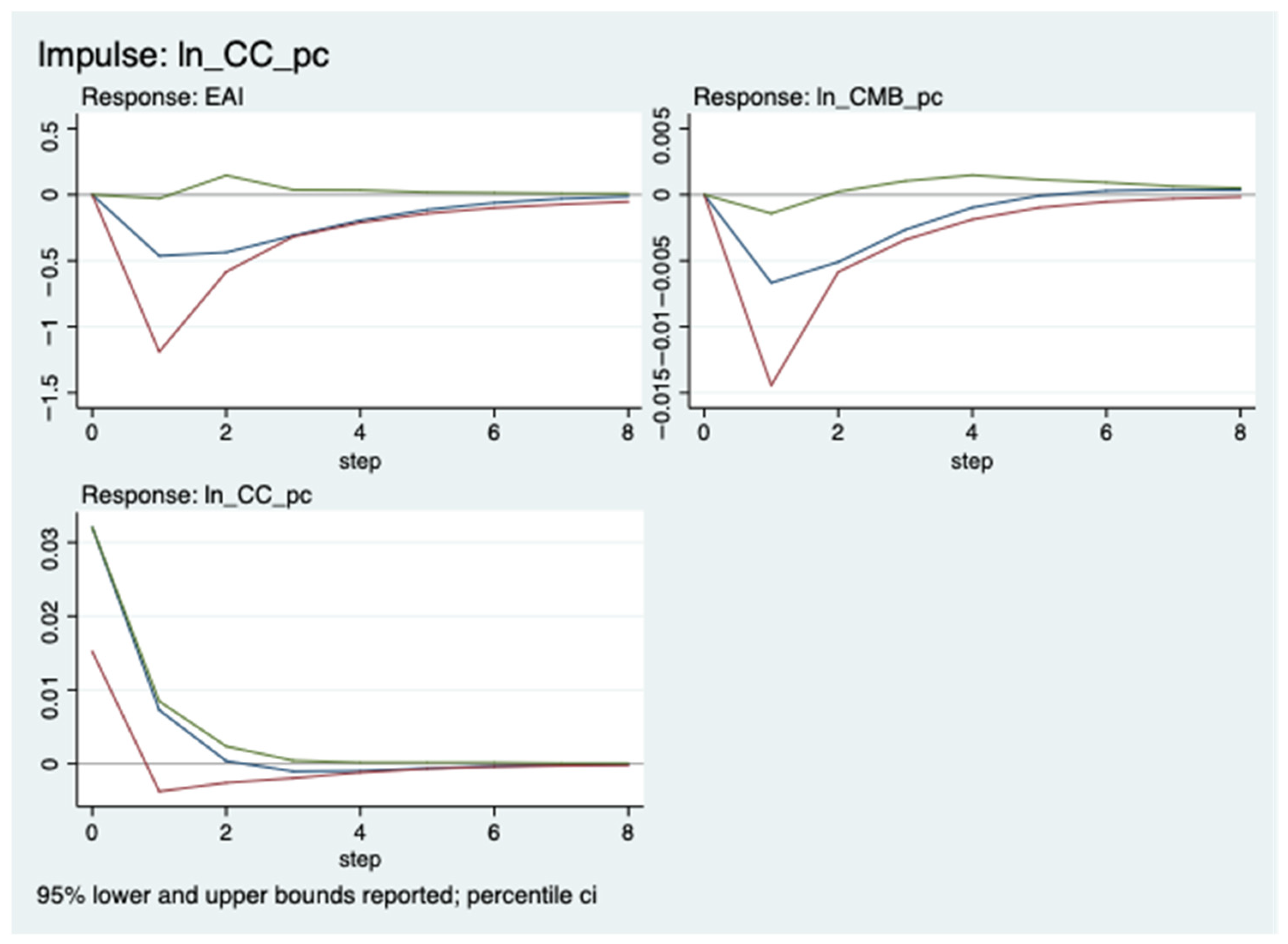
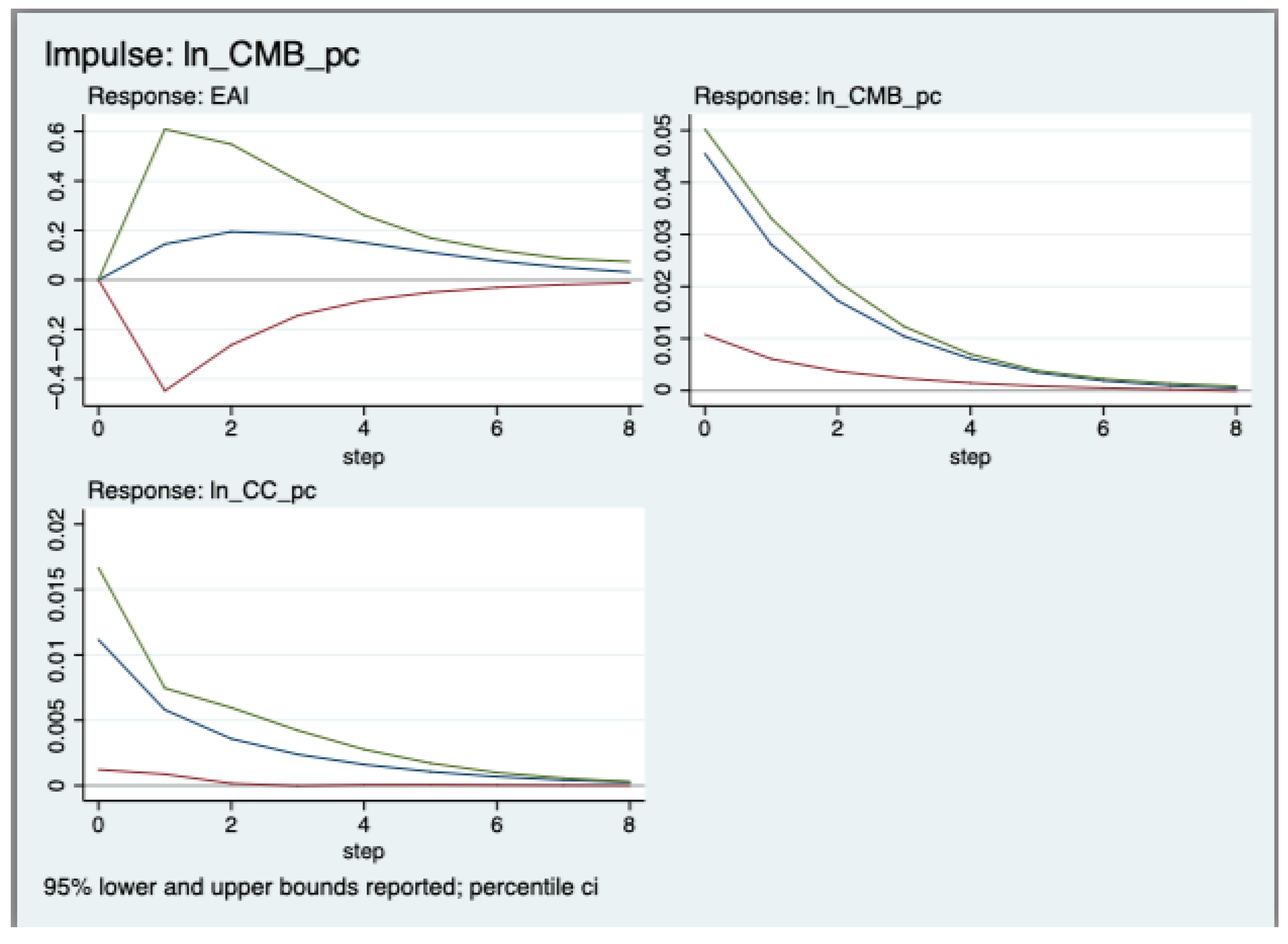
Finally, we estimate a small panel vector autoregression (PVAR) including the Economic Activity Index, mobile banking adoption (ln CMBpc), and credit card penetration (ln CCpc) to examine their joint evolution over time. Using a single lag to preserve degrees of freedom, the PVAR highlights clear temporal asymmetries. In particular, mobile financial inclusion Granger-causes subsequent increases in regional economic activity, whereas credit card diffusion does not display a comparable forward effect. Instead, higher economic activity predicts later expansion in credit card use. Impulse-response functions further show a positive and persistent response of economic activity following a shock to mobile inclusion, consistent with a leading role of digital financial adoption in regional economic dynamics.
Taken together, the empirical approaches provide consistent evidence of a dynamic association between financial inclusion and regional economic activity. The results highlight stronger and more persistent forward relationships for digital inclusion measures than for traditional banking instruments. These patterns motivate the dynamic analysis presented in the next section.
5. Results
This section presents the estimation results corresponding to the econometric models described above.
Table 5 reports baseline fixed-effects regressions with and without state-specific trends, providing the main within-state estimates for financial inclusion variables.
Table 6 summarizes the first-difference and long-difference estimates for 2018–2023, which serve as robustness checks against endogeneity and persistent heterogeneity.
Table 7 reports first-difference and long-difference specifications that assess robustness to functional form and persistent unobserved heterogeneity.
Table 8 presents the bias-corrected Least-Squares Dummy Variable (LSDVC) dynamic panel estimates, which account for persistence in regional economic activity and examine the temporal association between financial inclusion indicators and subsequent performance.
Table 9 reports placebo-lead tests designed to assess reverse causality within the fixed-effects framework.
Table 10 applies the
Oster (
2019) method to evaluate robustness to unobserved heterogeneity. Finally, in the
Appendix B, we include the VIF table and a small panel VAR (PVAR) results and corresponding impulse-response patterns, which explore dynamic feedback between economic activity and financial inclusion channels.
Table 5 presents fixed-effects estimates of the relationship between economic activity and financial infrastructure across Mexican states during 2018–2023
1. Column (1) reports the baseline specification with state and year fixed effects. Column (2) extends the model by adding state-specific linear trends to control for persistent local growth patterns. Column (3) replaces the individual infrastructure variables with a composite infrastructure index constructed through principal component analysis, capturing their joint contribution to economic activity. Standard errors are clustered by state. In Column (1), none of the individual infrastructure coefficients is precisely estimated; the point estimate for POS terminals is positive. Adding state trends in Column (2) absorbs much of the cross-sectional drift, and coefficients remain broadly imprecise. Column (3) replaces the individual infrastructure measures with a PCA index; its coefficient is positive (≈9.17) but imprecise, while the product variables remain small and mostly insignificant. These patterns suggest that time-invariant heterogeneity and slow-moving state trends drive much of the correlation structure, motivating the dynamic/robustness analyses that follow.
As a further robustness check, we estimated models in first differences and in long differences for the period between 2018 and 2023. The purpose of these differencing specifications is to reduce endogeneity concerns. Differencing removes time-invariant unobserved heterogeneity at the state level and also attenuates potential simultaneity between financial variables and economic activity.
The first-difference model, estimated with state-clustered standard errors, shows that year-on-year changes in financial inclusion variables are not significantly associated with changes in economic activity. Instead, the coefficients on the year dummies capture the main dynamics: the sharp negative effect of 2020 reflects the COVID-19 shock, followed by a strong rebound in 2021. This indicates that short-run fluctuations in economic activity were dominated by macroeconomic shocks rather than by financial inclusion variables.
The long-difference model collapses the panel into one change per state between 2018 and 2023. Here, some signals emerge. Growth in debit card usage is positively correlated with economic activity, whereas increases in credit card penetration and banking correspondents are negatively associated. Although the number of observations is small (32 states) and confidence intervals are wide, the direction of the coefficients is consistent with the idea that certain forms of financial inclusion contribute more effectively to economic growth than others. Debit cards, in particular, appear to support consumption and formalization, whereas credit cards and correspondents may be more prevalent in weaker regional economies.
In the first-difference specification with year dummies and state-clustered SEs, year effects dominate (COVID-19 contraction in 2020, rebound in 2021), while changes in inclusion variables are not significant. In long differences (2018–2023), debit cards display a positive association with ∆EAI, whereas credit cards and banking correspondents show negative associations; estimates are imprecise given 32 observations but point to heterogeneous medium-run effects across products.
Taken together, these results show that the short-run evidence is weak, but that, in the longer run, financial inclusion may matter, with heterogeneous effects across products. This reinforces the need to distinguish between different instruments of financial inclusion in the analysis.
To address potential dynamic bias in fixed-effects estimates, we implemented the bias-corrected LSDVC estimator for dynamic panel data.
Table 8 presents a compact version of the results (we show only a selection of relevant variables for the discussion).
The LSDVC estimator corrects for small-sample and dynamic biases in fixed-effects models with a lagged dependent variable. Results confirm strong persistence in economic activity (L1.EAI ≈ 0.68, p < 0.001). Among the inclusion variables, mobile banking (ln_CMB_pc) remains positive and statistically significant at the 5% level in the Arellano–Bond initialization, whereas all other financial variables are not statistically significant. The Anderson–Hsiao initialization yields similar signs but larger standard errors, as expected due to its lower efficiency. Overall, these results indicate that mobile banking is the only robust and economically meaningful driver of regional economic activity once persistence and dynamic bias are accounted for. However, a more nuanced interpretation emerges when considering the role of credit card diffusion.
An important nuance concerns the role of credit cards in the inclusion–growth relationship. While the dynamic panel estimates indicate that mobile banking is a statistically robust predictor of regional economic activity, the coefficient associated with credit card diffusion is not significant over the sample period. This suggests that the expansion of card-based financial products may represent a subsequent stage of financial deepening that does not immediately translate into measurable output effects at the state level. One possible interpretation is that mobile banking primarily reduces transaction costs and activates participation in formal financial markets. In contrast, the broader adoption of credit instruments operates through slower channels, such as consumption smoothing, credit history formation, or gradual integration into formal lending relationships. This interpretation is consistent with the panel VAR evidence presented below; therefore, credit card diffusion appears to follow rather than lead the inclusion process, with its potential growth effects likely materializing over a longer horizon than that captured in the present panel.
To further address concerns about reverse causality, we implement placebo-lead tests by augmenting the fixed-effects specification with one-year leads of all financial inclusion variables, controlling for state and year fixed effects and state-specific linear trends, with standard errors clustered at the state level. The leads are jointly insignificant (F(8,31) = 0.44, p = 0.886), and the individual leads for mobile banking and credit cards are far from statistical significance (p ≈ 0.95 and p ≈ 0.82, respectively). These findings indicate that future changes in financial inclusion do not predict current economic activity, supporting the temporal ordering implied by the dynamic estimates. Results remain stable when replacing state trends with Region × Year fixed effects, further alleviating concerns about pre-trends and reverse causality.
Table 9 reports a compact version of the placebo regressions with one-year leads of the financial inclusion variables. To facilitate interpretation, only the variables most relevant to the discussion are shown. These include mobile banking and credit cards, which represent the main channels of digital financial inclusion, and their one-year leads, which serve as placebo tests for reverse causality. In addition, a few representative controls are displayed, such as debit cards, ATMs, and mortgages, capturing alternative forms of access to finance and traditional credit use. All other inclusion variables and fixed effects are included in the estimation but omitted from the table for brevity, since their coefficients are small and statistically insignificant across specifications. This selection allows the table to focus on the variables that best illustrate the dynamic link between digital inclusion and economic activity.
To evaluate the potential influence of unobserved heterogeneity, we applied
Oster’s (
2019) method, using a specification with state- and year-fixed effects as the baseline.
Table 9 reports the implied bounds for two headline variables: ATMs and debit cards. The estimated δ parameter measures how much stronger selection on unobservables would need to be, relative to observables, to drive the estimated coefficient to zero.
We set Rmax = 1.3·R2_full (capped at 1), which implies δ ≈ 1.34 for ATMs and ≈0.90 for debit cards, consistent with the ATM association’s comparatively greater robustness. The Oster-adjusted coefficient remains positive, and a δ of 1.337 indicates that omitted factors would need to be more than one-third as strong as the observed controls to eliminate the effect. In contrast, the coefficient for debit cards is less robust: its adjusted estimate turns negative, and the implied δ of 0.9 indicates that unobserved heterogeneity of a similar magnitude to the observed variables would be sufficient to explain away the effect. These findings reinforce the main regression results, where ATMs showed a persistent and significant correlation with economic activity, whereas debit cards appeared more sensitive to specification changes.
6. Discussion
The empirical results point to a consistent dynamic pattern linking financial inclusion and regional economic activity across Mexican states during the period 2018–2023. Economic activity exhibits substantial persistence, implying that short-run fluctuations leave limited room for immediate responses to changes in financial access. Within this framework, mobile banking stands out as the only inclusion channel displaying a stable and statistically significant association with subsequent activity. In contrast, traditional infrastructure indicators show weaker and less precise relationships. These findings suggest that financial inclusion unfolds primarily through gradual diffusion processes rather than through sharp year-to-year adjustments in physical access. Once persistent structural differences and heterogeneous growth trends across states are accounted for, the contribution of infrastructure expansion appears modest, reflecting both limited within-state variation and the slow pace at which physical financial networks evolve.
Dynamic estimates reinforce the interpretation that financial inclusion affects regional economic performance through gradual adjustment mechanisms. Once persistence in economic activity is accounted for, the role of digital financial channels becomes more visible, suggesting that mobile banking contributes to sustained improvements in market participation and transactional efficiency rather than to short-term fluctuations. This pattern is consistent with regional growth frameworks in which financial deepening supports productivity gains through learning effects, network expansion, and institutional adaptation. By contrast, the weaker and less stable associations observed for credit card diffusion point to slower adjustment processes tied to consumption smoothing, credit history formation, and investment financing, whose economic effects are likely to materialize over longer horizons.
The dynamic pattern also varies across regional contexts. The association between mobile banking adoption and economic activity appears weaker in more financially developed northern states and stronger in less penetrated regions. This geographic asymmetry is consistent with a saturation mechanism: where financial systems are already dense and digitally integrated, the marginal impact of additional mobile access is naturally smaller. In contrast, in regions with lower initial levels of financial inclusion, digital channels can play a more transformative role by expanding participation in formal financial markets and supporting incremental gains in economic activity. These results highlight that the economic relevance of financial inclusion depends not only on the type of financial instrument but also on the stage of regional financial development.
Additional evidence on timing reinforces the view that the economic effects of financial inclusion emerge through cumulative exposure rather than through immediate short-run adjustments. Changes in financial access indicators do not systematically translate into contemporaneous fluctuations in regional economic activity, whereas longer-term developments reveal differentiated patterns across financial instruments. This suggests that inclusion operates through gradual behavioral and institutional adjustments, including learning, network formation, and deeper integration into formal financial systems. In this perspective, digital adoption can influence regional economic performance by progressively expanding transactional capacity and participation, while more complex forms of financial intermediation, such as credit provision, are likely to exert their effects over longer horizons.
These findings resonate with a growing literature emphasizing the role of digital financial technologies in reducing transaction costs and expanding market participation in emerging economies. The present analysis contributes to this debate by providing within-country evidence on how different inclusion channels evolve over time and interact in shaping regional economic performance. Whereas much of the existing literature focuses on aggregate correlations between financial depth and growth, the results highlight the importance of sequencing, showing that early digital adoption can precede deeper forms of financial intermediation. In this sense, the evidence complements theoretical perspectives that view technological diffusion as a gradual process influencing financial participation and economic activity across heterogeneous regional contexts.
Sensitivity analysis and evidence from dynamic systems jointly indicate that different financial inclusion indicators capture distinct dimensions of financial development. Measures of physical infrastructure reflect more durable structural characteristics of regional economies, whereas digital adoption responds more rapidly to changes in participation costs and transactional opportunities. Within this framework, the sequential pattern observed in the data suggests that mobile financial services can act as an entry point into formal financial systems, supporting incremental increases in economic activity and facilitating the later diffusion of more complex credit instruments.
The results also highlight that digital financial services operate primarily as a scalable complement to traditional banking infrastructure rather than as a direct substitute. Regions with lower initial levels of financial penetration tend to experience larger marginal gains from expanded digital access, underscoring the role of initial conditions in shaping the effectiveness of inclusion policies. Taken together, these findings portray financial inclusion as a context-dependent development process characterized by differentiated channels and uneven regional impacts.
Beyond aggregate growth dynamics, the results also carry important distributional implications for financial inclusion. Descriptive evidence indicates that gender disparities in access to financial products widened over the period analyzed, despite the rapid expansion of digital financial services, as reported in the
Appendix A in
Table A3. This pattern suggests that while mobile banking can reduce transaction and geographic barriers to participation, deeper structural constraints, including income inequality, unequal access to digital technologies, financial literacy gaps, and labor-market segmentation, may continue to shape women’s engagement with formal financial systems.
In this sense, digital diffusion can support aggregate economic dynamism without automatically ensuring more equitable participation across demographic groups. These findings align with recent research highlighting the persistence of socio-economic and technological frictions affecting women’s financial inclusion. They also point to the need for complementary policies addressing capability formation and access conditions if technological expansion is to translate into more inclusive development outcomes.
7. Conclusions
This paper examined how different channels of financial inclusion relate to regional economic activity in Mexico during a period of rapid digital transformation. Rather than treating financial inclusion as a homogeneous process, the analysis distinguished between traditional banking infrastructure, card-based financial products, and digital inclusion through mobile banking. Using a balanced panel of Mexican states and complementary empirical strategies designed to account for persistence and endogeneity concerns, the study explored the temporal ordering between financial inclusion and economic performance.
The results indicate that financial inclusion operates through heterogeneous and dynamic mechanisms. While traditional access indicators show limited short-run association with economic activity once persistent regional differences are taken into account, digital inclusion emerges as a more robust and leading margin. The evidence is consistent with a “mobile-first” pattern of financial deepening in which the expansion of digital financial services precedes both subsequent increases in regional economic activity and the later diffusion of more complex financial products. These findings suggest that the effectiveness of financial inclusion depends not only on the extent of access but also on the technological channels and sequencing through which inclusion expands.
From a policy perspective, the results imply that strategies supporting digital financial participation may yield stronger marginal developmental effects than approaches focused exclusively on expanding traditional banking infrastructure. Enhancing digital connectivity, improving financial capabilities, and reducing participation barriers in underserved regions may facilitate broader engagement with formal financial systems and contribute to more balanced regional growth.
Although the empirical analysis focuses on Mexico, the findings offer broader insights into financial inclusion processes in economies undergoing digital transformation. In particular, the evidence points to a staged pattern of financial deepening in which early adoption of digital payment technologies can facilitate subsequent credit market integration. At the same time, persistent gender disparities in access to financial services indicate that technological diffusion alone may not ensure equitable participation, highlighting the importance of complementary socio-economic and institutional conditions.
Several limitations should be acknowledged. The analysis relies on aggregate indicators and cannot directly capture household-level behavioral responses or informal financial practices. Despite efforts to address endogeneity, unobserved regional shocks and institutional differences may still influence both financial inclusion and economic performance. In addition, the relatively short time dimension of the panel constrains the study of longer-run structural adjustments.
These limitations suggest avenues for future research. Micro-level analyses could help clarify the mechanisms linking digital financial adoption to productivity and income dynamics. Comparative studies across countries or regions would allow assessment of whether the sequencing patterns observed in Mexico reflect broader features of financial deepening in emerging economies. Finally, integrating measures of financial literacy, institutional quality, and local policy interventions could improve understanding of the conditions under which financial inclusion contributes to sustainable and inclusive development.