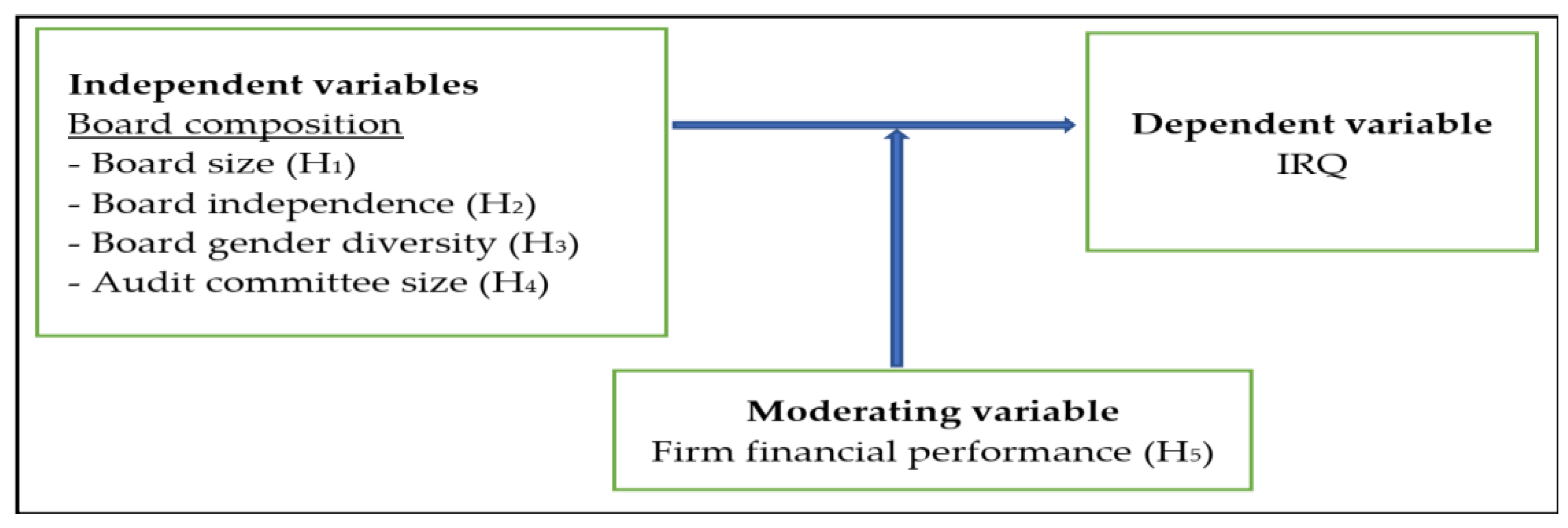
1. Introduction
The growing interest in integrated reporting (IR) and its disclosures among regulators, policymakers, shareholders, professionals, and scholars is largely driven by concerns about corporate information asymmetry, recurring corporate scandals, and the inability of traditional corporate reporting to adequately satisfy stakeholder information needs (
Ghaleb et al., 2024). Stakeholders, particularly providers of financial capital, increasingly demand high-quality and value-relevant non-financial information in addition to traditional financial disclosures (
Farooq et al., 2024;
García-Sánchez et al., 2023). In response to these expectations, the International Integrated Reporting Council (IIRC) introduced a voluntary, principles-based reporting framework known as integrated reporting on 9 December 2013. This framework combines financial and non-financial information to enhance the overall quality and usefulness of corporate reporting (
IIRC, 2021;
Khatlisi & Mashamba, 2025b;
Qaderi et al., 2024). IR seeks to promote a more coherent and efficient corporate reporting approach, strengthen accountability and stewardship, and encourage integrated thinking and decision-making that support value creation in the short, medium, and long term (
IIRC, 2013,
2021). Despite the growing adoption and conceptual development of IR, empirical understanding of the governance mechanisms that influence the quality of integrated reporting remains limited, highlighting an important gap in the literature.
Within corporate governance mechanisms, board composition plays a vital role in the effective functioning of the Board of Directors (the “Board”) (
Pucheta-Martínez et al., 2023;
Yusuf et al., 2024). The Board serves as a key internal control mechanism, appointed by shareholders to make strategic decisions, supervise management, and act on behalf of the company’s owners (
Anojan, 2024). To ensure sound corporate governance practices, several factors must be considered when determining an optimal board composition, including board size, power balance, independence, diversity, skills, and rotation. These elements are emphasised in corporate governance best-practice frameworks, such as King V, as well as in the laws and regulations governing corporate governance (
IoDSA, 2025;
Cooray et al., 2020).
Although legal provisions address aspects such as the minimum board size, directors’ terms of office, and qualification requirements, the Companies Act No. 71 of 2008 (Republic of South Africa, 2009) provides relatively limited guidance regarding the optimal composition of boards in South African companies. In contrast, the recent King V Code offers more comprehensive guidance, stating that “the governing body ensures that its composition is balanced with respect to the mix of competencies, diversity and independence that enables it to discharge its obligations objectively and effectively” (
IoDSA, 2025, p. 11). Consequently, companies are encouraged to rely on corporate governance best practices when determining and evaluating their ideal board composition (
Amanamah, 2024;
Pozzoli et al., 2022).
In line with this governance framework, Principle 5 of the King V Report on Corporate Governance for South Africa emphasises that the Board of Directors should oversee the preparation of high-quality annual reports, including integrated reports, to enable stakeholders to make well-informed decisions about a company’s performance and its capacity to create value over time (
IoDSA, 2025). The Board is therefore responsible for ensuring that stakeholder information needs are addressed within the broader corporate governance framework. A well-balanced board composition can help mitigate agency problems, strengthen corporate governance practices, sustain and enhance firm performance, improve reporting transparency, reduce information asymmetry, enhance organisational legitimacy, and respond to pressure from institutional stakeholders (
Al Amosh & Khatib, 2022;
Qaderi et al., 2022;
Martens & Bui, 2023).
Recent studies provide empirical evidence supporting a relationship between IR and good corporate governance practices (
Anojan, 2024;
Appiagyei et al., 2023;
Arinta & Ashari, 2022;
J. Chouaibi et al., 2022;
Cooray et al., 2020;
Devarapalli & Mohapatra, 2024;
Dumitru & Dragomir, 2023;
Halid et al., 2021;
Lawal & Yahaya, 2024;
Qaderi et al., 2022;
Yusuf et al., 2024). In contrast, other studies report inconsistent findings, with
Ahmed et al. (
2024),
Amanamah (
2024), and
Mawardani and Harymawan (
2021) documenting no significant association between IR quality and corporate governance practices. Additionally, some evidence suggests that the relationship between corporate governance characteristics and IRQ may be strengthened when moderating factors, such as firm performance, are considered (
Alatawi et al., 2025). Firm performance is closely linked to a company’s overall value and reflects profitability as well as the extent to which stakeholder expectations are met (
Khunkaew et al., 2023). It also encompasses financial outcomes, operational efficiency, and market growth (
Islam, 2021), all of which may influence the relationship between IRQ and board composition. Despite these insights, the existing literature has paid limited attention to how firm performance moderates the relationship between corporate governance and board composition.
Several studies have examined integrated reporting quality (IRQ) in South Africa, where integrated reporting (IR) and compliance with the King V Report on Corporate Governance are mandatory for companies listed on the Johannesburg Stock Exchange (JSE). Despite this regulatory environment, there remains limited empirical evidence on how board composition influences the quality of IR disclosures (
Appiagyei et al., 2023;
Arinta & Ashari, 2022;
Devarapalli & Mohapatra, 2024;
Mawardani & Harymawan, 2021). Furthermore, the moderating role of corporate characteristics, particularly firm performance, has received little attention in the existing literature (
Alatawi et al., 2025;
Islam, 2021;
Khunkaew et al., 2023). To address these gaps, this study contributes to the corporate governance and IR disclosure literature by empirically examining the relationship between board composition and IRQ in South Africa. Specifically, the study investigates board size, board independence, board gender diversity, and audit committee size as key governance mechanisms. The research is further motivated by increasing regulatory emphasis on corporate governance and integrated reporting, alongside growing stakeholder expectations for improved disclosure quality (
Alatawi et al., 2025). Importantly, this study incorporates firm performance as a moderating variable in the relationship between board composition and IRQ. By considering this often-overlooked moderating role, the analysis offers novel insights and addresses a significant gap in the IR disclosure and corporate governance literature, particularly within the unique South African context.
Previous research on IR disclosure practices in South Africa has adopted different approaches to population selection. Some studies have focused on the top-listed companies based on market capitalisation (
Chikutuma, 2024;
Khatlisi & Enwereji, 2025), while others have examined best-practice companies recognised through external awards such as the Nkonki Top Companies Awards and Ernst & Young (EY) Excellence Awards (
Chirairo & Molele, 2024;
Zúñiga et al., 2020). According to
Mans–Kemp and van der Lugt (
2020), the largest and best-practice companies listed on the JSE represent approximately 95% of total market capitalisation. These firms are generally well-managed, transparent, and more likely to produce high-quality integrated reports aligned with the IIRF. In contrast, the present study evaluates the quality of IR across the full population of JSE-listed companies rather than focusing solely on selected groups, sectors, or industries. This broader approach provides a more comprehensive understanding of IR practices across the South African corporate landscape.
The South African context is particularly significant because the country was the first to formally mandate integrated reporting as a core component of corporate reporting (
Mokabane & du Toit, 2022;
Sabelfeld et al., 2024). Specifically, the JSE required all companies with a primary listing to publish integrated reports for financial years ending on or after 1 March 2010, in accordance with the IIRF (
Mokabane & du Toit, 2022;
Sabelfeld et al., 2024). Notably, integrated reporting has also been widely adopted by non-listed South African organisations, including public, private, non-profit, and state-owned entities, as their primary form of corporate reporting.
The JSE provides an appropriate setting for this study due to its status as the largest and most developed stock exchange in Africa and one of the world’s top 20 exchanges by market capitalisation (
JSE, 2024). Moreover, the exchange is internationally recognised as a leader in promoting the adoption and practice of integrated reporting (
Khatlisi & Enwereji, 2025;
Mokabane & du Toit, 2022;
Sabelfeld et al., 2024).
Building on this context, the present study investigates the moderating role of firm performance in the relationship between board composition and IRQ, an area where these variables have largely been studied independently or remain underexplored. Firm performance is considered a moderator because prior research suggests that companies with stronger profitability, improved financial results, and higher market growth possess the resources and incentives necessary for boards to invest in more transparent and comprehensive reporting practices (
Alam et al., 2025;
J. Chouaibi et al., 2022;
Colak & Sarioglu, 2025;
Fayad et al., 2022;
Goel et al., 2022;
Raimo et al., 2020;
Yami et al., 2025). Strong financial performance can reduce the board’s tendency to withhold information, thereby decreasing information asymmetry (
Bek-Gaik & Surowiec, 2021;
Cojocaru et al., 2024;
Darminto et al., 2024;
Mediaty & Pratiwi, 2023). As a result, boards may be encouraged to improve disclosure quality in order to maintain organisational legitimacy and stakeholder trust (
Alam et al., 2025). Conversely, firms experiencing poor financial performance may face heightened agency problems, which can encourage insider opportunism and potentially alter the influence of board structure on disclosure quality (
Goel et al., 2022).
To address the research gaps identified in this study, the following research questions are raised:
RQ1: What is the impact of board composition on the IRQ of companies listed on the JSE?
RQ2: Does firm performance play any moderating role in the relationship between board composition and IRQ in the context of companies listed on the JSE?
Using multiple regression analysis, the study examines panel data from 550 integrated annual reports drawn from a randomly selected sample of 110 companies across various sectors listed on the JSE over a five-year period (2020–2024). The findings provide strong evidence that board size, board independence, and gender diversity are positively associated with IRQ, suggesting that boards of directors play a crucial role in monitoring managerial actions, addressing agency problems, and safeguarding stakeholder interests. In addition, the results indicate that firm performance positively moderates the relationship between board composition and IRQ. These findings highlight the importance of aligning corporate governance practices, particularly board composition, with integrated reporting practices in order to enhance transparency, build stakeholder trust, and support long-term value creation.
This study contributes to the corporate governance and integrated reporting literature in several ways. First, it provides empirical evidence on the importance of balanced board composition and its influence on IRQ in an emerging market where integrated reporting is mandatory. Second, the study introduces new insights regarding the moderating role of firm performance in the relationship between board composition and IRQ among JSE-listed companies. The findings have important implications for financial capital providers, corporate leaders, regulators, and policymakers seeking to promote balanced governance structures and stronger board independence. Furthermore, the results suggest that regulators should adopt a more proactive approach to strengthening corporate governance frameworks and integrated reporting strategies in order to improve the overall quality of IR and promote greater transparency and accountability across the business sector.
The rest of the study proceeds as follows:
Section 2 presents the literature review, including the theoretical framework and research hypotheses.
Section 3 details the research methodology employed, including data collection methods.
Section 4 presents and discusses the empirical results, while
Section 5 offers a robustness analysis. Finally,
Section 6 concludes the study.
4. Results
Statistical Package for Social Sciences (SPSS) was used for data analysis. This tool allowed the researchers to investigate the moderating effects and assess hypothesised correlations between the variables. Descriptive statistics, correlation analysis and multivariate multiple regression analysis were used to analyse the data. The dataset underwent a thorough cleaning process and was subsequently evaluated for accuracy, missing values, multicollinearity, and outliers. No missing data were identified.
Table 6 presents the descriptive statistics for the analysed variables, including the Variance Inflation Factor (VIF) values. The analysis includes 550 firm-year observations from a sample of 110 companies listed on the JSE.
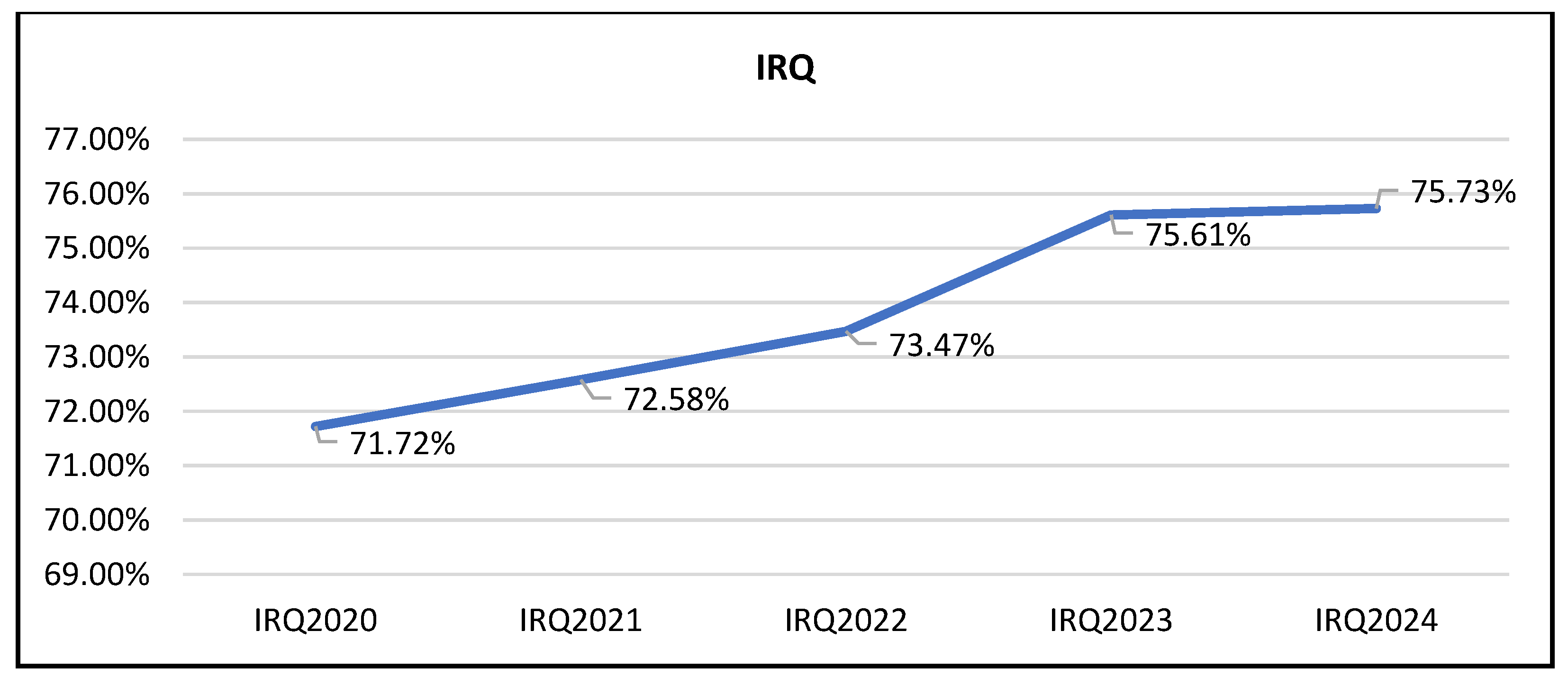
Firstly, the results of the average IRQ over the five-year period under review are presented in
Figure 2.
As shown in
Figure 2, the average IRQ scores demonstrated a consistent upward trend over the five-year period: 71.72% in 2020, 72.58% in 2021, 73.47% in 2022, 75.61% in 2023, and 75.73% in 2024. This progression reflects a significant improvement in the quality of content disclosures within the integrated annual reports of companies listed on the JSE between 2020 and 2024. Moreover, these scores substantially exceed those reported by
Chikutuma (
2019), who documented mean annual IRQ scores of 52.45% in 2013, 58.48% in 2014, 64.72% in 2015, and 68.29% in 2016 among JSE-listed companies. The current study’s scores also surpass those reported by
Islam (
2021), who observed mean scores of 65.97% in 2016 and 65.83% in 2017, followed by a marked increase in 2018, exceeding the 70.00% threshold for a sample of 20 firms listed on the Dhaka Stock Exchange from 2015–2018.
The high IRQ score observed in this study may be due in part to the fact that several universities in South Africa are now offering comprehensive academic programs in IR. These programs have equipped report preparers with the necessary skills and competence to produce high-quality integrated reports (
Oben, 2025). The upward trend in IRQ observed in our study could also be attributed to the accumulated experience of JSE-listed entities in preparing Integrated Annual Reports over time (
Chikutuma, 2019). It is also possible that the introduction of the revised IIRF in 2021 contributed to this positive development. This upward trend suggests that companies are increasingly articulating their value creation capabilities in a manner that aligns with their unique business contexts (
EY, 2024). The observed positive trend in overall mean IRQ scores over the five years supports the fundamental principles of stakeholder theory, which suggest that companies can enhance the quality of their integrated reports to address the informational needs of key stakeholder groups, as well as provide a holistic view of the companies’ ability to generate long-term value for all stakeholders (
IIRC, 2021;
Karim et al., 2024;
Kılıç et al., 2021;
Mokabane & du Toit, 2022;
Sun et al., 2022;
Wahl et al., 2020).
4.1. Descriptive Statistics
Focusing on the dependent variable IRQ, the minimum recorded score was 20.70%, while the maximum reached 95.90%, indicating a substantial range between these two extremes, as shown in
Table 6. This variation suggests that while some companies in the sample demonstrate near-complete compliance with the IIRF, others fall significantly behind. A plausible explanation for this discrepancy is that companies with a primary listing on the JSE are required to prepare integrated reports, while those with a secondary listing do so voluntarily. The mean IRQ score of 73.8230% indicates a central tendency around which the data are concentrated, suggesting that, on average, the quality of integrated reports among the sampled JSE-listed firms is relatively high compared to previous studies, such as those conducted in South Africa (see
Bondar et al., 2024;
Boujelben et al., 2024;
Eloff & Steenkamp, 2022;
Mans–Kemp & van der Lugt, 2020;
Marrone & Oliva, 2020;
Mokabane & du Toit, 2022;
Toerien et al., 2023),
Islam (
2021) in Bangladesh,
Sun et al. (
2022) in China and
Nada and Győri (
2023) in Europe. The standard deviation of 16.71156 for IRQ also reflects considerable variability in compliance with the IIRF among the sampled companies.
The board size ranges from a minimum of 4 members to a maximum of 22, with an average board size of 10.8091 members and a standard deviation of 3.24050. These findings indicate that, on average, the sampled companies comply with Section 66 of the South African Companies Act 71 of 2008, which requires public companies to have at least three directors. Regarding board independence, the average number of independent directors is 6.7218, with values ranging from two to fifteen members and a standard deviation of 3.11248.
In terms of gender diversity, the boards include an average of 3.6709 female members, ranging from 1 to 8 members, with a standard deviation of 1.61923. This highlights a significant lack of gender diversity in the board compositions of certain companies listed on the JSE. The size of the audit committees varies from two to ten members, with an average of 3.9255 and a standard deviation of 0.94468. These findings indicate that, on average, the companies comply with the requirements of Section 94 of the Companies Act 71 of 2008, which mandates that audit committees consist of at least three members.
Firm performance (PERF), operationalised as net profit after tax (net income) measured in millions of South African Rands at the end of each financial year under review, provides insights into the financial performance of the sampled companies. The mean PERF is reported as R5,748.6906 million, serving as an indicator of overall profitability. The standard deviation of PERF, calculated at R49,067.86274 million, reflects substantial variability in net profit after tax across the firms, indicating a wide dispersion in financial performance. The minimum and maximum PERF values are −R707,583.00 million and R517,643.10 million, respectively, facilitating the identification of firms with the lowest and highest net profits and enabling a comprehensive evaluation of the heterogeneity in their financial performance.
In terms of firm size, the market capitalisation ranges from a minimum of R0.03 billion to a maximum of R2343.80 billion, with a mean value of R65.6308 billion. The standard deviation of R234.68469 billion reflects considerable heterogeneity in firm size within the sample. Regarding firm age (FAGE), the sample encompasses firms aged between 4 and 82 years, with an average age of 27.8250 years. This suggests that the firms included in the study are relatively mature, with a mean operational duration of approximately 28 years. The standard deviation of 21.10952 years denotes substantial variability in the length of time these firms have been listed on the JSE.
4.2. Hypothesis Testing
4.2.1. Correlation Analysis
Since the dependent variable (IRQ) was measured on an ordinal scale and the independent variables were continuous, we employed Pearson correlation analysis to evaluate the strength and direction of the linear relationships between these variables. The results of the Pearson correlation matrix for the variables studied are presented in
Table 7. A statistical significance level of 1% (
p < 0.01) is indicated by **, and significance at the 5% level (
p < 0.05) is denoted by *.
All the independent variables, BSIZE (r = 0.216), BINDP (r = 0.191), BGDIV (r = 0.200), and ACSIZE (r = 0.101), show very weak positive correlations with the dependent variable IRQ. These results suggest that companies with large board size, independence and audit committee size are likely to produce high-quality integrated reports. A large board size and audit committee size, as well as the presence of independent members on the board, may have greater collective oversight and monitoring capabilities, as highlighted by agency theory. This observation is consistent with the findings of
Songini et al. (
2022), who reported a weak positive statistical relationship between IRQ and both BSIZE and BINDP, while revealing a negative association between BGDIV and IRQ.
The positive statistical relationship between IRQ and FSIZE (r = 0.194) and FAGE (r = 0.084) suggests that larger and older companies in this sample are more likely to comply with the IIRF by producing high-quality integrated reports. In contrast, the variable PERF did not show any statistically significant associations with IRQ. This suggests that the financial performance of JSE-listed firms may not directly impact the quality of the integrated reports produced by these companies. These findings align with those of
Senani et al. (
2024), who discovered that profitability (financial performance) does not have a systematic or significant relationship with IRQ. This underscores the complexity of compliance determinants, which are influenced by multiple factors rather than solely by any single governance or firm characteristic. Further regression analysis is warranted to isolate the predictive effects of these variables.
4.2.2. Multivariate Regression Analysis
The study uses a linear regression model to examine the relationship between the dependent variable IRQ and the independent variables BSIZE, BINDP, BGDIV and ACSIZE. Model 1 examines the relationship between board composition and IRQ. In contrast, Model 2 evaluates the moderating effect of firm performance on the association between board composition and IRQ among firms listed on the JSE. The results are presented in
Table 8 and
Table 9, respectively.
Consistent with the Pearson correlation results reported in
Table 7, board size (BSIZE) exhibits a positive and statistically significant relationship with IRQ (
p = 0.039), with a coefficient of 0.713 at the 5% significance level. This supports hypothesis H1, which posits a positive and statistically significant association between board size and IRQ among JSE-listed companies. These findings indicate that firms with larger boards tend to produce higher-quality integrated reports than those with smaller boards.
Board independence, with a coefficient of 0.299, does not show a statistically significant relationship with IRQ (p = 0.403). In contrast, board gender diversity has a positive and statistically significant association with IRQ, indicated by a coefficient of 0.976 and a significance level of 10% (p = 0.060). This finding is further supported by correlation analysis, which demonstrates a positive correlation between BGDIV and IRQ (r = 0.200) at the 1% significance level. These results suggest that firms with greater female representation on their boards tend to produce higher-quality integrated reports. Conversely, the size of the audit committee does not show a statistically significant relationship with IRQ (p = 0.181).
The regression analysis resulted in an R-squared value of 0.056 and an adjusted R-squared of 0.049, indicating that the independent variables explain a small portion (5.6%) of the variance in the dependent variable. This suggests that there are likely other factors, not included in this study, influencing IRQ. The F-statistic was F(4, n) = 8.146, with a significance level of p < 0.001, indicating that the independent variables significantly predict the dependent variable, which confirms the overall suitability of the regression model for the data. These results imply that the model is modestly effective in explaining the variability in IRQ compared to a null model that lacks predictors.
4.2.3. Robustness Analysis: Moderating Role of Firm Performance
To further validate our findings, additional analyses were conducted to explore the moderating effect of firm performance on the relationship between independent board composition (BSIZE, BINDP, BGDIV, and ACSIZE) and IRQ. The overall model was significant (
p < 0.001) and explained 5.65% of the variance in IRQ. Given the significance of the regression tests, we employed the PROCESS Procedure for SPSS Version 5.0. These findings support the robustness of our results. Following the approach of
Amanamah (
2024),
Bui and Krajcsák (
2024), and
Mshana et al. (
2025), we excluded control variables and re-estimated the empirical regression model. Importantly, our analysis showed that the control variables did not influence the primary results, confirming the stability of all research variables, as presented in
Table 8.
The results in
Table 9 demonstrate that the effects of all variables remain consistent with those reported in
Table 8, indicating a direct, positive, and significant association between the independent variable BIZE and IRQ (coefficient = 0.7142,
p = 0.0388) without the moderation of performance (PERF). Additionally, these results support the conclusions of
S. Chouaibi et al. (
2022), whose empirical study identified a positive and significant relationship between the total number of board directors and IRQ. BINDP does not show a significant unique effect on IRQ in this model (
p = 0.4111). Additionally, the results reveal that the direct effect of BGDIV is positive and statistically significant (
p = 0.0620) at the 10% level, with a confidence interval of 0.9703. Furthermore, ACSIZE does not exhibit a significant unique effect on IRQ in this model (
p = 0.4111). However, there was no evidence of moderation, suggesting that firm performance does not moderate the relationship between board composition and IRQ.
5. Discussion
This study examines the relationship between board composition and IRQ and whether this relationship is moderated by firm performance. The findings indicate a positive trend in the quality of content element disclosures within the integrated annual reports of companies listed on the JSE from 2020 to 2024. This upward trend in IRQ can be attributed to the incorporation of key elements of integrated reporting, including governance, risk management, and strategic management, into the accounting curriculum in South African universities (
Oben, 2025). This integration may have equipped preparers of integrated reports with the skills and knowledge necessary to produce high-quality reports (
Oben, 2025).
The empirical evidence reveals that various board characteristics do not uniformly impact the quality of integrated reports issued by JSE-listed companies. The variables board size (BSIZE) and board gender diversity (BGDIV) are seen to have a substantial impact, serving as important factors influencing IRQ.
The observed positive and significant relationship between board size and IRQ suggests that board size serves as an effective governance mechanism for overseeing IR. This finding implies that board members may place greater emphasis on information relevant to IR. These results align with prior research (
Amanamah, 2024;
Cooray et al., 2020;
Devarapalli & Mohapatra, 2024;
Mawardani & Harymawan, 2021;
Mohammadi et al., 2021;
Qaderi et al., 2022), which similarly identified a significant positive relationship between board size and IRQ across various national contexts. This finding aligns with agency theory, which suggests that board size is an indicator of managerial competence and reflects effective monitoring practices. These practices help mitigate information asymmetry and agency conflicts between managers and stakeholders (
Cooray et al., 2020). Ultimately, enhanced transparency contributes to reducing information asymmetry, lowering agency costs, and decreasing the cost of capital (
Pozzoli et al., 2022). From the perspective of stakeholder theory, the positive and significant association between board size and IRQ may be attributed to stakeholders relying more heavily on publicly available information, which is enhanced by direct insights from the board.
The statistically significant positive association between board gender diversity and the quality of integrated reports among companies listed on the JSE indicates that firms with a higher proportion of female board members tend to produce integrated reports of better quality. These findings are consistent with prior research conducted in South Africa by
Toerien et al. (
2023), which also identified a positive relationship between female board representation and both the extent and quality of corporate disclosures. This evidence further supports stakeholder theory, which posits that including female directors enhances a company’s ability to be attentive to and responsive to the needs and expectations of its stakeholders (
Denhere, 2024). From the perspective of agency theory, an increase in female representation on corporate boards may help reduce information asymmetry and improve societal legitimacy (
Mazumder, 2024;
Mazumder & Hossain, 2023).
Conversely, the board is independent, and the audit committee does not have a direct and statistically significant influence on IRQ. The absence of a significant direct impact of board independence and audit committee size on IRQ may stem from the limited involvement of independent directors and the audit committee in the firm’s reporting activities. Independent directors and audit committee members are typically less engaged in the day-to-day operations (
Anojan, 2024;
Fun et al., 2023;
Qaderi et al., 2024). Supporting this perspective, it is believed that board independence and the audit committee enhance accountability, which is likely to lead to an increase in corporate disclosure. In contrast, agency theory emphasises the important role of board composition, particularly the inclusion of independent non-executive directors, in achieving effective corporate governance (
Akhter, 2019).
Furthermore, there was no evidence of moderation, suggesting that firm performance does not moderate the relationship between board composition and IRQ.
6. Conclusions
The findings of this study highlight the significant impact of board composition on the quality of IR. Specifically, the research shows that board size and diversity are more influential predictors of IRQ among JSE-listed companies than board independence and the existence of an audit committee. The findings reveal that firm performance does not serve as a moderator in this relationship.
Specifically, an increased number of board members contributes to greater diversity in expertise and experience, which can influence managers’ voluntary disclosure decisions, ultimately enhancing the quality of disclosures. Some scholars argue that larger boards improve the effectiveness and efficiency of board functions, leading to greater corporate transparency and superior disclosure practices (
S. Chouaibi et al., 2022;
Denhere, 2024). While not mandatory, board characteristics such as board size and gender diversity are recommended as best practices in the guidelines outlined by the King V Report on Corporate Governance (
IoDSA, 2025). Overall, the results indicate that when forming an effective board, prioritising size and gender diversity among its members is essential. This diversity is likely to improve IRQ, as IR is a novel and complex process that requires a mindset distinct from traditional disclosure practices.
This study provides several practical insights for the IIRC, stock exchanges, financial capital providers, and those preparing integrated reports, whether the reporting is mandatory or voluntary. Consistent with prior research (
Denhere, 2024;
Qaderi et al., 2024 Samy & Mohamed, 2024), high-quality integrated reports help to build investor confidence and significantly impact investment decision-making processes. Therefore, companies should implement appropriate measures to enhance the quality of their integrated reports, ensuring their usefulness for investors.
Furthermore, these findings have significant implications for policymakers regarding regulations on board composition. The results indicate a positive correlation between board size and the quality of IR. This suggests that larger boards can more effectively oversee management performance, thereby reducing the risk of opportunistic managerial behaviour. Such governance oversight is essential in minimising information asymmetry between management and investors. Additionally, larger boards tend to include a wider range of expertise across various disciplines, allowing them to leverage collective knowledge, skills, and networks. This diversity facilitates the integration of external stakeholder perspectives into corporate decision-making. For instance, a larger board may prioritise incorporating both financial and non-financial performance indicators to promote value creation over short-, medium-, and long-term horizons.
Policymakers should recognise the positive impact of gender diversity on the quality of IR. This study recommends that stock exchanges and regulatory authorities consider implementing policies that establish minimum thresholds for both the total number of board members and the representation of female directors for companies seeking listing. The evidence supports increasing female representation on corporate boards, as female directors offer unique perspectives that enhance board dynamics compared to their male counterparts. This diversity is expected to improve the quality of IR and contribute to advancing SDG 5, which focuses on gender equality (
Denhere, 2024). The findings encourage firms to develop gender-diverse boards not simply to meet regulatory requirements or address stakeholder legitimacy concerns (such as quotas), but through proactive corporate decisions aimed at appointing skilled and well-educated women who can offer unique contributions to board activities.
The current study acknowledges several limitations that should be addressed in future research. First, the IRQ assessment disclosure indices used to evaluate the extent and quality of content in integrated reports were developed by the researchers. This may introduce bias or subjective interpretation. This limitation is consistent with previous studies that have also employed self-constructed indices to assess IRQ (
Mwangi et al., 2024;
Nada & Győri, 2023). However, these self-developed disclosure indices were validated by external experts who evaluated their face and content validity.
Moreover, this investigation focuses solely on the impact of board composition on IRQ, specifically analysing board size, board independence, board gender diversity, and the audit committee. To obtain a more comprehensive understanding of the factors influencing IRQ, future research should incorporate cross-national perspectives on corporate governance mechanisms. It should also examine the economic, legal, and regulatory environments, national cultural contexts, and levels of professionalisation in which organisations operate.
While the regression model for this study includes firm size and age as control variables, future research should consider adding other standard control variables, such as leverage, profitability, or industry type. Including some of these additional variables could improve the model specification and potentially strengthen the explanatory power of the relationship between board composition and IRQ.