Article

Financial Document Authentication and Verification Using Hierarchical Tokenization on Permissioned Blockchains


1
Department of Computer and Information Sciences, Towson University, Towson, MD 21252, USA
2
Department of Business Analytics and Technology Management, Towson University, Towson, MD 21252, USA
*
Author to whom correspondence should be addressed.
J. Risk Financ. Manag. 2026, 19(4), 239; https://doi.org/10.3390/jrfm19040239
Submission received: 18 February 2026 / Revised: 11 March 2026 / Accepted: 17 March 2026 / Published: 25 March 2026
(This article belongs to the Section Financial Technology and Innovation)

Abstract

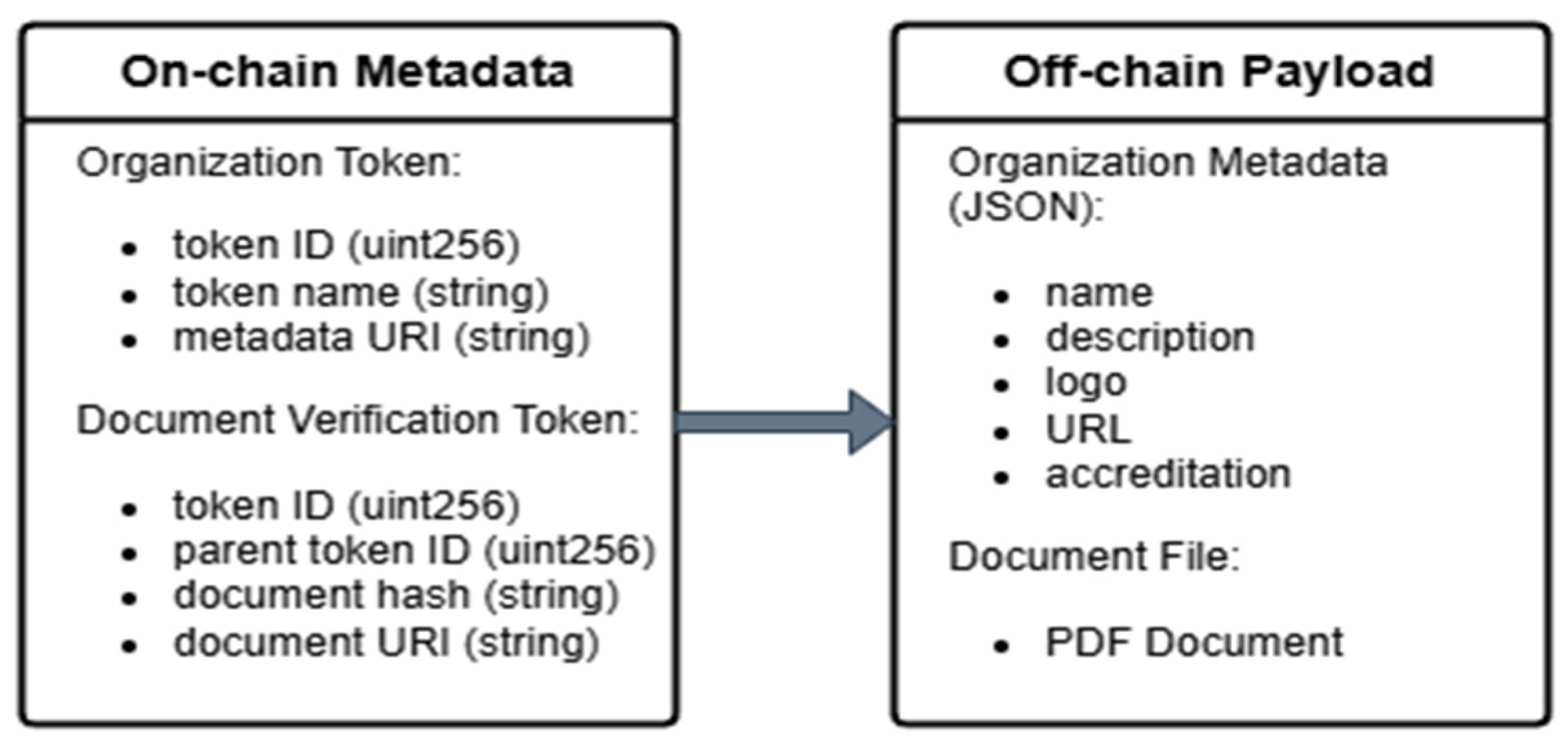
Document authentication remains a pressing challenge in various domains, including financial services, academic credentialing, healthcare, and supply chain management. Existing centralized verification systems are vulnerable to manipulation, inefficiency, and limited transparency. Blockchain technology, with its immutability and tamper-resistant capabilities, offers a strong decentralized alternative; however, many current implementations lack structured, issuer-bound relationships for documents. This paper proposes a blockchain-based model that leverages a hierarchical token structure to authenticate and trace the provenance of high-value digital documents, with a focus on financial records. The model introduces the concept of an issuer-bound parent token and document-linked child tokens, enforcing a structured trust relationship between a legitimate institution and the documents it issues. By combining on-chain cryptographic hashing with off-chain file references, the approach is designed to balance verifiability with scalability. We implement a proof-of-concept using Ethereum-compatible smart contracts on a permissioned blockchain and evaluate it in a consortium-style financial setting. Our functional analyses demonstrate the model’s ability to ensure document integrity, provenance, and resistance to document fraud. This work offers a practical and extensible foundation for secure digital document authentication and verification in financial and other trust-sensitive settings.
Keywords: permissioned blockchain; document authentication; document verification; hierarchical tokenization; provenance; non-transferable tokens; smart contracts; ERC-6150 permissioned blockchain; document authentication; document verification; hierarchical tokenization; provenance; non-transferable tokens; smart contracts; ERC-6150