1. Introduction
Globalization has profoundly reshaped the way multinational corporations (MNCs) design and implement their corporate and tax strategies. Increased trade liberalization, financial integration, and capital mobility have intensified cross-border economic activity, allowing firms to operate seamlessly across multiple jurisdictions. However, despite this growing economic integration, national tax systems remain largely fragmented. Differences in tax rates, reporting requirements, anti-abuse rules, and transparency standards continue to reflect domestic political choices, institutional arrangements, and historical legacies. As a result, multinational enterprises operate within a disjointed fiscal landscape that creates both constraints and opportunities for strategic tax planning.
Within this context, transfer pricing has emerged as one of the central mechanisms through which MNCs allocate profits across countries. A substantial body of theoretical and empirical literature has examined transfer pricing as a tool for tax optimization. Early contributions, such as
Contractor (
2016) and
Melnychenko et al. (
2017), document the main techniques used by multinational firms to minimize their global tax burden. Other studies, including
Kopel and Löffler (
2023) and
Choe and Hyde (
2007), show how production location decisions combined with sophisticated transfer pricing strategies enable firms to arbitrage across tax jurisdictions. More focused empirical analyses, such as those by
Fonseca et al. (
2024) and
Novotný (
2008), assess the impact of these practices on firm profitability, foreign direct investment, and tax revenues in specific economic contexts. At the institutional level, the OECD and the European Union estimate that profit shifting through transfer pricing generates annual tax revenue losses amounting to tens of billions of euros (
Candau & Le Cacheux, 2018).
Recent estimates from international institutions underscore the macroeconomic relevance of transfer pricing practices. The OECD estimates that global revenue losses from base erosion and profit shifting range between USD 100 and 240 billion annually, corresponding to approximately 4–10% of global corporate income tax revenues (
OECD, 2023a). Within the European Union, the European Commission reports that aggressive tax planning, including transfer pricing mechanisms, continues to generate substantial fiscal spillovers across member states despite recent reforms (
Loretz et al., 2018). Similarly, IMF assessments highlight that profit shifting disproportionately affects countries with high inward foreign direct investment and complex multinational structures, reinforcing the importance of examining transfer pricing from a macroeconomic perspective (
International Monetary Fund Fiscal Affairs Department & International Monetary Fund Legal Department, 2019).
France, Germany, Spain, and the United Kingdom represent some of the largest and most influential economies in Europe, characterized by high levels of foreign direct investment, extensive multinational activity, and active engagement in international tax reform initiatives. These countries have been at the forefront of implementing OECD BEPS measures, strengthening transfer pricing documentation requirements, and enhancing tax enforcement, while continuing to face significant exposure to profit-shifting risks. Moreover, the post-crisis period and, in the case of the United Kingdom, the post-Brexit institutional environment, have introduced additional regulatory and strategic complexities that may affect transfer pricing behavior. Examining these jurisdictions jointly therefore provides a relevant and timely context for assessing how macroeconomic conditions shape transfer pricing incentives under contemporary policy frameworks.
Despite this extensive literature, relatively little attention has been paid to the broader macroeconomic implications of transfer pricing practices. Most existing studies adopt a microeconomic perspective, relying on firm-level or case-based analyses that do not fully capture the aggregate dynamics linking transfer pricing to key macroeconomic variables such as foreign direct investment, economic growth, and tax revenues. This gap is particularly pronounced for OECD countries, which are among the most exposed to profit shifting yet remain underexplored from a macro-level empirical standpoint.
In addition, many of the econometric approaches used in prior research are not designed to simultaneously account for short-term adjustments, long-run structural relationships, and cross-country heterogeneity. As a result, the dynamic nature of transfer pricing behavior and its potential convergence patterns across similar economies remain insufficiently understood.
Against this background, the present study seeks to address a dual gap in the literature. First, it provides a macroeconomic assessment of transfer pricing behavior in advanced economies using aggregate data over an extended time horizon. Second, it applies dynamic panel econometric techniques, specifically, the Mean Group (MG) and Pooled Mean Group (PMG) estimators, to distinguish between country-specific short-run dynamics and common long-run relationships. This approach allows transfer pricing to be analyzed not only as a firm-level tax optimization strategy, but also as a phenomenon shaped by deeper structural and institutional forces affecting macroeconomic stability.
This study advances the existing literature by offering a timely macroeconomic reassessment of transfer pricing behavior in advanced European economies under contemporary regulatory conditions. Unlike much of the prior literature, which focuses on firm-level data or earlier regulatory regimes, this analysis captures recent developments such as the implementation of OECD BEPS measures, enhanced transparency requirements, post-crisis tax enforcement, and the post-Brexit institutional environment. By distinguishing between short-run fluctuations and long-run structural drivers using a dynamic panel framework, the study provides new insights into how transfer pricing incentives evolve over time. This perspective is particularly relevant given the increasing emphasis on coordinated international tax policies and the need to evaluate whether macroeconomic stability and investment dynamics continue to shape profit-shifting behavior in the current policy landscape.
By integrating fiscal, economic, and structural dimensions into a coherent analytical framework, this study contributes to recent work calling for a more systemic understanding of international tax planning in relatively transparent tax systems (
Moshenets et al., 2024;
Korol et al., 2022). It also responds to concerns raised by
Bärsch et al. (
2019), who argue that transfer pricing disputes are becoming increasingly complex and difficult to assess from a macroeconomic perspective.
Accordingly, the central research question guiding this study is the following: What macroeconomic and fiscal conditions are associated with short- and long-run transfer pricing behavior in advanced European economies, and how can these associations inform policy discussions aimed at mitigating profit shifting?
Beyond its theoretical contribution, this research offers relevant insights for public policymakers and tax authorities. By identifying macroeconomic environments that may facilitate or constrain transfer pricing aggressiveness, the findings provide indicative benchmarks for the design of anti-BEPS measures, international tax coordination, and administrative strategies that seek to balance fiscal consolidation with economic competitiveness.
In addition to its relevance for policymakers and tax authorities, this study is also of interest to international investors, financial analysts, and international organizations, for whom understanding the macroeconomic environments associated with profit shifting is essential for assessing investment risks, fiscal sustainability, and regulatory credibility.
4. Data and Methodology
This study uses panel data and an econometric approach to evaluate the effect of transfer pricing on macroeconomic indicators in a sample of developed nations (France, Spain, Germany, the United Kingdom, Italy, Portugal and The Netherlands) from 1985 to 2025.
The selection of the seven countries included in the sample is motivated by both economic and institutional considerations. These countries represent the largest and most internationally integrated European economies, accounting for a substantial share of intra-European trade, multinational activity, and cross-border capital flows. Their economic size and openness make them particularly relevant for analyzing transfer pricing dynamics, as profit-shifting strategies are more likely to emerge in highly integrated and multinational-intensive environments.
The primary data sources are World Bank Open Data and Eurostat, which provide harmonized and internationally comparable macroeconomic indicators for the selected countries. For the year 2025, official data were available for the majority of variables and countries at the time of collection. In cases where the 2025 observation was not yet released for a specific variable or country, the missing value was estimated using information from preceding years, based on observed historical trends and growth patterns within the same country. This approach was applied in a limited and clearly identified number of instances to maintain panel consistency. Importantly, the estimation procedure relied exclusively on past realized data and did not introduce external forecasts. To ensure that these estimated observations do not influence the results, robustness checks excluding the affected 2025 entries were performed, and the main findings remain qualitatively unchanged.
Following the methodology established by (
Pesaran et al., 1999), the research follows a structured process beginning with the identification of key variables, including dependent, independent, and control variables. The analysis then applies a Panel MG/PMG framework, incorporating unit root tests, model specification, and the estimation of Mean Group (MG) and Pooled Mean Group (PMG) models. This approach allows the study to capture both short-run dynamics, through error correction and immediate effects and long-run equilibrium relationships, providing insights into the enduring macroeconomic implications of transfer pricing practices. Finally, diagnostic procedures, such as multicollinearity test, cross-sectional dependence (CSD), and robustness checks, ensure the reliability and validity of the obtained results.
4.1. Preliminary Tests and Model Validity
Several diagnostic and pre-estimation tests are conducted to ensure the validity of the empirical strategy. Unit root tests are first employed to determine whether the variables exhibit stochastic trends, which helps identify the appropriate econometric specification and prevents spurious inference. Cointegration tests and the estimated error-correction term further assess whether a stable long-run relationship exists between transfer pricing behavior and its macroeconomic determinants. The magnitude and sign of the error-correction coefficient capture the speed at which deviations from the long-run equilibrium are corrected following short-run shocks.
Additional diagnostic tests, including cross-sectional dependence, correlation matrices and multicollinearity checks, are implemented to detect potential cross-unit correlations and excessive relationships among explanatory variables. To ensure the robustness of the empirical findings, alternative long-run estimators such as Fully Modified Ordinary Least Squares (FMOLS), Dynamic Ordinary Least Squares (DOLS), Canonical Cointegrating Regression (CCR), and Feasible Generalized Least Squares (FGLS) are applied, together with Driscoll–Kraay standard errors. Finally, Granger causality tests are conducted to explore the direction of causality between transfer pricing and its key macroeconomic determinants. Collectively, these procedures strengthen the reliability of the results and support consistent interpretation of both short-run dynamics and long-run determinants of transfer pricing behavior.
4.2. Data and Variable Construction
The analysis relies on annual data covering the period 1985–2025, yielding 40 observations per country, which represent the standard frequency for macroeconomic variables reported by international institutions such as the World Bank Open Data and the official website of the European Union Eurostat. Annual data are particularly appropriate for capturing structural relationships in fiscal and macroeconomic variables, which tend to adjust gradually over time.
Transfer pricing behavior is proxied by a composite indicator defined as:
The role of proxy 1 is not to measure firm-level transfer pricing manipulation directly, but to serve as a macro-structural indicator of potential tax base misalignment. Specifically, it captures the tension between a country’s export performance and its ability to translate economic activity into corporate tax revenues. In the absence of profit shifting and aggressive tax planning, higher export intensity should be associated with proportionately higher corporate tax receipts, reflecting taxable profits generated by export-oriented firms. The proxy therefore reflects the extent to which cross-border trade exposure translates into realized corporate tax capacity. A high value of the indicator signals a situation in which strong export activity coexists with relatively weak fiscal returns from corporate taxation, a pattern that may be consistent with transfer pricing practices and multinational profit shifting. Unlike firm-level measures, this proxy operates at the macroeconomic level and reflects structural discrepancies between real economic integration into global markets and domestic fiscal capacity. Similar macroeconomic approaches have been adopted in the literature to approximate profit shifting when microdata are unavailable, particularly in cross-country settings (
Crivelli et al., 2015;
Cobham & Janský, 2018;
Tørsløv et al., 2023).
The primary proxy used to capture transfer pricing activity remains subject to important limitations due to its indirect nature and its sensitivity to structural and institutional factors. Transfer pricing involving multinational enterprises is inherently difficult to observe and measure, particularly in transactions involving intangible assets and intra-group services. As emphasized in the (
OECD, 2017) Transfer Pricing Guidelines, the identification and valuation of intangibles and related intra-group transactions raise significant methodological challenges, since many valuable intangibles are not formally recorded or directly observable.
For this reason, a second proxy of Transfer Pricing is measured by:
This proxy is introduced as a second measure of transfer pricing. This indicator captures cross-border flows related to the use and transfer of intangible assets and intra-group royalties, which are widely recognized in the post-BEPS literature as major channels of profit shifting and transfer pricing practices (
Dischinger & Riedel, 2011;
Mutti & Grubert, 2009;
OECD, 2015). However, this proxy also remains indirect. Its variation may reflect differences in tax policy design, sectoral structure, incentive regimes, or reporting frameworks. Consequently, the results should be interpreted as indicative of macroeconomic conditions conducive to transfer pricing behavior rather than a quantitative measure of mispricing itself.
The set of explanatory variables includes foreign direct investment (FDI) as a % of GDP, the inflation measured by the GDP deflator (annual %), Control of Corruption, and the Exchange Rate expressed in U.S. Dollars. All variables included in the econometric estimations were transformed into natural logarithms prior to estimation, consistent with the ARDL–ECM framework. This logarithmic transformation was applied to stabilize variance, reduce potential heteroskedasticity, and allow the coefficients to be interpreted in elasticity terms. FDI captures cross-border investment activity and reflects the scale of multinational presence and capital mobility. Inflation, measured by the GDP deflator (annual %), reflects the overall change in price levels across the economy and captures broader macroeconomic stability conditions. Institutional quality is proxied by the control of corruption indicator, which reflects the extent to which public power is exercised for private gain and is widely used in cross-country empirical analyses. The exchange rate variable captures relative price competitiveness and external adjustment dynamics that may influence cross-border transactions and profit allocation behavior. Data are obtained from the World Bank’s World Development Indicators and Worldwide Governance Indicators databases.
Beyond capturing trade–tax imbalances, the transfer pricing indicators used in this study also provide a macro-level signal of fiscal elasticity in highly integrated economies. In structurally balanced systems, increases in international economic activity should normally be accompanied by proportional growth in corporate tax revenues over time. When this proportionality weakens persistently, it may indicate that the domestic tax base is not adjusting in line with real economic activity.
The use of two complementary proxies allows the analysis to capture different channels through which multinational profit allocation may occur, including both trade-related pricing mechanisms and intangible-based transfers. While these indicators do not directly prove aggressive transfer pricing at the firm level, they may reveal structural conditions under which multinational profit shifting becomes economically feasible.
4.3. Descriptive Statistics
As shown in
Table 1, the descriptive statistics indicate that the dataset contains 280 observations for each variable, confirming a balanced panel structure across countries and years. Transfer pricing proxy 1 (TP
1) exhibits a relatively high mean and a large standard deviation, indicating substantial variation across countries and over time. This suggests heterogeneous transfer pricing practices among multinational firms. The distribution is also highly skewed and non-normal, reflecting uneven profit-shifting intensity. In contrast, transfer pricing proxy 2 (TP
2) shows a lower mean but significantly higher skewness and kurtosis, indicating the presence of extreme values and stronger asymmetry. This suggests that TP
2 captures more concentrated transfer pricing activities in specific countries or periods. For both proxies, Foreign Direct Investment (FDI) and exchange rates display relatively high variability across the sample, whereas inflation and control of corruption show more moderate variation. Finally, the Jarque–Bera test confirms the presence of non-normality for both TP
1 and TP
2, a common feature in macroeconomic panel datasets.
4.4. Model Specification
The empirical model is formulated in an ARDL(p,q) framework for each country (i) and period (t):
where:
= transfer pricing variable for country i at time t
= vector of macroeconomic explanatory variables (FDI, GDP, Tax Revenue)
= country-specific effect
= error term
This model can be rewritten as an error correction model (ECM):
where
denotes the measure of transfer pricing behavior in country i at time t,
is a vector of macroeconomic determinants including foreign direct investment, Inflation, Control of Corruption, and Exchange Rate, and
is an error term. The coefficient φ
i < 0 captures the speed at which deviations from the long-run equilibrium are corrected, while θ represents the long-run elasticities linking macroeconomic fundamentals to transfer pricing behavior.
4.5. Stationarity Tests
Before estimation, the stationarity of the series is tested using the (
Pesaran, 2007)
CIPS second-generation panel unit root test and (
Maddala & Wu, 1999) Unit Root Test to account for potential cross-sectional dependence by augmenting individual regressions with cross-sectional averages.
This test is performed on level and first difference series, with or without trends, to determine the order of integration of the variables. This approach ensures that the panel does not contain variables integrated of order greater than one, a necessary condition for PMG/MG estimation (
Pesaran et al., 2001).
Table 2 reports the results of the Cross-sectionally Augmented Im–Pesaran–Shin (CIPS) unit root test. For Transfer Pricing Proxy 1 (TP
1), the results indicate that the variable is non-stationary at level but becomes stationary after first differencing. A similar pattern is observed for Transfer Pricing Proxy 2 (TP
2), which is also non-stationary in levels but becomes stationary after first differencing.
The explanatory variables display the same integration properties. In particular, Foreign Direct Investment, Inflation, Control of Corruption, and the Exchange Rate are all non-stationary at level but become stationary after first differencing, indicating that they are integrated of order one. Overall, these results indicate that most variables are integrated of order one, supporting the use of panel cointegration techniques in the subsequent analysis.
4.6. Cointegration Tests
Cointegration is a statistical property of time series variables where a linear combination of two or more non-stationary series creates another stationary time series. This idea, introduced by (
Engle & Granger, 1987), fundamentally reshaped the analysis of non-stationary data in economics and enabled the identification of long-run equilibrium relationships even when individual series turn out to be non-stationary.
When the variables are integrated of order I(1) or a mixture of I(0)/I(1), the existence of a long-run relationship is tested using the (
Kao, 1999), (
Pedroni, 1999) and (
Westerlund, 2007) panel cointegration tests. The Kao test is a residual-based approach derived from the Engle–Granger framework and evaluates whether the residuals from the hypothesized long-run panel regression are stationary, thereby providing evidence of cointegration across the panel.
The
Pedroni (
1999) test extends the Engle–Granger methodology by allowing for heterogeneity in both the intercepts and slope coefficients across cross-sectional units. It provides several within-dimension (panel statistics) and between-dimension (group statistics) tests, which examine whether a long-run equilibrium relationship exists while accounting for country-specific dynamics.
The
Westerlund (
2007) test is based on an error-correction model and directly evaluates the existence of cointegration by testing whether a meaningful error-correction mechanism is present. Unlike residual-based tests, it does not impose common factor restrictions and is more robust in the presence of cross-sectional dependence and heterogeneity. The rejection of the null hypothesis of no cointegration indicates that the variables share a stable long-run equilibrium relationship.
The cointegration literature has evolved from simple residual-based tests to sophisticated multivariate and panel techniques. The choice of methodology depends on the data structure, sample size, and the specific research question.
Table 3 reports the panel cointegration test results for both Transfer Pricing proxies.
For Proxy 1, the Pedroni, Kao, and Westerlund tests consistently reject the null hypothesis of no cointegration, confirming the existence of a stable long-run relationship between TP1 and its macroeconomic and institutional determinants.
For Proxy 2, the same cointegration tests also support the presence of a long-run equilibrium relationship between TP2 and the explanatory variables, although the strength of the evidence varies slightly across testing approaches.
These results confirm that both transfer pricing proxies are cointegrated with macroeconomic and institutional factors, justifying the estimation of long-run models.
when the variables are integrated of order I(1) and I(0), provided that a long-run relationship exists among them;
when cointegration is supported by residual-based panel tests (such as the Kao, Pedroni and Westerlund Tests).
when the estimated adjustment coefficient (ECM) is negative and significant, indicating convergence toward the long-run equilibrium.
The choice between PMG and MG depends on whether long-run slope homogeneity across countries is theoretically and empirically justified (favoring PMG) or whether long-run heterogeneity is preferred (favoring MG).
5. Results
5.1. Temporal Dynamics of Transfer Pricing
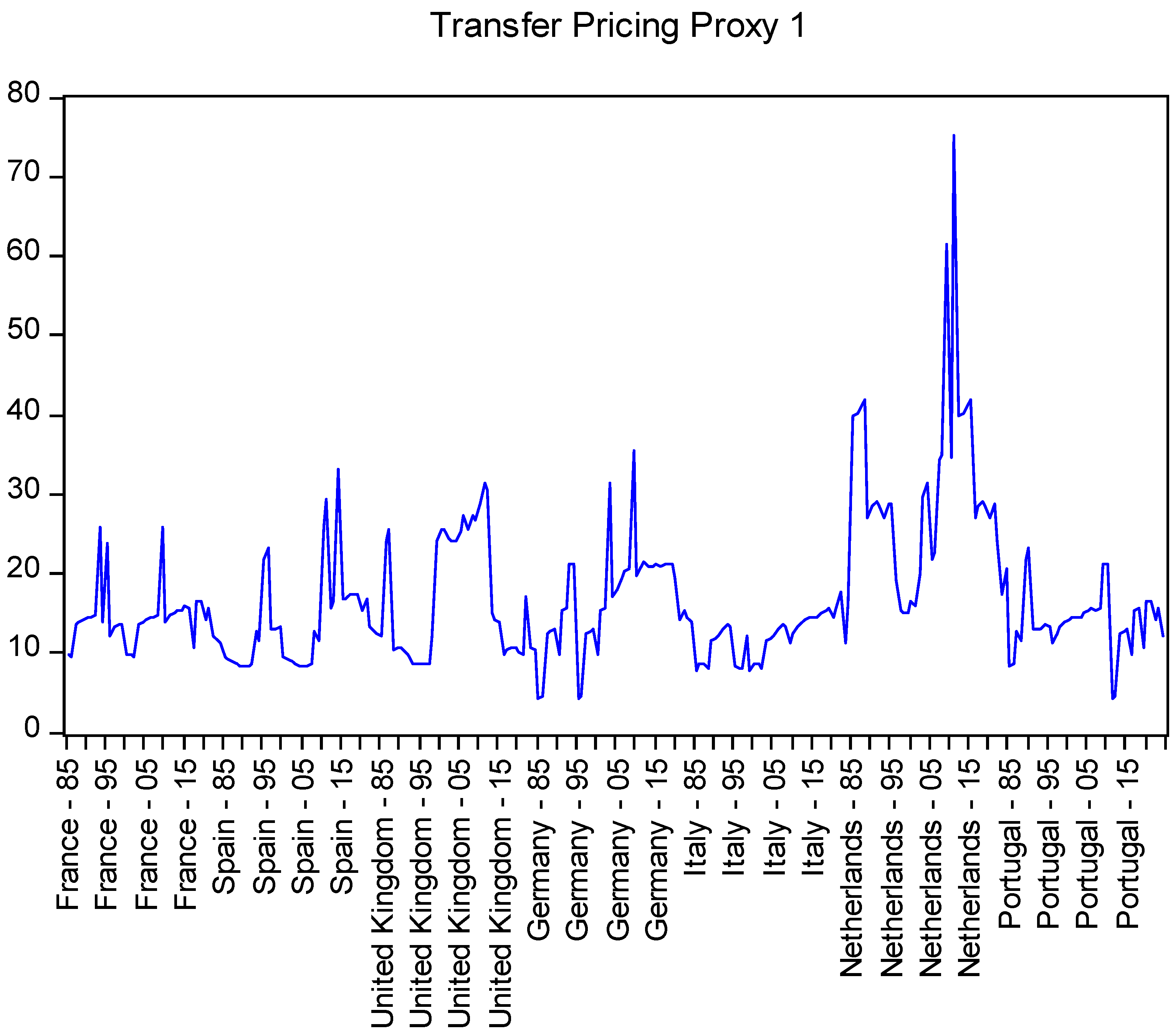
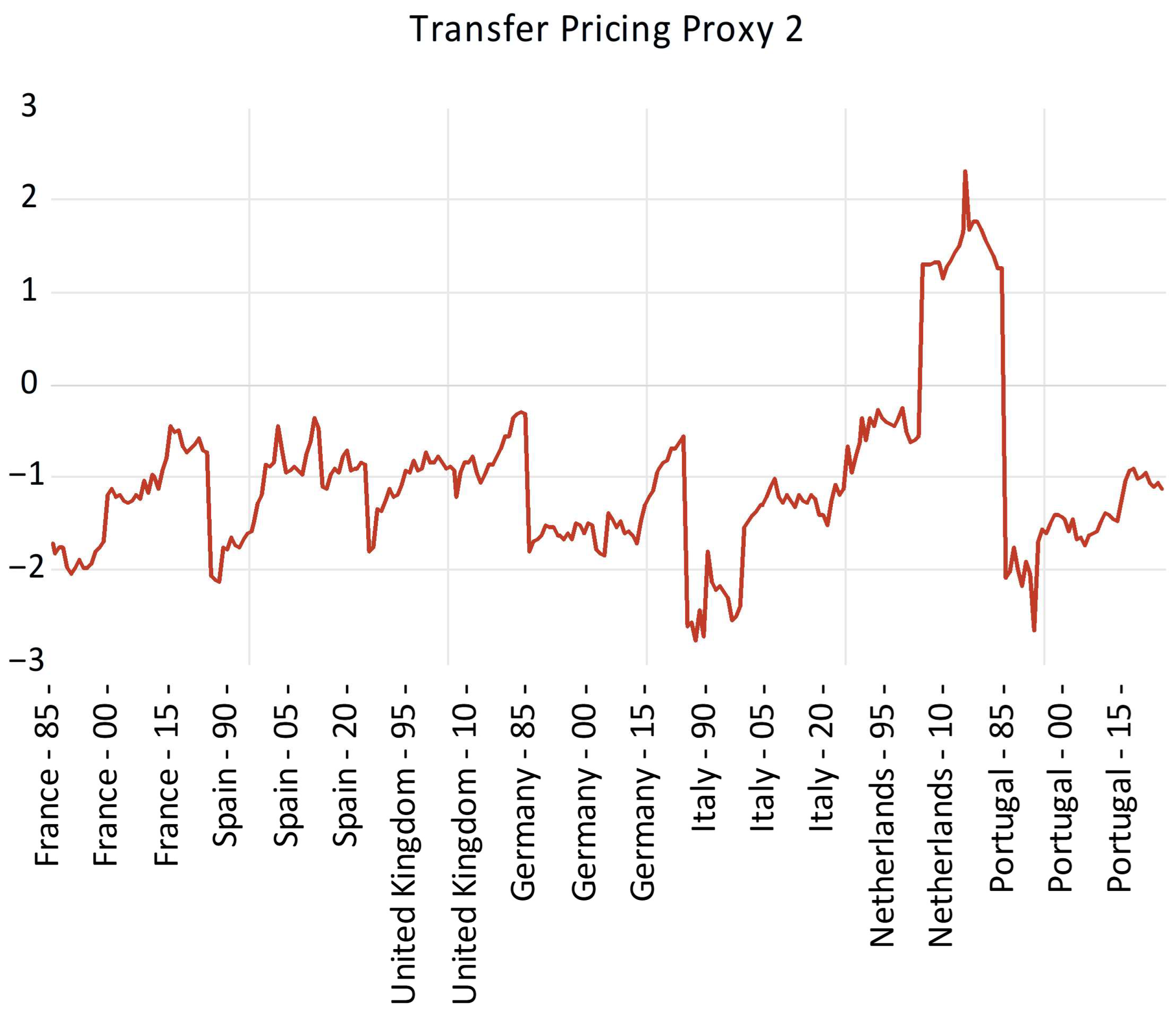
The graphical evolution of both transfer pricing proxies reveals substantial volatility, episodic spikes, and regime-like shifts across countries and over time. Neither series follows a smooth or steadily trending trajectory. Instead, both (Transfer Pricing Proxy 1) and (Transfer Pricing Proxy 2) display abrupt increases, sharp corrections, and clear structural breaks, particularly in jurisdictions often associated with international tax planning practices.
Proxy 1, constructed from the interaction between trade intensity and the corporate income tax base, exhibits pronounced amplitude in its fluctuations, reflecting structural imbalances between external economic integration and domestic fiscal capacity. Proxy 2 confirms the same underlying instability while moderating extreme values and highlighting proportional adjustments. The persistence of discontinuities in both representations suggests that the observed dynamics are not driven by scale effects alone, but reflect genuine structural shifts in profit shifting behavior.
As illustrated in
Figure 1 and
Figure 2, these patterns indicate that transfer pricing does not adjust proportionally to incremental macroeconomic changes. Rather, it appears to respond strategically when structural conditions such as high trade exposure, tax differentials, exchange rate misalignments, or institutional weaknesses reach critical thresholds. The consistency of non-smooth behavior across both proxies strengthens the argument that transfer pricing should not be modeled as a purely linear phenomenon.
While classical models of intrafirm pricing, such as (
Hirshleifer, 1956) and (
Horst, 1971), establish the theoretical incentive to shift profits under tax differentials, they do not imply constant marginal responses. Empirical evidence from (
Hines & Rice, 1994) and (
Clausing, 2003) shows that multinational firms react strategically and sometimes discontinuously to tax and macro-financial incentives. Moreover, the institutional channel emphasized by (
Dharmapala & Hines, 2009) suggests the existence of threshold effects, whereby deterioration in governance quality may generate disproportionate expansions in profit shifting.
5.2. Structural Breaks
The (
Bai & Perron, 2003) structural break test presented in
Table 4 reveals the presence of multiple structural changes in the relationship between transfer pricing and its determinants. The UDmax statistic is statistically significant, rejecting the null hypothesis of no structural break.
The estimated break (
Table 5) dates are located around 1990, 1998, and 2010, which coincide with major economic and institutional developments in Europe. The early 1990s correspond to the acceleration of European financial integration, while the late 1990s coincide with the introduction of the euro and deeper market integration. The break around 2010 likely reflects the effects of the European sovereign debt crisis and subsequent fiscal adjustments.
These results suggest that the determinants of transfer pricing may evolve over time in response to major macroeconomic and institutional changes.
5.3. Cross-Sectional Dependence and Slope Heterogeneity
Table 6 presents the results of the cross-sectional dependence and slope heterogeneity tests. These tests are conducted to assess whether shocks are correlated across countries and whether slope coefficients are homogeneous or heterogeneous within the panel.
For Proxy 1 TP1, the Pesaran cross-sectional dependence test for transfer pricing proxy 1 fails to reject the null hypothesis of cross-sectional independence in most specifications. This suggests that TP1 is primarily driven by country-specific determinants rather than common global shocks.
However, the Pesaran–Yamagata slope heterogeneity test strongly rejects the null hypothesis of homogeneous slope coefficients at the 1% significance level. This indicates that the impact of FDI, exchange rate, inflation, and corruption on TP1 differs across countries. Therefore, estimators allowing for heterogeneity, such as PMG and MG, are appropriate.
For Proxy 2 TP2, the Pesaran CD test provides evidence of cross-sectional dependence in several specifications. This suggests that TP2 is influenced by common shocks across countries, possibly reflecting global tax reforms, international financial crises, or coordinated multinational firm behavior. Similar to TP1, the slope heterogeneity tests strongly reject homogeneity for TP2. This confirms that long-run coefficients vary significantly across countries. The presence of cross-sectional dependence and heterogeneity justifies the use of second-generation panel estimators such as CCE-MG for TP2.
While TP1 appears to be more country-specific with limited cross-sectional interaction, TP2 exhibits stronger evidence of common shocks across countries. However, both proxies demonstrate significant slope heterogeneity, confirming that transfer pricing determinants differ across national contexts.
5.4. Test of Multicollinearity
The VIF values presented in
Table 7 are all very low (close to 1 and well below 5), confirming the absence of serious multicollinearity between the explanatory variables. This means that each variable contributes distinct information to the model and that the estimates are not biased by redundancies. These findings are consistent with the correlation matrix results (
Appendix A Table A1 and
Table A2), which reveal only weak to moderate pairwise correlations, further supporting the conclusion that multicollinearity does not pose a concern in the empirical specification.
5.5. Hausmann Test Estimation
Table 8 reports the Hausman test results for Transfer Pricing Proxy 1. The test fails to reject the null hypothesis, indicating that the PMG estimator is appropriate. This finding suggests the existence of homogeneous long-run relationships across countries, while allowing for heterogeneous short-run dynamics and speeds of adjustment.
Table 9 presents the Hausman test results for Proxy 2. In this case, the null hypothesis is rejected at the 1% significance level, implying that the MG estimator is more appropriate. This outcome indicates significant cross-country heterogeneity in the long-run coefficients when transfer pricing is measured using TP
2.
5.6. Long-Run Estimation Results
Table 10 reports the long-run estimation results. Inflation has a negative and statistically significant effect on TP
1, indicating that macroeconomic instability reduces transfer pricing incentives. Exchange rate depreciation also shows a negative effect, suggesting that currency instability discourages profit shifting. FDI exhibits mixed or weak effects depending on the specification, while corruption does not display consistent statistical significance. The error correction term is negative and significant, confirming the existence of a long-run equilibrium relationship and a relatively rapid adjustment toward equilibrium following short-run shocks. For completeness and comparative purposes, the Mean Group (MG) estimation results are reported in
Appendix A Table A3. Since the Hausman test indicates that the Pooled Mean Group (PMG) estimator is the preferred specification, the MG results are not presented in the main text but are provided in
Appendix A for reference and comparison, allowing to examine potential cross-country heterogeneity in the long-run coefficients.
Table 11 reports the long-run results for TP
2. FDI exhibits a positive and statistically significant effect in the long run, suggesting that a stronger multinational presence expands profit-shifting opportunities through intra-group transactions. In contrast, the short-run estimates indicate a negative and statistically significant effect, reflecting short-term adjustments before the long-run profit-shifting incentives fully materialize. Inflation shows a strong negative effect in the long run, indicating that higher inflation may increase macroeconomic uncertainty and operational costs, thereby discouraging transfer pricing activities.
In contrast, inflation and control of corruption exert a positive and statistically significant effect on TP2 in the long run, suggesting that macroeconomic conditions and institutional dynamics may create an environment that facilitates profit-shifting activities over time. In the short run, FDI shows a positive and statistically significant impact, indicating that increases in multinational investment can immediately expand opportunities for intra-group transactions, especially through the relocation and pricing of intangible assets.
In addition, the Pooled Mean Group (PMG) estimation results for Transfer Pricing Proxy 2 are reported in
Appendix A Table A4. As the Hausman test supports the use of the PMG estimator, this specification is retained as the preferred model. The corresponding results are therefore provided in
Appendix A to complement the main analysis and to offer additional insight into the long-run relationship.
As a robustness check, we employ the Common Correlated Effects Mean Group (CCE-MG) estimator (
Pesaran, 2006), which controls for cross-sectional dependence by incorporating cross-sectional averages of the variables to capture unobserved common factors. This estimator is particularly appropriate in the presence of cross-sectional dependence, as it controls for unobserved common factors by incorporating cross-sectional averages of the variables. In our case, the cross-sectional dependence test indicates significant dependence for Proxy 2, which justifies the use of the CCE-MG estimator. In addition, the Hausman test favors the Mean Group (MG) estimator over the Pooled Mean Group (PMG), suggesting that long-run coefficients differ across countries. Therefore, the CCE-MG specification provides a suitable framework to account simultaneously for cross-sectional dependence and parameter heterogeneity across panel units.
The Common Correlated Effects Mean Group (CCE-MG) test presented in
Table 12 indicate that inflation has a negative and statistically significant effect on transfer pricing, suggesting that higher inflation may reduce profit-shifting incentives by increasing macroeconomic instability and transaction costs. In contrast, foreign direct investment, exchange rate fluctuations, and control of corruption do not display statistically significant effects in this specification. However, the positive and highly significant coefficient of the lagged dependent variable indicates strong persistence in transfer pricing behavior, suggesting that past transfer pricing practices influence current profit-shifting dynamics.
5.7. Robustness Tests
Table 13 presents the long-run estimation results for Transfer Pricing Proxy 1 using FMOLS, DOLS, and FGLS estimators. The results show that exchange rate has a negative and significant effect under FMOLS and DOLS, while the FGLS estimator indicates a negative but insignificant impact. Inflation also displays a negative and significant relationship with transfer pricing in most specifications, suggesting that higher inflation may constrain trade-based profit shifting. Institutional quality (control of corruption) appears negative and significant under FMOLS and DOLS, indicating that stronger governance reduces opportunities for aggressive transfer pricing, although the FGLS result is insignificant. Finally, Foreign Direct Investment shows a positive and significant effect in most estimations, suggesting that expanding multinational investment networks increase opportunities for intra-group transactions and profit shifting. For completeness and robustness purposes, the results obtained from the Canonical Cointegrating Regression (CCR) estimator are also reported in
Appendix A Table A5.
Table 14 presents the estimation results for Transfer Pricing Proxy 2 using the same estimators. Exchange rate generally shows a negative relationship with transfer pricing, although the significance varies across models. Inflation exhibits mixed results, reflecting the complex pricing mechanisms associated with intangible assets. Institutional quality shows a negative and significant effect in several estimations, suggesting that stronger governance limits profit shifting through intellectual property channels. Foreign Direct Investment displays a positive relationship with transfer pricing, with significant effects in some specifications, indicating that multinational investment structures may facilitate profit shifting through intangible assets. To further ensure robustness, the results of the Canonical Cointegrating Regression (CCR) estimator are also reported as a complementary test in
Appendix A Table A5.
Table 15 presents the regression results estimated with Driscoll–Kraay robust standard errors, which account for cross-sectional dependence, heteroskedasticity, and serial correlation.
For Transfer Pricing Proxy 1, inflation has a negative and highly significant effect on transfer pricing, while control of corruption is also negatively significant at the 5% level. FDI shows a positive and significant effect, whereas the exchange rate is not statistically significant.
For Transfer Pricing Proxy 2, FDI and the exchange rate are highly significant determinants. FDI positively affects transfer pricing, while exchange rate depreciation reduces it. Control of corruption is only weakly significant, and inflation is not statistically significant.
Taken together, the results indicate that inflation is more relevant for Proxy 1, whereas FDI and exchange rate dynamics are more influential under Proxy 2.
5.8. Granger Causality Tests
Table 16 reports the Granger causality results for Proxy 1. The findings reveal a bidirectional causal relationship between Foreign Direct Investment and transfer pricing, indicating that foreign direct investment influences profit-shifting practices, while transfer pricing strategies may also affect investment flows. In addition, control of corruption weakly Granger-causes transfer pricing at the 10% significance level, suggesting a limited causal influence. However, no causal relationship is detected between transfer pricing and either inflation or the exchange rate.
Table 17 reports the Granger causality results for Proxy 2. The results again confirm a bidirectional causal relationship between Foreign Direct Investment and transfer pricing, reinforcing the interaction between multinational investment and profit-shifting behaviour. However, no significant causal links are found between transfer pricing and inflation, the exchange rate, or Control of corruption.
6. Discussion
Against a backdrop of intensified international tax reforms, including the OECD BEPS initiatives, enhanced transparency requirements, and evolving tax enforcement practices across Europe, it is important to reassess how transfer pricing behavior manifests at the macroeconomic level. The following discussion situates the empirical findings within this contemporary regulatory and institutional context.
The empirical findings provide robust evidence supporting the theoretical predictions of the international taxation and profit shifting literature. By combining heterogeneous panel estimators, multiple cointegration techniques, and several robustness checks, the analysis provides a comprehensive macro level perspective on the determinants of transfer pricing behavior. Overall, the results highlight the critical role played by macroeconomic conditions, institutional quality, and multinational investment dynamics in shaping profit shifting strategies.
From a methodological perspective, the econometric strategy adopted in this study is theoretically grounded. The use of heterogeneous panel estimators reflects the fundamental insight that multinational tax planning behavior varies significantly across countries. As emphasized by (
Pesaran & Smith, 1995), imposing slope homogeneity across heterogeneous economies can lead to biased and misleading estimates. Countries differ substantially in terms of regulatory frameworks, tax enforcement capacity, financial development, and exchange rate regimes. These structural differences imply that multinational enterprises operate within diverse institutional environments that influence the incentives and constraints associated with transfer pricing strategies. The slope heterogeneity tests confirm that the assumption of homogeneous responses across countries is not supported by the data. This finding is consistent with theoretical models of international tax competition.
Devereux et al. (
2008) argue that national tax systems interact with multinational corporate structures in ways that generate heterogeneous profit allocation patterns across jurisdictions. Consequently, allowing coefficients to vary across countries provides a more realistic representation of multinational behavior and improves the empirical identification of transfer pricing determinants.
The cointegration analysis provides further support for the existence of a stable long run relationship between transfer pricing and its macroeconomic and institutional drivers. The Pedroni, Kao, and Westerlund cointegration tests consistently indicate the presence of long run equilibrium relationships for both transfer pricing proxies. This finding suggests that multinational profit shifting behavior is not merely a short-term phenomenon driven by temporary fluctuations but rather reflects structural relationships between macroeconomic conditions, institutional quality, and multinational corporate strategies. The presence of a statistically significant and negative error correction mechanism further confirms this interpretation. The negative error correction coefficient implies that deviations from the long run equilibrium are gradually corrected over time. This dynamic adjustment process is consistent with theoretical models of multinational tax planning. Firms rarely adjust internal pricing structures instantaneously in response to economic shocks or policy changes. Instead, internal pricing decisions are embedded within broader strategic planning processes that involve financial restructuring, supply chain reorganization, and compliance considerations. Empirical evidence from (
Huizinga & Laeven, 2008) supports this interpretation. Their analysis demonstrates that multinational firms actively shift profits across jurisdictions in response to international tax differentials, but these adjustments occur progressively as firms adapt their internal accounting practices and corporate structures. Similarly, the (
OECD, 2015) emphasizes that profit shifting strategies evolve gradually as multinational firms respond to regulatory developments and enforcement initiatives.
Among the macroeconomic variables considered in the analysis, exchange rate dynamics emerge as an important determinant of transfer pricing behavior. Exchange rate fluctuations influence the relative valuation of cross-border transactions and therefore affect the geographical allocation of reported profits. This finding is consistent with the macro-financial channel of profit shifting identified in the literature.
Clausing (
2003) provides empirical evidence that multinational corporations manipulate intra-firm prices in order to shift income toward lower tax jurisdictions. Exchange rate movements can amplify this behavior by altering the profitability of intra-group trade flows. Similarly,
Cristea and Nguyen (
2016) show that multinational exporters adjust their internal export prices in response to currency fluctuations. By strategically modifying transfer prices, firms can reallocate profits across subsidiaries located in different jurisdictions.
The empirical results obtained using the first proxy provide partial support for this theoretical mechanism. The PMG estimation indicates a positive but statistically insignificant relationship between exchange rate movements and transfer pricing. However, alternative long-run estimators, including FMOLS, DOLS, and CCR, reveal a negative and statistically significant effect of the exchange rate, suggesting that currency fluctuations may reduce the intensity of trade-based transfer pricing in the long run. The robustness checks produce more mixed evidence. While the FGLS estimator also reports a negative but statistically insignificant coefficient, the Driscoll–Kraay estimator indicates a positive and insignificant relationship. Despite these differences across estimators, the predominance of negative coefficients in the long-run estimations suggests that exchange rate dynamics may influence multinational profit allocation by affecting cost structures, trade competitiveness, and the valuation of intra-group transactions. This finding suggest that exchange rate effects operate primarily through long-run structural adjustments rather than short-run responses. Multinational firms appear to incorporate exchange rate expectations into medium-term financial planning and internal pricing strategies rather than reacting immediately to short-term currency volatility. Transfer pricing decisions are therefore embedded within broader strategic frameworks of multinational tax planning rather than reflecting purely opportunistic reactions to temporary exchange rate shocks.
Inflation also plays a relevant role in explaining transfer pricing behavior under the first proxy specification. The empirical results indicate a predominantly negative and statistically significant relationship between inflation and transfer pricing. In particular, the PMG estimation shows a negative and highly significant coefficient at the 1% level, suggesting that higher inflation reduces the intensity of trade-based transfer pricing in the long run. This result is further confirmed by the robustness estimations, where inflation remains negative and significant in FMOLS, DOLS, CCR and FGLS specifications. Similarly, the Driscoll–Kraay estimator reports a negative and statistically significant coefficient. These findings suggest that inflation may act as a macroeconomic constraint on transfer pricing strategies by increasing production costs, price volatility, and macroeconomic uncertainty, which can limit the flexibility of multinational enterprises to manipulate intra-group prices. This interpretation is consistent with the broader literature indicating that stable macroeconomic environments facilitate complex internal pricing strategies, while macroeconomic instability may reduce firms’ ability to engage in aggressive profit shifting (
Clausing, 2003;
Cristea & Nguyen, 2016).
Institutional quality also emerges as an important determinant of transfer pricing activity. In particular, stronger control of corruption is generally associated with lower levels of profit shifting. This result is consistent with the institutional theory of tax avoidance. According to (
Dharmapala & Hines, 2009) and (
Bakke et al., 2019), weak governance environments reduce the expected cost of aggressive tax planning by lowering the probability of detection and enforcement. When institutional oversight is weak, multinational firms face fewer constraints when manipulating intra-firm prices or exploiting regulatory loopholes. Conversely, stronger governance institutions increase transparency and strengthen tax enforcement mechanisms.
Johannesen et al. (
2020) provide empirical evidence showing that multinational profits tend to concentrate in jurisdictions characterized by weak transparency and limited regulatory capacity. The empirical results of this study provide partial support for this theoretical expectation. The PMG and FGLS estimations indicate a positive but statistically insignificant relationship between control of corruption and transfer pricing. However, alternative estimators, including FMOLS, DOLS, CCR, and the Driscoll–Kraay estimator, reveal a negative and statistically significant relationship. These results suggest that improvements in institutional quality can act as a structural constraint on aggressive profit-shifting strategies, although the magnitude of the effect may vary across econometric specifications. The gradual nature of institutional effects is also noteworthy. Institutional reforms rarely produce immediate behavioral changes among multinational firms. Instead, improvements in governance tend to generate cumulative effects over time by increasing audit probabilities, strengthening regulatory frameworks, and reducing informational asymmetries between firms and tax authorities. The dynamic adjustment observed in the empirical results is consistent with this gradual institutional transformation process, where stronger governance progressively limits the scope for multinational enterprises to manipulate intra-group pricing strategies (
Marques & Pinho, 2016).
Foreign Direct Investment also plays a significant role in shaping transfer pricing dynamics. The short-run relationship between FDI and transfer pricing suggests that expanding multinational investment networks creates additional opportunities for intra-group transactions. As multinational firms expand their global operations, internal supply chains become increasingly complex. This complexity increases managerial discretion in setting internal prices and therefore expands the scope for strategic profit allocation. This mechanism is consistent with the transactional complexity hypothesis proposed in the international taxation literature.
Hines and Rice (
1994) demonstrate that multinational firms concentrate profits in low-tax jurisdictions by exploiting internal pricing mechanisms. As cross-border investment expands, the number of intra-firm transactions increases, creating additional channels through which profits can be shifted across jurisdictions. The empirical results of this study provide substantial support for this interpretation. The PMG estimation indicates a positive and statistically significant effect of FDI on transfer pricing at the 10% level, suggesting that increases in multinational investment are associated with greater opportunities for profit shifting. This result is largely confirmed by the robustness estimations. Both DOLS and CCR estimators reveal a positive and statistically significant relationship between FDI and transfer pricing, while the FMOLS estimator reports a positive but statistically insignificant effect. Similarly, the FGLS and Driscoll–Kraay estimators indicate a positive and significant impact of FDI on transfer pricing.
Taken together, these results suggest that expanding multinational investment networks tends to intensify intra-group transactions and increase the scope for strategic profit allocation across jurisdictions. However, while FDI appears to act as an important driver of transfer pricing activity, its role may be better interpreted as an enabling factor that amplifies profit shifting opportunities rather than as a purely structural determinant. Once multinational corporate structures stabilize, long-run profit allocation patterns appear to depend more strongly on broader macroeconomic conditions and institutional quality.
The analysis of the second proxy provides additional insights into contemporary profit shifting strategies. Proxy 2 captures the intangible channel of profit shifting by focusing on intellectual property-related payments. This dimension has become increasingly important in the modern digital economy. Digital business models rely heavily on intangible assets such as patents, algorithms, trademarks, and proprietary software. These assets can be legally located in jurisdictions that differ from the locations where real economic activity occurs. This separation between the legal ownership of intangible assets and the geographical location of production creates significant opportunities for multinational profit shifting.
Dischinger and Riedel (
2011) show that multinational firms strategically relocate intellectual property to low-tax jurisdictions in order to minimize global tax liabilities. More recent research by (
Tørsløv et al., 2023), estimates that a substantial share of global corporate profits is currently recorded in tax havens through such intangible asset structures. Theoretical models also suggest that multinational firms may strategically determine the location of intangible assets in order to balance tax minimization and operational efficiency, reinforcing the central role of intellectual property in transfer pricing strategies (
Reineke & Weiskirchner-Merten, 2021).
Interestingly, the empirical results reveal clear differences between the two transfer pricing proxies. While the first proxy captures trade-based transfer pricing within multinational supply chains, the second proxy reflects the intangible channel associated with intellectual property payments. Under Proxy 2, exchange rate effects appear weaker and less consistent: the MG estimation reports an insignificant effect, while FMOLS, DOLS, CCR, FGLS, and Driscoll–Kraay estimations generally indicate a negative relationship. This suggests that currency fluctuations may influence the valuation of intellectual property and royalty payments, although less systematically than in trade-related transfer pricing. Inflation also exhibits heterogeneous effects. The MG estimator indicates a positive and weakly significant long-run effect, whereas CCE-MG, FMOLS, DOLS, and CCR reveal a negative and significant relationship, while FGLS and Driscoll–Kraay remain insignificant. Institutional quality shows a similar pattern. While MG reports a positive and significant coefficient, robustness estimations based on FMOLS, DOLS, CCR, and Driscoll–Kraay indicate a negative and significant impact of control of corruption on transfer pricing. Regarding Foreign Direct Investment, the results show a positive but insignificant effect under MG, CCE-MG, and DOLS, while FMOLS, CCR, and FGLS estimations reveal a positive and significant relationship.
The differences between the two proxies of Transfer Pricing do not indicate inconsistency but rather reflect the distinct mechanisms captured by the two proxies. The first proxy captures trade-related pricing strategies, whereas the second highlights the growing role of intangible assets in profit shifting within the digital economy.
Traditional models of transfer pricing were developed in an economic environment dominated by physical goods and manufacturing trade. In contrast, modern multinational corporations increasingly derive value from intangible assets and digital platforms. This transformation has significantly increased the flexibility with which firms can allocate profits across jurisdictions. The
OECD (
2015) highlights that digitalization has intensified concerns regarding base erosion and profit shifting. In response, international policy initiatives have sought to address the challenges posed by the digital economy. The OECD G20 Inclusive Framework introduced a comprehensive set of reforms aimed at strengthening international tax coordination. Pillar One reallocates taxing rights toward market jurisdictions where economic activity occurs, particularly for large multinational enterprises operating digital business models. Pillar Two introduces a global minimum corporate tax rate designed to reduce incentives for profit shifting to low-tax jurisdictions. According to the (
OECD, 2023b), these reforms aim to reduce the strategic advantages associated with locating intellectual property in tax havens.
However, the literature on international tax competition suggests that multinational firms continuously adapt their strategies in response to regulatory changes.
Devereux et al. (
2008) argue that governments and multinational firms engage in strategic interactions in which regulatory reforms often trigger new forms of tax planning. While global tax coordination initiatives may reduce extreme forms of profit shifting, they are unlikely to eliminate multinational tax planning incentives entirely. From a broader theoretical perspective, the empirical results reinforce the continuing relevance of classical transfer pricing models. Early theoretical contributions such as
Hirshleifer (
1956) and
Horst (
1971) analyzed transfer pricing in the context of intra-firm trade in tangible goods. Although the global economy has undergone profound structural changes since these models were developed, the underlying strategic logic remains applicable. Multinational firms continue to allocate profits across jurisdictions in order to minimize global tax liabilities and maximize shareholder value. What has changed is not the fundamental objective of multinational tax planning but rather the mechanisms through which profit shifting occurs.
In the contemporary digital economy, intangible assets and intellectual property have become central instruments of profit allocation. The results of this study therefore extend classical transfer pricing theory into the modern context of digitalized multinational production networks. Trade-based transfer pricing and intangible-based profit shifting represent complementary mechanisms through which multinational firms manage global tax exposure. The persistence of institutional effects across both proxies further highlights the importance of governance quality as a structural determinant of multinational tax behavior. Taken together, these findings contribute to the broader literature by providing macro-level empirical evidence on the determinants of transfer pricing strategies.
By integrating macroeconomic variables, institutional indicators, and multinational investment dynamics within a heterogeneous panel framework, the study provides new insights into the structural drivers of profit shifting in the contemporary global economy.
7. Conclusions
Using heterogeneous panel estimators over the period 1985–2025, this study examines the macroeconomic and institutional determinants of transfer pricing across seven European economies: France, Spain, the United Kingdom, Germany, Italy, the Netherlands, and Portugal. By employing two alternative proxies for transfer pricing, the analysis captures both the traditional trade-based dimension of intra-group pricing and the growing importance of intangible asset–based profit shifting. The empirical findings confirm the existence of a stable long-run relationship between transfer pricing and its macroeconomic and institutional determinants.
Exchange rate dynamics emerge as a key structural factor shaping transfer pricing strategies. Currency fluctuations influence the valuation of cross-border intra-group transactions and affect the allocation of reported profits across jurisdictions. Institutional quality, proxied by control of corruption, also plays a decisive role in constraining aggressive profit-shifting practices. Stronger governance and improved regulatory oversight reduce the opportunities available for multinational enterprises to manipulate intra-group prices and shift profits toward more favorable tax environments.
In contrast, Foreign Direct Investment primarily affects transfer pricing in the short run. Expanding multinational investment networks increase the volume and complexity of intra-group transactions, temporarily amplifying opportunities for profit shifting. However, the absence of a strong long-run effect suggests that multinational profit allocation ultimately depends more heavily on structural macroeconomic conditions and institutional frameworks.
The comparison between the two transfer pricing proxies provides further insights into the evolving mechanisms of profit shifting. While the trade-based proxy reflects the traditional channel of transfer pricing associated with intra-group trade in goods and services, the alternative proxy based on intellectual property payments captures the intangible channel that has become increasingly prominent in the digital economy. The results indicate that multinational firms rely on both channels, highlighting the growing role of hard-to-value intangible assets as instruments of profit allocation.
These findings are particularly relevant in the context of the digitalization of the global economy. Digital business models rely heavily on mobile intangible assets, enabling multinational enterprises to separate the location of profits from the location of real economic activity. Recent international tax reforms, particularly those developed under the OECD/G20 Inclusive Framework, aim to address these challenges through the reallocation of taxing rights and the introduction of a global minimum corporate tax rate. While these initiatives may reduce incentives for certain forms of profit shifting, structural macroeconomic and institutional differences across countries are likely to remain important drivers of multinational tax planning strategies.
From a policy perspective, the results suggest that limiting aggressive transfer pricing requires more than adjustments to statutory tax rates. Strengthening institutional quality, improving transparency, enhancing audit capacity, and reinforcing tax enforcement mechanisms are critical components of effective anti–profit shifting policies. International tax coordination and consistent implementation of global tax reforms also remain essential in addressing the challenges posed by increasingly complex multinational structures.
Several limitations should be acknowledged. First, the use of macroeconomic proxies does not allow for firm-level analysis of specific intra-group pricing strategies. Second, although the sample period extends to 2025, the full impact of recent international tax reforms may only become visible in the coming years. Future research could therefore integrate firm-level data and explore how multinational enterprises adapt their profit shifting strategies under evolving global tax regulations.
On the whole, this study highlights the structural and institutional foundations of transfer pricing behavior within the modern global economy. Profit shifting remains a strategic and forward-looking phenomenon shaped by persistent cross-country differences in macroeconomic conditions and governance quality. Understanding its dynamics therefore requires integrating macroeconomic analysis, institutional perspectives, and ongoing developments in international tax policy.